Indian Aviation IndustryFramework Size: 75 million passengers5.6 billion dollarsGrowth:Around 15 % in last 10 yearsGrowth in current year ( 2009) O.7%Vision: 280 million customers by 2020
PHASE 1In 1932 JD TATA founded TATA AIRLINE
Air India International Company-Joint Sector-Govt. Of India- June 8, 1948 IN 1953
Air line sector not opened for Private playersTypes of Air ServicesScheduled Air Transport Service
Non-Scheduled Operation
An air cargo serviceFactors affecting Aviation Industry  Political
  Economic
  Technological
  Demographic
  Natural EnvironmentPoliticalDeregulations in different   spheresOpen Sky Policy  FDI limits :       49 % for airlines        100% for airports
Demographic and Natural  Changing pattern of consumers
  Highest percentage people   of   group   20-25
  Educational environment
  High energy cost    DETERMINANTS  OF PRICINGATFATF refers to air turbine fuel which is used by airlines in its operations.ATF contributes to the 40 % of operation costIt includes freight charges from gulf to India ,Customs Duty, Domestic Transportation and various taxes.India usually Pay higher ATF charges as compared to other countries.
Lease RentalPrivate operators except Air India have leased aircraft   from USA and Europe.They pay on average $375000 to $500000 per month  depending on the aircraftThey contribute almost 33 % of operational cost.They generally have to pay their rents in dollar        terms.
Airport ChargesIt is the basic fees that is charged by airports from airlinesThis include parking fees, landing fees , stop paging fees and aero bridge expensesNew airport charges more than established one to cover up all the cost incurred.
Other factorsAdvertising and Promotional ExpensesTechnology employed by the airlinesCurrent Financial positionPrices set by other airlines competing in the present environment.Pilot feesGovernment regulation.
Phase II (1986-2003)Granting scheduled status to  six private airlines
Till  1998
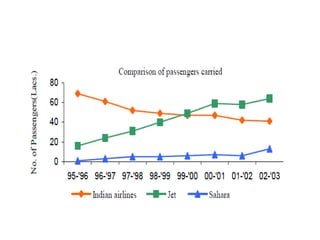
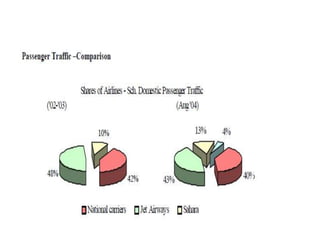
 ONLY TWO  AIRLINES (i. E jet airways and air Sahara) SURVIVED WHILE OTHERS SHUT BUSINESS
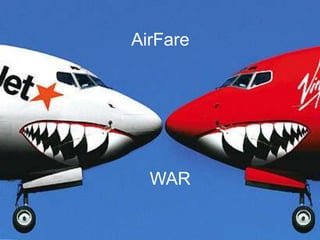
RESULTING A DUOPLY OF PRIVATE AIRLINESAirFareWAR
INDIAN AIRLINES       Indian Airlines came up with a new apex fare slab for  purchase   of tickets in eight sectors, 28 days in advance — two days less than  those offered by Air Sahara and Jet Airways.       The D-28 fares would be available for sale on one way or round trips as against round trip fares offered by Air Sahara.JET AIRWAYS Frequent Flyer Scheme
 APEX pricing Scheme
 Cash Back Offer
   Jet Privilege Scheme :  Extended its points partnerships to  Accor Hotels and Langham Hotels International.
   Internet  AuctionWhat is Apex?   Apex IS ADVANCE PURCHASE EXCURSION FARE. It is a non-cancellable return fare offered at a heavy discount on the conditions:  Tickets are purchased at least 21 days in   advance
  Minimum gap between departures range from one to six weeks.
  Maximum gap between departures is 12 to 24 weeks.
  There are no stopovers.Effects of APEXLed to increase in the number of customers.
Loss of airline companies minimized as with the increase of passengers the aircraft ran to their full capacity.
It brought a veritable boom in tourism sector.
It was able to lure the middle class people who preferred to travel by trains.AIRSAHARA  First Airlines to start innovative Pricing model rather than APEX   Model.
Sixer and Super Sixer Schemes in 2002 – Six refers to the six zones for 25k.These schemes offered more to the customers than their competitors.
   Square Drive Scheme – ( Family Pack) 4k-2.5k
“Steal a Seat” - Bidding process started from Base price – Re 1/- Defining relevant marketBusiness travelersTime sensitiveOpportunity cost of time is highLeisure travelersPrice elasticity of demand very highResponsive to price changes
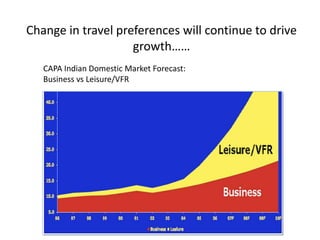
Change in travel preferences will continue to drive growth……CAPA Indian Domestic Market Forecast:Business vs Leisure/VFR

competition in airline industry

  • 1.
    Indian Aviation IndustryFrameworkSize: 75 million passengers5.6 billion dollarsGrowth:Around 15 % in last 10 yearsGrowth in current year ( 2009) O.7%Vision: 280 million customers by 2020
  • 2.
    PHASE 1In 1932JD TATA founded TATA AIRLINE
  • 3.
    Air India InternationalCompany-Joint Sector-Govt. Of India- June 8, 1948 IN 1953
  • 4.
    Air line sectornot opened for Private playersTypes of Air ServicesScheduled Air Transport Service
  • 5.
  • 6.
    An air cargoserviceFactors affecting Aviation Industry Political
  • 7.
  • 8.
  • 9.
  • 10.
    NaturalEnvironmentPoliticalDeregulations in different spheresOpen Sky Policy FDI limits : 49 % for airlines 100% for airports
  • 11.
    Demographic and Natural Changing pattern of consumers
  • 12.
    Highestpercentage people of group 20-25
  • 13.
    Educationalenvironment
  • 14.
    Highenergy cost DETERMINANTS OF PRICINGATFATF refers to air turbine fuel which is used by airlines in its operations.ATF contributes to the 40 % of operation costIt includes freight charges from gulf to India ,Customs Duty, Domestic Transportation and various taxes.India usually Pay higher ATF charges as compared to other countries.
  • 15.
    Lease RentalPrivate operatorsexcept Air India have leased aircraft from USA and Europe.They pay on average $375000 to $500000 per month depending on the aircraftThey contribute almost 33 % of operational cost.They generally have to pay their rents in dollar terms.
  • 16.
    Airport ChargesIt isthe basic fees that is charged by airports from airlinesThis include parking fees, landing fees , stop paging fees and aero bridge expensesNew airport charges more than established one to cover up all the cost incurred.
  • 17.
    Other factorsAdvertising andPromotional ExpensesTechnology employed by the airlinesCurrent Financial positionPrices set by other airlines competing in the present environment.Pilot feesGovernment regulation.
  • 18.
    Phase II (1986-2003)Grantingscheduled status to six private airlines
  • 19.
  • 20.
    ONLY TWO AIRLINES (i. E jet airways and air Sahara) SURVIVED WHILE OTHERS SHUT BUSINESS
  • 21.
    RESULTING A DUOPLYOF PRIVATE AIRLINESAirFareWAR
  • 22.
    INDIAN AIRLINES Indian Airlines came up with a new apex fare slab for purchase of tickets in eight sectors, 28 days in advance — two days less than those offered by Air Sahara and Jet Airways. The D-28 fares would be available for sale on one way or round trips as against round trip fares offered by Air Sahara.JET AIRWAYS Frequent Flyer Scheme
  • 23.
  • 24.
  • 25.
    Jet Privilege Scheme : Extended its points partnerships to Accor Hotels and Langham Hotels International.
  • 26.
    Internet AuctionWhat is Apex? Apex IS ADVANCE PURCHASE EXCURSION FARE. It is a non-cancellable return fare offered at a heavy discount on the conditions: Tickets are purchased at least 21 days in advance
  • 27.
    Minimumgap between departures range from one to six weeks.
  • 28.
    Maximumgap between departures is 12 to 24 weeks.
  • 29.
    Thereare no stopovers.Effects of APEXLed to increase in the number of customers.
  • 30.
    Loss of airlinecompanies minimized as with the increase of passengers the aircraft ran to their full capacity.
  • 31.
    It brought averitable boom in tourism sector.
  • 32.
    It was ableto lure the middle class people who preferred to travel by trains.AIRSAHARA First Airlines to start innovative Pricing model rather than APEX Model.
  • 33.
    Sixer and SuperSixer Schemes in 2002 – Six refers to the six zones for 25k.These schemes offered more to the customers than their competitors.
  • 34.
    Square Drive Scheme – ( Family Pack) 4k-2.5k
  • 35.
    “Steal a Seat”- Bidding process started from Base price – Re 1/- Defining relevant marketBusiness travelersTime sensitiveOpportunity cost of time is highLeisure travelersPrice elasticity of demand very highResponsive to price changes
  • 36.
    Change in travelpreferences will continue to drive growth……CAPA Indian Domestic Market Forecast:Business vs Leisure/VFR

Editor's Notes