ENTERPRISE RESOURCE PLANNING
SUBMITTED BY:
ABHAY KUMARSEN (A1802009232)
ANKIT MITTAL (A1802009318)
CHINMAYA MISHRA (A1802009377)
NEHA ARORA (A1802009395)
SALIL WADHAWAN (A1802009358)
SONAL MATHUR (A1802009456)
ENTERPRISE RESOURCE PLANNING
(ERP)
 A broad set of activities supported by multi-module
application software.
 Helps a manufacturer or other business in managing the
important parts of its business.
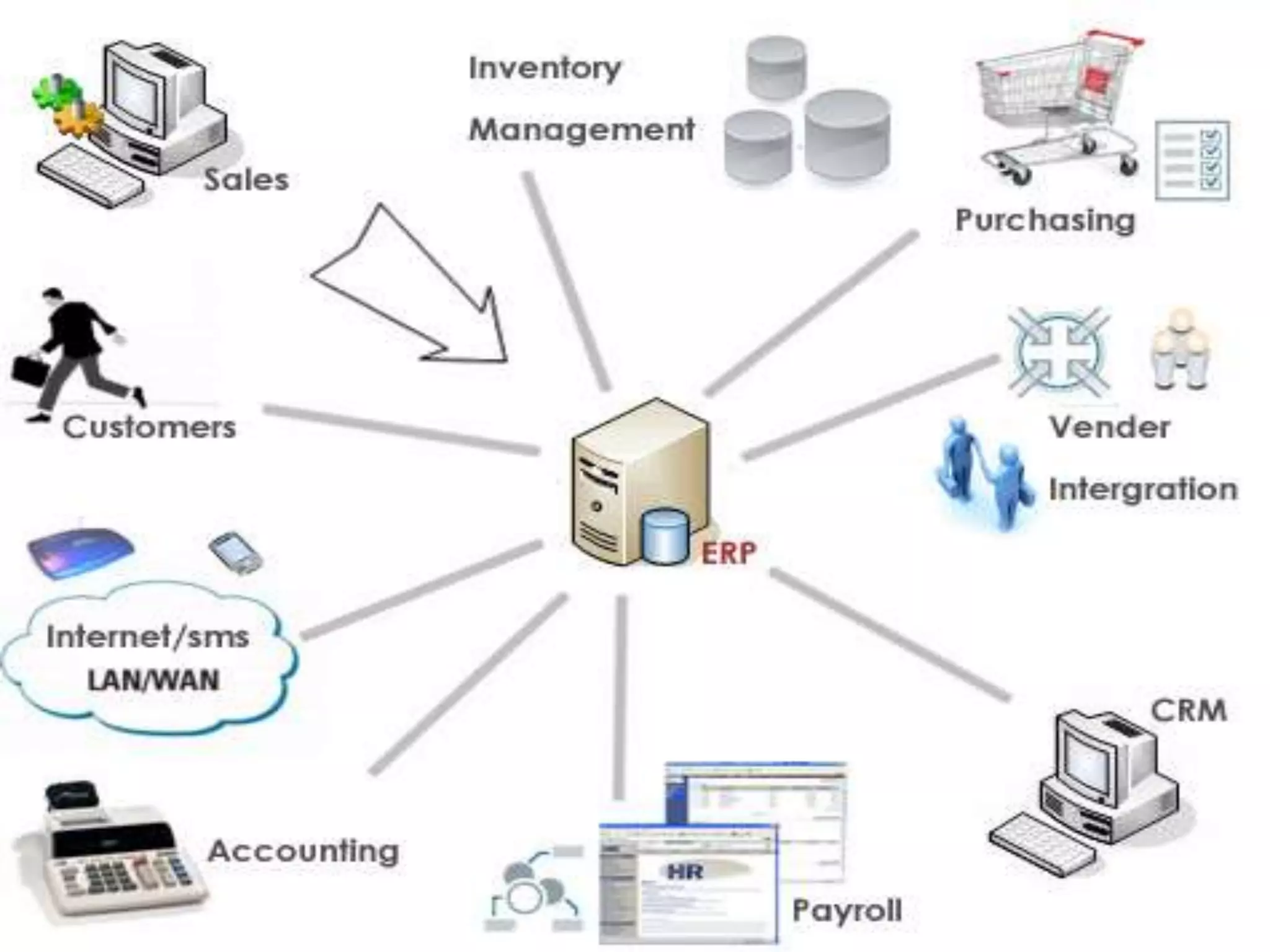
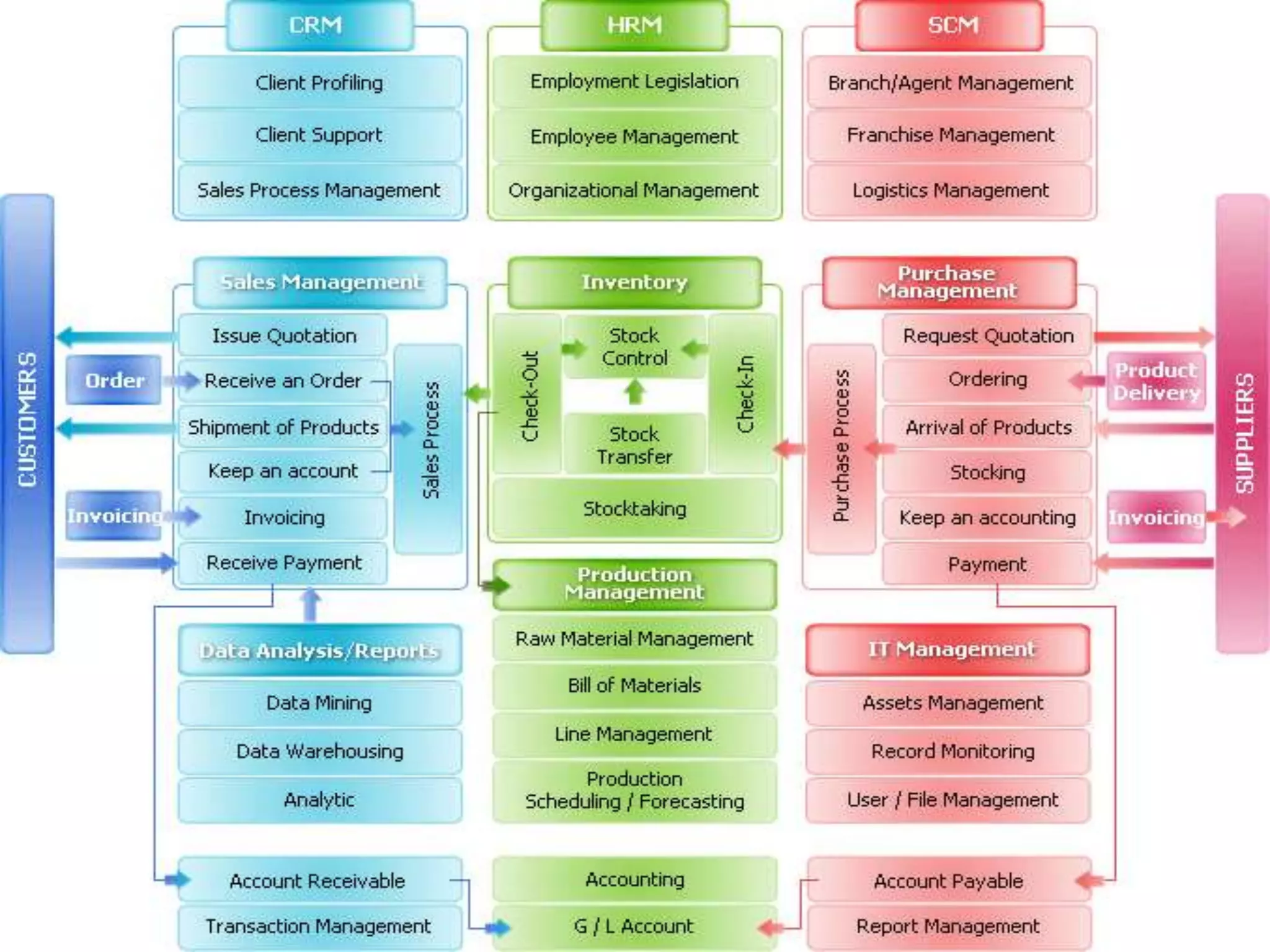
 An attempt to integrate all data and processes of an
organization into a unified system.
 Multiple components of computer software and hardware
to achieve the integration.
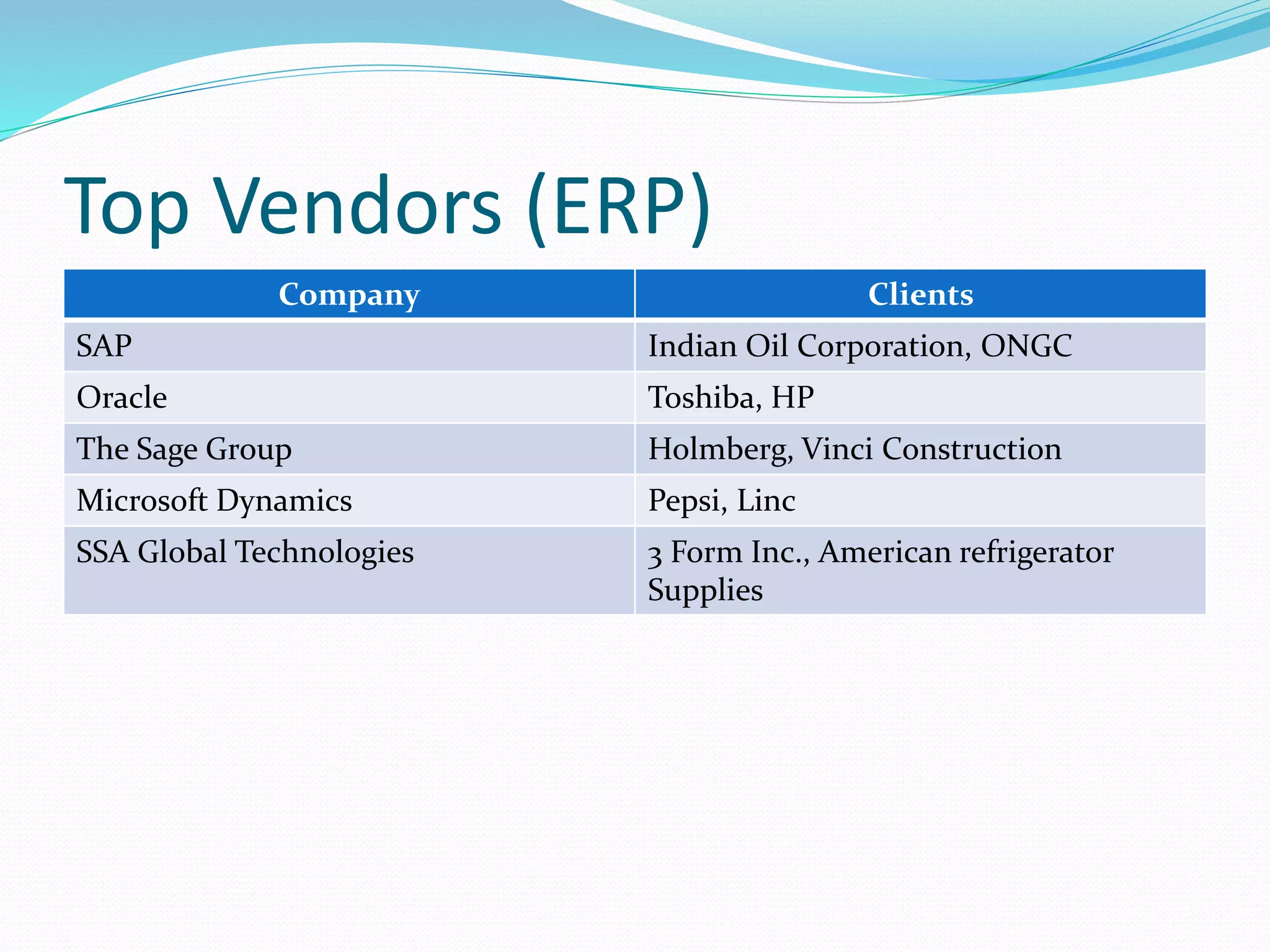
Top Vendors (ERP)
Company Clients
SAP Indian Oil Corporation, ONGC
Oracle Toshiba, HP
The Sage Group Holmberg, Vinci Construction
Microsoft Dynamics Pepsi, Linc
SSA Global Technologies 3 Form Inc., American refrigerator
Supplies
IMPACT OF SAAS ON ERP
INDUSTRY
SAAS
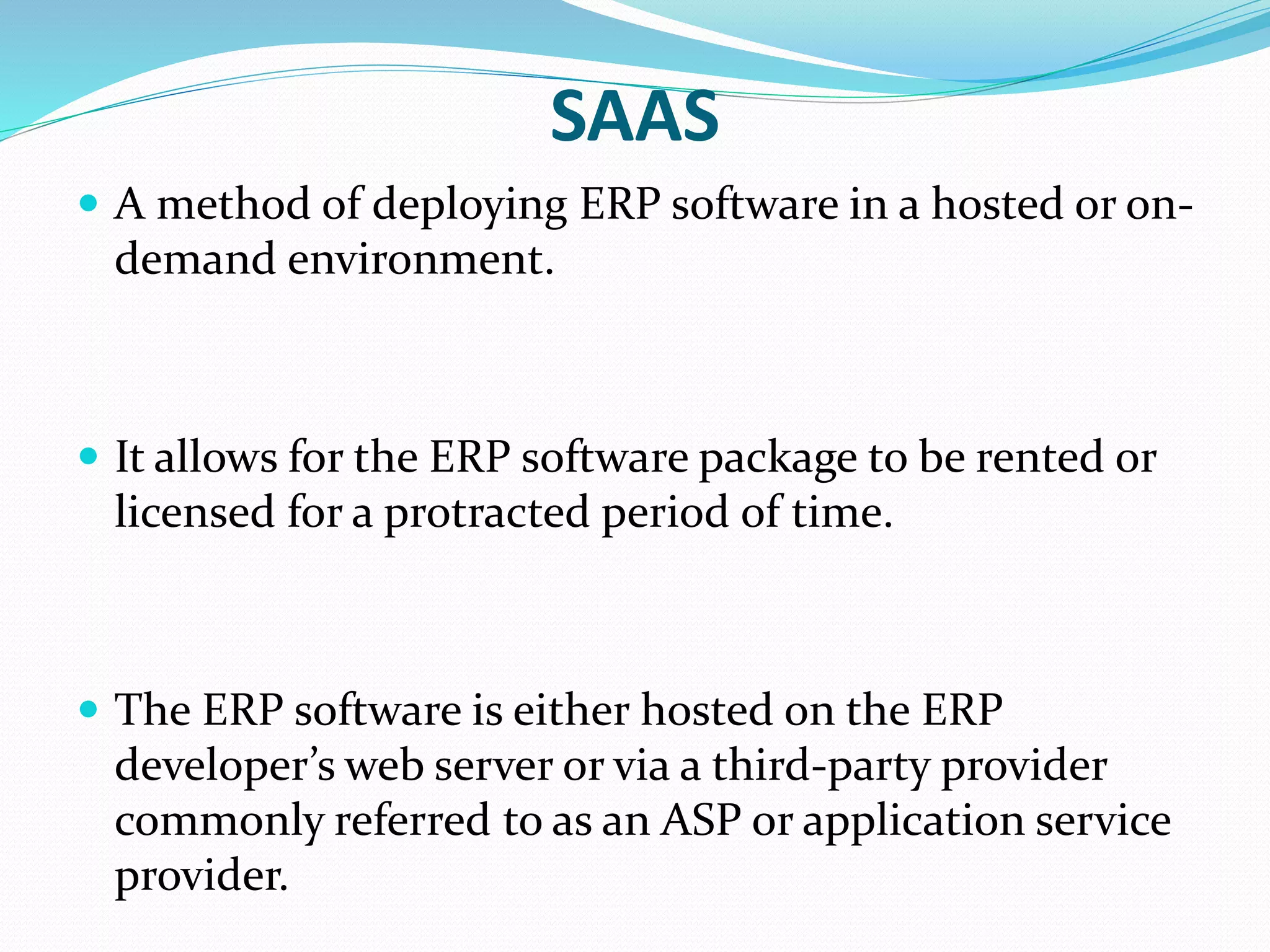
 A method of deploying ERP software in a hosted or on-
demand environment.
 It allows for the ERP software package to be rented or
licensed for a protracted period of time.
 The ERP software is either hosted on the ERP
developer’s web server or via a third-party provider
commonly referred to as an ASP or application service
provider.
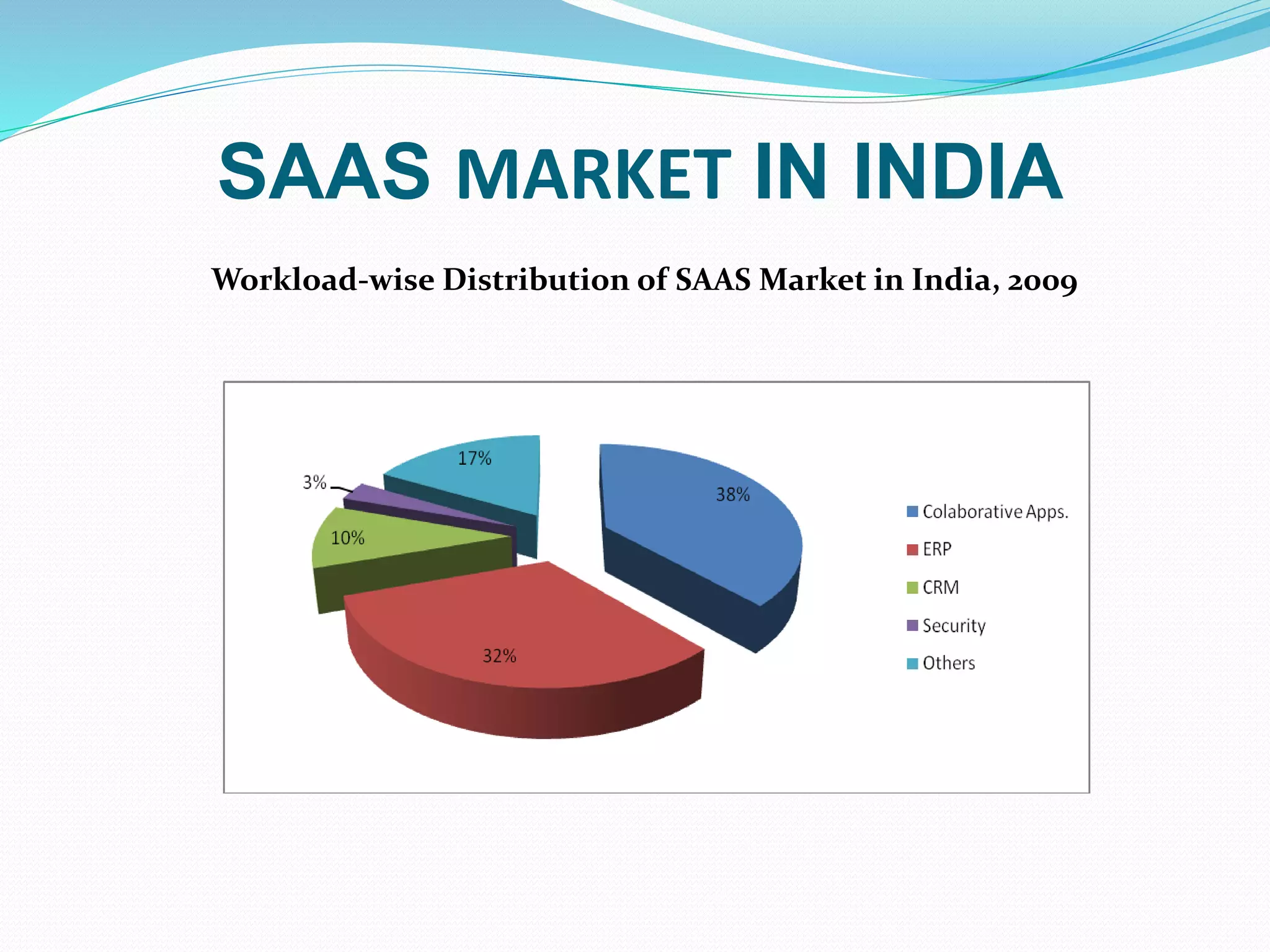
SAAS MARKET IN INDIA
Workload-wise Distribution of SAAS Market in India, 2009
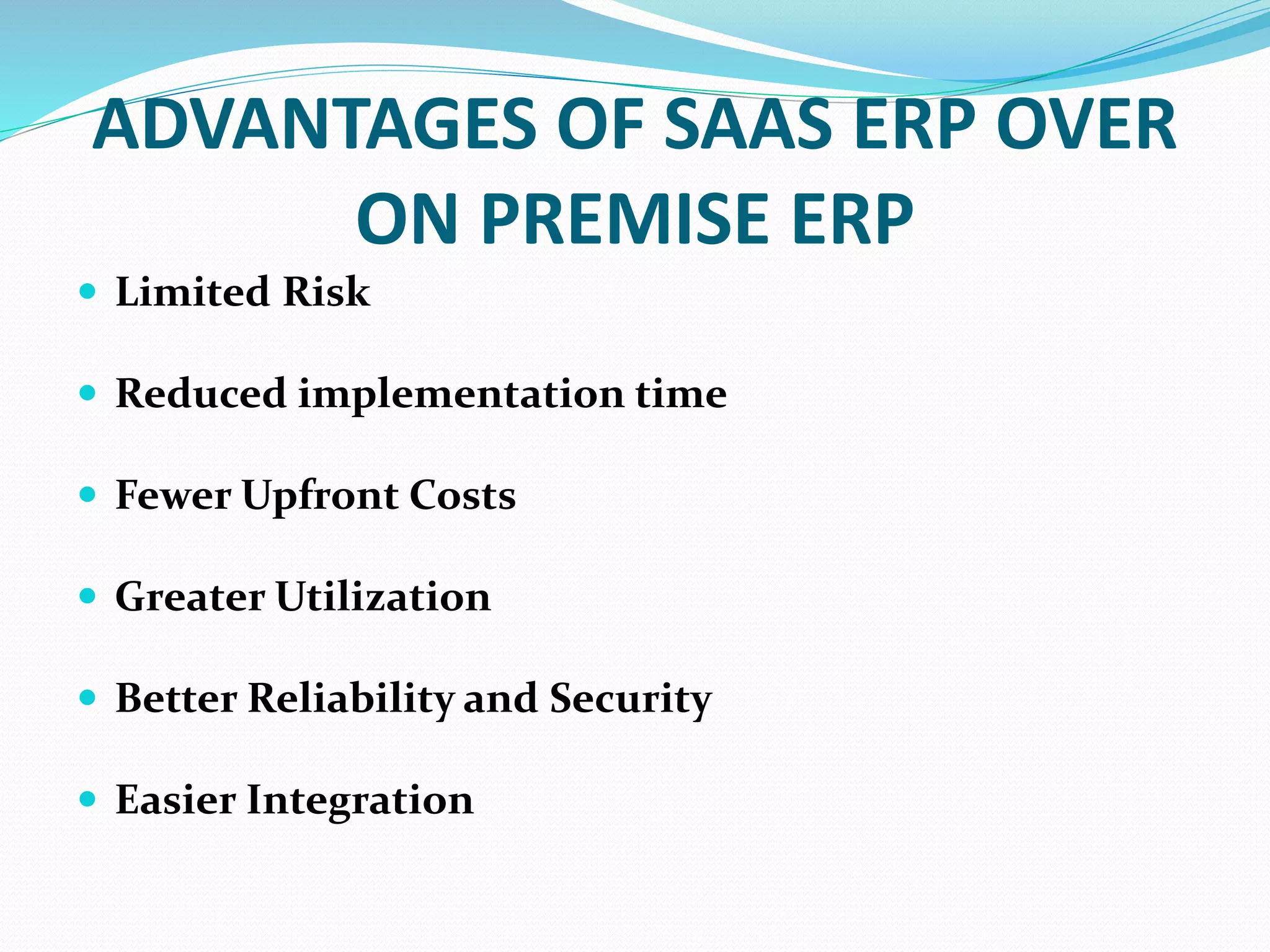
ADVANTAGES OF SAAS ERP OVER
ON PREMISE ERP
 Limited Risk
 Reduced implementation time
 Fewer Upfront Costs
 Greater Utilization
 Better Reliability and Security
 Easier Integration
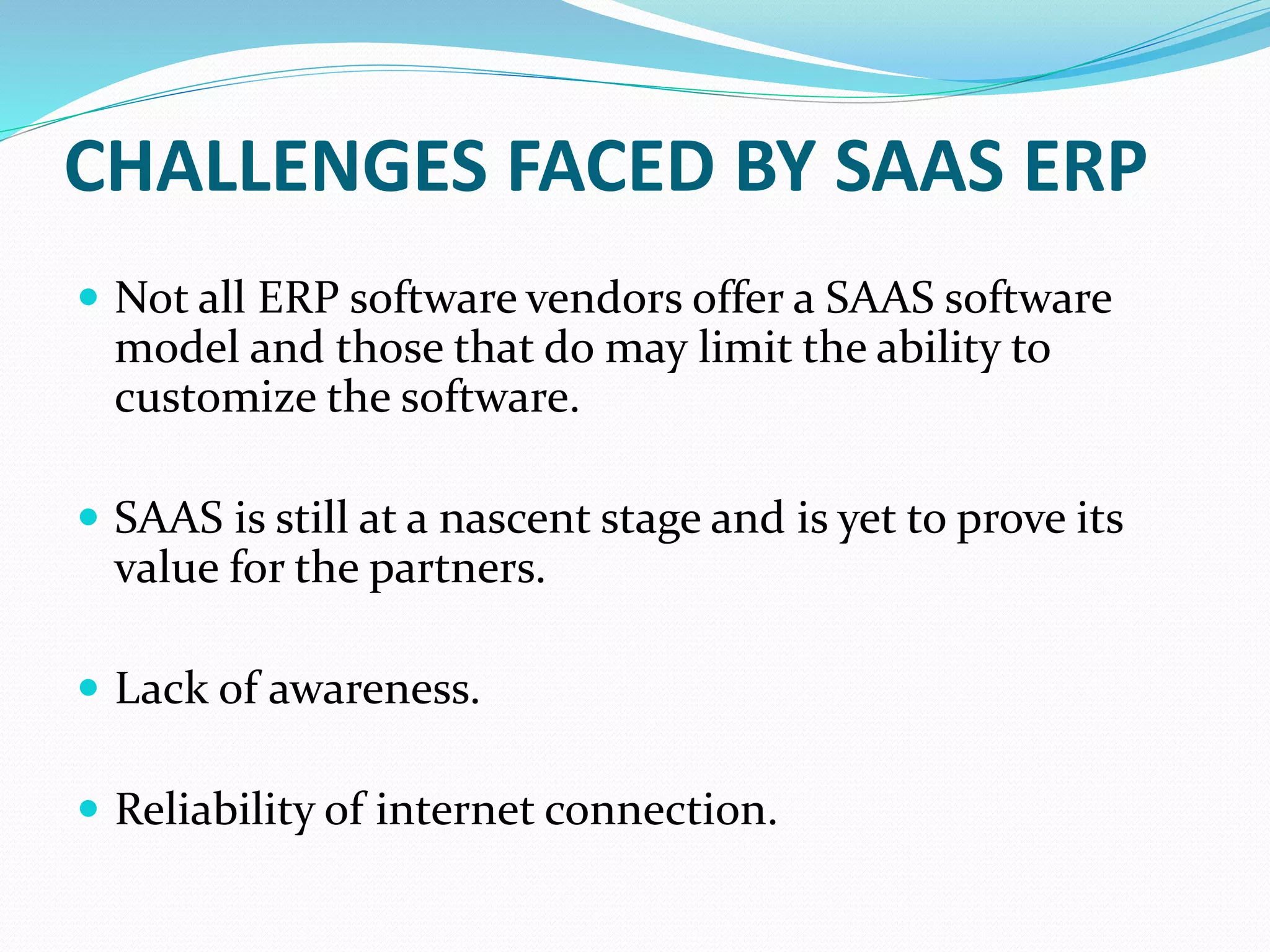
CHALLENGES FACED BY SAAS ERP
 Not all ERP software vendors offer a SAAS software
model and those that do may limit the ability to
customize the software.
 SAAS is still at a nascent stage and is yet to prove its
value for the partners.
 Lack of awareness.
 Reliability of internet connection.
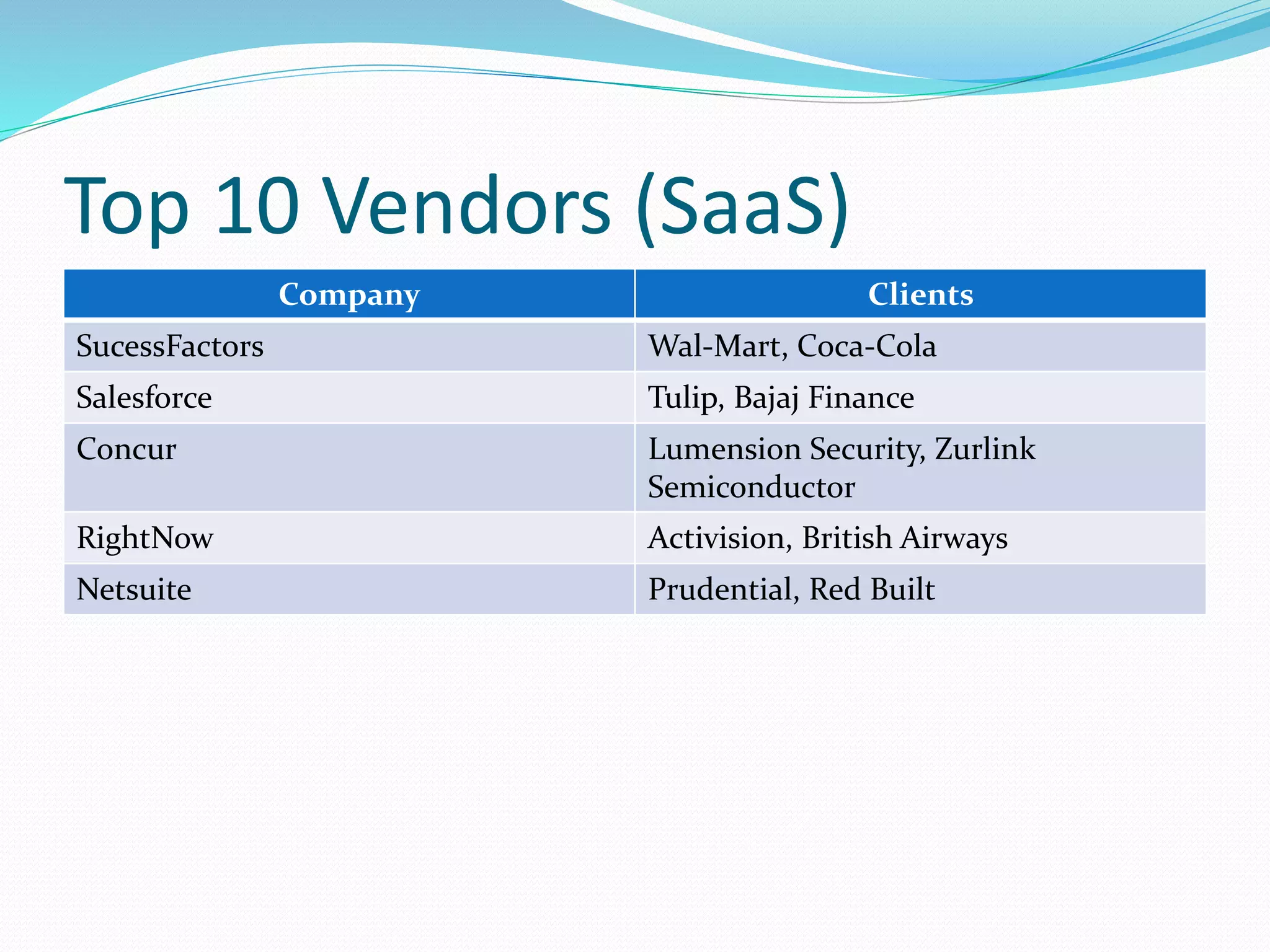
Top 10 Vendors (SaaS)
Company Clients
SucessFactors Wal-Mart, Coca-Cola
Salesforce Tulip, Bajaj Finance
Concur Lumension Security, Zurlink
Semiconductor
RightNow Activision, British Airways
Netsuite Prudential, Red Built
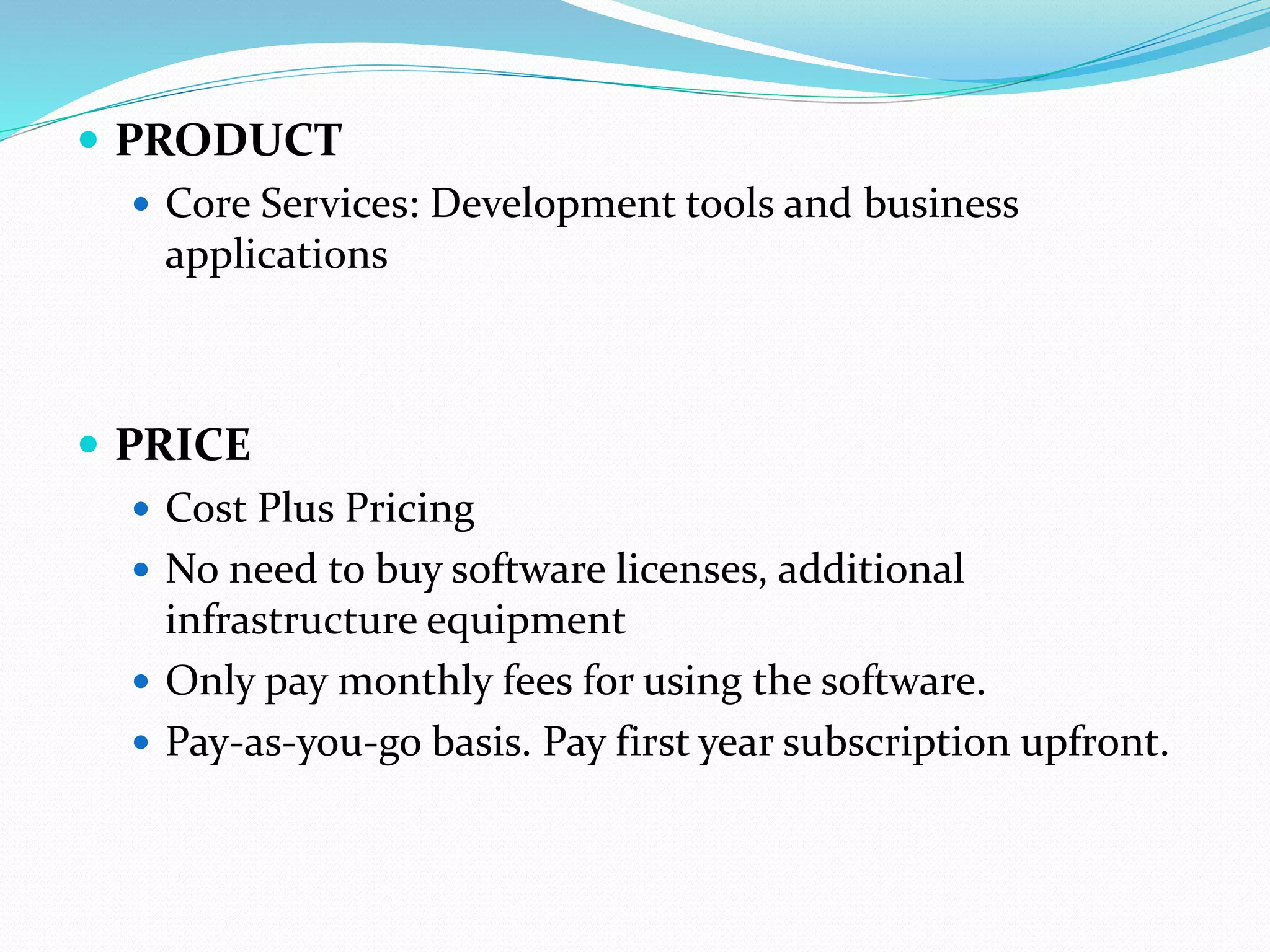
 PRODUCT
 Core Services: Development tools and business
applications
 PRICE
 Cost Plus Pricing
 No need to buy software licenses, additional
infrastructure equipment
 Only pay monthly fees for using the software.
 Pay-as-you-go basis. Pay first year subscription upfront.
 PLACE
 Sales model relies on the both direct and indirect distribution, leveraging the
indirect Channel (the Channel) to build a loyal customer base and to
generate a large portion of sales.
 Mostly sold directly to end customers.
 PROMOTION
 No particular promotional strategies.
 Resellers need to align with new SAAS customers and develop
rapport and demonstrate the benefits of SAAS.
 PEOPLE
 Well trained, technically equipped staff which can satisfy
customers in terms of security and the ease with which work
is accomplished.
PROCESS
 Configurable: The product architecture and design has been changed in
such a way that, personalized customization for different customers
(depending on their business needs) are provided through detailed
configuration options.
 Multi-Tenant-Efficient: This allow more efficient use of server resources
without any apparent difference to end users of the single instance in
execution by re-architected.
 Scalable: The system's capacity can be increased or decreased to match
demand by adding or removing servers, without the need for any further
alteration of the application software architecture.
PHYSICAL EVIDENCE
Trial periods are provided for checking the compatibility of the clients at their
site.
 CONSUMERS’ RATING WHILE SELECTING AN
ERP SYSTEM.
 ACTUAL TREND OF SELECTING DEPLOYMENT
OPTIONS
 PERCENTAGE OF APPLICATIONS IMPLEMENTED
THAT ARE SAAS BASED
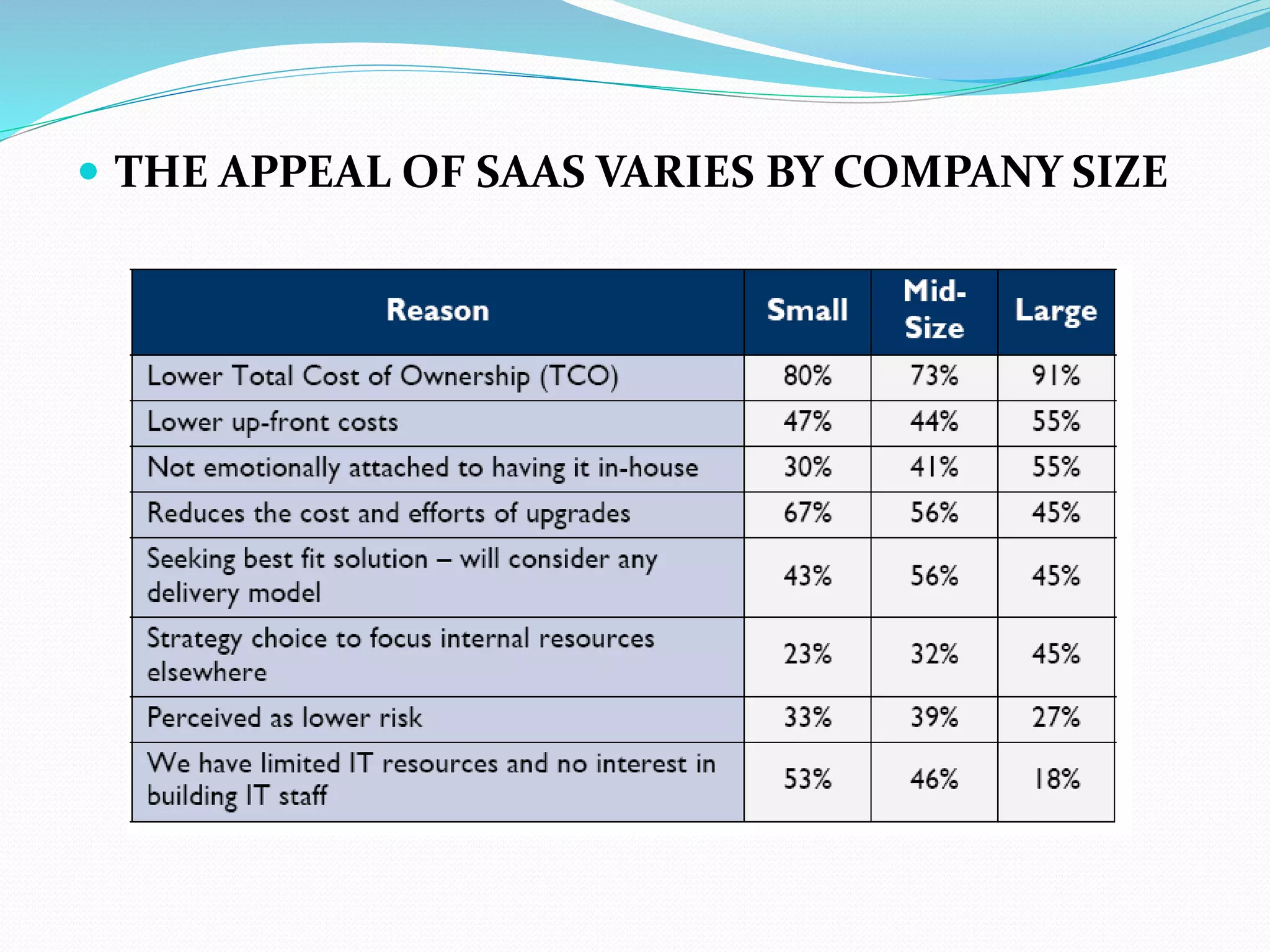
 THE APPEAL OF SAAS VARIES BY COMPANY SIZE
 WHAT PREVENTS PROSPECTS FROM
CONSIDERING SAAS ERP?
End
User
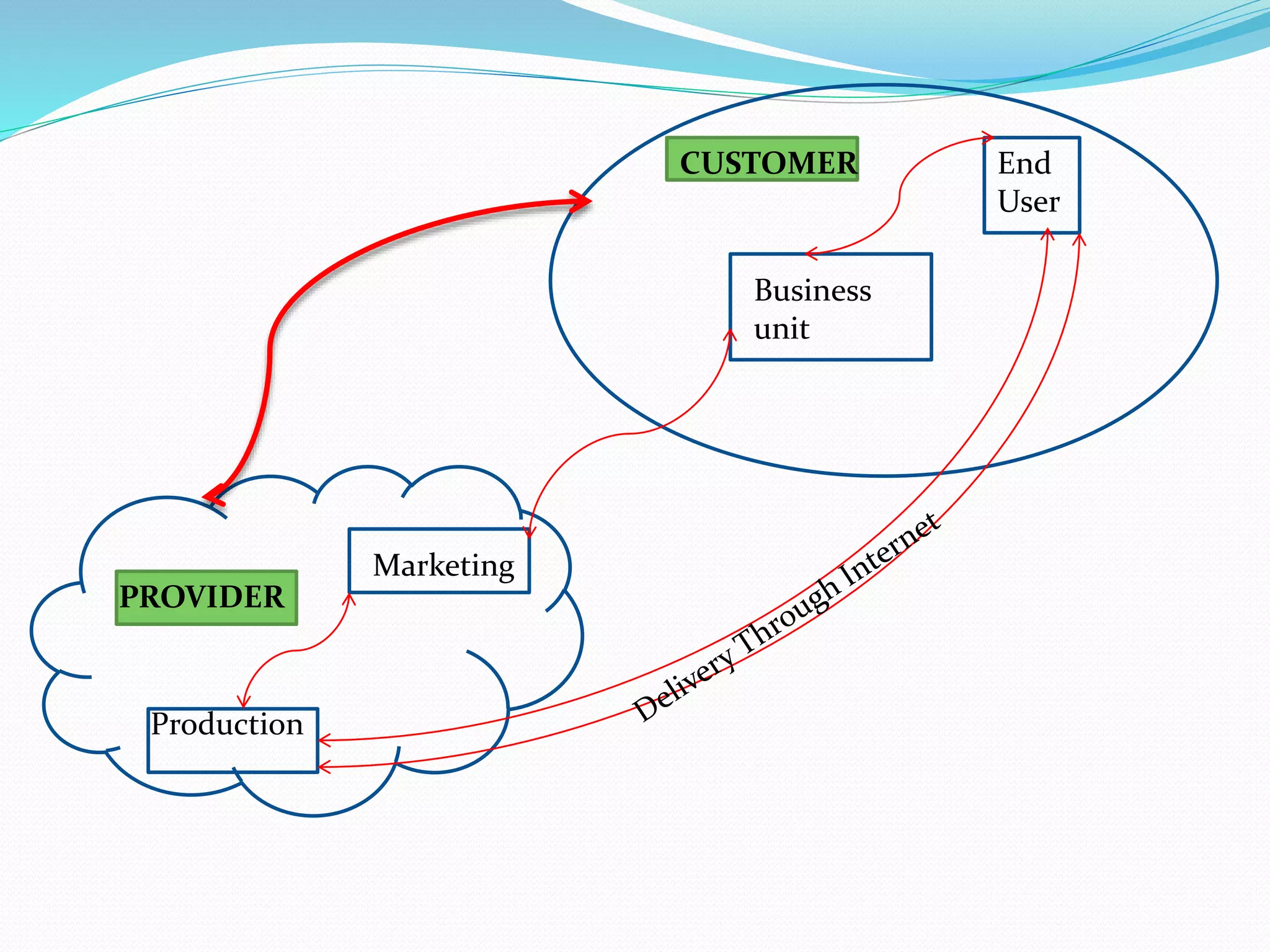
Business
unit
Marketing
Production
CUSTOMER
PROVIDER
End
User
Business
unit
Marketing
Production
SERVICE
PROVIDER
CUSTOMER
End
User
Business
unit
Marketing
Production
SERVICE
PROVIDER
CUSTOMER
End
User
Business
unit
Marketing
Production
SERVICE
PROVIDER
CUSTOMER
End
User
Business
unit
Marketing
Production
SERVICE
PROVIDER
CUSTOMER
SCOPE OF ERP IN SME OF
INDIA
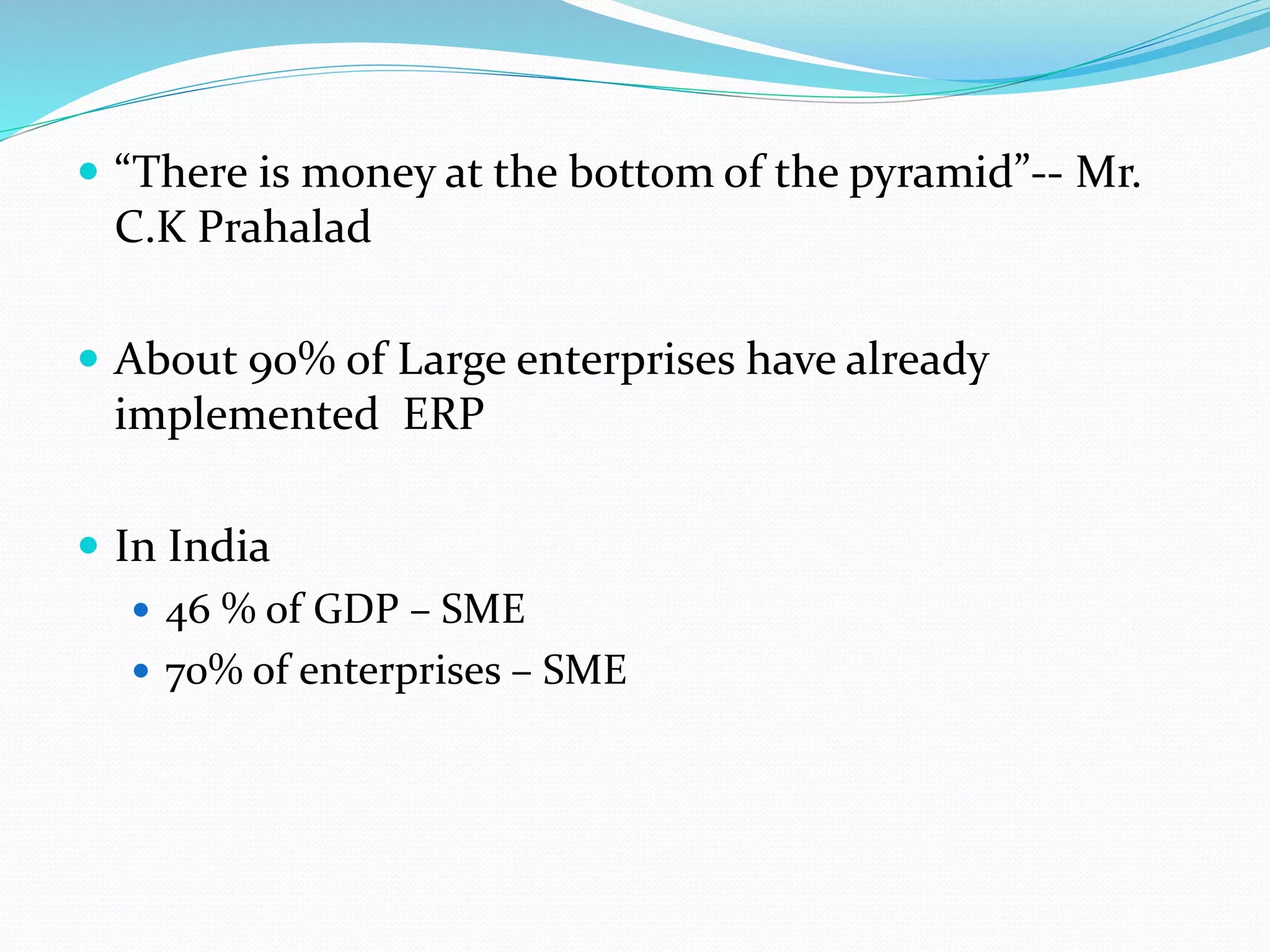
 “There is money at the bottom of the pyramid”-- Mr.
C.K Prahalad
 About 90% of Large enterprises have already
implemented ERP
 In India
 46 % of GDP – SME
 70% of enterprises – SME
CONCLUSION
 SaaS will be the most viable option for the following
companies:
 Companies that are SMEs(Small & Mid Size Enterprises)
 Companies that need to be up and running quickly in a
secure environment.
 Where acquisition / divesture has taken place.
 Companies operating in remote areas where IT
resources are scarce
 Companies in low-tech industries where it is hard to
recruit and retain IT talent
 Legacy applications are limiting growth and IT staffs
have outdated skills
erp

erp

  • 1.
    ENTERPRISE RESOURCE PLANNING SUBMITTEDBY: ABHAY KUMARSEN (A1802009232) ANKIT MITTAL (A1802009318) CHINMAYA MISHRA (A1802009377) NEHA ARORA (A1802009395) SALIL WADHAWAN (A1802009358) SONAL MATHUR (A1802009456)
  • 2.
    ENTERPRISE RESOURCE PLANNING (ERP) A broad set of activities supported by multi-module application software.  Helps a manufacturer or other business in managing the important parts of its business.  An attempt to integrate all data and processes of an organization into a unified system.  Multiple components of computer software and hardware to achieve the integration.
  • 5.
    Top Vendors (ERP) CompanyClients SAP Indian Oil Corporation, ONGC Oracle Toshiba, HP The Sage Group Holmberg, Vinci Construction Microsoft Dynamics Pepsi, Linc SSA Global Technologies 3 Form Inc., American refrigerator Supplies
  • 6.
    IMPACT OF SAASON ERP INDUSTRY
  • 7.
    SAAS  A methodof deploying ERP software in a hosted or on- demand environment.  It allows for the ERP software package to be rented or licensed for a protracted period of time.  The ERP software is either hosted on the ERP developer’s web server or via a third-party provider commonly referred to as an ASP or application service provider.
  • 8.
    SAAS MARKET ININDIA Workload-wise Distribution of SAAS Market in India, 2009
  • 9.
    ADVANTAGES OF SAASERP OVER ON PREMISE ERP  Limited Risk  Reduced implementation time  Fewer Upfront Costs  Greater Utilization  Better Reliability and Security  Easier Integration
  • 10.
    CHALLENGES FACED BYSAAS ERP  Not all ERP software vendors offer a SAAS software model and those that do may limit the ability to customize the software.  SAAS is still at a nascent stage and is yet to prove its value for the partners.  Lack of awareness.  Reliability of internet connection.
  • 11.
    Top 10 Vendors(SaaS) Company Clients SucessFactors Wal-Mart, Coca-Cola Salesforce Tulip, Bajaj Finance Concur Lumension Security, Zurlink Semiconductor RightNow Activision, British Airways Netsuite Prudential, Red Built
  • 13.
     PRODUCT  CoreServices: Development tools and business applications  PRICE  Cost Plus Pricing  No need to buy software licenses, additional infrastructure equipment  Only pay monthly fees for using the software.  Pay-as-you-go basis. Pay first year subscription upfront.
  • 14.
     PLACE  Salesmodel relies on the both direct and indirect distribution, leveraging the indirect Channel (the Channel) to build a loyal customer base and to generate a large portion of sales.  Mostly sold directly to end customers.  PROMOTION  No particular promotional strategies.  Resellers need to align with new SAAS customers and develop rapport and demonstrate the benefits of SAAS.  PEOPLE  Well trained, technically equipped staff which can satisfy customers in terms of security and the ease with which work is accomplished.
  • 15.
    PROCESS  Configurable: Theproduct architecture and design has been changed in such a way that, personalized customization for different customers (depending on their business needs) are provided through detailed configuration options.  Multi-Tenant-Efficient: This allow more efficient use of server resources without any apparent difference to end users of the single instance in execution by re-architected.  Scalable: The system's capacity can be increased or decreased to match demand by adding or removing servers, without the need for any further alteration of the application software architecture. PHYSICAL EVIDENCE Trial periods are provided for checking the compatibility of the clients at their site.
  • 17.
     CONSUMERS’ RATINGWHILE SELECTING AN ERP SYSTEM.
  • 18.
     ACTUAL TRENDOF SELECTING DEPLOYMENT OPTIONS
  • 19.
     PERCENTAGE OFAPPLICATIONS IMPLEMENTED THAT ARE SAAS BASED
  • 20.
     THE APPEALOF SAAS VARIES BY COMPANY SIZE
  • 21.
     WHAT PREVENTSPROSPECTS FROM CONSIDERING SAAS ERP?
  • 23.
  • 24.
  • 25.
  • 26.
  • 27.
  • 28.
    SCOPE OF ERPIN SME OF INDIA
  • 29.
     “There ismoney at the bottom of the pyramid”-- Mr. C.K Prahalad  About 90% of Large enterprises have already implemented ERP  In India  46 % of GDP – SME  70% of enterprises – SME
  • 30.
    CONCLUSION  SaaS willbe the most viable option for the following companies:  Companies that are SMEs(Small & Mid Size Enterprises)  Companies that need to be up and running quickly in a secure environment.  Where acquisition / divesture has taken place.  Companies operating in remote areas where IT resources are scarce  Companies in low-tech industries where it is hard to recruit and retain IT talent  Legacy applications are limiting growth and IT staffs have outdated skills