AVIATION
GHT DFSFJKSDF SUCHARITA  NANDAN BATCH-C4 FIAT GARIAHAT
Acknowledgment   We are very thankful to our lovely teacher Mrs. Santana Ghosh for teaching us the main subject Aviation. I thought that this will be very difficult subject for us, but her way of teaching is so different that we did not feel like that we were sitting in a class room. She described us each and every thing of this subject, she shared her experience with us, clear our doubts appreciate our good work and rectify our mistake. So I think not only me the full of C4 batch is very thankful to mam. .
Introduction Once upon a time people were started to travel by feet, then to cross the ocean they built ship, after that the train is innovated. Then the dreams to fly become true. To save time and for a hassle free a journey aircraft was innovated. Today this industry gives us comfortable, safe, secure and hassle free easiest travel experience within few hours from one destination to another. So this industry is the new passion for the people to travel, according to their needs and their choice and satisfy them in exchange of money.
LOW COST AIRLINES   Definition : A low cost airline or carrier is one that offers air travel at normally very low rates by cutting down on expensive customary in-flight passenger services. This low cost airline is also known as no-frills air-lines. ORIGIN :- The concept originally incepted in the US in early 1990s.while Richard Branson or Virgin Airlines was the forerunner in Britain, Qantas occupied a huge portion of the Australian budget skies. [  P1a   ]
 Air Deccan.    Spice Jet.    IndiGo.    Jet Lite.    Paramount Airways.    Go Air.    Jagson Airline. INDIA’S LOW COST AIRLINES:
A single Passenger class. A  single type of airplane reducing training and service cost. No frills  such as free food/drinks, lounges etc. Emphasis on direct sale of ticket through Internet avoiding fee and commission paid to travel agents. Employees working in multiple roles. Unbundling of ancillary charges to make the Headline fare lower Business Model of Low Cost Carriers
[ Air Deccan ] Origin : Air Deccan first started its civil aviation services in Aug, 2003.
Present Scenario & Growth :   Air Deccan is India’s No.1 cheap air carrier working under the aegis of Deccan Air Aviation PVT.Ltd.  Air Deccan has evolved into a growing unit in the aviation scene of India after it first started its services.  Air Deccan Airways growth has been attributed to the steadily growing Economy of India and increasing number of middle class dwellers in the Indian population.  Air Deccan led by  Cpt. GR Gopinath .  interior of Air Deccan
Fleet : The Deccan Air fleet consists of 61 aircrafts comprising of 44 A320-200, 5 ATR42-320, 5 ATR72 -212 and 9 ATR42-500 civil aircrafts.  There are also plans to lease 30 ATR 72-500 aircraft.
Destinations : New Delhi, Mumbai, Hyderabad, Kolkata, Guwahati, Jaipur, Jammu, Srinagar, Thiru’puram, Vadodara, Chennai, Nagpur, Cochin, Coimbatore, Goa, Silchar, Bangalore etc.
[ Spice Jet ] Origin : Spice Jet airways began its operations in May 2005.
Present Scenario & Growth : Spice Jet is a low cost airline based in New Delhi, India. Spice Jet’s mission is to become India’s preferred low cost airline & vision is to ensure that flying is no longer confined to CEOs and business travelers, but is affordable for every one.  Spice Jet airlines is promoted by  Ajay Singh .  interior of Spice Jet
Fleet :  It has a fleet of 6 Boeing 737-800 in a single class configuration with 189 seats .
Destinations :   Spice Jet currently flies to 16 destinations. These include: Ahmedabad, Bangalore, Chennai, Delhi, Goa, Hyderabad, Jammu, Kolkata, Mumbai, Pune and Srinagar.
[ IndiGo ] Origin : IndiGo lunched in Aug, 2006.
Present Scenario : IndiGo is built for people with things to do, place to be people to see who don’t want to waste time, money or energy in the process. Indigo incorporates the best hardware, software, interface design & personal from around the world. Indigo’s customer service is professional and fare is low. interior of IndiGo
Fleet :  Brand new 19 Airbus A320s-232.
Destinations : Serving 17  destination  within India.
[  Jet Lite  ] Origin : In a major announcement on 17th July 2007, Jet Airways announced its plan to re-launch the Air Sahara as Jet Lite,  Which is primarily operated as a low cost airline.
Present Scenario :  The basic structure of Jet Lite’s services feature services somewhere between that of full services Airliner and a low cost carrier.  The merging of the fleets and structure of the two Airlines create new opportunities in terms of cost reduction and supply facilities. And the synergy may actually help Jet Airways on the long run. interior of JetLite
Fleet :   It consists of 7 Boeing 737-800 aircraft, 2 Boeing 737-300, 3 Boeing 737-400, and 5 Boeing 737-700. Bombardier CRJ 200, total 24, 10 orders.
Destinations :  34 destinations.
OPEN SKY POLICY In April 1990 , The Government adopted  Open sky policy  and allowed air taxi operators to operate flights from any airport, both on a charter and non charter basis and to decide their own flight schedules, cargo and passenger fares.  In 1994 , the Indian Government, as part of its  Open sky policy , ended the monopoly of IA and AI in the transport services by repealing the  Air Corporations Act  of 1953 and replacing it with the  Air Corporations (Transfer of Undertaking and Repeal) Act, 1994 . Private operators were allowed to provide air transport services Foreign direct investment (FDI) of up to 49% equity stake and NRI (Non Resident Indian) investment of up to 100% equity stake were permitted through the automatic FDI route in the domestic air transport services sector. However, no foreign airline could directly or indirectly hold equity in a domestic airline company.
On May 1993,  Jet Airways  had started its operation. In 2000,   Sahara  come, later it was re-launched as  Jet Lite  by Jet Airways on 2007. In Aug 2003,   Air Deccan  started its services. In May   2005,   Kingfisher Airlines  &  Spice Jet  began their operation. In Aug 2005,   IndiGo   launched. In Oct 2005,  Paramount Airways  had started its service.
Players   Air Deccan Air-India Express Air India Go Air IndiGo Jet Airways Jet Lite SpiceJet Paramount Airways Kingfisher
GROWTH/IMPORTANT OF INDIAN AVIATION : In the recent past Indian civil aviation sector has grown manifold. The rapid growth of Indian economy has resulted in a spillover effect on the airline industry in India. The arrival of cheap airline carriers in India has spiced up the whole affair. Suddenly the air travel is no more the monopoly of the rich and the mighty. Now it has become a common man’s vehicle and revolutionized the way a common Indian traveler used to travel.
REGULAR AIRLINES   Air India  Jet Airways  Kingfisher Airlines LOW COST AIRLINES Air Deccan Spice Jet IndiGo  Go Air  JetLite  Jagson Airlines Paramount Airways DOMESTIC AIRLINES IN INDIA BUDGET AIRLINES   Air India Express
Jet Airways Origin : Jet airways had started its operation  on May 1993.
Present Scenario : Today Jet Airlines has become one of the most preferred Indian Airlines and is still gaining market share and growing everyday. Since its inception Jet Airways has been providing premier care and service to its customers and since then has been improving upon it continuously. MD of Jet Airways is Mr. Naresh Goyel .
 
Fleet : Jet Airways contains 62 aircrafts which include Boeing 777-300ER, Boeing 737-400/700/800/900, Airbus A340-300E and A330-200 Aircrafts, ATR turboprops 72-500.
Destinations :  All over India more than 50 destinations and also several international destinations like Kuala Lumpur in Malaysia, Singapore, Bangkok, Colombo, Heathrow, in London, Katmandu
Future Plan :   Planning to add many more destinations to the already impressive list. Plans to cover destinations in North America and Europe. They order 10 ATR 72-500, 19 Boeing 737-800, 5 Boeing 777-300ER and 10 Boeing 787-8.
Kingfisher Airlines   Origin :   Indian’s fastest growing airline commenced operations with a brand new fleet of aircraft on May 9th 2005.
Present Scenario : Kingfisher Airlines has always let the way and less than three years, changed the way a country flies. It is India’s first and only private airline to receive the prestigious, “Best New Airline of the Year” award in the Asia -Pacific and Middle East region from Centre for Asia Pacific Aviation (CAPA). Kingfisher Airlines is a part of the UB Group.   Dr. Vijay Mallya, chairman and CEO of Kingfisher Airlines.
interior of  Kingfisher airlines
Fleet :  with Kingfisher Airline’s significant investment in Air Deccan, the Kingfisher-Air Deccan Group is Indian’s largest domestic airline offering over 570 flights daily with a fleet of 78 aircraft.
Destinations : Kingfisher-Air Deccan Group connecting 69 cities.
Future Plan :   Kingfisher Airlines, envisions to be one of the top airlines of India by 2010 & 2013 shall have a fleet of 51 Airbus A320/ A319/ A321, 35 ATR, 5 A330, 5 A340 , 5 A350 & 5 A380 aircraft.
INDIA’S ECONOMICAL GROWTH 1990-2000 Since 1990 India has emerged as one of the wealthiest economics in the developing world; during this period, the economy has grown constantly. While the credit rating of India was hit by its nuclear tests in  1998,  it has been raised to investment level in  2007  by S&P and Moody’s.
Present    Future : . In  2003,  Goldman Sachs predicted that India’s GDP in current prices will overtake France and Italy by  2020 , Germany, UK and Russia by  2025  and Japan by  2035 .It was projected to be the third largest economy of the world, behind US and China
India’s improving economy  Our Indian economy has undergone a tremendous change with the plantation of a series of economic reforms.  These reforms focused attention on deregulating the country and including foreign in vestments. Eventually, it paved way for Indian occupying a position among the top Countries in the fast growing Asia Pacific Region.     India’s political institutions have encouraged the growth of an open society, where People can express themselves freely which is an example of a free economy.  India has a competitive and dynamic private sector that forms the backbone of India’s economic activities. It also accounts for more than 75% of India’s gross Domestic Product. It has a lot of scope for joint ventures and mergers.   India’s economy is vast and varied and consists of traditional village farming, Modern agriculture, Handicrafts, a wide distinctive range of modern industries, and a large number of support services.  Government has become more liberal and has reduced its control on foreign  trade and investment and is heading its way towards privatizing the domestic sector
AGICULTURE
India ranks  second  worldwide in farm output. Agriculture and allied sectors like forestry, logging and fishing accounted for  18.6%  of the GDP in  2005 , employed  60%  of the total workforce and depute a steady decline of its share in the GDP, is still the largest economic sector and play a significant role in the overall socioeconomic development of India.
Industries
●  India is  fourteenth  in the world in factory output. ●  They together account for  27.6%  of the GDP and employ  17%  of the total work  force. ●  About one-third of the industrial labor force is engaged in simple household manufacturing only. ●  Economic reforms brought foreign competition, led to privatization of certain public sector industries, opened up sectors hither to reserve for public sector and moving  consumer goods.  ●  34 Indian companies have been listed in the Forbes Global 2000 ranking for 2008.
Services
India is  fifteenth  in services output. It provides employment to  23%  of work force, and it is growing fast, growth rate  7.5% in  1991-2000  up from  4.5%  in  1951-80 . It has the largest share in the GDP, accounting for  53.8%   in  2005   up from  15%  in  1950 . Business services (IT, IT enabled services, business process out sourcing) are among the fastest growing sectors contributing to one-third of the total output of services in  2000
 
Banking & Financial sector
The Indian money market is classified into: the organized sector and unorganized sector. Prime Minister Indira Gandhi nationalized  14  banks in  1969 , six others in  1980 . Banks provide  40%  of their net credit to priority sectors like agriculture, small-scale industry, retail trade, small business etc. Bank branches have increased from  10,120  in  1969  to  98,910  in  2003 . Total deposits increased  32.6  times between  1971  to  1991  compared to  7  times between  1951  to  1971 . Since liberalization, the government has approved significant banking reforms. Other reforms have opened up the banking and insurance sectors to private and foreign players.
CONCLUSION : THE ARRIVEL OF CHEAP AIRLINE CARRIERS IN INDIA HAS SPICED UP THE WHOLE AFTER: -    The air travel is no more the monopoly of the reach and the mighty.  It has become a common man’s vehicle and revolutionized the way a common Indian traveler used to travel. IMPROVED ECONOMY HAS AFFECTED THE AVIATION INDUSTRY IN THE FOLLOWING WAYS  :-  Consumers have capacity to afford air travel.  Consumers have money to spend on tourism, religious tourism and business trips etc.  Competition amongst the Airlines  has resulted in sharp declined in  air forces.  The importance of time spent on  traveling has been understood by  the consumers    LOW COST AIRLINES.    INCREASED NUMBER OF DOMESTIC AIRLINES.    INDIA’S IMPROVING ECONOMY. These three factors have effected the development of the Aviation Industry.
P2a Good communication skills. Adaptability. Pleasing personality. Physical fitness. Politeness. Friendly attitude. Systematic approach. Judgment. Presence of mind. Common sense & Maturity. Personal attributes required by the cabin crew
Airbus Industries was formed in  1970  as a multinational effort between France, Germany, U.K, Spain & Belgium to create a high-capacity twin-jet transport. In  1972  the  A300  made its maiden flight. In  1974   the first production model, the  A300B2  entered service. In  1979  there were  81  aircraft in service. In  1981   it was   the launch of the  A320  which established Airbus as a major player in the aircraft market- the aircraft had over  400  orders before it first flew, compared to  15  for the  A300  in  1972 . Today  Airbus Industries has become the world’s second largest manufacture of civil airlines which seat over  100  passengers. In its first  25  years Airbus has sold over  2,100  aircraft, with more than  1,400  in service worldwide. The consortium in headquartered in southwest France near the city of Toulouse. Development History of  Airbus
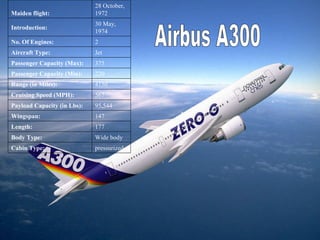
Airbus A300 pressurized Cabin Type: Wide body Body Type: 177 Length: 147 Wingspan: 95,544 Payload Capacity (in Lbs): 567 Cruising Speed (MPH): 4150 Range (in Miles): 220 Passenger Capacity (Min): 375 Passenger Capacity (Max): Jet Aircraft Type: 2 No. Of Engines: 30 May, 1974  Introduction:  28 October, 1972  Maiden flight:
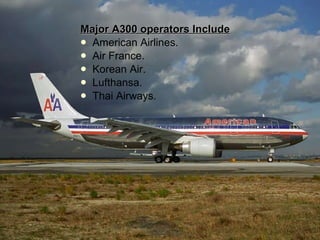
Major A300 operators Include American Airlines. Air France. Korean Air. Lufthansa.  Thai Airways.
 
Advanced wings by  de Havilland  (later  BAE Systems ) with:  222-inch diameter circular fuselage section for 8-abreast passenger seating and wide enough for 2  LD3  cargo containers side-by-side  Structures made from metal  billets , reducing weight  First airliner to be fitted with  wind shear  protection  Advanced autopilots capable of flying the aircraft from climb-out to landing  Electrically controlled braking system  Later A300s incorporate other advanced features such as 2-man crew by automating the  flight engineer's  functions, an industry first  Glass cockpit  flight instruments  Extensive use of composites for an aircraft of its era  Center-of-gravity control by shifting around fuel  The first airliner to use  wingtip fences  for better aerodynamics   Airbus A300 fuselage cross-section,   overhead  bins   Glass cockpit
The galley
Variants Airbus A300B1   Airbus A300B2
Airbus A300B4   Airbus A300-600
Airbus A310 pressurized Cabin Type: Wide body Body Type: 36,095 Takeoff Weight (in Lbs): 153 Length: 144 Wingspan: 79,560 Payload Capacity (in Lbs): 557 Cruising Speed (MPH): 5,200 Range (in Miles): 218 Passenger Capacity (Min): 280 Passenger Capacity (Max): Jet Aircraft Type: 2 No. Of Engines: April 1983 Introduced:
Major A310 operators Include Singapore Airlines. France Air Force. Korean Air. Lufthansa Turk Hava Yollari. Canadian Govt. German Air Force Royal Thai Air Force . The consortium in headquartered in southwest France near the city of Toulouse
 
cockpit   overhead bins The galley   Lavatory   Different parts of the aircraft A310
Variants   Airbus A310-200 fuselage  - same cross section, providing capacity of about   Airbus A310-300
Major A320 operators Include Airbus A320 family pressurized Cabin Type: Narrow  Body Type: 77,000 Takeoff Weight (in Lbs): 123 Length: 111 Wingspan: 45,686 Payload Capacity (in Lbs): 3305 Range (in Miles): 164 Passenger Capacity (Min): 179 Passenger Capacity (Max): Jet Aircraft Type: 2 No. Of Engines: 28 March 1988 Introduced: 22 February 1987 Maiden flight:
Major A320 operators Include Air Canada. Indian Airlines. Lufthansa. All Nippon Airways. Egypt Air. Gulf Air. Mexicana.
cockpit Interior Cabin   The galley Airbus A318
cockpit Interior Cabin The galley Airbus A319
cockpit Interior Cabin The galley Airbus A320
cockpit Interior Cabin The galley Airbus A321
Airbus A330 pressurized Cabin Type: Wide body Body Type: 6,400 Range (in Miles): 256 Passenger Capacity (Min): 335 Passenger Capacity (Max): Jet Aircraft Type: 2 No. Of Engines: January 1994, with Air Inter Introduced: 11 February, 1992 Maiden flight:
Major A330 operators Include North West Airlines. Qatar Airways. Emirates. Cathay Pacific.
cockpit
Economy Class Cabin
Business Class Cabin
First Class Cabin
The galley overhead bins Lavatory Different parts of the aircraft A330
Variants Airbus A330-200 Airbus A330-300
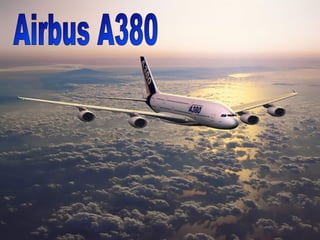
Airbus A380
pressurized Cabin Type: Wide body Body Type: 650 Takeoff Weight (in metric tones): 8000 Range (in Miles): 555 Passenger Capacity (Min): 853 Passenger Capacity (Max): Jet Aircraft Type: 4 No. Of Engines: 25October 2005 Introduced: 27 April2005 Maiden flight:
Major A380 operators Include Singapore Airlines Emirates. Airbus Industries was formed in 1970 as a multinational effort between
 
 
Wing of A380
C O C K P I T
A380: Cockpit overhead panel   A380 aircraft's control panel
A  Rolls-Royce Trent 900  engine on the wing of an Airbus A380
The auxiliary power unit (APU) of the  Airbus A380
RAT (Ram Air Turbine)
The A380's 20-wheel main  landing gear fuselage
Flight test engineer's station on the lower deck of Airbus A380 test aircraft F-WWOW (serial 001).
Luxurious Interior
Sky Suites
BAR
a large royal lounge
The Spiral Staircase
Upper Deck Economy Class
 
Upper Deck Business Class
Upper Deck
Luxurious Interior First Class Cabin
First Class Cabin
Privet Suit
cabin floor space.  duty-free shop, onboard
G A L L E Y
L A V A T O R Y
In-flight Service
Difference


15th October 2007 Singapore Airlines 27 April   2005 2002 853 555 4 engine, double deck, twin aisle [29] A380 December 1993 Air Inter 2 November   1992 June 1987 406-440 253-295 2 engine, twin aisle A330 January 1994 Lufthansa 11 March   1993 November 1989 220 185 2 engine, single aisle, lengthened 6.94 m from A320 A321 March 1988 Air Inter 22 February   1987 March 1984 180 150 2 engine, single aisle A320 April 1996 Swissair 25 August   1995 June 1993 156 124 2 engine, single aisle, shortened 3.77 m from A320 A319 October 2003 Air France 15 January   2002 April 1999 117 107 2 engine, single aisle, shortened 6.17 m from A320 A318 December 1985 Air Algeria 3 April   1982 July 1978 279 187 2 engine, twin aisle, modified A300 A310 May 1974 Air France 28 October   1972 May 1969 361 228-254 2 engine, twin aisle A300   1st delivery    1st flight    Launch date    Max    Seats    Description    Aircraft 
New Generation  New Experience
Current Scenario: 1) Emerged drastically. 2) Too many domestic airlines. 3) On demand. 4) Ruling Industry. 5) Latest technology. D
Aviation Industry in India Characteristics  : Huge Potential Under penetrated market Total Passenger Traffic : 50 million Passenger trips per annum :  India : 0.05  United states : 2.02 Untapped air cargo market
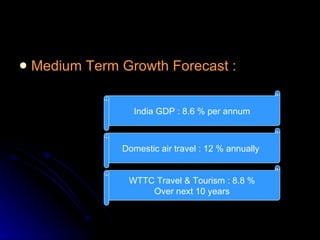
Medium Term Growth Forecast : India GDP : 8.6 % per annum WTTC Travel & Tourism : 8.8 % Over next 10 years Domestic air travel : 12 % annually
THE AVIATION BOOM IN INDIA India's strong economic growth has boosted the market for air travel.  Flying has become more affordable in India, where the number of people traveling by air in a year is nearly equal to the number of people traveling by train on a day. India recorded a 25% growth in air passenger traffic in last year alone. There are six to seven million air passengers in the country, and industry watchers say their numbers could easily rise nearly tenfold in five years.  This has meant a revival in the entire tourism and aviation industries, with increasing job opportunities for trained flying professionals not only with domestic airlines, but also international ones.  Civil aviation sector witnesses rapid expansion, there is a considerable shortage of trained pilots. Aviation has been a major opening for women, particularly in the area of flying. Besides the traditional air hostess' role, it is as pilots that a large number of women have already made their presence felt.
The unfolding aviation scenario is something like this:   Air India has ordered 18 Boeing 737 aircraft and is likely to require close to 150 pilots, Kingfisher Airlines has ordered 28 Airbus aircraft and would require about 140 pilots,  Spice Jet has ordered 20 aircraft and therefore its requirement is likely to be of close to 100 pilots.  Air Deccan, with 200 pilots on its rolls, hopes to add more than 600 pilots over the next five years. At present there are said to be about 2000 licensed pilots in India, with nearly half of them being employed by the airlines operating regular flights. And it is estimated that about 4000-5000 pilots are needed within five years. This is just an illustrative scenario as other airlines have also drawn up huge expansion plans.
Present Scenario 496 No. of Aircraft Set to be Import in Next Five Year 72 No. of Import Permit for Aircraft Granted in 2007 201 No. of Aircraft Possessed  65 No. of Non-scheduled Operator 334 No. of Aircraft Possessed  14 Scheduled Domestic Operator
 
Future Trends : Passenger Forecast
Advantages  Biggest advantage is that it makes travel the easiest. No more taking a week to cross the ocean or go to another country on vacation. We get to spend more time doing things we want or have to than traveling. Another advantage is that for what it is, it is not too expensive (yet) and it uses the latest greatest technological advances to better the flight and our pleasure in travel.  It is also a heavily governed industry so consumer safety for the most part is the  highest for almost any industry in the world.  There are more of advantages like comfortable, suit to meet your needs, excellent connectivity etc. The aviation industry is very big and vast the scope of jobs is immense and varies from aircraft pilot ,aircraft maintenance, aircraft crew/attendants or air hostess, ground staff,  ticketing, boarding staff, etc.
Disadvantages  Disadvantage is that it utilizes a lot of resources to do its thing. Fuel, rubber, metals, etc. The biggest problem for the industry is that it is getting too expensive for many airlines to afford newer aircraft and do maintenance on them. Parts prices are going through the roof. Some time in the near future you're likely to see some sharp price increases for flying. Disadvantage is air pollution and Increase in air traffic. Disadvantages are that you as a member of aviation industry, can have long duty hours, odd hours duty, continuous traveling for days together have to keep your cool in many untoward situations also.
Challenges  Constraints : Infrastructure constraints Shortage of airport facilities Parking bays Air traffic control facilities Takeoff and landing slots. Less than 100 airports having more than one daily service.
www.airliners.net en.wikipedia.org flyaow.com www.hamiltonsundstrand.com www.slideshare.net www.airbus.com   Bibliography
Conclusion   Today Aviation Industry becomes so popular. Aviation, Hospitality and Travel this three industries are related to each other. Now Aviation is booming and many people are like to work with this industry. From the class we come to know about the past and present scenario of the world aviation and Indian aviation, the types of aircraft, exterior and interior parts of an aircraft and their functions, the attributes of a cabin crew, embarkation and disembarkation procedure for passenger, types of passenger, meal service procedure, in-flight announcements and how to operate the safety equipment on board. I think this class has given us a lot of information about this industry, which will certainly help us in our future.
THANK  YOU

Aviation ( World and India)

  • 1.
  • 2.
    GHT DFSFJKSDF SUCHARITA NANDAN BATCH-C4 FIAT GARIAHAT
  • 3.
    Acknowledgment We are very thankful to our lovely teacher Mrs. Santana Ghosh for teaching us the main subject Aviation. I thought that this will be very difficult subject for us, but her way of teaching is so different that we did not feel like that we were sitting in a class room. She described us each and every thing of this subject, she shared her experience with us, clear our doubts appreciate our good work and rectify our mistake. So I think not only me the full of C4 batch is very thankful to mam. .
  • 4.
    Introduction Once upona time people were started to travel by feet, then to cross the ocean they built ship, after that the train is innovated. Then the dreams to fly become true. To save time and for a hassle free a journey aircraft was innovated. Today this industry gives us comfortable, safe, secure and hassle free easiest travel experience within few hours from one destination to another. So this industry is the new passion for the people to travel, according to their needs and their choice and satisfy them in exchange of money.
  • 5.
    LOW COST AIRLINES Definition : A low cost airline or carrier is one that offers air travel at normally very low rates by cutting down on expensive customary in-flight passenger services. This low cost airline is also known as no-frills air-lines. ORIGIN :- The concept originally incepted in the US in early 1990s.while Richard Branson or Virgin Airlines was the forerunner in Britain, Qantas occupied a huge portion of the Australian budget skies. [ P1a ]
  • 6.
     Air Deccan. Spice Jet.  IndiGo.  Jet Lite.  Paramount Airways.  Go Air.  Jagson Airline. INDIA’S LOW COST AIRLINES:
  • 7.
    A single Passengerclass. A single type of airplane reducing training and service cost. No frills such as free food/drinks, lounges etc. Emphasis on direct sale of ticket through Internet avoiding fee and commission paid to travel agents. Employees working in multiple roles. Unbundling of ancillary charges to make the Headline fare lower Business Model of Low Cost Carriers
  • 8.
    [ Air Deccan] Origin : Air Deccan first started its civil aviation services in Aug, 2003.
  • 9.
    Present Scenario &Growth : Air Deccan is India’s No.1 cheap air carrier working under the aegis of Deccan Air Aviation PVT.Ltd. Air Deccan has evolved into a growing unit in the aviation scene of India after it first started its services. Air Deccan Airways growth has been attributed to the steadily growing Economy of India and increasing number of middle class dwellers in the Indian population. Air Deccan led by Cpt. GR Gopinath . interior of Air Deccan
  • 10.
    Fleet : TheDeccan Air fleet consists of 61 aircrafts comprising of 44 A320-200, 5 ATR42-320, 5 ATR72 -212 and 9 ATR42-500 civil aircrafts. There are also plans to lease 30 ATR 72-500 aircraft.
  • 11.
    Destinations : NewDelhi, Mumbai, Hyderabad, Kolkata, Guwahati, Jaipur, Jammu, Srinagar, Thiru’puram, Vadodara, Chennai, Nagpur, Cochin, Coimbatore, Goa, Silchar, Bangalore etc.
  • 12.
    [ Spice Jet] Origin : Spice Jet airways began its operations in May 2005.
  • 13.
    Present Scenario &Growth : Spice Jet is a low cost airline based in New Delhi, India. Spice Jet’s mission is to become India’s preferred low cost airline & vision is to ensure that flying is no longer confined to CEOs and business travelers, but is affordable for every one. Spice Jet airlines is promoted by Ajay Singh . interior of Spice Jet
  • 14.
    Fleet : It has a fleet of 6 Boeing 737-800 in a single class configuration with 189 seats .
  • 15.
    Destinations : Spice Jet currently flies to 16 destinations. These include: Ahmedabad, Bangalore, Chennai, Delhi, Goa, Hyderabad, Jammu, Kolkata, Mumbai, Pune and Srinagar.
  • 16.
    [ IndiGo ]Origin : IndiGo lunched in Aug, 2006.
  • 17.
    Present Scenario :IndiGo is built for people with things to do, place to be people to see who don’t want to waste time, money or energy in the process. Indigo incorporates the best hardware, software, interface design & personal from around the world. Indigo’s customer service is professional and fare is low. interior of IndiGo
  • 18.
    Fleet : Brand new 19 Airbus A320s-232.
  • 19.
    Destinations : Serving17 destination within India.
  • 20.
    [ JetLite ] Origin : In a major announcement on 17th July 2007, Jet Airways announced its plan to re-launch the Air Sahara as Jet Lite, Which is primarily operated as a low cost airline.
  • 21.
    Present Scenario : The basic structure of Jet Lite’s services feature services somewhere between that of full services Airliner and a low cost carrier. The merging of the fleets and structure of the two Airlines create new opportunities in terms of cost reduction and supply facilities. And the synergy may actually help Jet Airways on the long run. interior of JetLite
  • 22.
    Fleet : It consists of 7 Boeing 737-800 aircraft, 2 Boeing 737-300, 3 Boeing 737-400, and 5 Boeing 737-700. Bombardier CRJ 200, total 24, 10 orders.
  • 23.
    Destinations : 34 destinations.
  • 24.
    OPEN SKY POLICYIn April 1990 , The Government adopted Open sky policy and allowed air taxi operators to operate flights from any airport, both on a charter and non charter basis and to decide their own flight schedules, cargo and passenger fares. In 1994 , the Indian Government, as part of its Open sky policy , ended the monopoly of IA and AI in the transport services by repealing the Air Corporations Act of 1953 and replacing it with the Air Corporations (Transfer of Undertaking and Repeal) Act, 1994 . Private operators were allowed to provide air transport services Foreign direct investment (FDI) of up to 49% equity stake and NRI (Non Resident Indian) investment of up to 100% equity stake were permitted through the automatic FDI route in the domestic air transport services sector. However, no foreign airline could directly or indirectly hold equity in a domestic airline company.
  • 25.
    On May 1993, Jet Airways had started its operation. In 2000, Sahara come, later it was re-launched as Jet Lite by Jet Airways on 2007. In Aug 2003, Air Deccan started its services. In May 2005, Kingfisher Airlines & Spice Jet began their operation. In Aug 2005, IndiGo launched. In Oct 2005, Paramount Airways had started its service.
  • 26.
    Players Air Deccan Air-India Express Air India Go Air IndiGo Jet Airways Jet Lite SpiceJet Paramount Airways Kingfisher
  • 27.
    GROWTH/IMPORTANT OF INDIANAVIATION : In the recent past Indian civil aviation sector has grown manifold. The rapid growth of Indian economy has resulted in a spillover effect on the airline industry in India. The arrival of cheap airline carriers in India has spiced up the whole affair. Suddenly the air travel is no more the monopoly of the rich and the mighty. Now it has become a common man’s vehicle and revolutionized the way a common Indian traveler used to travel.
  • 28.
    REGULAR AIRLINES Air India Jet Airways Kingfisher Airlines LOW COST AIRLINES Air Deccan Spice Jet IndiGo Go Air JetLite Jagson Airlines Paramount Airways DOMESTIC AIRLINES IN INDIA BUDGET AIRLINES Air India Express
  • 29.
    Jet Airways Origin: Jet airways had started its operation on May 1993.
  • 30.
    Present Scenario :Today Jet Airlines has become one of the most preferred Indian Airlines and is still gaining market share and growing everyday. Since its inception Jet Airways has been providing premier care and service to its customers and since then has been improving upon it continuously. MD of Jet Airways is Mr. Naresh Goyel .
  • 31.
  • 32.
    Fleet : JetAirways contains 62 aircrafts which include Boeing 777-300ER, Boeing 737-400/700/800/900, Airbus A340-300E and A330-200 Aircrafts, ATR turboprops 72-500.
  • 33.
    Destinations : All over India more than 50 destinations and also several international destinations like Kuala Lumpur in Malaysia, Singapore, Bangkok, Colombo, Heathrow, in London, Katmandu
  • 34.
    Future Plan : Planning to add many more destinations to the already impressive list. Plans to cover destinations in North America and Europe. They order 10 ATR 72-500, 19 Boeing 737-800, 5 Boeing 777-300ER and 10 Boeing 787-8.
  • 35.
    Kingfisher Airlines Origin : Indian’s fastest growing airline commenced operations with a brand new fleet of aircraft on May 9th 2005.
  • 36.
    Present Scenario :Kingfisher Airlines has always let the way and less than three years, changed the way a country flies. It is India’s first and only private airline to receive the prestigious, “Best New Airline of the Year” award in the Asia -Pacific and Middle East region from Centre for Asia Pacific Aviation (CAPA). Kingfisher Airlines is a part of the UB Group. Dr. Vijay Mallya, chairman and CEO of Kingfisher Airlines.
  • 37.
    interior of Kingfisher airlines
  • 38.
    Fleet : with Kingfisher Airline’s significant investment in Air Deccan, the Kingfisher-Air Deccan Group is Indian’s largest domestic airline offering over 570 flights daily with a fleet of 78 aircraft.
  • 39.
    Destinations : Kingfisher-AirDeccan Group connecting 69 cities.
  • 40.
    Future Plan : Kingfisher Airlines, envisions to be one of the top airlines of India by 2010 & 2013 shall have a fleet of 51 Airbus A320/ A319/ A321, 35 ATR, 5 A330, 5 A340 , 5 A350 & 5 A380 aircraft.
  • 41.
    INDIA’S ECONOMICAL GROWTH1990-2000 Since 1990 India has emerged as one of the wealthiest economics in the developing world; during this period, the economy has grown constantly. While the credit rating of India was hit by its nuclear tests in 1998, it has been raised to investment level in 2007 by S&P and Moody’s.
  • 42.
    Present  Future : . In 2003, Goldman Sachs predicted that India’s GDP in current prices will overtake France and Italy by 2020 , Germany, UK and Russia by 2025 and Japan by 2035 .It was projected to be the third largest economy of the world, behind US and China
  • 43.
    India’s improving economy Our Indian economy has undergone a tremendous change with the plantation of a series of economic reforms.  These reforms focused attention on deregulating the country and including foreign in vestments. Eventually, it paved way for Indian occupying a position among the top Countries in the fast growing Asia Pacific Region.  India’s political institutions have encouraged the growth of an open society, where People can express themselves freely which is an example of a free economy.  India has a competitive and dynamic private sector that forms the backbone of India’s economic activities. It also accounts for more than 75% of India’s gross Domestic Product. It has a lot of scope for joint ventures and mergers.  India’s economy is vast and varied and consists of traditional village farming, Modern agriculture, Handicrafts, a wide distinctive range of modern industries, and a large number of support services.  Government has become more liberal and has reduced its control on foreign trade and investment and is heading its way towards privatizing the domestic sector
  • 44.
  • 45.
    India ranks second worldwide in farm output. Agriculture and allied sectors like forestry, logging and fishing accounted for 18.6% of the GDP in 2005 , employed 60% of the total workforce and depute a steady decline of its share in the GDP, is still the largest economic sector and play a significant role in the overall socioeconomic development of India.
  • 46.
  • 47.
    ● Indiais fourteenth in the world in factory output. ● They together account for 27.6% of the GDP and employ 17% of the total work force. ● About one-third of the industrial labor force is engaged in simple household manufacturing only. ● Economic reforms brought foreign competition, led to privatization of certain public sector industries, opened up sectors hither to reserve for public sector and moving consumer goods. ● 34 Indian companies have been listed in the Forbes Global 2000 ranking for 2008.
  • 48.
  • 49.
    India is fifteenth in services output. It provides employment to 23% of work force, and it is growing fast, growth rate 7.5% in 1991-2000 up from 4.5% in 1951-80 . It has the largest share in the GDP, accounting for 53.8% in 2005 up from 15% in 1950 . Business services (IT, IT enabled services, business process out sourcing) are among the fastest growing sectors contributing to one-third of the total output of services in 2000
  • 50.
  • 51.
  • 52.
    The Indian moneymarket is classified into: the organized sector and unorganized sector. Prime Minister Indira Gandhi nationalized 14 banks in 1969 , six others in 1980 . Banks provide 40% of their net credit to priority sectors like agriculture, small-scale industry, retail trade, small business etc. Bank branches have increased from 10,120 in 1969 to 98,910 in 2003 . Total deposits increased 32.6 times between 1971 to 1991 compared to 7 times between 1951 to 1971 . Since liberalization, the government has approved significant banking reforms. Other reforms have opened up the banking and insurance sectors to private and foreign players.
  • 53.
    CONCLUSION : THEARRIVEL OF CHEAP AIRLINE CARRIERS IN INDIA HAS SPICED UP THE WHOLE AFTER: -  The air travel is no more the monopoly of the reach and the mighty.  It has become a common man’s vehicle and revolutionized the way a common Indian traveler used to travel. IMPROVED ECONOMY HAS AFFECTED THE AVIATION INDUSTRY IN THE FOLLOWING WAYS :-  Consumers have capacity to afford air travel.  Consumers have money to spend on tourism, religious tourism and business trips etc.  Competition amongst the Airlines has resulted in sharp declined in air forces.  The importance of time spent on traveling has been understood by the consumers  LOW COST AIRLINES.  INCREASED NUMBER OF DOMESTIC AIRLINES.  INDIA’S IMPROVING ECONOMY. These three factors have effected the development of the Aviation Industry.
  • 54.
    P2a Good communicationskills. Adaptability. Pleasing personality. Physical fitness. Politeness. Friendly attitude. Systematic approach. Judgment. Presence of mind. Common sense & Maturity. Personal attributes required by the cabin crew
  • 55.
    Airbus Industries wasformed in 1970 as a multinational effort between France, Germany, U.K, Spain & Belgium to create a high-capacity twin-jet transport. In 1972 the A300 made its maiden flight. In 1974 the first production model, the A300B2 entered service. In 1979 there were 81 aircraft in service. In 1981 it was the launch of the A320 which established Airbus as a major player in the aircraft market- the aircraft had over 400 orders before it first flew, compared to 15 for the A300 in 1972 . Today Airbus Industries has become the world’s second largest manufacture of civil airlines which seat over 100 passengers. In its first 25 years Airbus has sold over 2,100 aircraft, with more than 1,400 in service worldwide. The consortium in headquartered in southwest France near the city of Toulouse. Development History of Airbus
  • 56.
    Airbus A300 pressurizedCabin Type: Wide body Body Type: 177 Length: 147 Wingspan: 95,544 Payload Capacity (in Lbs): 567 Cruising Speed (MPH): 4150 Range (in Miles): 220 Passenger Capacity (Min): 375 Passenger Capacity (Max): Jet Aircraft Type: 2 No. Of Engines: 30 May, 1974 Introduction: 28 October, 1972 Maiden flight:
  • 57.
    Major A300 operatorsInclude American Airlines. Air France. Korean Air. Lufthansa. Thai Airways.
  • 58.
  • 59.
    Advanced wings by de Havilland (later BAE Systems ) with: 222-inch diameter circular fuselage section for 8-abreast passenger seating and wide enough for 2 LD3 cargo containers side-by-side Structures made from metal billets , reducing weight First airliner to be fitted with wind shear protection Advanced autopilots capable of flying the aircraft from climb-out to landing Electrically controlled braking system Later A300s incorporate other advanced features such as 2-man crew by automating the flight engineer's functions, an industry first Glass cockpit flight instruments Extensive use of composites for an aircraft of its era Center-of-gravity control by shifting around fuel The first airliner to use wingtip fences for better aerodynamics Airbus A300 fuselage cross-section, overhead bins Glass cockpit
  • 60.
  • 61.
    Variants Airbus A300B1 Airbus A300B2
  • 62.
    Airbus A300B4 Airbus A300-600
  • 63.
    Airbus A310 pressurizedCabin Type: Wide body Body Type: 36,095 Takeoff Weight (in Lbs): 153 Length: 144 Wingspan: 79,560 Payload Capacity (in Lbs): 557 Cruising Speed (MPH): 5,200 Range (in Miles): 218 Passenger Capacity (Min): 280 Passenger Capacity (Max): Jet Aircraft Type: 2 No. Of Engines: April 1983 Introduced:
  • 64.
    Major A310 operatorsInclude Singapore Airlines. France Air Force. Korean Air. Lufthansa Turk Hava Yollari. Canadian Govt. German Air Force Royal Thai Air Force . The consortium in headquartered in southwest France near the city of Toulouse
  • 65.
  • 66.
    cockpit overhead bins The galley Lavatory Different parts of the aircraft A310
  • 67.
    Variants Airbus A310-200 fuselage - same cross section, providing capacity of about Airbus A310-300
  • 68.
    Major A320 operatorsInclude Airbus A320 family pressurized Cabin Type: Narrow Body Type: 77,000 Takeoff Weight (in Lbs): 123 Length: 111 Wingspan: 45,686 Payload Capacity (in Lbs): 3305 Range (in Miles): 164 Passenger Capacity (Min): 179 Passenger Capacity (Max): Jet Aircraft Type: 2 No. Of Engines: 28 March 1988 Introduced: 22 February 1987 Maiden flight:
  • 69.
    Major A320 operatorsInclude Air Canada. Indian Airlines. Lufthansa. All Nippon Airways. Egypt Air. Gulf Air. Mexicana.
  • 70.
    cockpit Interior Cabin The galley Airbus A318
  • 71.
    cockpit Interior CabinThe galley Airbus A319
  • 72.
    cockpit Interior CabinThe galley Airbus A320
  • 73.
    cockpit Interior CabinThe galley Airbus A321
  • 74.
    Airbus A330 pressurizedCabin Type: Wide body Body Type: 6,400 Range (in Miles): 256 Passenger Capacity (Min): 335 Passenger Capacity (Max): Jet Aircraft Type: 2 No. Of Engines: January 1994, with Air Inter Introduced: 11 February, 1992 Maiden flight:
  • 75.
    Major A330 operatorsInclude North West Airlines. Qatar Airways. Emirates. Cathay Pacific.
  • 76.
  • 77.
  • 78.
  • 79.
  • 80.
    The galley overheadbins Lavatory Different parts of the aircraft A330
  • 81.
    Variants Airbus A330-200Airbus A330-300
  • 82.
  • 83.
    pressurized Cabin Type:Wide body Body Type: 650 Takeoff Weight (in metric tones): 8000 Range (in Miles): 555 Passenger Capacity (Min): 853 Passenger Capacity (Max): Jet Aircraft Type: 4 No. Of Engines: 25October 2005 Introduced: 27 April2005 Maiden flight:
  • 84.
    Major A380 operatorsInclude Singapore Airlines Emirates. Airbus Industries was formed in 1970 as a multinational effort between
  • 85.
  • 86.
  • 87.
  • 88.
    C O CK P I T
  • 89.
    A380: Cockpit overheadpanel A380 aircraft's control panel
  • 90.
    A Rolls-RoyceTrent 900 engine on the wing of an Airbus A380
  • 91.
    The auxiliary powerunit (APU) of the Airbus A380
  • 92.
    RAT (Ram AirTurbine)
  • 93.
    The A380's 20-wheelmain landing gear fuselage
  • 94.
    Flight test engineer'sstation on the lower deck of Airbus A380 test aircraft F-WWOW (serial 001).
  • 95.
  • 96.
  • 97.
  • 98.
  • 99.
  • 100.
  • 101.
  • 102.
  • 103.
  • 104.
  • 105.
  • 106.
  • 107.
    cabin floor space. duty-free shop, onboard
  • 108.
    G A LL E Y
  • 109.
    L A VA T O R Y
  • 110.
  • 111.
  • 112.
  • 113.
  • 114.
  • 115.
  • 116.
  • 117.
    15th October 2007Singapore Airlines 27 April 2005 2002 853 555 4 engine, double deck, twin aisle [29] A380 December 1993 Air Inter 2 November 1992 June 1987 406-440 253-295 2 engine, twin aisle A330 January 1994 Lufthansa 11 March 1993 November 1989 220 185 2 engine, single aisle, lengthened 6.94 m from A320 A321 March 1988 Air Inter 22 February 1987 March 1984 180 150 2 engine, single aisle A320 April 1996 Swissair 25 August 1995 June 1993 156 124 2 engine, single aisle, shortened 3.77 m from A320 A319 October 2003 Air France 15 January 2002 April 1999 117 107 2 engine, single aisle, shortened 6.17 m from A320 A318 December 1985 Air Algeria 3 April 1982 July 1978 279 187 2 engine, twin aisle, modified A300 A310 May 1974 Air France 28 October 1972 May 1969 361 228-254 2 engine, twin aisle A300   1st delivery    1st flight    Launch date    Max    Seats    Description    Aircraft 
  • 118.
    New Generation New Experience
  • 119.
    Current Scenario: 1)Emerged drastically. 2) Too many domestic airlines. 3) On demand. 4) Ruling Industry. 5) Latest technology. D
  • 120.
    Aviation Industry inIndia Characteristics : Huge Potential Under penetrated market Total Passenger Traffic : 50 million Passenger trips per annum : India : 0.05 United states : 2.02 Untapped air cargo market
  • 121.
    Medium Term GrowthForecast : India GDP : 8.6 % per annum WTTC Travel & Tourism : 8.8 % Over next 10 years Domestic air travel : 12 % annually
  • 122.
    THE AVIATION BOOMIN INDIA India's strong economic growth has boosted the market for air travel. Flying has become more affordable in India, where the number of people traveling by air in a year is nearly equal to the number of people traveling by train on a day. India recorded a 25% growth in air passenger traffic in last year alone. There are six to seven million air passengers in the country, and industry watchers say their numbers could easily rise nearly tenfold in five years. This has meant a revival in the entire tourism and aviation industries, with increasing job opportunities for trained flying professionals not only with domestic airlines, but also international ones. Civil aviation sector witnesses rapid expansion, there is a considerable shortage of trained pilots. Aviation has been a major opening for women, particularly in the area of flying. Besides the traditional air hostess' role, it is as pilots that a large number of women have already made their presence felt.
  • 123.
    The unfolding aviationscenario is something like this: Air India has ordered 18 Boeing 737 aircraft and is likely to require close to 150 pilots, Kingfisher Airlines has ordered 28 Airbus aircraft and would require about 140 pilots, Spice Jet has ordered 20 aircraft and therefore its requirement is likely to be of close to 100 pilots. Air Deccan, with 200 pilots on its rolls, hopes to add more than 600 pilots over the next five years. At present there are said to be about 2000 licensed pilots in India, with nearly half of them being employed by the airlines operating regular flights. And it is estimated that about 4000-5000 pilots are needed within five years. This is just an illustrative scenario as other airlines have also drawn up huge expansion plans.
  • 124.
    Present Scenario 496No. of Aircraft Set to be Import in Next Five Year 72 No. of Import Permit for Aircraft Granted in 2007 201 No. of Aircraft Possessed 65 No. of Non-scheduled Operator 334 No. of Aircraft Possessed 14 Scheduled Domestic Operator
  • 125.
  • 126.
    Future Trends :Passenger Forecast
  • 127.
    Advantages Biggestadvantage is that it makes travel the easiest. No more taking a week to cross the ocean or go to another country on vacation. We get to spend more time doing things we want or have to than traveling. Another advantage is that for what it is, it is not too expensive (yet) and it uses the latest greatest technological advances to better the flight and our pleasure in travel. It is also a heavily governed industry so consumer safety for the most part is the highest for almost any industry in the world. There are more of advantages like comfortable, suit to meet your needs, excellent connectivity etc. The aviation industry is very big and vast the scope of jobs is immense and varies from aircraft pilot ,aircraft maintenance, aircraft crew/attendants or air hostess, ground staff, ticketing, boarding staff, etc.
  • 128.
    Disadvantages Disadvantageis that it utilizes a lot of resources to do its thing. Fuel, rubber, metals, etc. The biggest problem for the industry is that it is getting too expensive for many airlines to afford newer aircraft and do maintenance on them. Parts prices are going through the roof. Some time in the near future you're likely to see some sharp price increases for flying. Disadvantage is air pollution and Increase in air traffic. Disadvantages are that you as a member of aviation industry, can have long duty hours, odd hours duty, continuous traveling for days together have to keep your cool in many untoward situations also.
  • 129.
    Challenges Constraints: Infrastructure constraints Shortage of airport facilities Parking bays Air traffic control facilities Takeoff and landing slots. Less than 100 airports having more than one daily service.
  • 130.
    www.airliners.net en.wikipedia.org flyaow.comwww.hamiltonsundstrand.com www.slideshare.net www.airbus.com Bibliography
  • 131.
    Conclusion Today Aviation Industry becomes so popular. Aviation, Hospitality and Travel this three industries are related to each other. Now Aviation is booming and many people are like to work with this industry. From the class we come to know about the past and present scenario of the world aviation and Indian aviation, the types of aircraft, exterior and interior parts of an aircraft and their functions, the attributes of a cabin crew, embarkation and disembarkation procedure for passenger, types of passenger, meal service procedure, in-flight announcements and how to operate the safety equipment on board. I think this class has given us a lot of information about this industry, which will certainly help us in our future.
  • 132.