Industry Analysis with focus on 5 forces
 Aviation Industry in India is one of the fastest
growing aviation industries in the world
 Indian aviation sector has the potential to be
number one globally by 2030: Indian Aviation
report by FICCI-KPMG(13th Mar 2014)
 From being primarily a government-owned
industry, the Indian aviation industry is now
dominated by privately owned full service
airlines and low cost carriers
 Low Cost Carriers (LCC)
 Modern airports
 Foreign Direct Investments (FDI) in domestic
airlines
 Cutting edge Information Technology (IT)
 Emphasis on regional connectivity
As per the 12th Five Year Plan (2012-17),
improving air connectivity in tier-2 and tier-3
cities in India is one of the key priorities of the
government
 International, National, Regional and Cargo
Issues: (generally speaking; on an avg)
1) Weather: Variable and Unpredictable. Flight
cancellations and accidents
2) Fuel Cost: 14-16% of an airlines cost
3) Labor: 40% of airline’s expense used to pay
pilots, flight attendants, baggage handlers,
dispatchers, customer service
Significant Costs: Airport capacity, route
structures, technology, and costs to lease or
buy the physical aircraft
 India sells one of the costliest Aviation
Turbine Fuel (ATF) in the world, nearly 60%
costlier than competing nations in the Middle
East and ASEAN regions
 Tax policies not favourable
 The raw material & ATF accounts for nearly
half of the operating cost of Indian carriers
Threat of New Entrants
 As of now there are very few entry barriers
except high cost of fuel and taxes
 Govt is also promoting this sector with the
increase in FDI limit to 49%
 However existing profitable routes are
already saturated
MEDIUM
Bargaining Power of Suppliers
 All suppliers have tremendous bargaining
power with the airline industry
 Few fuel providers and no alternative to fuel.
Aviation fuel is already a commodity
 The airline supply business is mainly
dominated by Boeing and Airbus
 Airports, Other Infrastructures are also fixed
in number
HIGH
Bargaining Power of Buyers
 With entry of substantial no of Low Cost Carriers
bargaining power of buyers is gradually
increasing
 Few fuel providers and no alternative to fuel.
Aviation fuel is already a commodity
 The airline supply business is mainly dominated
by Boeing and Airbus
 Airports, Other Infrastructures are also fixed in
number
Medium
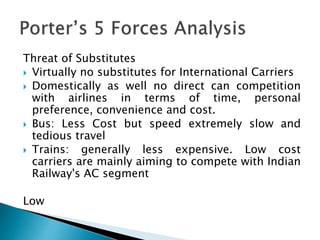
Threat of Substitutes
 Virtually no substitutes for International Carriers
 Domestically as well no direct can competition
with airlines in terms of time, personal
preference, convenience and cost.
 Bus: Less Cost but speed extremely slow and
tedious travel
 Trains: generally less expensive. Low cost
carriers are mainly aiming to compete with Indian
Railway's AC segment
Low
Competitive Rivalry
 Competition among major players is
extremely high in many aspects
 Intense price competition and High fixed cost
 Low profits and unused/excess capacity
 Switching costs are generally low. Companies
have tried to increase switching costs with
the use of "frequent flyer" programs
High
Competitive
Rivalry
HIGH
Bargaining Power of
Suppliers
HIGH
Threat of New Entrants
MEDIUM
Bargaining Power of
Buyers
MEDIUM
Threat of Substitutes
LOW
THANK YOU

Indian aviation industry analysis

  • 1.
    Industry Analysis withfocus on 5 forces
  • 2.
     Aviation Industryin India is one of the fastest growing aviation industries in the world  Indian aviation sector has the potential to be number one globally by 2030: Indian Aviation report by FICCI-KPMG(13th Mar 2014)  From being primarily a government-owned industry, the Indian aviation industry is now dominated by privately owned full service airlines and low cost carriers
  • 3.
     Low CostCarriers (LCC)  Modern airports  Foreign Direct Investments (FDI) in domestic airlines  Cutting edge Information Technology (IT)  Emphasis on regional connectivity As per the 12th Five Year Plan (2012-17), improving air connectivity in tier-2 and tier-3 cities in India is one of the key priorities of the government
  • 4.
     International, National,Regional and Cargo Issues: (generally speaking; on an avg) 1) Weather: Variable and Unpredictable. Flight cancellations and accidents 2) Fuel Cost: 14-16% of an airlines cost 3) Labor: 40% of airline’s expense used to pay pilots, flight attendants, baggage handlers, dispatchers, customer service Significant Costs: Airport capacity, route structures, technology, and costs to lease or buy the physical aircraft
  • 5.
     India sellsone of the costliest Aviation Turbine Fuel (ATF) in the world, nearly 60% costlier than competing nations in the Middle East and ASEAN regions  Tax policies not favourable  The raw material & ATF accounts for nearly half of the operating cost of Indian carriers
  • 6.
    Threat of NewEntrants  As of now there are very few entry barriers except high cost of fuel and taxes  Govt is also promoting this sector with the increase in FDI limit to 49%  However existing profitable routes are already saturated MEDIUM
  • 7.
    Bargaining Power ofSuppliers  All suppliers have tremendous bargaining power with the airline industry  Few fuel providers and no alternative to fuel. Aviation fuel is already a commodity  The airline supply business is mainly dominated by Boeing and Airbus  Airports, Other Infrastructures are also fixed in number HIGH
  • 8.
    Bargaining Power ofBuyers  With entry of substantial no of Low Cost Carriers bargaining power of buyers is gradually increasing  Few fuel providers and no alternative to fuel. Aviation fuel is already a commodity  The airline supply business is mainly dominated by Boeing and Airbus  Airports, Other Infrastructures are also fixed in number Medium
  • 9.
    Threat of Substitutes Virtually no substitutes for International Carriers  Domestically as well no direct can competition with airlines in terms of time, personal preference, convenience and cost.  Bus: Less Cost but speed extremely slow and tedious travel  Trains: generally less expensive. Low cost carriers are mainly aiming to compete with Indian Railway's AC segment Low
  • 10.
    Competitive Rivalry  Competitionamong major players is extremely high in many aspects  Intense price competition and High fixed cost  Low profits and unused/excess capacity  Switching costs are generally low. Companies have tried to increase switching costs with the use of "frequent flyer" programs High
  • 11.
    Competitive Rivalry HIGH Bargaining Power of Suppliers HIGH Threatof New Entrants MEDIUM Bargaining Power of Buyers MEDIUM Threat of Substitutes LOW
  • 12.