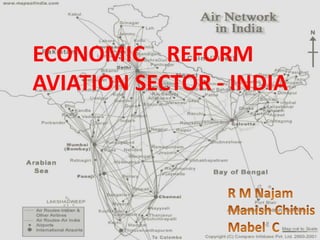
ECONOMIC REFORM
AVIATION SECTOR - INDIA
SOURCES
• 2nd U.S.-India Aviation Partnership Summit(2009)
• Research Study of the Civil Aviation Sector in India
SUBMITTED TO : The Ministry of Corporate Affairs, Govt. of
India (2012)
• WIKIPEDIA
• AIRLINE INDUSTRY- CHANGING TIMES (NMIMS PROJ;2002)
GUIDE : PROF N S SHETTY
• NEWSPAPER UPDATES TILL 20 Nov 2013
–
–
–
–
–
–

THE ECONOMIC TIMES
BUSINESS STANDARD
THE INDIAN EXPRESS
THE TIMES OF INDIA
LIVE MINT & THE WALL STREET JOURNAL.
WALL STREET JOURNAL
SUMMARY OF PRESENTATION
• Introduction
• India’s economy before 1991
• Aviation Industry before & after 1991
• Liberalisation policies/Government initiatives
• Impact of Liberalisation Policy
• Growth Story

• SWOT Analysis
• ROAD AHEAD
REGIONAL AIRLINES-29 JUL13
• GoI has set target of building 50 new low cost small
airports by AAI across 11 states to cater for regional
connectivity.
• Large airlines mandated to connect smaller cities
• scheduled regional airlines to induct smaller
aircraft for deployment on regional routes
• Relaxation on number of aircrafts
• Cess and tax relaxation on regional routes
• Reduce VAT on ATF and Less Airport charges.
• Permission to fly international routes to regional
airlines.
JET-ETIHAD

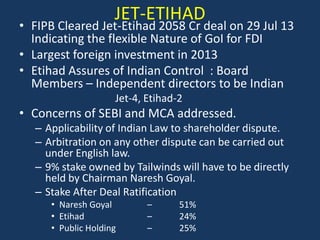
• FIPB Cleared Jet-Etihad 2058 Cr deal on 29 Jul 13
Indicating the flexible Nature of GoI for FDI
• Largest foreign investment in 2013
• Etihad Assures of Indian Control : Board
Members – Independent directors to be Indian
Jet-4, Etihad-2

• Concerns of SEBI and MCA addressed.
– Applicability of Indian Law to shareholder dispute.
– Arbitration on any other dispute can be carried out
under English law.
– 9% stake owned by Tailwinds will have to be directly
held by Chairman Naresh Goyal.
– Stake After Deal Ratification
• Naresh Goyal
• Etihad
• Public Holding

–
–
–

51%
24%
25%
AIR ASIA - JV
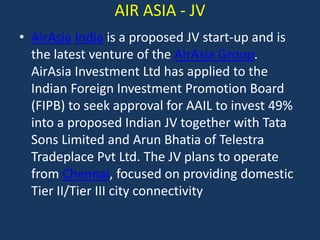
• AirAsia India is a proposed JV start-up and is
the latest venture of the AirAsia Group.
AirAsia Investment Ltd has applied to the
Indian Foreign Investment Promotion Board
(FIPB) to seek approval for AAIL to invest 49%
into a proposed Indian JV together with Tata
Sons Limited and Arun Bhatia of Telestra
Tradeplace Pvt Ltd. The JV plans to operate
from Chennai, focused on providing domestic
Tier II/Tier III city connectivity
AIRPORTS & AIRCRAFTS- INDIA
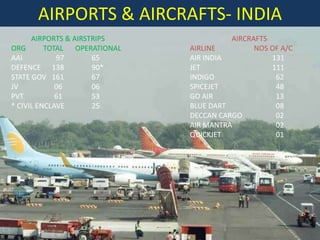
AIRPORTS & AIRSTRIPS
ORG
TOTAL
OPERATIONAL
AAI
97
65
DEFENCE 138
90*
STATE GOV 161
67
JV
06
06
PVT
61
53
* CIVIL ENCLAVE
25

AIRCRAFTS
AIRLINE
NOS OF A/C
AIR INDIA
131
JET
111
INDIGO
62
SPICEJET
48
GO AIR
13
BLUE DART
08
DECCAN CARGO
02
AIR MANTRA
02
QUICKJET
01
INDUSTRY OVERVIEW
•
•
•
•
•
•
•

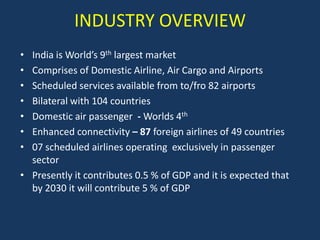
India is World’s 9th largest market
Comprises of Domestic Airline, Air Cargo and Airports
Scheduled services available from to/fro 82 airports
Bilateral with 104 countries
Domestic air passenger - Worlds 4th
Enhanced connectivity – 87 foreign airlines of 49 countries
07 scheduled airlines operating exclusively in passenger
sector
• Presently it contributes 0.5 % of GDP and it is expected that
by 2030 it will contribute 5 % of GDP
INDIA’S ECONOMY BEFORE 1991
• Influenced by Protectionism and Public ownership.
• Existence of License Raj (Red Tape).
• Average growth rate of India was 3.5% p.a with per capita
1.3%p.a.
• More focused on Heavy Industries and Agriculture.
• Less attention towards service sector.
• Downfall of USSR and Gulf War added fuel to the fire of crisis.
INDIA’S ECONOMY BEFORE 1991
• Major imbalance in payments of loans.
• International Monetary Fund (IMF) demanded for economic
reforms in return of aid.
• Prime Minister Narasimha Rao and Finance Minister Manmohan
Singh took initiative to bring Liberalization.
LICENCE RAJ
ECONOMIC REFORMS POST 1991
Policies
• Liberalisation - Private Players
• Open Sky
• Direct import of ATF - Regulation
• FDI – Domestic Services Sector
• Airports control - Airports Authority of India (AAI)
• Green Field Airport
IMPACT OF LIBERALISATION
• The Air Corporation Act, 1953 repealed

Opening up of the domestic sector
Disinvestment of the two public sector airlines
New privately owned domestic airlines
• Open Sky
Allow foreign airline of any country or ownership to land at
any port on any number of occasions and with unlimited seat
capacity.
• Foreign Direct Investment
Up To 49% Of Foreign Equity & 100% Of NRI investment is
allowed Pertaining to the Domestic Air Transport Services
IMPACT OF LIBERALISATION
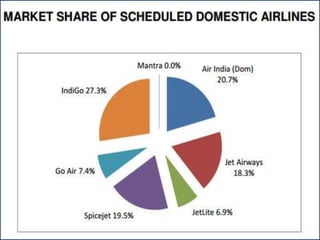
• Private Carriers permitted to operate scheduled services – 75%
share in domestic aviation
• Entry of low cost carriers
• City side development of non-metro airports
• Allowing Indian carriers to compete on international routes
• Reduction in Landing charges.
•

Fleet expansion plans of Air India
IMPACT OF LIBERALISATION
•

Restructuring of Delhi and Mumbai airport and development
of Greenfield airports at Bangalore and Hyderabad
undertaken.

• Up gradation/ expansion/ development of airports
undertaken depending upon traffic potential, requirement of
airline operators and need of air passengers.
IMPACT OF LIBERALISATION
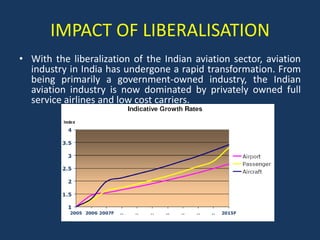
• With the liberalization of the Indian aviation sector, aviation
industry in India has undergone a rapid transformation. From
being primarily a government-owned industry, the Indian
aviation industry is now dominated by privately owned full
service airlines and low cost carriers.
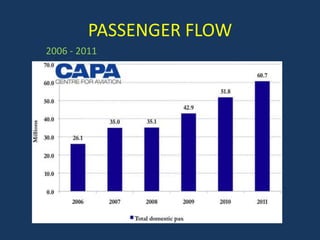
PASSENGER FLOW
2006 - 2011
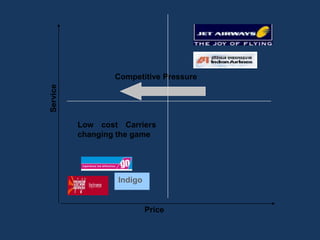
Service

Competitive Pressure

Low cost Carriers
changing the game

Indigo

Price
Market Size
Domestic Air Traffic quadrupled from 13 million to
52 billion in last decade
International Traffic more than tripled to 38 million
87 foreign airlines fly to and from India and 5 Indian
airlines fly to and from 40 countries
45 million tons of cargo through 920 airlines, using
4200 airports and deploying 27000 aircrafts
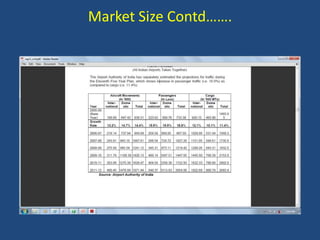
Projections for traffic during the Eleventh Five Year
Plan, which shows increase in passenger traffic (i.e.
18.8%) as compared to cargo (i.e. 11.4%). The figure
is as follows:
Market Size Contd…….
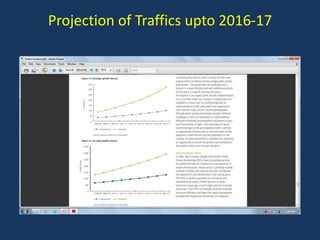
Projection of Traffics upto 2016-17
Major policies taken in 11th Five Year Plan
 Reduction of high Aviation Turbine Fuel(ATF) cost and
review of its Tax structure
 Multi Modal Connectivity by building expressways to
facilitate advantage of air transportation by reducing the
total travel time
 foreign equity participation up to 49% and investment by
non-resident Indians (NRIs) up to 100% in the domestic air
transport services
 Promotion of Regional Airlines by the way of liberal policy
and provision of better infrastructure facilities
 Development of MRO hub
 Review of RDG to bring them in line with developments
 Merger of AI and Indian Airlines to optimize fleet
acquisition & to leverage the asset base
Major policies taken in 11th Five Year Plan
100% FDI is permissible for existing airports;
FIPB approval required for FDI beyond 74%
100% FDI under automatic route is
permissible for greenfield airports
100% tax exemption for airport projects for a
period of 10 years
projected outlay for the Eleventh Plan for
MoCA is Rs 43560 crore at 2006–07 price
FDI Policy

•

•

The Reserve Bank of India (RBI) announced that foreign institutional investors
might have shareholdings more than the limited 49% in the domestic sector.
Airports
– Foreign equity up to 100% is allowed by the means of automatic approvals
pertaining to establishment of Greenfield airports
– Foreign equity up to 74% is allowed by the means of automatic approvals
pertaining to the existing airports
– Foreign equity up to 100% is allowed by the means of special permission from
Foreign Investment Promotion Board, Ministry of Finance, pertaining to the
existing airports
– 100 per cent tax exemption for airport projects for a period of 10 years.
Air Transport Services
– Up to 49% of foreign equity is allowed by the means of automatic approvals
pertaining to the domestic air transport services
– Up to 100% of NRI investment is allowed by the means of automatic approvals
pertaining to the domestic air transport services
– 74 per cent FDI is permissible in cargo and non-scheduled airlines.
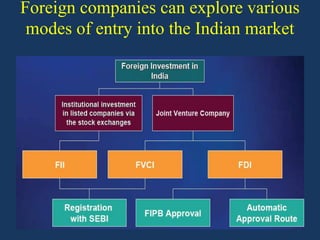
Foreign companies can explore various
modes of entry into the Indian market
AVIATION SECTOR
GROWTH OF THE INDUSTRY
• The growth of airlines traffic in Aviation Industry in India is almost
four times above international average.
• Domestic airlines passengers traffic in increasing at the rate of 25%.
• India ranks fourth after US, China and Japan in terms of domestic
passengers volume.
The domestic aviation sector is expected to grow at a rate of 9-10
per cent to reach a level of 150-180 million passengers by 2020.
• The industry witnessed an annual growth of 12.8 per cent during
the last 5 years in the international cargo handled at all Indian
airports.
GROWTH OF THE INDUSTRY
• Further, there has been an increase in tourist charter flights to India
with around 686 flights bringing 150,000 tourists.
• It is predicted that international passengers will grow upto 50
million by 2015
• Aviation is now affordable with check fares and discount schemes.

• Various Operators with different business model.

• Regional connectivity – Tier II & Tier III cities
Contribution to GDP
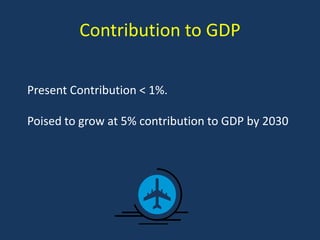
Present Contribution < 1%.
Poised to grow at 5% contribution to GDP by 2030
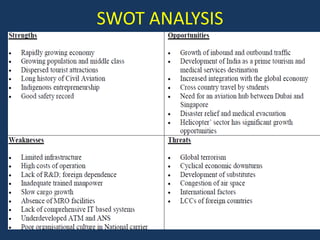
OPPORTUNITIES
Airport development and modernisation
• The government is promoting private participation for the
development of greenfield airports and modernisation of existing
airports.

Airport connectivity
• The Ministry of Civil Aviation is focussing on improving connectivity
to major airports.
City-side development
• The government is focussing on the city-side development of airports,
including real estate and commercial development. The city-side
development of 24 non-major airports is being taken up.
SWOT ANALYSIS
Road Ahead
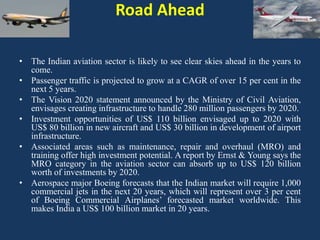
• The Indian aviation sector is likely to see clear skies ahead in the years to
come.
• Passenger traffic is projected to grow at a CAGR of over 15 per cent in the
next 5 years.
• The Vision 2020 statement announced by the Ministry of Civil Aviation,
envisages creating infrastructure to handle 280 million passengers by 2020.
• Investment opportunities of US$ 110 billion envisaged up to 2020 with
US$ 80 billion in new aircraft and US$ 30 billion in development of airport
infrastructure.
• Associated areas such as maintenance, repair and overhaul (MRO) and
training offer high investment potential. A report by Ernst & Young says the
MRO category in the aviation sector can absorb up to US$ 120 billion
worth of investments by 2020.
• Aerospace major Boeing forecasts that the Indian market will require 1,000
commercial jets in the next 20 years, which will represent over 3 per cent
of Boeing Commercial Airplanes’ forecasted market worldwide. This
makes India a US$ 100 billion market in 20 years.
THANK YOU

Economic reforms aviation industry

  • 1.
  • 2.
    SOURCES • 2nd U.S.-IndiaAviation Partnership Summit(2009) • Research Study of the Civil Aviation Sector in India SUBMITTED TO : The Ministry of Corporate Affairs, Govt. of India (2012) • WIKIPEDIA • AIRLINE INDUSTRY- CHANGING TIMES (NMIMS PROJ;2002) GUIDE : PROF N S SHETTY • NEWSPAPER UPDATES TILL 20 Nov 2013 – – – – – – THE ECONOMIC TIMES BUSINESS STANDARD THE INDIAN EXPRESS THE TIMES OF INDIA LIVE MINT & THE WALL STREET JOURNAL. WALL STREET JOURNAL
  • 3.
    SUMMARY OF PRESENTATION •Introduction • India’s economy before 1991 • Aviation Industry before & after 1991 • Liberalisation policies/Government initiatives • Impact of Liberalisation Policy • Growth Story • SWOT Analysis • ROAD AHEAD
  • 4.
    REGIONAL AIRLINES-29 JUL13 •GoI has set target of building 50 new low cost small airports by AAI across 11 states to cater for regional connectivity. • Large airlines mandated to connect smaller cities • scheduled regional airlines to induct smaller aircraft for deployment on regional routes • Relaxation on number of aircrafts • Cess and tax relaxation on regional routes • Reduce VAT on ATF and Less Airport charges. • Permission to fly international routes to regional airlines.
  • 5.
    JET-ETIHAD • FIPB ClearedJet-Etihad 2058 Cr deal on 29 Jul 13 Indicating the flexible Nature of GoI for FDI • Largest foreign investment in 2013 • Etihad Assures of Indian Control : Board Members – Independent directors to be Indian Jet-4, Etihad-2 • Concerns of SEBI and MCA addressed. – Applicability of Indian Law to shareholder dispute. – Arbitration on any other dispute can be carried out under English law. – 9% stake owned by Tailwinds will have to be directly held by Chairman Naresh Goyal. – Stake After Deal Ratification • Naresh Goyal • Etihad • Public Holding – – – 51% 24% 25%
  • 6.
    AIR ASIA -JV • AirAsia India is a proposed JV start-up and is the latest venture of the AirAsia Group. AirAsia Investment Ltd has applied to the Indian Foreign Investment Promotion Board (FIPB) to seek approval for AAIL to invest 49% into a proposed Indian JV together with Tata Sons Limited and Arun Bhatia of Telestra Tradeplace Pvt Ltd. The JV plans to operate from Chennai, focused on providing domestic Tier II/Tier III city connectivity
  • 7.
    AIRPORTS & AIRCRAFTS-INDIA AIRPORTS & AIRSTRIPS ORG TOTAL OPERATIONAL AAI 97 65 DEFENCE 138 90* STATE GOV 161 67 JV 06 06 PVT 61 53 * CIVIL ENCLAVE 25 AIRCRAFTS AIRLINE NOS OF A/C AIR INDIA 131 JET 111 INDIGO 62 SPICEJET 48 GO AIR 13 BLUE DART 08 DECCAN CARGO 02 AIR MANTRA 02 QUICKJET 01
  • 8.
    INDUSTRY OVERVIEW • • • • • • • India isWorld’s 9th largest market Comprises of Domestic Airline, Air Cargo and Airports Scheduled services available from to/fro 82 airports Bilateral with 104 countries Domestic air passenger - Worlds 4th Enhanced connectivity – 87 foreign airlines of 49 countries 07 scheduled airlines operating exclusively in passenger sector • Presently it contributes 0.5 % of GDP and it is expected that by 2030 it will contribute 5 % of GDP
  • 9.
    INDIA’S ECONOMY BEFORE1991 • Influenced by Protectionism and Public ownership. • Existence of License Raj (Red Tape). • Average growth rate of India was 3.5% p.a with per capita 1.3%p.a. • More focused on Heavy Industries and Agriculture. • Less attention towards service sector. • Downfall of USSR and Gulf War added fuel to the fire of crisis.
  • 10.
    INDIA’S ECONOMY BEFORE1991 • Major imbalance in payments of loans. • International Monetary Fund (IMF) demanded for economic reforms in return of aid. • Prime Minister Narasimha Rao and Finance Minister Manmohan Singh took initiative to bring Liberalization.
  • 11.
  • 13.
    ECONOMIC REFORMS POST1991 Policies • Liberalisation - Private Players • Open Sky • Direct import of ATF - Regulation • FDI – Domestic Services Sector • Airports control - Airports Authority of India (AAI) • Green Field Airport
  • 14.
    IMPACT OF LIBERALISATION •The Air Corporation Act, 1953 repealed Opening up of the domestic sector Disinvestment of the two public sector airlines New privately owned domestic airlines • Open Sky Allow foreign airline of any country or ownership to land at any port on any number of occasions and with unlimited seat capacity. • Foreign Direct Investment Up To 49% Of Foreign Equity & 100% Of NRI investment is allowed Pertaining to the Domestic Air Transport Services
  • 15.
    IMPACT OF LIBERALISATION •Private Carriers permitted to operate scheduled services – 75% share in domestic aviation • Entry of low cost carriers • City side development of non-metro airports • Allowing Indian carriers to compete on international routes • Reduction in Landing charges. • Fleet expansion plans of Air India
  • 16.
    IMPACT OF LIBERALISATION • Restructuringof Delhi and Mumbai airport and development of Greenfield airports at Bangalore and Hyderabad undertaken. • Up gradation/ expansion/ development of airports undertaken depending upon traffic potential, requirement of airline operators and need of air passengers.
  • 17.
    IMPACT OF LIBERALISATION •With the liberalization of the Indian aviation sector, aviation industry in India has undergone a rapid transformation. From being primarily a government-owned industry, the Indian aviation industry is now dominated by privately owned full service airlines and low cost carriers.
  • 18.
  • 20.
    Service Competitive Pressure Low costCarriers changing the game Indigo Price
  • 21.
    Market Size Domestic AirTraffic quadrupled from 13 million to 52 billion in last decade International Traffic more than tripled to 38 million 87 foreign airlines fly to and from India and 5 Indian airlines fly to and from 40 countries 45 million tons of cargo through 920 airlines, using 4200 airports and deploying 27000 aircrafts Projections for traffic during the Eleventh Five Year Plan, which shows increase in passenger traffic (i.e. 18.8%) as compared to cargo (i.e. 11.4%). The figure is as follows:
  • 22.
  • 23.
  • 24.
    Major policies takenin 11th Five Year Plan  Reduction of high Aviation Turbine Fuel(ATF) cost and review of its Tax structure  Multi Modal Connectivity by building expressways to facilitate advantage of air transportation by reducing the total travel time  foreign equity participation up to 49% and investment by non-resident Indians (NRIs) up to 100% in the domestic air transport services  Promotion of Regional Airlines by the way of liberal policy and provision of better infrastructure facilities  Development of MRO hub  Review of RDG to bring them in line with developments  Merger of AI and Indian Airlines to optimize fleet acquisition & to leverage the asset base
  • 25.
    Major policies takenin 11th Five Year Plan 100% FDI is permissible for existing airports; FIPB approval required for FDI beyond 74% 100% FDI under automatic route is permissible for greenfield airports 100% tax exemption for airport projects for a period of 10 years projected outlay for the Eleventh Plan for MoCA is Rs 43560 crore at 2006–07 price
  • 26.
    FDI Policy • • The ReserveBank of India (RBI) announced that foreign institutional investors might have shareholdings more than the limited 49% in the domestic sector. Airports – Foreign equity up to 100% is allowed by the means of automatic approvals pertaining to establishment of Greenfield airports – Foreign equity up to 74% is allowed by the means of automatic approvals pertaining to the existing airports – Foreign equity up to 100% is allowed by the means of special permission from Foreign Investment Promotion Board, Ministry of Finance, pertaining to the existing airports – 100 per cent tax exemption for airport projects for a period of 10 years. Air Transport Services – Up to 49% of foreign equity is allowed by the means of automatic approvals pertaining to the domestic air transport services – Up to 100% of NRI investment is allowed by the means of automatic approvals pertaining to the domestic air transport services – 74 per cent FDI is permissible in cargo and non-scheduled airlines.
  • 27.
    Foreign companies canexplore various modes of entry into the Indian market
  • 28.
  • 29.
    GROWTH OF THEINDUSTRY • The growth of airlines traffic in Aviation Industry in India is almost four times above international average. • Domestic airlines passengers traffic in increasing at the rate of 25%. • India ranks fourth after US, China and Japan in terms of domestic passengers volume. The domestic aviation sector is expected to grow at a rate of 9-10 per cent to reach a level of 150-180 million passengers by 2020. • The industry witnessed an annual growth of 12.8 per cent during the last 5 years in the international cargo handled at all Indian airports.

  • 30.
    GROWTH OF THEINDUSTRY • Further, there has been an increase in tourist charter flights to India with around 686 flights bringing 150,000 tourists. • It is predicted that international passengers will grow upto 50 million by 2015 • Aviation is now affordable with check fares and discount schemes. • Various Operators with different business model. • Regional connectivity – Tier II & Tier III cities
  • 31.
    Contribution to GDP PresentContribution < 1%. Poised to grow at 5% contribution to GDP by 2030
  • 32.
    OPPORTUNITIES Airport development andmodernisation • The government is promoting private participation for the development of greenfield airports and modernisation of existing airports. Airport connectivity • The Ministry of Civil Aviation is focussing on improving connectivity to major airports. City-side development • The government is focussing on the city-side development of airports, including real estate and commercial development. The city-side development of 24 non-major airports is being taken up.
  • 33.
  • 34.
    Road Ahead • TheIndian aviation sector is likely to see clear skies ahead in the years to come. • Passenger traffic is projected to grow at a CAGR of over 15 per cent in the next 5 years. • The Vision 2020 statement announced by the Ministry of Civil Aviation, envisages creating infrastructure to handle 280 million passengers by 2020. • Investment opportunities of US$ 110 billion envisaged up to 2020 with US$ 80 billion in new aircraft and US$ 30 billion in development of airport infrastructure. • Associated areas such as maintenance, repair and overhaul (MRO) and training offer high investment potential. A report by Ernst & Young says the MRO category in the aviation sector can absorb up to US$ 120 billion worth of investments by 2020. • Aerospace major Boeing forecasts that the Indian market will require 1,000 commercial jets in the next 20 years, which will represent over 3 per cent of Boeing Commercial Airplanes’ forecasted market worldwide. This makes India a US$ 100 billion market in 20 years.
  • 35.

Editor's Notes

  • #6 The Competition Commission of India has sought detailed response from Jet and Etihad on the combined market share the two airlines expect to have on the India-Abu Dhabi and beyond routes to places like North America and Europe where other Indian carriers also fly.
  • #7 New Delhi: Janata Party leader Subramanian Swamy on Thursday filed a petition in the Supreme Court seeking a quashing of the clearance granted to AirAsiaIndia Pvt. Ltd. In his 60-page public interest litigation (PIL),…
  • #32 The airports handled a total of 1020.9 thousand metric tones of international cargo in 2006-07.
  • #34 10 years back there were just 2 airlines. Both state owned . In the last 10years the economy has opened up. India has experienced growth rate of 8% per year.
  • #35 commenwelth games, world cup, ipl etc.
  • #36 It is also working towards making existing non-operational airports in the country operational. It has selected 12 airports. These include the Mumbai, Chennai, Bengaluru, Kolkata, Hyderabad, Ahmedabad, Cochin, Coimbatore and the proposed Navi Mumbai and Noida airports.
  • #38 The Reserve Bank of India (RBI) announced that foreign institutional investors might have shareholdings more than the limited 49% in the domestic sector.
  • #39 PppGovt. should be a participant not only in investment but accountability also..