Business Environment
Airlines Industry
DEPARTMENT OF COMMERCE
MASTER OF BUSINESS ADMINISTRATION
UNIVERSITY COLLEGE OF COMMERCE AND BUSINESS MANAGEMENT
KAKATIYA UNIVERSITY
2020 - 2022
1
HALL TICKET NO NAME PAGE No.
21564C1009 Thatikonda Harika 3-4
21564C1021 Barla Navya 7-8
21564C1025 V Umamaheshwar Goud 13-14
21564C1029 S Shiva prasad 15-16
21564C1118 Rasa Vijaysagar 10-12
21564C1121 Ande Rahul 21-22
21564C1125 R Nikthisha 23-24
21564C1127 K Saimurali Manohar 19-20
21564C1134 K Saiteja 9
21564C1149 G Srinath 5-6
21564C1151 Rakesh Davera 25-30
21564C1153 Ch.Divya 17-18
Airlines Industry
2
Introduction
3
DEF: AIRLINE is an Industry that provides both domestic & International
air transport services for travelling passengers and also freight. Currently
Airline Industry is preferred over other means of Transport, due to its Effective
& Efficient Operations.
Airlines utilize air crafts to supply the services and may form partnership or
alliances with other airlines for code share agreements in which they both offer
and operate the same flight.
Once upon a time people were started to travel by foot, then to cross the
oceans they built ships, many years later airlines were innovated.
Airlines were using for the transportation of men and material.
2.5 Billion passengers worldwide.
5.5 Million airline employees.
18 Million indirect tourism jobs.
Currently airline industry operates around 5000 services around the globe.
4
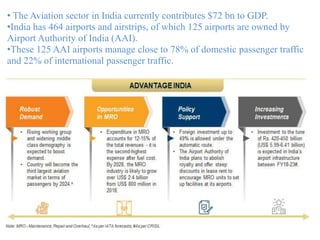
• The Aviation sector in India currently contributes $72 bn to GDP.
•India has 464 airports and airstrips, of which 125 airports are owned by
Airport Authority of India (AAI).
•These 125 AAI airports manage close to 78% of domestic passenger traffic
and 22% of international passenger traffic.
Continued….
The different types of airlines are passenger airlines and Cargo airlines
 In India on 17th February 1911 an airlines from Allahabad to Naini
station it covers 10KM in 13minutes this flight was not a passenger flight it
was actually a Cargo(Mail) flight it carries 650 post cards and few letters
 First airport – 1924 (Allahabad, Mumbai, Calcutta)
 Civil aviation department (1927) by British Govt. in India
1st international passenger flight to India (London to Karachi) in 1929
by imperial airways(British airlines),London.
First flying school of India (1929) was Aero club of India, Burma.
5
Continued…
•In India 1st airlines was Tata airlines by JRD Tata (1932)
•Later 1948 Tata airlines was merged with Govt. of India as Air India .
•1st single engine de Havilland(Canada) ,carrying air mail from
karachi’s drigh road aero drome to Bombay juhu aero drome and later
continued to Madras
•In India the 1st domestic flight which was from Mumbai to Trivandrum
by Tata airlines cost of 250Rs/- at 1932
•Malabar princess(Air India) 1st Indian flight from Bombay to London
of cost 1720Rs/-.
•In India 39 airlines operating (Scheduled, Regional, Chartered, Cargo)
6
4P’s
Product:
Air India is one of the leading airlines in India providing international
and domestic travel.
Air India provides only passenger transport services; thus, it is
committed to provide the best possible services to its customers.
Air India passenger fleet primarily consists of airplanes from Boeing
and Airbus.
Price:
Air India is a leading airline player in India with a pricing strategy
based on competition and sectors it covers.
Air India prices airline tickets such that it is easily accessible to
middle class families.
Quality of service is something that they do not compromise with the
basic technique.
7
4P’s
Place:
 Air India has its presence in all cities in India. Air India has flights
connecting India with major cities and business headquarters across
the world.
 They have also tied up with various agencies to sell their tickets, thus
increasing their service base and capabilities.
Promotion:
 Air India has tied up with various travel agencies like Yatra.com,
goibibo.com, etc..,
 By promoting their tagline “Air India… Truly India.” Air India has
leveraged huge gains by being able to promote their brand.
 Amadeus is a short term promotional strategy which Air India
implements
8
4C’s
9
Consumer wants and needs:
It is the focus on being product led to companies making things customer
didn’t want.
Cost to satisfy:
It is the basis that price was irrelevant. Consider all costs involved in
satisfying your customers including cost than customers themselves will
have to incur to satisfy their needs.
Convenience to buy:
Convenience to buy is noting but how and where does the customer want
to purchase.
Communication :
It is all the interactions between the organization and customer
communication was that it should be about dialogue, a two-way
conversation, between company and customer.
10
Airport authority of India manages total 125 airports in the country.
Out of which 11 are international airports, 94 domestic airports, 28
civil enclaves.
Main hubs of Indian airways was Chhatrapathi shivaji international
airport and Indira Gandhi international airport(Delhi).
“UDAN” letting common people to fly.
India as emerged as 3rd largest domestic aviation market in the world.
In our country international airports offering joint venture.
 Indian airlines was under the administration of Ministry of Civil
aviation (Hardeep Singh Puri).
 Annual budget of Indian airlines was around 6,602.86 Cr.
 Greenfield airport are getting developed at Kochi, Hyderabad,
Bangalore.
 100% foreign equity also allowed for construction and maintenance.
 The Directorate General of Civil Aviation is a regulatory body in the
field of civil aviation, Primarily deals with safety issues.
11
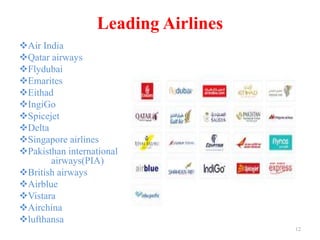
Leading Airlines
Air India
Qatar airways
Flydubai
Emarites
Eithad
IngiGo
Spicejet
Delta
Singapore airlines
Pakisthan international
airways(PIA)
British airways
Airblue
Vistara
Airchina
lufthansa
12
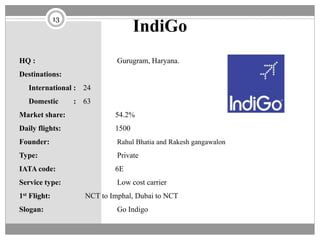
IndiGo
HQ : Gurugram, Haryana.
Destinations:
International : 24
Domestic : 63
Market share: 54.2%
Daily flights: 1500
Founder: Rahul Bhatia and Rakesh gangawalon
Type: Private
IATA code: 6E
Service type: Low cost carrier
1st Flight: NCT to Imphal, Dubai to NCT
Slogan: Go Indigo
13
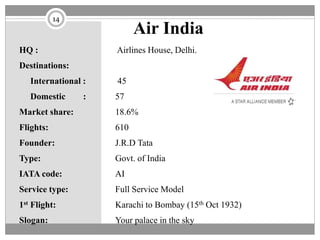
Air India
HQ : Airlines House, Delhi.
Destinations:
International : 45
Domestic : 57
Market share: 18.6%
Flights: 610
Founder: J.R.D Tata
Type: Govt. of India
IATA code: AI
Service type: Full Service Model
1st Flight: Karachi to Bombay (15th Oct 1932)
Slogan: Your palace in the sky
14
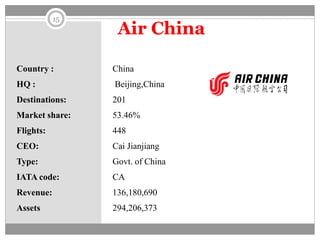
Air China
Country : China
HQ : Beijing,China
Destinations: 201
Market share: 53.46%
Flights: 448
CEO: Cai Jianjiang
Type: Govt. of China
IATA code: CA
Revenue: 136,180,690
Assets 294,206,373
15
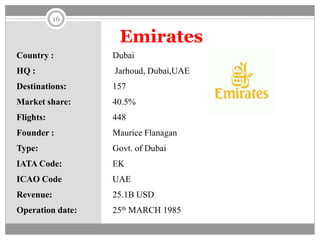
Emirates
Country : Dubai
HQ : Jarhoud, Dubai,UAE
Destinations: 157
Market share: 40.5%
Flights: 448
Founder : Maurice Flanagan
Type: Govt. of Dubai
IATA Code: EK
ICAO Code UAE
Revenue: 25.1B USD
Operation date: 25th MARCH 1985
16
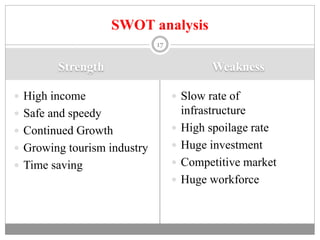
Strength Weakness
 High income
 Safe and speedy
 Continued Growth
 Growing tourism industry
 Time saving
 Slow rate of
infrastructure
 High spoilage rate
 Huge investment
 Competitive market
 Huge workforce
17
SWOT analysis
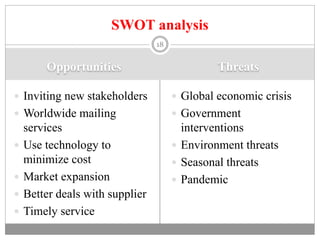
Opportunities Threats
 Inviting new stakeholders
 Worldwide mailing
services
 Use technology to
minimize cost
 Market expansion
 Better deals with supplier
 Timely service
 Global economic crisis
 Government
interventions
 Environment threats
 Seasonal threats
 Pandemic
18
SWOT analysis
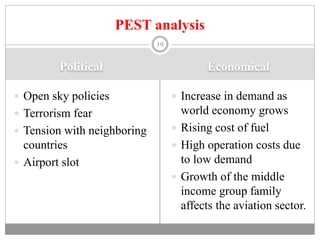
Political Economical
 Open sky policies
 Terrorism fear
 Tension with neighboring
countries
 Airport slot
 Increase in demand as
world economy grows
 Rising cost of fuel
 High operation costs due
to low demand
 Growth of the middle
income group family
affects the aviation sector.
19
PEST analysis
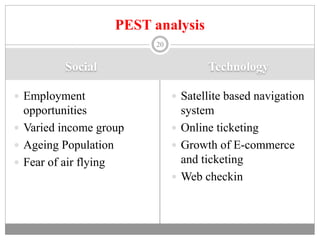
Social Technology
 Employment
opportunities
 Varied income group
 Ageing Population
 Fear of air flying
 Satellite based navigation
system
 Online ticketing
 Growth of E-commerce
and ticketing
 Web checkin
20
PEST analysis
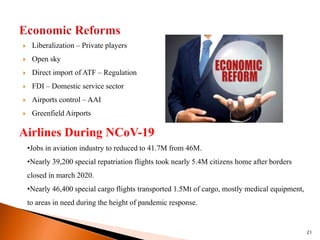
 Liberalization – Private players
 Open sky
 Direct import of ATF – Regulation
 FDI – Domestic service sector
 Airports control – AAI
 Greenfield Airports
21
Airlines During NCoV-19
•Jobs in aviation industry to reduced to 41.7M from 46M.
•Nearly 39,200 special repatriation flights took nearly 5.4M citizens home after borders
closed in march 2020.
•Nearly 46,400 special cargo flights transported 1.5Mt of cargo, mostly medical equipment,
to areas in need during the height of pandemic response.
 Private carriers permitted to operate scheduled services
 Entry of low cost carriers
 City side development of non metro airports
 Allowing Indian carriers to compete on internatioal
routes
 Reducing in landing charges.
 Fleet expansion plans of Air India.
 Restructuring of Delhi and Mumbai airport and
development of Greenfield airports at Bangalore and
Hyderabad undertaken.
22
National Civil Aviation policy of India
23
 Vision: To create an Eco-System to make flying affordable for the
masses and to enable 30 crore domestic ticketing by 2022 and 50 crore
by 2027, and international ticketing to increase to 20 crore by 2027.
Similarly, Cargo volumes should increase to 10 million tonnes by 2027.
 Mission: Provide safe, secure, affordable and sustainable air travel for
passengers and air transportation of cargo with access to various parts
of India and the World.
National Civil Aviation policy of India
24
Objectives:
 Establish an integrated eco-system which will lead to significant
growth of civil aviation sector, which in turn would promote tourism,
increase employment and lead to a balanced regional growth.
 Ensure safety, security and sustainability of aviation sector through the
use of technology and effective monitoring.
 Enhance regional connectivity through fiscal support and infrastructure
development.
 Enhance ease of doing business through deregulation, simplified
procedures and e-governance.
 Promote the entire aviation sector chain in a harmonized manner
covering cargo, MRO, general aviation, aerospace manufacturing and
skill development.
25
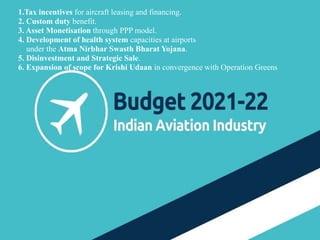
1.Tax incentives for aircraft leasing and financing.
2. Custom duty benefit.
3. Asset Monetisation through PPP model.
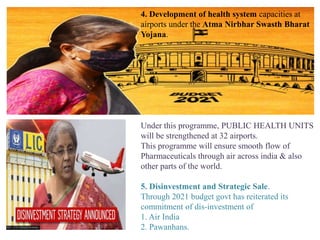
4. Development of health system capacities at airports
under the Atma Nirbhar Swasth Bharat Yojana.
5. Disinvestment and Strategic Sale.
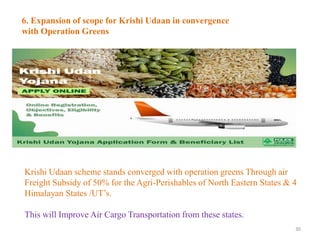
6. Expansion of scope for Krishi Udaan in convergence with Operation Greens
26
Ministry of Civil Aviation
Union Budget 2021: Major Highlights for The Aviation Industry
Budget Proposes More Tax Incentives for Aircraft
Govt Committed to make
(IFSC) a global Financial HUB
in GIFT city.
IFSC: International Financial
Services Centre.
GIFT : Gujarat International
Financial Tech.
Additional Incentives : 2021-2022
1. Tax Holiday For Capital Gains income ( of Aircraft Leasing & Financing Company).
(If a company gets Capital gains income through its operations like Leasing/financing, simply NO
Tax.)
2. Tax Exemptions for Aircraft Lease rentals or Royalty paid to Foreign lessor.
(If a company paying something to Foreign lessor, such company can claim back such payment)
3.Tax incentive for relocation of foreign funds in IFSC
4.Tax Exemptions to Investment division of Foreign Banks ( located in IFSC)
Tax Exemptions major Boost to Foreign Lessors operating from IFSC
These measures were out of series of initiatives Undertaken by MINISTRY OF CIVILAVIATION
since 2019.
27
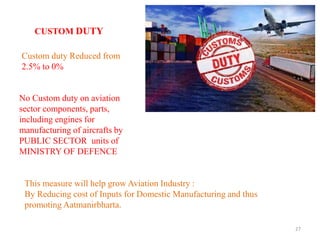
CUSTOM DUTY
Custom duty Reduced from
2.5% to 0%
No Custom duty on aviation
sector components, parts,
including engines for
manufacturing of aircrafts by
PUBLIC SECTOR units of
MINISTRY OF DEFENCE
This measure will help grow Aviation Industry :
By Reducing cost of Inputs for Domestic Manufacturing and thus
promoting Aatmanirbharta.
28
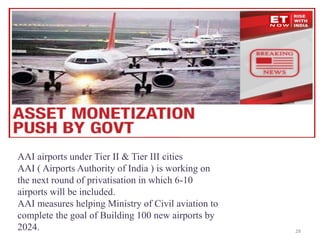
AAI airports under Tier II & Tier III cities
AAI ( Airports Authority of India ) is working on
the next round of privatisation in which 6-10
airports will be included.
AAI measures helping Ministry of Civil aviation to
complete the goal of Building 100 new airports by
2024.
4. Development of health system capacities at
airports under the Atma Nirbhar Swasth Bharat
Yojana.
Under this programme, PUBLIC HEALTH UNITS
will be strengthened at 32 airports.
This programme will ensure smooth flow of
Pharmaceuticals through air across india & also
other parts of the world.
5. Disinvestment and Strategic Sale.
Through 2021 budget govt has reiterated its
commitment of dis-investment of
1. Air India
2. Pawanhans.
30
6. Expansion of scope for Krishi Udaan in convergence
with Operation Greens
Krishi Udaan scheme stands converged with operation greens Through air
Freight Subsidy of 50% for the Agri-Perishables of North Eastern States & 4
Himalayan States /UT’s.
This will Improve Air Cargo Transportation from these states.
31
THANK YOU…

Airlines industry

  • 1.
    Business Environment Airlines Industry DEPARTMENTOF COMMERCE MASTER OF BUSINESS ADMINISTRATION UNIVERSITY COLLEGE OF COMMERCE AND BUSINESS MANAGEMENT KAKATIYA UNIVERSITY 2020 - 2022 1
  • 2.
    HALL TICKET NONAME PAGE No. 21564C1009 Thatikonda Harika 3-4 21564C1021 Barla Navya 7-8 21564C1025 V Umamaheshwar Goud 13-14 21564C1029 S Shiva prasad 15-16 21564C1118 Rasa Vijaysagar 10-12 21564C1121 Ande Rahul 21-22 21564C1125 R Nikthisha 23-24 21564C1127 K Saimurali Manohar 19-20 21564C1134 K Saiteja 9 21564C1149 G Srinath 5-6 21564C1151 Rakesh Davera 25-30 21564C1153 Ch.Divya 17-18 Airlines Industry 2
  • 3.
    Introduction 3 DEF: AIRLINE isan Industry that provides both domestic & International air transport services for travelling passengers and also freight. Currently Airline Industry is preferred over other means of Transport, due to its Effective & Efficient Operations. Airlines utilize air crafts to supply the services and may form partnership or alliances with other airlines for code share agreements in which they both offer and operate the same flight. Once upon a time people were started to travel by foot, then to cross the oceans they built ships, many years later airlines were innovated. Airlines were using for the transportation of men and material. 2.5 Billion passengers worldwide. 5.5 Million airline employees. 18 Million indirect tourism jobs. Currently airline industry operates around 5000 services around the globe.
  • 4.
    4 • The Aviationsector in India currently contributes $72 bn to GDP. •India has 464 airports and airstrips, of which 125 airports are owned by Airport Authority of India (AAI). •These 125 AAI airports manage close to 78% of domestic passenger traffic and 22% of international passenger traffic.
  • 5.
    Continued…. The different typesof airlines are passenger airlines and Cargo airlines  In India on 17th February 1911 an airlines from Allahabad to Naini station it covers 10KM in 13minutes this flight was not a passenger flight it was actually a Cargo(Mail) flight it carries 650 post cards and few letters  First airport – 1924 (Allahabad, Mumbai, Calcutta)  Civil aviation department (1927) by British Govt. in India 1st international passenger flight to India (London to Karachi) in 1929 by imperial airways(British airlines),London. First flying school of India (1929) was Aero club of India, Burma. 5
  • 6.
    Continued… •In India 1stairlines was Tata airlines by JRD Tata (1932) •Later 1948 Tata airlines was merged with Govt. of India as Air India . •1st single engine de Havilland(Canada) ,carrying air mail from karachi’s drigh road aero drome to Bombay juhu aero drome and later continued to Madras •In India the 1st domestic flight which was from Mumbai to Trivandrum by Tata airlines cost of 250Rs/- at 1932 •Malabar princess(Air India) 1st Indian flight from Bombay to London of cost 1720Rs/-. •In India 39 airlines operating (Scheduled, Regional, Chartered, Cargo) 6
  • 7.
    4P’s Product: Air India isone of the leading airlines in India providing international and domestic travel. Air India provides only passenger transport services; thus, it is committed to provide the best possible services to its customers. Air India passenger fleet primarily consists of airplanes from Boeing and Airbus. Price: Air India is a leading airline player in India with a pricing strategy based on competition and sectors it covers. Air India prices airline tickets such that it is easily accessible to middle class families. Quality of service is something that they do not compromise with the basic technique. 7
  • 8.
    4P’s Place:  Air Indiahas its presence in all cities in India. Air India has flights connecting India with major cities and business headquarters across the world.  They have also tied up with various agencies to sell their tickets, thus increasing their service base and capabilities. Promotion:  Air India has tied up with various travel agencies like Yatra.com, goibibo.com, etc..,  By promoting their tagline “Air India… Truly India.” Air India has leveraged huge gains by being able to promote their brand.  Amadeus is a short term promotional strategy which Air India implements 8
  • 9.
    4C’s 9 Consumer wants andneeds: It is the focus on being product led to companies making things customer didn’t want. Cost to satisfy: It is the basis that price was irrelevant. Consider all costs involved in satisfying your customers including cost than customers themselves will have to incur to satisfy their needs. Convenience to buy: Convenience to buy is noting but how and where does the customer want to purchase. Communication : It is all the interactions between the organization and customer communication was that it should be about dialogue, a two-way conversation, between company and customer.
  • 10.
    10 Airport authority ofIndia manages total 125 airports in the country. Out of which 11 are international airports, 94 domestic airports, 28 civil enclaves. Main hubs of Indian airways was Chhatrapathi shivaji international airport and Indira Gandhi international airport(Delhi). “UDAN” letting common people to fly. India as emerged as 3rd largest domestic aviation market in the world. In our country international airports offering joint venture.
  • 11.
     Indian airlineswas under the administration of Ministry of Civil aviation (Hardeep Singh Puri).  Annual budget of Indian airlines was around 6,602.86 Cr.  Greenfield airport are getting developed at Kochi, Hyderabad, Bangalore.  100% foreign equity also allowed for construction and maintenance.  The Directorate General of Civil Aviation is a regulatory body in the field of civil aviation, Primarily deals with safety issues. 11
  • 12.
    Leading Airlines Air India Qatarairways Flydubai Emarites Eithad IngiGo Spicejet Delta Singapore airlines Pakisthan international airways(PIA) British airways Airblue Vistara Airchina lufthansa 12
  • 13.
    IndiGo HQ : Gurugram,Haryana. Destinations: International : 24 Domestic : 63 Market share: 54.2% Daily flights: 1500 Founder: Rahul Bhatia and Rakesh gangawalon Type: Private IATA code: 6E Service type: Low cost carrier 1st Flight: NCT to Imphal, Dubai to NCT Slogan: Go Indigo 13
  • 14.
    Air India HQ :Airlines House, Delhi. Destinations: International : 45 Domestic : 57 Market share: 18.6% Flights: 610 Founder: J.R.D Tata Type: Govt. of India IATA code: AI Service type: Full Service Model 1st Flight: Karachi to Bombay (15th Oct 1932) Slogan: Your palace in the sky 14
  • 15.
    Air China Country :China HQ : Beijing,China Destinations: 201 Market share: 53.46% Flights: 448 CEO: Cai Jianjiang Type: Govt. of China IATA code: CA Revenue: 136,180,690 Assets 294,206,373 15
  • 16.
    Emirates Country : Dubai HQ: Jarhoud, Dubai,UAE Destinations: 157 Market share: 40.5% Flights: 448 Founder : Maurice Flanagan Type: Govt. of Dubai IATA Code: EK ICAO Code UAE Revenue: 25.1B USD Operation date: 25th MARCH 1985 16
  • 17.
    Strength Weakness  Highincome  Safe and speedy  Continued Growth  Growing tourism industry  Time saving  Slow rate of infrastructure  High spoilage rate  Huge investment  Competitive market  Huge workforce 17 SWOT analysis
  • 18.
    Opportunities Threats  Invitingnew stakeholders  Worldwide mailing services  Use technology to minimize cost  Market expansion  Better deals with supplier  Timely service  Global economic crisis  Government interventions  Environment threats  Seasonal threats  Pandemic 18 SWOT analysis
  • 19.
    Political Economical  Opensky policies  Terrorism fear  Tension with neighboring countries  Airport slot  Increase in demand as world economy grows  Rising cost of fuel  High operation costs due to low demand  Growth of the middle income group family affects the aviation sector. 19 PEST analysis
  • 20.
    Social Technology  Employment opportunities Varied income group  Ageing Population  Fear of air flying  Satellite based navigation system  Online ticketing  Growth of E-commerce and ticketing  Web checkin 20 PEST analysis
  • 21.
     Liberalization –Private players  Open sky  Direct import of ATF – Regulation  FDI – Domestic service sector  Airports control – AAI  Greenfield Airports 21 Airlines During NCoV-19 •Jobs in aviation industry to reduced to 41.7M from 46M. •Nearly 39,200 special repatriation flights took nearly 5.4M citizens home after borders closed in march 2020. •Nearly 46,400 special cargo flights transported 1.5Mt of cargo, mostly medical equipment, to areas in need during the height of pandemic response.
  • 22.
     Private carrierspermitted to operate scheduled services  Entry of low cost carriers  City side development of non metro airports  Allowing Indian carriers to compete on internatioal routes  Reducing in landing charges.  Fleet expansion plans of Air India.  Restructuring of Delhi and Mumbai airport and development of Greenfield airports at Bangalore and Hyderabad undertaken. 22
  • 23.
    National Civil Aviationpolicy of India 23  Vision: To create an Eco-System to make flying affordable for the masses and to enable 30 crore domestic ticketing by 2022 and 50 crore by 2027, and international ticketing to increase to 20 crore by 2027. Similarly, Cargo volumes should increase to 10 million tonnes by 2027.  Mission: Provide safe, secure, affordable and sustainable air travel for passengers and air transportation of cargo with access to various parts of India and the World.
  • 24.
    National Civil Aviationpolicy of India 24 Objectives:  Establish an integrated eco-system which will lead to significant growth of civil aviation sector, which in turn would promote tourism, increase employment and lead to a balanced regional growth.  Ensure safety, security and sustainability of aviation sector through the use of technology and effective monitoring.  Enhance regional connectivity through fiscal support and infrastructure development.  Enhance ease of doing business through deregulation, simplified procedures and e-governance.  Promote the entire aviation sector chain in a harmonized manner covering cargo, MRO, general aviation, aerospace manufacturing and skill development.
  • 25.
    25 1.Tax incentives foraircraft leasing and financing. 2. Custom duty benefit. 3. Asset Monetisation through PPP model. 4. Development of health system capacities at airports under the Atma Nirbhar Swasth Bharat Yojana. 5. Disinvestment and Strategic Sale. 6. Expansion of scope for Krishi Udaan in convergence with Operation Greens
  • 26.
    26 Ministry of CivilAviation Union Budget 2021: Major Highlights for The Aviation Industry Budget Proposes More Tax Incentives for Aircraft Govt Committed to make (IFSC) a global Financial HUB in GIFT city. IFSC: International Financial Services Centre. GIFT : Gujarat International Financial Tech. Additional Incentives : 2021-2022 1. Tax Holiday For Capital Gains income ( of Aircraft Leasing & Financing Company). (If a company gets Capital gains income through its operations like Leasing/financing, simply NO Tax.) 2. Tax Exemptions for Aircraft Lease rentals or Royalty paid to Foreign lessor. (If a company paying something to Foreign lessor, such company can claim back such payment) 3.Tax incentive for relocation of foreign funds in IFSC 4.Tax Exemptions to Investment division of Foreign Banks ( located in IFSC) Tax Exemptions major Boost to Foreign Lessors operating from IFSC These measures were out of series of initiatives Undertaken by MINISTRY OF CIVILAVIATION since 2019.
  • 27.
    27 CUSTOM DUTY Custom dutyReduced from 2.5% to 0% No Custom duty on aviation sector components, parts, including engines for manufacturing of aircrafts by PUBLIC SECTOR units of MINISTRY OF DEFENCE This measure will help grow Aviation Industry : By Reducing cost of Inputs for Domestic Manufacturing and thus promoting Aatmanirbharta.
  • 28.
    28 AAI airports underTier II & Tier III cities AAI ( Airports Authority of India ) is working on the next round of privatisation in which 6-10 airports will be included. AAI measures helping Ministry of Civil aviation to complete the goal of Building 100 new airports by 2024.
  • 29.
    4. Development ofhealth system capacities at airports under the Atma Nirbhar Swasth Bharat Yojana. Under this programme, PUBLIC HEALTH UNITS will be strengthened at 32 airports. This programme will ensure smooth flow of Pharmaceuticals through air across india & also other parts of the world. 5. Disinvestment and Strategic Sale. Through 2021 budget govt has reiterated its commitment of dis-investment of 1. Air India 2. Pawanhans.
  • 30.
    30 6. Expansion ofscope for Krishi Udaan in convergence with Operation Greens Krishi Udaan scheme stands converged with operation greens Through air Freight Subsidy of 50% for the Agri-Perishables of North Eastern States & 4 Himalayan States /UT’s. This will Improve Air Cargo Transportation from these states.
  • 31.