AVIATION SECTOR
OUTLINES
 Current Scenario of Indian Aviation industry
 Market Size
 Air Traffic
 Type of market
 Airport Infrastructure
 Aviation Policy
 Effect on Indian Economy
 Factors influencing growth rate
 Aviation Sector Outlook
Current Scenario of Indian Aviation
                Industry
 India completed 100 years in aviation sector on 18 February,
  2011
 The Indian Aviation Industry is one of the fastest growing
  aviation industries in the world
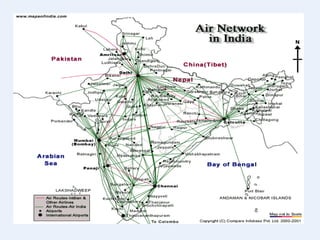
 454 airports and airstrips; 16 designated international airports
 With the liberalization of the Indian aviation sector aviation
  industry has undergone rapid transformation
 Being primarily a government-owned industry, Indian aviation
  now dominated by privately owned full-service airlines and low
  cost carriers
 Private airlines account for around 75% share of domestic
  airline aviation market
 Airline business growing at 27% per annum: Ministry of Civil
  Aviation
Market Size
 India is currently the ninth largest aviation market in
  the world
 India's domestic air traffic grew at a rate, which is the
  second highest after Brazil according to global figures
  for June 2011, compiled by IATA
 Domestic traffic growth 25-30% annually and
  international traffic 15% in 2010 :CAPA
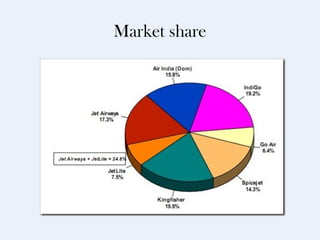
Domestic Airlines
   Air India
   Go Air Airlines
   Indigo Airlines
   Jagson Airline
   Jet Airways
   JetLite
   Kingfisher Airline
   Paramount Airways
   Spice Jet Airways
   MDLR Airlines
Market share
Air Traffic
 The country's domestic traffic grew by 14 per
 Strong domestic passenger growth rate of 22.3 per cent
  in July 2011
 Passenger traffic has grown at 18 per cent year on year
  (y-o-y) basis and the year 2010 closed at 90 million
  passengers both domestic and international
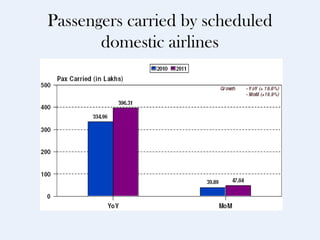
 In July 2011, airlines in India handled 5 million
  domestic passengers, according to data released by the
  Directorate General Civil Aviation (DGCA) on 12
  September 2011, marking the 11th consecutive month
  of double-digit growth
Passengers carried by scheduled
       domestic airlines
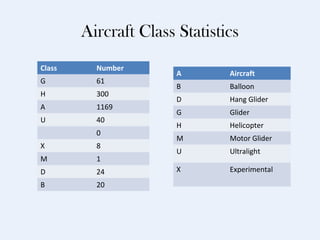
Aircraft Class Statistics
Class     Number
                       A       Aircraft
G         61
                       B       Balloon
H         300
                       D       Hang Glider
A         1169
                       G       Glider
U         40
                       H       Helicopter
          0
                       M       Motor Glider
X         8
                       U       Ultralight
M         1
D         24           X       Experimental
B         20
Aviation Sector: Some facts
 In present scenario around 11 domestic airlines
  operating in India
 Growth of airlines traffic in Aviation Industry in
  India is almost four times above international
  average
 Aviation Industry in India holds around 69% of
  the total share of the airlines traffic in the region
  of South Asia
Type of market
 In 1953, all airlines merged into Indian Airlines or Air
  India
 Monopoly perpetuated for next 40 years
 Controlled by Directorate General of Civil Aviation
 On 1 March 1994, Government open the gates for
  private entrants
 Sensing a huge opportunity, a large number of players
  jumped into the fray
 Now the market is Oligopoly
Airport Infrastructure
 Of the 454 airports and airstrips in India, 16 are
  designated international airports
 97 airports owned and operated by Airport Authority of
  India (AAI)
 India’s Civil Aviation Ministry aims 500 operational
  airports in next 12 years as per report by CAPA
 Government aims to attract private investment in Aviation
  Infrastructure
 Mumbai and Delhi airports already privatized, upgraded
  at an estimate investment of US$ 4 billion over 2006-1 6
Continued…
 A Greenfield airport already operational at Bangalore
  and Hyderabad, built by private consortia at total
  investment of over US$ 800 million
 A second Greenfield airport planned at Navi Mumbai,
  developed using public-private partnership mode at an
  estimated cost of US$ 2.5billion
 35 other city airports proposed to be upgraded
 Over next five years, AAI planned massive investment of
  US$ 3.7 billion – 43% of which for Kolkata, Chennai
  and Trivandrum and rest for other non metro airports
Aviation Policies
Many policies supporting the infrastructure are now
 in place
 For Greenfield airports, FDI up to 100% permitted
  through automatic approvals
 For existing airports, FDI up to 74% permitted
  through special permission from FIPB
 Private developers allowed to set up captive airstrips
  and general airports 150 km away from existing
  airports
 100% tax exemption for airport projects for a period of
  10 years
Continued…
 49% FDI permissible under automatic route, but not
  by foreign airline companies. 100% equity ownership
  by non-resident Indians (NRI’s) is permitted
 74% FDI permissible in cargo and non- scheduled
  airlines
 The “Open Sky” policy of the Government and rapid
  air traffic growth, resulted in the entry of several new
  privately owned airlines and increased frequency/flights
  for international airlines
How aviation industry is effecting
India’s economy?
Earlier there were just two airlines, both state owned. In last
  few years economy has opened up. India experienced
  growth rate of 8% per year
Main factors which effect the Indian Economy are:
1. Increased no. of domestic airlines
2. Low cost airlines
3. India’s improving economy
Other factors:
1. Increased in no. of business travelers to different
   countries
2. Increased no. of incoming tourist and business
   enterprises
Known factors Influencing Growth Rate
 Increase inward and outward tourism
 Increased competition driven down prices and margins
 Additional purchasing power due to rapidly rising real
  income amongst the middle class
 Increased business trade due to rapidly growing
  economy and free trade agreements with neighboring
  countries
 Favorable Government policies and tax reforms
Aviation Sector Outlook
As per the Investment Commission of India, aviation sector is likely
  to boom further in the coming years, attracting huge investment
 Passenger traffic is projected to grow at a compound annual
  growth rate (CAGR) of over 15% in next 5 years
 The vision 2020 statement announced by Ministry of Civil
  Aviation, envisages creating infrastructure to handle 280 million
  passengers by 2020
 Investment opportunities of US$ 110 billion envisaged up to
  2020, with 80 billion in new aircraft and US$ 30 billion in
  development of infrastructure
 Air cargo traffic to grow at over 11.4% p.a. over next 5 years

Aviation sector

  • 1.
  • 2.
    OUTLINES  Current Scenarioof Indian Aviation industry  Market Size  Air Traffic  Type of market  Airport Infrastructure  Aviation Policy  Effect on Indian Economy  Factors influencing growth rate  Aviation Sector Outlook
  • 3.
    Current Scenario ofIndian Aviation Industry  India completed 100 years in aviation sector on 18 February, 2011  The Indian Aviation Industry is one of the fastest growing aviation industries in the world  454 airports and airstrips; 16 designated international airports  With the liberalization of the Indian aviation sector aviation industry has undergone rapid transformation  Being primarily a government-owned industry, Indian aviation now dominated by privately owned full-service airlines and low cost carriers  Private airlines account for around 75% share of domestic airline aviation market  Airline business growing at 27% per annum: Ministry of Civil Aviation
  • 4.
    Market Size  Indiais currently the ninth largest aviation market in the world  India's domestic air traffic grew at a rate, which is the second highest after Brazil according to global figures for June 2011, compiled by IATA  Domestic traffic growth 25-30% annually and international traffic 15% in 2010 :CAPA
  • 5.
    Domestic Airlines  Air India  Go Air Airlines  Indigo Airlines  Jagson Airline  Jet Airways  JetLite  Kingfisher Airline  Paramount Airways  Spice Jet Airways  MDLR Airlines
  • 6.
  • 7.
    Air Traffic  Thecountry's domestic traffic grew by 14 per  Strong domestic passenger growth rate of 22.3 per cent in July 2011  Passenger traffic has grown at 18 per cent year on year (y-o-y) basis and the year 2010 closed at 90 million passengers both domestic and international  In July 2011, airlines in India handled 5 million domestic passengers, according to data released by the Directorate General Civil Aviation (DGCA) on 12 September 2011, marking the 11th consecutive month of double-digit growth
  • 8.
    Passengers carried byscheduled domestic airlines
  • 9.
    Aircraft Class Statistics Class Number A Aircraft G 61 B Balloon H 300 D Hang Glider A 1169 G Glider U 40 H Helicopter 0 M Motor Glider X 8 U Ultralight M 1 D 24 X Experimental B 20
  • 10.
    Aviation Sector: Somefacts  In present scenario around 11 domestic airlines operating in India  Growth of airlines traffic in Aviation Industry in India is almost four times above international average  Aviation Industry in India holds around 69% of the total share of the airlines traffic in the region of South Asia
  • 11.
    Type of market In 1953, all airlines merged into Indian Airlines or Air India  Monopoly perpetuated for next 40 years  Controlled by Directorate General of Civil Aviation  On 1 March 1994, Government open the gates for private entrants  Sensing a huge opportunity, a large number of players jumped into the fray  Now the market is Oligopoly
  • 12.
    Airport Infrastructure  Ofthe 454 airports and airstrips in India, 16 are designated international airports  97 airports owned and operated by Airport Authority of India (AAI)  India’s Civil Aviation Ministry aims 500 operational airports in next 12 years as per report by CAPA  Government aims to attract private investment in Aviation Infrastructure  Mumbai and Delhi airports already privatized, upgraded at an estimate investment of US$ 4 billion over 2006-1 6
  • 13.
    Continued…  A Greenfieldairport already operational at Bangalore and Hyderabad, built by private consortia at total investment of over US$ 800 million  A second Greenfield airport planned at Navi Mumbai, developed using public-private partnership mode at an estimated cost of US$ 2.5billion  35 other city airports proposed to be upgraded  Over next five years, AAI planned massive investment of US$ 3.7 billion – 43% of which for Kolkata, Chennai and Trivandrum and rest for other non metro airports
  • 14.
    Aviation Policies Many policiessupporting the infrastructure are now in place  For Greenfield airports, FDI up to 100% permitted through automatic approvals  For existing airports, FDI up to 74% permitted through special permission from FIPB  Private developers allowed to set up captive airstrips and general airports 150 km away from existing airports  100% tax exemption for airport projects for a period of 10 years
  • 15.
    Continued…  49% FDIpermissible under automatic route, but not by foreign airline companies. 100% equity ownership by non-resident Indians (NRI’s) is permitted  74% FDI permissible in cargo and non- scheduled airlines  The “Open Sky” policy of the Government and rapid air traffic growth, resulted in the entry of several new privately owned airlines and increased frequency/flights for international airlines
  • 17.
    How aviation industryis effecting India’s economy? Earlier there were just two airlines, both state owned. In last few years economy has opened up. India experienced growth rate of 8% per year Main factors which effect the Indian Economy are: 1. Increased no. of domestic airlines 2. Low cost airlines 3. India’s improving economy Other factors: 1. Increased in no. of business travelers to different countries 2. Increased no. of incoming tourist and business enterprises
  • 18.
    Known factors InfluencingGrowth Rate  Increase inward and outward tourism  Increased competition driven down prices and margins  Additional purchasing power due to rapidly rising real income amongst the middle class  Increased business trade due to rapidly growing economy and free trade agreements with neighboring countries  Favorable Government policies and tax reforms
  • 19.
    Aviation Sector Outlook Asper the Investment Commission of India, aviation sector is likely to boom further in the coming years, attracting huge investment  Passenger traffic is projected to grow at a compound annual growth rate (CAGR) of over 15% in next 5 years  The vision 2020 statement announced by Ministry of Civil Aviation, envisages creating infrastructure to handle 280 million passengers by 2020  Investment opportunities of US$ 110 billion envisaged up to 2020, with 80 billion in new aircraft and US$ 30 billion in development of infrastructure  Air cargo traffic to grow at over 11.4% p.a. over next 5 years