TOPIC
Airline
Industry
TEAM LEADER
Ram Mohan Reddy . R
TEAM MEMBERS:
 Vineeth
 Prathyusha
 Sravanthi
 Nagaraju
 Kavya
 Manisha
 Bhanu
 Sai Priya
 Soumya
TOPIC OF VINEETH
Introduction
 once upon a time people were started to
travel by foot, then to cross the oceans
they build ships, after the train is
innovated.after few years airlines are
innovated.
DEFINATION
 Airline industry is a system of
transportation
 Moving people and goods
 One of the true global
Business Types of airlines
 Passenger airlines
 Cargo airlines
 Super cargo airlines
ECONOMIC
2.5 billion passengers worldwide
5.5 million airlines employes
18 million indirect tourism jobs.
On Jan 1st 1914 the st .Peterbrug
became the world's first
scheduled passenger airline
service
There are around 5000 airlines in
the world.
TOPIC OF PRATHYUSHA
4 P’s
PRODUCT
 Air India is one of the leading airlines in India
providing international and domestic travel.
 Air India provides only passenger transport
services; thus, it is committed to provide the
best possible services to its customers.
 Air India passenger fleet primarily consists of
aeroplanes from Boeing and Airbus.
PRICE
 Air India is a leading airline player in India
with a pricing strategy based on competition
and sectors it covers.
 Air India prices airline tickets such that it is
easily accessible to middle class families.
 Quality of service is something that they do
not compromise with the basic technique
PLACE
 Air India has its presence in all cities in India. Air India
has flights connecting India with major cities and
business headquarters across the world.
 They have also tied up with various agencies to sell their
tickets, thus increasing their service base and
capabilities.
Promotion:
 Air India has tied up with various travel agencies like
yatra.com, goibibo.com, etc.
 By promoting their tagline “Air India…. Truly india.Air
India has leveraged huge gains by being able to
promote their brand bran.
 Amadeus, is a short term promotional strategy which Air
India implements.
TOPIC OF SRAVANTHI
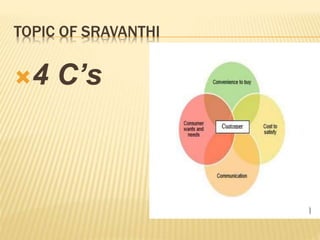
4 C’s
Consumer wants and needs’
It is the focus on being product-
led to companies making things
customers didn’t want.
Cost to satisfy’
It is the basis that price was
irrelevant. consider all costs
involved in satisfying your
customers including costs than
customers themselves will have
 Convenience to buy .
Convenience to buy is nothing but
how and where does the customer want
to purchase
Communication
It is all the interactions
between the organisation and customer
. communication was that it should be
about dialogue, a two-way conversation,
between company and customer​
TOPIC OF NAGARAJU
Major Players
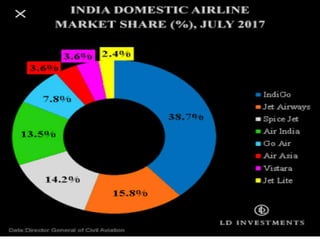
MAJOR PLAYERS IN AIR LINE INDUSTRY IN INDIA
 Indigo
 Jet airways
 Spice jet
 Air India
 Go Air
 Air Asia
 Vistara
 Jet Lite
TOPIC OF KAVYA
SWOT Analysis
SWOT ANALYSIS
STRENGTHS
Fastest transportation services
Heighly trained staff
Ticket pricing is on the hand of
players
Concentration on customers
satisfaction
Highly entry barriers to new player
WEAKNESS
High maintenance cost
Labour intensive industry
High wages paid to the staff
Directly dependent on some other
industry like tourism and
Corporate travelers
OPPORTUNITIES
 percentage of people travelling in airlines is
increasing gradually
 Increase percapita income
 Airlines can be used for cargo
 FDI's in Indian airline industry
 Threats
 Raising fuel costs Exchange rate fluctations,
Taxes imposed by the govt High competitive
industry because of large number of players.
TOPIC OF MANISHA
PEST Analysis
PEST ANALYSIS
POLITICAL
 Stable political environment
 Open skies
 Foreign ownership rules
ECONOMIC
 Global financial crisis
 Real household disposable
income
 Rising currency
SOCIAL
 Changing consumer demographic
 Increasing travel lifestyle
 Fluctuating consumer preferences
TECHNOLOGY
 Video conferencing
 Internet
 Surface transport investments
TOPIC OF BHANU
INDIAN SCENARIO OF AIRWAYS
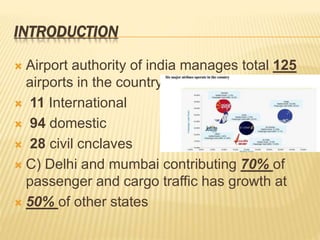
INTRODUCTION
 Airport authority of india manages total 125
airports in the country.
 11 International
 94 domestic
 28 civil cnclaves
 C) Delhi and mumbai contributing 70% of
passenger and cargo traffic has growth at
 50% of other states
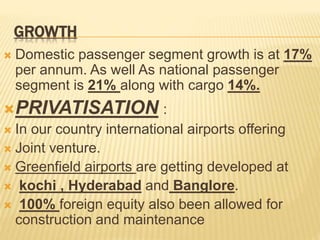
GROWTH
 Domestic passenger segment growth is at 17%
per annum. As well As national passenger
segment is 21% along with cargo 14%.
PRIVATISATION :
 In our country international airports offering
 Joint venture.
 Greenfield airports are getting developed at
 kochi , Hyderabad and Banglore.
 100% foreign equity also been allowed for
construction and maintenance
RESEARCH METHODOLOGY
 OJECTIVES:
 To find out challengers faced by
 Enterpreneurs
 (b) Data collection
 (c) research design
 MAJOR LOSS RESULTING FACTORS :
 a) Rising fuel prices
 b) High airport charges
 c) Huge competition faced by premium
GLOBAL SCENARIO OF AIRWAYS
 INTRODUCTION :
According to International Air Transport
Authority (IATA). There are various
process in
Aviation Industry related to passenger and
Cargo
GLOBAL SCENARIO :
 There are about 17,000 Airports operating
 Globally and providing Air Traffic service.
 These airports handling 3.7 billion
 Passengers per annum approx.
 Major airports concentrated in 3 regions i.e
North America , European , Asian Pacific.
In these regions contribute 92.0% of total
Air Traffic to world Economy.
These are known as “VOICE OF AIRPORTS.”
AIRPORTS COUNCIL INTERNATIONAL :
• Every individual of international airways
• Handling 30 million passengers per year.
• There are 1300 Air carriers in World.
• They are operating 18,000 Aircrafts over a
• Route of 15,000 kms serving 14,000 airports.
• Ratio of air cargo traffic proportions is 77:23 in
international air traffic.
This will increase in future
TOPIC OF SAI PRIYA
Market segmentation
WHAT IS MARKET SEGMENTATION
 Total market approach
Homogenous market
Single marketing mix
Segmented market approach
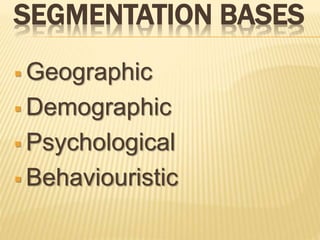
SEGMENTATION BASES
 Geographic
 Demographic
 Psychological
 Behaviouristic
TOPIC OF SOUMYA
Future out look
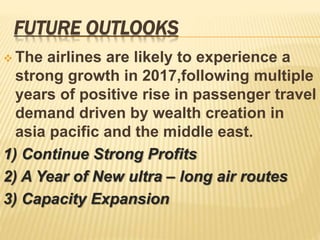
FUTURE OUTLOOKS
 The airlines are likely to experience a
strong growth in 2017,following multiple
years of positive rise in passenger travel
demand driven by wealth creation in
asia pacific and the middle east.
1) Continue Strong Profits
2) A Year of New ultra – long air routes
3) Capacity Expansion
CONCLUSION
o Due to this Assignment I got lots of
knowledge about the airline Industry
o In my assignment I have tried to present
various aspects of the airline industry
o This Assignment deals with the present
scenario in airline industry.
o I Thank MA’AM for giving me an
opportunity to present this assignment.
Thank you
Feedback

Air LINE Industry

  • 1.
  • 3.
  • 4.
    TEAM MEMBERS:  Vineeth Prathyusha  Sravanthi  Nagaraju  Kavya  Manisha  Bhanu  Sai Priya  Soumya
  • 5.
  • 6.
     once upona time people were started to travel by foot, then to cross the oceans they build ships, after the train is innovated.after few years airlines are innovated.
  • 7.
    DEFINATION  Airline industryis a system of transportation  Moving people and goods  One of the true global Business Types of airlines  Passenger airlines  Cargo airlines  Super cargo airlines
  • 8.
    ECONOMIC 2.5 billion passengersworldwide 5.5 million airlines employes 18 million indirect tourism jobs. On Jan 1st 1914 the st .Peterbrug became the world's first scheduled passenger airline service There are around 5000 airlines in the world.
  • 9.
  • 10.
    PRODUCT  Air Indiais one of the leading airlines in India providing international and domestic travel.  Air India provides only passenger transport services; thus, it is committed to provide the best possible services to its customers.  Air India passenger fleet primarily consists of aeroplanes from Boeing and Airbus.
  • 11.
    PRICE  Air Indiais a leading airline player in India with a pricing strategy based on competition and sectors it covers.  Air India prices airline tickets such that it is easily accessible to middle class families.  Quality of service is something that they do not compromise with the basic technique
  • 12.
    PLACE  Air Indiahas its presence in all cities in India. Air India has flights connecting India with major cities and business headquarters across the world.  They have also tied up with various agencies to sell their tickets, thus increasing their service base and capabilities. Promotion:  Air India has tied up with various travel agencies like yatra.com, goibibo.com, etc.  By promoting their tagline “Air India…. Truly india.Air India has leveraged huge gains by being able to promote their brand bran.  Amadeus, is a short term promotional strategy which Air India implements.
  • 13.
  • 14.
    Consumer wants andneeds’ It is the focus on being product- led to companies making things customers didn’t want. Cost to satisfy’ It is the basis that price was irrelevant. consider all costs involved in satisfying your customers including costs than customers themselves will have
  • 15.
     Convenience tobuy . Convenience to buy is nothing but how and where does the customer want to purchase Communication It is all the interactions between the organisation and customer . communication was that it should be about dialogue, a two-way conversation, between company and customer​
  • 16.
  • 17.
    MAJOR PLAYERS INAIR LINE INDUSTRY IN INDIA  Indigo  Jet airways  Spice jet  Air India  Go Air  Air Asia  Vistara  Jet Lite
  • 19.
  • 20.
    SWOT ANALYSIS STRENGTHS Fastest transportationservices Heighly trained staff Ticket pricing is on the hand of players Concentration on customers satisfaction Highly entry barriers to new player
  • 21.
    WEAKNESS High maintenance cost Labourintensive industry High wages paid to the staff Directly dependent on some other industry like tourism and Corporate travelers
  • 22.
    OPPORTUNITIES  percentage ofpeople travelling in airlines is increasing gradually  Increase percapita income  Airlines can be used for cargo  FDI's in Indian airline industry  Threats  Raising fuel costs Exchange rate fluctations, Taxes imposed by the govt High competitive industry because of large number of players.
  • 23.
  • 24.
    PEST ANALYSIS POLITICAL  Stablepolitical environment  Open skies  Foreign ownership rules
  • 25.
    ECONOMIC  Global financialcrisis  Real household disposable income  Rising currency
  • 26.
    SOCIAL  Changing consumerdemographic  Increasing travel lifestyle  Fluctuating consumer preferences TECHNOLOGY  Video conferencing  Internet  Surface transport investments
  • 27.
    TOPIC OF BHANU INDIANSCENARIO OF AIRWAYS
  • 28.
    INTRODUCTION  Airport authorityof india manages total 125 airports in the country.  11 International  94 domestic  28 civil cnclaves  C) Delhi and mumbai contributing 70% of passenger and cargo traffic has growth at  50% of other states
  • 29.
    GROWTH  Domestic passengersegment growth is at 17% per annum. As well As national passenger segment is 21% along with cargo 14%. PRIVATISATION :  In our country international airports offering  Joint venture.  Greenfield airports are getting developed at  kochi , Hyderabad and Banglore.  100% foreign equity also been allowed for construction and maintenance
  • 30.
    RESEARCH METHODOLOGY  OJECTIVES: To find out challengers faced by  Enterpreneurs  (b) Data collection  (c) research design  MAJOR LOSS RESULTING FACTORS :  a) Rising fuel prices  b) High airport charges  c) Huge competition faced by premium
  • 31.
    GLOBAL SCENARIO OFAIRWAYS  INTRODUCTION : According to International Air Transport Authority (IATA). There are various process in Aviation Industry related to passenger and Cargo
  • 32.
    GLOBAL SCENARIO : There are about 17,000 Airports operating  Globally and providing Air Traffic service.  These airports handling 3.7 billion  Passengers per annum approx.  Major airports concentrated in 3 regions i.e North America , European , Asian Pacific. In these regions contribute 92.0% of total Air Traffic to world Economy. These are known as “VOICE OF AIRPORTS.”
  • 33.
    AIRPORTS COUNCIL INTERNATIONAL: • Every individual of international airways • Handling 30 million passengers per year. • There are 1300 Air carriers in World. • They are operating 18,000 Aircrafts over a • Route of 15,000 kms serving 14,000 airports. • Ratio of air cargo traffic proportions is 77:23 in international air traffic. This will increase in future
  • 34.
    TOPIC OF SAIPRIYA Market segmentation
  • 35.
    WHAT IS MARKETSEGMENTATION  Total market approach Homogenous market Single marketing mix Segmented market approach
  • 36.
    SEGMENTATION BASES  Geographic Demographic  Psychological  Behaviouristic
  • 37.
  • 38.
    FUTURE OUTLOOKS  Theairlines are likely to experience a strong growth in 2017,following multiple years of positive rise in passenger travel demand driven by wealth creation in asia pacific and the middle east. 1) Continue Strong Profits 2) A Year of New ultra – long air routes 3) Capacity Expansion
  • 39.
    CONCLUSION o Due tothis Assignment I got lots of knowledge about the airline Industry o In my assignment I have tried to present various aspects of the airline industry o This Assignment deals with the present scenario in airline industry. o I Thank MA’AM for giving me an opportunity to present this assignment.
  • 40.
  • 41.