GAAP, Accounting
Standards and IFRS
SUBMITTED BY:
Sheetal Verma
What’s Accounting Standards?
 Accounting standard are written policy document issued by expert
accounting body or by government or other regulatory body.
 Accounting standards specify how transactions and other events are to
be recognized, measured, presented and disclosure in financial
statements.
 The institute of chartered accounting of india (ICAI), being a premier
accounting body in the country. It took upon itself the leadership role by
constituting the acounting standard board (ASB) in 1977.
What’s GAAP?
Why Organisation Use GAAP?
 Properly organize their financial information into accounting
records.
 Summarize the accounting records into financial statement.
 Anyone reading the financial statement of multiple companies
has a reasonable basis for comparision, since all companies
using GAAP have created their financial statement using the
same set of rules.
Importance of Accounting
Standards
 Protecting Investors : By employing accounting standards, investors’ interests are ensured
as the documents they review are definitely accurate and genuine. Accounting standards
increase the investors’ confidence in the business.
 Regulatory Compliance : Government regulators set accounting standards that have to be
followed to by all companies. This is both beneficial to the investor or business owner as
well as to the customers or clients because it protects them from frauds in businesses.
 Assessing Business Performance : The use of accounting standards will enable a business
to see or assess its performance. By doing so, they can also compare and contrast their
business’ performance with other companies or competitors. It further helps a business
see its strengths and weaknesses. By also comparing past and current performances, a
business can assess the success of its strategies.
Importance of GAAP
 GAAP is based on certain principles. They dictate to the accountants what
items should be recognized in the financial statements, which amounts
should be reported, how these items and amounts should be displayed,
and what disclosures are important to the readers of the financial
statements.
 When policy makers have to decide on monetary policy and government
budgeting, GAAP reporting helps them with all the data they need.
 It breaks down complex financial numbers and makes it easily
understandable for lenders, donors, and other stakeholders.
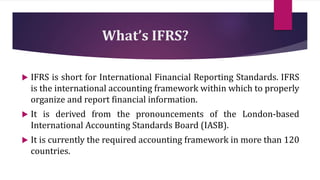
What’s IFRS?
 IFRS is short for International Financial Reporting Standards. IFRS
is the international accounting framework within which to properly
organize and report financial information.
 It is derived from the pronouncements of the London-based
International Accounting Standards Board (IASB).
 It is currently the required accounting framework in more than 120
countries.
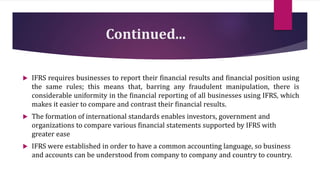
Continued...
 IFRS requires businesses to report their financial results and financial position using
the same rules; this means that, barring any fraudulent manipulation, there is
considerable uniformity in the financial reporting of all businesses using IFRS, which
makes it easier to compare and contrast their financial results.
 The formation of international standards enables investors, government and
organizations to compare various financial statements supported by IFRS with
greater ease
 IFRS were established in order to have a common accounting language, so business
and accounts can be understood from company to company and country to country.
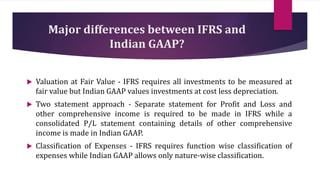
Major differences between IFRS and
Indian GAAP?
 Valuation at Fair Value - IFRS requires all investments to be measured at
fair value but Indian GAAP values investments at cost less depreciation.
 Two statement approach - Separate statement for Profit and Loss and
other comprehensive income is required to be made in IFRS while a
consolidated P/L statement containing details of other comprehensive
income is made in Indian GAAP.
 Classification of Expenses - IFRS requires function wise classification of
expenses while Indian GAAP allows only nature-wise classification.
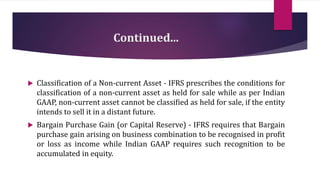
Continued...
 Classification of a Non-current Asset - IFRS prescribes the conditions for
classification of a non-current asset as held for sale while as per Indian
GAAP, non-current asset cannot be classified as held for sale, if the entity
intends to sell it in a distant future.
 Bargain Purchase Gain (or Capital Reserve) - IFRS requires that Bargain
purchase gain arising on business combination to be recognised in profit
or loss as income while Indian GAAP requires such recognition to be
accumulated in equity.
Why moving towards IFRS?
 Reduce cost of preparing the financial statements using different sets of
accounting standards.
 To develop better understanding of financial statements worldwide which
increase the confidence among the people as investors from the whole
world
 Adoption of IFRS will result in high quality, transparent and comparable
financial statements that are based on modern accounting principles and
concepts that are being applied in global markets.
Continued...
 If a company uses IFRS, the company could enjoy the benefit of raising
capital from abroad.
 Comparison is made easier with a foreign competitor if a company
presents its financial statement according to IFRS.
 The adoption of IFRS will improve cross border investment by enhancing
comparability of financial statements prepared anywhere in the world.
 For National Regulatory Bodies: It brings about a higher and improved
standard of financial disclosure. It also brings about better ability to attract
and monitor listings by foreign companies.
Thank You…

GAAP, Accounting Standards and IFRS

  • 1.
    GAAP, Accounting Standards andIFRS SUBMITTED BY: Sheetal Verma
  • 2.
    What’s Accounting Standards? Accounting standard are written policy document issued by expert accounting body or by government or other regulatory body.  Accounting standards specify how transactions and other events are to be recognized, measured, presented and disclosure in financial statements.  The institute of chartered accounting of india (ICAI), being a premier accounting body in the country. It took upon itself the leadership role by constituting the acounting standard board (ASB) in 1977.
  • 3.
  • 4.
    Why Organisation UseGAAP?  Properly organize their financial information into accounting records.  Summarize the accounting records into financial statement.  Anyone reading the financial statement of multiple companies has a reasonable basis for comparision, since all companies using GAAP have created their financial statement using the same set of rules.
  • 5.
    Importance of Accounting Standards Protecting Investors : By employing accounting standards, investors’ interests are ensured as the documents they review are definitely accurate and genuine. Accounting standards increase the investors’ confidence in the business.  Regulatory Compliance : Government regulators set accounting standards that have to be followed to by all companies. This is both beneficial to the investor or business owner as well as to the customers or clients because it protects them from frauds in businesses.  Assessing Business Performance : The use of accounting standards will enable a business to see or assess its performance. By doing so, they can also compare and contrast their business’ performance with other companies or competitors. It further helps a business see its strengths and weaknesses. By also comparing past and current performances, a business can assess the success of its strategies.
  • 6.
    Importance of GAAP GAAP is based on certain principles. They dictate to the accountants what items should be recognized in the financial statements, which amounts should be reported, how these items and amounts should be displayed, and what disclosures are important to the readers of the financial statements.  When policy makers have to decide on monetary policy and government budgeting, GAAP reporting helps them with all the data they need.  It breaks down complex financial numbers and makes it easily understandable for lenders, donors, and other stakeholders.
  • 7.
    What’s IFRS?  IFRSis short for International Financial Reporting Standards. IFRS is the international accounting framework within which to properly organize and report financial information.  It is derived from the pronouncements of the London-based International Accounting Standards Board (IASB).  It is currently the required accounting framework in more than 120 countries.
  • 8.
    Continued...  IFRS requiresbusinesses to report their financial results and financial position using the same rules; this means that, barring any fraudulent manipulation, there is considerable uniformity in the financial reporting of all businesses using IFRS, which makes it easier to compare and contrast their financial results.  The formation of international standards enables investors, government and organizations to compare various financial statements supported by IFRS with greater ease  IFRS were established in order to have a common accounting language, so business and accounts can be understood from company to company and country to country.
  • 9.
    Major differences betweenIFRS and Indian GAAP?  Valuation at Fair Value - IFRS requires all investments to be measured at fair value but Indian GAAP values investments at cost less depreciation.  Two statement approach - Separate statement for Profit and Loss and other comprehensive income is required to be made in IFRS while a consolidated P/L statement containing details of other comprehensive income is made in Indian GAAP.  Classification of Expenses - IFRS requires function wise classification of expenses while Indian GAAP allows only nature-wise classification.
  • 10.
    Continued...  Classification ofa Non-current Asset - IFRS prescribes the conditions for classification of a non-current asset as held for sale while as per Indian GAAP, non-current asset cannot be classified as held for sale, if the entity intends to sell it in a distant future.  Bargain Purchase Gain (or Capital Reserve) - IFRS requires that Bargain purchase gain arising on business combination to be recognised in profit or loss as income while Indian GAAP requires such recognition to be accumulated in equity.
  • 11.
    Why moving towardsIFRS?  Reduce cost of preparing the financial statements using different sets of accounting standards.  To develop better understanding of financial statements worldwide which increase the confidence among the people as investors from the whole world  Adoption of IFRS will result in high quality, transparent and comparable financial statements that are based on modern accounting principles and concepts that are being applied in global markets.
  • 12.
    Continued...  If acompany uses IFRS, the company could enjoy the benefit of raising capital from abroad.  Comparison is made easier with a foreign competitor if a company presents its financial statement according to IFRS.  The adoption of IFRS will improve cross border investment by enhancing comparability of financial statements prepared anywhere in the world.  For National Regulatory Bodies: It brings about a higher and improved standard of financial disclosure. It also brings about better ability to attract and monitor listings by foreign companies.
  • 13.