WELCOME
INTERNATIONAL FINANCIAL  REPORTING STANDARDS (I F R S) INTRODUCTION TO
WHY IFRS ? A single set of accounting standards would enable internationally to standardize training and assure better quality on a global screen, it would also permit international capital to flow more freely, enabling companies to develop consistent global practices on accounting problems. It would be beneficial to regulators too, as a complexity associated with needing to understand various reporting regimes  would be reduced.
OBJECTIVES OF IFRS to develop , in the public interest, a single set of high quality, understandable and enforceable  global accounting standards  that require high quality, transparent and comparable information in financial statements and other financial reporting to help participants in the world's capital markets and other users make economic decisions; to  promote  the use   and rigorous application  of those standards; in fulfilling the objectives associated with (1) and (2 ),  to take account of ,  as appropriate, the special needs of  small and medium-sized entities  and emerging economies. to bring  about convergence  of national accounting standards and International Accounting standards and IFRS to high quality solutions.
SCOPE OF IFRS IASB Standards are  known as  International Financial Reporting Standards (IFRSs). All International Accounting Standards (IASs) and Interpretations issued by the former IASC (International Accounting Standard Committee)  and SIC (Standard Interpretation Committee)  continue to be  applicable  unless and until they are amended or withdrawn.  IFRSs  apply to  the general purpose financial statements and other financial reporting by  profit-oriented entities  -- those engaged in commercial, industrial, financial, and similar activities, regardless of their legal form.  Entities  other than profit-oriented business entities  may also find IFRSs appropriate.
SCOPE OF IFRS General purpose financial statements  are intended to meet the common needs of shareholders, creditors, employees, and the public at large for information about an entity's financial position, performance, and cash flows.  6. Other financial reporting includes  information provided outside financial statements that assists in the interpretation of a complete set of financial statements or improves users' ability to make efficient economic decisions.  7. IFRS  apply to  individual company and consolidated financial statements. 8. A complete set of  financial statements includes  a balance sheet, an income statement, a cash flow statement, a statement showing either all changes in equity or changes in equity other than those arising from investments by and distributions to owners, a summary of accounting policies, and explanatory notes.
SCOPE OF IFRS 9. If an IFRS allows both a  'benchmark' and an 'allowed alternative ' treatment , financial statements may be described as conforming to IFRS whichever treatment is followed.  10. In developing Standards, IASB intends  not to permit choices   in accounting treatment . Further, IASB intends to reconsider the choices in existing IASs with a view to reducing the number of those choices.  11. IFRS will  present fundamental principles in bold face type  and other guidance in non-bold type (the 'black-letter'/'grey-letter' distinction). Paragraphs of both types have equal authority.  12. The  provision of  IAS 1  that conformity with IAS requires compliance with every applicable IAS and Interpretation requires  compliance with all IFRSs as well.
LIST OF IFRS IFRS 1   First-time Adoption of International Financial Reporting Standards IFRS 2   Share-based Payment IFRS 3   Business Combinations IFRS 4   Insurance Contracts IFRS 5   Non-current Assets Held for Sale and Discontinued Operations IFRS 6   Exploration for and evaluation of Mineral Resources IFRS 7   Financial Instruments: Disclosures IFRS 8   Operating Segments
FRAMEWORK FOR THE PREPARATION  AND PRESENTATION OF FINANCIAL STATEMENTS The  IASB Framework  was approved by  IASC Board  in April, 1989 for publication in July 1989, and adopted by the IASB in April, 2001. This Framework sets out the concepts that underlie the preparation and presentation of financial statements for external users. The  Framework  deals with: The  objective  of financial statements; The  qualitative characteristics  that determine the usefulness of information in financial statement; The Definition, recognition and measurement of the  elements  from which financial statements are constructed; and Concept of  capital  and capital maintenance.
The  Objective  of Financial statements is to provide useful information to  users of financial statements in making economic decision.  Financial Statements are  prepared  to provide information on Financial Position, Operating Performance and changes in financial position of an entity Financial Statements are normally prepared on the  assumption  that entity is a going concern and will continue in operation for the foreseeable future, and prepared on accrual basis of accounting. The four  Qualitative characteristics  are Understandability, relevance, reliability and comparability are the attributes that make the financial information useful to users. The  elements  directly related to the measurement of financial position are assets, liabilities and equity.
An item that meets the definition of an element should be recognized if: it is probable that any future economic benefit associated the item will flow to or from the entity. the item has a cost or value that can be measured with reliability. Measurement  is the process of determining the monetary amounts at which each element in the financial statements are to be recognized and carried in the Balance Sheet and Income statement. The concept of  capital maintenance  is concerned with how an entity defines the capital that it seeks to maintain. It provides the linkage between the concepts of capital and the concepts of profit because it provides the point of reference by which profit is measured.
OBJECTIVE OF THE STANDARD: The objective of this IFRS is to ensure that an entity’s  first IFRS financial statements ,  and its  interim financial reports   for part of the period covered by those financial statements, contain high quality information that: it is  transparen t  for users and  comparable  over all the periods presented. Provides a  suitable starting point   for accounting under International Financial Reporting Standards (IFRS); and Can be generated at a   cos t  that does not  exceed the benefits to users. IFRS -1 : FIRST TIME ADOPTION OF    I F R S
POINTS: An entity shall prepare and present an  opening IFRS statement of financial position   at the  date of transition to IFRSs . This is the starting point for its accounting under IFRSs. An entity shall prepare an  opening IFRS balance sheet   at the date of transition to IFRSs. This is the starting point for its accounting under IFRSs. An entity  need not present  its opening IFRS balance sheet in its first IFRS financial statements. In general, the IFRS requires an entity to  comply with each IFRS  effective at the end of its first IFRS reporting period. In particular, the IFRS requires an entity to do the following in the opening IFRS statement of financial position that it prepares as a starting point for its accounting under IFRSs: recognize all assets and liabilities whose recognition is required by IFRSs. not to recognize items as assets or liabilities if IFRSs do not permit such recognition; IFRS-1
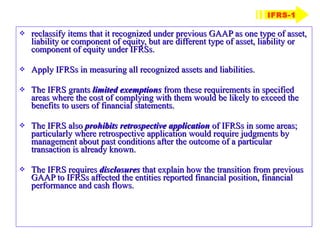
reclassify items that it recognized under previous GAAP as one type of asset, liability or component of equity, but are different type of asset, liability or component of equity under IFRSs. Apply IFRSs in measuring all recognized assets and liabilities. The IFRS grants  limited exemptions  from these requirements in specified areas where the cost of complying with them would be likely to exceed the benefits to users of financial statements. The IFRS also  prohibits retrospective application  of IFRSs in some areas; particularly where retrospective application would require judgments by management about past conditions after the outcome of a particular transaction is already known. The IFRS requires  disclosures  that explain how the transition from previous GAAP to IFRSs affected the entities reported financial position, financial performance and cash flows. IFRS-1
OBJECTIVE OF THIS STANDARD: The objective of this IFRS is to  specify  the financial reporting by an entity when it undertakes a share-based payment transaction. In particular, it requires an entity to  reflect  in its profit or loss and financial position the effects of share-based payment transactions, including expenses associated with transactions in which  share options   are granted to employees. IFRS -2 : SHARE-BASED PAYMENTS
POINTS: The IFRS requires an entity to  recognize  share-based payment transactions in its financial statements, including transactions with employees or other parties to be settled in cash, other assets, or equity instruments of the entity. There are  no exceptions  to the IFRS, other than for transactions to which other Standards apply. This  also applies  to transfers of equity instruments of the entity’s parent, or equity instruments of another entity in the same group as the entity, to parties that have supplied goods or services to the entity. IFRS-2
The IFRS  sets out  measurement principles  and  specific requirements  for  three types  of share-based payment transactions: equity-settled   share-based payment transactions, in which the entity receives goods or services as consideration for equity instruments of the entity (including shares or share options); (b)  cash-settled  share-based payment transactions, in which the entity acquires goods or services by incurring liabilities to the supplier of those goods or services for  amounts that are based on the price  (or value)  of the entity’s shares or other equity instruments of the entity;  and (c) t ransactions   in which the entity receives or acquires goods or  services and the terms of the arrangement provide either the entity or the  supplier of those goods or services with a choice of whether the  entity  settles the transaction in cash  or by issuing equity instruments. IFRS-2
For equity-settled share-based payment transactions, the IFRS requires an entity to  measure  the goods or services received,  and the corresponding increase in equity,  directly, at the fair value of the goods or services received, unless that fair value cannot be estimated reliably. If the entity  cannot estimate reliably  the fair value of the goods or services received, the entity is required to  measure their value , and the  corresponding increase in equity ,  indirectly , by reference to the fair value of the equity instruments granted. Furthermore: for  transactions with employees  and  others  providing similar services, the entity is required to  measure the fair value of the equity instruments granted,  because it is typically not possible to estimate reliably the fair value of employee services received. The fair value of the equity instruments granted is measured  at grant date. for transactions with  parties other than employees  (and those providing similar services), there is a rebut table presumption that the fair value of the goods or services received can be estimated reliably. That fair value is measured at the  date the entity obtains  the goods or the counterparty renders service. In rare cases, if the presumption is rebutted, the transaction is measured by reference to the fair value of the equity instruments granted, measured at the  date the entity obtains the goods or the counterparty renders  service. IFRS-2
for goods or services measured by reference to the fair value of the equity instruments granted, the IFRS specifies that  vesting conditions,  other than market conditions , are not taken into account  when estimating the fair value of the shares or options at  the relevant measurement date  (as specified above). Instead, vesting conditions are taken into account by adjusting the number of equity instruments included in the measurement of the transaction amount so that, ultimately, the amount recognized for goods or services received as consideration for the equity instruments granted is based on the number of equity instruments that eventually vest. Hence, on a cumulative basis, no amount is recognized for goods or services received if the equity instruments granted do not vest because of failure to satisfy a vesting condition (other than a market condition). the IFRS requires the  fair value of equity instruments  granted to be  based on market prices , if available, and to take into account the terms and conditions upon which those equity instruments were granted.  In the absence  of market prices, fair value is estimated, using a valuation technique to estimate what the price of those  equity instruments would have been on the measurement date  in an arm’s length transaction between  knowledgeable,  willing  parties. IFRS-2
the IFRS also sets out requirements if the terms and conditions of an  option or share grant are modified  (e.g. an option is reprised) or if a grant is cancelled, repurchased or replaced with another grant of equity instruments. For example, irrespective of any modification, cancellation or settlement of a grant of equity instruments to employees, the IFRS generally requires the  entity to recognize , as a minimum, the services received measured at the grant date fair value of the equity instruments granted. For cash-settled share-based payment transactions, the IFRS requires an entity to measure the goods or services acquired and the liability incurred at the fair value of the liability. Until the liability is settled, the entity is required to  re measure the fair value of the liability at each reporting date  and at the date of settlement, with any changes in value recognized in profit or loss for the period. IFRS-2
For share-based payment transactions in which the terms of the arrangement provide either the entity or the supplier of goods or services with a choice of whether the entity settles the transaction in cash or by issuing equity instruments, the entity is required to account for that transaction, or the components of that transaction, as a cash-settled share-based payment transaction if, and to the extent that, the entity has incurred a liability to settle in cash (or other assets), or as an equity-settled share-based payment transaction if, and to the extent that, no such liability has been incurred. The IFRS prescribes  various disclosure requirements  to enable users of financial statements to understand: the nature and extent of share-based payment arrangements that  existed  during the period; how the  fair value  of the goods or services received, or the fair value of the equity instruments granted, during the period was determined; and the effect  of share-based payment transactions on the entity’s profit or loss for the period and on its financial position. IFRS-2
OBJECTIVE OF THIS STANDARD: The objective of the IFRS is to  enhance the relevance, reliability and comparability  of the information that an entity provides in its financial statements about a  business combination and its effects . It does that by establishing principles and requirements for  how an acquirer : (a) recognizes and measures in its financial statements the identifiable  assets acquired, the liabilities   assumed  and any non-controlling interest in the acquire; (b) recognizes and measures the  goodwill  acquired in the business combination or a gain from a bargain purchase; and (c) determines what  information to disclose  to enable users  of the financial statements to evaluate the nature and  financial effects of the business combination.   IFRS -3 : BUSINESS COMBINATIONS
POINTS: Core principle An acquirer of a business  recognises  the assets acquired and liabilities assumed at their  acquisition-date  fair values and discloses information that enables users to evaluate the nature and financial effects of the acquisition. Applying the acquisition method A business combination must be  accounted  for by applying the  acquisition method , unless it is a combination involving entities or businesses under common control. One of the parties to a business combination can always be identified as the acquirer, being the entity that obtains control of the other business (the acquiree). Formations of a joint venture or the acquisition of an asset or a group of assets that does not constitute a business are not business combinations. IFRS-3
The  IFRS establishes principles  for recognising and measuring the identifiable assets acquired, the liabilities assumed and any non-controlling interest in the acquiree. Any classifications or designations made in recognising these items must be made in accordance with the contractual terms, economic conditions, acquirer’s operating or accounting policies and other factors that exist at the acquisition date. Each  identifiable asset and liability is measured at its acquisition-date   fair value . Any non-controlling interest in an acquiree is measured at fair value or as the non-controlling  interest’s proportionate share of the acquiree’s net identifiable  assets. IFRS-3
The IFRS provides  limited exceptions  to these recognition and measurement principles: Leases and insurance contracts  are required to be classified on the basis of the contractual terms and other factors at the inception of the contract (or when the terms have changed) rather than on the basis of the factors that exist at the acquisition date. Only those  contingent liabilities  assumed in a business combination that are a present obligation and can be measured reliably are recognized. Some assets and liabilities are required to be recognised or measured in accordance with  other IFRSs , rather than at fair value. The assets and liabilities affected are those falling within the scope of IAS 12  Income Taxes , IAS 19  Employee Benefits , IFRS 2  Share-based Payment  and IFRS 5  Non-current Assets Held for Sale and Discontinued Operations . IFRS-3
(d) There are special requirements for measuring  a reacquired right . (e)  Indemnification assets  are recognised and measured on a basis that is consistent with the item that is subject to the indemnification, even if that measure is not fair value. The IFRS requires the acquirer, having recognised the identifiable assets, the liabilities and any non-controlling interests,  to identify any difference  between:  the aggregate of the consideration transferred, any non-controlling interest in the acquiree and, in a business combination achieved in stages, the acquisition-date fair value of the acquirer’s previously held equity interest in the acquiree; and b)  the net identifiable assets acquired. The difference will, generally, be  recognised as goodwill . If the  acquirer has made a gain from a bargain purchase that  gain is  recognised in profit or loss. IFRS-3
The  consideration  transferred in a business combination (including any contingent consideration)  is measured at fair value . In general, an acquirer measures and accounts for assets acquired and liabilities assumed or incurred in a business combination after the business combination has been completed in accordance with other applicable IFRSs. However, the IFRS provides accounting requirements for reacquired rights, contingent liabilities, contingent consideration and indemnification assets.  Disclosure The IFRS requires the acquirer to disclose information that enables users of its financial statements to evaluate the  nature and financial effect of business combinations  that occurred during the current reporting period or after the reporting date but before the financial statements are authorised for issue. After a business combination, the acquirer must  disclose any  adjustments recognised  in the current reporting period that  relate to business combinations that occurred in the current  or previous reporting periods. IFRS-3
OBJECTIVE OF STANDARD: The objective of this IFRS is to  specify  the financial reporting  for   insurance contracts  by any  entity that issues such contracts  (described in this IFRS as an  insurer ) until the Board completes the second phase of its project on insurance contracts. In particular, this IFRS requires: limited  improvements to accounting  by insurers for insurance contracts. disclosure  that identifies and explains the  amounts  in an insurer’s financial statements arising from insurance contracts and helps users of those financial statements  understand the amount, timing and uncertainty of future  cash flows  from insurance contracts.   IFRS -4 : INSURANCE CONTRACTS
POINTS: An  insurance contract  is a contract under which one party (the insurer) accepts significant insurance risk from another party (the policyholder) by agreeing to compensate the policyholder if a specified uncertain future event (the insured event) adversely affects the policyholder. The IFRS  applies  to all insurance contracts (including reinsurance contracts) that an entity issues and to reinsurance contracts that it holds, except for specified contracts covered by other IFRSs. It  does not apply  to other assets and liabilities of an insurer, such as financial assets and financial liabilities within the scope of IAS 39  Financial Instruments: Recognition and Measurement . Furthermore, it does not address accounting by policyholders. IFRS-4
The IFRS  exempts an insurer temporarily  (ie during phase I of this project) from some requirements of other IFRSs, including the requirement to consider the  Framework  in selecting accounting policies for insurance contracts. However, the IFRS: prohibits provisions  for possible claims under  contracts that are not in   existence  at the end of the reporting period (such as catastrophe and equalisation provisions). requires a  test  for the adequacy of recognised insurance liabilities and an impairment test for reinsurance assets. requires an insurer to  keep insurance liabilities  in its statement of financial position until they are discharged or cancelled, or expire, and to present insurance liabilities without offsetting them against related reinsurance assets. IFRS-4
The IFRS permits an insurer to  change its accounting policies  for insurance contracts only if, as a result, its financial statements present information that is  more relevant and no less reliable, or more reliable and no less relevant . In particular, an  insurer cannot introduce any of the following practices , although it may continue using accounting policies that involve them: measuring insurance liabilities  on an undiscounted basis. measuring contractual rights  to future investment management  fees  at an amount that exceeds their fair value as implied by a comparison with current fees charged by other market participants for similar  services. using non-uniform accounting policies  for the insurance liabilities of subsidiaries. IFRS-4
The IFRS permits the  introduction of an accounting policy  that involves  re measuring designated insurance liabilities consistently  in each period to reflect current market interest rates (and, if the insurer so elects, other current estimates and assumptions). Without this permission, an insurer would have been required to apply the change in accounting policies consistently to all similar liabilities. The IFRS requires  disclosure  to help users understand: the  amounts  in the insurer’s financial statements that  arise  from insurance contracts. the amount, timing and uncertainty of  future cash flows  from insurance contracts IFRS-4
OBJECTIVE OF STANDARD: The objective of this IFRS is to  specify the accounting  for assets held for sale, and the  presentation and disclosure  of discontinued operations. In particular, the IFRS requires: assets that meet the  criteria to be classified  as held for sale to be measured at the  lower  of carrying amount and fair value less costs to sell, and depreciation on such assets to cease; and assets that meet the criteria to be classified as held for sale to be  presented separately  in the statement of financial position and the  results of discontinued operations  to be presented separately in the statement of comprehensive  income.  IFRS -5 : NON-CURRENT ASSETS HELD  FOR  SALE  AND DISCONTINUED OPERATIONS
POINTS: The IFRS: adopts  the classification  ‘held for sale’. introduces the concept of a  disposal group , being a group of assets to be disposed of, by sale or otherwise, together as a group in a single transaction, and liabilities directly associated with those assets that will be transferred in the transaction. classifies an operation  as discontinued at the date the operation meets the criteria to be classified as held for sale or when the entity has disposed of the operation. An entity shall  classify   a non-current asset (or disposal group)  as held for sale if its carrying amount will be recovered principally through a sale  transaction rather than through continuing use. IFRS-5
present condition subject only to terms that are usual and customary for sales of such assets (or disposal groups)  and its sale must be  highly probable . For the  sale to be highly probable , the appropriate level of management must be committed to a plan to sell the asset (or disposal group), and an active program to locate a buyer and complete the plan must have been initiated. Further, the asset (or disposal group) must be actively marketed for sale at a price that is reasonable in relation to its current fair value. In addition, the  sale should be expected to qualify for recognition as a completed sale   within one year   from the date of classification , except as permitted by paragraph 9, and actions required to complete the plan should indicate that it is unlikely that significant changes to the plan will be made or that the plan will be withdrawn. IFRS-5
A  discontinued operation   is a component of an entity  that either has been disposed of, or is classified as held for sale, and represents a separate major line of business or geographical area of operations, is part of a single co-ordinated plan to dispose of a separate major line of business or geographical area of operations or is a subsidiary acquired exclusively with a view to resale. A component of an entity comprises  operations and cash flows   that can be  clearly distinguished , operationally and for financial reporting purposes, from the rest of the entity. In other words, a component of an entity will have been a cash-generating unit or a group of cash-generating units while being held for use. An entity shall  not classify  as held for sale  a non-current asset (or disposal group) that is to be abandoned . This is because  its carrying amount will be recovered principally    through continuing use. IFRS-5
OBJECTIVE OF STANDARD: The objective of this IFRS is to specify the  financial reporting  for the exploration for and evaluation of mineral resources. POINTS: Exploration and evaluation expenditures  are expenditures incurred by an entity in connection with the exploration for and evaluation of mineral resources  before  the technical feasibility and commercial viability of extracting a mineral resource are demonstrable. Exploration for and evaluation of mineral resources is the search for mineral resources, including minerals, oil, natural gas and similar non-regenerative resources  after the entity has obtained legal rights  to explore in a specific area, as well as the determination of the technical feasibility and commercial viability of extracting the mineral resource. Exploration and evaluation assets are exploration and evaluation  expenditures  recognized as assets  in accordance with the  entity’s accounting policy. IFRS-6 : EXPLORATION FOR AND   EVALUATION OF MINERALS
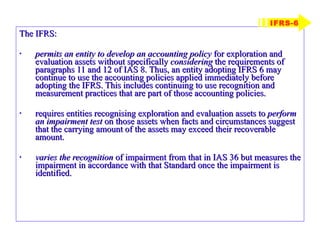
The IFRS: permits an entity to develop an accounting policy  for exploration and evaluation assets without specifically  considering  the requirements of paragraphs 11 and 12 of IAS 8. Thus, an entity adopting IFRS 6 may continue to use the accounting policies applied immediately before adopting the IFRS. This includes continuing to use recognition and measurement practices that are part of those accounting policies. requires entities recognising exploration and evaluation assets to  perform an impairment test  on those assets when facts and circumstances suggest that the carrying amount of the assets may exceed their recoverable amount. varies the recognition  of impairment from that in IAS 36 but measures the impairment in accordance with that Standard once the impairment is identified. IFRS-6
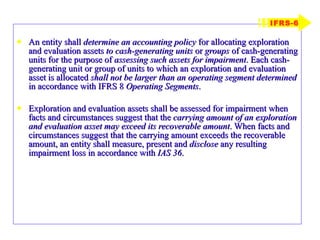
An entity shall  determine an accounting policy  for allocating exploration and evaluation assets  to cash-generating units  or  groups  of cash-generating units for the purpose of  assessing such assets for impairment . Each cash-generating unit or group of units to which an exploration and evaluation asset is allocated  shall not be larger than an operating segment determined  in accordance with IFRS 8  Operating Segments . Exploration and evaluation assets shall be assessed for impairment when facts and circumstances suggest that the  carrying amount of an exploration and evaluation asset may exceed its recoverable amount . When facts and circumstances suggest that the carrying amount exceeds the recoverable amount, an entity shall measure, present and  disclose  any resulting impairment loss in accordance with  IAS 36 . IFRS-6
One or more of the  following facts and circumstances indicate  that an entity should test exploration and evaluation assets for impairment (the list is not exhaustive): the  period  for which the entity has the right to explore in the specific area has  expired  during the period or will expire in the near future, and is not expected to be renewed. substantive expenditure  on further exploration for and evaluation of mineral resources in the specific area is  neither budgeted nor planned . exploration for and evaluation of mineral resources in the specific area have not led to the discovery of  commercially viable quantities  of mineral resources and the entity has decided to discontinue such activities in the specific area. sufficient data exist  to indicate that, although a development in the specific area is likely to proceed,  the carrying amount  of the exploration and evaluation asset is  unlikely to be recovered  in full from successful development or by sale. An entity shall  disclose  information  that identifies and explains the amounts recognised in its financial statements arising from the exploration for and valuation of mineral resources. IFRS-6
OBJECTIVE OF STANDARD: The objective of this IFRS is to require entities to provide disclosures in their financial statements that enable users to evaluate: the  significance of financial instruments  for the entity’s financial position and performance; and the nature and extent of  risks arising from financial instruments  to which the entity is exposed during the period and at the reporting date, and how the entity manages those risks. The  qualitative disclosures  describe management’s objectives, policies and processes for managing those risks. The  quantitative disclosures  provide information about the extent to which the entity is exposed to risk, based on information provided internally to the entity's key management personnel. Together, these disclosures provide an overview of the entity's use of financial instruments and the exposures to risks they create. IFRS-7 : FINANCIAL INSTRUMENTS:     DISCLOSURE
POINTS: The  IFRS applies to all entities , including entities that have few financial instruments (eg a manufacturer whose only financial instruments are accounts receivable and accounts payable) and those that have many financial instruments (eg a financial institution most of whose assets and liabilities are financial instruments). When this  IFRS requires disclosures by class  of financial instrument, an entity shall group financial instruments into classes that are appropriate to the nature of the information disclosed and that take into account the characteristics of those financial instruments. An entity shall provide sufficient information to permit reconciliation to the line items presented in the balance sheet. The principles in this IFRS  complement the principles  for recognising, measuring and presenting financial assets and financial liabilities in IAS 32  Financial Instruments: Presentation  and IAS 39  Financial Instruments: Recognition and Measurement . IFRS-7
OBJECTIVE OF STANDARD: Core principle —An entity shall disclose information to enable users of its financial statements to evaluate the  nature and financial effects of the business activities  in which it engages and the economic environments in which it operates. IFRS-8 : OPERATING SEGMENTS
POINTS: This  IFRS shall apply  to: (a) the  separate or individual financial statements  of an entity: whose debt or equity instruments are traded in a public market (a domestic or foreign stock exchange or an over-the-counter market, including local and regional markets), or that files, or is in the process of filing, its financial statements with a securities commission or other regulatory organisation for the purpose of issuing any class of instruments in a public  market; and (b) the  consolidated financial statements  of a group with a parent: whose debt or equity instruments are traded in a public market (a domestic or foreign stock exchange or an over-the-counter market, including local and regional markets), or that files, or is in the process of filing, the consolidated financial statements with a securities commission or other regulatory organisation for the purpose of issuing any class of instruments in a public market. IFRS-8
The IFRS  specifies how an entity should report information  about its operating segments in annual financial statements and, as a consequential amendment to IAS 34  Interim Financial Reporting , requires an entity to report  selected information  about its operating segments in interim financial reports. It also sets out requirements for related disclosures about products and services, geographical areas and major customers. The IFRS requires an entity  to report financial and descriptive information about its reportable segments . Reportable segments are operating segments or aggregations of operating segments that meet specified criteria. Operating segments are  components of an entity about which separate financial information is available that is evaluated regularly by the chief operating decision maker in deciding how to allocate resources and in assessing performance. Generally, financial information is required to be reported on the same basis as is used internally for evaluating operating segment performance  and deciding how to allocate resources to operating  segments.  IFRS-8
The IFRS requires an entity to  report a measure of operating segment profit or loss and of segment assets . It also requires an entity to report a measure of  segment liabilities  and particular income and expense items if such measures are regularly provided to the chief operating decision maker.  It requires  reconciliations  of total reportable segment revenues, total profit or loss, total assets, liabilities and other amounts disclosed for reportable segments to corresponding amounts in the entity’s financial statements. IFRS-8
The IFRS requires an entity to report information about the  revenues derived from its products or services  (or groups of similar products and services), about the  countries in which it earns revenues and holds assets , and about major customers, regardless of whether that information is used by management in making operating decisions. However, the IFRS does not require an entity to report information that is not prepared for internal use if the necessary information is not available and the cost to develop it would be excessive. The IFRS also requires an entity to  give descriptive information about the   way the   operating segments were determined , the products and services provided by the segments, differences between the  measurements  used in reporting segment information and those used in the entity’s financial statements, and changes in the measurement of segment amounts from period to period. IFRS-8
CA VENKATA SUNEEL PERUMALLA +91-9701899902 -CA Ramesh Ramagiri +91-9701599970 -CA Suntiha Yerram Presentation by
Thank you

Ifrs

  • 1.
  • 2.
    INTERNATIONAL FINANCIAL REPORTING STANDARDS (I F R S) INTRODUCTION TO
  • 3.
    WHY IFRS ?A single set of accounting standards would enable internationally to standardize training and assure better quality on a global screen, it would also permit international capital to flow more freely, enabling companies to develop consistent global practices on accounting problems. It would be beneficial to regulators too, as a complexity associated with needing to understand various reporting regimes would be reduced.
  • 4.
    OBJECTIVES OF IFRSto develop , in the public interest, a single set of high quality, understandable and enforceable global accounting standards that require high quality, transparent and comparable information in financial statements and other financial reporting to help participants in the world's capital markets and other users make economic decisions; to promote the use and rigorous application of those standards; in fulfilling the objectives associated with (1) and (2 ), to take account of , as appropriate, the special needs of small and medium-sized entities and emerging economies. to bring about convergence of national accounting standards and International Accounting standards and IFRS to high quality solutions.
  • 5.
    SCOPE OF IFRSIASB Standards are known as International Financial Reporting Standards (IFRSs). All International Accounting Standards (IASs) and Interpretations issued by the former IASC (International Accounting Standard Committee) and SIC (Standard Interpretation Committee) continue to be applicable unless and until they are amended or withdrawn. IFRSs apply to the general purpose financial statements and other financial reporting by profit-oriented entities -- those engaged in commercial, industrial, financial, and similar activities, regardless of their legal form. Entities other than profit-oriented business entities may also find IFRSs appropriate.
  • 6.
    SCOPE OF IFRSGeneral purpose financial statements are intended to meet the common needs of shareholders, creditors, employees, and the public at large for information about an entity's financial position, performance, and cash flows. 6. Other financial reporting includes information provided outside financial statements that assists in the interpretation of a complete set of financial statements or improves users' ability to make efficient economic decisions. 7. IFRS apply to individual company and consolidated financial statements. 8. A complete set of financial statements includes a balance sheet, an income statement, a cash flow statement, a statement showing either all changes in equity or changes in equity other than those arising from investments by and distributions to owners, a summary of accounting policies, and explanatory notes.
  • 7.
    SCOPE OF IFRS9. If an IFRS allows both a 'benchmark' and an 'allowed alternative ' treatment , financial statements may be described as conforming to IFRS whichever treatment is followed. 10. In developing Standards, IASB intends not to permit choices in accounting treatment . Further, IASB intends to reconsider the choices in existing IASs with a view to reducing the number of those choices. 11. IFRS will present fundamental principles in bold face type and other guidance in non-bold type (the 'black-letter'/'grey-letter' distinction). Paragraphs of both types have equal authority. 12. The provision of IAS 1 that conformity with IAS requires compliance with every applicable IAS and Interpretation requires compliance with all IFRSs as well.
  • 8.
    LIST OF IFRSIFRS 1 First-time Adoption of International Financial Reporting Standards IFRS 2 Share-based Payment IFRS 3 Business Combinations IFRS 4 Insurance Contracts IFRS 5 Non-current Assets Held for Sale and Discontinued Operations IFRS 6 Exploration for and evaluation of Mineral Resources IFRS 7 Financial Instruments: Disclosures IFRS 8 Operating Segments
  • 9.
    FRAMEWORK FOR THEPREPARATION AND PRESENTATION OF FINANCIAL STATEMENTS The IASB Framework was approved by IASC Board in April, 1989 for publication in July 1989, and adopted by the IASB in April, 2001. This Framework sets out the concepts that underlie the preparation and presentation of financial statements for external users. The Framework deals with: The objective of financial statements; The qualitative characteristics that determine the usefulness of information in financial statement; The Definition, recognition and measurement of the elements from which financial statements are constructed; and Concept of capital and capital maintenance.
  • 10.
    The Objective of Financial statements is to provide useful information to users of financial statements in making economic decision. Financial Statements are prepared to provide information on Financial Position, Operating Performance and changes in financial position of an entity Financial Statements are normally prepared on the assumption that entity is a going concern and will continue in operation for the foreseeable future, and prepared on accrual basis of accounting. The four Qualitative characteristics are Understandability, relevance, reliability and comparability are the attributes that make the financial information useful to users. The elements directly related to the measurement of financial position are assets, liabilities and equity.
  • 11.
    An item thatmeets the definition of an element should be recognized if: it is probable that any future economic benefit associated the item will flow to or from the entity. the item has a cost or value that can be measured with reliability. Measurement is the process of determining the monetary amounts at which each element in the financial statements are to be recognized and carried in the Balance Sheet and Income statement. The concept of capital maintenance is concerned with how an entity defines the capital that it seeks to maintain. It provides the linkage between the concepts of capital and the concepts of profit because it provides the point of reference by which profit is measured.
  • 12.
    OBJECTIVE OF THESTANDARD: The objective of this IFRS is to ensure that an entity’s first IFRS financial statements , and its interim financial reports for part of the period covered by those financial statements, contain high quality information that: it is transparen t for users and comparable over all the periods presented. Provides a suitable starting point for accounting under International Financial Reporting Standards (IFRS); and Can be generated at a cos t that does not exceed the benefits to users. IFRS -1 : FIRST TIME ADOPTION OF I F R S
  • 13.
    POINTS: An entityshall prepare and present an opening IFRS statement of financial position at the date of transition to IFRSs . This is the starting point for its accounting under IFRSs. An entity shall prepare an opening IFRS balance sheet at the date of transition to IFRSs. This is the starting point for its accounting under IFRSs. An entity need not present its opening IFRS balance sheet in its first IFRS financial statements. In general, the IFRS requires an entity to comply with each IFRS effective at the end of its first IFRS reporting period. In particular, the IFRS requires an entity to do the following in the opening IFRS statement of financial position that it prepares as a starting point for its accounting under IFRSs: recognize all assets and liabilities whose recognition is required by IFRSs. not to recognize items as assets or liabilities if IFRSs do not permit such recognition; IFRS-1
  • 14.
    reclassify items thatit recognized under previous GAAP as one type of asset, liability or component of equity, but are different type of asset, liability or component of equity under IFRSs. Apply IFRSs in measuring all recognized assets and liabilities. The IFRS grants limited exemptions from these requirements in specified areas where the cost of complying with them would be likely to exceed the benefits to users of financial statements. The IFRS also prohibits retrospective application of IFRSs in some areas; particularly where retrospective application would require judgments by management about past conditions after the outcome of a particular transaction is already known. The IFRS requires disclosures that explain how the transition from previous GAAP to IFRSs affected the entities reported financial position, financial performance and cash flows. IFRS-1
  • 15.
    OBJECTIVE OF THISSTANDARD: The objective of this IFRS is to specify the financial reporting by an entity when it undertakes a share-based payment transaction. In particular, it requires an entity to reflect in its profit or loss and financial position the effects of share-based payment transactions, including expenses associated with transactions in which share options are granted to employees. IFRS -2 : SHARE-BASED PAYMENTS
  • 16.
    POINTS: The IFRSrequires an entity to recognize share-based payment transactions in its financial statements, including transactions with employees or other parties to be settled in cash, other assets, or equity instruments of the entity. There are no exceptions to the IFRS, other than for transactions to which other Standards apply. This also applies to transfers of equity instruments of the entity’s parent, or equity instruments of another entity in the same group as the entity, to parties that have supplied goods or services to the entity. IFRS-2
  • 17.
    The IFRS sets out measurement principles and specific requirements for three types of share-based payment transactions: equity-settled share-based payment transactions, in which the entity receives goods or services as consideration for equity instruments of the entity (including shares or share options); (b) cash-settled share-based payment transactions, in which the entity acquires goods or services by incurring liabilities to the supplier of those goods or services for amounts that are based on the price (or value) of the entity’s shares or other equity instruments of the entity; and (c) t ransactions in which the entity receives or acquires goods or services and the terms of the arrangement provide either the entity or the supplier of those goods or services with a choice of whether the entity settles the transaction in cash or by issuing equity instruments. IFRS-2
  • 18.
    For equity-settled share-basedpayment transactions, the IFRS requires an entity to measure the goods or services received, and the corresponding increase in equity, directly, at the fair value of the goods or services received, unless that fair value cannot be estimated reliably. If the entity cannot estimate reliably the fair value of the goods or services received, the entity is required to measure their value , and the corresponding increase in equity , indirectly , by reference to the fair value of the equity instruments granted. Furthermore: for transactions with employees and others providing similar services, the entity is required to measure the fair value of the equity instruments granted, because it is typically not possible to estimate reliably the fair value of employee services received. The fair value of the equity instruments granted is measured at grant date. for transactions with parties other than employees (and those providing similar services), there is a rebut table presumption that the fair value of the goods or services received can be estimated reliably. That fair value is measured at the date the entity obtains the goods or the counterparty renders service. In rare cases, if the presumption is rebutted, the transaction is measured by reference to the fair value of the equity instruments granted, measured at the date the entity obtains the goods or the counterparty renders service. IFRS-2
  • 19.
    for goods orservices measured by reference to the fair value of the equity instruments granted, the IFRS specifies that vesting conditions, other than market conditions , are not taken into account when estimating the fair value of the shares or options at the relevant measurement date (as specified above). Instead, vesting conditions are taken into account by adjusting the number of equity instruments included in the measurement of the transaction amount so that, ultimately, the amount recognized for goods or services received as consideration for the equity instruments granted is based on the number of equity instruments that eventually vest. Hence, on a cumulative basis, no amount is recognized for goods or services received if the equity instruments granted do not vest because of failure to satisfy a vesting condition (other than a market condition). the IFRS requires the fair value of equity instruments granted to be based on market prices , if available, and to take into account the terms and conditions upon which those equity instruments were granted. In the absence of market prices, fair value is estimated, using a valuation technique to estimate what the price of those equity instruments would have been on the measurement date in an arm’s length transaction between knowledgeable, willing parties. IFRS-2
  • 20.
    the IFRS alsosets out requirements if the terms and conditions of an option or share grant are modified (e.g. an option is reprised) or if a grant is cancelled, repurchased or replaced with another grant of equity instruments. For example, irrespective of any modification, cancellation or settlement of a grant of equity instruments to employees, the IFRS generally requires the entity to recognize , as a minimum, the services received measured at the grant date fair value of the equity instruments granted. For cash-settled share-based payment transactions, the IFRS requires an entity to measure the goods or services acquired and the liability incurred at the fair value of the liability. Until the liability is settled, the entity is required to re measure the fair value of the liability at each reporting date and at the date of settlement, with any changes in value recognized in profit or loss for the period. IFRS-2
  • 21.
    For share-based paymenttransactions in which the terms of the arrangement provide either the entity or the supplier of goods or services with a choice of whether the entity settles the transaction in cash or by issuing equity instruments, the entity is required to account for that transaction, or the components of that transaction, as a cash-settled share-based payment transaction if, and to the extent that, the entity has incurred a liability to settle in cash (or other assets), or as an equity-settled share-based payment transaction if, and to the extent that, no such liability has been incurred. The IFRS prescribes various disclosure requirements to enable users of financial statements to understand: the nature and extent of share-based payment arrangements that existed during the period; how the fair value of the goods or services received, or the fair value of the equity instruments granted, during the period was determined; and the effect of share-based payment transactions on the entity’s profit or loss for the period and on its financial position. IFRS-2
  • 22.
    OBJECTIVE OF THISSTANDARD: The objective of the IFRS is to enhance the relevance, reliability and comparability of the information that an entity provides in its financial statements about a business combination and its effects . It does that by establishing principles and requirements for how an acquirer : (a) recognizes and measures in its financial statements the identifiable assets acquired, the liabilities assumed and any non-controlling interest in the acquire; (b) recognizes and measures the goodwill acquired in the business combination or a gain from a bargain purchase; and (c) determines what information to disclose to enable users of the financial statements to evaluate the nature and financial effects of the business combination. IFRS -3 : BUSINESS COMBINATIONS
  • 23.
    POINTS: Core principleAn acquirer of a business recognises the assets acquired and liabilities assumed at their acquisition-date fair values and discloses information that enables users to evaluate the nature and financial effects of the acquisition. Applying the acquisition method A business combination must be accounted for by applying the acquisition method , unless it is a combination involving entities or businesses under common control. One of the parties to a business combination can always be identified as the acquirer, being the entity that obtains control of the other business (the acquiree). Formations of a joint venture or the acquisition of an asset or a group of assets that does not constitute a business are not business combinations. IFRS-3
  • 24.
    The IFRSestablishes principles for recognising and measuring the identifiable assets acquired, the liabilities assumed and any non-controlling interest in the acquiree. Any classifications or designations made in recognising these items must be made in accordance with the contractual terms, economic conditions, acquirer’s operating or accounting policies and other factors that exist at the acquisition date. Each identifiable asset and liability is measured at its acquisition-date fair value . Any non-controlling interest in an acquiree is measured at fair value or as the non-controlling interest’s proportionate share of the acquiree’s net identifiable assets. IFRS-3
  • 25.
    The IFRS provides limited exceptions to these recognition and measurement principles: Leases and insurance contracts are required to be classified on the basis of the contractual terms and other factors at the inception of the contract (or when the terms have changed) rather than on the basis of the factors that exist at the acquisition date. Only those contingent liabilities assumed in a business combination that are a present obligation and can be measured reliably are recognized. Some assets and liabilities are required to be recognised or measured in accordance with other IFRSs , rather than at fair value. The assets and liabilities affected are those falling within the scope of IAS 12 Income Taxes , IAS 19 Employee Benefits , IFRS 2 Share-based Payment and IFRS 5 Non-current Assets Held for Sale and Discontinued Operations . IFRS-3
  • 26.
    (d) There arespecial requirements for measuring a reacquired right . (e) Indemnification assets are recognised and measured on a basis that is consistent with the item that is subject to the indemnification, even if that measure is not fair value. The IFRS requires the acquirer, having recognised the identifiable assets, the liabilities and any non-controlling interests, to identify any difference between: the aggregate of the consideration transferred, any non-controlling interest in the acquiree and, in a business combination achieved in stages, the acquisition-date fair value of the acquirer’s previously held equity interest in the acquiree; and b) the net identifiable assets acquired. The difference will, generally, be recognised as goodwill . If the acquirer has made a gain from a bargain purchase that gain is recognised in profit or loss. IFRS-3
  • 27.
    The consideration transferred in a business combination (including any contingent consideration) is measured at fair value . In general, an acquirer measures and accounts for assets acquired and liabilities assumed or incurred in a business combination after the business combination has been completed in accordance with other applicable IFRSs. However, the IFRS provides accounting requirements for reacquired rights, contingent liabilities, contingent consideration and indemnification assets. Disclosure The IFRS requires the acquirer to disclose information that enables users of its financial statements to evaluate the nature and financial effect of business combinations that occurred during the current reporting period or after the reporting date but before the financial statements are authorised for issue. After a business combination, the acquirer must disclose any adjustments recognised in the current reporting period that relate to business combinations that occurred in the current or previous reporting periods. IFRS-3
  • 28.
    OBJECTIVE OF STANDARD:The objective of this IFRS is to specify the financial reporting for insurance contracts by any entity that issues such contracts (described in this IFRS as an insurer ) until the Board completes the second phase of its project on insurance contracts. In particular, this IFRS requires: limited improvements to accounting by insurers for insurance contracts. disclosure that identifies and explains the amounts in an insurer’s financial statements arising from insurance contracts and helps users of those financial statements understand the amount, timing and uncertainty of future cash flows from insurance contracts. IFRS -4 : INSURANCE CONTRACTS
  • 29.
    POINTS: An insurance contract is a contract under which one party (the insurer) accepts significant insurance risk from another party (the policyholder) by agreeing to compensate the policyholder if a specified uncertain future event (the insured event) adversely affects the policyholder. The IFRS applies to all insurance contracts (including reinsurance contracts) that an entity issues and to reinsurance contracts that it holds, except for specified contracts covered by other IFRSs. It does not apply to other assets and liabilities of an insurer, such as financial assets and financial liabilities within the scope of IAS 39 Financial Instruments: Recognition and Measurement . Furthermore, it does not address accounting by policyholders. IFRS-4
  • 30.
    The IFRS exempts an insurer temporarily (ie during phase I of this project) from some requirements of other IFRSs, including the requirement to consider the Framework in selecting accounting policies for insurance contracts. However, the IFRS: prohibits provisions for possible claims under contracts that are not in existence at the end of the reporting period (such as catastrophe and equalisation provisions). requires a test for the adequacy of recognised insurance liabilities and an impairment test for reinsurance assets. requires an insurer to keep insurance liabilities in its statement of financial position until they are discharged or cancelled, or expire, and to present insurance liabilities without offsetting them against related reinsurance assets. IFRS-4
  • 31.
    The IFRS permitsan insurer to change its accounting policies for insurance contracts only if, as a result, its financial statements present information that is more relevant and no less reliable, or more reliable and no less relevant . In particular, an insurer cannot introduce any of the following practices , although it may continue using accounting policies that involve them: measuring insurance liabilities on an undiscounted basis. measuring contractual rights to future investment management fees at an amount that exceeds their fair value as implied by a comparison with current fees charged by other market participants for similar services. using non-uniform accounting policies for the insurance liabilities of subsidiaries. IFRS-4
  • 32.
    The IFRS permitsthe introduction of an accounting policy that involves re measuring designated insurance liabilities consistently in each period to reflect current market interest rates (and, if the insurer so elects, other current estimates and assumptions). Without this permission, an insurer would have been required to apply the change in accounting policies consistently to all similar liabilities. The IFRS requires disclosure to help users understand: the amounts in the insurer’s financial statements that arise from insurance contracts. the amount, timing and uncertainty of future cash flows from insurance contracts IFRS-4
  • 33.
    OBJECTIVE OF STANDARD:The objective of this IFRS is to specify the accounting for assets held for sale, and the presentation and disclosure of discontinued operations. In particular, the IFRS requires: assets that meet the criteria to be classified as held for sale to be measured at the lower of carrying amount and fair value less costs to sell, and depreciation on such assets to cease; and assets that meet the criteria to be classified as held for sale to be presented separately in the statement of financial position and the results of discontinued operations to be presented separately in the statement of comprehensive income. IFRS -5 : NON-CURRENT ASSETS HELD FOR SALE AND DISCONTINUED OPERATIONS
  • 34.
    POINTS: The IFRS:adopts the classification ‘held for sale’. introduces the concept of a disposal group , being a group of assets to be disposed of, by sale or otherwise, together as a group in a single transaction, and liabilities directly associated with those assets that will be transferred in the transaction. classifies an operation as discontinued at the date the operation meets the criteria to be classified as held for sale or when the entity has disposed of the operation. An entity shall classify a non-current asset (or disposal group) as held for sale if its carrying amount will be recovered principally through a sale transaction rather than through continuing use. IFRS-5
  • 35.
    present condition subjectonly to terms that are usual and customary for sales of such assets (or disposal groups) and its sale must be highly probable . For the sale to be highly probable , the appropriate level of management must be committed to a plan to sell the asset (or disposal group), and an active program to locate a buyer and complete the plan must have been initiated. Further, the asset (or disposal group) must be actively marketed for sale at a price that is reasonable in relation to its current fair value. In addition, the sale should be expected to qualify for recognition as a completed sale within one year from the date of classification , except as permitted by paragraph 9, and actions required to complete the plan should indicate that it is unlikely that significant changes to the plan will be made or that the plan will be withdrawn. IFRS-5
  • 36.
    A discontinuedoperation is a component of an entity that either has been disposed of, or is classified as held for sale, and represents a separate major line of business or geographical area of operations, is part of a single co-ordinated plan to dispose of a separate major line of business or geographical area of operations or is a subsidiary acquired exclusively with a view to resale. A component of an entity comprises operations and cash flows that can be clearly distinguished , operationally and for financial reporting purposes, from the rest of the entity. In other words, a component of an entity will have been a cash-generating unit or a group of cash-generating units while being held for use. An entity shall not classify as held for sale a non-current asset (or disposal group) that is to be abandoned . This is because its carrying amount will be recovered principally through continuing use. IFRS-5
  • 37.
    OBJECTIVE OF STANDARD:The objective of this IFRS is to specify the financial reporting for the exploration for and evaluation of mineral resources. POINTS: Exploration and evaluation expenditures are expenditures incurred by an entity in connection with the exploration for and evaluation of mineral resources before the technical feasibility and commercial viability of extracting a mineral resource are demonstrable. Exploration for and evaluation of mineral resources is the search for mineral resources, including minerals, oil, natural gas and similar non-regenerative resources after the entity has obtained legal rights to explore in a specific area, as well as the determination of the technical feasibility and commercial viability of extracting the mineral resource. Exploration and evaluation assets are exploration and evaluation expenditures recognized as assets in accordance with the entity’s accounting policy. IFRS-6 : EXPLORATION FOR AND EVALUATION OF MINERALS
  • 38.
    The IFRS: permitsan entity to develop an accounting policy for exploration and evaluation assets without specifically considering the requirements of paragraphs 11 and 12 of IAS 8. Thus, an entity adopting IFRS 6 may continue to use the accounting policies applied immediately before adopting the IFRS. This includes continuing to use recognition and measurement practices that are part of those accounting policies. requires entities recognising exploration and evaluation assets to perform an impairment test on those assets when facts and circumstances suggest that the carrying amount of the assets may exceed their recoverable amount. varies the recognition of impairment from that in IAS 36 but measures the impairment in accordance with that Standard once the impairment is identified. IFRS-6
  • 39.
    An entity shall determine an accounting policy for allocating exploration and evaluation assets to cash-generating units or groups of cash-generating units for the purpose of assessing such assets for impairment . Each cash-generating unit or group of units to which an exploration and evaluation asset is allocated shall not be larger than an operating segment determined in accordance with IFRS 8 Operating Segments . Exploration and evaluation assets shall be assessed for impairment when facts and circumstances suggest that the carrying amount of an exploration and evaluation asset may exceed its recoverable amount . When facts and circumstances suggest that the carrying amount exceeds the recoverable amount, an entity shall measure, present and disclose any resulting impairment loss in accordance with IAS 36 . IFRS-6
  • 40.
    One or moreof the following facts and circumstances indicate that an entity should test exploration and evaluation assets for impairment (the list is not exhaustive): the period for which the entity has the right to explore in the specific area has expired during the period or will expire in the near future, and is not expected to be renewed. substantive expenditure on further exploration for and evaluation of mineral resources in the specific area is neither budgeted nor planned . exploration for and evaluation of mineral resources in the specific area have not led to the discovery of commercially viable quantities of mineral resources and the entity has decided to discontinue such activities in the specific area. sufficient data exist to indicate that, although a development in the specific area is likely to proceed, the carrying amount of the exploration and evaluation asset is unlikely to be recovered in full from successful development or by sale. An entity shall disclose information that identifies and explains the amounts recognised in its financial statements arising from the exploration for and valuation of mineral resources. IFRS-6
  • 41.
    OBJECTIVE OF STANDARD:The objective of this IFRS is to require entities to provide disclosures in their financial statements that enable users to evaluate: the significance of financial instruments for the entity’s financial position and performance; and the nature and extent of risks arising from financial instruments to which the entity is exposed during the period and at the reporting date, and how the entity manages those risks. The qualitative disclosures describe management’s objectives, policies and processes for managing those risks. The quantitative disclosures provide information about the extent to which the entity is exposed to risk, based on information provided internally to the entity's key management personnel. Together, these disclosures provide an overview of the entity's use of financial instruments and the exposures to risks they create. IFRS-7 : FINANCIAL INSTRUMENTS: DISCLOSURE
  • 42.
    POINTS: The IFRS applies to all entities , including entities that have few financial instruments (eg a manufacturer whose only financial instruments are accounts receivable and accounts payable) and those that have many financial instruments (eg a financial institution most of whose assets and liabilities are financial instruments). When this IFRS requires disclosures by class of financial instrument, an entity shall group financial instruments into classes that are appropriate to the nature of the information disclosed and that take into account the characteristics of those financial instruments. An entity shall provide sufficient information to permit reconciliation to the line items presented in the balance sheet. The principles in this IFRS complement the principles for recognising, measuring and presenting financial assets and financial liabilities in IAS 32 Financial Instruments: Presentation and IAS 39 Financial Instruments: Recognition and Measurement . IFRS-7
  • 43.
    OBJECTIVE OF STANDARD:Core principle —An entity shall disclose information to enable users of its financial statements to evaluate the nature and financial effects of the business activities in which it engages and the economic environments in which it operates. IFRS-8 : OPERATING SEGMENTS
  • 44.
    POINTS: This IFRS shall apply to: (a) the separate or individual financial statements of an entity: whose debt or equity instruments are traded in a public market (a domestic or foreign stock exchange or an over-the-counter market, including local and regional markets), or that files, or is in the process of filing, its financial statements with a securities commission or other regulatory organisation for the purpose of issuing any class of instruments in a public market; and (b) the consolidated financial statements of a group with a parent: whose debt or equity instruments are traded in a public market (a domestic or foreign stock exchange or an over-the-counter market, including local and regional markets), or that files, or is in the process of filing, the consolidated financial statements with a securities commission or other regulatory organisation for the purpose of issuing any class of instruments in a public market. IFRS-8
  • 45.
    The IFRS specifies how an entity should report information about its operating segments in annual financial statements and, as a consequential amendment to IAS 34 Interim Financial Reporting , requires an entity to report selected information about its operating segments in interim financial reports. It also sets out requirements for related disclosures about products and services, geographical areas and major customers. The IFRS requires an entity to report financial and descriptive information about its reportable segments . Reportable segments are operating segments or aggregations of operating segments that meet specified criteria. Operating segments are components of an entity about which separate financial information is available that is evaluated regularly by the chief operating decision maker in deciding how to allocate resources and in assessing performance. Generally, financial information is required to be reported on the same basis as is used internally for evaluating operating segment performance and deciding how to allocate resources to operating segments. IFRS-8
  • 46.
    The IFRS requiresan entity to report a measure of operating segment profit or loss and of segment assets . It also requires an entity to report a measure of segment liabilities and particular income and expense items if such measures are regularly provided to the chief operating decision maker. It requires reconciliations of total reportable segment revenues, total profit or loss, total assets, liabilities and other amounts disclosed for reportable segments to corresponding amounts in the entity’s financial statements. IFRS-8
  • 47.
    The IFRS requiresan entity to report information about the revenues derived from its products or services (or groups of similar products and services), about the countries in which it earns revenues and holds assets , and about major customers, regardless of whether that information is used by management in making operating decisions. However, the IFRS does not require an entity to report information that is not prepared for internal use if the necessary information is not available and the cost to develop it would be excessive. The IFRS also requires an entity to give descriptive information about the way the operating segments were determined , the products and services provided by the segments, differences between the measurements used in reporting segment information and those used in the entity’s financial statements, and changes in the measurement of segment amounts from period to period. IFRS-8
  • 48.
    CA VENKATA SUNEELPERUMALLA +91-9701899902 -CA Ramesh Ramagiri +91-9701599970 -CA Suntiha Yerram Presentation by
  • 49.