Read Anytime Anywhere Easy Ebook Downloads at ebookluna.com
(eBook PDF) Financial Reporting by Janice Loftus
https://ebookluna.com/product/ebook-pdf-financial-reporting-
by-janice-loftus/
OR CLICK HERE
DOWLOAD EBOOK
Visit and Get More Ebook Downloads Instantly at https://ebookluna.com
Instant digital products (PDF, ePub, MOBI) available
Download now and explore formats that suit you...
(eBook PDF) Financial Reporting, 3rd Edition by Janice
Loftus
https://ebookluna.com/product/ebook-pdf-financial-reporting-3rd-
edition-by-janice-loftus/
ebookluna.com
(eBook PDF) Financial Reporting Financial Statement 8th
Edition
https://ebookluna.com/product/ebook-pdf-financial-reporting-financial-
statement-8th-edition/
ebookluna.com
Financial Reporting Analysis Using Financial Accounting
Information 13th
https://ebookluna.com/product/financial-reporting-analysis-using-
financial-accounting-information-13th/
ebookluna.com
(eBook PDF) Financial Reporting and Analysis 7th Edition
by Lawrence
https://ebookluna.com/product/ebook-pdf-financial-reporting-and-
analysis-7th-edition-by-lawrence/
ebookluna.com
(eBook PDF) Financial Reporting and Analysis 8th Edition
By Lawrence Revsine
https://ebookluna.com/product/ebook-pdf-financial-reporting-and-
analysis-8th-edition-by-lawrence-revsine/
ebookluna.com
(eBook PDF) Financial Reporting 2nd Australian Edition
https://ebookluna.com/product/ebook-pdf-financial-reporting-2nd-
australian-edition/
ebookluna.com
(eBook PDF) Financial Reporting, Financial Statement
Analysis and Valuation 9th Edition
https://ebookluna.com/product/ebook-pdf-financial-reporting-financial-
statement-analysis-and-valuation-9th-edition/
ebookluna.com
(eBook PDF) Financial Accounting with International
Financial Reporting Standards 4th Edition
https://ebookluna.com/product/ebook-pdf-financial-accounting-with-
international-financial-reporting-standards-4th-edition-2/
ebookluna.com
Financial Reporting, Financial Statement Analysis and
Valuation 9th Edition (eBook PDF)
https://ebookluna.com/product/financial-reporting-financial-statement-
analysis-and-valuation-9th-edition-ebook-pdf/
ebookluna.com
FINANCIAL
REPORTING
LOFTUS | LEO | BOYS | DANILIUC
LUKE | ANG | BYRNES
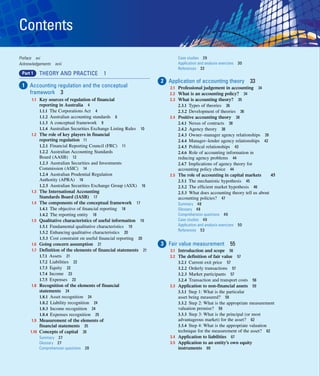
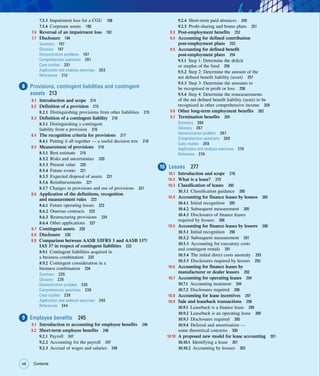
vi
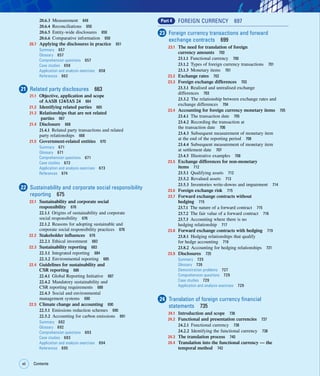
Contents
Preface xvi
Acknowledgements xviii
Part 1 THEORY AND PRACTICE 1
1 Accounting regulation and the conceptual
framework 3
 	1.1 Key sources of regulation of financial
reporting in Australia 4
1.1.1 The Corporations Act 4
1.1.2 Australian accounting standards 6
1.1.3 A conceptual framework 9
1.1.4 Australian Securities Exchange Listing Rules 10
 	
1.2 The role of key players in financial
reporting regulation 11
1.2.1 Financial Reporting Council (FRC) 11
1.2.2 Australian Accounting Standards
Board (AASB) 12
1.2.3 Australian Securities and Investments
Commission (ASIC) 14
1.2.4 Australian Prudential Regulation
Authority (APRA) 16
1.2.5 Australian Securities Exchange Group (ASX) 16
 	
1.3 The International Accounting
Standards Board (IASB) 17
 	
1.4 The components of the conceptual framework 17
1.4.1 The objective of financial reporting 18
1.4.2 The reporting entity 18
 	
1.5 Qualitative characteristics of useful information 19
1.5.1 Fundamental qualitative characteristics 19
1.5.2 Enhancing qualitative characteristics 20
1.5.3 Cost constraint on useful financial reporting 20
 	
1.6 Going concern assumption 21
 	1.7 Definition of the elements of financial statements 21
1.7.1 Assets 21
1.7.2 Liabilities 22
1.7.3 Equity 22
1.7.4 Income 23
1.7.5 Expenses 23
 	
1.8 Recognition of the elements of financial
statements 24
1.8.1 Asset recognition 24
1.8.2 Liability recognition 24
1.8.3 Income recognition 24
1.8.4 Expenses recognition 25
 	
1.9 Measurement of the elements of
financial statements 25
 	
1.10 Concepts of capital 26
Summary 27
Glossary 27
Comprehension questions 28
Case studies 29
Application and analysis exercises 30
References 32
2 Application of accounting theory 33
2.1 Professional judgement in accounting 34
2.2 What is an accounting policy? 34
2.3 What is accounting theory? 35
2.3.1 Types of theories 36
2.3.2 Development of theories 36
2.4 Positive accounting theory 38
2.4.1 Nexus of contracts 38
2.4.2 Agency theory 38
2.4.3 Owner–manager agency relationships 39
2.4.4 Manager–lender agency relationships 42
2.4.5 Political relationships 43
2.4.6 Role of accounting information in
reducing agency problems 44
2.4.7 Implications of agency theory for
accounting policy choice 44
2.5 The role of accounting in capital markets 45
2.5.1 The mechanistic hypothesis 45
2.5.2 The efficient market hypothesis 46
2.5.3 What does accounting theory tell us about
accounting policies? 47
Summary 48
Glossary 48
Comprehension questions 49
Case studies 49
Application and analysis exercises 50
References 53
3 Fair value measurement 55
3.1 Introduction and scope 56
3.2 The definition of fair value 57
3.2.1 Current exit price 57
3.2.2 Orderly transactions 57
3.2.3 Market participants 57
3.2.4 Transaction and transport costs 58
3.3 Application to non-financial assets 59
3.3.1 Step 1: What is the particular
asset being measured? 59
3.3.2 Step 2: What is the appropriate measurement
valuation premise? 59
3.3.3 Step 3: What is the principal (or most
advantageous market) for the asset? 62
3.3.4 Step 4: What is the appropriate valuation
technique for the measurement of the asset? 62
3.4 Application to liabilities 67
3.5	
Application to an entity’s own equity
instruments 69
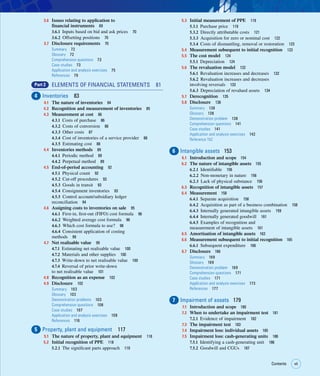
vii
Contents vii
3.6 Issues relating to application to
financial instruments 69
3.6.1 Inputs based on bid and ask prices 70
3.6.2 Offsetting positions 70
3.7 Disclosure requirements 70
Summary 72
Glossary 72
Comprehension questions 73
Case studies 73
Application and analysis exercises 75
References 79
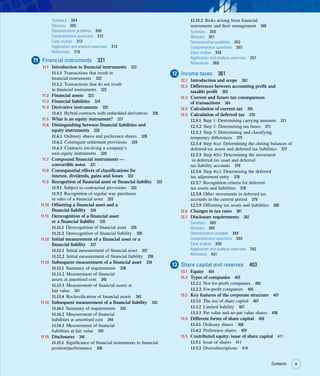
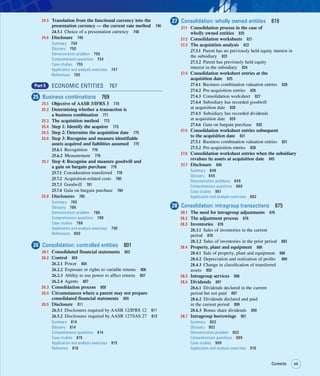
Part 2 ELEMENTS OF FINANCIAL STATEMENTS 81
4 Inventories 83
4.1 The nature of inventories 84
4.2 Recognition and measurement of inventories 85
4.3 Measurement at cost 86
4.3.1 Costs of purchase 86
4.3.2 Costs of conversion 86
4.3.3 Other costs 87
4.3.4 Cost of inventories of a service provider 88
4.3.5 Estimating cost 88
4.4 Inventories methods 89
4.4.1 Periodic method 89
4.4.2 Perpetual method 89
4.5 End-of-period accounting 92
4.5.1 Physical count 92
4.5.2 Cut-off procedures 93
4.5.3 Goods in transit 93
4.5.4 Consignment inventories 93
4.5.5 Control account/subsidiary ledger
reconciliation 94
4.6 Assigning costs to inventories on sale 95
4.6.1 First-in, first-out (FIFO) cost formula 96
4.6.2 Weighted average cost formula 96
4.6.3 Which cost formula to use? 98
4.6.4 Consistent application of costing
methods 99
4.7 Net realisable value 99
4.7.1 Estimating net realisable value 100
4.7.2 Materials and other supplies 100
4.7.3 Write-down to net realisable value 100
4.7.4 Reversal of prior write-down
to net realisable value 101
4.8 Recognition as an expense 102
4.9 Disclosure 102
Summary 103
Glossary 103
Demonstration problems 103
Comprehension questions 106
Case studies 107
Application and analysis exercises 108
References 116
5 Property, plant and equipment 117
5.1 The nature of property, plant and equipment 118
5.2 Initial recognition of PPE 118
5.2.1 The significant parts approach 119
5.3 Initial measurement of PPE 119
5.3.1 Purchase price 119
5.3.2 Directly attributable costs 121
5.3.3 Acquisition for zero or nominal cost 122
5.3.4 Costs of dismantling, removal or restoration 123
5.4 Measurement subsequent to initial recognition 123
5.5 The cost model 124
5.5.1 Depreciation 124
5.6 The revaluation model 132
5.6.1 Revaluation increases and decreases 132
5.6.2 Revaluation increases and decreases
involving reversals 133
5.6.3 Depreciation of revalued assets 134
5.7 Derecognition 135
5.8 Disclosure 136
Summary 138
Glossary 138
Demonstration problem 138
Comprehension questions 141
Case studies 141
Application and analysis exercises 142
Reference 152
6 Intangible assets 153
6.1 Introduction and scope 154
6.2 The nature of intangible assets 155
6.2.1 Identifiable 156
6.2.2 Non-monetary in nature 156
6.2.3 Lack of physical substance 156
6.3 Recognition of intangible assets 157
6.4 Measurement 158
6.4.1 Separate acquisition 158
6.4.2 Acquisition as part of a business combination 158
6.4.3 Internally generated intangible assets 159
6.4.4 Internally generated goodwill 161
6.4.5 Examples of recognition and
measurement of intangible assets 161
6.5 Amortisation of intangible assets 163
6.6 Measurement subsequent to initial recognition 165
6.6.1 Subsequent expenditure 166
6.7 Disclosure 166
Summary 169
Glossary 169
Demonstration problem 169
Comprehension questions 171
Case studies 171
Application and analysis exercises 173
References 177
7 Impairment of assets 179
7.1 Introduction and scope 180
7.2 When to undertake an impairment test 181
7.2.1 Evidence of impairment 182
7.3 The impairment test 183
7.4 Impairment loss: individual assets 185
7.5 Impairment loss: cash-generating units 186
7.5.1 Identifying a cash-generating unit 186
7.5.2 Goodwill and CGUs 187
viii Contents
viii
7.5.3 Impairment loss for a CGU 188
7.5.4 Corporate assets 190
7.6 Reversal of an impairment loss 192
7.7 Disclosure 194
Summary 197
Glossary 197
Demonstration problems 197
Comprehension questions 201
Case studies 201
Application and analysis exercises 203
References 212
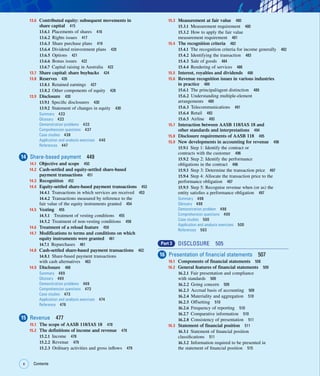
8 Provisions, contingent liabilities and contingent
assets 213
8.1 Introduction and scope 214
8.2 Definition of a provision 215
8.2.1 Distinguishing provisions from other liabilities 215
8.3 Definition of a contingent liability 216
8.3.1 Distinguishing a contingent
liability from a provision 216
8.4 The recognition criteria for provisions 217
8.4.1 Putting it all together — a useful decision tree 218
8.5 Measurement of provisions 219
8.5.1 Best estimate 219
8.5.2 Risks and uncertainties 220
8.5.3 Present value 220
8.5.4 Future events 221
8.5.5 Expected disposal of assets 221
8.5.6 Reimbursements 221
8.5.7 Changes in provisions and use of provisions 221
8.6 Application of the definitions, recognition
and measurement rules 223
8.6.1 Future operating losses 223
8.6.2 Onerous contracts 223
8.6.3 Restructuring provisions 224
8.6.4 Other applications 227
8.7 Contingent assets 230
8.8 Disclosure 230
8.9 Comparison between AASB 3/IFRS 3 and AASB 137/
IAS 37 in respect of contingent liabilities 233
8.9.1 Contingent liabilities acquired in
a business combination 233
8.9.2 Contingent consideration in a
business combination 234
Summary 235
Glossary 235
Demonstration problem 235
Comprehension questions 239
Case studies 239
Application and analysis exercises 240
References 244
9 Employee benefits 245
9.1 Introduction to accounting for employee benefits 246
9.2 Short-term employee benefits 246
9.2.1 Payroll 247
9.2.2 Accounting for the payroll 247
9.2.3 Accrual of wages and salaries 248
9.2.4 Short-term paid absences 249
9.2.5 Profit-sharing and bonus plans 251
9.3 Post-employment benefits 252
9.4 Accounting for defined contribution
post-employment plans 253
9.5 Accounting for defined benefit
post-employment plans 254
9.5.1 Step 1: Determine the deficit
or surplus of the fund 256
9.5.2 Step 2: Determine the amount of the
net defined benefit liability (asset) 257
9.5.3 Step 3: Determine the amounts to
be recognised in profit or loss 258
9.5.4 Step 4: Determine the remeasurements
of the net defined benefit liability (asset) to be
recognised in other comprehensive income 259
9.6 Other long-term employment benefits 262
9.7 Termination benefits 265
Summary 266
Glossary 267
Demonstration problem 267
Comprehension questions 269
Case studies 269
Application and analysis exercises 270
Reference 276
10 Leases 277
10.1 Introduction and scope 278
10.2 What is a lease? 279
10.3 Classification of leases 280
10.3.1 Classification guidance 280
10.4 Accounting for finance leases by lessees 285
10.4.1 Initial recognition 285
10.4.2 Subsequent measurement 285
10.4.3 Disclosures of finance leases
required by lessees 288
10.5 Accounting for finance leases by lessors 290
10.5.1 Initial recognition 290
10.5.2 Subsequent measurement 291
10.5.3 Accounting for executory costs
and contingent rentals 291
10.5.4 The initial direct costs anomaly 293
10.5.5 Disclosures required by lessors 293
10.6 Accounting for finance leases by
manufacturer or dealer lessors 293
10.7 Accounting for operating leases 294
10.7.1 Accounting treatment 294
10.7.2 Disclosures required 296
10.8 Accounting for lease incentives 297
10.9 Sale and leaseback transactions 298
10.9.1 Leaseback is a finance lease 299
10.9.2 Leaseback is an operating lease 300
10.9.3 Disclosures required 300
10.9.4 Deferral and amortisation —
some theoretical concerns 300
10.10 A proposed new model for lease accounting 301
10.10.1 Identifying a lease 301
10.10.2 Accounting by lessees 302
ix
Contents ix
Summary 304
Glossary 305
Demonstration problems 305
Comprehension questions 312
Case studies 312
Application and analysis exercises 313
References 319
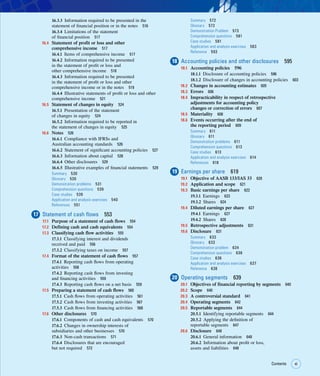
11 Financial instruments 321
11.1 Introduction to financial instruments 322
11.1.1 Transactions that result in
financial instruments 322
11.1.2 Transactions that do not result
in financial instruments 322
11.2 Financial assets 323
11.3 Financial liabilities 324
11.4 Derivative instruments 325
11.4.1 Hybrid contracts with embedded derivatives 326
11.5 What is an equity instrument? 327
11.6 Distinguishing between financial liabilities and
equity instruments 328
11.6.1 Ordinary shares and preference shares 328
11.6.2 Contingent settlement provisions 329
11.6.3 Contracts involving a company’s
own equity instruments 329
11.7 Compound financial instruments —
convertible notes 331
11.8 Consequential effects of classifications for
interest, dividends, gains and losses 332
11.9 Recognition of financial asset or financial liability 333
11.9.1 Subject to contractual provisions 333
11.9.2 Recognition of regular way purchases
or sales of a financial asset 333
11.10 Offsetting a financial asset and a
financial liability 334
11.11 Derecognition of a financial asset
or a financial liability 335
11.11.1 Derecognition of financial asset 335
11.11.2 Derecognition of financial liability 335
11.12 Initial measurement of a financial asset or a
financial liability 337
11.12.1 Initial measurement of financial asset 337
11.12.2 Initial measurement of financial liability 338
11.13 Subsequent measurement of a financial asset 339
11.13.1 Summary of requirements 339
11.13.2 Measurement of financial
assets at amortised cost 340
11.13.3 Measurement of financial assets at
fair value 341
11.13.4 Reclassification of financial assets 343
11.14 Subsequent measurement of a financial liability 343
11.14.1 Summary of requirements 343
11.14.2 Measurement of financial
liabilities at amortised cost 344
11.14.3 Measurement of financial
liabilities at fair value 345
11.15 Disclosures 346
11.15.1 Significance of financial instruments to financial
position/performance 346
11.15.2 Risks arising from financial
instruments and their management 349
Summary 350
Glossary 351
Demonstration problems 352
Comprehension questions 355
Case studies 356
Application and analysis exercises 357
References 360
12 Income taxes 361
12.1 Introduction and scope 362
12.2 Differences between accounting profit and
taxable profit 363
12.3 Current and future tax consequences
of transactions 364
12.4 Calculation of current tax 365
12.5 Calculation of deferred tax 370
12.5.1 Step 1: Determining carrying amounts 371
12.5.2 Step 2: Determining tax bases 371
12.5.3 Step 3: Determining and classifying
temporary differences 375
12.5.4 Step 4(a): Determining the closing balances of
deferred tax assets and deferred tax liabilities 377
12.5.5 Step 4(b): Determining the movement
in deferred tax asset and deferred
tax liability accounts 378
12.5.6 Step 4(c): Determining the deferred
tax adjustment entry 378
12.5.7 Recognition criteria for deferred
tax assets and liabilities 378
12.5.8 Other movements in deferred tax
accounts in the current period 379
12.5.9 Offsetting tax assets and liabilities 380
12.6 Changes in tax rates 381
12.7 Disclosure requirements 382
Summary 385
Glossary 385
Demonstration problem 385
Comprehension questions 390
Case studies 390
Application and analysis exercises 392
Reference 401
13 Share capital and reserves 403
13.1 Equity 404
13.2 Types of companies 405
13.2.1 Not-for-profit companies 405
13.2.2 For-profit companies 405
13.3 Key features of the corporate structure 407
13.3.1 The use of share capital 407
13.3.2 Limited liability 407
13.3.3 Par value and no-par value shares 408
13.4 Different forms of share capital 408
13.4.1 Ordinary shares 408
13.4.2 Preference shares 409
13.5 Contributed equity: issue of share capital 411
13.5.1 Issue of shares 411
13.5.2 Oversubscriptions 414
x Contents
x
13.6 Contributed equity: subsequent movements in
share capital 415
13.6.1 Placements of shares 416
13.6.2 Rights issues 417
13.6.3 Share purchase plans 419
13.6.4 Dividend reinvestment plans 420
13.6.5 Options 421
13.6.6 Bonus issues 422
13.6.7 Capital raising in Australia 422
13.7 Share capital: share buybacks 424
13.8 Reserves 426
13.8.1 Retained earnings 427
13.8.2 Other components of equity 428
13.9 Disclosure 430
13.9.1 Specific disclosures 430
13.9.2 Statement of changes in equity 430
Summary 433
Glossary 433
Demonstration problems 433
Comprehension questions 437
Case studies 438
Application and analysis exercises 440
References 447
14 Share-based payment 449
14.1 Objective and scope 450
14.2 Cash-settled and equity-settled share-based
payment transactions 451
14.3 Recognition 452
14.4 Equity-settled share-based payment transactions 453
14.4.1 Transactions in which services are received 453
14.4.2 Transactions measured by reference to the
fair value of the equity instruments granted 454
14.5 Vesting 455
14.5.1 Treatment of vesting conditions 455
14.5.2 Treatment of non-vesting conditions 458
14.6 Treatment of a reload feature 459
14.7 Modifications to terms and conditions on which
equity instruments were granted 461
14.7.1 Repurchases 461
14.8 Cash-settled share-based payment transactions 462
14.8.1 Share-based payment transactions
with cash alternatives 463
14.9 Disclosure 466
Summary 469
Glossary 469
Demonstration problems 469
Comprehension questions 473
Case studies 473
Application and analysis exercises 474
Reference 476
15 Revenue 477
15.1 The scope of AASB 118/IAS 18 478
15.2 The definitions of income and revenue 478
15.2.1 Income 478
15.2.2 Revenue 479
15.2.3 Ordinary activities and gross inflows 479
15.3 Measurement at fair value 480
15.3.1 Measurement requirement 480
15.3.2 How to apply the fair value
measurement requirement 481
15.4 The recognition criteria 482
15.4.1 The recognition criteria for income generally 482
15.4.2 Identifying the transaction 483
15.4.3 Sale of goods 484
15.4.4 Rendering of services 486
15.5 Interest, royalties and dividends 488
15.6 Revenue recognition issues in various industries
in practice 489
15.6.1 The principal/agent distinction 489
15.6.2 Understanding multiple-element
arrangements 489
15.6.3 Telecommunications 491
15.6.4 Retail 493
15.6.5 Airline 493
15.7 Interaction between AASB 118/IAS 18 and
other standards and interpretations 494
15.8 Disclosure requirements of AASB 118 495
15.9 New developments in accounting for revenue 496
15.9.1 Step 1: Identify the contract or
contracts with the customer 496
15.9.2 Step 2: Identify the performance
obligations in the contract 496
15.9.3 Step 3: Determine the transaction price 497
15.9.4 Step 4: Allocate the transaction price to the
performance obligation 497
15.9.5 Step 5: Recognise revenue when (or as) the
entity satisfies a performance obligation 497
Summary 498
Glossary 498
Demonstration problem 498
Comprehension questions 499
Case studies 500
Application and analysis exercises 500
References 503
Part 3 DISCLOSURE 505
16 Presentation of financial statements 507
16.1 Components of financial statements 508
16.2 General features of financial statements 509
16.2.1 Fair presentation and compliance
with standards 509
16.2.2 Going concern 509
16.2.3 Accrual basis of accounting 509
16.2.4 Materiality and aggregation 510
16.2.5 Offsetting 510
16.2.6 Frequency of reporting 510
16.2.7 Comparative information 510
16.2.8 Consistency of presentation 511
16.3 Statement of financial position 511
16.3.1 Statement of financial position
classifications 511
16.3.2 Information required to be presented in
the statement of financial position 515
xi
Contents xi
16.3.3 Information required to be presented in the
statement of financial position or in the notes 516
16.3.4 Limitations of the statement
of financial position 517
16.4 Statement of profit or loss and other
comprehensive income 517
16.4.1 Items of comprehensive income 517
16.4.2 Information required to be presented
in the statement of profit or loss and
other comprehensive income 518
16.4.3 Information required to be presented
in the statement of profit or loss and other
comprehensive income or in the notes 519
16.4.4 Illustrative statements of profit or loss and other
comprehensive income 521
16.5 Statement of changes in equity 524
16.5.1 Presentation of the statement
of changes in equity 524
16.5.2 Information required to be reported in
the statement of changes in equity 525
16.6 Notes 526
16.6.1 Compliance with IFRSs and
Australian accounting standards 526
16.6.2 Statement of significant accounting policies 527
16.6.3 Information about capital 528
16.6.4 Other disclosures 529
16.6.5 Illustrative examples of financial statements 529
Summary 530
Glossary 530
Demonstration problems 531
Comprehension questions 539
Case studies 539
Application and analysis exercises 540
References 551
17 Statement of cash flows 553
17.1 Purpose of a statement of cash flows 554
17.2 Defining cash and cash equivalents 554
17.3 Classifying cash flow activities 555
17.3.1 Classifying interest and dividends
received and paid 556
17.3.2 Classifying taxes on income 557
17.4 Format of the statement of cash flows 557
17.4.1 Reporting cash flows from operating
activities 558
17.4.2 Reporting cash flows from investing
and financing activities 559
17.4.3 Reporting cash flows on a net basis 559
17.5 Preparing a statement of cash flows 560
17.5.1 Cash flows from operating activities 561
17.5.2 Cash flows from investing activities 567
17.5.3 Cash flows from financing activities 568
17.6 Other disclosures 570
17.6.1 Components of cash and cash equivalents 570
17.6.2 Changes in ownership interests of
subsidiaries and other businesses 570
17.6.3 Non-cash transactions 571
17.6.4 Disclosures that are encouraged
but not required 572
Summary 572
Glossary 572
Demonstration Problem 573
Comprehension questions 581
Case studies 581
Application and analysis exercises 583
Reference 593
18 Accounting policies and other disclosures 595
18.1 Accounting policies 596
18.1.1 Disclosure of accounting policies 596
18.1.2 Disclosure of changes in accounting policies 603
18.2 Changes in accounting estimates 605
18.3 Errors 606
18.4 Impracticability in respect of retrospective
adjustments for accounting policy
changes or correction of errors 607
18.5 Materiality 608
18.6 Events occurring after the end of
the reporting period 609
Summary 611
Glossary 611
Demonstration problems 611
Comprehension questions 613
Case studies 613
Application and analysis exercises 614
References 618
19 Earnings per share 619
19.1 Objective of AASB 133/IAS 33 620
19.2 Application and scope 621
19.3 Basic earnings per share 622
19.3.1 Earnings 623
19.3.2 Shares 624
19.4 Diluted earnings per share 627
19.4.1 Earnings 627
19.4.2 Shares 628
19.5 Retrospective adjustments 631
19.6 Disclosure 631
Summary 633
Glossary 633
Demonstration problem 634
Comprehension questions 636
Case studies 636
Application and analysis exercises 637
Reference 638
20 Operating segments 639
20.1 Objectives of financial reporting by segments 640
20.2 Scope 640
20.3 A controversial standard 641
20.4 Operating segments 642
20.5 Reportable segments 644
20.5.1 Identifying reportable segments 644
20.5.2 Applying the definition of
reportable segments 647
20.6 Disclosure 648
20.6.1 General information 648
20.6.2 Information about profit or loss,
assets and liabilities 648
xii Contents
xii
20.6.3 Measurement 649
20.6.4 Reconciliations 650
20.6.5 Entity-wide disclosures 650
20.6.6 Comparative information 650
20.7 Applying the disclosures in practice 651
Summary 657
Glossary 657
Comprehension questions 657
Case studies 658
Application and analysis exercises 658
References 662
21 Related party disclosures 663
21.1 Objective, application and scope
of AASB 124/IAS 24 664
21.2 Identifying related parties 665
21.3 Relationships that are not related
parties 667
21.4 Disclosure 668
21.4.1 Related party transactions and related
party relationships 668
21.5 Government-related entities 670
Summary 671
Glossary 671
Comprehension questions 671
Case studies 672
Application and analysis exercises 673
References 674
22 Sustainability and corporate social responsibility
reporting 675
22.1 Sustainability and corporate social
responsibility 676
22.1.1 Origins of sustainability and corporate
social responsibility 676
22.1.2 Reasons for adopting sustainable and
corporate social responsibility practices 676
22.2 Stakeholder influences 678
22.2.1 Ethical investment 683
22.3 Sustainability reporting 683
22.3.1 Integrated reporting 684
22.3.2 Environmental reporting 685
22.4 Guidelines for sustainability and
CSR reporting 686
22.4.1 Global Reporting Initiative 687
22.4.2 Mandatory sustainability and
CSR reporting requirements 688
22.4.3 Social and environmental
management systems 690
22.5 Climate change and accounting 690
22.5.1 Emissions reduction schemes 690
22.5.2 Accounting for carbon emissions 691
Summary 692
Glossary 692
Comprehension questions 693
Case studies 693
Application and analysis exercises 694
References 695
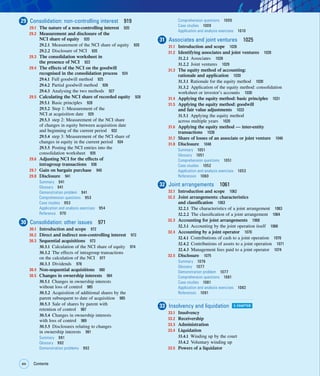
Part 4 FOREIGN CURRENCY 697
23 Foreign currency transactions and forward
exchange contracts 699
23.1 The need for translation of foreign
currency amounts 700
23.1.1 Functional currency 700
23.1.2 Types of foreign currency transactions 701
23.1.3 Monetary items 701
23.2 Exchange rates 702
23.3 Foreign exchange differences 703
23.3.1 Realised and unrealised exchange
differences 703
23.3.2 The relationship between exchange rates and
exchange differences 704
23.4 Accounting for foreign currency monetary items 705
23.4.1 The transaction date 705
23.4.2 Recording the transaction at
the transaction date 706
23.4.3 Subsequent measurement of monetary item
at the end of the reporting period 706
23.4.4 Subsequent measurement of monetary item
at settlement date 707
23.4.5 Illustrative examples 708
23.5 Exchange differences for non-monetary
items 712
23.5.1 Qualifying assets 712
23.5.2 Revalued assets 713
23.5.3 Inventories write-downs and impairment 714
23.6 Foreign exchange risk 715
23.7 Forward exchange contracts without
hedging 715
23.7.1 The nature of a forward contract 715
23.7.2 The fair value of a forward contract 716
23.7.3 Accounting where there is no
hedging relationship 717
23.8 Forward exchange contracts with hedging 719
23.8.1 Hedging relationships that qualify
for hedge accounting 719
23.8.2 Accounting for hedging relationships 721
23.9 Disclosures 725
Summary 725
Glossary 726
Demonstration problems 727
Comprehension questions 729
Case studies 729
Application and analysis exercises 729
24 Translation of foreign currency financial
statements 735
24.1 Introduction and scope 736
24.2 Functional and presentation currencies 737
24.2.1 Functional currency 738
24.2.2 Identifying the functional currency 738
24.3 The translation process 740
24.4 Translation into the functional currency — the
temporal method 742
xiii
Contents xiii
24.5 Translation from the functional currency into the
presentation currency — the current rate method 746
24.5.1 Choice of a presentation currency 748
24.6 Disclosure 749
Summary 750
Glossary 750
Demonstration problem 750
Comprehension questions 754
Case studies 755
Application and analysis exercises 757
References 765
Part 5 ECONOMIC ENTITIES 767
25 Business combinations 769
25.1 Objective of AASB 3/IFRS 3 770
25.2 Determining whether a transaction is
a business combination 771
25.3 The acquisition method 773
25.4 Step 1: Identify the acquirer 773
25.5 Step 2: Determine the acquisition date 775
25.6 Step 3: Recognise and measure identifiable
assets acquired and liabilities assumed 775
25.6.1 Recognition 776
25.6.2 Measurement 776
25.7 Step 4: Recognise and measure goodwill and
a gain on bargain purchase 778
25.7.1 Consideration transferred 778
25.7.2 Acquisition-related costs 780
25.7.3 Goodwill 781
25.7.4 Gain on bargain purchase 784
25.8 Disclosures 785
Summary 785
Glossary 786
Demonstration problem 786
Comprehension questions 788
Case studies 788
Application and analysis exercises 790
References 800
26 Consolidation: controlled entities 801
26.1 Consolidated financial statements 802
26.2 Control 804
26.2.1 Power 804
26.2.2 Exposure or rights to variable returns 806
26.2.3 Ability to use power to affect returns 807
26.2.4 Agents 807
26.3 Consolidation process 808
26.4 Circumstances where a parent may not prepare
consolidated financial statements 809
26.5 Disclosure 811
26.5.1 Disclosures required by AASB 12/IFRS 12 811
26.5.2 Disclosures required by AASB 127/IAS 27 813
Summary 814
Glossary 814
Comprehension questions 814
Case studies 815
Application and analysis exercises 815
Reference 818
27 Consolidation: wholly owned entities 819
27.1 Consolidation process in the case of
wholly owned entities 820
27.2 Consolidation worksheets 821
27.3 The acquisition analysis 822
27.3.1 Parent has no previously held equity interest in
the subsidiary 823
27.3.2 Parent has previously held equity
interest in the subsidiary 824
27.4 Consolidation worksheet entries at the
acquisition date 825
27.4.1 Business combination valuation entries 826
27.4.2 Pre-acquisition entries 826
27.4.3 Consolidation worksheet 827
27.4.4 Subsidiary has recorded goodwill
at acquisition date 828
27.4.5 Subsidiary has recorded dividends
at acquisition date 829
27.4.6 Gain on bargain purchase 830
27.5 Consolidation worksheet entries subsequent
to the acquisition date 831
27.5.1 Business combination valuation entries 831
27.5.2 Pre-acquisition entries 838
27.6 Consolidation worksheet entries when the subsidiary
revalues its assets at acquisition date 845
27.7 Disclosure 846
Summary 848
Glossary 849
Demonstration problems 849
Comprehension questions 860
Case studies 861
Application and analysis exercises 862
28 Consolidation: intragroup transactions 875
28.1 The need for intragroup adjustments 876
28.2 The adjustment process 876
28.3 Inventories 878
28.3.1 Sales of inventories in the current
period 878
28.3.2 Sales of inventories in the prior period 883
28.4 Property, plant and equipment 886
28.4.1 Sale of property, plant and equipment 886
28.4.2 Depreciation and realisation of profits 889
28.4.3 Change in classification of transferred
assets 892
28.5 Intragroup services 896
28.6 Dividends 897
28.6.1 Dividends declared in the current
period but not paid 897
28.6.2 Dividends declared and paid
in the current period 899
28.6.3 Bonus share dividends 899
28.7 Intragroup borrowings 901
Summary 903
Glossary 903
Demonstration problem 903
Comprehension questions 909
Case studies 909
Application and analysis exercises 910
xiv Contents
xiv
29 Consolidation: non-controlling interest 919
29.1 The nature of a non-controlling interest 920
29.2 Measurement and disclosure of the
NCI share of equity 920
29.2.1 Measurement of the NCI share of equity 920
29.2.2 Disclosure of NCI 920
29.3 The consolidation worksheet in
the presence of NCI 923
29.4 The effects of the NCI on the goodwill
recognised in the consolidation process 924
29.4.1 Full goodwill method 925
29.4.2 Partial goodwill method 926
29.4.3 Analysing the two methods 927
29.5 Calculating the NCI share of recorded equity 928
29.5.1 Basic principles 928
29.5.2 Step 1: Measurement of the
NCI at acquisition date 929
29.5.3 step 2: Measurement of the NCI share
of changes in equity between acquisition date
and beginning of the current period 932
29.5.4 step 3: Measurement of the NCI share of
changes in equity in the current period 934
29.5.5 Posting the NCI entries into the
consolidation worksheet 935
29.6 Adjusting NCI for the effects of
intragroup transactions 936
29.7 Gain on bargain purchase 940
29.8 Disclosure 941
Summary 941
Glossary 941
Demonstration problem 941
Comprehension questions 953
Case studies 953
Application and analysis exercises 954
Reference 970
30 Consolidation: other issues 971
30.1 Introduction and scope 972
30.2 Direct and indirect non-controlling interest 972
30.3 Sequential acquisitions 973
30.3.1 Calculation of the NCI share of equity 974
30.3.2 The effects of intragroup transactions
on the calculation of the NCI 977
30.3.3 Dividends 978
30.4 Non-sequential acquisitions 980
30.5 Changes in ownership interests 984
30.5.1 Changes in ownership interests
without loss of control 985
30.5.2 Acquisition of additional shares by the
parent subsequent to date of acquisition 985
30.5.3 Sale of shares by parent with
retention of control 987
30.5.4 Changes in ownership interests
with loss of control 989
30.5.5 Disclosures relating to changes
in ownership interests 991
Summary 991
Glossary 992
Demonstration problems 992
Comprehension questions 1009
Case studies 1009
Application and analysis exercises 1010
31 Associates and joint ventures 1025
31.1 Introduction and scope 1026
31.2 Identifying associates and joint ventures 1028
31.2.1 Associates 1028
31.2.2 Joint ventures 1029
31.3 The equity method of accounting:
rationale and application 1030
31.3.1 Rationale for the equity method 1030
31.3.2 Application of the equity method: consolidation
worksheet or investor’s accounts 1030
31.4 Applying the equity method: basic principles 1031
31.5 Applying the equity method: goodwill
and fair value adjustments 1033
31.5.1 Applying the equity method
across multiple years 1035
31.6 Applying the equity method — inter-entity
transactions 1038
31.7 Share of losses of an associate or joint venture 1046
31.8 Disclosure 1048
Summary 1051
Glossary 1051
Comprehension questions 1051
Case studies 1052
Application and analysis exercises 1053
References 1060
32 Joint arrangements 1061
32.1 Introduction and scope 1062
32.2 Joint arrangements: characteristics
and classification 1063
32.2.1 The characteristics of a joint arrangement 1063
32.2.2 The classification of a joint arrangement 1064
32.3 Accounting for joint arrangements 1068
32.3.1 Accounting by the joint operation itself 1068
32.4 Accounting by a joint operator 1070
32.4.1 Contributions of cash to a joint operation 1070
32.4.2 Contributions of assets to a joint operation 1071
32.4.3 Management fees paid to a joint operator 1074
32.5 Disclosure 1075
Summary 1076
Glossary 1077
Demonstration problem 1077
Comprehension questions 1081
Case studies 1081
Application and analysis exercises 1082
References 1091
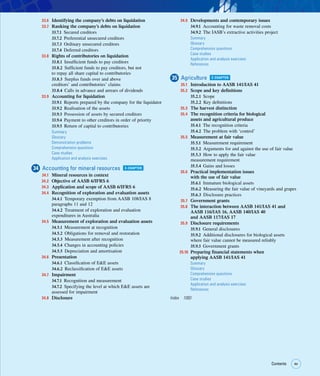
33 Insolvency and liquidation E-CHAPTER
33.1 Insolvency
33.2 Receivership
33.3 Administration
33.4 Liquidation
33.4.1 Winding up by the court
33.4.2 Voluntary winding up
33.5 Powers of a liquidator
Visit https://testbankfan.com
now to explore a rich
collection of testbank or
solution manual and enjoy
exciting offers!
xv
Contents xv
33.6 Identifying the company’s debts on liquidation
33.7 Ranking the company’s debts on liquidation
33.7.1 Secured creditors
33.7.2 Preferential unsecured creditors
33.7.3 Ordinary unsecured creditors
33.7.4 Deferred creditors
33.8 Rights of contributories on liquidation
33.8.1 Insufficient funds to pay creditors
33.8.2 Sufficient funds to pay creditors, but not
to repay all share capital to contributories
33.8.3 Surplus funds over and above
creditors’ and contributories’ claims
33.8.4 Calls in advance and arrears of dividends
33.9 Accounting for liquidation
33.9.1 Reports prepared by the company for the liquidator
33.9.2 Realisation of the assets
33.9.3 Possession of assets by secured creditors
33.9.4 Payment to other creditors in order of priority
33.9.5 Return of capital to contributories
Summary
Glossary
Demonstration problems
Comprehension questions
Case studies
Application and analysis exercises
34 Accounting for mineral resources E-CHAPTER
34.1 Mineral resources in context
34.2 Objective of AASB 6/IFRS 6
34.3 Application and scope of AASB 6/IFRS 6
34.4 Recognition of exploration and evaluation assets
34.4.1 Temporary exemption from AASB 108/IAS 8
paragraphs 11 and 12
34.4.2 Treatment of exploration and evaluation
expenditures in Australia
34.5 Measurement of exploration and evaluation assets
34.5.1 Measurement at recognition
34.5.2 Obligations for removal and restoration
34.5.3 Measurement after recognition
34.5.4 Changes in accounting policies
34.5.5 Depreciation and amortisation
34.6 Presentation
34.6.1 Classification of EE assets
34.6.2 Reclassification of EE assets
34.7 Impairment
34.7.1 Recognition and measurement
34.7.2 Specifying the level at which EE assets are
assessed for impairment
34.8 Disclosure
34.9 Developments and contemporary issues
34.9.1 Accounting for waste removal costs
34.9.2 The IASB’s extractive activities project
Summary
Glossary
Comprehension questions
Case studies
Application and analysis exercises
References
35 Agriculture E-CHAPTER
35.1 Introduction to AASB 141/IAS 41
35.2 Scope and key definitions
35.2.1 Scope
35.2.2 Key definitions
35.3 The harvest distinction
35.4 The recognition criteria for biological
assets and agricultural produce
35.4.1 The recognition criteria
35.4.2 The problem with ‘control’
35.5 Measurement at fair value
35.5.1 Measurement requirement
35.5.2 Arguments for and against the use of fair value
35.5.3 How to apply the fair value
measurement requirement
35.5.4 Gains and losses
35.6 Practical implementation issues
with the use of fair value
35.6.1 Immature biological assets
35.6.2 Measuring the fair value of vineyards and grapes
35.6.3 Disclosure practices
35.7 Government grants
35.8 The interaction between AASB 141/IAS 41 and
AASB 116/IAS 16, AASB 140/IAS 40
and AASB 117/IAS 17
35.9 Disclosure requirements
35.9.1 General disclosures
35.9.2 Additional disclosures for biological assets
where fair value cannot be measured reliably
35.9.3 Government grants
35.10 Preparing financial statements when
applying AASB 141/IAS 41
Summary
Glossary
Comprehension questions
Case studies
Application and analysis exercises
References
Index 1093
xvi
xvi Preface
Preface
We are excited to present the first edition of Financial Reporting! This new text builds on the strengths of
Understanding Australian Accounting Standards (Loftus) and Company Accounting (Leo), bringing the strongest
elements of those two respected titles into one combined volume.
Financial Reporting is designed to be used in the second and third year financial accounting courses. It covers
all the topics typically taught across two units, including company regulation, the conceptual framework, applying
accounting standards, disclosures and consolidations.
Our aim was to produce a book that explained accounting principles and practice to students in a clear, under-
standable way. In endeavouring to make accounting more understandable to students we have not lost sight of
the fact that Accounting Standards are principles-based. An understanding of the conceptual basis of accounting
and the rationale behind the principles espoused in particular standards is crucial to their consistent application
in a variety of practical contexts. The text then provides both a conceptual understanding as well as a practical
application of accounting standards.
At the time of writing the International Accounting Standards Board had several major projects on its agenda
that have implications for topics covered in this book, including financial instruments, revenue and leases. The
following discussion explains how those projects and the ensuing changes to accounting standards have been
treated in this book.
Accounting for financial instruments is regulated by AASB 132/IAS 32 Financial Instruments: Presentations,
AASB 7/IFRS 7 Financial Instruments: Disclosures and either AASB 139/IAS 39 Financial Instruments: Recog-
nition and Measurement or AASB 9/IFRS 9 Financial Instruments, which is effective from 1 January 2018 with
early adoption permitted. Much of the coverage of recognition and measurement issues in the financial instru-
ments chapter is based on AASB 9/IFRS 9 in anticipation of the Standard becoming effective from 1 January
2015, as per the scheduled operative date at the time of writing. However, impairment of financial instruments is
based on AASB 139/IAS 39 due to the timing of revision to that section of AASB 9/IFRS 9. Occasional refer-
ence is also made to AASB 139/IAS 39 in explaining terms, such as transaction costs, where AASB 9/IFRS 9
defers to the earlier standard for definitions.
In May 2014, the IASB issued IFRS 15 Revenue from Contracts with Customers, with the AASB following suit
with the issue of AASB 15 Revenue from Contracts with Customers in December 2014. When effective, that is,
from 1 January 2017, AASB 15/IFRS 15 will replace the current suite of pronouncements that regulate accounting
for revenue and other income — namely, AASB 111/IAS 11 Construction Contacts, AASB 118/IAS 18 Revenue,
AASB Interpretation 13/IFRIC 13 Customer Loyalty Programmes, AASB Interpretation 15/IFRIC 15 Agreements
for the Construction of Real Estate, AASB Interpretation 18/IFRIC 18 Transfers of Assets from Customers and
AASB Interpretation 131/SIC-31 Revenue — Barter Transactions Involving Advertising Services. The chapter on
revenue is based on the currently applicable standards and interpretations, with a section devoted to the principles
of AASB 15/IFRS 15 and their application.
A new IFRS on leases has been scheduled for release in the second half of 2015. Accordingly, the approach
adopted in this book is based on AASB 117/IAS 17 Leases, supplemented by comprehensive coverage of the
approach adopted by the IASB in developing the proposed new standard. The section explains the principles
embodied in the new approach and illustrates their application.
Learning design
We recognise that a university textbook should not be written for practising accountants, but for those who are
learning accounting prior to entering the accounting profession. Besides making explanations as simple as poss-
ible, we have not tried to cover everything that an accounting practitioner needs to know. We recognise that
university students will undertake further education and professional qualifications. Hence, we have provided
students with the basis necessary for further study. We see it as important that the basic principles are clear and
well understood before more difficult issues are discussed.
The author team has brought their collective teaching insights to bear on the learning design of the
text — the hallmark features of which include: an optimised mix of basic, moderate and difficult illustrative
examples; a similar graduation with the end-of-chapter questions; applications in the form of case studies;
and end-of-section learning checks to assist students to understand what they should now know and/or be
able to do.
xvii
xvii
Preface
Concepts for review. This feature lists the prerequisite knowledge students need in order to understand the
chapter. It prompts students to revise those concepts should they need to.
Learning objectives. The learning objectives have been designed to articulate into the broader Accounting
Threshold Learning Objectives. They reflect the level of knowledge and skill that an accounting major should
have acquired after studying each section of the chapter.
Key terms. The important terminology introduced in the chapter is bolded and coloured. These key terms help
students identify the most important concepts. They are also listed at the end of each chapter to help students
assess their knowledge.
AASB standards. Quotes from the AASB standards and explanations are included throughout the text. The
equivalent international standard is also noted.
Illustrative examples. In each chapter a range of illustrative examples are provided to model how accounting
principles are applied. The aim is to enable students to gradually build their understanding and skills by pro-
viding lower level examples initially and then progressing to more detailed scenarios as the chapter progresses.
Learning checks. A list of the main points covered in the topic appears at the end of every section. This helps
students to revise and assess whether they need to study the section more before proceeding to the next one.
Chapter summaries. Each chapter concludes with a succinct overview of the key concepts and processes dis-
cussed in the chapter.
Application and analysis exercises. End of chapter exercises allow students to test their progress and whether
they have understood what they have read. These exercises require the student to apply their knowledge to
specific problems and scenarios and are at graduated levels of difficulty, allowing students to build confidence by
achieving success with basic problems before tackling the more complex tasks.
Case studies. The case studies require the students to write a report explaining the accounting concepts relevant
to a particular example/scenario. As part of this, they may have to solve problems, but the focus is on explaining the
concepts.
Comprehension questions. Comprehension questions require the student to discuss, explain or apply a concept
rather than simply restate it.
Threshold Learning Outcomes. There is a growing demand for graduates with strong skills in communication,
problem solving, critical thinking and judgement, and the need to provide assurance that graduates have devel-
oped these skills. To this end, Threshold Learning Outcomes for accounting bachelors and coursework masters
degrees have been developed. This text supports the development of these learning outcomes by highlighting
which skills are developed across the end-of-chapter application and analysis exercises
WileyPLUS. The text is accompanied by a WileyPLUS course featuring algorithmic versions of most of the
end-of-chapter questions plus animated examples of the key demonstration problems from the text with additional
explanatory content to facilitate student self-study.
Supplementary materials
Financial Reporting 1st Edition is supported with an extensive teaching and learning resources supplementary
package.
•
• WileyPLUS is a research-based online environment for effective teaching and learning. With WileyPLUS, lecturers
can prepare, assign and grade accounting activities simply and in a time-efficient manner. WileyPLUS increases
student confidence through an innovative design that allows greater engagement, which leads to improved learning
outcomes. For more information, contact your John Wiley  Sons sales consultant or visit www.wileyplus.com.
•
• A solutions manual containing worked solutions to all end-of-chapter discussion questions, exercises, prob-
lems, case studies and activities is available for lecturers who prescribe this text. The solutions manual has
been thoroughly checked for accuracy and correctness.
•
• PowerPoint Presentations contain over 1000 slides with summaries of key concepts and processes presented in
the chapter as well as key diagrams and worked examples from the text.
•
• A testbank contains over 1000 multiple-choice questions designed to test students’ knowledge and under-
standing of the key concepts from the text.
Janice Loftus
Ken Leo
Noel Boys
Belinda Luke
Sorin Daniliuc
Hong Nee Ang
Karyn Byrnes
March 2015
xviii
xviii Acknowledgements
Acknowledgements
The authors and publisher would like to thank the following copyright holders, organisations and individuals for
their permission to reproduce copyright material in this book.
Images
• © 123RF: 5 maridav; 35 zstockphotos; 58 Dmytro Nikitin; 160 Stanislav Komogorov; 193 stockbroker; 223
conceptw; 250 pressmaster; 256 ximagination; 284 limonzest; 302, 461 dotshock; 328 andreypopov; 338 worradirek;
369 Wavebreak Media Ltd; 412 Attila Alexovics; 414 imtmphoto; 454, 1074 Cathy Yeulet. • © Financial Reporting
Council: 11 From the Financial Reporting Council, Australian Accounting Standards Board and Auditing and Assur-
ance Standards Board annual reports 2007–2008, p. 8. Reproduced with permission from the Financial Reporting
Council. • © Australian Accounting Standards Board: 13, 336, 458, 1065, 1067 © Commonwealth of Australia 2015.
All legislation herein is reproduced by permission but does not purport to be the official or authorised version. It is
subject to Commonwealth of Australia copyright. The Copyright Act 1968 permits certain reproduction and publi-
cation of Commonwealth legislation. In particular, s.182A of the Act enables a complete copy to be made by or on
behalf of a particular person. For reproduction or publication beyond that permitted by the Act, permission should
be sought in writing from the Commonwealth available from the Australian Accounting Standards Board. Requests
in the first instance should be addressed to the Administration Director, Australian Accounting Standards Board, PO
Box 204, Collins Street West, Melbourne, Victoria, 8007. • © Shutterstock.com: 94 Skydive Erick; 121 Creativa; 481
Diego Cervo; 486 terekhov igor; 520 Chuck Rausin; 570 CandyBox Images; 605 alterfalter; 610 Zastolskiy Victor;
623 buket bariskan; 626 Stuart Jenner; 642 Andresr; 644, 666 bikeriderlondon; 667 Hans Kim; 710 Shai_Halud; 718
NAN728; 744 bopav; 747 Chukcha; 777 Corepics VOF; 784, 975 Pressmaster; 885 Benjamin Haas; 895 auremar; 938
nata-lunata; 985 SpeedKingz; 1031 karelnoppe; 1042 Yuangeng Zhang; 1068 krsmanovic. • © Ernst  Young Australia:
218, 643, 646 Reproduced with permission from Ernst  Young Australia. • © BHP Billiton: 677. • © ANZ Banking
Group Limited: 678. • © AGL: 679.
Text
• © Australian Securities  Investments Commission: 7–8 Regulatory Guide 85, Reporting requirements for non-
reporting entities, July 2005, Section 2, pp. 5–6. Reproduced with permission. 14 Reproduced with permission.
14–6 14-141MR Findings from 31 December 2013 financial reports, 27 June. Reproduced with permission. 423–4
From Financial System Inquiry: Submission by the Australian Securities and Investments Commission, April 2014,
pp. 154–6. Reproduced with permission. • © CSR Limited: 41–2, 597–602, 1049–50. • © Woodside Petroleum: 71
Excerpt from the Annual Report 2013. • © Ernst  Young Australia: 72, 216 Reproduced with permission from Ernst
 Young Australia. • © Chartered Accountants Australia and New Zealand: 73–4, 74 ‘Fair value continues to capti-
vate’, Charter magazine, 2 July 2013. Reproduced with permission from Chartered Accountants Australia and New
Zealand. • © Rio Tinto: 74, 75, 167, 167–8. • © Woolworths Limited: 84, 187–8, 188, 450, 455, 468, 493, 620–1,
622, 627, 632, 651–3, 664, 666, 669, 670, 770–1. • © Energy Resources of Australia: 100–1 Reproduced with per-
mission from Energy Resources Australia. • © Wesfarmers Limited: 102, 313, 382, 383, 384, 404, 408–9, 420, 428,
428, 607, 654–6, 749, 773, 1076, 1076. • © Fortescue Metals Group Limited: 129–30, 137. • © Canstar Blue: 154
Domestic airlines, 26 February, www.canstarblue.com.au. • © The Motley Fool: 154 King, M 2014, ‘Australia’s top
10 most valuable brands’, 27 March, www.fool.com.au. • © Qantas: 161, 164, 278, 288, 289, 290, 297, 426, 432, 439,
439, 524–5, 525, 755, 1026–7. Reproduced with permission from Qantas Airways Ltd. • © Australian Pharmaceutical
Industries Limited: 162, 162. • © Lockheed Martin: 171 Media release, ‘Lockheed Martin marks significant mile-
stone in research  development for unmanned technologies, 29 April 2014. • © Austrade: 176 ‘Business spending on
research and development hits A$17.9 billion’, 25 September 2012, reproduced with permission from Austrade www
.austrade.gov.au. • © Mineweb: 180 Kosick, Dorothy 2013, ‘Newcrest reports record loss’, 13 August. Reproduced with
permission from Mineweb, www.mineweb.com. • © Toll Group: 195–6. • © American Accounting Association: 202
Figure 1 from ‘Overpriced shares, ill-advised acquisitions and goodwill impairment’ by Gu and Lev, The Accounting
Review, vol. 86, iss. 6, November 2011, p. 1996. • © Copyright Agency Limited: 203 Bartholomeusz, Stephen 2014,
‘Mammoth loss could just be the turning point for Qantas’, The Australian, 29 August. © News Limited. 201 Robins,
Brian 2014, ‘Ausdrill dives on write-off’, The Sydney Morning Herald, 6 August. © Fairfax Media. 425 Speedy, Brian
2013, ‘CSL share buyback could trigger cash avalanche for all investors’, The Australian, 17 October. © News Limited.
• © John Wiley  Sons UK: 220 Ernst  Young, International GAAP 2011, John Wiley  Sons, Chichester, p. 1397.
• © Bayer AG: 231–3. • © Australian Accounting Standards Board: 281, 749 © Commonwealth of Australia 2015. All
legislation herein is reproduced by permission but does not purport to be the official or authorised version. It is subject
to Commonwealth of Australia copyright. The Copyright Act 1968 permits certain reproduction and publication of Com-
monwealth legislation. In particular, s.182A of the Act enables a complete copy to be made by or on behalf of a particular
person. For reproduction or publication beyond that permitted by the Act, permission should be sought in writing from
xix
xix
Acknowledgements
the Commonwealth available from the Australian Accounting Standards Board. Requests in the first instance should be
addressed to the Administration Director, Australian Accounting Standards Board, PO Box 204, Collins Street West,
Melbourne, Victoria, 8007. • © IFRS Foundation: 356, various Copyright © IFRS Foundation. All rights reserved.
Reproduced by John Wiley  Sons Australia Ltd with the permission of the IFRS Foundation®. No permission granted
to third parties to reproduce or distribute. The IASB, the IFRS Foundation, the authors and the publishers do not accept
responsibility for any loss caused by acting or refraining from acting in reliance on the material in this publication,
whether such loss is caused by negligence or otherwise. • © Corrs Chambers Westgarth Lawyers: 416 Morris, Simon
and O’Grady, John 2012, ‘New ASX placement rules for small to mid caps: will they work?’ 27 August, www.corrs.
com.au. • © Orbis Gold: 416–7 Media Release, ‘Orbis Gold raises $10m to advance Burkina Faso Gold Projects’,
24 Feb 2014. • © Minbos Resources Limited: 418. • © Segue Resources Ltd: 419–20 Media release, ‘Underwritten share
purchase plan to raise up to $3 million to accelerate exploration at Primrose Nickel and Gold Projects’, 19 May 2014.
• © Australian Securities  Investments Commission: 423–4 ‘Financial system inquiry: submission by the Australian
Securities and Investments Commission’, April 2014, pp. 154–6. Reproduced with permission. • © Telstra Corporation
Limited: 492–3, 492–3, 512, 513, 515, 516, 528, 528. • © Virgin Australia: 494. • © Westpac Banking Corporation:
514. • © Bega Cheese Limited: 557. • © Aurizon: 603–4. • © Productivity Commission: 673 Executive remuneration
in Australia, Productivity Commission inquiry report, http://www.pc.gov.au/projects/inquiry/executive-remuneration.
• © BHP Billiton: 680. • © Australian Government Department of the Environment and Heritage, Environment: 684
Triple bottom line reporting in Australia: a guide to reporting against environmental indicators, 2003, p. 6. • © Inter-
national Integrated Reporting Committee: 685 The international framework, December 2013, p. 5. • © United Nations
Conference on Trade and Development: 686 Table 1: Selected Indicators, Guidance on corporate responsibility indi-
cators in annual reports, New York and Geneva, 2008, pp. 17–8. • © Global Reporting Initiative: 687–8 Table 5 from
G4 sustainability reporting guidelines: reporting principles and standard disclosures by the Global Reporting Initia-
tive, 2013, p. 44. • © Initiative For Responsible Investment: 688–9 Working paper ‘Current corporate social responsi-
bility disclosure efforts by national governments and stock exchanges’. Note: this Working Paper is updated throughout
the year at http://hausercenter.org/iri/wp-content/uploads/2011/08/CSR-Disclosure-Updates-6-26-14.pdf. • © Peter
Gerhardy: 928 Based on a diagram by Peter Gerhardy, Ernst  Young, Adelaide. • © CSR Ltd and Boral Ltd: 1062
Press release, ‘CSR and Boral propose to form east coast bricks JV’, 4 April 2014.
E-chapters
Images
• © Shutterstock.com: e-14 ronfromyork; e-16 Gunnar Pippel; e-58 leungchopan; e-61 xtrekx; e-71 Riccardo
Piccinini; e-74 Edler von Rabenstein.
Text
• © BHP Billiton: e-55; • © Scottish Salmon Company Ltd: e-78–80; • © Treasury Wine Estates Ltd: e-80–1, e-82.
Every effort has been made to trace the ownership of copyright material. Information that will enable the pub-
lisher to rectify any error or omission in subsequent editions will be welcome. In such cases, please contact the
Permissions Section of John Wiley  Sons Australia, Ltd who will arrange for the payment of the usual fee.
Random documents with unrelated
content Scribd suggests to you:
XLI
CAMPOAMOR
Siempre he temido volver á los lugares que dejaran en mí gratos
recuerdos. Siempre he temido volver á leer los libros que fueron el
encanto de mi niñez ó de mi juventud. El lugar será el mismo, el
libro también. Pero ¿estaba en ellos el encanto ó el encanto era el de
nuestras almas, sorprendidas y admiradas de todo, como ojos de
ciego abiertos por milagro á la luz... y sólo de ver ya gozosos,
porque ya el ver es una hermosura, aunque no sea hermoso todo lo
visto...?
Pero, entonces, ¿es que las cosas no son nada por sí? ¿No hay valor
alguno objetivo? Sí; las cosas son algo, son ellas, las mismas
siempre; pero la luz que las alegra ó las entristece, auroras ó
crepúsculos, pleno sol estival ó luz de luna, nubarrones tormentosos
con relámpagos de luz ó relámpagos de sombra, frecuentes en el
cielo de las almas, todo eso es nuestro, y todo eso es el espíritu de
las cosas... y también nuestro espíritu. Nos vemos en los ojos que
nos miran y vivimos en las almas que nos atienden...
Nosotros mismos no sabemos de nosotros más de lo que saben
decirnos los demás. Nuestra propia conciencia, lo más nuestro, se
esconde ante la conciencia ajena para que ella no pueda decirnos la
verdad de nuestra conciencia. Y este ocultarnos unos á otros la
verdad para creernos mejores de lo que somos, si es hipocresía
cuando nos damos tan mal arte á vestir el disfraz que todos
advierten que es disfraz, bien pudiera ser toda nuestra verdad
cuando sabemos disfrazarnos de tal suerte que el disfraz llega á ser
más que el vestido, algo tan propio y tan adaptado á nuestro espíritu
como nuestra corporal hechura. El que logra hacerse una cara con la
más agradable de las caretas ha dejado de ser hipócrita para ser
virtuoso. Y no digáis: ¡Buena virtud de mascarada será esa!, si
consideramos que ya es virtud llevar de ese modo una careta, y que
estas caretas espirituales, si han de parecer como nuestra propia
cara, han de amoldarse de dentro á fuera, y han de ir muy prendidas
en nuestro corazón.
Pues si difícil es saber la verdad de nosotros mismos, ¡cuánto más
difícil será saber la verdad de las cosas! Y si al volver á ellas ya no
somos los mismos, ¿qué habrá sido de ellas?
Como decía Ronssard, el poeta que dió sus mejores canciones á la
gloria efímera, ¿dónde están las nieves de antaño...? Nuestro
corazón es caminante que aunque dos veces pase por un camino
siempre le parece camino nuevo.
Un amigo mío acababa de reñir con su novia, á la que había jurado
amar eternamente, y á los pocos días me daba á leer una carta de
otra novia. Y con otra carta en sus manos de la novia antigua, me
decía como loco: «Esta sí que me quiere. Lee esa carta y compara,
compara con esa carta». Yo leí las dos cartas, y comparé: las dos
decían lo mismo. Y cuando él, al verme reir, se dió cuenta de ello,
sin darse á partido, me decía: «Sí, sí, dicen lo mismo; pero esta es
verdad y aquella era mentira».
Después de esto no extrañaréis que aun no os haya dicho nada de
nuestro poeta. Si veis que la apariencia de las cosas, no me atrevo á
decir su verdad, está en nosotros más que en ellas, estas emociones
suscitadas por el poeta, ¿no os dirán más lo que del poeta siento
que si de él os hablara?
¡Campoamor! Yo le conocí. Era yo un niño y su fisonomía me era ya
familiar. Sólo una vez hablé con él en los postreros años de su vida;
yo comenzaba á literatear, literatura de señorito.
Un ferviente admirador del gran poeta, gran amigo mío, me presentó
á él. Era á la puerta de la librería de Fe. Don Ramón, antiguo
tertuliante de la librería, por aquellos últimos años de su vida,
llegaba en coche ante la puerta, y desde allí saludaba á los amigos;
todos salían un momento de la tienda, rodeaban el coche y
conversaban con el anciano poeta, de rostro rubicundo, de ojos
azules, muy claros, unos ojos que sonreían á todo, con tal gracia,
que con no sonreir sus labios nunca, pues la boca era de severa
expresión, la gracia de sus ojos bastaba á mostrarle sonriente, como
abuelo bondadoso que con la voz reprende al nietezuelo y con los
ojos ríe la travesura.
Un amigo le dijo al presentarme: «Maestro, le presento á usted á
Jacinto Benavente, escritor; tiene mucho talento». Y el maestro, el
abuelo, me miró muy despacio y dijo: «¿Mucho, mucho talento?
Porque si no tiene mucho talento, vale más que sea bueno». Y yo no
he olvidado nunca aquellas palabras ni la mirada de bondad. Y como
no he estado nunca muy seguro de tener mucho talento, mucho
talento, he procurado siquiera, ya que en talento no fuese
aventajado, aventajar en bondad. Porque aquellas palabras del
poeta y otras del obispo, que al confirmarme me dijo: «Hijito, seas
santo», no he dejado de repetirlas un solo día desde que las oyera, y
han sido acaso mis oraciones más fervorosas, para que ellas me
guarden de toda vanidad.
Ahora, de la vida de Campoamor, ¿que sabré deciros? La vida de los
poetas está en sus poesías. La poesía de Campoamor es toda
inquietud espiritual; pero una inquietud que pudiera decirse
sosegada. Hay hombres de vida azarosa, perdida en vanas
agitaciones, que al parecer responden á desasosiego interior, á
inquietud espiritual, y si vamos á ver, toda aquella turbulencia es
epidérmica, de gestos y pasos.
Otras vidas hay de tranquila apariencia, sin sacudidas aparentes, y
toda aquella serenidad y placidez es muro de piedra en palacio
señorial, que parece al exterior alegre mansión de riqueza y es por
dentro mansión de dolor.
Nuestro poeta hubiera podido escribir como Goethe: «Tengo bien
señalada la demarcación entre mi vida política y social y mi vida
moral y poética. Demarcación puramente exterior, se entiende; pero
me va muy bien así». Goethe llamaba á Beethoven ser
indomesticable, y él se decía á sí mismo un ser social.
Campoamor era, como Goethe, un ser social. Y como el hombre era
tan amable de cerca, su poesía era también amable. Y el poeta de
las ironías y de los sarcasmos, el menos ortodoxo de los poetas
españoles, oía celebrados y repetidos sus versos en labios de las
damas y de las jóvenes más distinguidas de la mejor sociedad.
Fué el poeta preferido de las mujeres. Era el poeta que mejor las
comprendía; las perdonaba todo. Las mujeres ¡pobres mujeres!
creían por eso que las amaba mucho... No comprendían que aquel
su amable perdón, aquella su indulgencia para todas las faltas y
errores que pueden cometer las mujeres, tenía más de profundo
conocimiento de que no podían ser de otra manera, de que no se las
debía pedir lo que no pueden dar...
Las mujeres que saben de amor saben que el hombre que de verdad
las ama es el que peor habla de ellas y más abomina de sus
engaños y más se atormenta por sus traiciones... Lo otro no es
amar, es comprender y perdonar. Ahora, que la mujer, cuando sólo
de poesía se trata, no sabe distinguir al amigo del amante. El poeta
amigo de las mujeres, comprende y perdona. El poeta amante,
maldice y castiga.
En la realidad, ya saben ellas distinguirlos. Al buen amigo es al que
las mujeres le cuentan las perrerías que les hace el verdadero
amante, y suelen decirle: ¿Por qué no será como usted? Usted sí
que me quiere, usted sí que es bueno para mí. No hay que creerlas
mucho, porque si lo creyeran así, con dejar al amante y tomar al
amigo... Y ya se sabe que las mujeres conceden rara vez ese
ascenso.
El amor y la muerte fueron las dos grandes inquietudes que
animaron en la poesía de Campoamor. ¿Y qué pensaba Campoamor
del amor y de la muerte?
Del amor, tal vez como el filósofo pesimista. Es el lazo que la
Naturaleza nos tiende para perpetuar la especie.
¿Nada más? No, que de este lazo tendido por la Naturaleza, de este
instinto en que el hombre puede ser inferior al bruto, cuando el
hombre solo atienda al placer que engendra dolor, el espíritu puede
elevarse en sacrificio que, con ser dolor, será más alto goce, si
nuestro espíritu sabe elevarse al aceptarlo. Así, del placer instintivo,
por su conciencia de dolor, podemos elevarnos al amor espiritual.
Cerrado queda así el círculo de nuestra evolución. Completa será
cuando en sentido inverso, aceptado el deber, ya todo será
espiritualidad en nuestros amores, y del deber como instinto proceda
el goce espiritual, en vez de proceder del goce instintivo el deber
doloroso.
Y de la muerte... La región ignorada, de cuyos límites ningún
caminante torna, como dice Hamlet, ¿qué pensó Campoamor?
Campoamor no sabía si había un Dios; creía que debía haberlo. Y
esta creencia ya era una realidad. Si encerrados en un aposento
obscuro, por donde entre las maderas entornadas llega un rayo de
sol á nuestra frente, no supiéramos que el sol estaba allí detrás; si
ese rayo viniera del cielo azul sin astro visible á nuestros ojos, ¿no
pudiéramos creer que ese rayo de luz lo mismo pudiera llegar del
cielo á nuestra frente que de nuestra frente perderse en el cielo? ¿Y
dejaría su luz de ser luz por eso? ¡Dios! ¡Dios! ¿Dónde está? ¿Qué
es? ¿Qué importa? Si el sol fuese invisible á nuestros ojos pero su
luz no nos faltara... ¿qué importaría? Creyéramos que el rayo de sol
en el aposento obscuro era luz de nuestra frente ó luz de lo alto, su
resplandor siempre sería divino.
XLII[6]
Señoras y señores:
La Sección de Literatura sabe muy bien á lo que se expone con este
florilegio de poetas cuya lectura hoy comenzamos. Se expone á
vuestro aburrimiento. Y á conciencia de aburriros nos arriesgamos
en esta empresa. Sí, señores. En España es preciso que nos
acostumbremos al aburrimiento. Los españoles somos tristes por ser
demasiado divertidos. Parece paradoja, ¿verdad? Pues así es... Todo
nos aburre y todo nos fastidia, porque pretendemos divertirnos con
todo. De la palabra lata hemos hecho una pavorosa divinidad. Todo
es lata. Lata es un discurso de presupuestos; los diputados y
senadores huyen apenas se inicia la discusión, se refugian en el
salón de conferencias, en los pasillos y allí se bromea á costa de los
oradores serios y se prefiere la amenidad, la diversión de la comidilla
política diaria...
Después nos sorprende algún impuesto oneroso, algún despilfarro
que ha de pesar sobre el contribuyente harto castigado.
Pero ¿qué importa? Nos hemos librado de una lata.
La Ciencia nos engorra, el Arte en serio nos fastidia. Faltos de
ambiente, son muy contados los que trabajan por la Ciencia y el
Arte... ¡Asusta tanto que nos llamen lateros!
Un día las naciones de Europa llaman á concurso, se buscan
nombres, obras, no hay nombres ni obras que ofrecer á los
extranjeros. La vanidad nacional se siente herida... No tenemos
Ciencia, no tenemos Arte. Está bien. Pero tampoco hemos tenido
que soportar latas, ¿y lo que nos hemos divertido entre tanto?
Yo confieso que me encanta y me enamora este modo de ser
nuestro y prefiero para vivir las ciudades á lo morisco, en que las
gentes se tienden al sol y van reposadas por las calles en amables y
ociosas charlas á las ciudades á la europea, á la americana, por
donde se camina á empujones, á codazos, sin un saludo cordial, sin
un piropo chirigotero...
Lo malo es que la humanidad ha llegado á su madurez, y estos
pueblos infantiles, que sólo quieren diversión y juego como los
niños, están muy expuestos á ser traídos á la razón de mala manera.
Porque en la casa donde se trabaja, á la hora de trabajar molestan
los niños.
Por eso conviene que los españoles empecemos á saber aburrirnos.
La cultura no es otra cosa. Sólo son grandes y cultos los pueblos que
han logrado por fin no aburrirse con todo lo aburrido. Cuando se ha
llegado á sublimar el aburrimiento hasta el éxtasis, como en la
música de Wagner, se ha llegado á esa civilización suprema.
Por fortuna, este aburrimiento disciplinado concluye por ser más
segura diversión que la otra, la diversión alocada de un día y otro.
Porque la vida, aunque parece que es eso, un día y otro y una hora
y otra hora es algo más. Es el día de la suma, la hora de las cuentas,
en que todo se paga.
Hay una parte de nuestro ser perezosa, casi inerte, su aspiración es
el reposo y todo lo más un dulce columpiarnos, una diversión del
espíritu; avanzar un poco para retroceder al mismo punto. Hay otra
parte más alta y más noble que aspira á desprendernos de todo esto
que sujeta y detiene, de esto que llamamos la vida y con decir «la
vida es así» lo disculpa todo. Pero esta parte, única evolutiva,
creadora, única que puede libertarnos al fin de la vida y de nosotros
mismos, es la que hemos de cultivar con dolor y con aburrimiento
hasta vencerlos, hasta sobreponerse á ellos.
Decir ¡Qué lata! Es decir pereza mental, indigencia de nuestro
entendimiento, sequedad de nuestro corazón.
Decimos ¡Qué lata! Y cerramos el libro y apartamos al amigo y por
no aburrirnos un día nos quedamos en soledad para muchos días,
para toda la vida.
Y esa soledad, que es desolación porque nada queda donde nada
hubo y por habernos divertido unas horas nos aburrimos para
siempre.
He dicho, y como pocas veces he dicho lo que sentía, porque ¡deja
uno tantas veces de decir lo que siente por temor á parecer latero...!
XLIII[7]
Señoras y señores:
Por esta vez ¡Loado sea Dios! la Sección de Literatura no celebra
funerales literarios. Hoy podemos regocijarnos sin asomos de
tristeza, más ó menos espontánea. En otras ocasiones, al honrar la
memoria de algún difunto, veníamos á ser como la viuda rica, según
dice el refrán: «La viuda rica con un ojo llora y con el otro repica».
Hoy por fortuna podemos repicar y tocar á gloria de todo corazón.
Vivo y entre nosotros está el poeta festejado, vivo y en plenitud de
su númen poético; así es que tampoco tiene esta fiesta ese dejo
amargo de las despedidas, como otras semejantes en que parece
decirse al festejado, al declinar de su vida y de su entendimiento:
«Con esto cumplimos; ahora á casita y no se moleste usted más por
nosotros». Estos homenajes á lo Carlos V vienen á ser algo así como
el tercer aviso ó como la salida de tono de aquel ingenioso cuanto
iracundo escritor, al increpar á un portero agonizante: Usted á
morirse pronto, que es su obligación.
La Sección de Literatura bien quisiera no ser siempre una especie de
funeraria. Y si no prodiga con los vivos estos homenajes es... porque
entre los vivos los hay tan vivos que se organizarían ellos mismos el
obsequio y habría que declararse en sesión permanente. Los
muertos no suelen valerse de recomendación ni son tan intrigantes.
Aun así, yo no sé, ahora que hemos dado en practicar el espiritismo,
si no acudirá alguno del otro mundo á solicitar su homenaje.
Pero, en verdad, estos honores, sólo son en verdad honores cuando
más honra á quien los ofrece que á quien los acepta. Y nadie dudará
que hoy es el caso para esta Sección de Literatura.
Fuera también de toda utilidad y de toda consideración extraña al
Arte, ni siquiera pensamos al realizar este acto en estrechar los
consabidos lazos hispano-americanos... esos lazos tan traídos y
llevados en congresiles discursos y brindis de banquetes.
¿Qué discurso valdrá lo que un solo verso de Rubén Darío escrito en
noble lengua castellana?
¿Qué brindis, como la inspirada elevación de su poesía al alzar el
poeta, como el sacerdote en el más sublime misterio de nuestra
religión, en cáliz de oro la propia sangre que no es otro el misterio
de la poesía?
No hay poeta cuyo corazón no sangre siempre. La sangre del poeta
es chorro de luz, pero esa luz que es resplandor para todos, es en el
corazón del poeta herida dolorosa. Cuando cantáis á nuestra gloria
cantáis á vuestro dolor. ¿No es cierto, poeta? Que vuestras rosas
suavicen por un instante las espinas de vuestra corona. Las mejores
que os ofrecemos son de vuestros floridos rosales.
Nos las ofrecísteis para gloria de todos. Su aroma fué una música
espiritual de oraciones que saturó nuestras almas de poesía. Al
prenderlas sobre nuestro corazón aprenderán la más dulce palabra
de gloria. ¡Amor! ¡Amor al poeta! canta hoy en nuestros corazones
esa canción que es armonía de risa y llanto y pone en las palabras
más vulgares acentos de una verdad resplandeciente, y es como
temblar de aguas vivas, y es la caricia de lo sublime, y es el pasar de
Dios por nuestras almas.
He dicho.
XLIV
JUAN DE LEPES
Nació este santo poeta en Ontiveros, provincia de Salamanca; el
menor de tres hijos que tuvieran de su matrimonio Gonzalo de
Lepes, tejedor de oficio, y Catalina Alvarez. Nació en el año de 1542.
Viuda á muy poco su madre, y en extrema pobreza, pasó con sus
hijos á la villa de Arévalo y después á Medina del Campo. Allí halló
Juan un noble protector en don Alonso Alvarez de Toledo,
administrador de un Hospital de la villa. En este Hospital cuidaba
Juan de los enfermos y era en edad de doce años grave y pensativo.
A los veintiuno entró como novicio en el Monasterio de Santa Ana,
de los PP. Carmelitas, en Medina, y en este mismo Monasterio
profesó á su tiempo, con el nombre de Fray Juan de Santa María.
Enviáronle sus superiores á estudiar teología en Salamanca, y
aconsejado por Santa Teresa, ingresó en la Orden expresada de
Carmelitas descalzos. Discordias entre los calzados y los descalzos,
fueron causa de persecuciones para Fray Juan de la Cruz, que así se
llamó al cambiar de Orden. Fué trasladado á Toledo y allí encerrado
en el convento de observantes sujeto á duras penitencias.
Por inspiración divina, nunca nos falta en semejante caso, recibió la
orden de fugarse y así lo ejecutó, descolgándose por una ventana.
Refugióse en un convento de monjas y huyó después á Almodóvar.
De allí pasó á Granada y fué nombrado, primero, definidor de la
Orden, y después, vicario de la casa de Segovia.
Mal hallado su natural humilde en estos cargos, se retiró al desierto
de la Penila, en Sierra Morena, y allí, caballero andante á lo divino,
como Don Quijote, hizo penitencia, aunque por más alta Dulcinea.
Quebrantada su salud, hubo de recogerse en el convento de Ubeda,
y allí murió á 14 de Diciembre de 1591.
Fué canonizado en 1674. Su cuerpo está en Segovia en el convento
de la Orden.
Fué San Juan de la Cruz el místico por excelencia. La vulgar
acepción considera místicos á muchos escritores, que en rigor sólo
pueden ser llamados devotos y cuando más, ascéticos. De los
españoles, sólo Santa Teresa, en «Las moradas», el beato Juan de
Avila, algunas veces, pueden ser considerados como místicos en el
verdadero sentido del misticismo.
El misticismo, ha dicho Matter, se eleva sobre la ciencia positiva y la
especulación racional y aspira al elevarse, á la intuición en lo
metafísico, en lo moral á la perfección.
El misticismo llega al conocimiento por el amor como la filosofía y la
teología pretenden llegar por el entendimiento.
El misticismo no es luz que alumbra la razón, es llamarada que
abrasa sentidos y potencias y sublima el espíritu hasta confundirse
con el objeto de su amor. Amada en el amado confundido. Y para él
la verdad sólo tiene un nombre. Amor. ¡Amor! Unica verdad que no
admite contradicción ni razonamiento.
Cuando se dice: Creo, tal vez se dice: Dudo. La duda
condescendiente siempre se expresa así: Yo creo que... Cuando se
dice: Amo, se dice: Creo, creo con toda el alma.
De todos nuestros místicos ninguno tan desunido del mundo
exterior, de su propio mundo interior como San Juan de la Cruz. Su
espíritu no era siquiera mariposa que se abrasa á la llama del amor
divino, era la propia llama ardiente como el Espíritu divino en los
zarzales de Moisés, en el tabor de Cristo.
Voy á leeros la canción entre el alma y el Esposo, paráfrasis del
Cantar de los Cantares. San Juan de la Cruz escribió sobre estas
canciones: «El Cántico Espiritual», glosa y declaración de cada una
de sus estrofas.
Y según palabras del Santo. Por cuanto estas canciones parecen ser
escritas con algún fervor por el amor de Dios, no quiero yo decir
toda la anchura y copia que el espíritu fecundo del amor en ellos
lleva. Porque—añade después:—¿Quién podrá escribir lo que á las
almas amorosas donde él mora, hace entender?
Esta es la causa porque con figuras, comparaciones y semejanzas
antes rebosan algo de lo que sienten.
Las cuales semejanzas no leídas con la sencillez del espíritu de amor
é inteligencia que ellas llevan, antes parecen dislates que dichos
puestos en razón.
Por haberse, pues, estas canciones compuesto en amor de
abundante inteligencia mística, no se podrá declarar al justo, ni mi
intento es tal, sino dar alguna luz en general, y esto tengo por
mejor, porque los dichos de amor es mejor dejarlos á su anchura.
Sabia advertencia para los que pretenden razonar de lo que está
sobre toda razón.
Dejemos el amor á su anchura y ensanche el amor nuestras almas.
XLV
El proyecto de erigir una estatua á Lagartijo ha escandalizado á
muchos. No hay razón para ello.
Nunca tan bien empleado el arte de la escultura como al reproducir
en bronce ó mármol la humana belleza en su más apreciable
manifestación: la belleza del cuerpo.
Sabido es que, hasta la representación simbólica de abstracciones
por medio de la escultura, no tiene otra forma de expresión que la
más bella forma del cuerpo humano.
¿Es preciso buscar antecedentes, razón suprema de muchas
sinrazones nacionales? En Grecia tuvieron más estatuas los atletas y
corredores de sus juegos olímpicos, que los hombres de Estado, los
filósofos y los poetas. No se diga en Roma y en Bizancio.
Un sabio, un escritor, cualquier intelectual, en suma, va mejor
servido con la reproducción y estudio de sus obras, y si de perpetuar
su memoria en efigie se trata, con un busto es suficiente. ¿A qué
afligirnos con la contemplación antiestética de su abdomen,
doblemente si se nos presenta enfundado en una levita?
Por mucho arte y mucha habilidad del escultor, no podrá evitarse
que la estatua de un caballero moderno más nos recuerde las figuras
de cera del Museo Grevin que las esculturas del Museo del Vaticano.
La prueba es, que los escultores modernos procuran desquitarse en
grupos ó figuras alegóricas, del inconveniente buen señor, que viene,
de este modo, á ser accesorio del monumento elevado á su gloria.
Lo que sí puede discutirse es si la figura del torero en general, y la
de Lagartijo, en particular, se prestan á la representación escultórica.
El toreo es una habilidad. Sus apasionados y sus cultivadores
aseguran que es un arte. Vaya por el arte. De toda suerte—y aquí
bien puede decirse y en todas las suertes, es un arte cuya gracia
está en el movimiento.—Fijad cualquiera actitud de un lidiador, como
cualquiera actitud de una bailarina y habrá perdido toda su gracia en
la inmovilidad. No hay más que ver las fotografías instantáneas
obtenidas durante la ejecución de las más graciosas suertes del
toreo.
Sin el ritmo y el garbo en la sucesión de movimientos, ni el lidiador
ni la bailarina tienen valor artístico alguno. Es difícil, casi imposible,
plantar en una sola actitud la gracia, resultado de varias armónicas
actitudes. The moments monuments. La eternidad de un instante,
que según Rossetti es el soneto, no puede serlo el arte de torear.
Particularmente en Lagartijo, el ritmo era su mayor encanto. Aquella
dejadez señorial de sus pasos y de sus actitudes.
Este arte, de gracia dinámica, digámoslo así, tiene su mejor
expresión en la música. Por eso vemos que el toreo, con ser cosa
tan española, no ha inspirado grandes obras á los pintores ó los
escultores españoles. En cambio, es mucha y excelente la música
torera de nuestros más famosos compositores.
Y nótese, cómo un pasodoble brillante es más evocador de majezas
taurinas, que puede serlo una página literaria, un cuadro ó una
escultura.
Con ser figuras tan famosas y características, la pintura española no
ha legado á la posteridad un buen retrato de Lagartijo, ni de
Frascuelo, ni de Guerrita, ni del Espartero, ni de Reverte.
Los mejores cuadros inspirados por nuestra fiesta nacional, son los
de Zuloaga. Y no son por cierto un himno á sus gallardías y sus
proezas. Hay en ellos una sonrisa de amargura, más patriótica que
las fanfarrias coloristas de los aduladores de multitudes incultas.
Hay más luz interior en los cuadros de Zuloaga que en todos los
cuadros de esos pintores de la luz tan celebrados. Hay luz que
debiera iluminar la conciencia española. Por eso ofende, irrita á
muchos.
—¡Es una España de fantasía!—dicen.—No; la de fantasía es la otra.
Por eso me parece muy bien el proyecto de erigir una estatua á
Lagartijo, y celebraría con toda el alma que se llegara á su
realización.
Esa estatua pudiera, al levantarse, ser una forma visible del
remordimiento, como la sombra de Banguo en el festín de Macbeth.
Hay conciencias tan dormidas que no necesitan menos para
despertarse.
Ante la estatua de Lagartijo se caería en la cuenta: ó de las muchas
que faltan, ó de que sobran todas.
NOTAS:
[1] Discurso leído en la fiesta que dió el Mundo Gráfico á
beneficio de los soldados heridos en campaña.
[2] Leído en la ciudad de Valladolid en una fiesta de los pájaros.
[3] Leído en una función á beneficio del Montepío para médicos.
[4] Discurso de D. Jacinto Benavente. 11 de Mayo de 1911. En los
Juegos Florales de Badajoz.
[5] Leído en la función de despedida de Rosario Pino.
[6] Leído en la inauguración del Florilegio de poetas castellanos.
[7] Leído en la sesión en honor de Rubén Darío.
*** END OF THE PROJECT GUTENBERG EBOOK DE SOBREMESA;
CRÓNICAS, QUINTA PARTE (DE 5) ***
Updated editions will replace the previous one—the old editions
will be renamed.
Creating the works from print editions not protected by U.S.
copyright law means that no one owns a United States
copyright in these works, so the Foundation (and you!) can copy
and distribute it in the United States without permission and
without paying copyright royalties. Special rules, set forth in the
General Terms of Use part of this license, apply to copying and
distributing Project Gutenberg™ electronic works to protect the
PROJECT GUTENBERG™ concept and trademark. Project
Gutenberg is a registered trademark, and may not be used if
you charge for an eBook, except by following the terms of the
trademark license, including paying royalties for use of the
Project Gutenberg trademark. If you do not charge anything for
copies of this eBook, complying with the trademark license is
very easy. You may use this eBook for nearly any purpose such
as creation of derivative works, reports, performances and
research. Project Gutenberg eBooks may be modified and
printed and given away—you may do practically ANYTHING in
the United States with eBooks not protected by U.S. copyright
law. Redistribution is subject to the trademark license, especially
commercial redistribution.
START: FULL LICENSE
THE FULL PROJECT GUTENBERG LICENSE
PLEASE READ THIS BEFORE YOU DISTRIBUTE OR USE THIS WORK
To protect the Project Gutenberg™ mission of promoting the
free distribution of electronic works, by using or distributing this
work (or any other work associated in any way with the phrase
“Project Gutenberg”), you agree to comply with all the terms of
the Full Project Gutenberg™ License available with this file or
online at www.gutenberg.org/license.
Section 1. General Terms of Use and
Redistributing Project Gutenberg™
electronic works
1.A. By reading or using any part of this Project Gutenberg™
electronic work, you indicate that you have read, understand,
agree to and accept all the terms of this license and intellectual
property (trademark/copyright) agreement. If you do not agree
to abide by all the terms of this agreement, you must cease
using and return or destroy all copies of Project Gutenberg™
electronic works in your possession. If you paid a fee for
obtaining a copy of or access to a Project Gutenberg™
electronic work and you do not agree to be bound by the terms
of this agreement, you may obtain a refund from the person or
entity to whom you paid the fee as set forth in paragraph 1.E.8.
1.B. “Project Gutenberg” is a registered trademark. It may only
be used on or associated in any way with an electronic work by
people who agree to be bound by the terms of this agreement.
There are a few things that you can do with most Project
Gutenberg™ electronic works even without complying with the
full terms of this agreement. See paragraph 1.C below. There
are a lot of things you can do with Project Gutenberg™
electronic works if you follow the terms of this agreement and
help preserve free future access to Project Gutenberg™
electronic works. See paragraph 1.E below.
1.C. The Project Gutenberg Literary Archive Foundation (“the
Foundation” or PGLAF), owns a compilation copyright in the
collection of Project Gutenberg™ electronic works. Nearly all the
individual works in the collection are in the public domain in the
United States. If an individual work is unprotected by copyright
law in the United States and you are located in the United
States, we do not claim a right to prevent you from copying,
distributing, performing, displaying or creating derivative works
based on the work as long as all references to Project
Gutenberg are removed. Of course, we hope that you will
support the Project Gutenberg™ mission of promoting free
access to electronic works by freely sharing Project Gutenberg™
works in compliance with the terms of this agreement for
keeping the Project Gutenberg™ name associated with the
work. You can easily comply with the terms of this agreement
by keeping this work in the same format with its attached full
Project Gutenberg™ License when you share it without charge
with others.
1.D. The copyright laws of the place where you are located also
govern what you can do with this work. Copyright laws in most
countries are in a constant state of change. If you are outside
the United States, check the laws of your country in addition to
the terms of this agreement before downloading, copying,
displaying, performing, distributing or creating derivative works
based on this work or any other Project Gutenberg™ work. The
Foundation makes no representations concerning the copyright
status of any work in any country other than the United States.
1.E. Unless you have removed all references to Project
Gutenberg:
1.E.1. The following sentence, with active links to, or other
immediate access to, the full Project Gutenberg™ License must
appear prominently whenever any copy of a Project
Gutenberg™ work (any work on which the phrase “Project
Gutenberg” appears, or with which the phrase “Project
Gutenberg” is associated) is accessed, displayed, performed,
viewed, copied or distributed:
This eBook is for the use of anyone anywhere in the United
States and most other parts of the world at no cost and
with almost no restrictions whatsoever. You may copy it,
give it away or re-use it under the terms of the Project
Gutenberg License included with this eBook or online at
www.gutenberg.org. If you are not located in the United
States, you will have to check the laws of the country
where you are located before using this eBook.
1.E.2. If an individual Project Gutenberg™ electronic work is
derived from texts not protected by U.S. copyright law (does not
contain a notice indicating that it is posted with permission of
the copyright holder), the work can be copied and distributed to
anyone in the United States without paying any fees or charges.
If you are redistributing or providing access to a work with the
phrase “Project Gutenberg” associated with or appearing on the
work, you must comply either with the requirements of
paragraphs 1.E.1 through 1.E.7 or obtain permission for the use
of the work and the Project Gutenberg™ trademark as set forth
in paragraphs 1.E.8 or 1.E.9.
1.E.3. If an individual Project Gutenberg™ electronic work is
posted with the permission of the copyright holder, your use and
distribution must comply with both paragraphs 1.E.1 through
1.E.7 and any additional terms imposed by the copyright holder.
Additional terms will be linked to the Project Gutenberg™
License for all works posted with the permission of the copyright
holder found at the beginning of this work.
1.E.4. Do not unlink or detach or remove the full Project
Gutenberg™ License terms from this work, or any files
containing a part of this work or any other work associated with
Project Gutenberg™.
1.E.5. Do not copy, display, perform, distribute or redistribute
this electronic work, or any part of this electronic work, without
prominently displaying the sentence set forth in paragraph 1.E.1
with active links or immediate access to the full terms of the
Project Gutenberg™ License.
1.E.6. You may convert to and distribute this work in any binary,
compressed, marked up, nonproprietary or proprietary form,
including any word processing or hypertext form. However, if
you provide access to or distribute copies of a Project
Gutenberg™ work in a format other than “Plain Vanilla ASCII” or
other format used in the official version posted on the official
Project Gutenberg™ website (www.gutenberg.org), you must,
at no additional cost, fee or expense to the user, provide a copy,
a means of exporting a copy, or a means of obtaining a copy
upon request, of the work in its original “Plain Vanilla ASCII” or
other form. Any alternate format must include the full Project
Gutenberg™ License as specified in paragraph 1.E.1.
1.E.7. Do not charge a fee for access to, viewing, displaying,
performing, copying or distributing any Project Gutenberg™
works unless you comply with paragraph 1.E.8 or 1.E.9.
1.E.8. You may charge a reasonable fee for copies of or
providing access to or distributing Project Gutenberg™
electronic works provided that:
• You pay a royalty fee of 20% of the gross profits you derive
from the use of Project Gutenberg™ works calculated using the
method you already use to calculate your applicable taxes. The
fee is owed to the owner of the Project Gutenberg™ trademark,
but he has agreed to donate royalties under this paragraph to
the Project Gutenberg Literary Archive Foundation. Royalty
payments must be paid within 60 days following each date on
which you prepare (or are legally required to prepare) your
periodic tax returns. Royalty payments should be clearly marked
as such and sent to the Project Gutenberg Literary Archive
Foundation at the address specified in Section 4, “Information
about donations to the Project Gutenberg Literary Archive
Foundation.”
• You provide a full refund of any money paid by a user who
notifies you in writing (or by e-mail) within 30 days of receipt
that s/he does not agree to the terms of the full Project
Gutenberg™ License. You must require such a user to return or
destroy all copies of the works possessed in a physical medium
and discontinue all use of and all access to other copies of
Project Gutenberg™ works.
• You provide, in accordance with paragraph 1.F.3, a full refund of
any money paid for a work or a replacement copy, if a defect in
the electronic work is discovered and reported to you within 90
days of receipt of the work.
• You comply with all other terms of this agreement for free
distribution of Project Gutenberg™ works.
1.E.9. If you wish to charge a fee or distribute a Project
Gutenberg™ electronic work or group of works on different
terms than are set forth in this agreement, you must obtain
permission in writing from the Project Gutenberg Literary
Archive Foundation, the manager of the Project Gutenberg™
trademark. Contact the Foundation as set forth in Section 3
below.
1.F.
1.F.1. Project Gutenberg volunteers and employees expend
considerable effort to identify, do copyright research on,
transcribe and proofread works not protected by U.S. copyright
law in creating the Project Gutenberg™ collection. Despite these
efforts, Project Gutenberg™ electronic works, and the medium
on which they may be stored, may contain “Defects,” such as,
but not limited to, incomplete, inaccurate or corrupt data,
transcription errors, a copyright or other intellectual property
infringement, a defective or damaged disk or other medium, a
computer virus, or computer codes that damage or cannot be
read by your equipment.
1.F.2. LIMITED WARRANTY, DISCLAIMER OF DAMAGES - Except
for the “Right of Replacement or Refund” described in
paragraph 1.F.3, the Project Gutenberg Literary Archive
Foundation, the owner of the Project Gutenberg™ trademark,
and any other party distributing a Project Gutenberg™ electronic
work under this agreement, disclaim all liability to you for
damages, costs and expenses, including legal fees. YOU AGREE
THAT YOU HAVE NO REMEDIES FOR NEGLIGENCE, STRICT
LIABILITY, BREACH OF WARRANTY OR BREACH OF CONTRACT
EXCEPT THOSE PROVIDED IN PARAGRAPH 1.F.3. YOU AGREE
THAT THE FOUNDATION, THE TRADEMARK OWNER, AND ANY
DISTRIBUTOR UNDER THIS AGREEMENT WILL NOT BE LIABLE
TO YOU FOR ACTUAL, DIRECT, INDIRECT, CONSEQUENTIAL,
PUNITIVE OR INCIDENTAL DAMAGES EVEN IF YOU GIVE
NOTICE OF THE POSSIBILITY OF SUCH DAMAGE.
1.F.3. LIMITED RIGHT OF REPLACEMENT OR REFUND - If you
discover a defect in this electronic work within 90 days of
receiving it, you can receive a refund of the money (if any) you
paid for it by sending a written explanation to the person you
received the work from. If you received the work on a physical
medium, you must return the medium with your written
explanation. The person or entity that provided you with the
defective work may elect to provide a replacement copy in lieu
of a refund. If you received the work electronically, the person
or entity providing it to you may choose to give you a second
opportunity to receive the work electronically in lieu of a refund.
If the second copy is also defective, you may demand a refund
in writing without further opportunities to fix the problem.
1.F.4. Except for the limited right of replacement or refund set
forth in paragraph 1.F.3, this work is provided to you ‘AS-IS’,
WITH NO OTHER WARRANTIES OF ANY KIND, EXPRESS OR
IMPLIED, INCLUDING BUT NOT LIMITED TO WARRANTIES OF
MERCHANTABILITY OR FITNESS FOR ANY PURPOSE.
1.F.5. Some states do not allow disclaimers of certain implied
warranties or the exclusion or limitation of certain types of
damages. If any disclaimer or limitation set forth in this
agreement violates the law of the state applicable to this
agreement, the agreement shall be interpreted to make the
maximum disclaimer or limitation permitted by the applicable
state law. The invalidity or unenforceability of any provision of
this agreement shall not void the remaining provisions.
1.F.6. INDEMNITY - You agree to indemnify and hold the
Foundation, the trademark owner, any agent or employee of the
Foundation, anyone providing copies of Project Gutenberg™
electronic works in accordance with this agreement, and any
volunteers associated with the production, promotion and
distribution of Project Gutenberg™ electronic works, harmless
from all liability, costs and expenses, including legal fees, that
arise directly or indirectly from any of the following which you
do or cause to occur: (a) distribution of this or any Project
Gutenberg™ work, (b) alteration, modification, or additions or
deletions to any Project Gutenberg™ work, and (c) any Defect
you cause.
Section 2. Information about the Mission
of Project Gutenberg™
Project Gutenberg™ is synonymous with the free distribution of
electronic works in formats readable by the widest variety of
computers including obsolete, old, middle-aged and new
computers. It exists because of the efforts of hundreds of
volunteers and donations from people in all walks of life.
Volunteers and financial support to provide volunteers with the
assistance they need are critical to reaching Project
Gutenberg™’s goals and ensuring that the Project Gutenberg™
collection will remain freely available for generations to come. In
2001, the Project Gutenberg Literary Archive Foundation was
created to provide a secure and permanent future for Project
Gutenberg™ and future generations. To learn more about the
Project Gutenberg Literary Archive Foundation and how your
efforts and donations can help, see Sections 3 and 4 and the
Foundation information page at www.gutenberg.org.
Section 3. Information about the Project
Gutenberg Literary Archive Foundation
The Project Gutenberg Literary Archive Foundation is a non-
profit 501(c)(3) educational corporation organized under the
laws of the state of Mississippi and granted tax exempt status
by the Internal Revenue Service. The Foundation’s EIN or
federal tax identification number is 64-6221541. Contributions
to the Project Gutenberg Literary Archive Foundation are tax
deductible to the full extent permitted by U.S. federal laws and
your state’s laws.
The Foundation’s business office is located at 809 North 1500
West, Salt Lake City, UT 84116, (801) 596-1887. Email contact
links and up to date contact information can be found at the
Foundation’s website and official page at
www.gutenberg.org/contact
Section 4. Information about Donations to
the Project Gutenberg Literary Archive
Foundation
Project Gutenberg™ depends upon and cannot survive without
widespread public support and donations to carry out its mission
of increasing the number of public domain and licensed works
that can be freely distributed in machine-readable form
accessible by the widest array of equipment including outdated
equipment. Many small donations ($1 to $5,000) are particularly
important to maintaining tax exempt status with the IRS.
The Foundation is committed to complying with the laws
regulating charities and charitable donations in all 50 states of
the United States. Compliance requirements are not uniform
and it takes a considerable effort, much paperwork and many
fees to meet and keep up with these requirements. We do not
solicit donations in locations where we have not received written
confirmation of compliance. To SEND DONATIONS or determine
the status of compliance for any particular state visit
www.gutenberg.org/donate.
While we cannot and do not solicit contributions from states
where we have not met the solicitation requirements, we know
of no prohibition against accepting unsolicited donations from
donors in such states who approach us with offers to donate.
International donations are gratefully accepted, but we cannot
make any statements concerning tax treatment of donations
received from outside the United States. U.S. laws alone swamp
our small staff.
Please check the Project Gutenberg web pages for current
donation methods and addresses. Donations are accepted in a
number of other ways including checks, online payments and
Welcome to our website – the ideal destination for book lovers and
knowledge seekers. With a mission to inspire endlessly, we offer a
vast collection of books, ranging from classic literary works to
specialized publications, self-development books, and children's
literature. Each book is a new journey of discovery, expanding
knowledge and enriching the soul of the reade
Our website is not just a platform for buying books, but a bridge
connecting readers to the timeless values of culture and wisdom. With
an elegant, user-friendly interface and an intelligent search system,
we are committed to providing a quick and convenient shopping
experience. Additionally, our special promotions and home delivery
services ensure that you save time and fully enjoy the joy of reading.
Let us accompany you on the journey of exploring knowledge and
personal growth!
ebookluna.com


(eBook PDF) Financial Reporting by Janice Loftus

  • 1.
    Read Anytime AnywhereEasy Ebook Downloads at ebookluna.com (eBook PDF) Financial Reporting by Janice Loftus https://ebookluna.com/product/ebook-pdf-financial-reporting- by-janice-loftus/ OR CLICK HERE DOWLOAD EBOOK Visit and Get More Ebook Downloads Instantly at https://ebookluna.com

  • 2.
    Instant digital products(PDF, ePub, MOBI) available Download now and explore formats that suit you... (eBook PDF) Financial Reporting, 3rd Edition by Janice Loftus https://ebookluna.com/product/ebook-pdf-financial-reporting-3rd- edition-by-janice-loftus/ ebookluna.com (eBook PDF) Financial Reporting Financial Statement 8th Edition https://ebookluna.com/product/ebook-pdf-financial-reporting-financial- statement-8th-edition/ ebookluna.com Financial Reporting Analysis Using Financial Accounting Information 13th https://ebookluna.com/product/financial-reporting-analysis-using- financial-accounting-information-13th/ ebookluna.com (eBook PDF) Financial Reporting and Analysis 7th Edition by Lawrence https://ebookluna.com/product/ebook-pdf-financial-reporting-and- analysis-7th-edition-by-lawrence/ ebookluna.com


  • 3.
    (eBook PDF) FinancialReporting and Analysis 8th Edition By Lawrence Revsine https://ebookluna.com/product/ebook-pdf-financial-reporting-and- analysis-8th-edition-by-lawrence-revsine/ ebookluna.com (eBook PDF) Financial Reporting 2nd Australian Edition https://ebookluna.com/product/ebook-pdf-financial-reporting-2nd- australian-edition/ ebookluna.com (eBook PDF) Financial Reporting, Financial Statement Analysis and Valuation 9th Edition https://ebookluna.com/product/ebook-pdf-financial-reporting-financial- statement-analysis-and-valuation-9th-edition/ ebookluna.com (eBook PDF) Financial Accounting with International Financial Reporting Standards 4th Edition https://ebookluna.com/product/ebook-pdf-financial-accounting-with- international-financial-reporting-standards-4th-edition-2/ ebookluna.com Financial Reporting, Financial Statement Analysis and Valuation 9th Edition (eBook PDF) https://ebookluna.com/product/financial-reporting-financial-statement- analysis-and-valuation-9th-edition-ebook-pdf/ ebookluna.com
  • 5.
    FINANCIAL REPORTING LOFTUS | LEO| BOYS | DANILIUC LUKE | ANG | BYRNES
  • 6.
    vi Contents Preface xvi Acknowledgements xviii Part1 THEORY AND PRACTICE 1 1 Accounting regulation and the conceptual framework 3   1.1 Key sources of regulation of financial reporting in Australia 4 1.1.1 The Corporations Act 4 1.1.2 Australian accounting standards 6 1.1.3 A conceptual framework 9 1.1.4 Australian Securities Exchange Listing Rules 10   1.2 The role of key players in financial reporting regulation 11 1.2.1 Financial Reporting Council (FRC) 11 1.2.2 Australian Accounting Standards Board (AASB) 12 1.2.3 Australian Securities and Investments Commission (ASIC) 14 1.2.4 Australian Prudential Regulation Authority (APRA) 16 1.2.5 Australian Securities Exchange Group (ASX) 16   1.3 The International Accounting Standards Board (IASB) 17   1.4 The components of the conceptual framework 17 1.4.1 The objective of financial reporting 18 1.4.2 The reporting entity 18   1.5 Qualitative characteristics of useful information 19 1.5.1 Fundamental qualitative characteristics 19 1.5.2 Enhancing qualitative characteristics 20 1.5.3 Cost constraint on useful financial reporting 20   1.6 Going concern assumption 21   1.7 Definition of the elements of financial statements 21 1.7.1 Assets 21 1.7.2 Liabilities 22 1.7.3 Equity 22 1.7.4 Income 23 1.7.5 Expenses 23   1.8 Recognition of the elements of financial statements 24 1.8.1 Asset recognition 24 1.8.2 Liability recognition 24 1.8.3 Income recognition 24 1.8.4 Expenses recognition 25   1.9 Measurement of the elements of financial statements 25   1.10 Concepts of capital 26 Summary 27 Glossary 27 Comprehension questions 28 Case studies 29 Application and analysis exercises 30 References 32 2 Application of accounting theory 33 2.1 Professional judgement in accounting 34 2.2 What is an accounting policy? 34 2.3 What is accounting theory? 35 2.3.1 Types of theories 36 2.3.2 Development of theories 36 2.4 Positive accounting theory 38 2.4.1 Nexus of contracts 38 2.4.2 Agency theory 38 2.4.3 Owner–manager agency relationships 39 2.4.4 Manager–lender agency relationships 42 2.4.5 Political relationships 43 2.4.6 Role of accounting information in reducing agency problems 44 2.4.7 Implications of agency theory for accounting policy choice 44 2.5 The role of accounting in capital markets 45 2.5.1 The mechanistic hypothesis 45 2.5.2 The efficient market hypothesis 46 2.5.3 What does accounting theory tell us about accounting policies? 47 Summary 48 Glossary 48 Comprehension questions 49 Case studies 49 Application and analysis exercises 50 References 53 3 Fair value measurement 55 3.1 Introduction and scope 56 3.2 The definition of fair value 57 3.2.1 Current exit price 57 3.2.2 Orderly transactions 57 3.2.3 Market participants 57 3.2.4 Transaction and transport costs 58 3.3 Application to non-financial assets 59 3.3.1 Step 1: What is the particular asset being measured? 59 3.3.2 Step 2: What is the appropriate measurement valuation premise? 59 3.3.3 Step 3: What is the principal (or most advantageous market) for the asset? 62 3.3.4 Step 4: What is the appropriate valuation technique for the measurement of the asset? 62 3.4 Application to liabilities 67 3.5 Application to an entity’s own equity instruments 69
  • 7.
    vii Contents vii 3.6 Issuesrelating to application to financial instruments 69 3.6.1 Inputs based on bid and ask prices 70 3.6.2 Offsetting positions 70 3.7 Disclosure requirements 70 Summary 72 Glossary 72 Comprehension questions 73 Case studies 73 Application and analysis exercises 75 References 79 Part 2 ELEMENTS OF FINANCIAL STATEMENTS 81 4 Inventories 83 4.1 The nature of inventories 84 4.2 Recognition and measurement of inventories 85 4.3 Measurement at cost 86 4.3.1 Costs of purchase 86 4.3.2 Costs of conversion 86 4.3.3 Other costs 87 4.3.4 Cost of inventories of a service provider 88 4.3.5 Estimating cost 88 4.4 Inventories methods 89 4.4.1 Periodic method 89 4.4.2 Perpetual method 89 4.5 End-of-period accounting 92 4.5.1 Physical count 92 4.5.2 Cut-off procedures 93 4.5.3 Goods in transit 93 4.5.4 Consignment inventories 93 4.5.5 Control account/subsidiary ledger reconciliation 94 4.6 Assigning costs to inventories on sale 95 4.6.1 First-in, first-out (FIFO) cost formula 96 4.6.2 Weighted average cost formula 96 4.6.3 Which cost formula to use? 98 4.6.4 Consistent application of costing methods 99 4.7 Net realisable value 99 4.7.1 Estimating net realisable value 100 4.7.2 Materials and other supplies 100 4.7.3 Write-down to net realisable value 100 4.7.4 Reversal of prior write-down to net realisable value 101 4.8 Recognition as an expense 102 4.9 Disclosure 102 Summary 103 Glossary 103 Demonstration problems 103 Comprehension questions 106 Case studies 107 Application and analysis exercises 108 References 116 5 Property, plant and equipment 117 5.1 The nature of property, plant and equipment 118 5.2 Initial recognition of PPE 118 5.2.1 The significant parts approach 119 5.3 Initial measurement of PPE 119 5.3.1 Purchase price 119 5.3.2 Directly attributable costs 121 5.3.3 Acquisition for zero or nominal cost 122 5.3.4 Costs of dismantling, removal or restoration 123 5.4 Measurement subsequent to initial recognition 123 5.5 The cost model 124 5.5.1 Depreciation 124 5.6 The revaluation model 132 5.6.1 Revaluation increases and decreases 132 5.6.2 Revaluation increases and decreases involving reversals 133 5.6.3 Depreciation of revalued assets 134 5.7 Derecognition 135 5.8 Disclosure 136 Summary 138 Glossary 138 Demonstration problem 138 Comprehension questions 141 Case studies 141 Application and analysis exercises 142 Reference 152 6 Intangible assets 153 6.1 Introduction and scope 154 6.2 The nature of intangible assets 155 6.2.1 Identifiable 156 6.2.2 Non-monetary in nature 156 6.2.3 Lack of physical substance 156 6.3 Recognition of intangible assets 157 6.4 Measurement 158 6.4.1 Separate acquisition 158 6.4.2 Acquisition as part of a business combination 158 6.4.3 Internally generated intangible assets 159 6.4.4 Internally generated goodwill 161 6.4.5 Examples of recognition and measurement of intangible assets 161 6.5 Amortisation of intangible assets 163 6.6 Measurement subsequent to initial recognition 165 6.6.1 Subsequent expenditure 166 6.7 Disclosure 166 Summary 169 Glossary 169 Demonstration problem 169 Comprehension questions 171 Case studies 171 Application and analysis exercises 173 References 177 7 Impairment of assets 179 7.1 Introduction and scope 180 7.2 When to undertake an impairment test 181 7.2.1 Evidence of impairment 182 7.3 The impairment test 183 7.4 Impairment loss: individual assets 185 7.5 Impairment loss: cash-generating units 186 7.5.1 Identifying a cash-generating unit 186 7.5.2 Goodwill and CGUs 187
  • 8.
    viii Contents viii 7.5.3 Impairmentloss for a CGU 188 7.5.4 Corporate assets 190 7.6 Reversal of an impairment loss 192 7.7 Disclosure 194 Summary 197 Glossary 197 Demonstration problems 197 Comprehension questions 201 Case studies 201 Application and analysis exercises 203 References 212 8 Provisions, contingent liabilities and contingent assets 213 8.1 Introduction and scope 214 8.2 Definition of a provision 215 8.2.1 Distinguishing provisions from other liabilities 215 8.3 Definition of a contingent liability 216 8.3.1 Distinguishing a contingent liability from a provision 216 8.4 The recognition criteria for provisions 217 8.4.1 Putting it all together — a useful decision tree 218 8.5 Measurement of provisions 219 8.5.1 Best estimate 219 8.5.2 Risks and uncertainties 220 8.5.3 Present value 220 8.5.4 Future events 221 8.5.5 Expected disposal of assets 221 8.5.6 Reimbursements 221 8.5.7 Changes in provisions and use of provisions 221 8.6 Application of the definitions, recognition and measurement rules 223 8.6.1 Future operating losses 223 8.6.2 Onerous contracts 223 8.6.3 Restructuring provisions 224 8.6.4 Other applications 227 8.7 Contingent assets 230 8.8 Disclosure 230 8.9 Comparison between AASB 3/IFRS 3 and AASB 137/ IAS 37 in respect of contingent liabilities 233 8.9.1 Contingent liabilities acquired in a business combination 233 8.9.2 Contingent consideration in a business combination 234 Summary 235 Glossary 235 Demonstration problem 235 Comprehension questions 239 Case studies 239 Application and analysis exercises 240 References 244 9 Employee benefits 245 9.1 Introduction to accounting for employee benefits 246 9.2 Short-term employee benefits 246 9.2.1 Payroll 247 9.2.2 Accounting for the payroll 247 9.2.3 Accrual of wages and salaries 248 9.2.4 Short-term paid absences 249 9.2.5 Profit-sharing and bonus plans 251 9.3 Post-employment benefits 252 9.4 Accounting for defined contribution post-employment plans 253 9.5 Accounting for defined benefit post-employment plans 254 9.5.1 Step 1: Determine the deficit or surplus of the fund 256 9.5.2 Step 2: Determine the amount of the net defined benefit liability (asset) 257 9.5.3 Step 3: Determine the amounts to be recognised in profit or loss 258 9.5.4 Step 4: Determine the remeasurements of the net defined benefit liability (asset) to be recognised in other comprehensive income 259 9.6 Other long-term employment benefits 262 9.7 Termination benefits 265 Summary 266 Glossary 267 Demonstration problem 267 Comprehension questions 269 Case studies 269 Application and analysis exercises 270 Reference 276 10 Leases 277 10.1 Introduction and scope 278 10.2 What is a lease? 279 10.3 Classification of leases 280 10.3.1 Classification guidance 280 10.4 Accounting for finance leases by lessees 285 10.4.1 Initial recognition 285 10.4.2 Subsequent measurement 285 10.4.3 Disclosures of finance leases required by lessees 288 10.5 Accounting for finance leases by lessors 290 10.5.1 Initial recognition 290 10.5.2 Subsequent measurement 291 10.5.3 Accounting for executory costs and contingent rentals 291 10.5.4 The initial direct costs anomaly 293 10.5.5 Disclosures required by lessors 293 10.6 Accounting for finance leases by manufacturer or dealer lessors 293 10.7 Accounting for operating leases 294 10.7.1 Accounting treatment 294 10.7.2 Disclosures required 296 10.8 Accounting for lease incentives 297 10.9 Sale and leaseback transactions 298 10.9.1 Leaseback is a finance lease 299 10.9.2 Leaseback is an operating lease 300 10.9.3 Disclosures required 300 10.9.4 Deferral and amortisation — some theoretical concerns 300 10.10 A proposed new model for lease accounting 301 10.10.1 Identifying a lease 301 10.10.2 Accounting by lessees 302
  • 9.
    ix Contents ix Summary 304 Glossary305 Demonstration problems 305 Comprehension questions 312 Case studies 312 Application and analysis exercises 313 References 319 11 Financial instruments 321 11.1 Introduction to financial instruments 322 11.1.1 Transactions that result in financial instruments 322 11.1.2 Transactions that do not result in financial instruments 322 11.2 Financial assets 323 11.3 Financial liabilities 324 11.4 Derivative instruments 325 11.4.1 Hybrid contracts with embedded derivatives 326 11.5 What is an equity instrument? 327 11.6 Distinguishing between financial liabilities and equity instruments 328 11.6.1 Ordinary shares and preference shares 328 11.6.2 Contingent settlement provisions 329 11.6.3 Contracts involving a company’s own equity instruments 329 11.7 Compound financial instruments — convertible notes 331 11.8 Consequential effects of classifications for interest, dividends, gains and losses 332 11.9 Recognition of financial asset or financial liability 333 11.9.1 Subject to contractual provisions 333 11.9.2 Recognition of regular way purchases or sales of a financial asset 333 11.10 Offsetting a financial asset and a financial liability 334 11.11 Derecognition of a financial asset or a financial liability 335 11.11.1 Derecognition of financial asset 335 11.11.2 Derecognition of financial liability 335 11.12 Initial measurement of a financial asset or a financial liability 337 11.12.1 Initial measurement of financial asset 337 11.12.2 Initial measurement of financial liability 338 11.13 Subsequent measurement of a financial asset 339 11.13.1 Summary of requirements 339 11.13.2 Measurement of financial assets at amortised cost 340 11.13.3 Measurement of financial assets at fair value 341 11.13.4 Reclassification of financial assets 343 11.14 Subsequent measurement of a financial liability 343 11.14.1 Summary of requirements 343 11.14.2 Measurement of financial liabilities at amortised cost 344 11.14.3 Measurement of financial liabilities at fair value 345 11.15 Disclosures 346 11.15.1 Significance of financial instruments to financial position/performance 346 11.15.2 Risks arising from financial instruments and their management 349 Summary 350 Glossary 351 Demonstration problems 352 Comprehension questions 355 Case studies 356 Application and analysis exercises 357 References 360 12 Income taxes 361 12.1 Introduction and scope 362 12.2 Differences between accounting profit and taxable profit 363 12.3 Current and future tax consequences of transactions 364 12.4 Calculation of current tax 365 12.5 Calculation of deferred tax 370 12.5.1 Step 1: Determining carrying amounts 371 12.5.2 Step 2: Determining tax bases 371 12.5.3 Step 3: Determining and classifying temporary differences 375 12.5.4 Step 4(a): Determining the closing balances of deferred tax assets and deferred tax liabilities 377 12.5.5 Step 4(b): Determining the movement in deferred tax asset and deferred tax liability accounts 378 12.5.6 Step 4(c): Determining the deferred tax adjustment entry 378 12.5.7 Recognition criteria for deferred tax assets and liabilities 378 12.5.8 Other movements in deferred tax accounts in the current period 379 12.5.9 Offsetting tax assets and liabilities 380 12.6 Changes in tax rates 381 12.7 Disclosure requirements 382 Summary 385 Glossary 385 Demonstration problem 385 Comprehension questions 390 Case studies 390 Application and analysis exercises 392 Reference 401 13 Share capital and reserves 403 13.1 Equity 404 13.2 Types of companies 405 13.2.1 Not-for-profit companies 405 13.2.2 For-profit companies 405 13.3 Key features of the corporate structure 407 13.3.1 The use of share capital 407 13.3.2 Limited liability 407 13.3.3 Par value and no-par value shares 408 13.4 Different forms of share capital 408 13.4.1 Ordinary shares 408 13.4.2 Preference shares 409 13.5 Contributed equity: issue of share capital 411 13.5.1 Issue of shares 411 13.5.2 Oversubscriptions 414
  • 10.
    x Contents x 13.6 Contributedequity: subsequent movements in share capital 415 13.6.1 Placements of shares 416 13.6.2 Rights issues 417 13.6.3 Share purchase plans 419 13.6.4 Dividend reinvestment plans 420 13.6.5 Options 421 13.6.6 Bonus issues 422 13.6.7 Capital raising in Australia 422 13.7 Share capital: share buybacks 424 13.8 Reserves 426 13.8.1 Retained earnings 427 13.8.2 Other components of equity 428 13.9 Disclosure 430 13.9.1 Specific disclosures 430 13.9.2 Statement of changes in equity 430 Summary 433 Glossary 433 Demonstration problems 433 Comprehension questions 437 Case studies 438 Application and analysis exercises 440 References 447 14 Share-based payment 449 14.1 Objective and scope 450 14.2 Cash-settled and equity-settled share-based payment transactions 451 14.3 Recognition 452 14.4 Equity-settled share-based payment transactions 453 14.4.1 Transactions in which services are received 453 14.4.2 Transactions measured by reference to the fair value of the equity instruments granted 454 14.5 Vesting 455 14.5.1 Treatment of vesting conditions 455 14.5.2 Treatment of non-vesting conditions 458 14.6 Treatment of a reload feature 459 14.7 Modifications to terms and conditions on which equity instruments were granted 461 14.7.1 Repurchases 461 14.8 Cash-settled share-based payment transactions 462 14.8.1 Share-based payment transactions with cash alternatives 463 14.9 Disclosure 466 Summary 469 Glossary 469 Demonstration problems 469 Comprehension questions 473 Case studies 473 Application and analysis exercises 474 Reference 476 15 Revenue 477 15.1 The scope of AASB 118/IAS 18 478 15.2 The definitions of income and revenue 478 15.2.1 Income 478 15.2.2 Revenue 479 15.2.3 Ordinary activities and gross inflows 479 15.3 Measurement at fair value 480 15.3.1 Measurement requirement 480 15.3.2 How to apply the fair value measurement requirement 481 15.4 The recognition criteria 482 15.4.1 The recognition criteria for income generally 482 15.4.2 Identifying the transaction 483 15.4.3 Sale of goods 484 15.4.4 Rendering of services 486 15.5 Interest, royalties and dividends 488 15.6 Revenue recognition issues in various industries in practice 489 15.6.1 The principal/agent distinction 489 15.6.2 Understanding multiple-element arrangements 489 15.6.3 Telecommunications 491 15.6.4 Retail 493 15.6.5 Airline 493 15.7 Interaction between AASB 118/IAS 18 and other standards and interpretations 494 15.8 Disclosure requirements of AASB 118 495 15.9 New developments in accounting for revenue 496 15.9.1 Step 1: Identify the contract or contracts with the customer 496 15.9.2 Step 2: Identify the performance obligations in the contract 496 15.9.3 Step 3: Determine the transaction price 497 15.9.4 Step 4: Allocate the transaction price to the performance obligation 497 15.9.5 Step 5: Recognise revenue when (or as) the entity satisfies a performance obligation 497 Summary 498 Glossary 498 Demonstration problem 498 Comprehension questions 499 Case studies 500 Application and analysis exercises 500 References 503 Part 3 DISCLOSURE 505 16 Presentation of financial statements 507 16.1 Components of financial statements 508 16.2 General features of financial statements 509 16.2.1 Fair presentation and compliance with standards 509 16.2.2 Going concern 509 16.2.3 Accrual basis of accounting 509 16.2.4 Materiality and aggregation 510 16.2.5 Offsetting 510 16.2.6 Frequency of reporting 510 16.2.7 Comparative information 510 16.2.8 Consistency of presentation 511 16.3 Statement of financial position 511 16.3.1 Statement of financial position classifications 511 16.3.2 Information required to be presented in the statement of financial position 515
  • 11.
    xi Contents xi 16.3.3 Informationrequired to be presented in the statement of financial position or in the notes 516 16.3.4 Limitations of the statement of financial position 517 16.4 Statement of profit or loss and other comprehensive income 517 16.4.1 Items of comprehensive income 517 16.4.2 Information required to be presented in the statement of profit or loss and other comprehensive income 518 16.4.3 Information required to be presented in the statement of profit or loss and other comprehensive income or in the notes 519 16.4.4 Illustrative statements of profit or loss and other comprehensive income 521 16.5 Statement of changes in equity 524 16.5.1 Presentation of the statement of changes in equity 524 16.5.2 Information required to be reported in the statement of changes in equity 525 16.6 Notes 526 16.6.1 Compliance with IFRSs and Australian accounting standards 526 16.6.2 Statement of significant accounting policies 527 16.6.3 Information about capital 528 16.6.4 Other disclosures 529 16.6.5 Illustrative examples of financial statements 529 Summary 530 Glossary 530 Demonstration problems 531 Comprehension questions 539 Case studies 539 Application and analysis exercises 540 References 551 17 Statement of cash flows 553 17.1 Purpose of a statement of cash flows 554 17.2 Defining cash and cash equivalents 554 17.3 Classifying cash flow activities 555 17.3.1 Classifying interest and dividends received and paid 556 17.3.2 Classifying taxes on income 557 17.4 Format of the statement of cash flows 557 17.4.1 Reporting cash flows from operating activities 558 17.4.2 Reporting cash flows from investing and financing activities 559 17.4.3 Reporting cash flows on a net basis 559 17.5 Preparing a statement of cash flows 560 17.5.1 Cash flows from operating activities 561 17.5.2 Cash flows from investing activities 567 17.5.3 Cash flows from financing activities 568 17.6 Other disclosures 570 17.6.1 Components of cash and cash equivalents 570 17.6.2 Changes in ownership interests of subsidiaries and other businesses 570 17.6.3 Non-cash transactions 571 17.6.4 Disclosures that are encouraged but not required 572 Summary 572 Glossary 572 Demonstration Problem 573 Comprehension questions 581 Case studies 581 Application and analysis exercises 583 Reference 593 18 Accounting policies and other disclosures 595 18.1 Accounting policies 596 18.1.1 Disclosure of accounting policies 596 18.1.2 Disclosure of changes in accounting policies 603 18.2 Changes in accounting estimates 605 18.3 Errors 606 18.4 Impracticability in respect of retrospective adjustments for accounting policy changes or correction of errors 607 18.5 Materiality 608 18.6 Events occurring after the end of the reporting period 609 Summary 611 Glossary 611 Demonstration problems 611 Comprehension questions 613 Case studies 613 Application and analysis exercises 614 References 618 19 Earnings per share 619 19.1 Objective of AASB 133/IAS 33 620 19.2 Application and scope 621 19.3 Basic earnings per share 622 19.3.1 Earnings 623 19.3.2 Shares 624 19.4 Diluted earnings per share 627 19.4.1 Earnings 627 19.4.2 Shares 628 19.5 Retrospective adjustments 631 19.6 Disclosure 631 Summary 633 Glossary 633 Demonstration problem 634 Comprehension questions 636 Case studies 636 Application and analysis exercises 637 Reference 638 20 Operating segments 639 20.1 Objectives of financial reporting by segments 640 20.2 Scope 640 20.3 A controversial standard 641 20.4 Operating segments 642 20.5 Reportable segments 644 20.5.1 Identifying reportable segments 644 20.5.2 Applying the definition of reportable segments 647 20.6 Disclosure 648 20.6.1 General information 648 20.6.2 Information about profit or loss, assets and liabilities 648
  • 12.
    xii Contents xii 20.6.3 Measurement649 20.6.4 Reconciliations 650 20.6.5 Entity-wide disclosures 650 20.6.6 Comparative information 650 20.7 Applying the disclosures in practice 651 Summary 657 Glossary 657 Comprehension questions 657 Case studies 658 Application and analysis exercises 658 References 662 21 Related party disclosures 663 21.1 Objective, application and scope of AASB 124/IAS 24 664 21.2 Identifying related parties 665 21.3 Relationships that are not related parties 667 21.4 Disclosure 668 21.4.1 Related party transactions and related party relationships 668 21.5 Government-related entities 670 Summary 671 Glossary 671 Comprehension questions 671 Case studies 672 Application and analysis exercises 673 References 674 22 Sustainability and corporate social responsibility reporting 675 22.1 Sustainability and corporate social responsibility 676 22.1.1 Origins of sustainability and corporate social responsibility 676 22.1.2 Reasons for adopting sustainable and corporate social responsibility practices 676 22.2 Stakeholder influences 678 22.2.1 Ethical investment 683 22.3 Sustainability reporting 683 22.3.1 Integrated reporting 684 22.3.2 Environmental reporting 685 22.4 Guidelines for sustainability and CSR reporting 686 22.4.1 Global Reporting Initiative 687 22.4.2 Mandatory sustainability and CSR reporting requirements 688 22.4.3 Social and environmental management systems 690 22.5 Climate change and accounting 690 22.5.1 Emissions reduction schemes 690 22.5.2 Accounting for carbon emissions 691 Summary 692 Glossary 692 Comprehension questions 693 Case studies 693 Application and analysis exercises 694 References 695 Part 4 FOREIGN CURRENCY 697 23 Foreign currency transactions and forward exchange contracts 699 23.1 The need for translation of foreign currency amounts 700 23.1.1 Functional currency 700 23.1.2 Types of foreign currency transactions 701 23.1.3 Monetary items 701 23.2 Exchange rates 702 23.3 Foreign exchange differences 703 23.3.1 Realised and unrealised exchange differences 703 23.3.2 The relationship between exchange rates and exchange differences 704 23.4 Accounting for foreign currency monetary items 705 23.4.1 The transaction date 705 23.4.2 Recording the transaction at the transaction date 706 23.4.3 Subsequent measurement of monetary item at the end of the reporting period 706 23.4.4 Subsequent measurement of monetary item at settlement date 707 23.4.5 Illustrative examples 708 23.5 Exchange differences for non-monetary items 712 23.5.1 Qualifying assets 712 23.5.2 Revalued assets 713 23.5.3 Inventories write-downs and impairment 714 23.6 Foreign exchange risk 715 23.7 Forward exchange contracts without hedging 715 23.7.1 The nature of a forward contract 715 23.7.2 The fair value of a forward contract 716 23.7.3 Accounting where there is no hedging relationship 717 23.8 Forward exchange contracts with hedging 719 23.8.1 Hedging relationships that qualify for hedge accounting 719 23.8.2 Accounting for hedging relationships 721 23.9 Disclosures 725 Summary 725 Glossary 726 Demonstration problems 727 Comprehension questions 729 Case studies 729 Application and analysis exercises 729 24 Translation of foreign currency financial statements 735 24.1 Introduction and scope 736 24.2 Functional and presentation currencies 737 24.2.1 Functional currency 738 24.2.2 Identifying the functional currency 738 24.3 The translation process 740 24.4 Translation into the functional currency — the temporal method 742
  • 13.
    xiii Contents xiii 24.5 Translationfrom the functional currency into the presentation currency — the current rate method 746 24.5.1 Choice of a presentation currency 748 24.6 Disclosure 749 Summary 750 Glossary 750 Demonstration problem 750 Comprehension questions 754 Case studies 755 Application and analysis exercises 757 References 765 Part 5 ECONOMIC ENTITIES 767 25 Business combinations 769 25.1 Objective of AASB 3/IFRS 3 770 25.2 Determining whether a transaction is a business combination 771 25.3 The acquisition method 773 25.4 Step 1: Identify the acquirer 773 25.5 Step 2: Determine the acquisition date 775 25.6 Step 3: Recognise and measure identifiable assets acquired and liabilities assumed 775 25.6.1 Recognition 776 25.6.2 Measurement 776 25.7 Step 4: Recognise and measure goodwill and a gain on bargain purchase 778 25.7.1 Consideration transferred 778 25.7.2 Acquisition-related costs 780 25.7.3 Goodwill 781 25.7.4 Gain on bargain purchase 784 25.8 Disclosures 785 Summary 785 Glossary 786 Demonstration problem 786 Comprehension questions 788 Case studies 788 Application and analysis exercises 790 References 800 26 Consolidation: controlled entities 801 26.1 Consolidated financial statements 802 26.2 Control 804 26.2.1 Power 804 26.2.2 Exposure or rights to variable returns 806 26.2.3 Ability to use power to affect returns 807 26.2.4 Agents 807 26.3 Consolidation process 808 26.4 Circumstances where a parent may not prepare consolidated financial statements 809 26.5 Disclosure 811 26.5.1 Disclosures required by AASB 12/IFRS 12 811 26.5.2 Disclosures required by AASB 127/IAS 27 813 Summary 814 Glossary 814 Comprehension questions 814 Case studies 815 Application and analysis exercises 815 Reference 818 27 Consolidation: wholly owned entities 819 27.1 Consolidation process in the case of wholly owned entities 820 27.2 Consolidation worksheets 821 27.3 The acquisition analysis 822 27.3.1 Parent has no previously held equity interest in the subsidiary 823 27.3.2 Parent has previously held equity interest in the subsidiary 824 27.4 Consolidation worksheet entries at the acquisition date 825 27.4.1 Business combination valuation entries 826 27.4.2 Pre-acquisition entries 826 27.4.3 Consolidation worksheet 827 27.4.4 Subsidiary has recorded goodwill at acquisition date 828 27.4.5 Subsidiary has recorded dividends at acquisition date 829 27.4.6 Gain on bargain purchase 830 27.5 Consolidation worksheet entries subsequent to the acquisition date 831 27.5.1 Business combination valuation entries 831 27.5.2 Pre-acquisition entries 838 27.6 Consolidation worksheet entries when the subsidiary revalues its assets at acquisition date 845 27.7 Disclosure 846 Summary 848 Glossary 849 Demonstration problems 849 Comprehension questions 860 Case studies 861 Application and analysis exercises 862 28 Consolidation: intragroup transactions 875 28.1 The need for intragroup adjustments 876 28.2 The adjustment process 876 28.3 Inventories 878 28.3.1 Sales of inventories in the current period 878 28.3.2 Sales of inventories in the prior period 883 28.4 Property, plant and equipment 886 28.4.1 Sale of property, plant and equipment 886 28.4.2 Depreciation and realisation of profits 889 28.4.3 Change in classification of transferred assets 892 28.5 Intragroup services 896 28.6 Dividends 897 28.6.1 Dividends declared in the current period but not paid 897 28.6.2 Dividends declared and paid in the current period 899 28.6.3 Bonus share dividends 899 28.7 Intragroup borrowings 901 Summary 903 Glossary 903 Demonstration problem 903 Comprehension questions 909 Case studies 909 Application and analysis exercises 910
  • 14.
    xiv Contents xiv 29 Consolidation:non-controlling interest 919 29.1 The nature of a non-controlling interest 920 29.2 Measurement and disclosure of the NCI share of equity 920 29.2.1 Measurement of the NCI share of equity 920 29.2.2 Disclosure of NCI 920 29.3 The consolidation worksheet in the presence of NCI 923 29.4 The effects of the NCI on the goodwill recognised in the consolidation process 924 29.4.1 Full goodwill method 925 29.4.2 Partial goodwill method 926 29.4.3 Analysing the two methods 927 29.5 Calculating the NCI share of recorded equity 928 29.5.1 Basic principles 928 29.5.2 Step 1: Measurement of the NCI at acquisition date 929 29.5.3 step 2: Measurement of the NCI share of changes in equity between acquisition date and beginning of the current period 932 29.5.4 step 3: Measurement of the NCI share of changes in equity in the current period 934 29.5.5 Posting the NCI entries into the consolidation worksheet 935 29.6 Adjusting NCI for the effects of intragroup transactions 936 29.7 Gain on bargain purchase 940 29.8 Disclosure 941 Summary 941 Glossary 941 Demonstration problem 941 Comprehension questions 953 Case studies 953 Application and analysis exercises 954 Reference 970 30 Consolidation: other issues 971 30.1 Introduction and scope 972 30.2 Direct and indirect non-controlling interest 972 30.3 Sequential acquisitions 973 30.3.1 Calculation of the NCI share of equity 974 30.3.2 The effects of intragroup transactions on the calculation of the NCI 977 30.3.3 Dividends 978 30.4 Non-sequential acquisitions 980 30.5 Changes in ownership interests 984 30.5.1 Changes in ownership interests without loss of control 985 30.5.2 Acquisition of additional shares by the parent subsequent to date of acquisition 985 30.5.3 Sale of shares by parent with retention of control 987 30.5.4 Changes in ownership interests with loss of control 989 30.5.5 Disclosures relating to changes in ownership interests 991 Summary 991 Glossary 992 Demonstration problems 992 Comprehension questions 1009 Case studies 1009 Application and analysis exercises 1010 31 Associates and joint ventures 1025 31.1 Introduction and scope 1026 31.2 Identifying associates and joint ventures 1028 31.2.1 Associates 1028 31.2.2 Joint ventures 1029 31.3 The equity method of accounting: rationale and application 1030 31.3.1 Rationale for the equity method 1030 31.3.2 Application of the equity method: consolidation worksheet or investor’s accounts 1030 31.4 Applying the equity method: basic principles 1031 31.5 Applying the equity method: goodwill and fair value adjustments 1033 31.5.1 Applying the equity method across multiple years 1035 31.6 Applying the equity method — inter-entity transactions 1038 31.7 Share of losses of an associate or joint venture 1046 31.8 Disclosure 1048 Summary 1051 Glossary 1051 Comprehension questions 1051 Case studies 1052 Application and analysis exercises 1053 References 1060 32 Joint arrangements 1061 32.1 Introduction and scope 1062 32.2 Joint arrangements: characteristics and classification 1063 32.2.1 The characteristics of a joint arrangement 1063 32.2.2 The classification of a joint arrangement 1064 32.3 Accounting for joint arrangements 1068 32.3.1 Accounting by the joint operation itself 1068 32.4 Accounting by a joint operator 1070 32.4.1 Contributions of cash to a joint operation 1070 32.4.2 Contributions of assets to a joint operation 1071 32.4.3 Management fees paid to a joint operator 1074 32.5 Disclosure 1075 Summary 1076 Glossary 1077 Demonstration problem 1077 Comprehension questions 1081 Case studies 1081 Application and analysis exercises 1082 References 1091 33 Insolvency and liquidation E-CHAPTER 33.1 Insolvency 33.2 Receivership 33.3 Administration 33.4 Liquidation 33.4.1 Winding up by the court 33.4.2 Voluntary winding up 33.5 Powers of a liquidator
  • 15.
    Visit https://testbankfan.com now toexplore a rich collection of testbank or solution manual and enjoy exciting offers!
  • 16.
    xv Contents xv 33.6 Identifyingthe company’s debts on liquidation 33.7 Ranking the company’s debts on liquidation 33.7.1 Secured creditors 33.7.2 Preferential unsecured creditors 33.7.3 Ordinary unsecured creditors 33.7.4 Deferred creditors 33.8 Rights of contributories on liquidation 33.8.1 Insufficient funds to pay creditors 33.8.2 Sufficient funds to pay creditors, but not to repay all share capital to contributories 33.8.3 Surplus funds over and above creditors’ and contributories’ claims 33.8.4 Calls in advance and arrears of dividends 33.9 Accounting for liquidation 33.9.1 Reports prepared by the company for the liquidator 33.9.2 Realisation of the assets 33.9.3 Possession of assets by secured creditors 33.9.4 Payment to other creditors in order of priority 33.9.5 Return of capital to contributories Summary Glossary Demonstration problems Comprehension questions Case studies Application and analysis exercises 34 Accounting for mineral resources E-CHAPTER 34.1 Mineral resources in context 34.2 Objective of AASB 6/IFRS 6 34.3 Application and scope of AASB 6/IFRS 6 34.4 Recognition of exploration and evaluation assets 34.4.1 Temporary exemption from AASB 108/IAS 8 paragraphs 11 and 12 34.4.2 Treatment of exploration and evaluation expenditures in Australia 34.5 Measurement of exploration and evaluation assets 34.5.1 Measurement at recognition 34.5.2 Obligations for removal and restoration 34.5.3 Measurement after recognition 34.5.4 Changes in accounting policies 34.5.5 Depreciation and amortisation 34.6 Presentation 34.6.1 Classification of EE assets 34.6.2 Reclassification of EE assets 34.7 Impairment 34.7.1 Recognition and measurement 34.7.2 Specifying the level at which EE assets are assessed for impairment 34.8 Disclosure 34.9 Developments and contemporary issues 34.9.1 Accounting for waste removal costs 34.9.2 The IASB’s extractive activities project Summary Glossary Comprehension questions Case studies Application and analysis exercises References 35 Agriculture E-CHAPTER 35.1 Introduction to AASB 141/IAS 41 35.2 Scope and key definitions 35.2.1 Scope 35.2.2 Key definitions 35.3 The harvest distinction 35.4 The recognition criteria for biological assets and agricultural produce 35.4.1 The recognition criteria 35.4.2 The problem with ‘control’ 35.5 Measurement at fair value 35.5.1 Measurement requirement 35.5.2 Arguments for and against the use of fair value 35.5.3 How to apply the fair value measurement requirement 35.5.4 Gains and losses 35.6 Practical implementation issues with the use of fair value 35.6.1 Immature biological assets 35.6.2 Measuring the fair value of vineyards and grapes 35.6.3 Disclosure practices 35.7 Government grants 35.8 The interaction between AASB 141/IAS 41 and AASB 116/IAS 16, AASB 140/IAS 40 and AASB 117/IAS 17 35.9 Disclosure requirements 35.9.1 General disclosures 35.9.2 Additional disclosures for biological assets where fair value cannot be measured reliably 35.9.3 Government grants 35.10 Preparing financial statements when applying AASB 141/IAS 41 Summary Glossary Comprehension questions Case studies Application and analysis exercises References Index 1093
  • 17.
    xvi xvi Preface Preface We areexcited to present the first edition of Financial Reporting! This new text builds on the strengths of Understanding Australian Accounting Standards (Loftus) and Company Accounting (Leo), bringing the strongest elements of those two respected titles into one combined volume. Financial Reporting is designed to be used in the second and third year financial accounting courses. It covers all the topics typically taught across two units, including company regulation, the conceptual framework, applying accounting standards, disclosures and consolidations. Our aim was to produce a book that explained accounting principles and practice to students in a clear, under- standable way. In endeavouring to make accounting more understandable to students we have not lost sight of the fact that Accounting Standards are principles-based. An understanding of the conceptual basis of accounting and the rationale behind the principles espoused in particular standards is crucial to their consistent application in a variety of practical contexts. The text then provides both a conceptual understanding as well as a practical application of accounting standards. At the time of writing the International Accounting Standards Board had several major projects on its agenda that have implications for topics covered in this book, including financial instruments, revenue and leases. The following discussion explains how those projects and the ensuing changes to accounting standards have been treated in this book. Accounting for financial instruments is regulated by AASB 132/IAS 32 Financial Instruments: Presentations, AASB 7/IFRS 7 Financial Instruments: Disclosures and either AASB 139/IAS 39 Financial Instruments: Recog- nition and Measurement or AASB 9/IFRS 9 Financial Instruments, which is effective from 1 January 2018 with early adoption permitted. Much of the coverage of recognition and measurement issues in the financial instru- ments chapter is based on AASB 9/IFRS 9 in anticipation of the Standard becoming effective from 1 January 2015, as per the scheduled operative date at the time of writing. However, impairment of financial instruments is based on AASB 139/IAS 39 due to the timing of revision to that section of AASB 9/IFRS 9. Occasional refer- ence is also made to AASB 139/IAS 39 in explaining terms, such as transaction costs, where AASB 9/IFRS 9 defers to the earlier standard for definitions. In May 2014, the IASB issued IFRS 15 Revenue from Contracts with Customers, with the AASB following suit with the issue of AASB 15 Revenue from Contracts with Customers in December 2014. When effective, that is, from 1 January 2017, AASB 15/IFRS 15 will replace the current suite of pronouncements that regulate accounting for revenue and other income — namely, AASB 111/IAS 11 Construction Contacts, AASB 118/IAS 18 Revenue, AASB Interpretation 13/IFRIC 13 Customer Loyalty Programmes, AASB Interpretation 15/IFRIC 15 Agreements for the Construction of Real Estate, AASB Interpretation 18/IFRIC 18 Transfers of Assets from Customers and AASB Interpretation 131/SIC-31 Revenue — Barter Transactions Involving Advertising Services. The chapter on revenue is based on the currently applicable standards and interpretations, with a section devoted to the principles of AASB 15/IFRS 15 and their application. A new IFRS on leases has been scheduled for release in the second half of 2015. Accordingly, the approach adopted in this book is based on AASB 117/IAS 17 Leases, supplemented by comprehensive coverage of the approach adopted by the IASB in developing the proposed new standard. The section explains the principles embodied in the new approach and illustrates their application. Learning design We recognise that a university textbook should not be written for practising accountants, but for those who are learning accounting prior to entering the accounting profession. Besides making explanations as simple as poss- ible, we have not tried to cover everything that an accounting practitioner needs to know. We recognise that university students will undertake further education and professional qualifications. Hence, we have provided students with the basis necessary for further study. We see it as important that the basic principles are clear and well understood before more difficult issues are discussed. The author team has brought their collective teaching insights to bear on the learning design of the text — the hallmark features of which include: an optimised mix of basic, moderate and difficult illustrative examples; a similar graduation with the end-of-chapter questions; applications in the form of case studies; and end-of-section learning checks to assist students to understand what they should now know and/or be able to do.
  • 18.
    xvii xvii Preface Concepts for review.This feature lists the prerequisite knowledge students need in order to understand the chapter. It prompts students to revise those concepts should they need to. Learning objectives. The learning objectives have been designed to articulate into the broader Accounting Threshold Learning Objectives. They reflect the level of knowledge and skill that an accounting major should have acquired after studying each section of the chapter. Key terms. The important terminology introduced in the chapter is bolded and coloured. These key terms help students identify the most important concepts. They are also listed at the end of each chapter to help students assess their knowledge. AASB standards. Quotes from the AASB standards and explanations are included throughout the text. The equivalent international standard is also noted. Illustrative examples. In each chapter a range of illustrative examples are provided to model how accounting principles are applied. The aim is to enable students to gradually build their understanding and skills by pro- viding lower level examples initially and then progressing to more detailed scenarios as the chapter progresses. Learning checks. A list of the main points covered in the topic appears at the end of every section. This helps students to revise and assess whether they need to study the section more before proceeding to the next one. Chapter summaries. Each chapter concludes with a succinct overview of the key concepts and processes dis- cussed in the chapter. Application and analysis exercises. End of chapter exercises allow students to test their progress and whether they have understood what they have read. These exercises require the student to apply their knowledge to specific problems and scenarios and are at graduated levels of difficulty, allowing students to build confidence by achieving success with basic problems before tackling the more complex tasks. Case studies. The case studies require the students to write a report explaining the accounting concepts relevant to a particular example/scenario. As part of this, they may have to solve problems, but the focus is on explaining the concepts. Comprehension questions. Comprehension questions require the student to discuss, explain or apply a concept rather than simply restate it. Threshold Learning Outcomes. There is a growing demand for graduates with strong skills in communication, problem solving, critical thinking and judgement, and the need to provide assurance that graduates have devel- oped these skills. To this end, Threshold Learning Outcomes for accounting bachelors and coursework masters degrees have been developed. This text supports the development of these learning outcomes by highlighting which skills are developed across the end-of-chapter application and analysis exercises WileyPLUS. The text is accompanied by a WileyPLUS course featuring algorithmic versions of most of the end-of-chapter questions plus animated examples of the key demonstration problems from the text with additional explanatory content to facilitate student self-study. Supplementary materials Financial Reporting 1st Edition is supported with an extensive teaching and learning resources supplementary package. • • WileyPLUS is a research-based online environment for effective teaching and learning. With WileyPLUS, lecturers can prepare, assign and grade accounting activities simply and in a time-efficient manner. WileyPLUS increases student confidence through an innovative design that allows greater engagement, which leads to improved learning outcomes. For more information, contact your John Wiley Sons sales consultant or visit www.wileyplus.com. • • A solutions manual containing worked solutions to all end-of-chapter discussion questions, exercises, prob- lems, case studies and activities is available for lecturers who prescribe this text. The solutions manual has been thoroughly checked for accuracy and correctness. • • PowerPoint Presentations contain over 1000 slides with summaries of key concepts and processes presented in the chapter as well as key diagrams and worked examples from the text. • • A testbank contains over 1000 multiple-choice questions designed to test students’ knowledge and under- standing of the key concepts from the text. Janice Loftus Ken Leo Noel Boys Belinda Luke Sorin Daniliuc Hong Nee Ang Karyn Byrnes March 2015
  • 19.
    xviii xviii Acknowledgements Acknowledgements The authorsand publisher would like to thank the following copyright holders, organisations and individuals for their permission to reproduce copyright material in this book. Images • © 123RF: 5 maridav; 35 zstockphotos; 58 Dmytro Nikitin; 160 Stanislav Komogorov; 193 stockbroker; 223 conceptw; 250 pressmaster; 256 ximagination; 284 limonzest; 302, 461 dotshock; 328 andreypopov; 338 worradirek; 369 Wavebreak Media Ltd; 412 Attila Alexovics; 414 imtmphoto; 454, 1074 Cathy Yeulet. • © Financial Reporting Council: 11 From the Financial Reporting Council, Australian Accounting Standards Board and Auditing and Assur- ance Standards Board annual reports 2007–2008, p. 8. Reproduced with permission from the Financial Reporting Council. • © Australian Accounting Standards Board: 13, 336, 458, 1065, 1067 © Commonwealth of Australia 2015. All legislation herein is reproduced by permission but does not purport to be the official or authorised version. It is subject to Commonwealth of Australia copyright. The Copyright Act 1968 permits certain reproduction and publi- cation of Commonwealth legislation. In particular, s.182A of the Act enables a complete copy to be made by or on behalf of a particular person. For reproduction or publication beyond that permitted by the Act, permission should be sought in writing from the Commonwealth available from the Australian Accounting Standards Board. Requests in the first instance should be addressed to the Administration Director, Australian Accounting Standards Board, PO Box 204, Collins Street West, Melbourne, Victoria, 8007. • © Shutterstock.com: 94 Skydive Erick; 121 Creativa; 481 Diego Cervo; 486 terekhov igor; 520 Chuck Rausin; 570 CandyBox Images; 605 alterfalter; 610 Zastolskiy Victor; 623 buket bariskan; 626 Stuart Jenner; 642 Andresr; 644, 666 bikeriderlondon; 667 Hans Kim; 710 Shai_Halud; 718 NAN728; 744 bopav; 747 Chukcha; 777 Corepics VOF; 784, 975 Pressmaster; 885 Benjamin Haas; 895 auremar; 938 nata-lunata; 985 SpeedKingz; 1031 karelnoppe; 1042 Yuangeng Zhang; 1068 krsmanovic. • © Ernst Young Australia: 218, 643, 646 Reproduced with permission from Ernst Young Australia. • © BHP Billiton: 677. • © ANZ Banking Group Limited: 678. • © AGL: 679. Text • © Australian Securities Investments Commission: 7–8 Regulatory Guide 85, Reporting requirements for non- reporting entities, July 2005, Section 2, pp. 5–6. Reproduced with permission. 14 Reproduced with permission. 14–6 14-141MR Findings from 31 December 2013 financial reports, 27 June. Reproduced with permission. 423–4 From Financial System Inquiry: Submission by the Australian Securities and Investments Commission, April 2014, pp. 154–6. Reproduced with permission. • © CSR Limited: 41–2, 597–602, 1049–50. • © Woodside Petroleum: 71 Excerpt from the Annual Report 2013. • © Ernst Young Australia: 72, 216 Reproduced with permission from Ernst Young Australia. • © Chartered Accountants Australia and New Zealand: 73–4, 74 ‘Fair value continues to capti- vate’, Charter magazine, 2 July 2013. Reproduced with permission from Chartered Accountants Australia and New Zealand. • © Rio Tinto: 74, 75, 167, 167–8. • © Woolworths Limited: 84, 187–8, 188, 450, 455, 468, 493, 620–1, 622, 627, 632, 651–3, 664, 666, 669, 670, 770–1. • © Energy Resources of Australia: 100–1 Reproduced with per- mission from Energy Resources Australia. • © Wesfarmers Limited: 102, 313, 382, 383, 384, 404, 408–9, 420, 428, 428, 607, 654–6, 749, 773, 1076, 1076. • © Fortescue Metals Group Limited: 129–30, 137. • © Canstar Blue: 154 Domestic airlines, 26 February, www.canstarblue.com.au. • © The Motley Fool: 154 King, M 2014, ‘Australia’s top 10 most valuable brands’, 27 March, www.fool.com.au. • © Qantas: 161, 164, 278, 288, 289, 290, 297, 426, 432, 439, 439, 524–5, 525, 755, 1026–7. Reproduced with permission from Qantas Airways Ltd. • © Australian Pharmaceutical Industries Limited: 162, 162. • © Lockheed Martin: 171 Media release, ‘Lockheed Martin marks significant mile- stone in research development for unmanned technologies, 29 April 2014. • © Austrade: 176 ‘Business spending on research and development hits A$17.9 billion’, 25 September 2012, reproduced with permission from Austrade www .austrade.gov.au. • © Mineweb: 180 Kosick, Dorothy 2013, ‘Newcrest reports record loss’, 13 August. Reproduced with permission from Mineweb, www.mineweb.com. • © Toll Group: 195–6. • © American Accounting Association: 202 Figure 1 from ‘Overpriced shares, ill-advised acquisitions and goodwill impairment’ by Gu and Lev, The Accounting Review, vol. 86, iss. 6, November 2011, p. 1996. • © Copyright Agency Limited: 203 Bartholomeusz, Stephen 2014, ‘Mammoth loss could just be the turning point for Qantas’, The Australian, 29 August. © News Limited. 201 Robins, Brian 2014, ‘Ausdrill dives on write-off’, The Sydney Morning Herald, 6 August. © Fairfax Media. 425 Speedy, Brian 2013, ‘CSL share buyback could trigger cash avalanche for all investors’, The Australian, 17 October. © News Limited. • © John Wiley Sons UK: 220 Ernst Young, International GAAP 2011, John Wiley Sons, Chichester, p. 1397. • © Bayer AG: 231–3. • © Australian Accounting Standards Board: 281, 749 © Commonwealth of Australia 2015. All legislation herein is reproduced by permission but does not purport to be the official or authorised version. It is subject to Commonwealth of Australia copyright. The Copyright Act 1968 permits certain reproduction and publication of Com- monwealth legislation. In particular, s.182A of the Act enables a complete copy to be made by or on behalf of a particular person. For reproduction or publication beyond that permitted by the Act, permission should be sought in writing from
  • 20.
    xix xix Acknowledgements the Commonwealth availablefrom the Australian Accounting Standards Board. Requests in the first instance should be addressed to the Administration Director, Australian Accounting Standards Board, PO Box 204, Collins Street West, Melbourne, Victoria, 8007. • © IFRS Foundation: 356, various Copyright © IFRS Foundation. All rights reserved. Reproduced by John Wiley Sons Australia Ltd with the permission of the IFRS Foundation®. No permission granted to third parties to reproduce or distribute. The IASB, the IFRS Foundation, the authors and the publishers do not accept responsibility for any loss caused by acting or refraining from acting in reliance on the material in this publication, whether such loss is caused by negligence or otherwise. • © Corrs Chambers Westgarth Lawyers: 416 Morris, Simon and O’Grady, John 2012, ‘New ASX placement rules for small to mid caps: will they work?’ 27 August, www.corrs. com.au. • © Orbis Gold: 416–7 Media Release, ‘Orbis Gold raises $10m to advance Burkina Faso Gold Projects’, 24 Feb 2014. • © Minbos Resources Limited: 418. • © Segue Resources Ltd: 419–20 Media release, ‘Underwritten share purchase plan to raise up to $3 million to accelerate exploration at Primrose Nickel and Gold Projects’, 19 May 2014. • © Australian Securities Investments Commission: 423–4 ‘Financial system inquiry: submission by the Australian Securities and Investments Commission’, April 2014, pp. 154–6. Reproduced with permission. • © Telstra Corporation Limited: 492–3, 492–3, 512, 513, 515, 516, 528, 528. • © Virgin Australia: 494. • © Westpac Banking Corporation: 514. • © Bega Cheese Limited: 557. • © Aurizon: 603–4. • © Productivity Commission: 673 Executive remuneration in Australia, Productivity Commission inquiry report, http://www.pc.gov.au/projects/inquiry/executive-remuneration. • © BHP Billiton: 680. • © Australian Government Department of the Environment and Heritage, Environment: 684 Triple bottom line reporting in Australia: a guide to reporting against environmental indicators, 2003, p. 6. • © Inter- national Integrated Reporting Committee: 685 The international framework, December 2013, p. 5. • © United Nations Conference on Trade and Development: 686 Table 1: Selected Indicators, Guidance on corporate responsibility indi- cators in annual reports, New York and Geneva, 2008, pp. 17–8. • © Global Reporting Initiative: 687–8 Table 5 from G4 sustainability reporting guidelines: reporting principles and standard disclosures by the Global Reporting Initia- tive, 2013, p. 44. • © Initiative For Responsible Investment: 688–9 Working paper ‘Current corporate social responsi- bility disclosure efforts by national governments and stock exchanges’. Note: this Working Paper is updated throughout the year at http://hausercenter.org/iri/wp-content/uploads/2011/08/CSR-Disclosure-Updates-6-26-14.pdf. • © Peter Gerhardy: 928 Based on a diagram by Peter Gerhardy, Ernst Young, Adelaide. • © CSR Ltd and Boral Ltd: 1062 Press release, ‘CSR and Boral propose to form east coast bricks JV’, 4 April 2014. E-chapters Images • © Shutterstock.com: e-14 ronfromyork; e-16 Gunnar Pippel; e-58 leungchopan; e-61 xtrekx; e-71 Riccardo Piccinini; e-74 Edler von Rabenstein. Text • © BHP Billiton: e-55; • © Scottish Salmon Company Ltd: e-78–80; • © Treasury Wine Estates Ltd: e-80–1, e-82. Every effort has been made to trace the ownership of copyright material. Information that will enable the pub- lisher to rectify any error or omission in subsequent editions will be welcome. In such cases, please contact the Permissions Section of John Wiley Sons Australia, Ltd who will arrange for the payment of the usual fee.
  • 21.
    Random documents withunrelated content Scribd suggests to you:
  • 22.
    XLI CAMPOAMOR Siempre he temidovolver á los lugares que dejaran en mí gratos recuerdos. Siempre he temido volver á leer los libros que fueron el encanto de mi niñez ó de mi juventud. El lugar será el mismo, el libro también. Pero ¿estaba en ellos el encanto ó el encanto era el de nuestras almas, sorprendidas y admiradas de todo, como ojos de ciego abiertos por milagro á la luz... y sólo de ver ya gozosos, porque ya el ver es una hermosura, aunque no sea hermoso todo lo visto...? Pero, entonces, ¿es que las cosas no son nada por sí? ¿No hay valor alguno objetivo? Sí; las cosas son algo, son ellas, las mismas siempre; pero la luz que las alegra ó las entristece, auroras ó crepúsculos, pleno sol estival ó luz de luna, nubarrones tormentosos con relámpagos de luz ó relámpagos de sombra, frecuentes en el cielo de las almas, todo eso es nuestro, y todo eso es el espíritu de las cosas... y también nuestro espíritu. Nos vemos en los ojos que nos miran y vivimos en las almas que nos atienden... Nosotros mismos no sabemos de nosotros más de lo que saben decirnos los demás. Nuestra propia conciencia, lo más nuestro, se esconde ante la conciencia ajena para que ella no pueda decirnos la verdad de nuestra conciencia. Y este ocultarnos unos á otros la verdad para creernos mejores de lo que somos, si es hipocresía
  • 23.
    cuando nos damostan mal arte á vestir el disfraz que todos advierten que es disfraz, bien pudiera ser toda nuestra verdad cuando sabemos disfrazarnos de tal suerte que el disfraz llega á ser más que el vestido, algo tan propio y tan adaptado á nuestro espíritu como nuestra corporal hechura. El que logra hacerse una cara con la más agradable de las caretas ha dejado de ser hipócrita para ser virtuoso. Y no digáis: ¡Buena virtud de mascarada será esa!, si consideramos que ya es virtud llevar de ese modo una careta, y que estas caretas espirituales, si han de parecer como nuestra propia cara, han de amoldarse de dentro á fuera, y han de ir muy prendidas en nuestro corazón. Pues si difícil es saber la verdad de nosotros mismos, ¡cuánto más difícil será saber la verdad de las cosas! Y si al volver á ellas ya no somos los mismos, ¿qué habrá sido de ellas? Como decía Ronssard, el poeta que dió sus mejores canciones á la gloria efímera, ¿dónde están las nieves de antaño...? Nuestro corazón es caminante que aunque dos veces pase por un camino siempre le parece camino nuevo. Un amigo mío acababa de reñir con su novia, á la que había jurado amar eternamente, y á los pocos días me daba á leer una carta de otra novia. Y con otra carta en sus manos de la novia antigua, me decía como loco: «Esta sí que me quiere. Lee esa carta y compara, compara con esa carta». Yo leí las dos cartas, y comparé: las dos decían lo mismo. Y cuando él, al verme reir, se dió cuenta de ello, sin darse á partido, me decía: «Sí, sí, dicen lo mismo; pero esta es verdad y aquella era mentira». Después de esto no extrañaréis que aun no os haya dicho nada de nuestro poeta. Si veis que la apariencia de las cosas, no me atrevo á decir su verdad, está en nosotros más que en ellas, estas emociones suscitadas por el poeta, ¿no os dirán más lo que del poeta siento que si de él os hablara?
  • 24.
    ¡Campoamor! Yo leconocí. Era yo un niño y su fisonomía me era ya familiar. Sólo una vez hablé con él en los postreros años de su vida; yo comenzaba á literatear, literatura de señorito. Un ferviente admirador del gran poeta, gran amigo mío, me presentó á él. Era á la puerta de la librería de Fe. Don Ramón, antiguo tertuliante de la librería, por aquellos últimos años de su vida, llegaba en coche ante la puerta, y desde allí saludaba á los amigos; todos salían un momento de la tienda, rodeaban el coche y conversaban con el anciano poeta, de rostro rubicundo, de ojos azules, muy claros, unos ojos que sonreían á todo, con tal gracia, que con no sonreir sus labios nunca, pues la boca era de severa expresión, la gracia de sus ojos bastaba á mostrarle sonriente, como abuelo bondadoso que con la voz reprende al nietezuelo y con los ojos ríe la travesura. Un amigo le dijo al presentarme: «Maestro, le presento á usted á Jacinto Benavente, escritor; tiene mucho talento». Y el maestro, el abuelo, me miró muy despacio y dijo: «¿Mucho, mucho talento? Porque si no tiene mucho talento, vale más que sea bueno». Y yo no he olvidado nunca aquellas palabras ni la mirada de bondad. Y como no he estado nunca muy seguro de tener mucho talento, mucho talento, he procurado siquiera, ya que en talento no fuese aventajado, aventajar en bondad. Porque aquellas palabras del poeta y otras del obispo, que al confirmarme me dijo: «Hijito, seas santo», no he dejado de repetirlas un solo día desde que las oyera, y han sido acaso mis oraciones más fervorosas, para que ellas me guarden de toda vanidad. Ahora, de la vida de Campoamor, ¿que sabré deciros? La vida de los poetas está en sus poesías. La poesía de Campoamor es toda inquietud espiritual; pero una inquietud que pudiera decirse sosegada. Hay hombres de vida azarosa, perdida en vanas agitaciones, que al parecer responden á desasosiego interior, á inquietud espiritual, y si vamos á ver, toda aquella turbulencia es epidérmica, de gestos y pasos.
  • 25.
    Otras vidas hayde tranquila apariencia, sin sacudidas aparentes, y toda aquella serenidad y placidez es muro de piedra en palacio señorial, que parece al exterior alegre mansión de riqueza y es por dentro mansión de dolor. Nuestro poeta hubiera podido escribir como Goethe: «Tengo bien señalada la demarcación entre mi vida política y social y mi vida moral y poética. Demarcación puramente exterior, se entiende; pero me va muy bien así». Goethe llamaba á Beethoven ser indomesticable, y él se decía á sí mismo un ser social. Campoamor era, como Goethe, un ser social. Y como el hombre era tan amable de cerca, su poesía era también amable. Y el poeta de las ironías y de los sarcasmos, el menos ortodoxo de los poetas españoles, oía celebrados y repetidos sus versos en labios de las damas y de las jóvenes más distinguidas de la mejor sociedad. Fué el poeta preferido de las mujeres. Era el poeta que mejor las comprendía; las perdonaba todo. Las mujeres ¡pobres mujeres! creían por eso que las amaba mucho... No comprendían que aquel su amable perdón, aquella su indulgencia para todas las faltas y errores que pueden cometer las mujeres, tenía más de profundo conocimiento de que no podían ser de otra manera, de que no se las debía pedir lo que no pueden dar... Las mujeres que saben de amor saben que el hombre que de verdad las ama es el que peor habla de ellas y más abomina de sus engaños y más se atormenta por sus traiciones... Lo otro no es amar, es comprender y perdonar. Ahora, que la mujer, cuando sólo de poesía se trata, no sabe distinguir al amigo del amante. El poeta amigo de las mujeres, comprende y perdona. El poeta amante, maldice y castiga. En la realidad, ya saben ellas distinguirlos. Al buen amigo es al que las mujeres le cuentan las perrerías que les hace el verdadero amante, y suelen decirle: ¿Por qué no será como usted? Usted sí que me quiere, usted sí que es bueno para mí. No hay que creerlas
  • 26.
    mucho, porque silo creyeran así, con dejar al amante y tomar al amigo... Y ya se sabe que las mujeres conceden rara vez ese ascenso. El amor y la muerte fueron las dos grandes inquietudes que animaron en la poesía de Campoamor. ¿Y qué pensaba Campoamor del amor y de la muerte? Del amor, tal vez como el filósofo pesimista. Es el lazo que la Naturaleza nos tiende para perpetuar la especie. ¿Nada más? No, que de este lazo tendido por la Naturaleza, de este instinto en que el hombre puede ser inferior al bruto, cuando el hombre solo atienda al placer que engendra dolor, el espíritu puede elevarse en sacrificio que, con ser dolor, será más alto goce, si nuestro espíritu sabe elevarse al aceptarlo. Así, del placer instintivo, por su conciencia de dolor, podemos elevarnos al amor espiritual. Cerrado queda así el círculo de nuestra evolución. Completa será cuando en sentido inverso, aceptado el deber, ya todo será espiritualidad en nuestros amores, y del deber como instinto proceda el goce espiritual, en vez de proceder del goce instintivo el deber doloroso. Y de la muerte... La región ignorada, de cuyos límites ningún caminante torna, como dice Hamlet, ¿qué pensó Campoamor? Campoamor no sabía si había un Dios; creía que debía haberlo. Y esta creencia ya era una realidad. Si encerrados en un aposento obscuro, por donde entre las maderas entornadas llega un rayo de sol á nuestra frente, no supiéramos que el sol estaba allí detrás; si ese rayo viniera del cielo azul sin astro visible á nuestros ojos, ¿no pudiéramos creer que ese rayo de luz lo mismo pudiera llegar del cielo á nuestra frente que de nuestra frente perderse en el cielo? ¿Y dejaría su luz de ser luz por eso? ¡Dios! ¡Dios! ¿Dónde está? ¿Qué es? ¿Qué importa? Si el sol fuese invisible á nuestros ojos pero su luz no nos faltara... ¿qué importaría? Creyéramos que el rayo de sol
  • 27.
    en el aposentoobscuro era luz de nuestra frente ó luz de lo alto, su resplandor siempre sería divino.
  • 29.
    XLII[6] Señoras y señores: LaSección de Literatura sabe muy bien á lo que se expone con este florilegio de poetas cuya lectura hoy comenzamos. Se expone á vuestro aburrimiento. Y á conciencia de aburriros nos arriesgamos en esta empresa. Sí, señores. En España es preciso que nos acostumbremos al aburrimiento. Los españoles somos tristes por ser demasiado divertidos. Parece paradoja, ¿verdad? Pues así es... Todo nos aburre y todo nos fastidia, porque pretendemos divertirnos con todo. De la palabra lata hemos hecho una pavorosa divinidad. Todo es lata. Lata es un discurso de presupuestos; los diputados y senadores huyen apenas se inicia la discusión, se refugian en el salón de conferencias, en los pasillos y allí se bromea á costa de los oradores serios y se prefiere la amenidad, la diversión de la comidilla política diaria... Después nos sorprende algún impuesto oneroso, algún despilfarro que ha de pesar sobre el contribuyente harto castigado. Pero ¿qué importa? Nos hemos librado de una lata. La Ciencia nos engorra, el Arte en serio nos fastidia. Faltos de ambiente, son muy contados los que trabajan por la Ciencia y el Arte... ¡Asusta tanto que nos llamen lateros! Un día las naciones de Europa llaman á concurso, se buscan nombres, obras, no hay nombres ni obras que ofrecer á los
  • 30.
    extranjeros. La vanidadnacional se siente herida... No tenemos Ciencia, no tenemos Arte. Está bien. Pero tampoco hemos tenido que soportar latas, ¿y lo que nos hemos divertido entre tanto? Yo confieso que me encanta y me enamora este modo de ser nuestro y prefiero para vivir las ciudades á lo morisco, en que las gentes se tienden al sol y van reposadas por las calles en amables y ociosas charlas á las ciudades á la europea, á la americana, por donde se camina á empujones, á codazos, sin un saludo cordial, sin un piropo chirigotero... Lo malo es que la humanidad ha llegado á su madurez, y estos pueblos infantiles, que sólo quieren diversión y juego como los niños, están muy expuestos á ser traídos á la razón de mala manera. Porque en la casa donde se trabaja, á la hora de trabajar molestan los niños. Por eso conviene que los españoles empecemos á saber aburrirnos. La cultura no es otra cosa. Sólo son grandes y cultos los pueblos que han logrado por fin no aburrirse con todo lo aburrido. Cuando se ha llegado á sublimar el aburrimiento hasta el éxtasis, como en la música de Wagner, se ha llegado á esa civilización suprema. Por fortuna, este aburrimiento disciplinado concluye por ser más segura diversión que la otra, la diversión alocada de un día y otro. Porque la vida, aunque parece que es eso, un día y otro y una hora y otra hora es algo más. Es el día de la suma, la hora de las cuentas, en que todo se paga. Hay una parte de nuestro ser perezosa, casi inerte, su aspiración es el reposo y todo lo más un dulce columpiarnos, una diversión del espíritu; avanzar un poco para retroceder al mismo punto. Hay otra parte más alta y más noble que aspira á desprendernos de todo esto que sujeta y detiene, de esto que llamamos la vida y con decir «la vida es así» lo disculpa todo. Pero esta parte, única evolutiva, creadora, única que puede libertarnos al fin de la vida y de nosotros
  • 31.
    mismos, es laque hemos de cultivar con dolor y con aburrimiento hasta vencerlos, hasta sobreponerse á ellos. Decir ¡Qué lata! Es decir pereza mental, indigencia de nuestro entendimiento, sequedad de nuestro corazón. Decimos ¡Qué lata! Y cerramos el libro y apartamos al amigo y por no aburrirnos un día nos quedamos en soledad para muchos días, para toda la vida. Y esa soledad, que es desolación porque nada queda donde nada hubo y por habernos divertido unas horas nos aburrimos para siempre. He dicho, y como pocas veces he dicho lo que sentía, porque ¡deja uno tantas veces de decir lo que siente por temor á parecer latero...!
  • 33.
    XLIII[7] Señoras y señores: Poresta vez ¡Loado sea Dios! la Sección de Literatura no celebra funerales literarios. Hoy podemos regocijarnos sin asomos de tristeza, más ó menos espontánea. En otras ocasiones, al honrar la memoria de algún difunto, veníamos á ser como la viuda rica, según dice el refrán: «La viuda rica con un ojo llora y con el otro repica». Hoy por fortuna podemos repicar y tocar á gloria de todo corazón. Vivo y entre nosotros está el poeta festejado, vivo y en plenitud de su númen poético; así es que tampoco tiene esta fiesta ese dejo amargo de las despedidas, como otras semejantes en que parece decirse al festejado, al declinar de su vida y de su entendimiento: «Con esto cumplimos; ahora á casita y no se moleste usted más por nosotros». Estos homenajes á lo Carlos V vienen á ser algo así como el tercer aviso ó como la salida de tono de aquel ingenioso cuanto iracundo escritor, al increpar á un portero agonizante: Usted á morirse pronto, que es su obligación. La Sección de Literatura bien quisiera no ser siempre una especie de funeraria. Y si no prodiga con los vivos estos homenajes es... porque entre los vivos los hay tan vivos que se organizarían ellos mismos el obsequio y habría que declararse en sesión permanente. Los muertos no suelen valerse de recomendación ni son tan intrigantes. Aun así, yo no sé, ahora que hemos dado en practicar el espiritismo, si no acudirá alguno del otro mundo á solicitar su homenaje.
  • 34.
    Pero, en verdad,estos honores, sólo son en verdad honores cuando más honra á quien los ofrece que á quien los acepta. Y nadie dudará que hoy es el caso para esta Sección de Literatura. Fuera también de toda utilidad y de toda consideración extraña al Arte, ni siquiera pensamos al realizar este acto en estrechar los consabidos lazos hispano-americanos... esos lazos tan traídos y llevados en congresiles discursos y brindis de banquetes. ¿Qué discurso valdrá lo que un solo verso de Rubén Darío escrito en noble lengua castellana? ¿Qué brindis, como la inspirada elevación de su poesía al alzar el poeta, como el sacerdote en el más sublime misterio de nuestra religión, en cáliz de oro la propia sangre que no es otro el misterio de la poesía? No hay poeta cuyo corazón no sangre siempre. La sangre del poeta es chorro de luz, pero esa luz que es resplandor para todos, es en el corazón del poeta herida dolorosa. Cuando cantáis á nuestra gloria cantáis á vuestro dolor. ¿No es cierto, poeta? Que vuestras rosas suavicen por un instante las espinas de vuestra corona. Las mejores que os ofrecemos son de vuestros floridos rosales. Nos las ofrecísteis para gloria de todos. Su aroma fué una música espiritual de oraciones que saturó nuestras almas de poesía. Al prenderlas sobre nuestro corazón aprenderán la más dulce palabra de gloria. ¡Amor! ¡Amor al poeta! canta hoy en nuestros corazones esa canción que es armonía de risa y llanto y pone en las palabras más vulgares acentos de una verdad resplandeciente, y es como temblar de aguas vivas, y es la caricia de lo sublime, y es el pasar de Dios por nuestras almas. He dicho.
  • 36.
    XLIV JUAN DE LEPES Nacióeste santo poeta en Ontiveros, provincia de Salamanca; el menor de tres hijos que tuvieran de su matrimonio Gonzalo de Lepes, tejedor de oficio, y Catalina Alvarez. Nació en el año de 1542. Viuda á muy poco su madre, y en extrema pobreza, pasó con sus hijos á la villa de Arévalo y después á Medina del Campo. Allí halló Juan un noble protector en don Alonso Alvarez de Toledo, administrador de un Hospital de la villa. En este Hospital cuidaba Juan de los enfermos y era en edad de doce años grave y pensativo. A los veintiuno entró como novicio en el Monasterio de Santa Ana, de los PP. Carmelitas, en Medina, y en este mismo Monasterio profesó á su tiempo, con el nombre de Fray Juan de Santa María. Enviáronle sus superiores á estudiar teología en Salamanca, y aconsejado por Santa Teresa, ingresó en la Orden expresada de Carmelitas descalzos. Discordias entre los calzados y los descalzos, fueron causa de persecuciones para Fray Juan de la Cruz, que así se llamó al cambiar de Orden. Fué trasladado á Toledo y allí encerrado en el convento de observantes sujeto á duras penitencias. Por inspiración divina, nunca nos falta en semejante caso, recibió la orden de fugarse y así lo ejecutó, descolgándose por una ventana. Refugióse en un convento de monjas y huyó después á Almodóvar.
  • 37.
    De allí pasóá Granada y fué nombrado, primero, definidor de la Orden, y después, vicario de la casa de Segovia. Mal hallado su natural humilde en estos cargos, se retiró al desierto de la Penila, en Sierra Morena, y allí, caballero andante á lo divino, como Don Quijote, hizo penitencia, aunque por más alta Dulcinea. Quebrantada su salud, hubo de recogerse en el convento de Ubeda, y allí murió á 14 de Diciembre de 1591. Fué canonizado en 1674. Su cuerpo está en Segovia en el convento de la Orden. Fué San Juan de la Cruz el místico por excelencia. La vulgar acepción considera místicos á muchos escritores, que en rigor sólo pueden ser llamados devotos y cuando más, ascéticos. De los españoles, sólo Santa Teresa, en «Las moradas», el beato Juan de Avila, algunas veces, pueden ser considerados como místicos en el verdadero sentido del misticismo. El misticismo, ha dicho Matter, se eleva sobre la ciencia positiva y la especulación racional y aspira al elevarse, á la intuición en lo metafísico, en lo moral á la perfección. El misticismo llega al conocimiento por el amor como la filosofía y la teología pretenden llegar por el entendimiento. El misticismo no es luz que alumbra la razón, es llamarada que abrasa sentidos y potencias y sublima el espíritu hasta confundirse con el objeto de su amor. Amada en el amado confundido. Y para él la verdad sólo tiene un nombre. Amor. ¡Amor! Unica verdad que no admite contradicción ni razonamiento. Cuando se dice: Creo, tal vez se dice: Dudo. La duda condescendiente siempre se expresa así: Yo creo que... Cuando se dice: Amo, se dice: Creo, creo con toda el alma.
  • 38.
    De todos nuestrosmísticos ninguno tan desunido del mundo exterior, de su propio mundo interior como San Juan de la Cruz. Su espíritu no era siquiera mariposa que se abrasa á la llama del amor divino, era la propia llama ardiente como el Espíritu divino en los zarzales de Moisés, en el tabor de Cristo. Voy á leeros la canción entre el alma y el Esposo, paráfrasis del Cantar de los Cantares. San Juan de la Cruz escribió sobre estas canciones: «El Cántico Espiritual», glosa y declaración de cada una de sus estrofas. Y según palabras del Santo. Por cuanto estas canciones parecen ser escritas con algún fervor por el amor de Dios, no quiero yo decir toda la anchura y copia que el espíritu fecundo del amor en ellos lleva. Porque—añade después:—¿Quién podrá escribir lo que á las almas amorosas donde él mora, hace entender? Esta es la causa porque con figuras, comparaciones y semejanzas antes rebosan algo de lo que sienten. Las cuales semejanzas no leídas con la sencillez del espíritu de amor é inteligencia que ellas llevan, antes parecen dislates que dichos puestos en razón. Por haberse, pues, estas canciones compuesto en amor de abundante inteligencia mística, no se podrá declarar al justo, ni mi intento es tal, sino dar alguna luz en general, y esto tengo por mejor, porque los dichos de amor es mejor dejarlos á su anchura. Sabia advertencia para los que pretenden razonar de lo que está sobre toda razón. Dejemos el amor á su anchura y ensanche el amor nuestras almas.
  • 40.
    XLV El proyecto deerigir una estatua á Lagartijo ha escandalizado á muchos. No hay razón para ello. Nunca tan bien empleado el arte de la escultura como al reproducir en bronce ó mármol la humana belleza en su más apreciable manifestación: la belleza del cuerpo. Sabido es que, hasta la representación simbólica de abstracciones por medio de la escultura, no tiene otra forma de expresión que la más bella forma del cuerpo humano. ¿Es preciso buscar antecedentes, razón suprema de muchas sinrazones nacionales? En Grecia tuvieron más estatuas los atletas y corredores de sus juegos olímpicos, que los hombres de Estado, los filósofos y los poetas. No se diga en Roma y en Bizancio. Un sabio, un escritor, cualquier intelectual, en suma, va mejor servido con la reproducción y estudio de sus obras, y si de perpetuar su memoria en efigie se trata, con un busto es suficiente. ¿A qué afligirnos con la contemplación antiestética de su abdomen, doblemente si se nos presenta enfundado en una levita? Por mucho arte y mucha habilidad del escultor, no podrá evitarse que la estatua de un caballero moderno más nos recuerde las figuras de cera del Museo Grevin que las esculturas del Museo del Vaticano.
  • 41.
    La prueba es,que los escultores modernos procuran desquitarse en grupos ó figuras alegóricas, del inconveniente buen señor, que viene, de este modo, á ser accesorio del monumento elevado á su gloria. Lo que sí puede discutirse es si la figura del torero en general, y la de Lagartijo, en particular, se prestan á la representación escultórica. El toreo es una habilidad. Sus apasionados y sus cultivadores aseguran que es un arte. Vaya por el arte. De toda suerte—y aquí bien puede decirse y en todas las suertes, es un arte cuya gracia está en el movimiento.—Fijad cualquiera actitud de un lidiador, como cualquiera actitud de una bailarina y habrá perdido toda su gracia en la inmovilidad. No hay más que ver las fotografías instantáneas obtenidas durante la ejecución de las más graciosas suertes del toreo. Sin el ritmo y el garbo en la sucesión de movimientos, ni el lidiador ni la bailarina tienen valor artístico alguno. Es difícil, casi imposible, plantar en una sola actitud la gracia, resultado de varias armónicas actitudes. The moments monuments. La eternidad de un instante, que según Rossetti es el soneto, no puede serlo el arte de torear. Particularmente en Lagartijo, el ritmo era su mayor encanto. Aquella dejadez señorial de sus pasos y de sus actitudes. Este arte, de gracia dinámica, digámoslo así, tiene su mejor expresión en la música. Por eso vemos que el toreo, con ser cosa tan española, no ha inspirado grandes obras á los pintores ó los escultores españoles. En cambio, es mucha y excelente la música torera de nuestros más famosos compositores. Y nótese, cómo un pasodoble brillante es más evocador de majezas taurinas, que puede serlo una página literaria, un cuadro ó una escultura. Con ser figuras tan famosas y características, la pintura española no ha legado á la posteridad un buen retrato de Lagartijo, ni de Frascuelo, ni de Guerrita, ni del Espartero, ni de Reverte.
  • 42.
    Los mejores cuadrosinspirados por nuestra fiesta nacional, son los de Zuloaga. Y no son por cierto un himno á sus gallardías y sus proezas. Hay en ellos una sonrisa de amargura, más patriótica que las fanfarrias coloristas de los aduladores de multitudes incultas. Hay más luz interior en los cuadros de Zuloaga que en todos los cuadros de esos pintores de la luz tan celebrados. Hay luz que debiera iluminar la conciencia española. Por eso ofende, irrita á muchos. —¡Es una España de fantasía!—dicen.—No; la de fantasía es la otra. Por eso me parece muy bien el proyecto de erigir una estatua á Lagartijo, y celebraría con toda el alma que se llegara á su realización. Esa estatua pudiera, al levantarse, ser una forma visible del remordimiento, como la sombra de Banguo en el festín de Macbeth. Hay conciencias tan dormidas que no necesitan menos para despertarse. Ante la estatua de Lagartijo se caería en la cuenta: ó de las muchas que faltan, ó de que sobran todas.
  • 43.
    NOTAS: [1] Discurso leídoen la fiesta que dió el Mundo Gráfico á beneficio de los soldados heridos en campaña. [2] Leído en la ciudad de Valladolid en una fiesta de los pájaros. [3] Leído en una función á beneficio del Montepío para médicos. [4] Discurso de D. Jacinto Benavente. 11 de Mayo de 1911. En los Juegos Florales de Badajoz. [5] Leído en la función de despedida de Rosario Pino. [6] Leído en la inauguración del Florilegio de poetas castellanos. [7] Leído en la sesión en honor de Rubén Darío.
  • 44.
    *** END OFTHE PROJECT GUTENBERG EBOOK DE SOBREMESA; CRÓNICAS, QUINTA PARTE (DE 5) *** Updated editions will replace the previous one—the old editions will be renamed. Creating the works from print editions not protected by U.S. copyright law means that no one owns a United States copyright in these works, so the Foundation (and you!) can copy and distribute it in the United States without permission and without paying copyright royalties. Special rules, set forth in the General Terms of Use part of this license, apply to copying and distributing Project Gutenberg™ electronic works to protect the PROJECT GUTENBERG™ concept and trademark. Project Gutenberg is a registered trademark, and may not be used if you charge for an eBook, except by following the terms of the trademark license, including paying royalties for use of the Project Gutenberg trademark. If you do not charge anything for copies of this eBook, complying with the trademark license is very easy. You may use this eBook for nearly any purpose such as creation of derivative works, reports, performances and research. Project Gutenberg eBooks may be modified and printed and given away—you may do practically ANYTHING in the United States with eBooks not protected by U.S. copyright law. Redistribution is subject to the trademark license, especially commercial redistribution. START: FULL LICENSE
  • 45.
    THE FULL PROJECTGUTENBERG LICENSE
  • 46.
    PLEASE READ THISBEFORE YOU DISTRIBUTE OR USE THIS WORK To protect the Project Gutenberg™ mission of promoting the free distribution of electronic works, by using or distributing this work (or any other work associated in any way with the phrase “Project Gutenberg”), you agree to comply with all the terms of the Full Project Gutenberg™ License available with this file or online at www.gutenberg.org/license. Section 1. General Terms of Use and Redistributing Project Gutenberg™ electronic works 1.A. By reading or using any part of this Project Gutenberg™ electronic work, you indicate that you have read, understand, agree to and accept all the terms of this license and intellectual property (trademark/copyright) agreement. If you do not agree to abide by all the terms of this agreement, you must cease using and return or destroy all copies of Project Gutenberg™ electronic works in your possession. If you paid a fee for obtaining a copy of or access to a Project Gutenberg™ electronic work and you do not agree to be bound by the terms of this agreement, you may obtain a refund from the person or entity to whom you paid the fee as set forth in paragraph 1.E.8. 1.B. “Project Gutenberg” is a registered trademark. It may only be used on or associated in any way with an electronic work by people who agree to be bound by the terms of this agreement. There are a few things that you can do with most Project Gutenberg™ electronic works even without complying with the full terms of this agreement. See paragraph 1.C below. There are a lot of things you can do with Project Gutenberg™ electronic works if you follow the terms of this agreement and help preserve free future access to Project Gutenberg™ electronic works. See paragraph 1.E below.
  • 47.
    1.C. The ProjectGutenberg Literary Archive Foundation (“the Foundation” or PGLAF), owns a compilation copyright in the collection of Project Gutenberg™ electronic works. Nearly all the individual works in the collection are in the public domain in the United States. If an individual work is unprotected by copyright law in the United States and you are located in the United States, we do not claim a right to prevent you from copying, distributing, performing, displaying or creating derivative works based on the work as long as all references to Project Gutenberg are removed. Of course, we hope that you will support the Project Gutenberg™ mission of promoting free access to electronic works by freely sharing Project Gutenberg™ works in compliance with the terms of this agreement for keeping the Project Gutenberg™ name associated with the work. You can easily comply with the terms of this agreement by keeping this work in the same format with its attached full Project Gutenberg™ License when you share it without charge with others. 1.D. The copyright laws of the place where you are located also govern what you can do with this work. Copyright laws in most countries are in a constant state of change. If you are outside the United States, check the laws of your country in addition to the terms of this agreement before downloading, copying, displaying, performing, distributing or creating derivative works based on this work or any other Project Gutenberg™ work. The Foundation makes no representations concerning the copyright status of any work in any country other than the United States. 1.E. Unless you have removed all references to Project Gutenberg: 1.E.1. The following sentence, with active links to, or other immediate access to, the full Project Gutenberg™ License must appear prominently whenever any copy of a Project Gutenberg™ work (any work on which the phrase “Project
  • 48.
    Gutenberg” appears, orwith which the phrase “Project Gutenberg” is associated) is accessed, displayed, performed, viewed, copied or distributed: This eBook is for the use of anyone anywhere in the United States and most other parts of the world at no cost and with almost no restrictions whatsoever. You may copy it, give it away or re-use it under the terms of the Project Gutenberg License included with this eBook or online at www.gutenberg.org. If you are not located in the United States, you will have to check the laws of the country where you are located before using this eBook. 1.E.2. If an individual Project Gutenberg™ electronic work is derived from texts not protected by U.S. copyright law (does not contain a notice indicating that it is posted with permission of the copyright holder), the work can be copied and distributed to anyone in the United States without paying any fees or charges. If you are redistributing or providing access to a work with the phrase “Project Gutenberg” associated with or appearing on the work, you must comply either with the requirements of paragraphs 1.E.1 through 1.E.7 or obtain permission for the use of the work and the Project Gutenberg™ trademark as set forth in paragraphs 1.E.8 or 1.E.9. 1.E.3. If an individual Project Gutenberg™ electronic work is posted with the permission of the copyright holder, your use and distribution must comply with both paragraphs 1.E.1 through 1.E.7 and any additional terms imposed by the copyright holder. Additional terms will be linked to the Project Gutenberg™ License for all works posted with the permission of the copyright holder found at the beginning of this work. 1.E.4. Do not unlink or detach or remove the full Project Gutenberg™ License terms from this work, or any files
  • 49.
    containing a partof this work or any other work associated with Project Gutenberg™. 1.E.5. Do not copy, display, perform, distribute or redistribute this electronic work, or any part of this electronic work, without prominently displaying the sentence set forth in paragraph 1.E.1 with active links or immediate access to the full terms of the Project Gutenberg™ License. 1.E.6. You may convert to and distribute this work in any binary, compressed, marked up, nonproprietary or proprietary form, including any word processing or hypertext form. However, if you provide access to or distribute copies of a Project Gutenberg™ work in a format other than “Plain Vanilla ASCII” or other format used in the official version posted on the official Project Gutenberg™ website (www.gutenberg.org), you must, at no additional cost, fee or expense to the user, provide a copy, a means of exporting a copy, or a means of obtaining a copy upon request, of the work in its original “Plain Vanilla ASCII” or other form. Any alternate format must include the full Project Gutenberg™ License as specified in paragraph 1.E.1. 1.E.7. Do not charge a fee for access to, viewing, displaying, performing, copying or distributing any Project Gutenberg™ works unless you comply with paragraph 1.E.8 or 1.E.9. 1.E.8. You may charge a reasonable fee for copies of or providing access to or distributing Project Gutenberg™ electronic works provided that: • You pay a royalty fee of 20% of the gross profits you derive from the use of Project Gutenberg™ works calculated using the method you already use to calculate your applicable taxes. The fee is owed to the owner of the Project Gutenberg™ trademark, but he has agreed to donate royalties under this paragraph to the Project Gutenberg Literary Archive Foundation. Royalty
  • 50.
    payments must bepaid within 60 days following each date on which you prepare (or are legally required to prepare) your periodic tax returns. Royalty payments should be clearly marked as such and sent to the Project Gutenberg Literary Archive Foundation at the address specified in Section 4, “Information about donations to the Project Gutenberg Literary Archive Foundation.” • You provide a full refund of any money paid by a user who notifies you in writing (or by e-mail) within 30 days of receipt that s/he does not agree to the terms of the full Project Gutenberg™ License. You must require such a user to return or destroy all copies of the works possessed in a physical medium and discontinue all use of and all access to other copies of Project Gutenberg™ works. • You provide, in accordance with paragraph 1.F.3, a full refund of any money paid for a work or a replacement copy, if a defect in the electronic work is discovered and reported to you within 90 days of receipt of the work. • You comply with all other terms of this agreement for free distribution of Project Gutenberg™ works. 1.E.9. If you wish to charge a fee or distribute a Project Gutenberg™ electronic work or group of works on different terms than are set forth in this agreement, you must obtain permission in writing from the Project Gutenberg Literary Archive Foundation, the manager of the Project Gutenberg™ trademark. Contact the Foundation as set forth in Section 3 below. 1.F. 1.F.1. Project Gutenberg volunteers and employees expend considerable effort to identify, do copyright research on, transcribe and proofread works not protected by U.S. copyright
  • 51.
    law in creatingthe Project Gutenberg™ collection. Despite these efforts, Project Gutenberg™ electronic works, and the medium on which they may be stored, may contain “Defects,” such as, but not limited to, incomplete, inaccurate or corrupt data, transcription errors, a copyright or other intellectual property infringement, a defective or damaged disk or other medium, a computer virus, or computer codes that damage or cannot be read by your equipment. 1.F.2. LIMITED WARRANTY, DISCLAIMER OF DAMAGES - Except for the “Right of Replacement or Refund” described in paragraph 1.F.3, the Project Gutenberg Literary Archive Foundation, the owner of the Project Gutenberg™ trademark, and any other party distributing a Project Gutenberg™ electronic work under this agreement, disclaim all liability to you for damages, costs and expenses, including legal fees. YOU AGREE THAT YOU HAVE NO REMEDIES FOR NEGLIGENCE, STRICT LIABILITY, BREACH OF WARRANTY OR BREACH OF CONTRACT EXCEPT THOSE PROVIDED IN PARAGRAPH 1.F.3. YOU AGREE THAT THE FOUNDATION, THE TRADEMARK OWNER, AND ANY DISTRIBUTOR UNDER THIS AGREEMENT WILL NOT BE LIABLE TO YOU FOR ACTUAL, DIRECT, INDIRECT, CONSEQUENTIAL, PUNITIVE OR INCIDENTAL DAMAGES EVEN IF YOU GIVE NOTICE OF THE POSSIBILITY OF SUCH DAMAGE. 1.F.3. LIMITED RIGHT OF REPLACEMENT OR REFUND - If you discover a defect in this electronic work within 90 days of receiving it, you can receive a refund of the money (if any) you paid for it by sending a written explanation to the person you received the work from. If you received the work on a physical medium, you must return the medium with your written explanation. The person or entity that provided you with the defective work may elect to provide a replacement copy in lieu of a refund. If you received the work electronically, the person or entity providing it to you may choose to give you a second opportunity to receive the work electronically in lieu of a refund.
  • 52.
    If the secondcopy is also defective, you may demand a refund in writing without further opportunities to fix the problem. 1.F.4. Except for the limited right of replacement or refund set forth in paragraph 1.F.3, this work is provided to you ‘AS-IS’, WITH NO OTHER WARRANTIES OF ANY KIND, EXPRESS OR IMPLIED, INCLUDING BUT NOT LIMITED TO WARRANTIES OF MERCHANTABILITY OR FITNESS FOR ANY PURPOSE. 1.F.5. Some states do not allow disclaimers of certain implied warranties or the exclusion or limitation of certain types of damages. If any disclaimer or limitation set forth in this agreement violates the law of the state applicable to this agreement, the agreement shall be interpreted to make the maximum disclaimer or limitation permitted by the applicable state law. The invalidity or unenforceability of any provision of this agreement shall not void the remaining provisions. 1.F.6. INDEMNITY - You agree to indemnify and hold the Foundation, the trademark owner, any agent or employee of the Foundation, anyone providing copies of Project Gutenberg™ electronic works in accordance with this agreement, and any volunteers associated with the production, promotion and distribution of Project Gutenberg™ electronic works, harmless from all liability, costs and expenses, including legal fees, that arise directly or indirectly from any of the following which you do or cause to occur: (a) distribution of this or any Project Gutenberg™ work, (b) alteration, modification, or additions or deletions to any Project Gutenberg™ work, and (c) any Defect you cause. Section 2. Information about the Mission of Project Gutenberg™
  • 53.
    Project Gutenberg™ issynonymous with the free distribution of electronic works in formats readable by the widest variety of computers including obsolete, old, middle-aged and new computers. It exists because of the efforts of hundreds of volunteers and donations from people in all walks of life. Volunteers and financial support to provide volunteers with the assistance they need are critical to reaching Project Gutenberg™’s goals and ensuring that the Project Gutenberg™ collection will remain freely available for generations to come. In 2001, the Project Gutenberg Literary Archive Foundation was created to provide a secure and permanent future for Project Gutenberg™ and future generations. To learn more about the Project Gutenberg Literary Archive Foundation and how your efforts and donations can help, see Sections 3 and 4 and the Foundation information page at www.gutenberg.org. Section 3. Information about the Project Gutenberg Literary Archive Foundation The Project Gutenberg Literary Archive Foundation is a non- profit 501(c)(3) educational corporation organized under the laws of the state of Mississippi and granted tax exempt status by the Internal Revenue Service. The Foundation’s EIN or federal tax identification number is 64-6221541. Contributions to the Project Gutenberg Literary Archive Foundation are tax deductible to the full extent permitted by U.S. federal laws and your state’s laws. The Foundation’s business office is located at 809 North 1500 West, Salt Lake City, UT 84116, (801) 596-1887. Email contact links and up to date contact information can be found at the Foundation’s website and official page at www.gutenberg.org/contact
  • 54.
    Section 4. Informationabout Donations to the Project Gutenberg Literary Archive Foundation Project Gutenberg™ depends upon and cannot survive without widespread public support and donations to carry out its mission of increasing the number of public domain and licensed works that can be freely distributed in machine-readable form accessible by the widest array of equipment including outdated equipment. Many small donations ($1 to $5,000) are particularly important to maintaining tax exempt status with the IRS. The Foundation is committed to complying with the laws regulating charities and charitable donations in all 50 states of the United States. Compliance requirements are not uniform and it takes a considerable effort, much paperwork and many fees to meet and keep up with these requirements. We do not solicit donations in locations where we have not received written confirmation of compliance. To SEND DONATIONS or determine the status of compliance for any particular state visit www.gutenberg.org/donate. While we cannot and do not solicit contributions from states where we have not met the solicitation requirements, we know of no prohibition against accepting unsolicited donations from donors in such states who approach us with offers to donate. International donations are gratefully accepted, but we cannot make any statements concerning tax treatment of donations received from outside the United States. U.S. laws alone swamp our small staff. Please check the Project Gutenberg web pages for current donation methods and addresses. Donations are accepted in a number of other ways including checks, online payments and
  • 55.
    Welcome to ourwebsite – the ideal destination for book lovers and knowledge seekers. With a mission to inspire endlessly, we offer a vast collection of books, ranging from classic literary works to specialized publications, self-development books, and children's literature. Each book is a new journey of discovery, expanding knowledge and enriching the soul of the reade Our website is not just a platform for buying books, but a bridge connecting readers to the timeless values of culture and wisdom. With an elegant, user-friendly interface and an intelligent search system, we are committed to providing a quick and convenient shopping experience. Additionally, our special promotions and home delivery services ensure that you save time and fully enjoy the joy of reading. Let us accompany you on the journey of exploring knowledge and personal growth! ebookluna.com