
Accounting Standards in India –
Simple Explanation - Part one (AS 1 to
AS 4 )
>> MAY 28, 2009
After becoming Indian Accounting standard board as the prime
authority for making Indian Accounting Standard in 1977, it made
Indian Accounting Standards in 1979. These are also called Indian
GAAP. This board also made many amendments in these Accounting
standards. I have already made AS 1 to AS 32 content list in General
Accepted accounting principles (GAAP) article. But I could not write its
simple explain. So, today, this tutorial is just simple explanation of
Accounting Standard especially for students who are doing chartered
Accountancy in India and accountants who is practising accounting
profession in India .
1. Accounting Standard 1(AS 1)
(Disclosure of accounting policies)
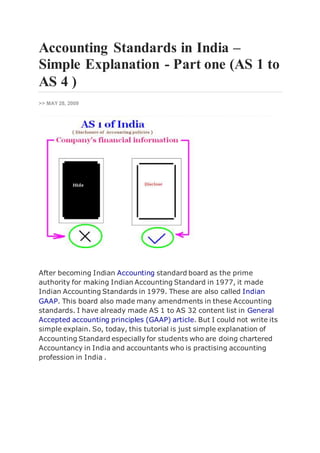
This accounting standard guides to company accountants for making
their companies financial statements. After making financial statement,
it should disclose all financial information of business because business
of company is not the business of one man. It is also duty of
accountant to make and disclose also extra accounting policy if
company is using different depreciation, stock and investment
valuation method. This accounting standard is made also for public
interest and providing them full financial information. After they can
take the decision of investment by purchasing the shares of company
from stock exchange.
2. Accounting Standard 2 ( AS 2 )
(Valuation of Inventories)
This accounting standard is very helpful to calculate the value of
inventories. ASB comprise all stocks which is purchased for sale or
production in inventories.
Value of stock is not fixed by single formula but this standard provides
following guidelines for calculating the value of inventories.
1st stock must be valued on cost or net realizable value which is lower
.
2nd Every company is free to use FIFO, LIFO or weighted average
method for proper calculation of the value of inventories.
3rd Cost of inventories
= cost of raw material + cost of direct labour + cost of direct expenses
4th
Companies are also free to use standard cost method or retail cost
method for calculating the value of inventories.
5th Inventories does not encompass the value of tools which is used
for repair of machinery
3. Accounting Standard 3 ( AS 3)
(Cash flow statement)
Accounting standard three which is revised in 1997 states that cash
flow statement is a necessary statement under this standard for banks
, financial institute or any institute whose annual turnover is more than
Rs. 50 crores or any institute who has borrowed money more than Rs.
10 crores . This standard does not provide the Proforma of cash flow
statement but deeply explain the two way of making this statement .
Ist Way Direct method
Under this method, cash flow statement is made by inflow and outflow
of cash in operating , investing and financial activities .
2nd way indirect method
It is different from direct method. Under this method cash from
operating activities is calculated on the basis of net profit after
different adjustments of non cash and non operating items like
depreciation , interest , dividend paid and also adjusting net changes
in working capital . All other part of cash flow from investing and
financial activities are as same as direct method.
related see : Proforma of Cash flow statement
4. Accounting standard 4 (AS 4)
(Contingencies and events occurring after the
balance sheet date)
Accounting standard four provides the rules of accounting treatment of
losses due to contingencies and event happening after balance sheet
date but before approving of balance sheet by board of directors.
Any contingencies like loss by fire or liabilities due to employee’s
accident should be provided in financial statement after these
contingencies losses are confirmed.
Impairment losses of assets is also covered under AS 4
Any losses due to happening of any event is also shown in financial
statement before approving financial statement.
Accounting Standards in India -
Simple explanation ( AS 5 to AS 8 )
Part second
>> MAY 28, 2009
5. Accounting standard 5 ( AS 5)
Profit or loss for the period prior of changing
accounting policies:-
ICAI’s this standard explains two simple rules
1. All ordinary and extraordinary item relating to the financial
statement should be disclosed if it effects on profit or loss period
before changing of accounting policies.
2. If accounting policies are changed. Then it is the duty of enterprise
to disclose all important items relating to income and expenditures, so
that profit or losses before the period and after period of changes of
accounting policies can easily compare with other enterprises business.
6. Accounting standard 6 (AS 6 )
Accounting of Depreciation
Accounting standard 6 explains rules and regulations regarding
charging of depreciation on any fixed asset . These rules can be
explained in following way.
1. Depreciation must be charged on fixed assets which is used in
business for more than one year .
2. Depreciation should charge with consisted method of charging
depreciation. Two famous method of charging depreciation are straight
line and reducing balance method.
3. Rate of depreciation should be according to company law 1956 and
if it is not written in it then companies are free to charge depreciation
with appropriate rate of depreciation.
4. Any company can also change the method of charging depreciation.
But its effect in the form of deficiency or surplus also should show in
profit and loss account of business .
5. Deficiency due to changing the method of depreciation will be
debited in profit and loss account and surplus due to changing the
method of depreciation will be credited in profit and loss account of
business.
7. Accounting standard 7 ( AS 7 )
Accounting of construction contracts
Construction contracts are those contracts relating to build of dam,
building, pipelines, ships and other fixed assets. The nature of business
is different from business of general manufacturing. Because time of
completing contract is more than the time of accounting period. So,
ICAI makes some rules and regulation that should be adopt in the
business relating to construction.
1. Construction Company should identify all their resources of revenue.
It may be fixed at the time of contract or it may be cost plus profit
basis. So, it is necessary to make contract account statement in which
all revenue of construction business must be shown.
2. Costs of contract comprise all raw material labour and other
expenses which incurred for completing of contact. These costs should
also calculate and deduct from revenue for calculating net earning
from each contract.
8. Accounting standard 8 (AS 8)
(Accounting for research and development)
Research and development is important department of any company.
AS 8 cares its accounting treatment and related to calculate its proper
cost and charging on profit and loss account.
Ist part
Calculate the cost of research and development with following formula
= Cost of raw material used in research and development +
Cost of wages and salaries of employees working in this
department +depreciation of assets used in this department +
amortization cost of patents and licenses + other related cost
2nd part
This part is related to charge the written off proportion to profit and
loss account. For this company’s accountant should see what will
company gets future benefits and how many years will company get
these profits. On this estimation, company will charge written off cost
to debit side of profit and loss account and rest amount of deferred
expenditure of research and development will be shown in balance
sheet’s asset side under miscellaneous expenditures .
Accounting Standards in India –
Simple Explanation - Part third (AS 9
to AS 12 )
>> MAY 30, 2009
Accounting Standard 9 ( AS 9 )
Revenue recognition
Accounting standard of India explains the concept of revenue deeply.
When goods are sold or services rendered. At this time it is deemed
that money is earned by enterprise. There is also revenue from
interest, royalty and dividend. Revenue recognition standard comprises
different earning relating to advertising and other services projects
when these are completed by professionals. But this standard also
provides guidance about revenue recognition in following cases.
 If stock is sold on approval basis then, revenue is generated only when
the buyer gives the approval.
 In case of agency business revenue will be recognized when risk of
ownership also transferred under consignment.
Accounting Standard 10 (AS 10 )
(Accounting of fixed assets)
Accounting standard 10 of ICAI helps professional accountants for
proper accounting treatment of fixed assets.
Determination of cost of fixed assets
Assets purchase value + all cost to bring the fixed assets to
plant.
New extension of fixed assets
Any new extensions are capital nature expenditure and it will include in
the total value of respective fixed assets.
Goodwill is also treated as fixed asset in balance sheet if the amount is
for this paid. In fixed assets, Enterprise will also include the amount of
know how and patents.
Accounting standard 11 ( AS 11 )
Effect of changes of foreign exchange rates
There are two main reasons for providing effect of changes of foreign
exchange rates on accounting.
1. When goods are sold or buy in price which is dominated in foreign
currency.
2. When enterprise is doing any foreign operations.
Calculate the value of foreign exchange profit or
loss
It is very simple when any transaction is done, this date is called
closing date and we can calculate foreign exchange profit or loss on
the basis of exchange rate. If it is rated to purchasing or selling related
profit from foreign exchange currency. Then it will show as capital
reserve. Otherwise it is revenue earning and it will transfer to profit
and loss account.
Accounting standard 12 (AS 12)
(Accounting treatment of Govt. grants)
The Govt. grant means any benefit given by govt. in the form of
subsidy, reduction in duty and taxes and other non monetary help .
Accounting standard accepts two way for providing accounting
treatment of govt. grants. If it is received by any special enterprise.
First way
To show as capital earning and include it in the value of shareholder
fund in liability side of balance sheet and also shown in bank in current
assets side .
2nd Way
Transfer all govt. grants to the credit side of profit and loss account
ACCOUNTING CONCEPTS-
Accounting Concepts and its Main
Types
>> OCTOBER 14, 2008
Definition of Accounting Concepts
Accounting concepts means flow of thoughts of all wise accounting professionals of this world . It can also
be interpreted as "process of understanding of accounting to make sense of universal acceptability. "
In other words accounting concepts some normal rules which can be changed but which has come in to
existence with so many hard work of accountants in past. These are basics thoughts of an accountant.
Types of Accounting Concepts
To know more about Accounting Concepts are very necessary to learn because without this you can not
understand the fundamentals of accounting. There are many concepts which an accountant uses in their
accounting working.
1st concept – Separate entity concept
Under this concept the entity of business man is separate from its business. The main reason is that owner
is just giver of capital but if he withdraws without any restriction or any control. Business can dissolve
within two days. So every transaction related to withdrawing money from business must be recorded by
accountant. So this concept gives us basic knowledge while we are recording transactions in our books that
we must know that concern has its own entity and our duty is to record every transaction even it is related
to owner or not . Businessman's capital is also the liability of business and if he withdraw for personal use ,
it is known as drawing and it is deducted from his capital . So under this concept , accountant records
every cash , goods and usage of fixed assets for personaluse of businessman and while he makes balance
sheet all these expenses are deducted from businessman's capital.
2nd Concept – Cost Concept
Under this concept we record all assets on their cost not in market value. This concept is very useful for
stable recording of accounting .Because if all transaction recording will start on their market value then it
create tension to accountant. Because nobody can say what will the price of your fixed asset in next day.
So record all assets on their original cost. But time to time depreciation is deducted from this . But we
never record all assets on their market price .
3rd Concept – Matching Concept
When I was doing graduate from my college, my respected teacher taught me that matching concept is
very important for an accountant. It means we will compare all expenses with the incomes of business.
After matching or compare, it will provide you the real result of performance of business. We can say it
profit or loss . So If today you want to know profit or loss of your business, let us start match of your
business incomes with your business expenses.
4th Concept – Conservatism Concept
This concept is made when accountant thought that it is very important to secure our business. The risk of
business is called losses. So it is the basic duty of accountant to secure his business from different losses.
For securing Loss he can make different provisions like provision for doubtful debts, provision for
depreciation reserve for contingent liabilities.
Now you are in position to understand different types of concepts for accounting profession. You are also
an accountant , you can also make your accounting concepts. I hope, you will make certain new accounting
concepts which will very useful for accounting and accounting profession
Accounting Conventions
>> JUNE 10, 2010
In financial accounting, accounting concepts, conventions and
standards are base to do work in this field.
For understanding accounting conventions, we have to understand
conventions. Conventions means rules which has been sanctioned by
general custom. These rules are also based on practical approach of
customs. For example it is convention to say quantal instead of saying
100 kgs. In accounting, there are many accounting conventions which
are used by accountants according to traditional custom. We can
explain it following way:
1. Relevance Convention
This accounting convention pressures on the fact that accountant
should record only useful information and show which are helpful to
achieve the targets of company. Suppose, accountant should
interested what is total amount of salary payable or paid or paid in
advance. He should ignore what is total expenditure of employee or
how much will he save?
2. Objectivity Convention
This accounting convention emphasizes on the case that accounting
information should be made according to the general accepted
accounting principles. This will be helpful to achieve the objectives of
company. For example, accountant should use AS-2 for valuation of
inventory. He should calculate the value of closing inventory on the
amount of cost or net realisable value which ever is less.
3. Feasibility Convention
This accounting convention accentuates on the truth that in
accounting, we should compare each information with its cost and time
to collect it. If cost is more than benefits from accounting information,
then we should leave that information and concentrate other important
accounting information.
Importance of Accounting Concepts
and Conventions
>> JUNE 10, 2010
In this world, everything is important. Nothing is useless. But for
knowing the importance of anything, you have to raise your thinking
level. You can see the importance in your failure and success of others.
You can think that treatment of poisons through poisons. Only after
this, you can use that things properly and save from pecuniary losses.
Like other things of accounting, Accounting Concepts and Conventions
are also important. These concepts and conventions have been made
by accounting experts. They do experiments practically with these
concepts and conventions and found that if any accountant will use
these concepts and conventions in his professional work, he can save
money, energy, time and provide effective services to organization.

Accounting standards in india

  • 1.
    Accounting Standards inIndia – Simple Explanation - Part one (AS 1 to AS 4 ) >> MAY 28, 2009 After becoming Indian Accounting standard board as the prime authority for making Indian Accounting Standard in 1977, it made Indian Accounting Standards in 1979. These are also called Indian GAAP. This board also made many amendments in these Accounting standards. I have already made AS 1 to AS 32 content list in General Accepted accounting principles (GAAP) article. But I could not write its simple explain. So, today, this tutorial is just simple explanation of Accounting Standard especially for students who are doing chartered Accountancy in India and accountants who is practising accounting profession in India .
  • 2.
    1. Accounting Standard1(AS 1) (Disclosure of accounting policies) This accounting standard guides to company accountants for making their companies financial statements. After making financial statement, it should disclose all financial information of business because business of company is not the business of one man. It is also duty of accountant to make and disclose also extra accounting policy if company is using different depreciation, stock and investment valuation method. This accounting standard is made also for public interest and providing them full financial information. After they can take the decision of investment by purchasing the shares of company from stock exchange. 2. Accounting Standard 2 ( AS 2 ) (Valuation of Inventories) This accounting standard is very helpful to calculate the value of inventories. ASB comprise all stocks which is purchased for sale or production in inventories. Value of stock is not fixed by single formula but this standard provides following guidelines for calculating the value of inventories. 1st stock must be valued on cost or net realizable value which is lower . 2nd Every company is free to use FIFO, LIFO or weighted average method for proper calculation of the value of inventories. 3rd Cost of inventories
  • 3.
    = cost ofraw material + cost of direct labour + cost of direct expenses 4th Companies are also free to use standard cost method or retail cost method for calculating the value of inventories. 5th Inventories does not encompass the value of tools which is used for repair of machinery 3. Accounting Standard 3 ( AS 3) (Cash flow statement) Accounting standard three which is revised in 1997 states that cash flow statement is a necessary statement under this standard for banks , financial institute or any institute whose annual turnover is more than Rs. 50 crores or any institute who has borrowed money more than Rs. 10 crores . This standard does not provide the Proforma of cash flow statement but deeply explain the two way of making this statement . Ist Way Direct method Under this method, cash flow statement is made by inflow and outflow of cash in operating , investing and financial activities . 2nd way indirect method It is different from direct method. Under this method cash from operating activities is calculated on the basis of net profit after different adjustments of non cash and non operating items like depreciation , interest , dividend paid and also adjusting net changes in working capital . All other part of cash flow from investing and financial activities are as same as direct method.
  • 4.
    related see :Proforma of Cash flow statement 4. Accounting standard 4 (AS 4) (Contingencies and events occurring after the balance sheet date) Accounting standard four provides the rules of accounting treatment of losses due to contingencies and event happening after balance sheet date but before approving of balance sheet by board of directors. Any contingencies like loss by fire or liabilities due to employee’s accident should be provided in financial statement after these contingencies losses are confirmed. Impairment losses of assets is also covered under AS 4 Any losses due to happening of any event is also shown in financial statement before approving financial statement. Accounting Standards in India - Simple explanation ( AS 5 to AS 8 ) Part second >> MAY 28, 2009 5. Accounting standard 5 ( AS 5) Profit or loss for the period prior of changing accounting policies:- ICAI’s this standard explains two simple rules 1. All ordinary and extraordinary item relating to the financial
  • 5.
    statement should bedisclosed if it effects on profit or loss period before changing of accounting policies. 2. If accounting policies are changed. Then it is the duty of enterprise to disclose all important items relating to income and expenditures, so that profit or losses before the period and after period of changes of accounting policies can easily compare with other enterprises business. 6. Accounting standard 6 (AS 6 ) Accounting of Depreciation Accounting standard 6 explains rules and regulations regarding charging of depreciation on any fixed asset . These rules can be explained in following way. 1. Depreciation must be charged on fixed assets which is used in business for more than one year . 2. Depreciation should charge with consisted method of charging depreciation. Two famous method of charging depreciation are straight line and reducing balance method. 3. Rate of depreciation should be according to company law 1956 and if it is not written in it then companies are free to charge depreciation with appropriate rate of depreciation. 4. Any company can also change the method of charging depreciation. But its effect in the form of deficiency or surplus also should show in profit and loss account of business . 5. Deficiency due to changing the method of depreciation will be
  • 6.
    debited in profitand loss account and surplus due to changing the method of depreciation will be credited in profit and loss account of business. 7. Accounting standard 7 ( AS 7 ) Accounting of construction contracts Construction contracts are those contracts relating to build of dam, building, pipelines, ships and other fixed assets. The nature of business is different from business of general manufacturing. Because time of completing contract is more than the time of accounting period. So, ICAI makes some rules and regulation that should be adopt in the business relating to construction. 1. Construction Company should identify all their resources of revenue. It may be fixed at the time of contract or it may be cost plus profit basis. So, it is necessary to make contract account statement in which all revenue of construction business must be shown. 2. Costs of contract comprise all raw material labour and other expenses which incurred for completing of contact. These costs should also calculate and deduct from revenue for calculating net earning from each contract. 8. Accounting standard 8 (AS 8) (Accounting for research and development) Research and development is important department of any company.
  • 7.
    AS 8 caresits accounting treatment and related to calculate its proper cost and charging on profit and loss account. Ist part Calculate the cost of research and development with following formula = Cost of raw material used in research and development + Cost of wages and salaries of employees working in this department +depreciation of assets used in this department + amortization cost of patents and licenses + other related cost 2nd part This part is related to charge the written off proportion to profit and loss account. For this company’s accountant should see what will company gets future benefits and how many years will company get these profits. On this estimation, company will charge written off cost to debit side of profit and loss account and rest amount of deferred expenditure of research and development will be shown in balance sheet’s asset side under miscellaneous expenditures . Accounting Standards in India – Simple Explanation - Part third (AS 9 to AS 12 ) >> MAY 30, 2009 Accounting Standard 9 ( AS 9 )
  • 8.
    Revenue recognition Accounting standardof India explains the concept of revenue deeply. When goods are sold or services rendered. At this time it is deemed that money is earned by enterprise. There is also revenue from interest, royalty and dividend. Revenue recognition standard comprises different earning relating to advertising and other services projects when these are completed by professionals. But this standard also provides guidance about revenue recognition in following cases.  If stock is sold on approval basis then, revenue is generated only when the buyer gives the approval.  In case of agency business revenue will be recognized when risk of ownership also transferred under consignment. Accounting Standard 10 (AS 10 ) (Accounting of fixed assets) Accounting standard 10 of ICAI helps professional accountants for proper accounting treatment of fixed assets. Determination of cost of fixed assets Assets purchase value + all cost to bring the fixed assets to plant. New extension of fixed assets
  • 9.
    Any new extensionsare capital nature expenditure and it will include in the total value of respective fixed assets. Goodwill is also treated as fixed asset in balance sheet if the amount is for this paid. In fixed assets, Enterprise will also include the amount of know how and patents. Accounting standard 11 ( AS 11 ) Effect of changes of foreign exchange rates There are two main reasons for providing effect of changes of foreign exchange rates on accounting. 1. When goods are sold or buy in price which is dominated in foreign currency. 2. When enterprise is doing any foreign operations. Calculate the value of foreign exchange profit or loss It is very simple when any transaction is done, this date is called closing date and we can calculate foreign exchange profit or loss on the basis of exchange rate. If it is rated to purchasing or selling related profit from foreign exchange currency. Then it will show as capital reserve. Otherwise it is revenue earning and it will transfer to profit and loss account. Accounting standard 12 (AS 12) (Accounting treatment of Govt. grants)
  • 10.
    The Govt. grantmeans any benefit given by govt. in the form of subsidy, reduction in duty and taxes and other non monetary help . Accounting standard accepts two way for providing accounting treatment of govt. grants. If it is received by any special enterprise. First way To show as capital earning and include it in the value of shareholder fund in liability side of balance sheet and also shown in bank in current assets side . 2nd Way Transfer all govt. grants to the credit side of profit and loss account ACCOUNTING CONCEPTS- Accounting Concepts and its Main Types >> OCTOBER 14, 2008 Definition of Accounting Concepts Accounting concepts means flow of thoughts of all wise accounting professionals of this world . It can also be interpreted as "process of understanding of accounting to make sense of universal acceptability. " In other words accounting concepts some normal rules which can be changed but which has come in to existence with so many hard work of accountants in past. These are basics thoughts of an accountant.
  • 11.
    Types of AccountingConcepts To know more about Accounting Concepts are very necessary to learn because without this you can not understand the fundamentals of accounting. There are many concepts which an accountant uses in their accounting working. 1st concept – Separate entity concept Under this concept the entity of business man is separate from its business. The main reason is that owner is just giver of capital but if he withdraws without any restriction or any control. Business can dissolve within two days. So every transaction related to withdrawing money from business must be recorded by accountant. So this concept gives us basic knowledge while we are recording transactions in our books that we must know that concern has its own entity and our duty is to record every transaction even it is related to owner or not . Businessman's capital is also the liability of business and if he withdraw for personal use , it is known as drawing and it is deducted from his capital . So under this concept , accountant records every cash , goods and usage of fixed assets for personaluse of businessman and while he makes balance sheet all these expenses are deducted from businessman's capital. 2nd Concept – Cost Concept Under this concept we record all assets on their cost not in market value. This concept is very useful for stable recording of accounting .Because if all transaction recording will start on their market value then it create tension to accountant. Because nobody can say what will the price of your fixed asset in next day. So record all assets on their original cost. But time to time depreciation is deducted from this . But we never record all assets on their market price . 3rd Concept – Matching Concept When I was doing graduate from my college, my respected teacher taught me that matching concept is very important for an accountant. It means we will compare all expenses with the incomes of business. After matching or compare, it will provide you the real result of performance of business. We can say it
  • 12.
    profit or loss. So If today you want to know profit or loss of your business, let us start match of your business incomes with your business expenses. 4th Concept – Conservatism Concept This concept is made when accountant thought that it is very important to secure our business. The risk of business is called losses. So it is the basic duty of accountant to secure his business from different losses. For securing Loss he can make different provisions like provision for doubtful debts, provision for depreciation reserve for contingent liabilities. Now you are in position to understand different types of concepts for accounting profession. You are also an accountant , you can also make your accounting concepts. I hope, you will make certain new accounting concepts which will very useful for accounting and accounting profession Accounting Conventions >> JUNE 10, 2010 In financial accounting, accounting concepts, conventions and standards are base to do work in this field. For understanding accounting conventions, we have to understand conventions. Conventions means rules which has been sanctioned by general custom. These rules are also based on practical approach of customs. For example it is convention to say quantal instead of saying 100 kgs. In accounting, there are many accounting conventions which are used by accountants according to traditional custom. We can explain it following way: 1. Relevance Convention This accounting convention pressures on the fact that accountant should record only useful information and show which are helpful to achieve the targets of company. Suppose, accountant should interested what is total amount of salary payable or paid or paid in
  • 13.
    advance. He shouldignore what is total expenditure of employee or how much will he save? 2. Objectivity Convention This accounting convention emphasizes on the case that accounting information should be made according to the general accepted accounting principles. This will be helpful to achieve the objectives of company. For example, accountant should use AS-2 for valuation of inventory. He should calculate the value of closing inventory on the amount of cost or net realisable value which ever is less. 3. Feasibility Convention This accounting convention accentuates on the truth that in accounting, we should compare each information with its cost and time to collect it. If cost is more than benefits from accounting information, then we should leave that information and concentrate other important accounting information. Importance of Accounting Concepts and Conventions >> JUNE 10, 2010 In this world, everything is important. Nothing is useless. But for knowing the importance of anything, you have to raise your thinking level. You can see the importance in your failure and success of others. You can think that treatment of poisons through poisons. Only after this, you can use that things properly and save from pecuniary losses. Like other things of accounting, Accounting Concepts and Conventions are also important. These concepts and conventions have been made
  • 14.
    by accounting experts.They do experiments practically with these concepts and conventions and found that if any accountant will use these concepts and conventions in his professional work, he can save money, energy, time and provide effective services to organization.