1
Nurse Practitioners –
‘Strengthening the point of entry
into the Healthcare system’
Dr. Majid Al-Maqbali, RN, PhD
Director of Nursing &
Midwifery Affairs
June 2014
2
Outline:
 Introduction – Advanced Nursing Practice, What is it?
 Driving Forces and Restraining Forces.
 Our Approach – Situational Analysis
 Why do we need ANP?
 Roles and Responsibilities
 What are the benefits for Patients and Services?
 Recommendations
Purposes of the Presentation
 Develop consensus
 Highlight the importance of the role
 Advise Top Authorities
 Implementation Plan
3
Purposes of the Presentation
 MOH is held accountable for patient safety, nurse’s
achievements, positive patient outcomes, cost
containment, etc.
 High standards = high performance
4
Advanced Nursing Practice, What
Is It?
“A registered nurse with expert knowledge base,
complex decision making skills and clinical
competences for expanded practice, governed by
the context and country in which practice is
credentialed. A master’s degree is recommended for
entry level internationally” (ICN, 2002)
5
6
Advanced Practice ‘What are the
Driving Forces?’
 Service Driven – Shortfall in doctors both numbers
and specific expertise (Affara, & Schober 2012)
 Emerging Health problems due to lifestyle changes
e.g. Diabetes, hypertension – (1996) overall OPD
morbidity 0.6% - 2012 – 1.3% (MOH, 2012)
 The global trend of moving care closer and deeper
in the community (De Geest, et al. 2008)
7
Advanced Practice ‘What are the
Driving Forces?’
 People are living longer and are more likely to
develop long term conditions requiring specialist
care. (MOH, 2012)
 Clinical career pathway for nurses: the opportunity
to stay at the bedside. (MOH, 2013)
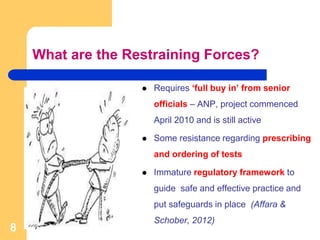
What are the Restraining Forces?
 Requires ‘full buy in’ from senior
officials – ANP, project commenced
April 2010 and is still active
 Some resistance regarding prescribing
and ordering of tests
 Immature regulatory framework to
guide safe and effective practice and
put safeguards in place (Affara &
Schober, 2012)
8
Our Approach – Situational Analysis
 Build on the work of Schober– Site visits, focus groups, workshop
(2006).
 Questionnaire data gathered and analysed from PHC settings (2011).
 Nursing stakeholder focus groups discussions, (2011).
 A review of International literature on Nurse Practitioners / Advanced
Practice (2010-2014).
 Questionnaire - perceptions of health professionals on the ANP role
(2012)
 Visit American Universities (2013)9
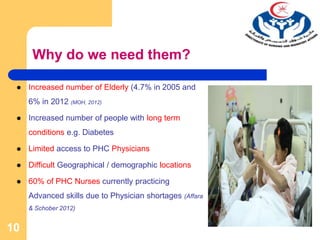
Why do we need them?
 Increased number of Elderly (4.7% in 2005 and
6% in 2012 (MOH, 2012)
 Increased number of people with long term
conditions e.g. Diabetes
 Limited access to PHC Physicians
 Difficult Geographical / demographic locations
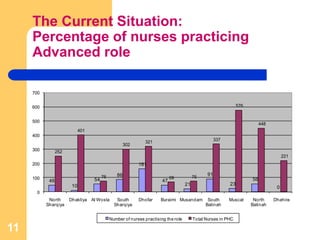
 60% of PHC Nurses currently practicing
Advanced skills due to Physician shortages (Affara
& Schober 2012)
10
The Current Situation:
Percentage of nurses practicing
Advanced role
11
46
10
54
86
161
47
21
91
23
56
0
252
401
76
302
321
69 75
337
576
448
221
0
100
200
300
400
500
600
700
North
Sharqiya
Dhakliya Al Wosta South
Sharqiya
Dhofar Buraimi Musandam South
Batinah
Muscat North
Batinah
Dhahira
Number of nurses practising the role Total Nurses in PHC
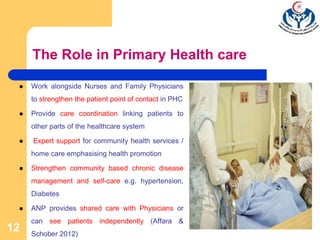
The Role in Primary Health care
 Work alongside Nurses and Family Physicians
to strengthen the patient point of contact in PHC
 Provide care coordination linking patients to
other parts of the healthcare system
 Expert support for community health services /
home care emphasising health promotion
 Strengthen community based chronic disease
management and self-care e.g. hypertension,
Diabetes
 ANP provides shared care with Physicians or
can see patients independently (Affara &
Schober 2012)
12
The Role in Hospital Services
 Focus on specialization for a specific patient population e.g. Neonates,
Emergency, Endoscopy, etc.
 Expansion of practice and role autonomy
 Manages own caseload including advanced practice skills (e.g. intubation and
ventilation)
 Applying critical thinking and evaluation skills to solve clinical problems using
advanced skills
 Knows own limitations and makes referrals to senior colleagues when required
 Integration of theory research evidence and practical knowledge to deliver patient
centered care (Bryant – Lukosius, et al 2004)13
General Role
 Enhance skills, knowledge, and attitudes of other nurses
 Foster collaborative atmosphere
 Establish positive systems to improve leadership, teaching, and healthcare
providers’ performance.
14
o Advanced Nurse Practitioners (ANP) deliver high quality care the same as
Physicians (OECD, 2010)
o Enable Physicians to focus on complex health problems of an uncertain
nature. (Sibbald, 2008)
o Increase access for patients to PHC and emergency services (Peltonen, 2009)
o Decrease emergency visits to Physicians by 18-25% (Hukkanen & Villimies –
Patomaki, 2005)
o Better results in health promotion and self care than Physicians (EROS, 1999)
15
What are the benefits for – Patients –
Services?
What are the benefits for – Patients –
Services?
 Longer Individualized patient consultations by ANP, more information is
given and patient satisfaction is higher (Edwards et al, 2003)
 Higher quality chronic disease management by ANP(Russell et al, 2009)
 Reduced admissions for unplanned acute relapses e.g. Asthma (Griffin et al,
2004)
 Significant improvement in patient blood pressure and diabetes control
(Litaker et al, 2003)
 No documented negative impact of ANP transfer of tasks from Physicians
to ANP (OECD, 2010)
16
Conclusion
• Currently the driving forces for ANP are stronger than the restraining forces,
therefore it’s introduction would be supported
• Shortage of Physicians and burden of long term and chronic conditions are the
main drivers
• ANP will strengthen community based chronic disease management and self-
care e.g. Diabetes
• ANP will enable Physicians to focus on complex health problems of an uncertain
nature (Sibbald, 2008)
• Implementation requires a strategic approach that involves all key stakeholders
17
Establish an Advanced Practice national taskforce to:
• Determine Scope of practice, competences, standards, domains
• Develop and source an education curriculum to meet the above
standards
• Ensure title, registration and licensure requirements are met
• Ensure Job description are agreed by stakeholders
• Ensure ANP is an official category in national health Humans
Resources plan
18
Recommendations
Recommendations
• Develop an implementation, monitoring, and evaluation plan
(Taskforce)
• Recruit international expert with proven track record in ANP education
and role development (DNMA)
• Upgrading of Nurses in PHC already working in extended roles through
a locally determined education curriculum to safeguard the public
(DNMA)
19
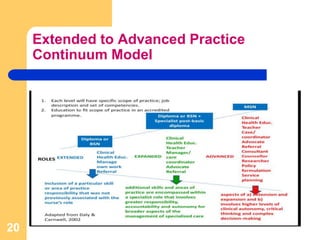
Extended to Advanced Practice
Continuum Model
20
Affara, F. & Schober, M. (2012) Assignment Report – Sultanate of Oman, April 2012,
ICN: Geneva
Bryant – Lukosius, D. DiCenso, A. Browne, G. Pinelli, J. (2004) Advanced practice
nursing roles: development, implementation and evaluation, Journal of Advanced
Nursing, 48, (5) p 519 - 529
De Geest, S. Moons, P. Callens, B. Gut, C. Lindpaintner, L. Spirig, r. (2008) Introducing
advanced practice / nurse practitioners in health systems: A framework for reflection and
analysis, Swiss Med. Weekly, (138) p33-34
Edwards J.B., S. Oppewal and C.L. Logan (2003), “Nurse-managed primary care:
outcomes of a faculty practice network”, Journal Am Acad Nurse Pract, 15 (12): 563-9.
EROS Project team (1999), “Training nurse practitioners for general practice”, The
EROS Project Team, Br J. Gen Pract, 49 (444): 531-5.
21
References
22
References:
Griffiths C. et al. (2004), “Specialist nurse intervention to reduce unscheduled asthma care
in a deprived multiethnic area: the east London randomised controlled trial for high risk
asthma (ELECTRA)”, British Medical Journal, 10.1136.37 950, January.
Hukkanen E. and M. Vallimies-Patomaki (2005), “Cooperation and division of tasks in
ensuring access to care, a survey of the pilot projects on labour division carried out within
the National Health Care Project”, Ministry of Social Affairs and Health, Helsinki, 2005:21,
Helsinki, available at http://pre20090115.stm.fi/pr1129788573664/passthru.pdf[in Finnish]
International Council of Nurses, (2002) Definitions and characteristics for nurse
practitioner / advanced practice nursing roles. www.icn.ch/networks_ap.htm
[Accessed March 20 2014]
Litaker, D. et al. (2003), “Physician-nurse practitioner teams in chronic disease
management: The impact on costs, clinical effectiveness, and patients' perception of care”,
Journal of Interprofessional Care, 17(3), 223-237.
23
References:
Ministry of Health, (2013) Career pathway for nurses & midwives, Muscat, Sultanate of
Oman Ministry of Health,
Ministry of Health, (2012) Annual Healthcare Statistics, Department of planning, Muscat,
Sultanate of Oman, Ministry of Health
OECD, (2010) Health working papers no 54 – Nurses in advanced roles; A description and
evaluation of experiences in 12 developed countries, Paris; OECD
[Available from] http://www.oecd.org/els/health/workingpapers [Accessed 20 March 2014]
Peltonen E. (2009), “The Doctor-Nurse Pair Model and the Admissions Team Model in
Primary Health Care: a Comparative Study”, E. Social Sciences 168, Doctoral thesis,
University of Kuopio (In Finnish, English abstract), [available at]
http://www.uku.fi/vaitokset/2009/isbn978-951-27-1227-4.pdf Accessed 20 March 2014]
Sibbald B. (2008), “Head to head - Should primary care be nurse led? Yes”, British
Medical Journal, 4th of September, 337: a1157

Introducing Advanced Nursing Practice in Oman

  • 1.
    1 Nurse Practitioners – ‘Strengtheningthe point of entry into the Healthcare system’ Dr. Majid Al-Maqbali, RN, PhD Director of Nursing & Midwifery Affairs June 2014
  • 2.
    2 Outline:  Introduction –Advanced Nursing Practice, What is it?  Driving Forces and Restraining Forces.  Our Approach – Situational Analysis  Why do we need ANP?  Roles and Responsibilities  What are the benefits for Patients and Services?  Recommendations
  • 3.
    Purposes of thePresentation  Develop consensus  Highlight the importance of the role  Advise Top Authorities  Implementation Plan 3
  • 4.
    Purposes of thePresentation  MOH is held accountable for patient safety, nurse’s achievements, positive patient outcomes, cost containment, etc.  High standards = high performance 4
  • 5.
    Advanced Nursing Practice,What Is It? “A registered nurse with expert knowledge base, complex decision making skills and clinical competences for expanded practice, governed by the context and country in which practice is credentialed. A master’s degree is recommended for entry level internationally” (ICN, 2002) 5
  • 6.
    6 Advanced Practice ‘Whatare the Driving Forces?’  Service Driven – Shortfall in doctors both numbers and specific expertise (Affara, & Schober 2012)  Emerging Health problems due to lifestyle changes e.g. Diabetes, hypertension – (1996) overall OPD morbidity 0.6% - 2012 – 1.3% (MOH, 2012)  The global trend of moving care closer and deeper in the community (De Geest, et al. 2008)
  • 7.
    7 Advanced Practice ‘Whatare the Driving Forces?’  People are living longer and are more likely to develop long term conditions requiring specialist care. (MOH, 2012)  Clinical career pathway for nurses: the opportunity to stay at the bedside. (MOH, 2013)
  • 8.
    What are theRestraining Forces?  Requires ‘full buy in’ from senior officials – ANP, project commenced April 2010 and is still active  Some resistance regarding prescribing and ordering of tests  Immature regulatory framework to guide safe and effective practice and put safeguards in place (Affara & Schober, 2012) 8
  • 9.
    Our Approach –Situational Analysis  Build on the work of Schober– Site visits, focus groups, workshop (2006).  Questionnaire data gathered and analysed from PHC settings (2011).  Nursing stakeholder focus groups discussions, (2011).  A review of International literature on Nurse Practitioners / Advanced Practice (2010-2014).  Questionnaire - perceptions of health professionals on the ANP role (2012)  Visit American Universities (2013)9
  • 10.
    Why do weneed them?  Increased number of Elderly (4.7% in 2005 and 6% in 2012 (MOH, 2012)  Increased number of people with long term conditions e.g. Diabetes  Limited access to PHC Physicians  Difficult Geographical / demographic locations  60% of PHC Nurses currently practicing Advanced skills due to Physician shortages (Affara & Schober 2012) 10
  • 11.
    The Current Situation: Percentageof nurses practicing Advanced role 11 46 10 54 86 161 47 21 91 23 56 0 252 401 76 302 321 69 75 337 576 448 221 0 100 200 300 400 500 600 700 North Sharqiya Dhakliya Al Wosta South Sharqiya Dhofar Buraimi Musandam South Batinah Muscat North Batinah Dhahira Number of nurses practising the role Total Nurses in PHC
  • 12.
    The Role inPrimary Health care  Work alongside Nurses and Family Physicians to strengthen the patient point of contact in PHC  Provide care coordination linking patients to other parts of the healthcare system  Expert support for community health services / home care emphasising health promotion  Strengthen community based chronic disease management and self-care e.g. hypertension, Diabetes  ANP provides shared care with Physicians or can see patients independently (Affara & Schober 2012) 12
  • 13.
    The Role inHospital Services  Focus on specialization for a specific patient population e.g. Neonates, Emergency, Endoscopy, etc.  Expansion of practice and role autonomy  Manages own caseload including advanced practice skills (e.g. intubation and ventilation)  Applying critical thinking and evaluation skills to solve clinical problems using advanced skills  Knows own limitations and makes referrals to senior colleagues when required  Integration of theory research evidence and practical knowledge to deliver patient centered care (Bryant – Lukosius, et al 2004)13
  • 14.
    General Role  Enhanceskills, knowledge, and attitudes of other nurses  Foster collaborative atmosphere  Establish positive systems to improve leadership, teaching, and healthcare providers’ performance. 14
  • 15.
    o Advanced NursePractitioners (ANP) deliver high quality care the same as Physicians (OECD, 2010) o Enable Physicians to focus on complex health problems of an uncertain nature. (Sibbald, 2008) o Increase access for patients to PHC and emergency services (Peltonen, 2009) o Decrease emergency visits to Physicians by 18-25% (Hukkanen & Villimies – Patomaki, 2005) o Better results in health promotion and self care than Physicians (EROS, 1999) 15 What are the benefits for – Patients – Services?
  • 16.
    What are thebenefits for – Patients – Services?  Longer Individualized patient consultations by ANP, more information is given and patient satisfaction is higher (Edwards et al, 2003)  Higher quality chronic disease management by ANP(Russell et al, 2009)  Reduced admissions for unplanned acute relapses e.g. Asthma (Griffin et al, 2004)  Significant improvement in patient blood pressure and diabetes control (Litaker et al, 2003)  No documented negative impact of ANP transfer of tasks from Physicians to ANP (OECD, 2010) 16
  • 17.
    Conclusion • Currently thedriving forces for ANP are stronger than the restraining forces, therefore it’s introduction would be supported • Shortage of Physicians and burden of long term and chronic conditions are the main drivers • ANP will strengthen community based chronic disease management and self- care e.g. Diabetes • ANP will enable Physicians to focus on complex health problems of an uncertain nature (Sibbald, 2008) • Implementation requires a strategic approach that involves all key stakeholders 17
  • 18.
    Establish an AdvancedPractice national taskforce to: • Determine Scope of practice, competences, standards, domains • Develop and source an education curriculum to meet the above standards • Ensure title, registration and licensure requirements are met • Ensure Job description are agreed by stakeholders • Ensure ANP is an official category in national health Humans Resources plan 18 Recommendations
  • 19.
    Recommendations • Develop animplementation, monitoring, and evaluation plan (Taskforce) • Recruit international expert with proven track record in ANP education and role development (DNMA) • Upgrading of Nurses in PHC already working in extended roles through a locally determined education curriculum to safeguard the public (DNMA) 19
  • 20.
    Extended to AdvancedPractice Continuum Model 20
  • 21.
    Affara, F. &Schober, M. (2012) Assignment Report – Sultanate of Oman, April 2012, ICN: Geneva Bryant – Lukosius, D. DiCenso, A. Browne, G. Pinelli, J. (2004) Advanced practice nursing roles: development, implementation and evaluation, Journal of Advanced Nursing, 48, (5) p 519 - 529 De Geest, S. Moons, P. Callens, B. Gut, C. Lindpaintner, L. Spirig, r. (2008) Introducing advanced practice / nurse practitioners in health systems: A framework for reflection and analysis, Swiss Med. Weekly, (138) p33-34 Edwards J.B., S. Oppewal and C.L. Logan (2003), “Nurse-managed primary care: outcomes of a faculty practice network”, Journal Am Acad Nurse Pract, 15 (12): 563-9. EROS Project team (1999), “Training nurse practitioners for general practice”, The EROS Project Team, Br J. Gen Pract, 49 (444): 531-5. 21 References
  • 22.
    22 References: Griffiths C. etal. (2004), “Specialist nurse intervention to reduce unscheduled asthma care in a deprived multiethnic area: the east London randomised controlled trial for high risk asthma (ELECTRA)”, British Medical Journal, 10.1136.37 950, January. Hukkanen E. and M. Vallimies-Patomaki (2005), “Cooperation and division of tasks in ensuring access to care, a survey of the pilot projects on labour division carried out within the National Health Care Project”, Ministry of Social Affairs and Health, Helsinki, 2005:21, Helsinki, available at http://pre20090115.stm.fi/pr1129788573664/passthru.pdf[in Finnish] International Council of Nurses, (2002) Definitions and characteristics for nurse practitioner / advanced practice nursing roles. www.icn.ch/networks_ap.htm [Accessed March 20 2014] Litaker, D. et al. (2003), “Physician-nurse practitioner teams in chronic disease management: The impact on costs, clinical effectiveness, and patients' perception of care”, Journal of Interprofessional Care, 17(3), 223-237.
  • 23.
    23 References: Ministry of Health,(2013) Career pathway for nurses & midwives, Muscat, Sultanate of Oman Ministry of Health, Ministry of Health, (2012) Annual Healthcare Statistics, Department of planning, Muscat, Sultanate of Oman, Ministry of Health OECD, (2010) Health working papers no 54 – Nurses in advanced roles; A description and evaluation of experiences in 12 developed countries, Paris; OECD [Available from] http://www.oecd.org/els/health/workingpapers [Accessed 20 March 2014] Peltonen E. (2009), “The Doctor-Nurse Pair Model and the Admissions Team Model in Primary Health Care: a Comparative Study”, E. Social Sciences 168, Doctoral thesis, University of Kuopio (In Finnish, English abstract), [available at] http://www.uku.fi/vaitokset/2009/isbn978-951-27-1227-4.pdf Accessed 20 March 2014] Sibbald B. (2008), “Head to head - Should primary care be nurse led? Yes”, British Medical Journal, 4th of September, 337: a1157