Jamie Burney and Heather Cameron, Fairmont Middle School
 James.burney@robeson.k12.nc.us
 Taught 6th and 7th grade ELA and Social
Studies
 Currently teaching 6th grade ELA
 PSRCTeacher of theYear
 Heather.cameron@robeson.k12.nc.us
 11 years in ELA
 Curriculum Specialist
 NOT just ELA teachers
 ALL subjects should use complex text,
reading, and writing in their content areas.
 ELA should NOT be the dumping ground for
all things reading and writing.
 Improve text analysis skills.
 Make students better in all content areas.
 Demonstrate mastery.
 Students who master a rigorous curriculum
are more prepared for post-secondary
instruction.
 QualitativeComplexity
 QuantitativeComplexity
 Reader/Task Complexity
 Quantitative complexity
 Some selections from a text may be more
complex than others.
 Is it above the students lexile?
 Qualitative complexity:
▪ The levels of meaning/purpose and the ease with which they
are identified
▪ The amount of figurative language used in the text
▪ The conformity of the text to genre expectations
▪ The organization of the text and amount of supportive text
features
▪ The match between language used by the text (including
vocabulary and word choice) and language used by the
students
▪ The register (formal to informal) used in the text
▪ The demands the text places on the reader's knowledge
 Reader characteristics/task considerations:
 Based on the reader's capabilities, a text can be
complex regardless of its quantitative or
qualitative characteristics.
 Student motivation affects complexity.
 How students are asked to respond to a text
influences complexity.Teacher support allows
access to a text too complex for students
independently.
 When reading to or with students ALWAYS
select text that has a higher lexile.
 Independent reading should be at their level (not
necessarily at their grade level)
 The easier the text, the harder the task should
be.
 The harder the text, make the task less
challenging.
 Gradually move the text complexity up!
 Connections are not as important as we once
thought. Text dependency is though!
 Select a text based on STANDARDS.
 Develop text-dependent questions and tasks
that force students to answer based on
information from the text. No outside
knowledge allowed.
 Read, Read, Read!!! (Read the text more than
once and read everyday!)
 Write,Write,Write!!!
 Model, Model, Model!!!
 Model your expectations with your students.
 Let them practice with you (guided
practice)—Maybe more than once depending
on your class.
 Independent practice.
 I DO,WE DO,YOU DO!
 Don’t be afraid to give them the control in the
assignment.
 Re-teachingWILL be necessary!
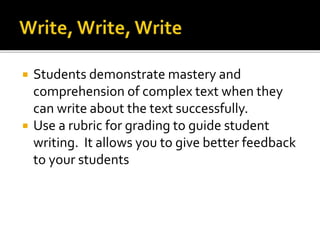
 Students demonstrate mastery and
comprehension of complex text when they
can write about the text successfully.
 Use a rubric for grading to guide student
writing. It allows you to give better feedback
to your students
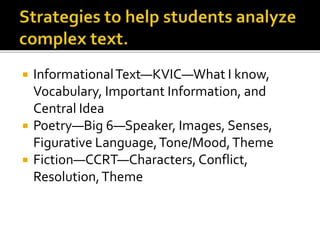
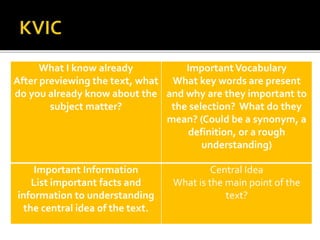
 InformationalText—KVIC—What I know,
Vocabulary, Important Information, and
Central Idea
 Poetry—Big 6—Speaker, Images, Senses,
Figurative Language,Tone/Mood,Theme
 Fiction—CCRT—Characters, Conflict,
Resolution,Theme
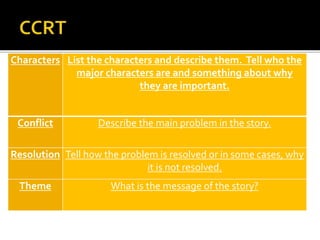
Characters List the characters and describe them. Tell who the
major characters are and something about why
they are important.
Conflict Describe the main problem in the story.
Resolution Tell how the problem is resolved or in some cases, why
it is not resolved.
Theme What is the message of the story?
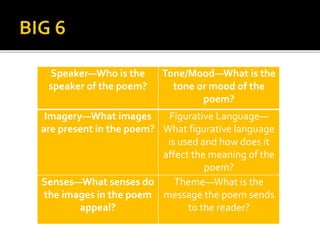
Speaker—Who is the
speaker of the poem?
Tone/Mood—What is the
tone or mood of the
poem?
Imagery—What images
are present in the poem?
Figurative Language—
What figurative language
is used and how does it
affect the meaning of the
poem?
Senses—What senses do
the images in the poem
appeal?
Theme—What is the
message the poem sends
to the reader?
What I know already
After previewing the text, what
do you already know about the
subject matter?
ImportantVocabulary
What key words are present
and why are they important to
the selection? What do they
mean? (Could be a synonym, a
definition, or a rough
understanding)
Important Information
List important facts and
information to understanding
the central idea of the text.
Central Idea
What is the main point of the
text?
 How does the setting of a particular work of
literature impact the plot?
 How does the author’s use of personification
impact the theme of a poem?
 Do you agree or disagree with the author’s
claim? Why or Why not?
 Do you think MaeTuck is guilty or innocent of
murder inTuck Everlasting? Why orWhy not?
 How has technology impacted war in modern
society?
 Do entitlements help or hurt lower class
families?
 How does the absence of light affect the
process of photosynthesis?
 Would life on Mars be feasible? Why or Why
not?
 Does the answer meet the expectations of
the question?
 Is there elaboration?
 Did the students answer the question by
providing text evidence to support his or her
claims?
 http://www.teachingthecore.com/resources/a
rticle-of-the-week-aow/
 http://www.newsela.com
 Scholastic Scope/Junior Scholastic
Increasing Rigor Using Complex Text

Increasing Rigor Using Complex Text

  • 1.
    Jamie Burney andHeather Cameron, Fairmont Middle School
  • 2.
     James.burney@robeson.k12.nc.us  Taught6th and 7th grade ELA and Social Studies  Currently teaching 6th grade ELA  PSRCTeacher of theYear
  • 3.
     Heather.cameron@robeson.k12.nc.us  11years in ELA  Curriculum Specialist
  • 4.
     NOT justELA teachers  ALL subjects should use complex text, reading, and writing in their content areas.  ELA should NOT be the dumping ground for all things reading and writing.
  • 5.
     Improve textanalysis skills.  Make students better in all content areas.  Demonstrate mastery.  Students who master a rigorous curriculum are more prepared for post-secondary instruction.
  • 6.
  • 7.
     Quantitative complexity Some selections from a text may be more complex than others.  Is it above the students lexile?
  • 8.
     Qualitative complexity: ▪The levels of meaning/purpose and the ease with which they are identified ▪ The amount of figurative language used in the text ▪ The conformity of the text to genre expectations ▪ The organization of the text and amount of supportive text features ▪ The match between language used by the text (including vocabulary and word choice) and language used by the students ▪ The register (formal to informal) used in the text ▪ The demands the text places on the reader's knowledge
  • 9.
     Reader characteristics/taskconsiderations:  Based on the reader's capabilities, a text can be complex regardless of its quantitative or qualitative characteristics.  Student motivation affects complexity.  How students are asked to respond to a text influences complexity.Teacher support allows access to a text too complex for students independently.
  • 10.
     When readingto or with students ALWAYS select text that has a higher lexile.  Independent reading should be at their level (not necessarily at their grade level)  The easier the text, the harder the task should be.  The harder the text, make the task less challenging.  Gradually move the text complexity up!  Connections are not as important as we once thought. Text dependency is though!
  • 11.
     Select atext based on STANDARDS.  Develop text-dependent questions and tasks that force students to answer based on information from the text. No outside knowledge allowed.  Read, Read, Read!!! (Read the text more than once and read everyday!)  Write,Write,Write!!!  Model, Model, Model!!!
  • 12.
     Model yourexpectations with your students.  Let them practice with you (guided practice)—Maybe more than once depending on your class.  Independent practice.  I DO,WE DO,YOU DO!  Don’t be afraid to give them the control in the assignment.  Re-teachingWILL be necessary!
  • 13.
     Students demonstratemastery and comprehension of complex text when they can write about the text successfully.  Use a rubric for grading to guide student writing. It allows you to give better feedback to your students
  • 14.
     InformationalText—KVIC—What Iknow, Vocabulary, Important Information, and Central Idea  Poetry—Big 6—Speaker, Images, Senses, Figurative Language,Tone/Mood,Theme  Fiction—CCRT—Characters, Conflict, Resolution,Theme
  • 15.
    Characters List thecharacters and describe them. Tell who the major characters are and something about why they are important. Conflict Describe the main problem in the story. Resolution Tell how the problem is resolved or in some cases, why it is not resolved. Theme What is the message of the story?
  • 16.
    Speaker—Who is the speakerof the poem? Tone/Mood—What is the tone or mood of the poem? Imagery—What images are present in the poem? Figurative Language— What figurative language is used and how does it affect the meaning of the poem? Senses—What senses do the images in the poem appeal? Theme—What is the message the poem sends to the reader?
  • 17.
    What I knowalready After previewing the text, what do you already know about the subject matter? ImportantVocabulary What key words are present and why are they important to the selection? What do they mean? (Could be a synonym, a definition, or a rough understanding) Important Information List important facts and information to understanding the central idea of the text. Central Idea What is the main point of the text?
  • 18.
     How doesthe setting of a particular work of literature impact the plot?  How does the author’s use of personification impact the theme of a poem?  Do you agree or disagree with the author’s claim? Why or Why not?  Do you think MaeTuck is guilty or innocent of murder inTuck Everlasting? Why orWhy not?
  • 19.
     How hastechnology impacted war in modern society?  Do entitlements help or hurt lower class families?  How does the absence of light affect the process of photosynthesis?  Would life on Mars be feasible? Why or Why not?
  • 20.
     Does theanswer meet the expectations of the question?  Is there elaboration?  Did the students answer the question by providing text evidence to support his or her claims?
  • 21.