Reading Literature
and
Informational Text
Standards Gradient
Kindergarten-5th Grade
Reading
Literature
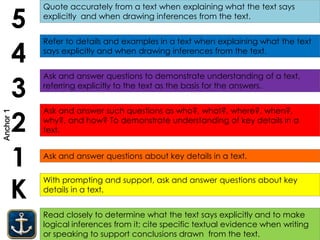
Read closely to determine what the text says explicitly and to make
logical inferences from it; cite specific textual evidence when writing
or speaking to support conclusions drawn from the text.
K
1
2
3
4
5
With prompting and support, ask and answer questions about key
details in a text.
Ask and answer questions about key details in a text.
Ask and answer questions to demonstrate understanding of a text,
referring explicitly to the text as the basis for the answers.
Refer to details and examples in a text when explaining what the text
says explicitly and when drawing inferences from the text.
Quote accurately from a text when explaining what the text says
explicitly and when drawing inferences from the text.
Ask and answer such questions as who?, what?, where?, when?,
why?, and how? To demonstrate understanding of key details in a
text.
Anchor1
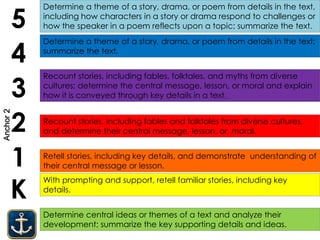
Determine central ideas or themes of a text and analyze their
development; summarize the key supporting details and ideas.
K
1
2
3
4
5
With prompting and support, retell familiar stories, including key
details.
Retell stories, including key details, and demonstrate understanding of
their central message or lesson.
Recount stories, including fables, folktales, and myths from diverse
cultures; determine the central message, lesson, or moral and explain
how it is conveyed through key details in a text.
Determine a theme of a story, drama, or poem from details in the text;
summarize the text.
Determine a theme of a story, drama, or poem from details in the text,
including how characters in a story or drama respond to challenges or
how the speaker in a poem reflects upon a topic; summarize the text.
Recount stories, including fables and folktales from diverse cultures,
and determine their central message, lesson, or moral.
Anchor2
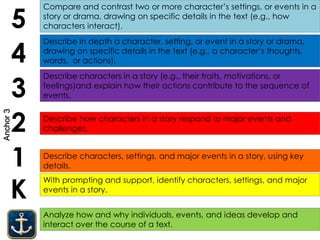
Analyze how and why individuals, events, and ideas develop and
interact over the course of a text.
K
1
2
3
4
5
With prompting and support, identify characters, settings, and major
events in a story.
Describe characters, settings, and major events in a story, using key
details.
Describe characters in a story (e.g., their traits, motivations, or
feelings)and explain how their actions contribute to the sequence of
events.
Describe in depth a character, setting, or event in a story or drama,
drawing on specific details in the text (e.g., a character’s thoughts,
words, or actions).
Compare and contrast two or more character’s settings, or events in a
story or drama, drawing on specific details in the text (e.g., how
characters interact).
Describe how characters in a story respond to major events and
challenges.
Anchor3
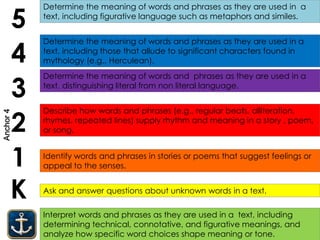
Interpret words and phrases as they are used in a text, including
determining technical, connotative, and figurative meanings, and
analyze how specific word choices shape meaning or tone.
K
1
2
3
4
5
Ask and answer questions about unknown words in a text.
Identify words and phrases in stories or poems that suggest feelings or
appeal to the senses.
Determine the meaning of words and phrases as they are used in a
text, distinguishing literal from non literal language.
Determine the meaning of words and phrases as they are used in a
text, including those that allude to significant characters found in
mythology (e.g., Herculean).
Determine the meaning of words and phrases as they are used in a
text, including figurative language such as metaphors and similes.
Describe how words and phrases (e.g., regular beats, alliteration,
rhymes, repeated lines) supply rhythm and meaning in a story , poem,
or song.
Anchor4
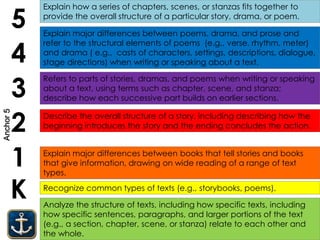
Analyze the structure of texts, including how specific texts, including
how specific sentences, paragraphs, and larger portions of the text
(e.g., a section, chapter, scene, or stanza) relate to each other and
the whole.
K
1
2
3
4
5
Recognize common types of texts (e.g., storybooks, poems).
Explain major differences between books that tell stories and books
that give information, drawing on wide reading of a range of text
types.
Refers to parts of stories, dramas, and poems when writing or speaking
about a text, using terms such as chapter, scene, and stanza;
describe how each successive part builds on earlier sections.
Explain major differences between poems, drama, and prose and
refer to the structural elements of poems (e.g., verse, rhythm, meter)
and drama ( e.g., casts of characters, settings, descriptions, dialogue,
stage directions) when writing or speaking about a text.
Explain how a series of chapters, scenes, or stanzas fits together to
provide the overall structure of a particular story, drama, or poem.
Describe the overall structure of a story, including describing how the
beginning introduces the story and the ending concludes the action.
Anchor5
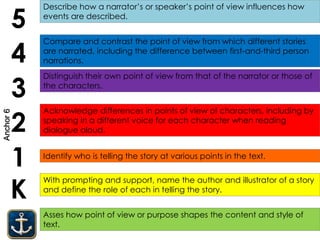
Asses how point of view or purpose shapes the content and style of
text.
K
1
2
3
4
5
With prompting and support, name the author and illustrator of a story
and define the role of each in telling the story.
Identify who is telling the story at various points in the text.
Distinguish their own point of view from that of the narrator or those of
the characters.
Compare and contrast the point of view from which different stories
are narrated, including the difference between first-and-third person
narrations.
Describe how a narrator’s or speaker’s point of view influences how
events are described.
Acknowledge differences in points of view of characters, including by
speaking in a different voice for each character when reading
dialogue aloud.
Anchor6
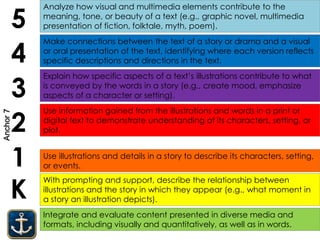
Integrate and evaluate content presented in diverse media and
formats, including visually and quantitatively, as well as in words.
K
1
2
3
4
5
With prompting and support, describe the relationship between
illustrations and the story in which they appear (e.g., what moment in
a story an illustration depicts).
Use illustrations and details in a story to describe its characters, setting,
or events.
Explain how specific aspects of a text’s illustrations contribute to what
is conveyed by the words in a story (e.g., create mood, emphasize
aspects of a character or setting).
Make connections between the text of a story or drama and a visual
or oral presentation of the text, identifying where each version reflects
specific descriptions and directions in the text.
Analyze how visual and multimedia elements contribute to the
meaning, tone, or beauty of a text (e.g., graphic novel, multimedia
presentation of fiction, folktale, myth, poem).
Use information gained from the illustrations and words in a print or
digital text to demonstrate understanding of its characters, setting, or
plot.
Anchor7
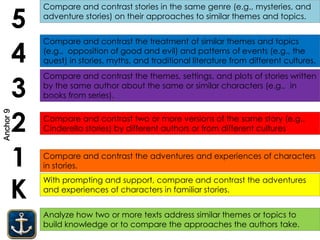
Analyze how two or more texts address similar themes or topics to
build knowledge or to compare the approaches the authors take.
K
1
2
3
4
5
With prompting and support, compare and contrast the adventures
and experiences of characters in familiar stories.
Compare and contrast the adventures and experiences of characters
in stories.
Compare and contrast the themes, settings, and plots of stories written
by the same author about the same or similar characters (e.g., in
books from series).
Compare and contrast the treatment of similar themes and topics
(e.g., opposition of good and evil) and patterns of events (e.g., the
quest) in stories, myths, and traditional literature from different cultures.
Compare and contrast stories in the same genre (e.g., mysteries, and
adventure stories) on their approaches to similar themes and topics.
Compare and contrast two or more versions of the same story (e.g.,
Cinderella stories) by different authors or from different cultures
Anchor9
Reading
Informational
Text
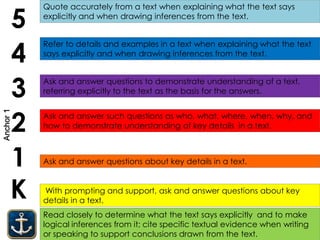
Read closely to determine what the text says explicitly and to make
logical inferences from it; cite specific textual evidence when writing
or speaking to support conclusions drawn from the text.
K
1
2
3
4
5
With prompting and support, ask and answer questions about key
details in a text.
Ask and answer questions about key details in a text.
Ask and answer questions to demonstrate understanding of a text,
referring explicitly to the text as the basis for the answers.
Refer to details and examples in a text when explaining what the text
says explicitly and when drawing inferences from the text.
Quote accurately from a text when explaining what the text says
explicitly and when drawing inferences from the text.
Ask and answer such questions as who, what, where, when, why, and
how to demonstrate understanding of key details in a text.
Anchor1
Determine central ideas or themes of a text and analyze their
development; summarize the key supporting details and ideas.
K
1
2
3
4
5
With prompting and support, identify the main topic and retell key
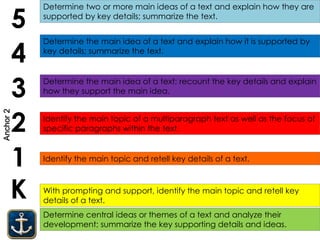
details of a text.
Identify the main topic and retell key details of a text.
Determine the main idea of a text; recount the key details and explain
how they support the main idea.
Determine the main idea of a text and explain how it is supported by
key details; summarize the text.
Determine two or more main ideas of a text and explain how they are
supported by key details; summarize the text.
Identify the main topic of a multiparagraph text as well as the focus of
specific paragraphs within the text.
Anchor2
Interpret words and phrases as they are used in a text, including
determining technical, connotative, and figurative meanings, and
analyze how specific word choices shape meaning or tone.
K
1
2
3
4
5
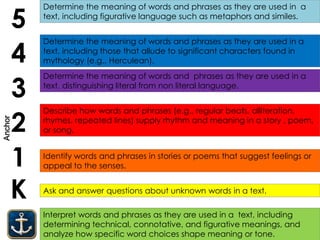
Ask and answer questions about unknown words in a text.
Identify words and phrases in stories or poems that suggest feelings or
appeal to the senses.
Determine the meaning of words and phrases as they are used in a
text, distinguishing literal from non literal language.
Determine the meaning of words and phrases as they are used in a
text, including those that allude to significant characters found in
mythology (e.g., Herculean).
Determine the meaning of words and phrases as they are used in a
text, including figurative language such as metaphors and similes.
Describe how words and phrases (e.g., regular beats, alliteration,
rhymes, repeated lines) supply rhythm and meaning in a story , poem,
or song.
Anchor
Interpret words and phrases as they are used in a text, including
determining technical, connotative, and figurative meanings, and
analyze how specific word choices shape meaning or tone.
K
1
2
3
4
5
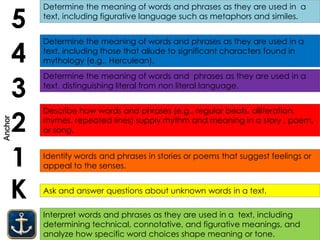
Ask and answer questions about unknown words in a text.
Identify words and phrases in stories or poems that suggest feelings or
appeal to the senses.
Determine the meaning of words and phrases as they are used in a
text, distinguishing literal from non literal language.
Determine the meaning of words and phrases as they are used in a
text, including those that allude to significant characters found in
mythology (e.g., Herculean).
Determine the meaning of words and phrases as they are used in a
text, including figurative language such as metaphors and similes.
Describe how words and phrases (e.g., regular beats, alliteration,
rhymes, repeated lines) supply rhythm and meaning in a story , poem,
or song.
Anchor
Analyze how and why individuals, events, and ideas develop and
interact over the course of a text.
K
1
2
3
4
5
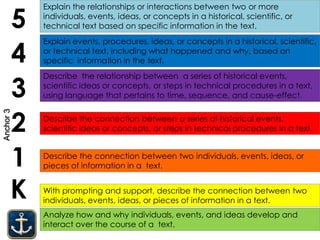
With prompting and support, describe the connection between two
individuals, events, ideas, or pieces of information in a text.
Describe the connection between two individuals, events, ideas, or
pieces of information in a text.
Describe the relationship between a series of historical events,
scientific ideas or concepts, or steps in technical procedures in a text,
using language that pertains to time, sequence, and cause-effect.
Explain events, procedures, ideas, or concepts in a historical, scientific,
or technical text, including what happened and why, based on
specific information in the text.
Explain the relationships or interactions between two or more
individuals, events, ideas, or concepts in a historical, scientific, or
technical text based on specific information in the text.
Describe the connection between a series of historical events,
scientific ideas or concepts, or steps in technical procedures in a text.
Anchor3
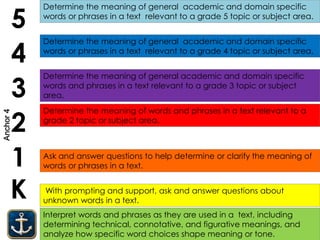
Interpret words and phrases as they are used in a text, including
determining technical, connotative, and figurative meanings, and
analyze how specific word choices shape meaning or tone.
K
1
2
3
4
5
With prompting and support, ask and answer questions about
unknown words in a text.
Ask and answer questions to help determine or clarify the meaning of
words or phrases in a text.
Determine the meaning of general academic and domain specific
words and phrases in a text relevant to a grade 3 topic or subject
area.
Determine the meaning of general academic and domain specific
words or phrases in a text relevant to a grade 4 topic or subject area.
Determine the meaning of general academic and domain specific
words or phrases in a text relevant to a grade 5 topic or subject area.
Determine the meaning of words and phrases in a text relevant to a
grade 2 topic or subject area.
Anchor4
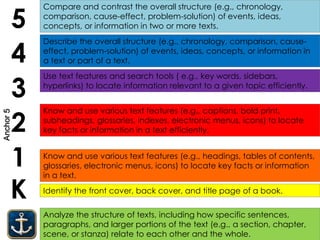
Analyze the structure of texts, including how specific sentences,
paragraphs, and larger portions of the text (e.g., a section, chapter,
scene, or stanza) relate to each other and the whole.
K
1
2
3
4
5
Identify the front cover, back cover, and title page of a book.
Know and use various text features (e.g., headings, tables of contents,
glossaries, electronic menus, icons) to locate key facts or information
in a text.
Use text features and search tools ( e.g., key words, sidebars,
hyperlinks) to locate information relevant to a given topic efficiently.
Describe the overall structure (e.g., chronology, comparison, cause-
effect, problem-solution) of events, ideas, concepts, or information in
a text or part of a text.
Compare and contrast the overall structure (e.g., chronology,
comparison, cause-effect, problem-solution) of events, ideas,
concepts, or information in two or more texts.
Know and use various text features (e.g., captions, bold print,
subheadings, glossaries, indexes, electronic menus, icons) to locate
key facts or information in a text efficiently.
Anchor5
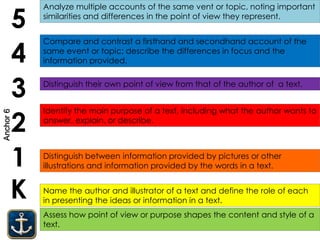
Assess how point of view or purpose shapes the content and style of a
text.
K
1
2
3
4
5
Name the author and illustrator of a text and define the role of each
in presenting the ideas or information in a text.
Distinguish between information provided by pictures or other
illustrations and information provided by the words in a text.
Distinguish their own point of view from that of the author of a text.
Compare and contrast a firsthand and secondhand account of the
same event or topic; describe the differences in focus and the
information provided.
Analyze multiple accounts of the same vent or topic, noting important
similarities and differences in the point of view they represent.
Identify the main purpose of a text, including what the author wants to
answer, explain, or describe.
Anchor6
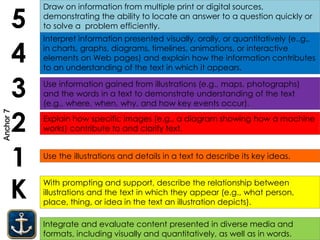
Integrate and evaluate content presented in diverse media and
formats, including visually and quantitatively, as well as in words.
K
1
2
3
4
5
With prompting and support, describe the relationship between
illustrations and the text in which they appear (e.g., what person,
place, thing, or idea in the text an illustration depicts).
Use the illustrations and details in a text to describe its key ideas.
Use information gained from illustrations (e.g., maps, photographs)
and the words in a text to demonstrate understanding of the text
(e.g., where, when, why, and how key events occur).
Interpret information presented visually, orally, or quantitatively (e..g.,
in charts, graphs, diagrams, timelines, animations, or interactive
elements on Web pages) and explain how the information contributes
to an understanding of the text in which it appears.
Draw on information from multiple print or digital sources,
demonstrating the ability to locate an answer to a question quickly or
to solve a problem efficiently.
Explain how specific images (e.g., a diagram showing how a machine
works) contribute to and clarify text.
Anchor7
Delineate and evaluate the argument and specific claims in a text,
including the validity of the reasoning as well as the relevance and
sufficiently of the evidence.
K
1
2
3
4
5
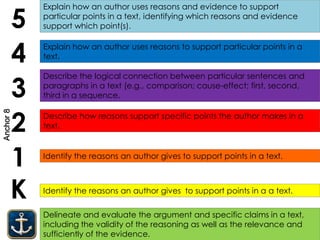
Identify the reasons an author gives to support points in a a text.
Identify the reasons an author gives to support points in a text.
Describe the logical connection between particular sentences and
paragraphs in a text (e.g., comparison; cause-effect; first, second,
third in a sequence.
Explain how an author uses reasons to support particular points in a
text.
Explain how an author uses reasons and evidence to support
particular points in a text, identifying which reasons and evidence
support which point(s).
Describe how reasons support specific points the author makes in a
text.
Anchor8
Analyze how two or more texts address similar themes or topics in
order to build knowledge or to compare the approaches the authirs
take.
K
1
2
3
4
5
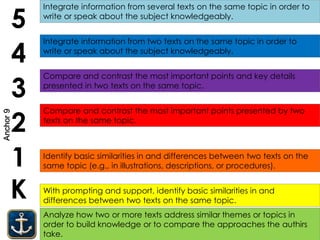
With prompting and support, identify basic similarities in and
differences between two texts on the same topic.
Identify basic similarities in and differences between two texts on the
same topic (e.g., in illustrations, descriptions, or procedures).
Compare and contrast the most important points and key details
presented in two texts on the same topic.
Integrate information from two texts on the same topic in order to
write or speak about the subject knowledgeably.
Integrate information from several texts on the same topic in order to
write or speak about the subject knowledgeably.
Compare and contrast the most important points presented by two
texts on the same topic.
Anchor9
Read and comprehend complex literary and informational texts
independently and proficiently.
K
1
2
3
4
5
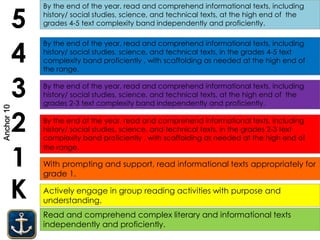
Actively engage in group reading activities with purpose and
understanding.
With prompting and support, read informational texts appropriately for
grade 1.
By the end of the year, read and comprehend informational texts, including
history/ social studies, science, and technical texts, at the high end of the
grades 2-3 text complexity band independently and proficiently.
By the end of the year, read and comprehend informational texts, including
history/ social studies, science, and technical texts, in the grades 4-5 text
complexity band proficiently , with scaffolding as needed at the high end of
the range.
By the end of the year, read and comprehend informational texts, including
history/ social studies, science, and technical texts, at the high end of the
grades 4-5 text complexity band independently and proficiently.
By the end of the year, read and comprehend informational texts, including
history/ social studies, science, and technical texts, in the grades 2-3 text
complexity band proficiently , with scaffolding as needed at the high end of
the range.
Anchor10

Standards gradient

  • 1.
  • 2.
  • 3.
    Read closely todetermine what the text says explicitly and to make logical inferences from it; cite specific textual evidence when writing or speaking to support conclusions drawn from the text. K 1 2 3 4 5 With prompting and support, ask and answer questions about key details in a text. Ask and answer questions about key details in a text. Ask and answer questions to demonstrate understanding of a text, referring explicitly to the text as the basis for the answers. Refer to details and examples in a text when explaining what the text says explicitly and when drawing inferences from the text. Quote accurately from a text when explaining what the text says explicitly and when drawing inferences from the text. Ask and answer such questions as who?, what?, where?, when?, why?, and how? To demonstrate understanding of key details in a text. Anchor1
  • 4.
    Determine central ideasor themes of a text and analyze their development; summarize the key supporting details and ideas. K 1 2 3 4 5 With prompting and support, retell familiar stories, including key details. Retell stories, including key details, and demonstrate understanding of their central message or lesson. Recount stories, including fables, folktales, and myths from diverse cultures; determine the central message, lesson, or moral and explain how it is conveyed through key details in a text. Determine a theme of a story, drama, or poem from details in the text; summarize the text. Determine a theme of a story, drama, or poem from details in the text, including how characters in a story or drama respond to challenges or how the speaker in a poem reflects upon a topic; summarize the text. Recount stories, including fables and folktales from diverse cultures, and determine their central message, lesson, or moral. Anchor2
  • 5.
    Analyze how andwhy individuals, events, and ideas develop and interact over the course of a text. K 1 2 3 4 5 With prompting and support, identify characters, settings, and major events in a story. Describe characters, settings, and major events in a story, using key details. Describe characters in a story (e.g., their traits, motivations, or feelings)and explain how their actions contribute to the sequence of events. Describe in depth a character, setting, or event in a story or drama, drawing on specific details in the text (e.g., a character’s thoughts, words, or actions). Compare and contrast two or more character’s settings, or events in a story or drama, drawing on specific details in the text (e.g., how characters interact). Describe how characters in a story respond to major events and challenges. Anchor3
  • 6.
    Interpret words andphrases as they are used in a text, including determining technical, connotative, and figurative meanings, and analyze how specific word choices shape meaning or tone. K 1 2 3 4 5 Ask and answer questions about unknown words in a text. Identify words and phrases in stories or poems that suggest feelings or appeal to the senses. Determine the meaning of words and phrases as they are used in a text, distinguishing literal from non literal language. Determine the meaning of words and phrases as they are used in a text, including those that allude to significant characters found in mythology (e.g., Herculean). Determine the meaning of words and phrases as they are used in a text, including figurative language such as metaphors and similes. Describe how words and phrases (e.g., regular beats, alliteration, rhymes, repeated lines) supply rhythm and meaning in a story , poem, or song. Anchor4
  • 7.
    Analyze the structureof texts, including how specific texts, including how specific sentences, paragraphs, and larger portions of the text (e.g., a section, chapter, scene, or stanza) relate to each other and the whole. K 1 2 3 4 5 Recognize common types of texts (e.g., storybooks, poems). Explain major differences between books that tell stories and books that give information, drawing on wide reading of a range of text types. Refers to parts of stories, dramas, and poems when writing or speaking about a text, using terms such as chapter, scene, and stanza; describe how each successive part builds on earlier sections. Explain major differences between poems, drama, and prose and refer to the structural elements of poems (e.g., verse, rhythm, meter) and drama ( e.g., casts of characters, settings, descriptions, dialogue, stage directions) when writing or speaking about a text. Explain how a series of chapters, scenes, or stanzas fits together to provide the overall structure of a particular story, drama, or poem. Describe the overall structure of a story, including describing how the beginning introduces the story and the ending concludes the action. Anchor5
  • 8.
    Asses how pointof view or purpose shapes the content and style of text. K 1 2 3 4 5 With prompting and support, name the author and illustrator of a story and define the role of each in telling the story. Identify who is telling the story at various points in the text. Distinguish their own point of view from that of the narrator or those of the characters. Compare and contrast the point of view from which different stories are narrated, including the difference between first-and-third person narrations. Describe how a narrator’s or speaker’s point of view influences how events are described. Acknowledge differences in points of view of characters, including by speaking in a different voice for each character when reading dialogue aloud. Anchor6
  • 9.
    Integrate and evaluatecontent presented in diverse media and formats, including visually and quantitatively, as well as in words. K 1 2 3 4 5 With prompting and support, describe the relationship between illustrations and the story in which they appear (e.g., what moment in a story an illustration depicts). Use illustrations and details in a story to describe its characters, setting, or events. Explain how specific aspects of a text’s illustrations contribute to what is conveyed by the words in a story (e.g., create mood, emphasize aspects of a character or setting). Make connections between the text of a story or drama and a visual or oral presentation of the text, identifying where each version reflects specific descriptions and directions in the text. Analyze how visual and multimedia elements contribute to the meaning, tone, or beauty of a text (e.g., graphic novel, multimedia presentation of fiction, folktale, myth, poem). Use information gained from the illustrations and words in a print or digital text to demonstrate understanding of its characters, setting, or plot. Anchor7
  • 10.
    Analyze how twoor more texts address similar themes or topics to build knowledge or to compare the approaches the authors take. K 1 2 3 4 5 With prompting and support, compare and contrast the adventures and experiences of characters in familiar stories. Compare and contrast the adventures and experiences of characters in stories. Compare and contrast the themes, settings, and plots of stories written by the same author about the same or similar characters (e.g., in books from series). Compare and contrast the treatment of similar themes and topics (e.g., opposition of good and evil) and patterns of events (e.g., the quest) in stories, myths, and traditional literature from different cultures. Compare and contrast stories in the same genre (e.g., mysteries, and adventure stories) on their approaches to similar themes and topics. Compare and contrast two or more versions of the same story (e.g., Cinderella stories) by different authors or from different cultures Anchor9
  • 11.
  • 12.
    Read closely todetermine what the text says explicitly and to make logical inferences from it; cite specific textual evidence when writing or speaking to support conclusions drawn from the text. K 1 2 3 4 5 With prompting and support, ask and answer questions about key details in a text. Ask and answer questions about key details in a text. Ask and answer questions to demonstrate understanding of a text, referring explicitly to the text as the basis for the answers. Refer to details and examples in a text when explaining what the text says explicitly and when drawing inferences from the text. Quote accurately from a text when explaining what the text says explicitly and when drawing inferences from the text. Ask and answer such questions as who, what, where, when, why, and how to demonstrate understanding of key details in a text. Anchor1
  • 13.
    Determine central ideasor themes of a text and analyze their development; summarize the key supporting details and ideas. K 1 2 3 4 5 With prompting and support, identify the main topic and retell key details of a text. Identify the main topic and retell key details of a text. Determine the main idea of a text; recount the key details and explain how they support the main idea. Determine the main idea of a text and explain how it is supported by key details; summarize the text. Determine two or more main ideas of a text and explain how they are supported by key details; summarize the text. Identify the main topic of a multiparagraph text as well as the focus of specific paragraphs within the text. Anchor2
  • 14.
    Interpret words andphrases as they are used in a text, including determining technical, connotative, and figurative meanings, and analyze how specific word choices shape meaning or tone. K 1 2 3 4 5 Ask and answer questions about unknown words in a text. Identify words and phrases in stories or poems that suggest feelings or appeal to the senses. Determine the meaning of words and phrases as they are used in a text, distinguishing literal from non literal language. Determine the meaning of words and phrases as they are used in a text, including those that allude to significant characters found in mythology (e.g., Herculean). Determine the meaning of words and phrases as they are used in a text, including figurative language such as metaphors and similes. Describe how words and phrases (e.g., regular beats, alliteration, rhymes, repeated lines) supply rhythm and meaning in a story , poem, or song. Anchor
  • 15.
    Interpret words andphrases as they are used in a text, including determining technical, connotative, and figurative meanings, and analyze how specific word choices shape meaning or tone. K 1 2 3 4 5 Ask and answer questions about unknown words in a text. Identify words and phrases in stories or poems that suggest feelings or appeal to the senses. Determine the meaning of words and phrases as they are used in a text, distinguishing literal from non literal language. Determine the meaning of words and phrases as they are used in a text, including those that allude to significant characters found in mythology (e.g., Herculean). Determine the meaning of words and phrases as they are used in a text, including figurative language such as metaphors and similes. Describe how words and phrases (e.g., regular beats, alliteration, rhymes, repeated lines) supply rhythm and meaning in a story , poem, or song. Anchor
  • 16.
    Analyze how andwhy individuals, events, and ideas develop and interact over the course of a text. K 1 2 3 4 5 With prompting and support, describe the connection between two individuals, events, ideas, or pieces of information in a text. Describe the connection between two individuals, events, ideas, or pieces of information in a text. Describe the relationship between a series of historical events, scientific ideas or concepts, or steps in technical procedures in a text, using language that pertains to time, sequence, and cause-effect. Explain events, procedures, ideas, or concepts in a historical, scientific, or technical text, including what happened and why, based on specific information in the text. Explain the relationships or interactions between two or more individuals, events, ideas, or concepts in a historical, scientific, or technical text based on specific information in the text. Describe the connection between a series of historical events, scientific ideas or concepts, or steps in technical procedures in a text. Anchor3
  • 17.
    Interpret words andphrases as they are used in a text, including determining technical, connotative, and figurative meanings, and analyze how specific word choices shape meaning or tone. K 1 2 3 4 5 With prompting and support, ask and answer questions about unknown words in a text. Ask and answer questions to help determine or clarify the meaning of words or phrases in a text. Determine the meaning of general academic and domain specific words and phrases in a text relevant to a grade 3 topic or subject area. Determine the meaning of general academic and domain specific words or phrases in a text relevant to a grade 4 topic or subject area. Determine the meaning of general academic and domain specific words or phrases in a text relevant to a grade 5 topic or subject area. Determine the meaning of words and phrases in a text relevant to a grade 2 topic or subject area. Anchor4
  • 18.
    Analyze the structureof texts, including how specific sentences, paragraphs, and larger portions of the text (e.g., a section, chapter, scene, or stanza) relate to each other and the whole. K 1 2 3 4 5 Identify the front cover, back cover, and title page of a book. Know and use various text features (e.g., headings, tables of contents, glossaries, electronic menus, icons) to locate key facts or information in a text. Use text features and search tools ( e.g., key words, sidebars, hyperlinks) to locate information relevant to a given topic efficiently. Describe the overall structure (e.g., chronology, comparison, cause- effect, problem-solution) of events, ideas, concepts, or information in a text or part of a text. Compare and contrast the overall structure (e.g., chronology, comparison, cause-effect, problem-solution) of events, ideas, concepts, or information in two or more texts. Know and use various text features (e.g., captions, bold print, subheadings, glossaries, indexes, electronic menus, icons) to locate key facts or information in a text efficiently. Anchor5
  • 19.
    Assess how pointof view or purpose shapes the content and style of a text. K 1 2 3 4 5 Name the author and illustrator of a text and define the role of each in presenting the ideas or information in a text. Distinguish between information provided by pictures or other illustrations and information provided by the words in a text. Distinguish their own point of view from that of the author of a text. Compare and contrast a firsthand and secondhand account of the same event or topic; describe the differences in focus and the information provided. Analyze multiple accounts of the same vent or topic, noting important similarities and differences in the point of view they represent. Identify the main purpose of a text, including what the author wants to answer, explain, or describe. Anchor6
  • 20.
    Integrate and evaluatecontent presented in diverse media and formats, including visually and quantitatively, as well as in words. K 1 2 3 4 5 With prompting and support, describe the relationship between illustrations and the text in which they appear (e.g., what person, place, thing, or idea in the text an illustration depicts). Use the illustrations and details in a text to describe its key ideas. Use information gained from illustrations (e.g., maps, photographs) and the words in a text to demonstrate understanding of the text (e.g., where, when, why, and how key events occur). Interpret information presented visually, orally, or quantitatively (e..g., in charts, graphs, diagrams, timelines, animations, or interactive elements on Web pages) and explain how the information contributes to an understanding of the text in which it appears. Draw on information from multiple print or digital sources, demonstrating the ability to locate an answer to a question quickly or to solve a problem efficiently. Explain how specific images (e.g., a diagram showing how a machine works) contribute to and clarify text. Anchor7
  • 21.
    Delineate and evaluatethe argument and specific claims in a text, including the validity of the reasoning as well as the relevance and sufficiently of the evidence. K 1 2 3 4 5 Identify the reasons an author gives to support points in a a text. Identify the reasons an author gives to support points in a text. Describe the logical connection between particular sentences and paragraphs in a text (e.g., comparison; cause-effect; first, second, third in a sequence. Explain how an author uses reasons to support particular points in a text. Explain how an author uses reasons and evidence to support particular points in a text, identifying which reasons and evidence support which point(s). Describe how reasons support specific points the author makes in a text. Anchor8
  • 22.
    Analyze how twoor more texts address similar themes or topics in order to build knowledge or to compare the approaches the authirs take. K 1 2 3 4 5 With prompting and support, identify basic similarities in and differences between two texts on the same topic. Identify basic similarities in and differences between two texts on the same topic (e.g., in illustrations, descriptions, or procedures). Compare and contrast the most important points and key details presented in two texts on the same topic. Integrate information from two texts on the same topic in order to write or speak about the subject knowledgeably. Integrate information from several texts on the same topic in order to write or speak about the subject knowledgeably. Compare and contrast the most important points presented by two texts on the same topic. Anchor9
  • 23.
    Read and comprehendcomplex literary and informational texts independently and proficiently. K 1 2 3 4 5 Actively engage in group reading activities with purpose and understanding. With prompting and support, read informational texts appropriately for grade 1. By the end of the year, read and comprehend informational texts, including history/ social studies, science, and technical texts, at the high end of the grades 2-3 text complexity band independently and proficiently. By the end of the year, read and comprehend informational texts, including history/ social studies, science, and technical texts, in the grades 4-5 text complexity band proficiently , with scaffolding as needed at the high end of the range. By the end of the year, read and comprehend informational texts, including history/ social studies, science, and technical texts, at the high end of the grades 4-5 text complexity band independently and proficiently. By the end of the year, read and comprehend informational texts, including history/ social studies, science, and technical texts, in the grades 2-3 text complexity band proficiently , with scaffolding as needed at the high end of the range. Anchor10