ENGLISH
(JUDGE THE VALIDITY)
LEARNING
OBJECTIVES
BRAINSTORM
Think a words that
associate with the
word EVIDENCE
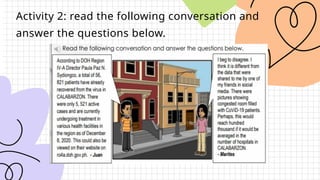
Activity 2: read the following conversation and
answer the questions below.
Direction:
TIME TO
LEARN
What is validity?
- Refers to the soundness and strength
of arguments. Is the evidence clear
and effective?
Oxford language dictionary defines
validity as the quality or being factually
sound : the state of being legally or
officially binding or acceptable.
What is evidence?
- Evidence is the available body of facts
or information indicating whether a
belief or proposition is true or valid.
Don’t confuse evidence with citation.
Evidence is the facts used to
support the point.
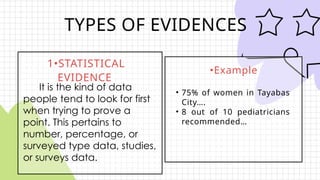
TYPES OF EVIDENCES
1•STATISTICAL
EVIDENCE
•Example
• 75% of women in Tayabas
City….
• 8 out of 10 pediatricians
recommended…
It is the kind of data
people tend to look for first
when trying to prove a
point. This pertains to
number, percentage, or
surveyed type data, studies,
or surveys data.
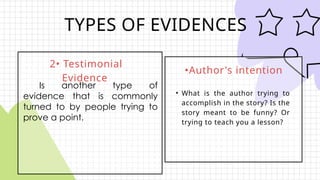
TYPES OF EVIDENCES
2• Testimonial
Evidence
•Author's intention
• What is the author trying to
accomplish in the story? Is the
story meant to be funny? Or
trying to teach you a lesson?
Is another type of
evidence that is commonly
turned to by people trying to
prove a point.
TYPES OF EVIDENCES
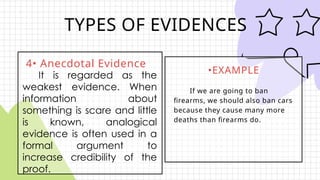
4• Anecdotal Evidence
•EXAMPLE
If we are going to ban
firearms, we should also ban cars
because they cause many more
deaths than firearms do.
It is regarded as the
weakest evidence. When
information about
something is scare and little
is known, analogical
evidence is often used in a
formal argument to
increase credibility of the
proof.
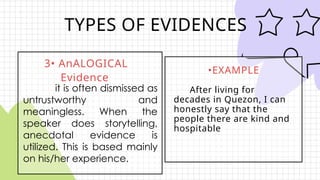
TYPES OF EVIDENCES
3• AnALOGICAL
Evidence
•EXAMPLE
After living for
decades in Quezon, I can
honestly say that the
people there are kind and
hospitable
it is often dismissed as
untrustworthy and
meaningless. When the
speaker does storytelling,
anecdotal evidence is
utilized. This is based mainly
on his/her experience.
reliability
- relia
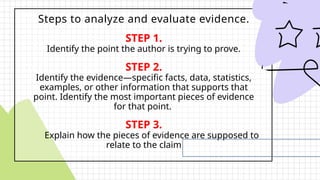
Steps to analyze and evaluate evidence.
STEP 1.
Identify the point the author is trying to prove.
STEP 2.
Identify the evidence—specific facts, data, statistics,
examples, or other information that supports that
point. Identify the most important pieces of evidence
for that point.
STEP 3.
Explain how the pieces of evidence are supposed to
relate to the claim
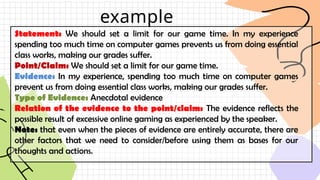
example
Statement: We should set a limit for our game time. In my experience
spending too much time on computer games prevents us from doing essential
class works, making our grades suffer.
Point/Claim: We should set a limit for our game time.
Evidence: In my experience, spending too much time on computer games
prevent us from doing essential class works, making our grades suffer.
Type of Evidence: Anecdotal evidence
Relation of the evidence to the point/claim: The evidence reflects the
possible result of excessive online gaming as experienced by the speaker.
Note: that even when the pieces of evidence are entirely accurate, there are
other factors that we need to consider/before using them as bases for our
thoughts and actions.
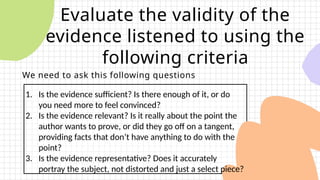
Evaluate the validity of the
evidence listened to using the
following criteria
We need to ask this following questions
1. Is the evidence sufficient? Is there enough of it, or do
you need more to feel convinced?
2. Is the evidence relevant? Is it really about the point the
author wants to prove, or did they go off on a tangent,
providing facts that don’t have anything to do with the
point?
3. Is the evidence representative? Does it accurately
portray the subject, not distorted and just a select piece?
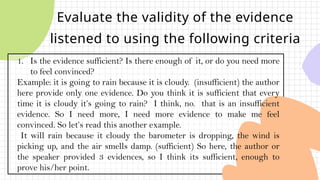
Evaluate the validity of the evidence
listened to using the following criteria
1. Is the evidence sufficient? Is there enough of it, or do you need more
to feel convinced?
Example: it is going to rain because it is cloudy. (insufficient) the author
here provide only one evidence. Do you think it is sufficient that every
time it is cloudy it’s going to rain? I think, no. that is an insufficient
evidence. So I need more, I need more evidence to make me feel
convinced. So let’s read this another example.
It will rain because it cloudy the barometer is dropping, the wind is
picking up, and the air smells damp. (sufficient) So here, the author or
the speaker provided 3 evidences, so I think its sufficient, enough to
prove his/her point.
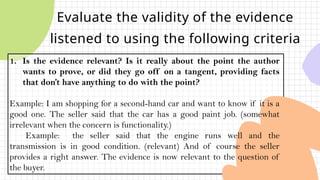
Evaluate the validity of the evidence
listened to using the following criteria
1. Is the evidence relevant? Is it really about the point the author
wants to prove, or did they go off on a tangent, providing facts
that don’t have anything to do with the point?
Example: I am shopping for a second-hand car and want to know if it is a
good one. The seller said that the car has a good paint job. (somewhat
irrelevant when the concern is functionality.)
Example: the seller said that the engine runs well and the
transmission is in good condition. (relevant) And of course the seller
provides a right answer. The evidence is now relevant to the question of
the buyer.
Evaluate the validity of the evidence
listened to using the following criteria
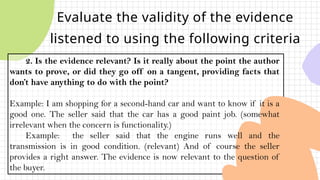
2. Is the evidence relevant? Is it really about the point the author
wants to prove, or did they go off on a tangent, providing facts that
don’t have anything to do with the point?
Example: I am shopping for a second-hand car and want to know if it is a
good one. The seller said that the car has a good paint job. (somewhat
irrelevant when the concern is functionality.)
Example: the seller said that the engine runs well and the
transmission is in good condition. (relevant) And of course the seller
provides a right answer. The evidence is now relevant to the question of
the buyer.
Evaluate the validity of the evidence
listened to using the following criteria
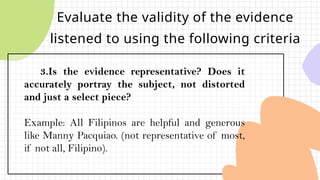
3.Is the evidence representative? Does it
accurately portray the subject, not distorted
and just a select piece?
Example: All Filipinos are helpful and generous
like Manny Pacquiao. (not representative of most,
if not all, Filipino).
“time for
knowledge
check!”
ASSIGNME
NT:
Direction: Find/watch a latest news article
then evaluate the validity of the evidences
presented, and structure your evaluation by
clearly stating each point or claim,
presenting the evidence provided, and
identify the type of evidence presented. (It
can be printed or hand written)
“THE FACT THAT AN OPINION HAS BEEN WIDELY HELD
IS NO EVIDENCE WHATEVER THAT IS NOT UTTERLY
ABSURB”
-BERTRAND RUSSEL-
THANK YOU!

Judging the Validity of the Materials viewed

  • 1.
  • 2.
  • 3.
    BRAINSTORM Think a wordsthat associate with the word EVIDENCE
  • 4.
    Activity 2: readthe following conversation and answer the questions below. Direction:
  • 5.
  • 6.
    What is validity? -Refers to the soundness and strength of arguments. Is the evidence clear and effective? Oxford language dictionary defines validity as the quality or being factually sound : the state of being legally or officially binding or acceptable.
  • 7.
    What is evidence? -Evidence is the available body of facts or information indicating whether a belief or proposition is true or valid. Don’t confuse evidence with citation. Evidence is the facts used to support the point.
  • 8.
    TYPES OF EVIDENCES 1•STATISTICAL EVIDENCE •Example •75% of women in Tayabas City…. • 8 out of 10 pediatricians recommended… It is the kind of data people tend to look for first when trying to prove a point. This pertains to number, percentage, or surveyed type data, studies, or surveys data.
  • 9.
    TYPES OF EVIDENCES 2•Testimonial Evidence •Author's intention • What is the author trying to accomplish in the story? Is the story meant to be funny? Or trying to teach you a lesson? Is another type of evidence that is commonly turned to by people trying to prove a point.
  • 10.
    TYPES OF EVIDENCES 4•Anecdotal Evidence •EXAMPLE If we are going to ban firearms, we should also ban cars because they cause many more deaths than firearms do. It is regarded as the weakest evidence. When information about something is scare and little is known, analogical evidence is often used in a formal argument to increase credibility of the proof.
  • 11.
    TYPES OF EVIDENCES 3•AnALOGICAL Evidence •EXAMPLE After living for decades in Quezon, I can honestly say that the people there are kind and hospitable it is often dismissed as untrustworthy and meaningless. When the speaker does storytelling, anecdotal evidence is utilized. This is based mainly on his/her experience.
  • 12.
  • 13.
    Steps to analyzeand evaluate evidence. STEP 1. Identify the point the author is trying to prove. STEP 2. Identify the evidence—specific facts, data, statistics, examples, or other information that supports that point. Identify the most important pieces of evidence for that point. STEP 3. Explain how the pieces of evidence are supposed to relate to the claim
  • 14.
    example Statement: We shouldset a limit for our game time. In my experience spending too much time on computer games prevents us from doing essential class works, making our grades suffer. Point/Claim: We should set a limit for our game time. Evidence: In my experience, spending too much time on computer games prevent us from doing essential class works, making our grades suffer. Type of Evidence: Anecdotal evidence Relation of the evidence to the point/claim: The evidence reflects the possible result of excessive online gaming as experienced by the speaker. Note: that even when the pieces of evidence are entirely accurate, there are other factors that we need to consider/before using them as bases for our thoughts and actions.
  • 15.
    Evaluate the validityof the evidence listened to using the following criteria We need to ask this following questions 1. Is the evidence sufficient? Is there enough of it, or do you need more to feel convinced? 2. Is the evidence relevant? Is it really about the point the author wants to prove, or did they go off on a tangent, providing facts that don’t have anything to do with the point? 3. Is the evidence representative? Does it accurately portray the subject, not distorted and just a select piece?
  • 16.
    Evaluate the validityof the evidence listened to using the following criteria 1. Is the evidence sufficient? Is there enough of it, or do you need more to feel convinced? Example: it is going to rain because it is cloudy. (insufficient) the author here provide only one evidence. Do you think it is sufficient that every time it is cloudy it’s going to rain? I think, no. that is an insufficient evidence. So I need more, I need more evidence to make me feel convinced. So let’s read this another example. It will rain because it cloudy the barometer is dropping, the wind is picking up, and the air smells damp. (sufficient) So here, the author or the speaker provided 3 evidences, so I think its sufficient, enough to prove his/her point.
  • 17.
    Evaluate the validityof the evidence listened to using the following criteria 1. Is the evidence relevant? Is it really about the point the author wants to prove, or did they go off on a tangent, providing facts that don’t have anything to do with the point? Example: I am shopping for a second-hand car and want to know if it is a good one. The seller said that the car has a good paint job. (somewhat irrelevant when the concern is functionality.) Example: the seller said that the engine runs well and the transmission is in good condition. (relevant) And of course the seller provides a right answer. The evidence is now relevant to the question of the buyer.
  • 18.
    Evaluate the validityof the evidence listened to using the following criteria 2. Is the evidence relevant? Is it really about the point the author wants to prove, or did they go off on a tangent, providing facts that don’t have anything to do with the point? Example: I am shopping for a second-hand car and want to know if it is a good one. The seller said that the car has a good paint job. (somewhat irrelevant when the concern is functionality.) Example: the seller said that the engine runs well and the transmission is in good condition. (relevant) And of course the seller provides a right answer. The evidence is now relevant to the question of the buyer.
  • 19.
    Evaluate the validityof the evidence listened to using the following criteria 3.Is the evidence representative? Does it accurately portray the subject, not distorted and just a select piece? Example: All Filipinos are helpful and generous like Manny Pacquiao. (not representative of most, if not all, Filipino).
  • 20.
  • 21.
    ASSIGNME NT: Direction: Find/watch alatest news article then evaluate the validity of the evidences presented, and structure your evaluation by clearly stating each point or claim, presenting the evidence provided, and identify the type of evidence presented. (It can be printed or hand written)
  • 22.
    “THE FACT THATAN OPINION HAS BEEN WIDELY HELD IS NO EVIDENCE WHATEVER THAT IS NOT UTTERLY ABSURB” -BERTRAND RUSSEL-
  • 23.