Concept Checking for Vocabulary

                       Jo Gakonga
                    CELTA trainer
                 elt-training.com
Teaching Vocabulary
1. Put the new vocabulary in a clear context

2. Explain/ clarify what it means
Teaching Vocabulary
1. Put the new vocabulary in a clear context

2. Explain/ clarify what it means

3. Check that they understand.
For class:
Watch this video to find out:


  –Why is concept checking important?
  –What are the ‘golden rules’?
What problems can you see with the following
ways of checking meaning?

  What does ‘bait’ mean?
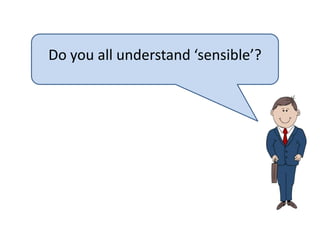
  Do you all understand ‘sensible’?
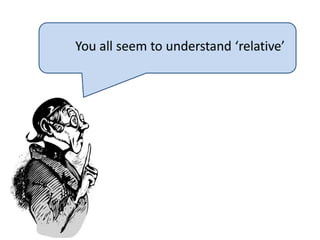
  You all seem to understand
  ‘relative’
What does ‘bait’ mean?
What does ‘irony’ mean?
Do you all understand ‘sensible’?
How can we check that they understand?

By asking (closed) questions that are easy
to answer and prove that they understand.
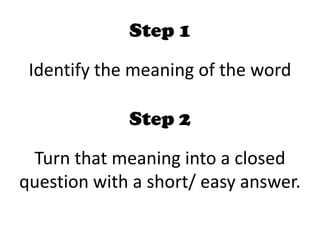
Step 1

 Identify the meaning of the word

             Step 2

 Turn that meaning into a closed
question with a short/ easy answer.
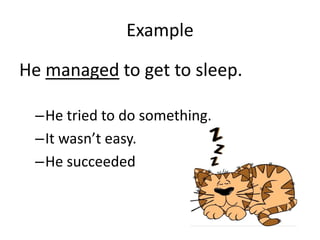
Example

He managed to get to sleep.

 –He tried to do something.
 –It wasn’t easy.
 –He succeeded
Now make these into questions..
He tried to do something.
       Did he try? (yes)
It wasn’t easy.
       Was it easy? (no)
He succeeded.
       Did he succeed? (yes)
And that’s all there is to it!
What’s wrong with this?
He didn't know if he was coming or going

• Was he coming?
• Was he going?
• Did he know?
What’s wrong with this?
He didn't know if he was coming or going

• He was confused.
     Was he confused?
Helpful Hint 1

Make sure that you are checking the


                MEANING
What’s wrong with this?
A wardrobe.

• Is it made of wood?
• Is there one in your house?
What’s wrong with this?
A wardrobe.

• Do you put food or clothes in a wardrobe?
  (clothes)
• Which room is it in? (bedroom)
• Show a picture – Is this a wardrobe? (yes)
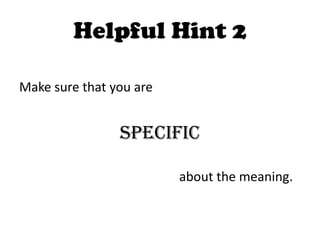
Helpful Hint 2

Make sure that you are


                specific

                         about the meaning.
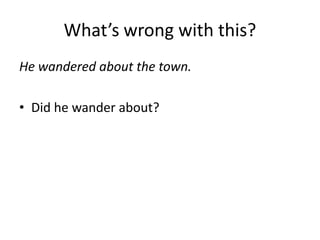
What’s wrong with this?
He wandered about the town.

• Did he wander about?
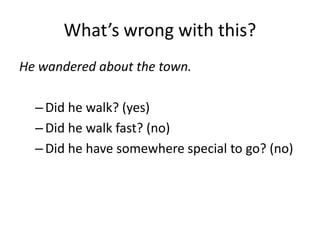
What’s wrong with this?
He wandered about the town.

  – Did he walk? (yes)
  – Did he walk fast? (no)
  – Did he have somewhere special to go? (no)
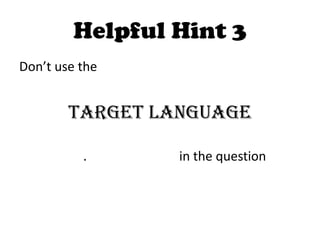
Helpful Hint 3
Don’t use the


        target language

          .      in the question
What’s wrong with this?
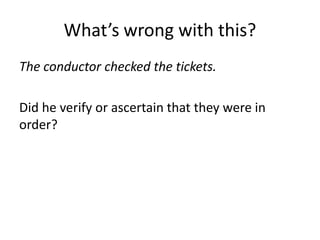
The conductor checked the tickets.

Did he verify or ascertain that they were in
order?
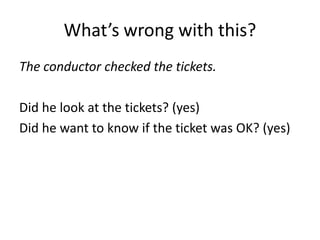
What’s wrong with this?
The conductor checked the tickets.

Did he look at the tickets? (yes)
Did he want to know if the ticket was OK? (yes)
Helpful Hint 4

Grade the vocabulary

that you use below the target language
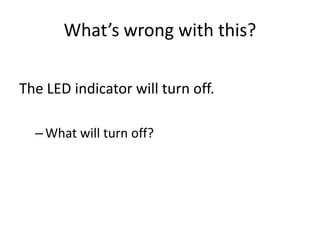
What’s wrong with this?

The LED indicator will turn off.

  – What will turn off?
What’s wrong with this?

The LED indicator will turn off.

  – Show a picture – Is this an LED indicator? (yes)
  – Is it a light? (yes)
  – Is it big or small? (small)
Helpful Hint 5

Make sure that your questions

                 target
                     the right language
Now you try……

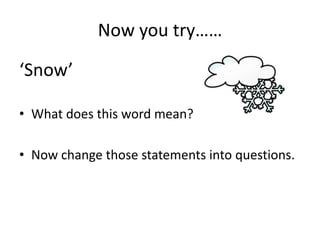
‘Snow’

• What does this word mean?

• Now change those statements into questions.
Possible CCQs

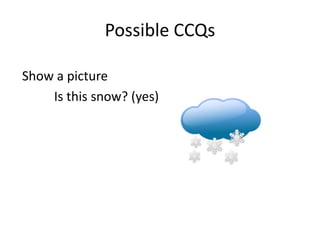
Show a picture
    Is this snow? (yes)
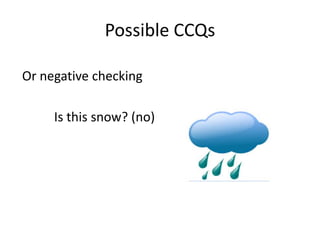
Possible CCQs

Or negative checking

     Is this snow? (no)
Possible CCQs
Yes/ No questions

• Is it cold? (yes)
• Does it fall from the sky? (yes)
Possible CCQs
Short answer questions

• What colour is it? (white)
• What time of year does it usually come?
  (winter)
• What sport can you do in it? (skiing)
Possible answers
Either/or questions

Is it hot or cold? (cold)
Does it come in the winter or summer, usually?
(winter)
Possible CCQs
Personalised questions

Do you get snow in your country?
Now try doing some on your own.


 Choose a word
 Identify its meaning
 Think of two or three CCQs

                    Good luck!

Concept checking for vocabulary short