INCREASED INTRACRANIAL  PRESSURE Ma. Tosca Cybil A. Torres, RN
INTRACRANIAL PRESSURE   is the pressure exerted by the cranium on the brain tissue, cerebrospinal fluid (CSF), and the brain's circulating blood volume  constantly fluctuating in response to activities such as exercise, coughing, straining, arterial pulsation, and respiratory cycle  measured in millimeters of mercury (mmHg)  at rest, is normally 7–15 mmHg for a supine adult  becomes negative (averaging −10 mmHg) in the vertical position
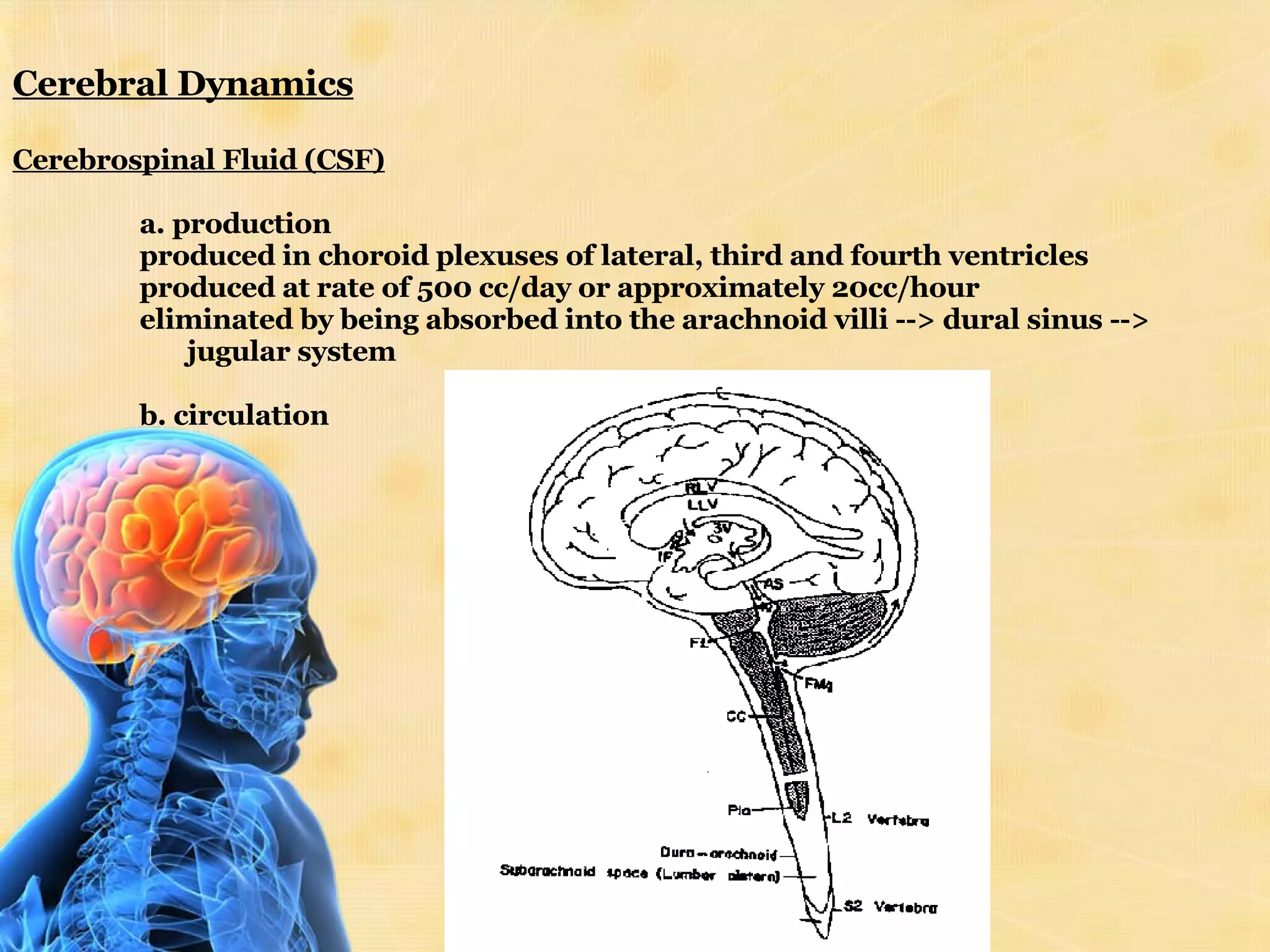
Cerebral Dynamics Cerebrospinal Fluid (CSF) a. production produced in choroid plexuses of lateral, third and fourth ventricles  produced at rate of 500 cc/day or approximately 20cc/hour  eliminated by being absorbed into the arachnoid villi --> dural sinus --> jugular system  b. circulation
Cerebral Blood Flow (CBF) 750 mL/minute which is 15% of the cardiac output Autoregulation pressure autoregulation arterioles dilate or constrict in response to changes in BP and ICP in order to maintain a constant CBF
b. metabolic autoregulation arterioles dilate in response to potent chemicals that are by-products of metabolism such as lactic acid, carbon dioxide and pyruvic acid  CO2 is a potent vasodilator  increased CO2/decreased BP --> vasodilation  decreased CO2/increased BP --> vasoconstriction
PATHOPHYSIOLOGY Causes of increased intracranial pressure can be classified by the mechanism in which ICP is increased: mass effect  such as brain tumor, infarction with oedema, contusions, subdural or epidural hematoma, or abscess all tend to deform the adjacent brain.  generalized brain swelling  can occur in ischemic-anoxia states, acute liver failure, hypertensive encephalopathy, pseudotumor cerebri, hypercarbia, and Reye hepatocerebral syndrome. These conditions tend to decrease the cerebral perfusion pressure but with minimal tissue shifts.  increase in venous pressure  can be due to venous sinus thrombosis, heart failure, or obstruction of superior mediastinal or jugular veins.  obstruction to CSF flow and/or absorption  can occur in hydrocephalus (blockage in ventricles or subarachnoid space at base of brain, e.g., by Arnold-Chiari malformation), extensive meningeal disease (e.g., infectious, carcinomatous, granulomatous, or hemorrhagic), or obstruction in cerebral convexities and superior sagittal sinus (decreased absorption).
Elevation in ICP can be graded as follows:   Normal ICP                             0 - 15mm Hg  Mile elevation                           16 - 20 mm Hg  Moderate elevation                   21 - 30 mm Hg  Sever elevation             31 - 40 mm Hg  Very severe elevation            41 mm Hg and above     SIGNS AND SYMPTOMS Early Signs decreased level of consciousness, confusion, restlessness, lethargy, difficulty with memory and thinking  pupillary dysfunction  changes in vision  deterioration of motor function  Headache, personality changes decreasing Glascow Coma Score  
Later Signs continued decrease in level of consciousness (stuporous, comatose)   dilated pupils, no reaction to light  hemiplegia that progresses  vomiting  bradycardia  hyperthermia  papiledema
Late changes include:   Decreased LOC with difficulty to arouse and further decrease in the Glascow Coma Score.  More stimulation will be required to elicit any type of response.  Pupils will become unilaterally enlarged progressing to fixed and dilated.  Eventually becoming bilaterally fixed and dilated with noted papilledema.  Decorticate  or decerebrate posturing to flaccidity will occur.  Patient may only posture to painful stimuli.  Speech may be absent with only moaning.  Respiration will be irregular advancing to Neurogenic hyperventilation and respiratory arrest.  Loss of corneal and gag reflexes.  Abnormal reflexes such as positive Babinski reflex.  Vital signs will present the "Cushing triad".  hypertention, bradycardia, widening pulse pressure
INTERVENTIONS FOR THE PATIENT WITH INCREASED ICP Goals of Therapy Maintain cerebral perfusion pressure. b. Prevent focal or global cerebral ischemia and focal brain compression Nursing Management includes:   Maintain the patients head midline to facilitate blood flow.  Maintain the head of the bed at 30 - 45 degrees to facilitate venous drainage.  Avoid activities that can increase ICP such as suctioning or gagging.  Treat hyperthermia as it increases the metabolic needs of the brain.  Decrease environmental stimuli which can increase ICP.
6. Dim all lights  7.Speak softly   8.Touch gently and only when needed  9. Space all interventions  10. Limit noxious stimuli such as suctioning to only as needed  11. Maintain fluid balance via accurate I & O.  Overhydration will lead to cerebral edema. 12.Monitor electrolytes as these patients are prone to hypernatremia, hypoglycemia, and hypokalemia with diuretic useage. 13. Monitor hyperventilation to maintain CO2 levels at 25 - 35mm Hg to prevent vasodilation.    
Medical Management includes:   Anticonvulsant therapy for seizures. Use of diuretics such as Mannitol, Urea, and Glycerol. Barbiturate Coma Therapy to decrease the metabolic demands  of the brain. 50% Dextrose solution if hypoglycemia is present and persistent. 5.  Surgical decompression -         considered life saving measure -         opening of the skull can lead to severe herniation
Specific Treatment Surgical removal of intracranial masses. b. Placement of extraventricular drain (temporary). c. Placement of VP shunt (usually permanent).
b.  Fluid Restriction restrict fluids to 65-75% of normal maintenance fluids 2. use 0.9% NS when possible 3. D5W may decrease osmolarity of the blood and increase cerebral edema; may cross BBB and negate effect c.  Hypothermia d.  Elevation of the Bed 1. raise the head of the bed 25-30 degrees to promote intracranial drainage 2. promotes venous drainage 3. avoid compression of jugular veins or kinking of the neck
Pharmacologic Methods Osmotic Diuretics Mannitol   MOA: reduces the water content of the brain due to the establishment of an osmotic gradient between the brain and the intravascular compartment. Mannitol is a large molecule and will not cross the BBB.    b.  Dosage: 50 – 200 Gm (1 Gm/kg) IV over 24 hours                    Titrated to maintain urine output at 30 – 50cc/hr.            c.  Contraindications:   Patients with anuria related to renal disease, pulmonary edema, severe dehydration, or active intracranial bleeding. d. Usually used with Lasix 0.5mg/kg.
e.  Nursing Implications: Assure foley patency Preassessment of patients cardiovascular status Monitor electrolytes frequently :  serum and urine osmolarity, serum and urine electrolytes Always use a filtered needle due to crystallization of the drug An administration set with a 0.22 micron filter must be used Available iv as 20% solution (100 gm in 500 ml of d5w)  Must be kept warm or will precipitate  Adverse effects: chf, pulmonary edema, kidney failure
2.  Glycerol MOA: reduces CSF production along with osmotic effects Dose: 0.5 to 1.0 gm/kg Q 4-6 hours; do not exceed 0.2-1.0 gm/kg/hour  give IV as a 10-20% solution in 0.45% or 0.9% saline over several hours (3-5 hours)  Side Effects: rate-related; reduced with slow infusion  Nursing Implications: Slow acting Can be used long-term Metabolized by the body producing energy Mix with iced lemon or juice Monitor electrolytes due to diuresis
b.  Loop Diuretics-  Furosemide, Ethacrynic Acid MOA: inhibit sodium and chloride resbsorption in the loop of Henle resulting in contraction of the blood volume which may mobilize cerebral edema 2. usually administered with mannitol to increase the therapeutic effect 3. Dose: 0.5 to 1.0 mg/kg prn 4. Side Effects: hypokalemia, dehydration, hypotension, glucose intolerance
c.  Corticosteroids 1. only proven to be effective in reducing cerebral edema associated with brain tumors; role in traumatic cerebral edema is uncertain 2. MOA: exact mechanism unknown; may decrease CSF production and stablize brain cell membranes 3. Dose: dexamethasone most commonly used; 10 mg IV/IM followed by 4 mg IV/IM Q 6 hrs 4. Side Effects: hyperglycemia, GI bleeding, increased infection risk
End of discussion

Increased Intracranial Pressure

  • 1.
    INCREASED INTRACRANIAL PRESSURE Ma. Tosca Cybil A. Torres, RN
  • 2.
    INTRACRANIAL PRESSURE is the pressure exerted by the cranium on the brain tissue, cerebrospinal fluid (CSF), and the brain's circulating blood volume constantly fluctuating in response to activities such as exercise, coughing, straining, arterial pulsation, and respiratory cycle measured in millimeters of mercury (mmHg) at rest, is normally 7–15 mmHg for a supine adult becomes negative (averaging −10 mmHg) in the vertical position
  • 3.
    Cerebral Dynamics CerebrospinalFluid (CSF) a. production produced in choroid plexuses of lateral, third and fourth ventricles produced at rate of 500 cc/day or approximately 20cc/hour eliminated by being absorbed into the arachnoid villi --> dural sinus --> jugular system b. circulation
  • 4.
    Cerebral Blood Flow(CBF) 750 mL/minute which is 15% of the cardiac output Autoregulation pressure autoregulation arterioles dilate or constrict in response to changes in BP and ICP in order to maintain a constant CBF
  • 5.
    b. metabolic autoregulationarterioles dilate in response to potent chemicals that are by-products of metabolism such as lactic acid, carbon dioxide and pyruvic acid CO2 is a potent vasodilator increased CO2/decreased BP --> vasodilation decreased CO2/increased BP --> vasoconstriction
  • 6.
    PATHOPHYSIOLOGY Causes ofincreased intracranial pressure can be classified by the mechanism in which ICP is increased: mass effect such as brain tumor, infarction with oedema, contusions, subdural or epidural hematoma, or abscess all tend to deform the adjacent brain. generalized brain swelling can occur in ischemic-anoxia states, acute liver failure, hypertensive encephalopathy, pseudotumor cerebri, hypercarbia, and Reye hepatocerebral syndrome. These conditions tend to decrease the cerebral perfusion pressure but with minimal tissue shifts. increase in venous pressure can be due to venous sinus thrombosis, heart failure, or obstruction of superior mediastinal or jugular veins. obstruction to CSF flow and/or absorption can occur in hydrocephalus (blockage in ventricles or subarachnoid space at base of brain, e.g., by Arnold-Chiari malformation), extensive meningeal disease (e.g., infectious, carcinomatous, granulomatous, or hemorrhagic), or obstruction in cerebral convexities and superior sagittal sinus (decreased absorption).
  • 7.
    Elevation in ICPcan be graded as follows:   Normal ICP                             0 - 15mm Hg Mile elevation                           16 - 20 mm Hg Moderate elevation                   21 - 30 mm Hg Sever elevation             31 - 40 mm Hg Very severe elevation            41 mm Hg and above   SIGNS AND SYMPTOMS Early Signs decreased level of consciousness, confusion, restlessness, lethargy, difficulty with memory and thinking pupillary dysfunction changes in vision deterioration of motor function Headache, personality changes decreasing Glascow Coma Score  
  • 8.
    Later Signs continueddecrease in level of consciousness (stuporous, comatose) dilated pupils, no reaction to light hemiplegia that progresses vomiting bradycardia hyperthermia papiledema
  • 9.
    Late changes include:  Decreased LOC with difficulty to arouse and further decrease in the Glascow Coma Score.  More stimulation will be required to elicit any type of response. Pupils will become unilaterally enlarged progressing to fixed and dilated.  Eventually becoming bilaterally fixed and dilated with noted papilledema. Decorticate  or decerebrate posturing to flaccidity will occur. Patient may only posture to painful stimuli. Speech may be absent with only moaning. Respiration will be irregular advancing to Neurogenic hyperventilation and respiratory arrest. Loss of corneal and gag reflexes. Abnormal reflexes such as positive Babinski reflex. Vital signs will present the "Cushing triad". hypertention, bradycardia, widening pulse pressure
  • 10.
    INTERVENTIONS FOR THEPATIENT WITH INCREASED ICP Goals of Therapy Maintain cerebral perfusion pressure. b. Prevent focal or global cerebral ischemia and focal brain compression Nursing Management includes:   Maintain the patients head midline to facilitate blood flow. Maintain the head of the bed at 30 - 45 degrees to facilitate venous drainage. Avoid activities that can increase ICP such as suctioning or gagging. Treat hyperthermia as it increases the metabolic needs of the brain. Decrease environmental stimuli which can increase ICP.
  • 11.
    6. Dim alllights 7.Speak softly 8.Touch gently and only when needed 9. Space all interventions 10. Limit noxious stimuli such as suctioning to only as needed 11. Maintain fluid balance via accurate I & O.  Overhydration will lead to cerebral edema. 12.Monitor electrolytes as these patients are prone to hypernatremia, hypoglycemia, and hypokalemia with diuretic useage. 13. Monitor hyperventilation to maintain CO2 levels at 25 - 35mm Hg to prevent vasodilation.    
  • 12.
    Medical Management includes:  Anticonvulsant therapy for seizures. Use of diuretics such as Mannitol, Urea, and Glycerol. Barbiturate Coma Therapy to decrease the metabolic demands of the brain. 50% Dextrose solution if hypoglycemia is present and persistent. 5. Surgical decompression -         considered life saving measure -         opening of the skull can lead to severe herniation
  • 13.
    Specific Treatment Surgicalremoval of intracranial masses. b. Placement of extraventricular drain (temporary). c. Placement of VP shunt (usually permanent).
  • 14.
    b. FluidRestriction restrict fluids to 65-75% of normal maintenance fluids 2. use 0.9% NS when possible 3. D5W may decrease osmolarity of the blood and increase cerebral edema; may cross BBB and negate effect c. Hypothermia d. Elevation of the Bed 1. raise the head of the bed 25-30 degrees to promote intracranial drainage 2. promotes venous drainage 3. avoid compression of jugular veins or kinking of the neck
  • 15.
    Pharmacologic Methods OsmoticDiuretics Mannitol MOA: reduces the water content of the brain due to the establishment of an osmotic gradient between the brain and the intravascular compartment. Mannitol is a large molecule and will not cross the BBB.   b. Dosage: 50 – 200 Gm (1 Gm/kg) IV over 24 hours                    Titrated to maintain urine output at 30 – 50cc/hr.            c. Contraindications: Patients with anuria related to renal disease, pulmonary edema, severe dehydration, or active intracranial bleeding. d. Usually used with Lasix 0.5mg/kg.
  • 16.
    e. NursingImplications: Assure foley patency Preassessment of patients cardiovascular status Monitor electrolytes frequently : serum and urine osmolarity, serum and urine electrolytes Always use a filtered needle due to crystallization of the drug An administration set with a 0.22 micron filter must be used Available iv as 20% solution (100 gm in 500 ml of d5w) Must be kept warm or will precipitate Adverse effects: chf, pulmonary edema, kidney failure
  • 17.
    2. GlycerolMOA: reduces CSF production along with osmotic effects Dose: 0.5 to 1.0 gm/kg Q 4-6 hours; do not exceed 0.2-1.0 gm/kg/hour give IV as a 10-20% solution in 0.45% or 0.9% saline over several hours (3-5 hours) Side Effects: rate-related; reduced with slow infusion Nursing Implications: Slow acting Can be used long-term Metabolized by the body producing energy Mix with iced lemon or juice Monitor electrolytes due to diuresis
  • 18.
    b. LoopDiuretics- Furosemide, Ethacrynic Acid MOA: inhibit sodium and chloride resbsorption in the loop of Henle resulting in contraction of the blood volume which may mobilize cerebral edema 2. usually administered with mannitol to increase the therapeutic effect 3. Dose: 0.5 to 1.0 mg/kg prn 4. Side Effects: hypokalemia, dehydration, hypotension, glucose intolerance
  • 19.
    c. Corticosteroids1. only proven to be effective in reducing cerebral edema associated with brain tumors; role in traumatic cerebral edema is uncertain 2. MOA: exact mechanism unknown; may decrease CSF production and stablize brain cell membranes 3. Dose: dexamethasone most commonly used; 10 mg IV/IM followed by 4 mg IV/IM Q 6 hrs 4. Side Effects: hyperglycemia, GI bleeding, increased infection risk
  • 20.