Medical Surgical Nursing
Increase Intracranial Pressure
 
Brain Brain tissue (1,400g) Blood (75mL) CSF (75mL) Normal ICP 10 to 20 mmHg
Monro-Kellie Hypothesis Limited space for expansion in the skull, an increase in anyone of the components causes a change in the volume of the others.
Pathophysiology
Increase ICP is a syndrome that affects many patients with acute neurologic conditions. This is because pathologic conditions alter the relationship between intracranial volume and pressure.
Elevated ICP most commonly associated with head injury Secondary Effects Brain tumors Subarachnoid hemorrhage Toxic and viral encephalities
Brain Tumor Decrease Cerebral Blood Flow Ischemia and Cell Death Early Cerebral Ischemia Vasomotor Stimulation (brainstem) Increase Systemic Pressure (s/sx slow pulse, cheyne-stokes  resp.,elevated temp.) Increase ICP
Diagnostic Findings
Cerebral Angiography Computed Tomography (CT) Scanning Magnetic Resonance Imaging (MRI) Positron Emission Tomography (PET) Transcranial Doppler
Cerebral Angiography The first image shows normal brain blood flow The second image shows presence of cerebral aneurysm that can cause decease cerebral blood flow may lead to increase ICP
Computed Tomography Scanning The first image shows a normal view of the brain The second image shows brain with tumor and edema that may lead to increase ICP
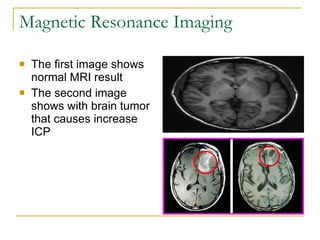
Magnetic Resonance Imaging The first image shows normal MRI result The second image shows with brain tumor that causes increase ICP
Positron Emission Tomography The first image shows normal PET result The second image shows with brain tumor that may lead to increase ICP
Transcranial Doppler The top shows a TCD of a normal artery  Bottom shows a severely stenosed internal carotid artery causes decrease cerebral blood flow may lead to increase ICP
Nursing Process The Patient with Increased Intracranial Pressure
Assessment
History  Present Illness Obtain Subjective Data Neurologic examination Mental Status LOC Cranial Nerve Function Cerebral Function (balance and coordination) Reflexes Motor and Sensory Function Abnormal Respiratory Pattern
Nursing Diagnosis
Ineffective airway clearance related to diminished protective reflexes Ineffective breathing patterns related to neurologic dysfunction Ineffective cerebral tissue perfusion related to the effects of increased ICP Deficient fluid volume related to fluid restriction Risk for infection related to ICP monitoring system
Planning and Goals
Maintenance of patent airway Normalization of respiration Adequate cerebral tissue perfusion through reduction in ICP Restoration of fluid balance Absence of infection Absence of complication
Nursing Intervention
Maintaining patent airway and adequate ventilation Monitor vital signs and neurochecks Maintain fluid balance Position client with head of the bed elevated 30 to 45 degrees and neck in neutral position Maintain a quiet environment Avoid use of restraints Prevent straining at stool Prevent excessive cough and vomiting Prevent complication of immobility Preventing infection Administer medication as ordered
Evaluation
Maintained patent airway Attains optimal breathing pattern Attains desired fluid balance Infection prevented Complications prevented

Increase Intracranial Pressure

  • 1.
  • 2.
  • 3.
  • 4.
    Brain Brain tissue(1,400g) Blood (75mL) CSF (75mL) Normal ICP 10 to 20 mmHg
  • 5.
    Monro-Kellie Hypothesis Limitedspace for expansion in the skull, an increase in anyone of the components causes a change in the volume of the others.
  • 6.
  • 7.
    Increase ICP isa syndrome that affects many patients with acute neurologic conditions. This is because pathologic conditions alter the relationship between intracranial volume and pressure.
  • 8.
    Elevated ICP mostcommonly associated with head injury Secondary Effects Brain tumors Subarachnoid hemorrhage Toxic and viral encephalities
  • 9.
    Brain Tumor DecreaseCerebral Blood Flow Ischemia and Cell Death Early Cerebral Ischemia Vasomotor Stimulation (brainstem) Increase Systemic Pressure (s/sx slow pulse, cheyne-stokes resp.,elevated temp.) Increase ICP
  • 10.
  • 11.
    Cerebral Angiography ComputedTomography (CT) Scanning Magnetic Resonance Imaging (MRI) Positron Emission Tomography (PET) Transcranial Doppler
  • 12.
    Cerebral Angiography Thefirst image shows normal brain blood flow The second image shows presence of cerebral aneurysm that can cause decease cerebral blood flow may lead to increase ICP
  • 13.
    Computed Tomography ScanningThe first image shows a normal view of the brain The second image shows brain with tumor and edema that may lead to increase ICP
  • 14.
    Magnetic Resonance ImagingThe first image shows normal MRI result The second image shows with brain tumor that causes increase ICP
  • 15.
    Positron Emission TomographyThe first image shows normal PET result The second image shows with brain tumor that may lead to increase ICP
  • 16.
    Transcranial Doppler Thetop shows a TCD of a normal artery Bottom shows a severely stenosed internal carotid artery causes decrease cerebral blood flow may lead to increase ICP
  • 17.
    Nursing Process ThePatient with Increased Intracranial Pressure
  • 18.
  • 19.
    History PresentIllness Obtain Subjective Data Neurologic examination Mental Status LOC Cranial Nerve Function Cerebral Function (balance and coordination) Reflexes Motor and Sensory Function Abnormal Respiratory Pattern
  • 20.
  • 21.
    Ineffective airway clearancerelated to diminished protective reflexes Ineffective breathing patterns related to neurologic dysfunction Ineffective cerebral tissue perfusion related to the effects of increased ICP Deficient fluid volume related to fluid restriction Risk for infection related to ICP monitoring system
  • 22.
  • 23.
    Maintenance of patentairway Normalization of respiration Adequate cerebral tissue perfusion through reduction in ICP Restoration of fluid balance Absence of infection Absence of complication
  • 24.
  • 25.
    Maintaining patent airwayand adequate ventilation Monitor vital signs and neurochecks Maintain fluid balance Position client with head of the bed elevated 30 to 45 degrees and neck in neutral position Maintain a quiet environment Avoid use of restraints Prevent straining at stool Prevent excessive cough and vomiting Prevent complication of immobility Preventing infection Administer medication as ordered
  • 26.
  • 27.
    Maintained patent airwayAttains optimal breathing pattern Attains desired fluid balance Infection prevented Complications prevented