Management of
unconscious patient
By:
Nidhi Maurya
Era’s college of nursing
M.Sc. Nursing 1st year
Learning Objectives
 Definition of unconsciousness
 Common causes
 Diagnosis and treatment of unconscious patient
Definition
Unconsciousness is a state in which a patient is totally unaware of both
self and external surroundings, and unable to respond meaningfully to
external stimuli.
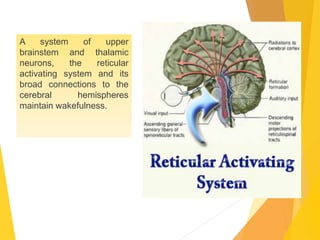
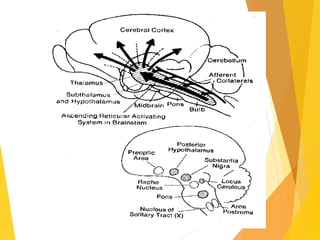
A system of upper
brainstem and thalamic
neurons, the reticular
activating system and its
broad connections to the
cerebral hemispheres
maintain wakefulness.
Common Causes I
 Interruption of energy substrate delivery
a. Hypoxia
b. Ischemia
c. Hypoglycemia
 Alteration of neurophysiologic responses of neuronal
membranes
a. Drug intoxication
b. Alcohol intoxication
c. Epilepsy
Common Causes II
 Abnormalities of osmolarity
a. Diabetic ketoacidosis
b. Nonketotic hyperosmolar state
c. Hyponatremia
 Hepatic encephalopathy
 Hypertensive encephalopathy
 Uremic encephalopathy
Common Causes III
 Hypercapnia
 Hypothyroidism
 Hypothermia
 Hyperthermia
An unconscious case
• 46 years old, male
• DM
• Unconscious
First Aid
• A (Airway)
• B (Breathing)
• C (Circulation)
• D (Disability)
• E (Exposure)
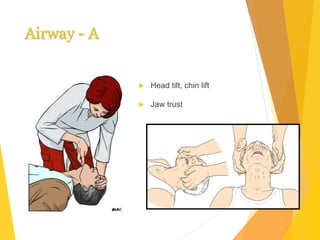
Airway - A
 Head tilt, chin lift
 Jaw trust
Airway - A
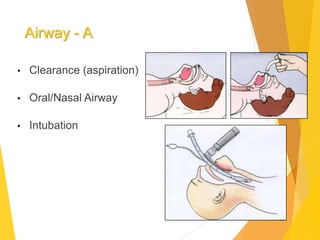
• Clearance (aspiration)
• Oral/Nasal Airway
• Intubation
Breathing - B
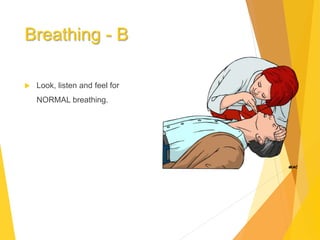
 Look, listen and feel for
NORMAL breathing.
Breathing - B
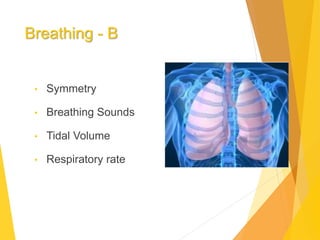
• Symmetry
• Breathing Sounds
• Tidal Volume
• Respiratory rate
Abnormal breathing
 Occurs shortly after the heart stops
in up to 40% of cardiac arrests
 Described as barely, heavy, noisy or gasping breathing
 Recognise as a sign of cardiac arrest
Circulation - C
• Pulse
• Rate
• Rhythmed
• Arterial Pressure
• Hypertension
• Hypotension
Disability - D
 Disability is determined from the
patient level of consciousness
according to the AVPU or GCS.A for ALERT
V for VOICE
P for PAIN
U for UNRESPONSIVE to any
stimulus
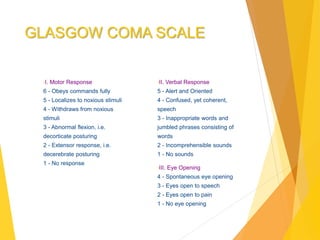
GLASGOW COMA SCALE
•I. Motor Response
6 - Obeys commands fully
5 - Localizes to noxious stimuli
4 - Withdraws from noxious
stimuli
3 - Abnormal flexion, i.e.
decorticate posturing
2 - Extensor response, i.e.
decerebrate posturing
1 - No response
•II. Verbal Response
5 - Alert and Oriented
4 - Confused, yet coherent,
speech
3 - Inappropriate words and
jumbled phrases consisting of
words
2 - Incomprehensible sounds
1 - No sounds
•III. Eye Opening
4 - Spontaneous eye opening
3 - Eyes open to speech
2 - Eyes open to pain
1 - No eye opening
Exposure an Environment - E
The patient’s clothes should be removed or cut in an
appropriate manner so that any injuries can be seen.
General Physical Examination
 History
 Neurologic examination
 The eye examination
 Fundoscopy
 Ventilatory pattern
History
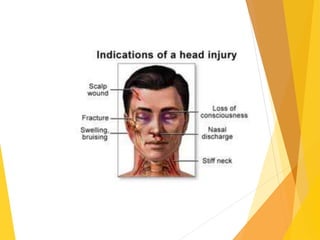
 In many cases, the cause of coma is immediately
evident;
- Trauma
- Cardiac arrest
- Drug ingestion
 In the reminder, historical information may be helpful.
.
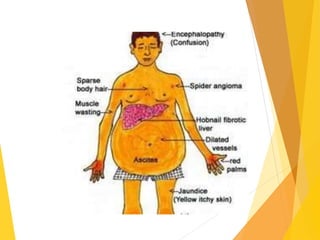
Cirrhosis
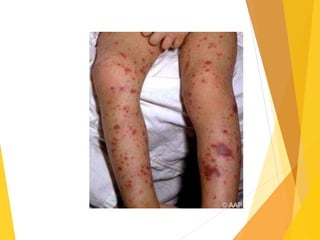
Meningococcemia
rash's
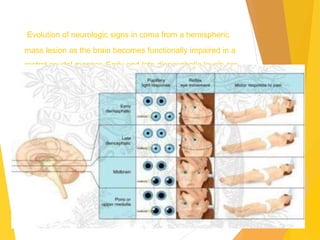
Evolution of neurologic signs in coma from a hemispheric
mass lesion as the brain becomes functionally impaired in a
rostral caudal manner. Early and late diencephalic levels are
levels of dysfunction just above (early) and just below (late)
the thalamus.
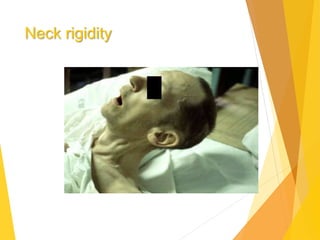
Neck rigidity
Neck rigidity
 Bacterial meningitis
 Subarachnoid hemorrhage
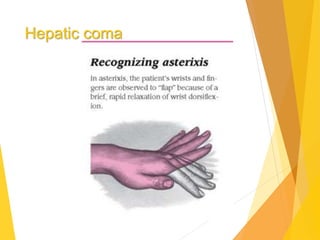
Hepatic coma
The eye examination
Pupillary abnormality is one of the cardinal features
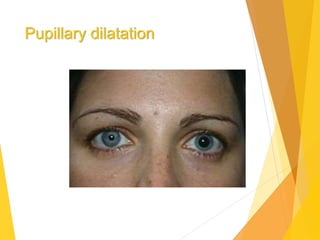
differentiating surgical disorders from medical disorders.
Pupillary abnormalities in coma generally herald
structural changes in brain, whereas in metabolic coma
such abnormalities are not present.
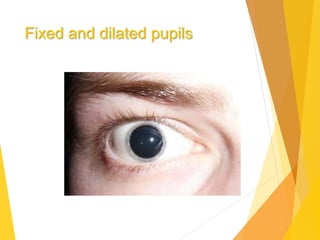
Fixed and dilated pupils
 The terminal stage of brain death
 Atropine effect
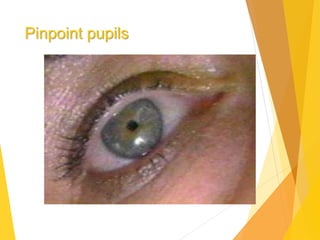
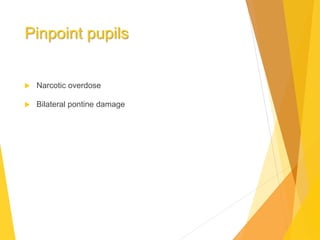
Pinpoint pupils
Pinpoint pupils
 Narcotic overdose
 Bilateral pontine damage
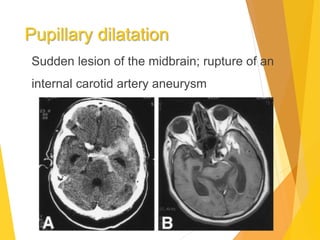
Pupillary dilatation
Sudden lesion of the midbrain; rupture of an
internal carotid artery aneurysm
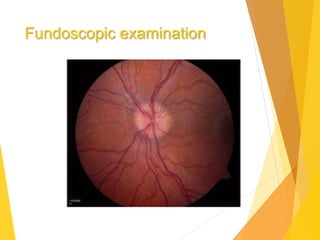
Fundoscopic examination
 Subarachnoid hemorrhages
 Hypertensive encephalopathy
 Increased intracranial pressure
Laboratory examination
Chemical blood determinations are
made routinely to investigate
metabolic, toxic or drug induced
encephalopathies.
-Electrolytes
-Calcium
-Blood urea nitrogen
-Glucose
-NH3
Laboratory examination
 Toxicological analysis is of great value in any case of
coma where the diagnosis is not immediately clear.
 The presence of alcohol does not ensure that alcohol is
the cause of the altered mental status. Other, life-
threatening, causes must be ruled out.
Imaging
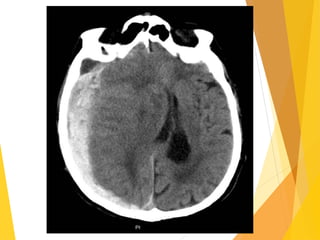
 In coma of unknown etiology, CT or MRI must be
performed.
 Radiologically detectable causes of coma;
- Hemorrhage
- Tumor
- Hydrocephalus
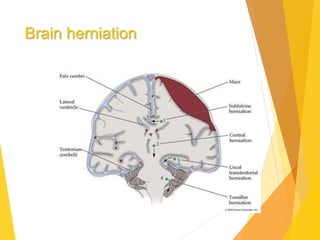
Brain herniation
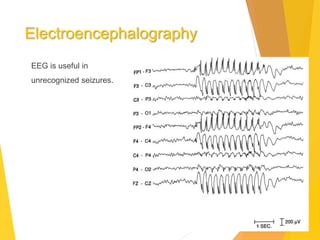
Electroencephalography
EEG is useful in
unrecognized seizures.
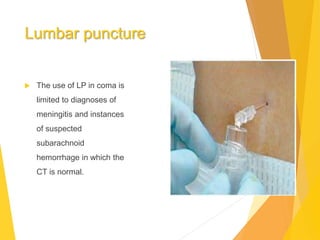
Lumbar puncture
 The use of LP in coma is
limited to diagnoses of
meningitis and instances
of suspected
subarachnoid
hemorrhage in which the
CT is normal.
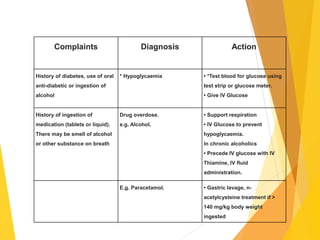
Complaints Diagnosis Action
History of diabetes, use of oral
anti-diabetic or ingestion of
alcohol
* Hypoglycaemia • *Test blood for glucose using
test strip or glucose meter.
• Give IV Glucose
History of ingestion of
medication (tablets or liquid).
There may be smell of alcohol
or other substance on breath
Drug overdose.
e.g. Alcohol,
• Support respiration
• IV Glucose to prevent
hypoglycaemia.
In chronic alcoholics
• Precede IV glucose with IV
Thiamine, IV fluid
administration.
E.g. Paracetamol. • Gastric lavage, n-
acetylcysteine treatment if >
140 mg/kg body weight
ingested
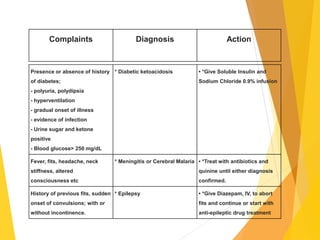
Complaints Diagnosis Action
Presence or absence of history
of diabetes;
- polyuria, polydipsia
- hyperventilation
- gradual onset of illness
- evidence of infection
- Urine sugar and ketone
positive
- Blood glucose> 250 mg/dL
* Diabetic ketoacidosis • *Give Soluble Insulin and
Sodium Chloride 0.9% infusion
Fever, fits, headache, neck
stiffness, altered
consciousness etc
* Meningitis or Cerebral Malaria • *Treat with antibiotics and
quinine until either diagnosis
confirmed.
History of previous fits, sudden
onset of convulsions; with or
without incontinence.
* Epilepsy • *Give Diazepam, IV, to abort
fits and continue or start with
anti-epileptic drug treatment
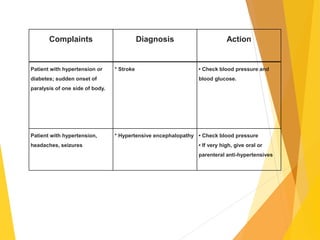
Patient with hypertension or
diabetes; sudden onset of
paralysis of one side of body.
* Stroke • Check blood pressure and
blood glucose.
Patient with hypertension,
headaches, seizures
* Hypertensive encephalopathy • Check blood pressure
• If very high, give oral or
parenteral anti-hypertensives
Complaints Diagnosis Action
Management of-unconscious-patient

Management of-unconscious-patient

  • 1.
    Management of unconscious patient By: NidhiMaurya Era’s college of nursing M.Sc. Nursing 1st year
  • 2.
    Learning Objectives  Definitionof unconsciousness  Common causes  Diagnosis and treatment of unconscious patient
  • 3.
    Definition Unconsciousness is astate in which a patient is totally unaware of both self and external surroundings, and unable to respond meaningfully to external stimuli.
  • 4.
    A system ofupper brainstem and thalamic neurons, the reticular activating system and its broad connections to the cerebral hemispheres maintain wakefulness.
  • 6.
    Common Causes I Interruption of energy substrate delivery a. Hypoxia b. Ischemia c. Hypoglycemia  Alteration of neurophysiologic responses of neuronal membranes a. Drug intoxication b. Alcohol intoxication c. Epilepsy
  • 7.
    Common Causes II Abnormalities of osmolarity a. Diabetic ketoacidosis b. Nonketotic hyperosmolar state c. Hyponatremia  Hepatic encephalopathy  Hypertensive encephalopathy  Uremic encephalopathy
  • 8.
    Common Causes III Hypercapnia  Hypothyroidism  Hypothermia  Hyperthermia
  • 9.
    An unconscious case •46 years old, male • DM • Unconscious
  • 11.
    First Aid • A(Airway) • B (Breathing) • C (Circulation) • D (Disability) • E (Exposure)
  • 12.
    Airway - A Head tilt, chin lift  Jaw trust
  • 13.
    Airway - A •Clearance (aspiration) • Oral/Nasal Airway • Intubation
  • 14.
    Breathing - B Look, listen and feel for NORMAL breathing.
  • 15.
    Breathing - B •Symmetry • Breathing Sounds • Tidal Volume • Respiratory rate
  • 16.
    Abnormal breathing  Occursshortly after the heart stops in up to 40% of cardiac arrests  Described as barely, heavy, noisy or gasping breathing  Recognise as a sign of cardiac arrest
  • 17.
    Circulation - C •Pulse • Rate • Rhythmed • Arterial Pressure • Hypertension • Hypotension
  • 18.
    Disability - D Disability is determined from the patient level of consciousness according to the AVPU or GCS.A for ALERT V for VOICE P for PAIN U for UNRESPONSIVE to any stimulus
  • 19.
    GLASGOW COMA SCALE •I.Motor Response 6 - Obeys commands fully 5 - Localizes to noxious stimuli 4 - Withdraws from noxious stimuli 3 - Abnormal flexion, i.e. decorticate posturing 2 - Extensor response, i.e. decerebrate posturing 1 - No response •II. Verbal Response 5 - Alert and Oriented 4 - Confused, yet coherent, speech 3 - Inappropriate words and jumbled phrases consisting of words 2 - Incomprehensible sounds 1 - No sounds •III. Eye Opening 4 - Spontaneous eye opening 3 - Eyes open to speech 2 - Eyes open to pain 1 - No eye opening
  • 20.
    Exposure an Environment- E The patient’s clothes should be removed or cut in an appropriate manner so that any injuries can be seen.
  • 21.
    General Physical Examination History  Neurologic examination  The eye examination  Fundoscopy  Ventilatory pattern
  • 22.
    History  In manycases, the cause of coma is immediately evident; - Trauma - Cardiac arrest - Drug ingestion  In the reminder, historical information may be helpful. .
  • 24.
  • 26.
  • 28.
    Evolution of neurologicsigns in coma from a hemispheric mass lesion as the brain becomes functionally impaired in a rostral caudal manner. Early and late diencephalic levels are levels of dysfunction just above (early) and just below (late) the thalamus.
  • 29.
  • 30.
    Neck rigidity  Bacterialmeningitis  Subarachnoid hemorrhage
  • 31.
  • 32.
    The eye examination Pupillaryabnormality is one of the cardinal features differentiating surgical disorders from medical disorders. Pupillary abnormalities in coma generally herald structural changes in brain, whereas in metabolic coma such abnormalities are not present.
  • 33.
  • 34.
    Fixed and dilatedpupils  The terminal stage of brain death  Atropine effect
  • 35.
  • 36.
    Pinpoint pupils  Narcoticoverdose  Bilateral pontine damage
  • 37.
  • 38.
    Pupillary dilatation Sudden lesionof the midbrain; rupture of an internal carotid artery aneurysm
  • 39.
  • 40.
    Fundoscopic examination  Subarachnoidhemorrhages  Hypertensive encephalopathy  Increased intracranial pressure
  • 41.
    Laboratory examination Chemical blooddeterminations are made routinely to investigate metabolic, toxic or drug induced encephalopathies. -Electrolytes -Calcium -Blood urea nitrogen -Glucose -NH3
  • 42.
    Laboratory examination  Toxicologicalanalysis is of great value in any case of coma where the diagnosis is not immediately clear.  The presence of alcohol does not ensure that alcohol is the cause of the altered mental status. Other, life- threatening, causes must be ruled out.
  • 43.
    Imaging  In comaof unknown etiology, CT or MRI must be performed.  Radiologically detectable causes of coma; - Hemorrhage - Tumor - Hydrocephalus
  • 44.
  • 46.
    Electroencephalography EEG is usefulin unrecognized seizures.
  • 47.
    Lumbar puncture  Theuse of LP in coma is limited to diagnoses of meningitis and instances of suspected subarachnoid hemorrhage in which the CT is normal.
  • 48.
    Complaints Diagnosis Action Historyof diabetes, use of oral anti-diabetic or ingestion of alcohol * Hypoglycaemia • *Test blood for glucose using test strip or glucose meter. • Give IV Glucose History of ingestion of medication (tablets or liquid). There may be smell of alcohol or other substance on breath Drug overdose. e.g. Alcohol, • Support respiration • IV Glucose to prevent hypoglycaemia. In chronic alcoholics • Precede IV glucose with IV Thiamine, IV fluid administration. E.g. Paracetamol. • Gastric lavage, n- acetylcysteine treatment if > 140 mg/kg body weight ingested
  • 49.
    Complaints Diagnosis Action Presenceor absence of history of diabetes; - polyuria, polydipsia - hyperventilation - gradual onset of illness - evidence of infection - Urine sugar and ketone positive - Blood glucose> 250 mg/dL * Diabetic ketoacidosis • *Give Soluble Insulin and Sodium Chloride 0.9% infusion Fever, fits, headache, neck stiffness, altered consciousness etc * Meningitis or Cerebral Malaria • *Treat with antibiotics and quinine until either diagnosis confirmed. History of previous fits, sudden onset of convulsions; with or without incontinence. * Epilepsy • *Give Diazepam, IV, to abort fits and continue or start with anti-epileptic drug treatment
  • 50.
    Patient with hypertensionor diabetes; sudden onset of paralysis of one side of body. * Stroke • Check blood pressure and blood glucose. Patient with hypertension, headaches, seizures * Hypertensive encephalopathy • Check blood pressure • If very high, give oral or parenteral anti-hypertensives Complaints Diagnosis Action