Nursing Management of
Intracranial Pressure
Presented By:
Mr. TAUQEER AHMED, Sr. Lecturer
(FUCN)
Dated: 11/10/22
AHN-II
BSN Year-II SEMESTER-IV
Objectives
By the end of this lecture, students will be able to:
Review the basic anatomy & physiology of
Brain/spinal cord and CSF
Understand the mechanism of CSF production
and regulation
Discuss the causes of ICP
Know the signs and symptoms owing to ICP
Discuss the Nursing interventions to manage
the ICP
Intracranial Pressure
• Refers to the pressure contained within the
cranial cavity.
• The normal range is between 0 to 15 mmHg.
• ICP over 20 mm/Hg is considered elevated ICP,
also known as intracranial hypertension.
• The management team becomes concerned
whenever a patient’s ICP is over 15 mm/Hg,
but is especially concerned when it reaches
levels of intracranial hypertension.
Intracranial Pressure
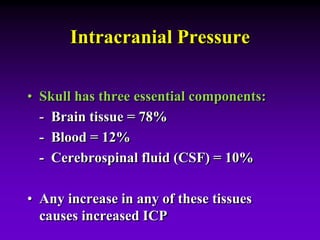
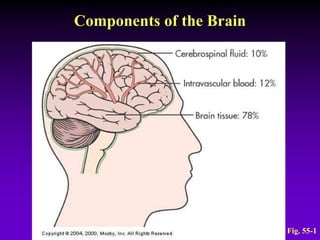
• Skull has three essential components:
- Brain tissue = 78%
- Blood = 12%
- Cerebrospinal fluid (CSF) = 10%
• Any increase in any of these tissues
causes increased ICP
Components of the Brain
Fig. 55-1
Factors that influence ICP
1. Arterial pressure
2. Venous pressure
3. Intraabdominal and intrathoracic pressure
4. Posture
5. Temperature
6. Blood gases (CO2 levels)
Intracranial Pressure
• The degree to which these factors  ICP
depends on the ability of the brain to
accommodate to the changes
Regulation and Maintenance for
ICP
– If the volume in any one of the components
(brain tissue, blood, and CSF)
– increases within the cranial vault and the
volume from another component is
displaced, the total intracranial volume will
not change
Intracranial Pressure
Regulation and Maintenance
• Normal compensatory adaptations
– Alteration of CSF absorption or
production
– Shunting of CSF into spinal
subarachnoid space
– Shunting of venous blood out of the
skull
Mechanisms of Increased ICP
• Causes
– Mass lesion
– Cerebral edema
– Head injury
– Brain inflammation
– Metabolic insult
Increased Intracranial Pressure
Mechanisms of Increased ICP
• Sustained increases in ICP result in
brainstem compression and herniation of
the brain from one compartment to
another
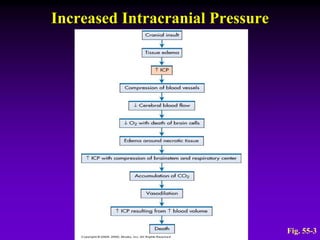
Increased Intracranial Pressure
Fig. 55-3
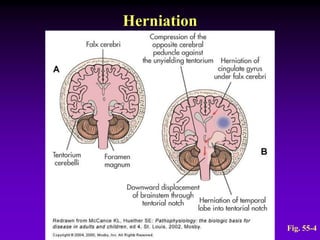
Herniation
Fig. 55-4
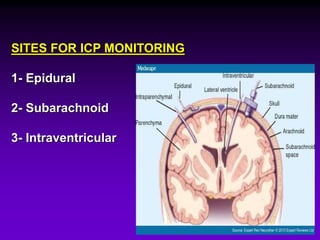
SITES FOR ICP MONITORING
1- Epidural
2- Subarachnoid
3- Intraventricular
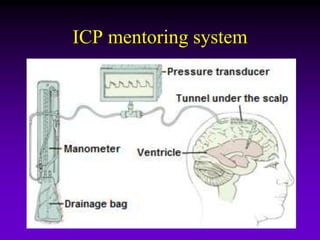
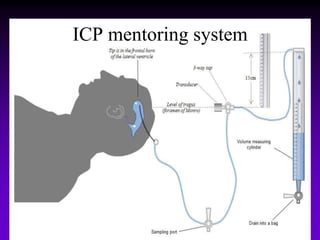
ICP mentoring system
Increased Intracranial Pressure
(ICP)
Copyright © 2011, 2007 by Mosby, Inc., an
affiliate of Elsevier Inc. 17
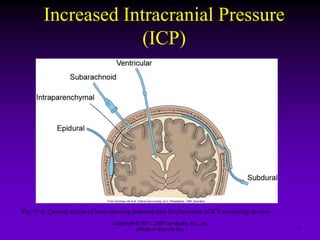
Fig. 57-6. Coronal section of brain showing potential sites for placement of ICP monitoring devices.
Increased Intracranial Pressure
(ICP)
Copyright © 2011, 2007 by Mosby, Inc., an
affiliate of Elsevier Inc. 18
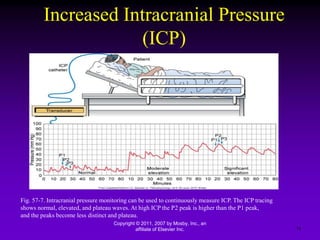
Fig. 57-7. Intracranial pressure monitoring can be used to continuously measure ICP. The ICP tracing
shows normal, elevated, and plateau waves. At high ICP the P2 peak is higher than the P1 peak,
and the peaks become less distinct and plateau.
Increased Intracranial Pressure
(ICP)
Copyright © 2011, 2007 by Mosby, Inc., an
affiliate of Elsevier Inc. 19
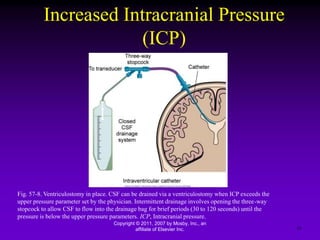
Fig. 57-8. Ventriculostomy in place. CSF can be drained via a ventriculostomy when ICP exceeds the
upper pressure parameter set by the physician. Intermittent drainage involves opening the three-way
stopcock to allow CSF to flow into the drainage bag for brief periods (30 to 120 seconds) until the
pressure is below the upper pressure parameters. ICP, Intracranial pressure.
Increased Intracranial Pressure
(ICP)
Copyright © 2011, 2007 by Mosby, Inc., an
affiliate of Elsevier Inc. 20
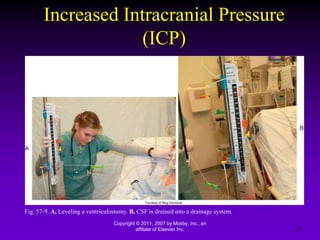
Fig. 57-9. A, Leveling a ventriculostomy. B, CSF is drained into a drainage system.
Increased Intracranial Pressure
(ICP)
• Monitoring of ICP and Cerebral Oxygenation,
continued
– CSF drainage
– Cerebral oxygenation monitoring
Copyright © 2011, 2007 by Mosby, Inc., an
affiliate of Elsevier Inc. 21
Increased Intracranial Pressure
(ICP)
Copyright © 2011, 2007 by Mosby, Inc., an
affiliate of Elsevier Inc. 22
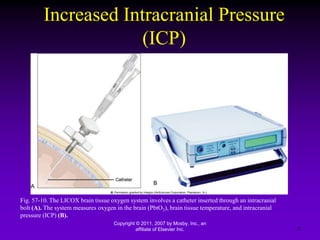
Fig. 57-10. The LICOX brain tissue oxygen system involves a catheter inserted through an intracranial
bolt (A). The system measures oxygen in the brain (PbtO2), brain tissue temperature, and intracranial
pressure (ICP) (B).
Increased Intracranial Pressure
(ICP)
• Collaborative Care
– Drug therapy
– Nutritional therapy
Copyright © 2011, 2007 by Mosby, Inc., an
affiliate of Elsevier Inc. 23
Nursing Care: Assessment
• Change in level of consciousness
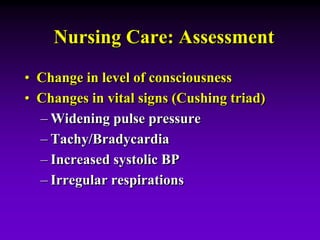
• Changes in vital signs (Cushing triad)
– Widening pulse pressure
– Tachy/Bradycardia
– Increased systolic BP
– Irregular respirations
Nursing Care: Assessment
• Ocular signs
• Decrease in motor strength and function
– Assess movement
– Assess response to stimuli
– Assess:
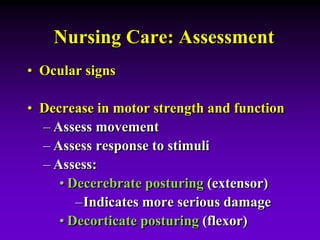
• Decerebrate posturing (extensor)
–Indicates more serious damage
• Decorticate posturing (flexor)
Decorticate and Decerebrate Posturing
Nursing Care: Assessment
• Headache
– Often continuous and worse in the
morning
• Vomiting
– Not preceded by nausea
– Projectile
Increased Intracranial Pressure
Collaborative Care
• Hyperventilation therapy: suctioning →
hyperventilate with 100% oxygen
• Adequate oxygenation
– PaO2 maintenance at 100 mm Hg or
greater
– ABG analysis guides the oxygen therapy
– May require mechanical ventilator
Increased Intracranial Pressure
Collaborative Care
• Drug therapy
– Mannitol
– Loop diuretics
– Corticosteroids
– Barbiturates
– Antiseizure drugs
Increased Intracranial Pressure
Collaborative Care
• Nutritional therapy
– Patient is in hypermetabolic and
hypercatabolic state
–  Need for glucose
– Keep patient normovolemic
• IV 0.45% or 0.9% sodium chloride
Increased Intracranial Pressure
Nursing Management
Overall goals:
• ICP WNL
• Maintain patent airway
• Normal fluid and electrolyte balance
• No complications secondary to immobility
• Respiratory function
• Fluid and electrolyte balance
Increased Intracranial Pressure
Nursing Management
Overall goals (cont’d)
• Body position maintained in head-up
position: elevate HOB 30°
• Protection from injury: positioning/turning
• Pain control
• Psychological considerations
References
•
The Glasgow Structured Approach to Assessment of the Glasgow Coma Scale. Royal College of
Physicians and Surgeons of Glasgow. Retrieved from: https://www.glasgowcomascale.org/what-is-
gcs/
Hussein, M., Zettel, S., Suykens, A. (2017).The ABCs of managing increased intracranial
pressure. Journal of Nursing Education and Practice, 7(4), 6-14.
• Levine, W., Allain, R., Alston, T., Dunn, P., Kwo, J., Rosow, C. (2010). Anesthesia for
neurosurgery. In SA LeGrand & M Szabo (8th ed), Clinical anesthesia procedures of the
Massachusetts General Hospital: 389-408.
Maiese, K. (2019). Brain Herniation. The Merck Manual Professional Edition. Retrieved

from: https://www.merckmanuals.com/professional/neurologic-disorders/coma-and-impaired-
consciousness/brain-herniation
Smith, E.R. and Amin-Hanjani, S. (2019) Evaluation and management of elevated intracranial
pressure in adults. UpToDate. Retrieved from: https://www.uptodate.com/contents/evaluation-and-
management-of-elevated-intracranial-pressure-in-adults
Thompson, H.J. (2012). Care of the Patient Undergoing Intracranial Pressure Monitoring/ External
Ventricular Drainage or Lumbar Drainage. AANN Clinical Practice Guideline Series. Retrieved
from: https://www.bmc.org/sites/default/files/Patient_Care/Specialty_Care/Stroke_and_Cerebrovasc
ular_Center/Medical_Professionals/Protocols/AANN%20Guideline%20caring%20for%20ICP%20
Monitor%20External%20Vent%20Drain%20or%20Lumbar%20Drainage.pdf
intracranialpressure.ppt

intracranialpressure.ppt

  • 1.
    Nursing Management of IntracranialPressure Presented By: Mr. TAUQEER AHMED, Sr. Lecturer (FUCN) Dated: 11/10/22 AHN-II BSN Year-II SEMESTER-IV
  • 2.
    Objectives By the endof this lecture, students will be able to: Review the basic anatomy & physiology of Brain/spinal cord and CSF Understand the mechanism of CSF production and regulation Discuss the causes of ICP Know the signs and symptoms owing to ICP Discuss the Nursing interventions to manage the ICP
  • 3.
    Intracranial Pressure • Refersto the pressure contained within the cranial cavity. • The normal range is between 0 to 15 mmHg. • ICP over 20 mm/Hg is considered elevated ICP, also known as intracranial hypertension. • The management team becomes concerned whenever a patient’s ICP is over 15 mm/Hg, but is especially concerned when it reaches levels of intracranial hypertension.
  • 4.
    Intracranial Pressure • Skullhas three essential components: - Brain tissue = 78% - Blood = 12% - Cerebrospinal fluid (CSF) = 10% • Any increase in any of these tissues causes increased ICP
  • 5.
    Components of theBrain Fig. 55-1
  • 6.
    Factors that influenceICP 1. Arterial pressure 2. Venous pressure 3. Intraabdominal and intrathoracic pressure 4. Posture 5. Temperature 6. Blood gases (CO2 levels)
  • 7.
    Intracranial Pressure • Thedegree to which these factors  ICP depends on the ability of the brain to accommodate to the changes
  • 8.
    Regulation and Maintenancefor ICP – If the volume in any one of the components (brain tissue, blood, and CSF) – increases within the cranial vault and the volume from another component is displaced, the total intracranial volume will not change
  • 9.
    Intracranial Pressure Regulation andMaintenance • Normal compensatory adaptations – Alteration of CSF absorption or production – Shunting of CSF into spinal subarachnoid space – Shunting of venous blood out of the skull
  • 10.
    Mechanisms of IncreasedICP • Causes – Mass lesion – Cerebral edema – Head injury – Brain inflammation – Metabolic insult
  • 11.
    Increased Intracranial Pressure Mechanismsof Increased ICP • Sustained increases in ICP result in brainstem compression and herniation of the brain from one compartment to another
  • 12.
  • 13.
  • 14.
    SITES FOR ICPMONITORING 1- Epidural 2- Subarachnoid 3- Intraventricular
  • 15.
  • 16.
  • 17.
    Increased Intracranial Pressure (ICP) Copyright© 2011, 2007 by Mosby, Inc., an affiliate of Elsevier Inc. 17 Fig. 57-6. Coronal section of brain showing potential sites for placement of ICP monitoring devices.
  • 18.
    Increased Intracranial Pressure (ICP) Copyright© 2011, 2007 by Mosby, Inc., an affiliate of Elsevier Inc. 18 Fig. 57-7. Intracranial pressure monitoring can be used to continuously measure ICP. The ICP tracing shows normal, elevated, and plateau waves. At high ICP the P2 peak is higher than the P1 peak, and the peaks become less distinct and plateau.
  • 19.
    Increased Intracranial Pressure (ICP) Copyright© 2011, 2007 by Mosby, Inc., an affiliate of Elsevier Inc. 19 Fig. 57-8. Ventriculostomy in place. CSF can be drained via a ventriculostomy when ICP exceeds the upper pressure parameter set by the physician. Intermittent drainage involves opening the three-way stopcock to allow CSF to flow into the drainage bag for brief periods (30 to 120 seconds) until the pressure is below the upper pressure parameters. ICP, Intracranial pressure.
  • 20.
    Increased Intracranial Pressure (ICP) Copyright© 2011, 2007 by Mosby, Inc., an affiliate of Elsevier Inc. 20 Fig. 57-9. A, Leveling a ventriculostomy. B, CSF is drained into a drainage system.
  • 21.
    Increased Intracranial Pressure (ICP) •Monitoring of ICP and Cerebral Oxygenation, continued – CSF drainage – Cerebral oxygenation monitoring Copyright © 2011, 2007 by Mosby, Inc., an affiliate of Elsevier Inc. 21
  • 22.
    Increased Intracranial Pressure (ICP) Copyright© 2011, 2007 by Mosby, Inc., an affiliate of Elsevier Inc. 22 Fig. 57-10. The LICOX brain tissue oxygen system involves a catheter inserted through an intracranial bolt (A). The system measures oxygen in the brain (PbtO2), brain tissue temperature, and intracranial pressure (ICP) (B).
  • 23.
    Increased Intracranial Pressure (ICP) •Collaborative Care – Drug therapy – Nutritional therapy Copyright © 2011, 2007 by Mosby, Inc., an affiliate of Elsevier Inc. 23
  • 24.
    Nursing Care: Assessment •Change in level of consciousness • Changes in vital signs (Cushing triad) – Widening pulse pressure – Tachy/Bradycardia – Increased systolic BP – Irregular respirations
  • 25.
    Nursing Care: Assessment •Ocular signs • Decrease in motor strength and function – Assess movement – Assess response to stimuli – Assess: • Decerebrate posturing (extensor) –Indicates more serious damage • Decorticate posturing (flexor)
  • 26.
  • 27.
    Nursing Care: Assessment •Headache – Often continuous and worse in the morning • Vomiting – Not preceded by nausea – Projectile
  • 28.
    Increased Intracranial Pressure CollaborativeCare • Hyperventilation therapy: suctioning → hyperventilate with 100% oxygen • Adequate oxygenation – PaO2 maintenance at 100 mm Hg or greater – ABG analysis guides the oxygen therapy – May require mechanical ventilator
  • 29.
    Increased Intracranial Pressure CollaborativeCare • Drug therapy – Mannitol – Loop diuretics – Corticosteroids – Barbiturates – Antiseizure drugs
  • 30.
    Increased Intracranial Pressure CollaborativeCare • Nutritional therapy – Patient is in hypermetabolic and hypercatabolic state –  Need for glucose – Keep patient normovolemic • IV 0.45% or 0.9% sodium chloride
  • 31.
    Increased Intracranial Pressure NursingManagement Overall goals: • ICP WNL • Maintain patent airway • Normal fluid and electrolyte balance • No complications secondary to immobility • Respiratory function • Fluid and electrolyte balance
  • 32.
    Increased Intracranial Pressure NursingManagement Overall goals (cont’d) • Body position maintained in head-up position: elevate HOB 30° • Protection from injury: positioning/turning • Pain control • Psychological considerations
  • 33.
    References • The Glasgow StructuredApproach to Assessment of the Glasgow Coma Scale. Royal College of Physicians and Surgeons of Glasgow. Retrieved from: https://www.glasgowcomascale.org/what-is- gcs/ Hussein, M., Zettel, S., Suykens, A. (2017).The ABCs of managing increased intracranial pressure. Journal of Nursing Education and Practice, 7(4), 6-14. • Levine, W., Allain, R., Alston, T., Dunn, P., Kwo, J., Rosow, C. (2010). Anesthesia for neurosurgery. In SA LeGrand & M Szabo (8th ed), Clinical anesthesia procedures of the Massachusetts General Hospital: 389-408. Maiese, K. (2019). Brain Herniation. The Merck Manual Professional Edition. Retrieved from: https://www.merckmanuals.com/professional/neurologic-disorders/coma-and-impaired- consciousness/brain-herniation Smith, E.R. and Amin-Hanjani, S. (2019) Evaluation and management of elevated intracranial pressure in adults. UpToDate. Retrieved from: https://www.uptodate.com/contents/evaluation-and- management-of-elevated-intracranial-pressure-in-adults Thompson, H.J. (2012). Care of the Patient Undergoing Intracranial Pressure Monitoring/ External Ventricular Drainage or Lumbar Drainage. AANN Clinical Practice Guideline Series. Retrieved from: https://www.bmc.org/sites/default/files/Patient_Care/Specialty_Care/Stroke_and_Cerebrovasc ular_Center/Medical_Professionals/Protocols/AANN%20Guideline%20caring%20for%20ICP%20 Monitor%20External%20Vent%20Drain%20or%20Lumbar%20Drainage.pdf