INCREASED
INTRACRANIAL PRESSURE
 WALID S. MAANI
 PROFESSOR OF NEUROSURGERY
 JORDAN UNIVERSITY AND MEDICAL SCHOOL


                                1
PHYSIOLOGICAL PRINCIPLES
  The  skull is a rigid structure.
  It contains:
    Brain
    Blood
    Cerebro   spinal fluid (CSF)
  Any  increase of theses contents and/or
   the addition of any mass will lead to
   increase in the pressure (the Monroe-
   Kellie doctrine).
                                             2
PHYSIOLOGY

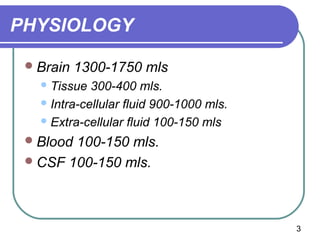
  Brain   1300-1750 mls
    Tissue  300-400 mls.
    Intra-cellular fluid 900-1000 mls.

    Extra-cellular fluid 100-150 mls

  Blood100-150 mls.
  CSF 100-150 mls.


                                          3
PHYSIOLOGY
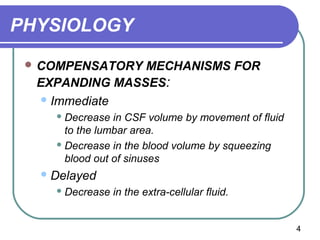
  COMPENSATORY MECHANISMS FOR
  EXPANDING MASSES:
   Immediate
     Decrease  in CSF volume by movement of fluid
      to the lumbar area.
     Decrease in the blood volume by squeezing

      blood out of sinuses
   Delayed
     Decrease   in the extra-cellular fluid.


                                                     4
PHYSIOLOGY
  CEREBROSPINAL        FLUID
    Secreted at the rate of 500 mls per day
    Secreted by the choroid plexus in the lateral
     ventricles
    Flows through the ventricular system
    Exits to the subarachnoid space through the
     foramina of Magendie and Luschka
    Absorbed into the venous system via the arachnoid
     granulations
    Any obstruction to the flow will lead to
     HYDROCEPHALUS and increased pressure.

                                                         5
PHYSIOLOGY
  BRAIN          OEDEMA
      An excess of brain water may occur:
           Around lesions within the brain:
                 Tumor
                 Abscess
         In relation to traumatic damage
         In relation to ischemic brain insult

    Leads to increase in the pressure.
    Types of edema:
         Vasogenic (extra cellular): tumors
         Cytotoxic (intra cellular): metabolic states

         Interstitial (extra cellular): increased IVP


                                                         6
PHYSIOLOGY
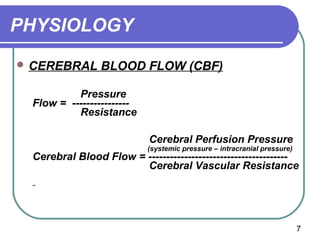
 CEREBRAL      BLOOD FLOW (CBF)

          Pressure
 Flow = ----------------
          Resistance

                           Cerebral Perfusion Pressure
                           (systemic pressure – intracranial pressure)
 Cerebral Blood Flow = ---------------------------------------
                       Cerebral Vascular Resistance


                                                                         7
PHYSIOLOGY
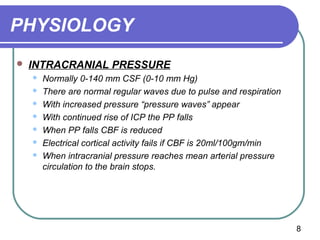
   INTRACRANIAL PRESSURE
       Normally 0-140 mm CSF (0-10 mm Hg)
       There are normal regular waves due to pulse and respiration
       With increased pressure “pressure waves” appear
       With continued rise of ICP the PP falls
       When PP falls CBF is reduced
       Electrical cortical activity fails if CBF is 20ml/100gm/min
       When intracranial pressure reaches mean arterial pressure
        circulation to the brain stops.


                                                                      8
PHYSIOLOGY


  Increased ICP is defined as a sustained
  elevation in pressure above 20mm of Hg


                                             9
PHYSIOLOGY


      During slow increase in volume in a
      continuous mode, the ICP rises to a plateau
      level at which the increase level of CSF
      absorption keeps pace with the increase in
      volume.


                                                    10
PHYSIOLOGY


   Intermittentexpansion causes only a
   transient rise in ICP at first. When sufficient
   CSF has been absorbed to accommodate
   the volume the ICP returns to normal.


                                                     11
PHYSIOLOGY


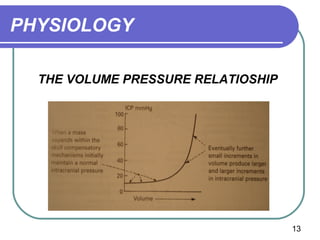
   Expansion  to a critical volume does
   however cause persistent rise in ICP which
   thereafter increases logarithmically with
   increasing volume ( volume - pressure
   relationship).


                                                12
PHYSIOLOGY

  THE VOLUME PRESSURE RELATIOSHIP


                                    13
PHYSIOLOGY


   The ICP finally rises to the level of arterial
   pressure which it self begins to increase,
   accompanied by bradycardia or other
   disturbances of heart rhythm (Cushing
   response). This is accompanied by
   dilatation of small pial arteries and some
   slowing of venous flow which is followed by
   pulsatile venous flow.

                                                     14
PHYSIOLOGY
    COMPENSATORY MECHANISMS
      PushCSF out to spinal theca
      Compress venous sinuses and push blood out
    WHEN COMPENSATORY MECHANISMS FAIL;
     BRAIN HERNIATION OCCURS
      Push  cerebral hemisphere to other side
       (midline shift and Cingulate (subfalcine
       herniation)
      Push brain down
         Uncal  and Central (transtentorial herniation)
         Tonsillar (transforaminal herniation)


                                                           15
CLINICAL PICTURE
    The rise in ICP disturbs brain function by:
      (1) Reduction in CBF
      (2) Transtentorial or foramen magnum herniation
       resulting in selective compression and ischaemia in
       the brain stem.


                                                         16
CLINICAL PICTURE
  Early:
      Headache, projectile vomiting and papilloedema.
  Late:
    Change in the level of consciousness,
    Loss of motor and sensory functions, pupillary
     changes (compression of Cranial Nerve III)
    Vital sign changes including widening pulse
     pressure, bradycardia and irregular respirations,
    Posturing: decorticate(flexion), decerebrate
     (extension) or mixed (intermittent)
    Coma
    Changing and irregular respiratory patterns


                                                         17
CLINICAL PICTURE


              PAPILLEDEMA


                            18
CLINICAL PICTURE
 Herniation of intracerebral contents

   Supratentorial herniation
          Uncal: most frequently noted herniation
    Results in ipsilateral pupil dilatation, decreased level of consciousness,
    changes in respiratory patterns, respiratory arrest, and contralateral
    hemiplegia
          Subfalcine which results in affection of the ACA leading to
    contralateral leg weakness

   Central/Transtentorial herniation
    Results in loss of consciousness, small reactive pupils advancing to
    fixed/dilated pupils, respiratory changes leading to respiratory arrest and
    decorticate posturing advancing to flacidity.

   Infratentorial herniation
    Tonsillar: As a result of a downward herniation the medula oblongata is
    compressed and displaced causing respiratory and cardiac arrest

                                                                                  19
MANAGEMENT

    REDUCE THE INTRACRANIAL PRESSURE
        REMOVE THE CAUSE OF INCREASED PRESSURE
        AND/ OR:
             Hyperventilation to induce vaso constriction by keeping the
              PaCO2 below 25 mm Hg
             Osmotic diuresis like mannitol
             Barbiturates
             Surgical decompression
             Shunts or drains
        INTRACRANIAL PRESSURE MONIRORING IS REQUIRED


                                                                            20
MANAGEMENT

  INTRACRANIAL PRESSURE MONITORING


                              1) Subdural
                              2) Subarachnoid
                              3) Interparenchymal
                              4) Intraventricular


                                                    21

INCREASED INTRA CRANIAL PRESSURE

  • 1.
    INCREASED INTRACRANIAL PRESSURE WALIDS. MAANI PROFESSOR OF NEUROSURGERY JORDAN UNIVERSITY AND MEDICAL SCHOOL 1
  • 2.
    PHYSIOLOGICAL PRINCIPLES The skull is a rigid structure.  It contains:  Brain  Blood  Cerebro spinal fluid (CSF)  Any increase of theses contents and/or the addition of any mass will lead to increase in the pressure (the Monroe- Kellie doctrine). 2
  • 3.
    PHYSIOLOGY  Brain 1300-1750 mls  Tissue 300-400 mls.  Intra-cellular fluid 900-1000 mls.  Extra-cellular fluid 100-150 mls  Blood100-150 mls.  CSF 100-150 mls. 3
  • 4.
    PHYSIOLOGY  COMPENSATORYMECHANISMS FOR EXPANDING MASSES:  Immediate  Decrease in CSF volume by movement of fluid to the lumbar area.  Decrease in the blood volume by squeezing blood out of sinuses  Delayed  Decrease in the extra-cellular fluid. 4
  • 5.
    PHYSIOLOGY  CEREBROSPINAL FLUID  Secreted at the rate of 500 mls per day  Secreted by the choroid plexus in the lateral ventricles  Flows through the ventricular system  Exits to the subarachnoid space through the foramina of Magendie and Luschka  Absorbed into the venous system via the arachnoid granulations  Any obstruction to the flow will lead to HYDROCEPHALUS and increased pressure. 5
  • 6.
    PHYSIOLOGY  BRAIN OEDEMA  An excess of brain water may occur:  Around lesions within the brain:  Tumor  Abscess  In relation to traumatic damage  In relation to ischemic brain insult  Leads to increase in the pressure.  Types of edema:  Vasogenic (extra cellular): tumors  Cytotoxic (intra cellular): metabolic states  Interstitial (extra cellular): increased IVP 6
  • 7.
    PHYSIOLOGY  CEREBRAL BLOOD FLOW (CBF) Pressure Flow = ---------------- Resistance Cerebral Perfusion Pressure (systemic pressure – intracranial pressure) Cerebral Blood Flow = --------------------------------------- Cerebral Vascular Resistance 7
  • 8.
    PHYSIOLOGY  INTRACRANIAL PRESSURE  Normally 0-140 mm CSF (0-10 mm Hg)  There are normal regular waves due to pulse and respiration  With increased pressure “pressure waves” appear  With continued rise of ICP the PP falls  When PP falls CBF is reduced  Electrical cortical activity fails if CBF is 20ml/100gm/min  When intracranial pressure reaches mean arterial pressure circulation to the brain stops. 8
  • 9.
    PHYSIOLOGY  IncreasedICP is defined as a sustained elevation in pressure above 20mm of Hg 9
  • 10.
    PHYSIOLOGY  During slow increase in volume in a continuous mode, the ICP rises to a plateau level at which the increase level of CSF absorption keeps pace with the increase in volume. 10
  • 11.
    PHYSIOLOGY Intermittentexpansion causes only a transient rise in ICP at first. When sufficient CSF has been absorbed to accommodate the volume the ICP returns to normal. 11
  • 12.
    PHYSIOLOGY Expansion to a critical volume does however cause persistent rise in ICP which thereafter increases logarithmically with increasing volume ( volume - pressure relationship). 12
  • 13.
    PHYSIOLOGY THEVOLUME PRESSURE RELATIOSHIP 13
  • 14.
    PHYSIOLOGY The ICP finally rises to the level of arterial pressure which it self begins to increase, accompanied by bradycardia or other disturbances of heart rhythm (Cushing response). This is accompanied by dilatation of small pial arteries and some slowing of venous flow which is followed by pulsatile venous flow. 14
  • 15.
    PHYSIOLOGY  COMPENSATORY MECHANISMS  PushCSF out to spinal theca  Compress venous sinuses and push blood out  WHEN COMPENSATORY MECHANISMS FAIL; BRAIN HERNIATION OCCURS  Push cerebral hemisphere to other side (midline shift and Cingulate (subfalcine herniation)  Push brain down  Uncal and Central (transtentorial herniation)  Tonsillar (transforaminal herniation) 15
  • 16.
    CLINICAL PICTURE  The rise in ICP disturbs brain function by:  (1) Reduction in CBF  (2) Transtentorial or foramen magnum herniation resulting in selective compression and ischaemia in the brain stem. 16
  • 17.
    CLINICAL PICTURE Early:  Headache, projectile vomiting and papilloedema.  Late:  Change in the level of consciousness,  Loss of motor and sensory functions, pupillary changes (compression of Cranial Nerve III)  Vital sign changes including widening pulse pressure, bradycardia and irregular respirations,  Posturing: decorticate(flexion), decerebrate (extension) or mixed (intermittent)  Coma  Changing and irregular respiratory patterns 17
  • 18.
    CLINICAL PICTURE PAPILLEDEMA 18
  • 19.
    CLINICAL PICTURE Herniationof intracerebral contents  Supratentorial herniation Uncal: most frequently noted herniation Results in ipsilateral pupil dilatation, decreased level of consciousness, changes in respiratory patterns, respiratory arrest, and contralateral hemiplegia Subfalcine which results in affection of the ACA leading to contralateral leg weakness  Central/Transtentorial herniation Results in loss of consciousness, small reactive pupils advancing to fixed/dilated pupils, respiratory changes leading to respiratory arrest and decorticate posturing advancing to flacidity.  Infratentorial herniation Tonsillar: As a result of a downward herniation the medula oblongata is compressed and displaced causing respiratory and cardiac arrest 19
  • 20.
    MANAGEMENT  REDUCE THE INTRACRANIAL PRESSURE  REMOVE THE CAUSE OF INCREASED PRESSURE  AND/ OR:  Hyperventilation to induce vaso constriction by keeping the PaCO2 below 25 mm Hg  Osmotic diuresis like mannitol  Barbiturates  Surgical decompression  Shunts or drains  INTRACRANIAL PRESSURE MONIRORING IS REQUIRED 20
  • 21.
    MANAGEMENT INTRACRANIALPRESSURE MONITORING 1) Subdural 2) Subarachnoid 3) Interparenchymal 4) Intraventricular 21