Respect in the Workplace
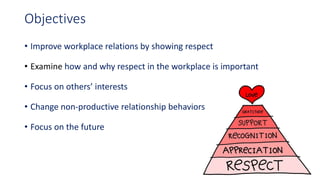
Objectives
• Improve workplace relations by showing respect
• Examine how and why respect in the workplace is important
• Focus on others’ interests
• Change non-productive relationship behaviors
• Focus on the future
• Ask anyone in the workforce what they most desire from
their superiors and peers, and the answer is likely to be
“treated with dignity and respect.”
• Everyone in the organization can, and should, show respect
for others.
• Showing respect for others in the workplace is easy and it
goes a long way.
Mutual respect means that you exhibit respect for your colleagues and
they reciprocate. Find ways to show that you truly value your
colleagues contribution to your workplace. Let them know that you
consider them (and their work) as important.
What should be your response when a colleague doesn’t reciprocate,
i.e. - show respect in return? Do we allow that to define how you act?
Types of Respect
• Owed
• Earned
• Here’s how and why you should be demonstrating respect
every day.
HOW
Do I
Demonstrate
Respect in
the
Workplace?
• There first has to be a commitment.
• Treat people how you’d like to be treated: with kindness, courtesy and
politeness.
• Encourage other coworkers to share their valuable ideas.
• Actively listen to others. Never interrupt or put in your two cents before
they’re finished.
• Use other people’s ideas often to increase productivity and efficiency.
• Don’t insult people or talk behind their back.
• Don’t nitpick, micromanage, criticize or demean others.
• Be aware of your tone, your body language, your expression and your
demeanor during all interactions.
• Treat people the same no matter their race, religion, age, etc. All
people you interact with should be treated equally.
• Include all necessary coworkers in meetings, lunches and after work
activities.
• Provide an equal opportunity for employees to participate in
committees or improvement teams.
• Always praise more than you criticize.
• Encourage employees to give praise to others where needed.
• Manage your anger
• Communicate in a polite manner
• Encourage and help each other
• Avoid judging your peers
• Lead by example
• Swiftly shut down disrespectful behavior
• Recognize respectful employees
• Sensitivity training
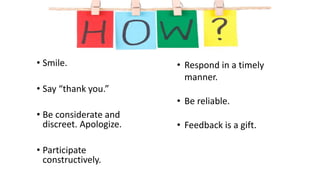
• Smile.
• Say “thank you.”
• Be considerate and
discreet. Apologize.
• Participate
constructively.
• Respond in a timely
manner.
• Be reliable.
• Feedback is a gift.
Empathy
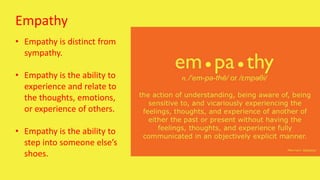
• Empathy is distinct from
sympathy.
• Empathy is the ability to
experience and relate to
the thoughts, emotions,
or experience of others.
• Empathy is the ability to
step into someone else’s
shoes.
Communication
•Choose your words carefully
•Listen actively
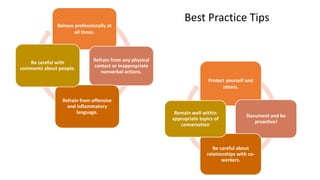
Behave professionally at
all times.
Refrain from any physical
contact or inappropriate
nonverbal actions.
Refrain from offensive
and inflammatory
language.
Be careful with
comments about people.
Protect yourself and
others.
Document and be
proactive!
Be careful about
relationships with co-
workers.
Remain well within
appropriate topics of
conversation
Best Practice Tips
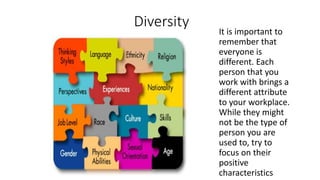
Diversity
It is important to
remember that
everyone is
different. Each
person that you
work with brings a
different attribute
to your workplace.
While they might
not be the type of
person you are
used to, try to
focus on their
positive
characteristics
WHY
Do I need to
Demonstrate
Respect in
the
Workplace?
• Respect Contributes to Job Satisfaction
• Respect Can Increase Employee Engagement
• Respect Can Help to Create a Fair Workplace
• Respect Can Reduce Stress
• Respect Improves Collaboration

Respect in the Workplace.pptx

  • 1.
    Respect in theWorkplace
  • 2.
    Objectives • Improve workplacerelations by showing respect • Examine how and why respect in the workplace is important • Focus on others’ interests • Change non-productive relationship behaviors • Focus on the future
  • 4.
    • Ask anyonein the workforce what they most desire from their superiors and peers, and the answer is likely to be “treated with dignity and respect.” • Everyone in the organization can, and should, show respect for others. • Showing respect for others in the workplace is easy and it goes a long way.
  • 5.
    Mutual respect meansthat you exhibit respect for your colleagues and they reciprocate. Find ways to show that you truly value your colleagues contribution to your workplace. Let them know that you consider them (and their work) as important. What should be your response when a colleague doesn’t reciprocate, i.e. - show respect in return? Do we allow that to define how you act?
  • 6.
    Types of Respect •Owed • Earned • Here’s how and why you should be demonstrating respect every day.
  • 7.
  • 8.
    • There firsthas to be a commitment. • Treat people how you’d like to be treated: with kindness, courtesy and politeness. • Encourage other coworkers to share their valuable ideas. • Actively listen to others. Never interrupt or put in your two cents before they’re finished. • Use other people’s ideas often to increase productivity and efficiency.
  • 9.
    • Don’t insultpeople or talk behind their back. • Don’t nitpick, micromanage, criticize or demean others. • Be aware of your tone, your body language, your expression and your demeanor during all interactions. • Treat people the same no matter their race, religion, age, etc. All people you interact with should be treated equally.
  • 10.
    • Include allnecessary coworkers in meetings, lunches and after work activities. • Provide an equal opportunity for employees to participate in committees or improvement teams. • Always praise more than you criticize. • Encourage employees to give praise to others where needed.
  • 11.
    • Manage youranger • Communicate in a polite manner • Encourage and help each other • Avoid judging your peers
  • 12.
    • Lead byexample • Swiftly shut down disrespectful behavior • Recognize respectful employees • Sensitivity training
  • 13.
    • Smile. • Say“thank you.” • Be considerate and discreet. Apologize. • Participate constructively. • Respond in a timely manner. • Be reliable. • Feedback is a gift.
  • 14.
    Empathy • Empathy isdistinct from sympathy. • Empathy is the ability to experience and relate to the thoughts, emotions, or experience of others. • Empathy is the ability to step into someone else’s shoes.
  • 15.
    Communication •Choose your wordscarefully •Listen actively
  • 16.
    Behave professionally at alltimes. Refrain from any physical contact or inappropriate nonverbal actions. Refrain from offensive and inflammatory language. Be careful with comments about people. Protect yourself and others. Document and be proactive! Be careful about relationships with co- workers. Remain well within appropriate topics of conversation Best Practice Tips
  • 17.
    Diversity It is importantto remember that everyone is different. Each person that you work with brings a different attribute to your workplace. While they might not be the type of person you are used to, try to focus on their positive characteristics
  • 18.
    WHY Do I needto Demonstrate Respect in the Workplace?
  • 19.
    • Respect Contributesto Job Satisfaction • Respect Can Increase Employee Engagement • Respect Can Help to Create a Fair Workplace • Respect Can Reduce Stress • Respect Improves Collaboration

Editor's Notes

  • #5 Whether you’re regularly saying good morning to your coworkers or cleaning up after yourself in the office kitchen, showing respect for others in the workplace is easy and it goes a long way. Here’s how, and why, you should be demonstrating this every day.
  • #7 Owed respect is accorded equally to all members of a work group or an organization; it meets the universal need to feel included. It’s signaled by civility and an atmosphere suggesting that every member of the group is inherently valuable. In environments with too little owed respect, we typically see Tayloristic overmonitoring and micromanagement, incivility and abuse of power, and a sense that employees are interchangeable.  Earned respect recognizes individual employees who display valued qualities or behaviors. It distinguishes employees who have exceeded expectations and, particularly in knowledge work settings, affirms that each employee has unique strengths and talents. Earned respect meets the need to be valued for doing good work. Stealing credit for others’ success and failing to recognize employees’ achievements are signs that it is lacking.
  • #10 Some people can detect the slightest hints of what seems like disrespect, even if you aren’t aware of it yourself. Embracing workplace diversity is important, as it increases the talent pool and brings new ideas, perspectives and skills to your workforce. Put simply, greater diversity means greater business vibrancy, and you must ensure you stress the importance of respect in the workplace to reflect this.
  • #11 Implemented regularly at work, these respectful actions help ensure a happy, considerate and professional workplace
  • #12 Controlling anger is important when in a professional work environment. You and your employees need to learn to let the little things go. Urge employees to avoid getting fixated and annoyed with things out of their control. Instead, they should learn to understand their triggers. If you notice an employee often getting angry at work, you should engage in a one-to-one meeting. Rude and abrasive discourse between colleagues will likely harm the positive workplace culture that you are striving for. No one wants to come to work if their colleagues are going to degrade, belittle and insult them. As a result, you should strive to incite a polite and positive working atmosphere. Judging people is an easy way to destroy a positive workplace. It stops employees getting to know each other.
  • #13 As leaders and employees, it’s not only in your interest to treat peers with respect and dignity; it’s your duty. Leaders and employees set the tone for their teams, and subsequently for their organizations, so it's your duty to strive to be respectful and inclusive at all times People disrespect each other intentionally and unintentionally, but if it’s something that happens regularly it’s typically because there’s no consequence. Shut down bad behavior immediately because, if you shrug it off or turn a blind eye, it can quickly poison an organization’s culture and tank employee morale. If it doesn't get shut down, it's going to be a bigger problem later on. Calling out a colleague or team member for inappropriate or malicious behavior makes it abundantly clear that 1) employee wellbeing and psychological safety are held in high regard, and 2) disrespectful behavior won’t be tolerated. Recognizing employees rewards respect in the workplace and gives colleagues a standard of respect to emulate in their everyday interactions with one other.  Implementing a short sensitivity program into your employee onboarding helps set expectations around behavior among new hires from the get-go.
  • #14 Smile. Empathize and be considerate of others. Make it a routine to smile and greet everyone as you arrive at work—it’s a sign of courtesy and kindness. Say “thank you.” It may seem like common sense, but many people forget to say thank you or don’t say it with sincerity. Show gratitude often by making sure people know you appreciate them and their actions. Give encouragement to show you value your team’s contributions. Be considerate and discreet. Be mindful of your surroundings. If you work in an open workspace and need to make a phone call, make sure to control your own volume and respect your neighbors. Participate constructively. Make sure your contribution in meetings are on topic and respectful. Avoid interrupting others and give others your full attention. Respond in a timely manner. Answer phone calls and emails promptly—this shows people you value their time. Ensure that information is communicated and shared openly as appropriate. Sharing information signals trust and confidence. Go the extra mile. Sometimes your team needs additional help to get the job done. Offer to pitch in and share the load. If a co-worker has helped you in the past, then returning the favor is a good way to show both your respect and gratitude. Be reliable. Follow through on your commitments and responsibilities. Keep your word. Make task lists or reminders if needed and avoid distractions that make it easy to lose sight of deadlines. You’ll earn your coworkers’ respect when they know they can count on you. Feedback is a gift. Praise much more often than you criticize. Share your expertise respectfully and be open to growth and learning. A collaborative workplace where everyone shares their ideas and offers creative solutions is one that thrives.
  • #15 Empathy is distinct from sympathy, which is the ability to support others with compassion. When you empathize with another person’s experience, you are better able to show respect toward that person Empathy is the ability to step into someone else’s shoes, be aware of their feelings, and understand their needs.
  • #16 Choose your words carefully. Make sure that you clearly articulate your points and state exactly what you mean. This will help avoid confusion about goals or expectations. Listen actively. Communication includes listening. Demonstrate to your co-workers that you are paying attention by asking follow up questions and paraphrasing some of their statements.
  • #20 According to a survey conducted by the Society for Human Resources Management (SHRM) in 2014, respectful treatment of all employees at all levels was rated as “very important” by 72 percent of those surveyed, making it the top contributor to overall employee job satisfaction. In respectful workplaces, employees are inclined to work harder and stay productive. In workplaces with little or no respect, employees report more conflicts and misunderstandings and have lower attendance and engagement A recent Gallup study of over 350,000 American employees showed that only 30 percent were engaged with their work. One of the simplest strategies to combat this is to show respect for coworkers. In a survey of more than 20,000 employees, Harvard Business Review found that respect was the top behavior that would lead to an increase in employee engagement. When employees know they are respected by other team members, they are less stressed and more committed to their jobs. The same is true when an employee knows that upper management values and respects them and their work. When team members equally show respect for others, a sense of fairness is established and harassment, gossiping and negativity are minimized. When upper management respects their employees, there’s no room for harassment or favoritism, which sets a good example for employees as well as allows them to feel equal to other coworkers When employees know they’re respected, they can freely do their jobs without worry of being ridiculed or criticized. They can also relax and be themselves without the stress of feeling like they need to overwork themselves in order to prove their worth. Big ideas often come out of collaborative meetings? A group of respected employees will naturally share ideas with each other in an effort to build relationships and improve workflow. For employees, employers, and managers, the rules of respect are the same. Use these tips if you’re ready to take the next step toward building a stronger organizational culture Implemented regularly at work, these respectful actions help ensure a happy, considerate and professional workplace