How many of you have worked alongside an uncivil or rude
coworker?
How did those experiences affect...
• You
• Your work
• Your health
• Your family
• Your desire to get revenge
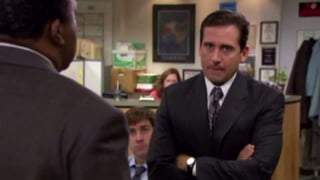
Let’s take a look at an example...
Incivility Behaviors
Low level rude behaviors
• Talking down to others
• Not listening
• Talking over or interrupting others
• Withholding information
• Showing little interest in others’ opinions
• Making demeaning or derogatory remarks
Do you see yourself in any of these behaviors?But, do people intend
to be rude or uncivil at work?
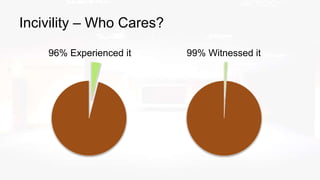
Incivility – Who Cares?
96% Experienced it 99% Witnessed it
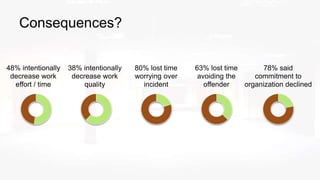
Consequences?
48% intentionally
decrease work
effort / time
38% intentionally
decrease work
quality
80% lost time
worrying over
incident
63% lost time
avoiding the
offender
78% said
commitment to
organization declined
Performance Costs?
20% decline in
concentration at work
65-75% drop in
helpfulness
33% decline in
verbal tasks
25-49% drop
in helpfulness
Incivility Targets Incivility Observers
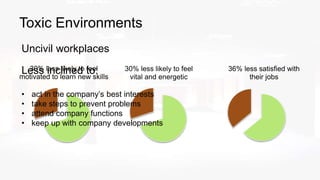
Toxic Environments
30% less likely to feel
vital and energetic
36% less satisfied with
their jobs
Uncivil workplaces
30% less likely to feel
motivated to learn new skills
Less inclined to:
• act in the company’s best interests
• take steps to prevent problems
• attend company functions
• keep up with company developments
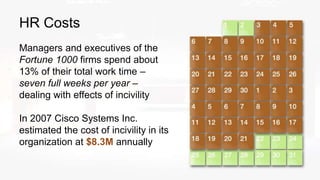
HR Costs
Managers and executives of the
Fortune 1000 firms spend about
13% of their total work time –
seven full weeks per year –
dealing with effects of incivility
In 2007 Cisco Systems Inc.
estimated the cost of incivility in its
organization at $8.3M annually
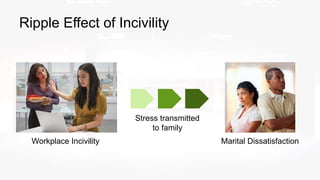
Ripple Effect of Incivility
Workplace Incivility Marital Dissatisfaction
Stress transmitted
to family
Revenge is (not so) sweet
94% of targets get
even with their
offender
88% of targets get
even with their
organization
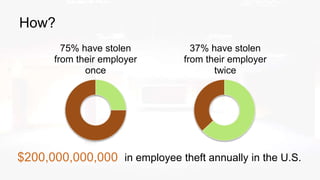
How?
75% have stolen
from their employer
once
37% have stolen
from their employer
twice
in employee theft annually in the U.S.$200,000,000,000
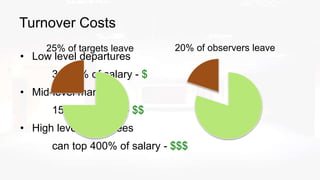
Turnover Costs
20% of observers leave
• Low level departures
30-50% of salary - $
• Mid-level managers
150% of salary - $$
• High level employees
can top 400% of salary - $$$
25% of targets leave
Spiral &
Escalation• Incivility, though often unintentional, is harmful
• Having an abusive supervisor (or coworker?) is
even worse!
– Intentional
– Hostile
– “Strategically used” by some supervisors
• Sets the tone for the organization or group culture
• “This is how we treat each other”
Abusive Supervisors
• How many of you have had or know of someone else
who has had an abusive supervisor or manager?
• Think about what kind of impact those experiences had
on your life at work...or your life OUTSIDE of work.
What does an Abusive Supervisor Do?
Sustained display of hostile verbal and nonverbal behaviors
• Tells subordinates that their thoughts or feelings are stupid
• Silent treatment
• Puts subordinates down in front of others
• Blames subordinates to save himself / herself embarrassment
• Breaks promises he / she makes
• Expresses anger at subordinates when he / she is mad for
another reason
Self Assessment
When was the last time...
• You said “Thank you”
• You said “I’m sorry”
• A subordinate or coworker brought you ‘bad news’
• A subordinate quit...or multiple subordinates quit?
(Employees don’t quit jobs, they quit bosses!)
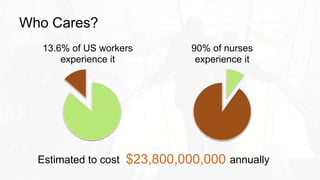
Who Cares?
13.6% of US workers
experience it
90% of nurses
experience it
Estimated to cost annually$23,800,000,000
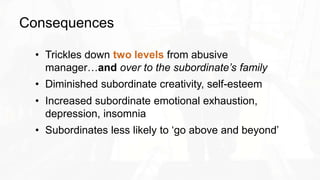
Consequences
• Trickles down two levels from abusive
manager…and over to the subordinate’s family
• Diminished subordinate creativity, self-esteem
• Increased subordinate emotional exhaustion,
depression, insomnia
• Subordinates less likely to ‘go above and beyond’
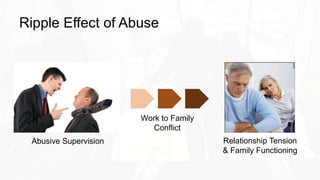
Ripple Effect of Abuse
Abusive Supervision Relationship Tension
& Family Functioning
Work to Family
Conflict
An Ounce of Prevention
Keep uncivil people out of your organization!
• Vendors, contractors, customers, employees
• Selectivity in recruitment / selection
Teach civility through building competencies
• Listening
• Conflict resolution
• Negotiation
• Dealing with difficult people
• Stress management
What’s an Organization to do?
Set Zero-Tolerance Expectations
• Shapes behavior
• Sets a norm
• Start with your mission or values statement
What’s an Organization to do?
Have Managers Look in the Mirror
• Strive to live by the norms set
• Less likely to hear negative information as we climb the ladder
• Upward evaluations or 360-degree feedback (anonymously
collected)
What’s an Organization to do?
Take complaints seriously
• Open door policy
• Gather data quickly
• Get the facts
• Act swiftly
What’s an Organization to do?
Don’t make excuses for powerful instigators or high
performers
• Don’t move the offender to a new location!
• Incivility is like a virus, it’s contagious...and can spread easily
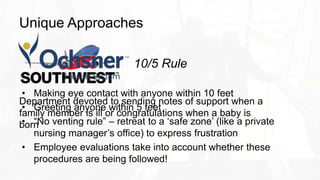
Unique Approaches
Department devoted to sending notes of support when a
family member is ill or congratulations when a baby is
born
10/5 Rule
• Making eye contact with anyone within 10 feet
• Greeting anyone within 5 feet
• “No venting rule” – retreat to a ‘safe zone’ (like a private
nursing manager’s office) to express frustration
• Employee evaluations take into account whether these
procedures are being followed!
questions?
thank you

Merideth Ferguson Sunrise Session

  • 2.
    How many ofyou have worked alongside an uncivil or rude coworker? How did those experiences affect... • You • Your work • Your health • Your family • Your desire to get revenge Let’s take a look at an example...
  • 4.
    Incivility Behaviors Low levelrude behaviors • Talking down to others • Not listening • Talking over or interrupting others • Withholding information • Showing little interest in others’ opinions • Making demeaning or derogatory remarks
  • 5.
    Do you seeyourself in any of these behaviors?But, do people intend to be rude or uncivil at work?
  • 6.
    Incivility – WhoCares? 96% Experienced it 99% Witnessed it
  • 7.
    Consequences? 48% intentionally decrease work effort/ time 38% intentionally decrease work quality 80% lost time worrying over incident 63% lost time avoiding the offender 78% said commitment to organization declined
  • 8.
    Performance Costs? 20% declinein concentration at work 65-75% drop in helpfulness 33% decline in verbal tasks 25-49% drop in helpfulness Incivility Targets Incivility Observers
  • 9.
    Toxic Environments 30% lesslikely to feel vital and energetic 36% less satisfied with their jobs Uncivil workplaces 30% less likely to feel motivated to learn new skills Less inclined to: • act in the company’s best interests • take steps to prevent problems • attend company functions • keep up with company developments
  • 10.
    HR Costs Managers andexecutives of the Fortune 1000 firms spend about 13% of their total work time – seven full weeks per year – dealing with effects of incivility In 2007 Cisco Systems Inc. estimated the cost of incivility in its organization at $8.3M annually
  • 11.
    Ripple Effect ofIncivility Workplace Incivility Marital Dissatisfaction Stress transmitted to family
  • 12.
    Revenge is (notso) sweet 94% of targets get even with their offender 88% of targets get even with their organization
  • 13.
    How? 75% have stolen fromtheir employer once 37% have stolen from their employer twice in employee theft annually in the U.S.$200,000,000,000
  • 14.
    Turnover Costs 20% ofobservers leave • Low level departures 30-50% of salary - $ • Mid-level managers 150% of salary - $$ • High level employees can top 400% of salary - $$$ 25% of targets leave
  • 15.
    Spiral & Escalation• Incivility,though often unintentional, is harmful • Having an abusive supervisor (or coworker?) is even worse! – Intentional – Hostile – “Strategically used” by some supervisors • Sets the tone for the organization or group culture • “This is how we treat each other”
  • 16.
    Abusive Supervisors • Howmany of you have had or know of someone else who has had an abusive supervisor or manager? • Think about what kind of impact those experiences had on your life at work...or your life OUTSIDE of work.
  • 17.
    What does anAbusive Supervisor Do? Sustained display of hostile verbal and nonverbal behaviors • Tells subordinates that their thoughts or feelings are stupid • Silent treatment • Puts subordinates down in front of others • Blames subordinates to save himself / herself embarrassment • Breaks promises he / she makes • Expresses anger at subordinates when he / she is mad for another reason
  • 19.
    Self Assessment When wasthe last time... • You said “Thank you” • You said “I’m sorry” • A subordinate or coworker brought you ‘bad news’ • A subordinate quit...or multiple subordinates quit? (Employees don’t quit jobs, they quit bosses!)
  • 20.
    Who Cares? 13.6% ofUS workers experience it 90% of nurses experience it Estimated to cost annually$23,800,000,000
  • 21.
    Consequences • Trickles downtwo levels from abusive manager…and over to the subordinate’s family • Diminished subordinate creativity, self-esteem • Increased subordinate emotional exhaustion, depression, insomnia • Subordinates less likely to ‘go above and beyond’
  • 22.
    Ripple Effect ofAbuse Abusive Supervision Relationship Tension & Family Functioning Work to Family Conflict
  • 23.
    An Ounce ofPrevention Keep uncivil people out of your organization! • Vendors, contractors, customers, employees • Selectivity in recruitment / selection Teach civility through building competencies • Listening • Conflict resolution • Negotiation • Dealing with difficult people • Stress management
  • 24.
    What’s an Organizationto do? Set Zero-Tolerance Expectations • Shapes behavior • Sets a norm • Start with your mission or values statement
  • 25.
    What’s an Organizationto do? Have Managers Look in the Mirror • Strive to live by the norms set • Less likely to hear negative information as we climb the ladder • Upward evaluations or 360-degree feedback (anonymously collected)
  • 26.
    What’s an Organizationto do? Take complaints seriously • Open door policy • Gather data quickly • Get the facts • Act swiftly
  • 27.
    What’s an Organizationto do? Don’t make excuses for powerful instigators or high performers • Don’t move the offender to a new location! • Incivility is like a virus, it’s contagious...and can spread easily
  • 29.
    Unique Approaches Department devotedto sending notes of support when a family member is ill or congratulations when a baby is born 10/5 Rule • Making eye contact with anyone within 10 feet • Greeting anyone within 5 feet • “No venting rule” – retreat to a ‘safe zone’ (like a private nursing manager’s office) to express frustration • Employee evaluations take into account whether these procedures are being followed!
  • 30.
  • 31.

Editor's Notes

  • #2 Hook:
  • #3 Example of theft as a coping mechanism for toxic workplaces
  • #4 Video
  • #12 Ferguson, M. (2012). “You cannot leave it at the office: Spillover and crossover of coworker incivility.” Journal of Organizational Behavior, 33: 571-588.
  • #14 Incivility Spirals Gossip about incivility events leads to more incivility (Ferguson, M. & Barry, B. (2011). “I know what you did: The effects of interpersonal deviance on bystanders.” Journal of Occupational Health Psychology, 16: 80-94.
  • #17 Kimberly’s health issues
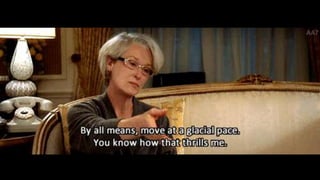
  • #19 “Devil Wears Prada” – Abusive Boss – Meryl Streep as Miranda Priestly
  • #21 Part of that 23.8 billion is Absenteeism, Health Care Costs, Low Productivity
  • #23 Carlson, D., Ferguson, M., Perrewé, P., & Whitten, D. (2011). “The fallout from abusive supervision through work-family conflict: The impact on the job incumbent and beyond.” Personnel Psychology, 64: 937-961.
  • #24 Customers – Southwest Air – get belligerent with a flight attendant and the captain may turn the plane around. Microsoft Corp. has also revamped its entire learning and development program with a focus on civility as open and respectful interactions. For example, in their ‘‘Precision Questioning’’ class, a popular course among new employees, participants learn to question their own ideas, building emotional agility and calm even in high-intensity situations. To retain civility, participants are taught in other classes how to improve their abilities to listen and appreciate healthy, constructive criticism. Overall, Microsoft’s training instills the notion that civility is the currency for designing the best product possible.