Prepared By: Vipin Kumar Shukla
Assistant Lecturer.
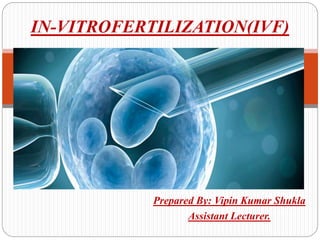
IN-VITROFERTILIZATION(IVF)
Introduction:
 In vitro fertilization (IVF) is a type of assistive reproductive
technology (ART). It involves retrieving eggs from a
woman’s ovaries and fertilizing them with sperm. This
fertilized egg is known as an embryo. The embryo can then
be frozen for storage or transferred to a woman’s uterus.
 Depending on your situation, IVF can use:
 your eggs and your partner’s sperm.
 your eggs and donor sperm.
 donor eggs and your partner’s sperm.
Continued….
 Your doctor can also implant embryos in a
surrogate, or gestational carrier. This is a woman
who carries your baby for you.
 The success rate of IVF varies. According to
the American Pregnancy Association, the live birth
rate for women under age 35 undergoing IVF is 41
to 43 percent. This rate falls to 13 to 18 percent for
women over the age of 40.
What Is a Test Tube Baby:
 The term “test tube baby” means a child that is conceived outside
a woman’s body. A more complete definition specifies test tube
babies as being conceived in a laboratory through the scientific
process of In-Vitro Fertilization (IVF). The use of the words
“test tube” is also erroneous because, right from the beginning
decades back with Edwards and Steptoe, the lab instrument that
they used to mix the eggs and sperm in is a Petri dish.
 It can be stated therefore that “test tube baby” is an
oversimplified term for a child born through IVF. Hence, there is
actually NO difference between IVF and test tube baby.
Step involved in Test Tube baby process:
 Test Tube Baby Step-by-Step Process
 Ever since that successful attempt in 1978, numerous
advancements have been made to IVF but the
core procedure remains the same.
Step 1: Egg production stimulated by hormone therapy:
 Prior to egg retrieval, the woman is prescribed injectable
hormones of GnRHa and gonadotrophins to promote the
synchronous growth and maturation of the follicles inside her
ovaries. Final maturation of the eggs is accomplished through the
injection of HCG 36 hours before egg collection.
 Step 2: Eggs retrieved from ovary
 The woman is given a mild sedative or anesthetic so that she
won’t feel pain or other discomforts during egg retrieval. Using
an ultrasound vaginal probe with a fine hollow needle attached to
it, the fertility specialist aspirates eggs from the woman’s
ovaries. These samples are promptly brought to the laboratory.
 Step 3: Sperm Sample Provided
 On the same day as the egg retrieval, the man is required to
produce a fresh semen sample.
Continued……
 Step 4: Eggs and sperm combined to allow fertilization
 The sperm and eggs are mixed together in a Petri dish and then
place inside an incubator for a few days. During this period, the
fertility specialist checks for signs of fertilization and monitors the
growth of the embryos.
 Step 5: Fertilized eggs introduced into the uterus
 On the day of embryo transfer, two or three embryos are transferred
into the uterus of the woman with the use of a fine catheter. To
strengthen and support the uterine lining and increase the possibility
of implantation, she is advised to administer progesterone or HCG
daily.
Continued……
 A common question that is asked is how painful are
IVF injections? Most women experience minimal pain
and discomfort with the hormone injections, describing
them as being similar to the insulin injections for
diabetes.
 Other women claim that the more painful shots are
those of progesterone because it is oil-based and
requires the use of a needle with a larger bore.
Systemic flow chart of Test Tube baby production:
What is Infertility?
 Infertility is a disease that affects the reproductive organs of
both men and women. It impairs one of the body’s most
basic functions, which is the ability to have offspring.
Infertility affects about 6.1 million women and men in the
United States; this is 10 percent of the reproductive-age
population.
 Smoking, sexually transmitted
 infections, age, and an
 unhealthy body weight can
 increase risks of infertility.
Reasons for Infertility:
 Fallopian tubes are blocked or damaged.
 Sperm do not swim well.
 Sperm are too few in number.
 The lining of womb is affected.
 Ovarian do not produce eggs.
 Qualities of eggs is compromised.
 Hormonal Imbalances.
Why Is In Vitro Fertilization Performed:
 IVF helps people with infertility who want to have a baby.
IVF is expensive and invasive, so couples often try other
fertility treatments first.
 These may include taking fertility drugs or having
intrauterine insemination. During that procedure, a doctor
transfers sperm directly into a woman’s uterus.
 Infertility issues for which IVF is mandatory it includes:
 Reduced fertility in women over the age of 40
 Blocked or damaged fallopian tubes
Continued……
 Reduced ovarian function
 Endometriosis
 Uterine fibroids
 Male infertility, such as low sperm count or
abnormalities in sperm shape
 Unexplained infertility
Continued……
 Parents may also choose IVF if they run the risk of
passing a genetic disorder on to their offspring. A
medical lab can test the embryos for genetic
abnormalities. Then, a doctor only implants
embryos without genetic defects.
How we prepare for In Vitro
Fertilization:
 Before beginning IVF, women will first undergo ovarian reserve
testing. This involves taking a blood sample and testing it for the
level of follicle stimulating hormone (FSH). The results of this
test will give your doctor information about the size and quality
of your eggs.
 Your doctor will also examine your uterus. This may involve
doing an ultrasound, which uses high-frequency sound waves to
create an image of your uterus. Your doctor may also insert a
scope through your vagina and into your uterus. These tests can
reveal the health of your uterus and help the doctor determine the
best way to implant the embryos.
Continued……
 Men will need to have sperm testing. This involves
giving a semen sample, which a lab will analyze
for the number, size, and shape of the sperm.
 If the sperm are weak or damaged, a procedure
called intracytoplasmic sperm injection (ICSI) may
be necessary.
 During ICSI, a technician injects sperm directly
into the egg. ICSI can be part of the IVF process.
Steps Involved in IVF:
Factors responsible for choosing IVF:
 How many embryos do you wish to transfer? The more
embryos transferred, the higher the risk of a multiple
pregnancy. Most doctors won’t transfer more than two
embryos.
 How do you feel about the possibility of having twins,
triplets, or a higher order multiple pregnancy?
 What about the legal and emotional issues associated with
using donated eggs, sperm, and embryos or a surrogate?
 What are the financial, physical, and emotional stresses
associated with IVF?
History of IVF:
 1890-the very first in vitro manipulation of eggs/embryos was
performed by Walter Heape,when he transferred in vivo
fertilized from one female rabbit to another.
 1959-M.C Chang successfully conducted IVF in rabbits.
 February 15,1969-the journal nature published a paper
authored by R.G Edwards.
 1977,the first IVF pregnancy in human and the birth of Louis
Brown.
Continued…..
 The first successful embryo transfer was carried out in
rabbit by heap in 1890.
 First lamb by ETT-1949 by berry.
 First calf by-1951 by willet et al
 In swine-1951 by kvansnickii
 In Asian buffalo-1983by drost et al.
 Steps involved in embryo transfer
GENERAL PROTOCOL:
 Patient selection
 Manipulation of menstrual cycle;superovulation
 Oocytes retrieval
 Preparation of semen sample
 IVF treatment
 Embryo transfer
 Cryopreservation
Basic Principle of IVF:
Steps in IVF:
 Initial evaluation
 ovarian stimulation
 Collection of Oocytes
 Collection of sperm
 In vitro fertilization of Oocytes
 Embryo transfer
Female Infertility Factors:
 The most common female
infertility factor is an ovulation
disorder.
 Blocked fallopian tubes, which
can occur when a woman has
had pelvic inflammatory disease
or endometriosis (a sometimes
painful condition causing
adhesions and cysts).
Male Infertility Factors:
 The most common male infertility
factors include Azoosprmia (no
sperm cells are produced) and
 Oligospermia (few sperm cells are
produced).
 Sometimes, sperm cells are
malformed or they die before
 they can reach the egg.
 Also a genetic disease such as cystic
fibrosis or a chromosomal
abnormality causes infertility in men.
Female Reproductive Organs:
 Normal anatomy and regular menstrual cycles are key
factors in establishing female fertility.
 The female reproductive system is mainly internal. The
vagina is the passage that leads from the outside of the
body to the cervix, which is the opening to the Uterus.
 The uterus is a muscular organ about the size and shape of
a pear, which is lined with a rich and nourishing mucous
membrane called the Endometrium. The Uterus is where
a fertilized egg attaches itself and develops into a baby.
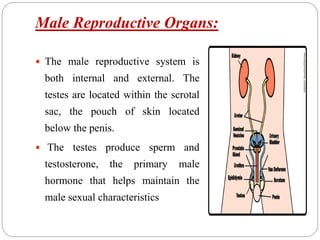
Male Reproductive Organs:
 The male reproductive system is
both internal and external. The
testes are located within the scrotal
sac, the pouch of skin located
below the penis.
 The testes produce sperm and
testosterone, the primary male
hormone that helps maintain the
male sexual characteristics
Artificial Insemination:
 Artificial insemination:
 Introducing semen into the uterus or oviduct by other
than natural means.
In Vitro Fertilization:
 In vitro fertilization:
 Taking eggs from a woman,
fertilizing them in the
laboratory with a man's sperm,
and returning the resulting
embryos to her uterus several
days later.
Intra-Cytoplasmic Sperm Injection (ICSI):
 Intra-Cytoplasmic sperm
injection - is a lab
procedure to help infertile
couples undergo in vitro
fertilization due to male
factor infertility.
Frozen Embryos:
 Frozen embryos: Specialists
may freeze additional embryos
from a woman's cycle for later
use. They may also freeze
embryos of a donor in order to
have them ready to place in a
surrogate mother's uterus at the
appropriate moment in the
surrogate's natural or hormone-
replaced cycle.
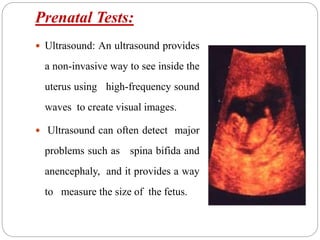
Prenatal Tests:
 Ultrasound: An ultrasound provides
a non-invasive way to see inside the
uterus using high-frequency sound
waves to create visual images.
 Ultrasound can often detect major
problems such as spina bifida and
anencephaly, and it provides a way
to measure the size of the fetus.
IVF Cycle outcomes age wise flow chart:
In vitrofertilization(ivf)

In vitrofertilization(ivf)

  • 1.
    Prepared By: VipinKumar Shukla Assistant Lecturer. IN-VITROFERTILIZATION(IVF)
  • 2.
    Introduction:  In vitrofertilization (IVF) is a type of assistive reproductive technology (ART). It involves retrieving eggs from a woman’s ovaries and fertilizing them with sperm. This fertilized egg is known as an embryo. The embryo can then be frozen for storage or transferred to a woman’s uterus.  Depending on your situation, IVF can use:  your eggs and your partner’s sperm.  your eggs and donor sperm.  donor eggs and your partner’s sperm.
  • 3.
    Continued….  Your doctorcan also implant embryos in a surrogate, or gestational carrier. This is a woman who carries your baby for you.  The success rate of IVF varies. According to the American Pregnancy Association, the live birth rate for women under age 35 undergoing IVF is 41 to 43 percent. This rate falls to 13 to 18 percent for women over the age of 40.
  • 4.
    What Is aTest Tube Baby:  The term “test tube baby” means a child that is conceived outside a woman’s body. A more complete definition specifies test tube babies as being conceived in a laboratory through the scientific process of In-Vitro Fertilization (IVF). The use of the words “test tube” is also erroneous because, right from the beginning decades back with Edwards and Steptoe, the lab instrument that they used to mix the eggs and sperm in is a Petri dish.  It can be stated therefore that “test tube baby” is an oversimplified term for a child born through IVF. Hence, there is actually NO difference between IVF and test tube baby.
  • 6.
    Step involved inTest Tube baby process:  Test Tube Baby Step-by-Step Process  Ever since that successful attempt in 1978, numerous advancements have been made to IVF but the core procedure remains the same.
  • 7.
    Step 1: Eggproduction stimulated by hormone therapy:  Prior to egg retrieval, the woman is prescribed injectable hormones of GnRHa and gonadotrophins to promote the synchronous growth and maturation of the follicles inside her ovaries. Final maturation of the eggs is accomplished through the injection of HCG 36 hours before egg collection.  Step 2: Eggs retrieved from ovary  The woman is given a mild sedative or anesthetic so that she won’t feel pain or other discomforts during egg retrieval. Using an ultrasound vaginal probe with a fine hollow needle attached to it, the fertility specialist aspirates eggs from the woman’s ovaries. These samples are promptly brought to the laboratory.  Step 3: Sperm Sample Provided  On the same day as the egg retrieval, the man is required to produce a fresh semen sample.
  • 8.
    Continued……  Step 4:Eggs and sperm combined to allow fertilization  The sperm and eggs are mixed together in a Petri dish and then place inside an incubator for a few days. During this period, the fertility specialist checks for signs of fertilization and monitors the growth of the embryos.  Step 5: Fertilized eggs introduced into the uterus  On the day of embryo transfer, two or three embryos are transferred into the uterus of the woman with the use of a fine catheter. To strengthen and support the uterine lining and increase the possibility of implantation, she is advised to administer progesterone or HCG daily.
  • 9.
    Continued……  A commonquestion that is asked is how painful are IVF injections? Most women experience minimal pain and discomfort with the hormone injections, describing them as being similar to the insulin injections for diabetes.  Other women claim that the more painful shots are those of progesterone because it is oil-based and requires the use of a needle with a larger bore.
  • 10.
    Systemic flow chartof Test Tube baby production:
  • 11.
    What is Infertility? Infertility is a disease that affects the reproductive organs of both men and women. It impairs one of the body’s most basic functions, which is the ability to have offspring. Infertility affects about 6.1 million women and men in the United States; this is 10 percent of the reproductive-age population.  Smoking, sexually transmitted  infections, age, and an  unhealthy body weight can  increase risks of infertility.
  • 12.
    Reasons for Infertility: Fallopian tubes are blocked or damaged.  Sperm do not swim well.  Sperm are too few in number.  The lining of womb is affected.  Ovarian do not produce eggs.  Qualities of eggs is compromised.  Hormonal Imbalances.
  • 13.
    Why Is InVitro Fertilization Performed:  IVF helps people with infertility who want to have a baby. IVF is expensive and invasive, so couples often try other fertility treatments first.  These may include taking fertility drugs or having intrauterine insemination. During that procedure, a doctor transfers sperm directly into a woman’s uterus.  Infertility issues for which IVF is mandatory it includes:  Reduced fertility in women over the age of 40  Blocked or damaged fallopian tubes
  • 14.
    Continued……  Reduced ovarianfunction  Endometriosis  Uterine fibroids  Male infertility, such as low sperm count or abnormalities in sperm shape  Unexplained infertility
  • 15.
    Continued……  Parents mayalso choose IVF if they run the risk of passing a genetic disorder on to their offspring. A medical lab can test the embryos for genetic abnormalities. Then, a doctor only implants embryos without genetic defects.
  • 16.
    How we preparefor In Vitro Fertilization:  Before beginning IVF, women will first undergo ovarian reserve testing. This involves taking a blood sample and testing it for the level of follicle stimulating hormone (FSH). The results of this test will give your doctor information about the size and quality of your eggs.  Your doctor will also examine your uterus. This may involve doing an ultrasound, which uses high-frequency sound waves to create an image of your uterus. Your doctor may also insert a scope through your vagina and into your uterus. These tests can reveal the health of your uterus and help the doctor determine the best way to implant the embryos.
  • 17.
    Continued……  Men willneed to have sperm testing. This involves giving a semen sample, which a lab will analyze for the number, size, and shape of the sperm.  If the sperm are weak or damaged, a procedure called intracytoplasmic sperm injection (ICSI) may be necessary.  During ICSI, a technician injects sperm directly into the egg. ICSI can be part of the IVF process.
  • 18.
  • 19.
    Factors responsible forchoosing IVF:  How many embryos do you wish to transfer? The more embryos transferred, the higher the risk of a multiple pregnancy. Most doctors won’t transfer more than two embryos.  How do you feel about the possibility of having twins, triplets, or a higher order multiple pregnancy?  What about the legal and emotional issues associated with using donated eggs, sperm, and embryos or a surrogate?  What are the financial, physical, and emotional stresses associated with IVF?
  • 20.
    History of IVF: 1890-the very first in vitro manipulation of eggs/embryos was performed by Walter Heape,when he transferred in vivo fertilized from one female rabbit to another.  1959-M.C Chang successfully conducted IVF in rabbits.  February 15,1969-the journal nature published a paper authored by R.G Edwards.  1977,the first IVF pregnancy in human and the birth of Louis Brown.
  • 21.
    Continued…..  The firstsuccessful embryo transfer was carried out in rabbit by heap in 1890.  First lamb by ETT-1949 by berry.  First calf by-1951 by willet et al  In swine-1951 by kvansnickii  In Asian buffalo-1983by drost et al.  Steps involved in embryo transfer
  • 22.
    GENERAL PROTOCOL:  Patientselection  Manipulation of menstrual cycle;superovulation  Oocytes retrieval  Preparation of semen sample  IVF treatment  Embryo transfer  Cryopreservation
  • 23.
  • 24.
    Steps in IVF: Initial evaluation  ovarian stimulation  Collection of Oocytes  Collection of sperm  In vitro fertilization of Oocytes  Embryo transfer
  • 25.
    Female Infertility Factors: The most common female infertility factor is an ovulation disorder.  Blocked fallopian tubes, which can occur when a woman has had pelvic inflammatory disease or endometriosis (a sometimes painful condition causing adhesions and cysts).
  • 26.
    Male Infertility Factors: The most common male infertility factors include Azoosprmia (no sperm cells are produced) and  Oligospermia (few sperm cells are produced).  Sometimes, sperm cells are malformed or they die before  they can reach the egg.  Also a genetic disease such as cystic fibrosis or a chromosomal abnormality causes infertility in men.
  • 27.
    Female Reproductive Organs: Normal anatomy and regular menstrual cycles are key factors in establishing female fertility.  The female reproductive system is mainly internal. The vagina is the passage that leads from the outside of the body to the cervix, which is the opening to the Uterus.  The uterus is a muscular organ about the size and shape of a pear, which is lined with a rich and nourishing mucous membrane called the Endometrium. The Uterus is where a fertilized egg attaches itself and develops into a baby.
  • 29.
    Male Reproductive Organs: The male reproductive system is both internal and external. The testes are located within the scrotal sac, the pouch of skin located below the penis.  The testes produce sperm and testosterone, the primary male hormone that helps maintain the male sexual characteristics
  • 30.
    Artificial Insemination:  Artificialinsemination:  Introducing semen into the uterus or oviduct by other than natural means.
  • 31.
    In Vitro Fertilization: In vitro fertilization:  Taking eggs from a woman, fertilizing them in the laboratory with a man's sperm, and returning the resulting embryos to her uterus several days later.
  • 32.
    Intra-Cytoplasmic Sperm Injection(ICSI):  Intra-Cytoplasmic sperm injection - is a lab procedure to help infertile couples undergo in vitro fertilization due to male factor infertility.
  • 33.
    Frozen Embryos:  Frozenembryos: Specialists may freeze additional embryos from a woman's cycle for later use. They may also freeze embryos of a donor in order to have them ready to place in a surrogate mother's uterus at the appropriate moment in the surrogate's natural or hormone- replaced cycle.
  • 34.
    Prenatal Tests:  Ultrasound:An ultrasound provides a non-invasive way to see inside the uterus using high-frequency sound waves to create visual images.  Ultrasound can often detect major problems such as spina bifida and anencephaly, and it provides a way to measure the size of the fetus.
  • 35.
    IVF Cycle outcomesage wise flow chart: