ASSISTED
REPRODUCTIVE
TECHNOLOGY (ART)
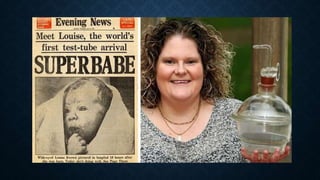
The ART encompasses
all the procedures that
involve manipulation
of gametes and
embryos outside the
body for the treatment
of infertility
• IVF – ET (In vitro fertilization and embryo transfer)
• GIFT ( Gamate intra fallopian transfer)
• ZIFT (Zygote intra fallopian transfer)
• POST (Peritoneal oocyte and sperm transfer)
• TET ( Tubal embryo transfer zone)
• SUZI ( Subzonal insemination)
• AH (Assisted hatching)
• IVM (In vitro maturation of oocyte)
IN VITRO FERTILIZATION AND
EMBRYO TRANSFER (IVF-ET)
INDICATIONS OF IVF
• Tubal disease
• Unexplained infertility
• endometriosis
• Male factor infertility
• Multiple factors (female
and male)
• Failed ovulation induction
• ovarian failure
• Non functional uterus
• Women with genetic risk
PATIENT SELECTION (IDEAL)
• Age < 35 years
• Presence of ovarian reserve (D-3, serum FSH <10 IU/L).
• Husband—normal seminogram.
• Couple must be screened negative for HIV and hepatitis.
• Normal uterine cavity as evaluated by
hysteroscopy/sonohysterography.
PRINCIPAL STEPS OF AN ART CYCLE
• Down regulation using GnRH agonist.
• Controlled ovarian hyperstimulation (COH).
• Monitoring of follicular growth.
• Oocyte retrieval.
• Fertilization in vitro
• Transfer of gametes or embryos.
• Luteal support with progesterone.
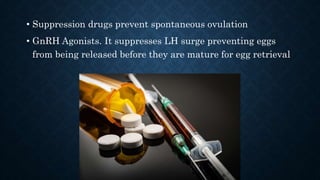
• Suppression drugs prevent spontaneous ovulation
• GnRH Agonists. It suppresses LH surge preventing eggs
from being released before they are mature for egg retrieval
• Ovarian stimulation is used to produce multiple
mature follicles, rather than the single egg normally
developed each month.
• Produces many good follicles to be Fertilized.
• Multiple eggs are stimulated because some eggs
will not fertilize or develop normally after
fertilization.
• Regular monitoring by ultrasound scan is done.
• The oocyte maturation is performed, generally by an
injection of human chorionic gonadotropin (hCG).
Commonly, known as the "trigger shot.“
• The egg retrieval is performed at a time usually between 34
and 36 hours after hCG injection.
• Egg retrieval is usually accomplished by transvaginal
ultrasound aspiration.
• Fertilization is started by adding 10,000-50,000 motile
sperms to about 100 µl to 1 ml culture medium in which the
oocytes is being incubated.
• Fertilisation check is performed the next day approximately
18 hours after sperm injection or insemination of the eggs.
• Usually 65% to 75% of mature eggs will fertilize after
insemination
• They are cultured in special incubators to support division
and development.
• Embryo transfer may be performed on day 2, 3 or 5 post
fertilization.
• One or more embryos suspended in a drop of culture
medium are drawn into a transfer catheter, a long, thin
sterile tube with a syringe on one end.
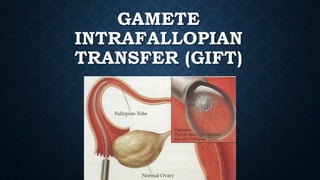
GAMETE
INTRAFALLOPIAN
TRANSFER (GIFT)
• It is a more invasive and expensive procedure
• In this procedure, both the sperm and the
unfertilized oocytes are transferred into the
fallopian tubes.
• Fertilization is then achieved in vivo.
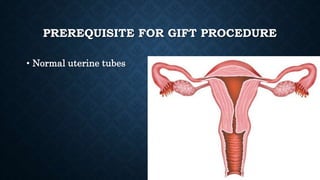
PREREQUISITE FOR GIFT PROCEDURE
• Normal uterine tubes
TECHNIQUE
• Superovulation is done
• Two collected oocytes along with approximately 200,000–
500,000 motile sperm for each fallopian tube are placed in a
plastic tube container.
• It is then passed through laparoscope and inserted 4 cm
into the distal end of the fallopian tube where the
combination is injected.

Assisted reproductive technology

  • 1.
  • 2.
    The ART encompasses allthe procedures that involve manipulation of gametes and embryos outside the body for the treatment of infertility
  • 3.
    • IVF –ET (In vitro fertilization and embryo transfer) • GIFT ( Gamate intra fallopian transfer) • ZIFT (Zygote intra fallopian transfer) • POST (Peritoneal oocyte and sperm transfer) • TET ( Tubal embryo transfer zone) • SUZI ( Subzonal insemination) • AH (Assisted hatching) • IVM (In vitro maturation of oocyte)
  • 4.
    IN VITRO FERTILIZATIONAND EMBRYO TRANSFER (IVF-ET)
  • 6.
    INDICATIONS OF IVF •Tubal disease • Unexplained infertility • endometriosis • Male factor infertility • Multiple factors (female and male) • Failed ovulation induction • ovarian failure • Non functional uterus • Women with genetic risk
  • 7.
    PATIENT SELECTION (IDEAL) •Age < 35 years • Presence of ovarian reserve (D-3, serum FSH <10 IU/L). • Husband—normal seminogram. • Couple must be screened negative for HIV and hepatitis. • Normal uterine cavity as evaluated by hysteroscopy/sonohysterography.
  • 8.
    PRINCIPAL STEPS OFAN ART CYCLE • Down regulation using GnRH agonist. • Controlled ovarian hyperstimulation (COH). • Monitoring of follicular growth. • Oocyte retrieval. • Fertilization in vitro • Transfer of gametes or embryos. • Luteal support with progesterone.
  • 9.
    • Suppression drugsprevent spontaneous ovulation • GnRH Agonists. It suppresses LH surge preventing eggs from being released before they are mature for egg retrieval
  • 10.
    • Ovarian stimulationis used to produce multiple mature follicles, rather than the single egg normally developed each month. • Produces many good follicles to be Fertilized. • Multiple eggs are stimulated because some eggs will not fertilize or develop normally after fertilization. • Regular monitoring by ultrasound scan is done.
  • 11.
    • The oocytematuration is performed, generally by an injection of human chorionic gonadotropin (hCG). Commonly, known as the "trigger shot.“ • The egg retrieval is performed at a time usually between 34 and 36 hours after hCG injection. • Egg retrieval is usually accomplished by transvaginal ultrasound aspiration.
  • 12.
    • Fertilization isstarted by adding 10,000-50,000 motile sperms to about 100 µl to 1 ml culture medium in which the oocytes is being incubated. • Fertilisation check is performed the next day approximately 18 hours after sperm injection or insemination of the eggs. • Usually 65% to 75% of mature eggs will fertilize after insemination • They are cultured in special incubators to support division and development.
  • 13.
    • Embryo transfermay be performed on day 2, 3 or 5 post fertilization. • One or more embryos suspended in a drop of culture medium are drawn into a transfer catheter, a long, thin sterile tube with a syringe on one end.
  • 14.
  • 15.
    • It isa more invasive and expensive procedure • In this procedure, both the sperm and the unfertilized oocytes are transferred into the fallopian tubes. • Fertilization is then achieved in vivo.
  • 16.
    PREREQUISITE FOR GIFTPROCEDURE • Normal uterine tubes
  • 17.
    TECHNIQUE • Superovulation isdone • Two collected oocytes along with approximately 200,000– 500,000 motile sperm for each fallopian tube are placed in a plastic tube container. • It is then passed through laparoscope and inserted 4 cm into the distal end of the fallopian tube where the combination is injected.