WebRTC Global Summit 2015
The Telco’s WebRTC dichotomy (it only exists from a
telecom perspective)
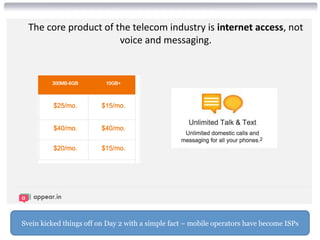
The core product of the telecom industry is internet access, not
voice and messaging.
Svein kicked things off on Day 2 with a simple fact – mobile operators have become ISPs
path: create service platforms
Telcos continue to be conned by their vendors into spending $10s to $100s of millions on
platforms. Even on Big Data, they’ve spent on data lakes with no clear insights that generate
a return on investment.
path: create communication services
Naturally, I agree with Svein’s conclusions. But Telcos continue to massively under-invest
in services. Spending money on a platform (IMS, VoLTE app server, Cloud, etc.) is not
investing in services. TADHack is about trying to show the power of telecom capabilities
and bring new service ideas and partners together.
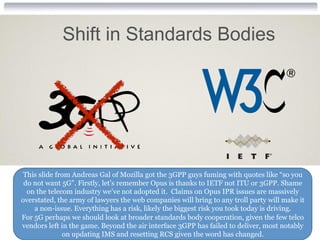
This slide from Andreas Gal of Mozilla got the 3GPP guys fuming with quotes like “so you
do not want 5G”. Firstly, let’s remember Opus is thanks to IETF not ITU or 3GPP. Shame
on the telecom industry we’ve not adopted it. Claims on Opus IPR issues are massively
overstated, the army of lawyers the web companies will bring to any troll party will make it
a non-issue. Everything has a risk, likely the biggest risk you took today is driving.
For 5G perhaps we should look at broader standards body cooperation, given the few telco
vendors left in the game. Beyond the air interface 3GPP has failed to deliver, most notably
on updating IMS and resetting RCS given the word has changed.
Shift in Standards Bodies
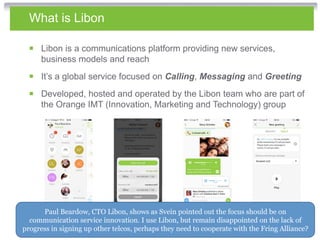
What is Libon
■ Libon is a communications platform providing new services,
business models and reach
■ It’s a global service focused on Calling, Messaging and Greeting
■ Developed, hosted and operated by the Libon team who are part ofDeveloped, hosted and operated by the Libon team who are part of
the Orange IMT (Innovation, Marketing and Technology) group
Paul Beardow, CTO Libon, shows as Svein pointed out the focus should be on
communication service innovation. I use Libon, but remain disappointed on the lack of
progress in signing up other telcos, perhaps they need to cooperate with the Fring Alliance?
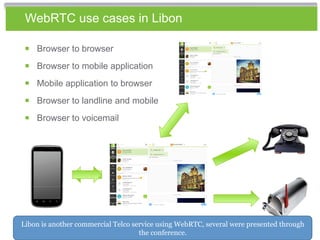
WebRTC use cases in Libon
■ Browser to browser
■ Browser to mobile application■ Browser to mobile application
■ Mobile application to browser
■ Browser to landline and mobile
■ Browser to voicemail
Libon is another commercial Telco service using WebRTC, several were presented through
the conference.
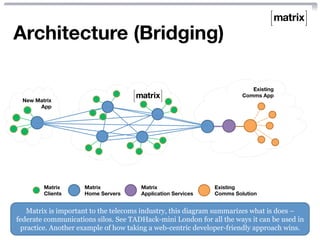
Matrix
Clients
Matrix

Home Servers
New Matrix
App
Existing
Comms App
Matrix

Application Services
Architecture (Bridging)
Existing
Comms Solution
Matrix is important to the telecoms industry, this diagram summarizes what is does –
federate communications silos. See TADHack-mini London for all the ways it can be used in
practice. Another example of how taking a web-centric developer-friendly approach wins.
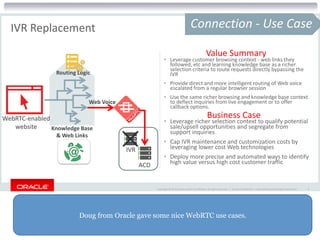
Doug from Oracle gave some nice WebRTC use cases.
Copyright © 2015 Oracle and/or its affiliates. All rights reserved. | Oracle Confidential – Internal/Restricted/Highly Restricted 9
IVR Replacement Connection - Use Case
• Leverage customer browsing context - web links they
followed, etc and learning knowledge base as a richer
selection criteria to route requests directly bypassing the
IVR
• Provide direct and more intelligent routing of Web voice
escalated from a regular browser session
• Use the same richer browsing and knowledge base context
to deflect inquiries from live engagement or to offer
callback options.
• Leverage richer selection context to qualify potential
sale/upsell opportunities and segregate from
support inquiries
• Cap IVR maintenance and customization costs by
leveraging lower cost Web technologies
• Deploy more precise and automated ways to identify
high value versus high cost customer traffic
Value Summary
Business CaseWebRTC-enabled
website Knowledge Base
& Web Links
Routing Logic
ACD
IVR
Web Voice
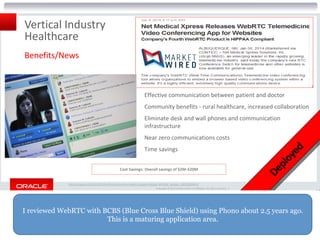
I reviewed WebRTC with BCBS (Blue Cross Blue Shield) using Phono about 2.5 years ago.
This is a maturing application area.
Copyright © 2015 Oracle and/or its affiliates. All rights reserved. |
Vertical Industry
Healthcare
Benefits/News
Effective communication between patient and doctor
Community benefits - rural healthcare, increased collaboration
Eliminate desk and wall phones and communication
infrastructure
Near zero communications costs
Time savings
Cost Savings: Overall savings of $2M-$20M
http://stcblog.com/2012/10/31/healthcare-disruption-webrtc/?goback=%2Egde_4677426_member_180792367#%21
10
Doug from Oracle gave some great WebRTC use cases.
Copyright © 2015 Oracle and/or its affiliates. All rights reserved. | Oracle Confidential – Internal/Restricted/Highly Restricted 11
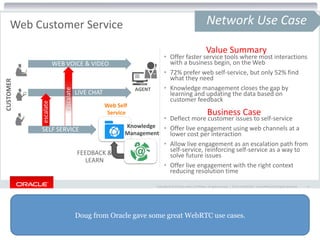
Web Customer Service Network Use Case
• Offer faster service tools where most interactions
with a business begin, on the Web
• 72% prefer web self-service, but only 52% find
what they need
• Knowledge management closes the gap by
learning and updating the data based on
customer feedback
• Deflect more customer issues to self-service
• Offer live engagement using web channels at a
lower cost per interaction
• Allow live engagement as an escalation path from
self-service, reinforcing self-service as a way to
solve future issues
• Offer live engagement with the right context
reducing resolution time
Value Summary
Business Case
Web Self
Service
CUSTOMER
Knowledge
Management
FEEDBACK &
LEARN
LIVE CHAT
WEB VOICE & VIDEO
escalate
AGENT
escalate
SELF SERVICE
Doug from Oracle gave some nice WebRTC use cases.
Copyright © 2015 Oracle and/or its affiliates. All rights reserved. |
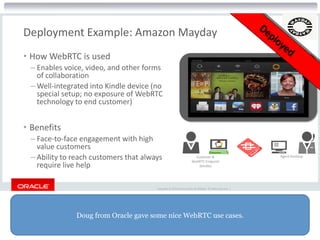
Deployment Example: Amazon Mayday
• How WebRTC is used
– Enables voice, video, and other forms
of collaboration
– Well-integrated into Kindle device (no
special setup; no exposure of WebRTC
technology to end customer)
• Benefits
– Face-to-face engagement with high
value customers
– Ability to reach customers that always
require live help
Customer &
WebRTC Endpoint
(Kindle)
Agent Desktop
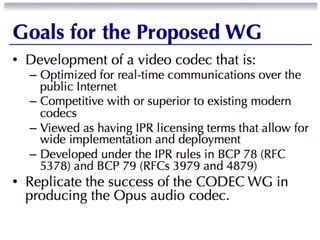
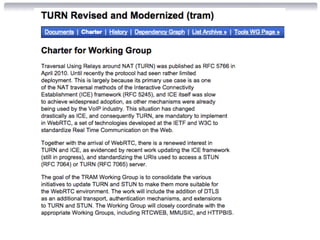
Victor highlighted 2 important WebRTC initiatives to keep an eye on: an attempt to produce
a video version of Opus, and TURN/STUN are getting a much needed update.
16'
17'
18'
04/15/2015 5
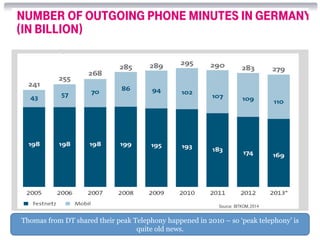
number of outgoing phone minutes in germany
(in billion)
Source: BITKOM, 2014
Thomas from DT shared their peak Telephony happened in 2010 – so ‘peak telephony’ is
quite old news.
04/15/2015 6
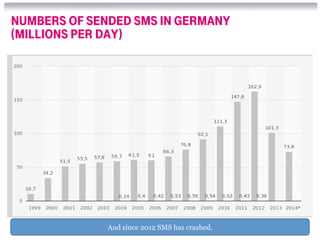
numbers of sended sms in germany
(millions per day)
Source: VATM, Dialog Consult / Statista 2015
And since 2012 SMS has crashed.
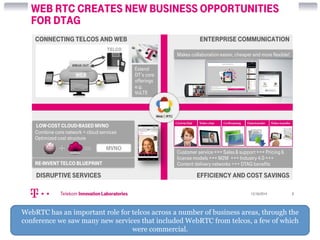
WebRTC has an important role for telcos across a number of business areas, through the
conference we saw many new services that included WebRTC from telcos, a few of which
were commercial.
12/16/2014 8
web rtc creates new business opportunities
for dtag
connecting telcos and web
low-cost cloud-based mvno
Combine core network + cloud services
Optimized cost structure
disruptive services
enterprise communication
re-invent telco blueprint
Customer service +++ Sales & support +++ Pricing &
license models +++ M2M +++ Industry 4.0 +++
Content delivery networks +++ DTAG benefits
efficiency and cost savings
Makes collaboration easier, cheaper and more flexible!
MVNO
Extend
DT’s core
offerings
e.g.
VoLTE
Popular Verticals
4/17/2015 17
Financial
Surveillance
Job Interviews
Gaming
Education
Experts market
Healthcare
WebRTC Use Case Verticals
April 2015
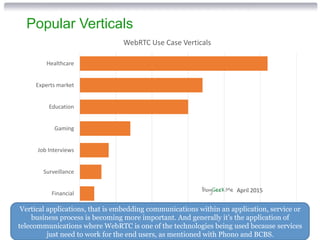
Vertical applications, that is embedding communications within an application, service or
business process is becoming more important. And generally it’s the application of
telecommunications where WebRTC is one of the technologies being used because services
just need to work for the end users, as mentioned with Phono and BCBS.
Conclusion
• Anywhere, Anytime
– 3G, 4G(+), Wifi …
What is the Next Gen. Comm ? « 9A »
• Any Device
– Smartphone, tablet, PC, TV…
Any Voice/Visio, Any Messaging, Any Content
• Anyone
– User, 3rd-Pty Apps
• Anonymous
– Simple clic
• Aware
– Discover presence, capability…
Visio on TV
Visio on
Web browser
Click2All
RCS features
(Presence, Discovery,
content (sharing)…)
Visio
Conferencing
New apps
(ehealth, ecommerce, gaming, automotive, eLearning,
enterprise, contact center…)
Multi-devices
H264
VGA
Interco
Enabler
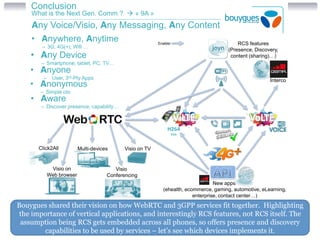
Bouygues shared their vision on how WebRTC and 3GPP services fit together. Highlighting
the importance of vertical applications, and interestingly RCS features, not RCS itself. The
assumption being RCS gets embedded across all phones, so offers presence and discovery
capabilities to be used by services – let’s see which devices implements it.
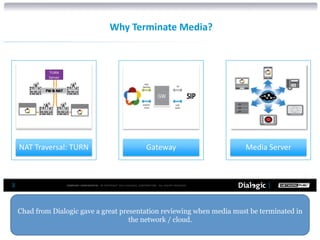
Chad from Dialogic gave a great presentation reviewing when media must be terminated in
the network / cloud.
COMPANY CONFIDENTIAL © COPYRIGHT 2015 DIALOGIC CORPORATION. ALL RIGHTS RESERVED.3
Why Terminate Media?
NAT Traversal: TURN Gateway Media Server
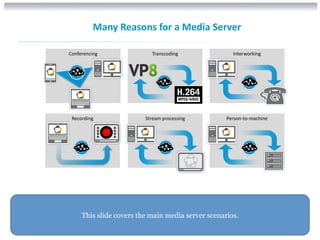
This slide covers the main media server scenarios.
COMPANY CONFIDENTIAL © COPYRIGHT 2015 DIALOGIC CORPORATION. ALL RIGHTS RESERVED.7
Many Reasons for a Media Server
Conferencing InterworkingTranscoding
Stream processingRecording Person-to-machine
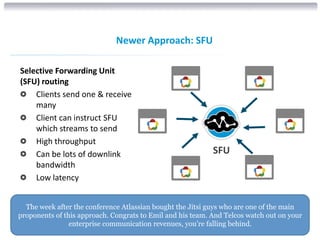
The week after the conference Atlassian bought the Jitsi guys who are one of the main
proponents of this approach. Congrats to Emil and his team. And Telcos watch out on your
enterprise communication revenues, you’re falling behind.
COMPANY CONFIDENTIAL © COPYRIGHT 2015 DIALOGIC CORPORATION. ALL RIGHTS RESERVED.17
Newer Approach: SFU
SFU
Selective Forwarding Unit
(SFU) routing
Clients send one & receive
many
Client can instruct SFU
which streams to send
High throughput
Can be lots of downlink
bandwidth
Low latency
© Analysys Mason Limited 2015
Seven screens compete for our attention
4
Average daily usage and penetration of selected device types
Mobile
handsetTablet
eBook reader
TV set
PC
Handheld
console
PMP
0
0.5
1
1.5
2
2.5
3
3.5
4
0% 25% 50% 75% 100%
Hoursperday
Percentage of respondents
Source: The Connected Consumer Survey 2014; “Which of the following devices do you own, or have very regular access to (for
example through someone who lives with you)?”; n = 7485.
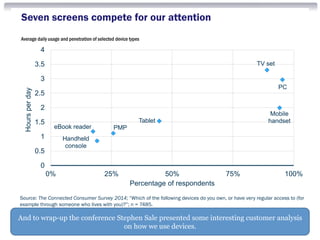
And to wrap-up the conference Stephen Sale presented some interesting customer analysis
on how we use devices.
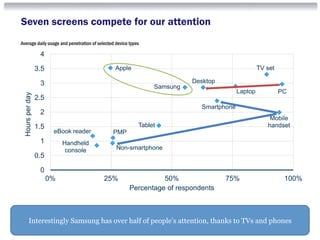
Interestingly Samsung has over half of people’s attention, thanks to TVs and phones
Consumer behaviour – device and app usage (an operator view)
© Analysys Mason Limited 2015
Seven screens compete for our attention
6
Average daily usage and penetration of selected device types
Source: The Connected Consumer Survey 2014; “Which of the following devices do you own, or have very regular access to (for
example through someone who lives with you)?”; n = 7485.
Mobile
handsetTablet
eBook reader
TV set
PC
Handheld
console
PMP
Smartphone
Non-smartphone
Desktop
Laptop
Apple
Samsung
0
0.5
1
1.5
2
2.5
3
3.5
4
0% 25% 50% 75% 100%
Hoursperday
Percentage of respondents
Apps currently dominate customer time on smartphones, but browsers continue their slow
climb. And operator app usage falls away quite rapidly. Many telco apps remain slow and
ponderous compared to the state of the art app experiences.
© Analysys Mason Limited 2015
Smartphones have driven changes in consumer engagement
7
Time spent on smartphones by type of interface [Source: Analysys Mason and Nielsen, 2014]
98 mins 197 mins
Interface
Operator interface
Device functions
Browser
Apps
31%
16%
8%
45%
2011
252 mins
17%
8%
10%
65%
2013
11%
8%
12%
69%
2015 (est.)
VoIP means cheap break-out calling applications versus video services from Skype or
Facetime. This highlights video telephony is important to people, more important that
cheap bypass VoIP bypass calling. Peer group communications is important – not universal
connectivity. I just need to video skype with my mum, not everyone and my mum.
Consumer behaviour – device and app usage (an operator view)
© Analysys Mason Limited 2015
0%
10%
20%
30%
40%
50%
0% 10% 20% 30% 40% 50%
Videocalling
VoIP
VoIP and video-calling penetration on handsets, by country [Source: Analysys Mason]
9
Highest penetration amongst
migrant worker populations
Correlation between penetration of
VoIP and video calling service usage.
Video calling was a more widely
used service than VoIP on handsets.
• adds value to the experience in
typical use cases,
overwhelmingly on Wi-Fi.
• apps perceived primarily as video
apps, rather than simply cheap
voice.
Video calling is more widely used than VoIP in most markets
Videocalling
Consumer behaviour – device and app usage (an operator view)
© Analysys Mason Limited 2015
Operators should be looking for growth in consumer attention and
identifying service/partnership opportunities
16
Penetration of apps by category, and corresponding growth between 2011 and 2013; (2011: n = 1079; 2013: n = 1596)
9%
38% 30% 42%
89%
83%
242%
40%
0%
50%
100%
150%
200%
250%
300%
0%
20%
40%
60%
80%
100%
Social
networking
Productivity
Gaming
TVand
video
Commerce
Music
Financial
services
Health
Addressablemarketgrowth
Percentageofpanellists
Source: Analysys Mason and Nielsen
2011 2013 GrowthPenetration:
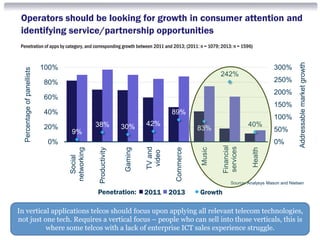
In vertical applications telcos should focus upon applying all relevant telecom technologies,
not just one tech. Requires a vertical focus – people who can sell into those verticals, this is
where some telcos with a lack of enterprise ICT sales experience struggle.
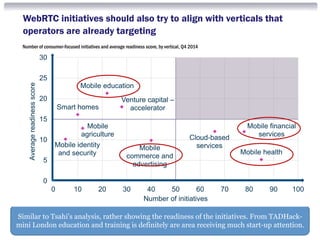
Similar to Tsahi’s analysis, rather showing the readiness of the initiatives. From TADHack-
mini London education and training is definitely are area receiving much start-up attention.
Consumer behaviour – device and app usage (an operator view)
© Analysys Mason Limited 2015
WebRTC initiatives should also try to align with verticals that
operators are already targeting
18
Number of consumer-focused initiatives and average readiness score, by vertical, Q4 2014
Cloud-based
services
Mobile
agriculture
Mobile
commerce and
advertising
Mobile education
Mobile financial
services
Mobile health
Mobile identity
and security
Smart homes
Venture capital –
accelerator
0
5
10
15
20
25
30
0 10 20 30 40 50 60 70 80 90 100
Averagereadinessscore
Number of initiatives
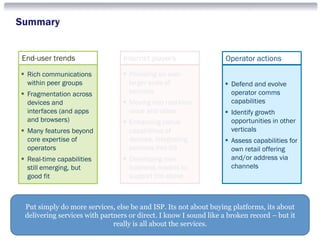
Put simply do more services, else be and ISP. Its not about buying platforms, its about
delivering services with partners or direct. I know I sound like a broken record – but it
really is all about the services.
Consumer behaviour – device and app usage (an operator view)
© Analysys Mason Limited 2015
Summary
19
Defend and evolve
operator comms
capabilities
Identify growth
opportunities in other
verticals
Assess capabilities for
own retail offering
and/or address via
channels
Operator actions
Providing an ever-
larger suite of
services
Moving into real-time
voice and video
Enhancing native
capabilities of
devices, integrating
services into OS
Developing new
business models to
support the above
Internet players
Rich communications
within peer groups
Fragmentation across
devices and
interfaces (and apps
and browsers)
Many features beyond
core expertise of
operators
Real-time capabilities
still emerging, but
good fit
End-user trends

WebRTC Global Summit Summary 2015

  • 1.
    WebRTC Global Summit2015 The Telco’s WebRTC dichotomy (it only exists from a telecom perspective)
  • 2.
    The core productof the telecom industry is internet access, not voice and messaging. Svein kicked things off on Day 2 with a simple fact – mobile operators have become ISPs
  • 3.
    path: create serviceplatforms Telcos continue to be conned by their vendors into spending $10s to $100s of millions on platforms. Even on Big Data, they’ve spent on data lakes with no clear insights that generate a return on investment.
  • 4.
    path: create communicationservices Naturally, I agree with Svein’s conclusions. But Telcos continue to massively under-invest in services. Spending money on a platform (IMS, VoLTE app server, Cloud, etc.) is not investing in services. TADHack is about trying to show the power of telecom capabilities and bring new service ideas and partners together.
  • 5.
    This slide fromAndreas Gal of Mozilla got the 3GPP guys fuming with quotes like “so you do not want 5G”. Firstly, let’s remember Opus is thanks to IETF not ITU or 3GPP. Shame on the telecom industry we’ve not adopted it. Claims on Opus IPR issues are massively overstated, the army of lawyers the web companies will bring to any troll party will make it a non-issue. Everything has a risk, likely the biggest risk you took today is driving. For 5G perhaps we should look at broader standards body cooperation, given the few telco vendors left in the game. Beyond the air interface 3GPP has failed to deliver, most notably on updating IMS and resetting RCS given the word has changed. Shift in Standards Bodies
  • 6.
    What is Libon ■Libon is a communications platform providing new services, business models and reach ■ It’s a global service focused on Calling, Messaging and Greeting ■ Developed, hosted and operated by the Libon team who are part ofDeveloped, hosted and operated by the Libon team who are part of the Orange IMT (Innovation, Marketing and Technology) group Paul Beardow, CTO Libon, shows as Svein pointed out the focus should be on communication service innovation. I use Libon, but remain disappointed on the lack of progress in signing up other telcos, perhaps they need to cooperate with the Fring Alliance?
  • 7.
    WebRTC use casesin Libon ■ Browser to browser ■ Browser to mobile application■ Browser to mobile application ■ Mobile application to browser ■ Browser to landline and mobile ■ Browser to voicemail Libon is another commercial Telco service using WebRTC, several were presented through the conference.
  • 8.
    Matrix Clients Matrix
 Home Servers New Matrix App Existing CommsApp Matrix
 Application Services Architecture (Bridging) Existing Comms Solution Matrix is important to the telecoms industry, this diagram summarizes what is does – federate communications silos. See TADHack-mini London for all the ways it can be used in practice. Another example of how taking a web-centric developer-friendly approach wins.
  • 9.
    Doug from Oraclegave some nice WebRTC use cases. Copyright © 2015 Oracle and/or its affiliates. All rights reserved. | Oracle Confidential – Internal/Restricted/Highly Restricted 9 IVR Replacement Connection - Use Case • Leverage customer browsing context - web links they followed, etc and learning knowledge base as a richer selection criteria to route requests directly bypassing the IVR • Provide direct and more intelligent routing of Web voice escalated from a regular browser session • Use the same richer browsing and knowledge base context to deflect inquiries from live engagement or to offer callback options. • Leverage richer selection context to qualify potential sale/upsell opportunities and segregate from support inquiries • Cap IVR maintenance and customization costs by leveraging lower cost Web technologies • Deploy more precise and automated ways to identify high value versus high cost customer traffic Value Summary Business CaseWebRTC-enabled website Knowledge Base & Web Links Routing Logic ACD IVR Web Voice
  • 10.
    I reviewed WebRTCwith BCBS (Blue Cross Blue Shield) using Phono about 2.5 years ago. This is a maturing application area. Copyright © 2015 Oracle and/or its affiliates. All rights reserved. | Vertical Industry Healthcare Benefits/News Effective communication between patient and doctor Community benefits - rural healthcare, increased collaboration Eliminate desk and wall phones and communication infrastructure Near zero communications costs Time savings Cost Savings: Overall savings of $2M-$20M http://stcblog.com/2012/10/31/healthcare-disruption-webrtc/?goback=%2Egde_4677426_member_180792367#%21 10
  • 11.
    Doug from Oraclegave some great WebRTC use cases. Copyright © 2015 Oracle and/or its affiliates. All rights reserved. | Oracle Confidential – Internal/Restricted/Highly Restricted 11 Web Customer Service Network Use Case • Offer faster service tools where most interactions with a business begin, on the Web • 72% prefer web self-service, but only 52% find what they need • Knowledge management closes the gap by learning and updating the data based on customer feedback • Deflect more customer issues to self-service • Offer live engagement using web channels at a lower cost per interaction • Allow live engagement as an escalation path from self-service, reinforcing self-service as a way to solve future issues • Offer live engagement with the right context reducing resolution time Value Summary Business Case Web Self Service CUSTOMER Knowledge Management FEEDBACK & LEARN LIVE CHAT WEB VOICE & VIDEO escalate AGENT escalate SELF SERVICE
  • 12.
    Doug from Oraclegave some nice WebRTC use cases. Copyright © 2015 Oracle and/or its affiliates. All rights reserved. | Deployment Example: Amazon Mayday • How WebRTC is used – Enables voice, video, and other forms of collaboration – Well-integrated into Kindle device (no special setup; no exposure of WebRTC technology to end customer) • Benefits – Face-to-face engagement with high value customers – Ability to reach customers that always require live help Customer & WebRTC Endpoint (Kindle) Agent Desktop
  • 13.
    Victor highlighted 2important WebRTC initiatives to keep an eye on: an attempt to produce a video version of Opus, and TURN/STUN are getting a much needed update. 16'
  • 14.
  • 15.
  • 16.
    04/15/2015 5 number ofoutgoing phone minutes in germany (in billion) Source: BITKOM, 2014 Thomas from DT shared their peak Telephony happened in 2010 – so ‘peak telephony’ is quite old news.
  • 17.
    04/15/2015 6 numbers ofsended sms in germany (millions per day) Source: VATM, Dialog Consult / Statista 2015 And since 2012 SMS has crashed.
  • 18.
    WebRTC has animportant role for telcos across a number of business areas, through the conference we saw many new services that included WebRTC from telcos, a few of which were commercial. 12/16/2014 8 web rtc creates new business opportunities for dtag connecting telcos and web low-cost cloud-based mvno Combine core network + cloud services Optimized cost structure disruptive services enterprise communication re-invent telco blueprint Customer service +++ Sales & support +++ Pricing & license models +++ M2M +++ Industry 4.0 +++ Content delivery networks +++ DTAG benefits efficiency and cost savings Makes collaboration easier, cheaper and more flexible! MVNO Extend DT’s core offerings e.g. VoLTE
  • 19.
    Popular Verticals 4/17/2015 17 Financial Surveillance JobInterviews Gaming Education Experts market Healthcare WebRTC Use Case Verticals April 2015 Vertical applications, that is embedding communications within an application, service or business process is becoming more important. And generally it’s the application of telecommunications where WebRTC is one of the technologies being used because services just need to work for the end users, as mentioned with Phono and BCBS.
  • 20.
    Conclusion • Anywhere, Anytime –3G, 4G(+), Wifi … What is the Next Gen. Comm ? « 9A » • Any Device – Smartphone, tablet, PC, TV… Any Voice/Visio, Any Messaging, Any Content • Anyone – User, 3rd-Pty Apps • Anonymous – Simple clic • Aware – Discover presence, capability… Visio on TV Visio on Web browser Click2All RCS features (Presence, Discovery, content (sharing)…) Visio Conferencing New apps (ehealth, ecommerce, gaming, automotive, eLearning, enterprise, contact center…) Multi-devices H264 VGA Interco Enabler Bouygues shared their vision on how WebRTC and 3GPP services fit together. Highlighting the importance of vertical applications, and interestingly RCS features, not RCS itself. The assumption being RCS gets embedded across all phones, so offers presence and discovery capabilities to be used by services – let’s see which devices implements it.
  • 21.
    Chad from Dialogicgave a great presentation reviewing when media must be terminated in the network / cloud. COMPANY CONFIDENTIAL © COPYRIGHT 2015 DIALOGIC CORPORATION. ALL RIGHTS RESERVED.3 Why Terminate Media? NAT Traversal: TURN Gateway Media Server
  • 22.
    This slide coversthe main media server scenarios. COMPANY CONFIDENTIAL © COPYRIGHT 2015 DIALOGIC CORPORATION. ALL RIGHTS RESERVED.7 Many Reasons for a Media Server Conferencing InterworkingTranscoding Stream processingRecording Person-to-machine
  • 23.
    The week afterthe conference Atlassian bought the Jitsi guys who are one of the main proponents of this approach. Congrats to Emil and his team. And Telcos watch out on your enterprise communication revenues, you’re falling behind. COMPANY CONFIDENTIAL © COPYRIGHT 2015 DIALOGIC CORPORATION. ALL RIGHTS RESERVED.17 Newer Approach: SFU SFU Selective Forwarding Unit (SFU) routing Clients send one & receive many Client can instruct SFU which streams to send High throughput Can be lots of downlink bandwidth Low latency
  • 24.
    © Analysys MasonLimited 2015 Seven screens compete for our attention 4 Average daily usage and penetration of selected device types Mobile handsetTablet eBook reader TV set PC Handheld console PMP 0 0.5 1 1.5 2 2.5 3 3.5 4 0% 25% 50% 75% 100% Hoursperday Percentage of respondents Source: The Connected Consumer Survey 2014; “Which of the following devices do you own, or have very regular access to (for example through someone who lives with you)?”; n = 7485. And to wrap-up the conference Stephen Sale presented some interesting customer analysis on how we use devices.
  • 25.
    Interestingly Samsung hasover half of people’s attention, thanks to TVs and phones Consumer behaviour – device and app usage (an operator view) © Analysys Mason Limited 2015 Seven screens compete for our attention 6 Average daily usage and penetration of selected device types Source: The Connected Consumer Survey 2014; “Which of the following devices do you own, or have very regular access to (for example through someone who lives with you)?”; n = 7485. Mobile handsetTablet eBook reader TV set PC Handheld console PMP Smartphone Non-smartphone Desktop Laptop Apple Samsung 0 0.5 1 1.5 2 2.5 3 3.5 4 0% 25% 50% 75% 100% Hoursperday Percentage of respondents
  • 26.
    Apps currently dominatecustomer time on smartphones, but browsers continue their slow climb. And operator app usage falls away quite rapidly. Many telco apps remain slow and ponderous compared to the state of the art app experiences. © Analysys Mason Limited 2015 Smartphones have driven changes in consumer engagement 7 Time spent on smartphones by type of interface [Source: Analysys Mason and Nielsen, 2014] 98 mins 197 mins Interface Operator interface Device functions Browser Apps 31% 16% 8% 45% 2011 252 mins 17% 8% 10% 65% 2013 11% 8% 12% 69% 2015 (est.)
  • 27.
    VoIP means cheapbreak-out calling applications versus video services from Skype or Facetime. This highlights video telephony is important to people, more important that cheap bypass VoIP bypass calling. Peer group communications is important – not universal connectivity. I just need to video skype with my mum, not everyone and my mum. Consumer behaviour – device and app usage (an operator view) © Analysys Mason Limited 2015 0% 10% 20% 30% 40% 50% 0% 10% 20% 30% 40% 50% Videocalling VoIP VoIP and video-calling penetration on handsets, by country [Source: Analysys Mason] 9 Highest penetration amongst migrant worker populations Correlation between penetration of VoIP and video calling service usage. Video calling was a more widely used service than VoIP on handsets. • adds value to the experience in typical use cases, overwhelmingly on Wi-Fi. • apps perceived primarily as video apps, rather than simply cheap voice. Video calling is more widely used than VoIP in most markets Videocalling
  • 28.
    Consumer behaviour –device and app usage (an operator view) © Analysys Mason Limited 2015 Operators should be looking for growth in consumer attention and identifying service/partnership opportunities 16 Penetration of apps by category, and corresponding growth between 2011 and 2013; (2011: n = 1079; 2013: n = 1596) 9% 38% 30% 42% 89% 83% 242% 40% 0% 50% 100% 150% 200% 250% 300% 0% 20% 40% 60% 80% 100% Social networking Productivity Gaming TVand video Commerce Music Financial services Health Addressablemarketgrowth Percentageofpanellists Source: Analysys Mason and Nielsen 2011 2013 GrowthPenetration: In vertical applications telcos should focus upon applying all relevant telecom technologies, not just one tech. Requires a vertical focus – people who can sell into those verticals, this is where some telcos with a lack of enterprise ICT sales experience struggle.
  • 29.
    Similar to Tsahi’sanalysis, rather showing the readiness of the initiatives. From TADHack- mini London education and training is definitely are area receiving much start-up attention. Consumer behaviour – device and app usage (an operator view) © Analysys Mason Limited 2015 WebRTC initiatives should also try to align with verticals that operators are already targeting 18 Number of consumer-focused initiatives and average readiness score, by vertical, Q4 2014 Cloud-based services Mobile agriculture Mobile commerce and advertising Mobile education Mobile financial services Mobile health Mobile identity and security Smart homes Venture capital – accelerator 0 5 10 15 20 25 30 0 10 20 30 40 50 60 70 80 90 100 Averagereadinessscore Number of initiatives
  • 30.
    Put simply domore services, else be and ISP. Its not about buying platforms, its about delivering services with partners or direct. I know I sound like a broken record – but it really is all about the services. Consumer behaviour – device and app usage (an operator view) © Analysys Mason Limited 2015 Summary 19 Defend and evolve operator comms capabilities Identify growth opportunities in other verticals Assess capabilities for own retail offering and/or address via channels Operator actions Providing an ever- larger suite of services Moving into real-time voice and video Enhancing native capabilities of devices, integrating services into OS Developing new business models to support the above Internet players Rich communications within peer groups Fragmentation across devices and interfaces (and apps and browsers) Many features beyond core expertise of operators Real-time capabilities still emerging, but good fit End-user trends