It Gives You Wiings
Contents Executive Summary SWOT Analysis Promotion Opportunity Analysis Corporate Strategies Integrated Marketing Communications Management Media Plan Evaluation & Control
Executive Summary Red Bull can be called as a pioneer in the energy drink category worldwide. In India too, Red Bull was the brand that created the energy drink category. The brand came into existence in 1984.  The brand came to India in 2003. Although the brand has been keeping a low profile compared to the Cola majors , Red Bull has created a category of energy drinks in the Indian market.
Contd. According to Economic Times ( 30.05.08) the energy drink market in India is estimated to be around 100 crores. The market now has two main players Red Bull and Power Horse. RB has an assessed market share of 29% of the global market of energy Drinks. In the U.S., Red Bull enjoys a 47% share of the energy drink market, and now has a 50% share of the German energy drink market.
SWOT Analysis  Market leadership- Within the energy drinks market Red Bull is the industry leader throughout the world. Marketing Efforts- a lot of promotions and well targeted campaigns and sponsorship e.g. formula 1 helps to expand Red bull brand and increase consumer brand awareness. Strong , fresh & fashionable brand identity. Strengths
Weaknesses Above-average prices. Lack of innovation- there are a lot of competitors in the market and they have their own USP which leaves Red Bull behind. Reliant on small product base- The company only markets one branded product, Red Bull Energy Drink (along with a sugar free variety). Inexperience: is only 6 years old in India. Lack of patent on RB ‘s  recipe means anyone can copy it.
Opportunities Extension of product line- this will help to retain market share. Hardcore Advertising and Promotions. Consumer recognition through sponsorship of sports events. New ventures like partnership with Facebook.
Threats Health concerns- tougher rules from government on high caffeine content. Consumer awareness of health and well being- people may start to drink other alternatives as it is associated with healthier life style. Drinks might not be accepted in the new markets. Organic energy drinks might steal RB’s market share.
Promotion Opportunity Analysis Competitive Analysis Opportunity Analysis Target Market Analysis Customer Analysis Market Segmentation Strategy
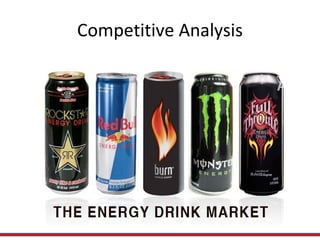
Competitive Analysis
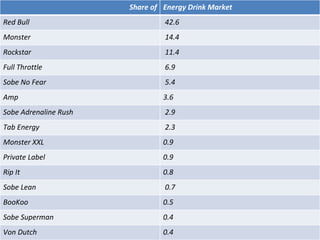
Share of Energy Drink Market Red Bull 42.6 Monster 14.4 Rockstar 11.4 Full Throttle 6.9 Sobe No Fear 5.4 Amp 3.6 Sobe Adrenaline Rush 2.9 Tab Energy 2.3 Monster XXL 0.9 Private Label 0.9 Rip It 0.8 Sobe Lean 0.7 BooKoo 0.5 Sobe Superman 0.4 Von Dutch 0.4
Real Competition Redbull’s real competitors are the market leaders of cola companies such as : Pepsi & Coca Cola, who have created their brand leadership since several years in the Indian market.
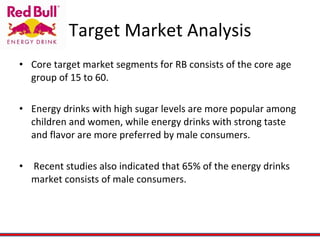
Opportunity Analysis RB has a niche market & is yet to percolate in the mass market.
Target Market Analysis Core target market segments for RB consists of the core age group of 15 to 60. Energy drinks with high sugar levels are more popular among children and women, while energy drinks with strong taste and flavor are more preferred by male consumers. Recent studies also indicated that 65% of the energy drinks market consists of male consumers.
Customer Analysis Young people are especially open to determined exhaustion and insufficient energy.  More specifically male teenagers & people in their 20s, are also most likely to believe in the authenticity of the energy drinks’.  As a result, the majority of energy drinks are developed for and advertised to this younger generation. Appeal to very specialized groups, such as gamers, extreme sports enthusiasts, and the hip-hop crowd.
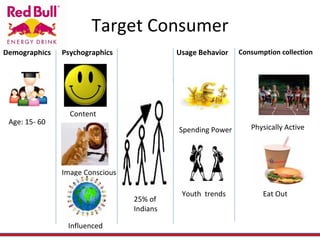
Target Consumer Demographics Psychographics Usage Behavior Consumption collection Age: 15- 60 Content  Image Conscious Influenced Spending Power Youth  trends Physically Active Eat Out 25% of  Indians
Market Segmentation Strategy RedBull avoided usual methods of marketing, relying more on what is called 'buzz marketing' or word-of-mouth. Red Bull advertised directly to  Generation Y , the so-called 'millennial': people born after 1981. ‘ Student brand managers'  who would be used to promote Red Bull on university campuses. These students would be encouraged to throw parties at which cases of Red Bull would be distributed.
Corporate Strategies Mission Statement Our mission is to be the premier marketer and supplier of  RedBull in Asia, Europe and other parts of the globe.  We will  achieve this mission by building long-term relationships with the  people who can make it become a reality.
Vision Statement:  People:  Be a great place to work where people are inspired to be the best they can be. Portfolio:  Bring to the world a portfolio of quality beverage that anticipate and satisfy people's desires and needs.  Partners:  Nurture a winning network of customers and suppliers, together we create mutual, enduring value.  Profit:  Maximize long-term return to shareowners while being mindful of our overall responsibilities.  Productivity:  Be a highly effective, lean and fast-moving organization.
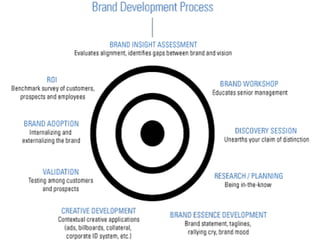
Brand Development Strategy Great Strategy Begins with Great Research. Once the brand’s core values have been identified, the road towards effective brand proposition development begins. Development of the brand statement- commencing a Brand development strategy.
 
Brand Positioning Strategy Clear, Engaging, Unique, & Relevant to the target audience.  Able to incorporate an element of positive emotional attachment that is better than just "good”.   Echoed within business, internally and externally. Consistent across multiple marketing & advertising mediums (print, online presence, etc).   Continually toughened within the organization so that employees consistently deliver what is promised.     Able to adapt to a changing marketplace.
Distribution Strategy Intensive distribution  aims to provide saturation coverage of the market by using all available outlets such as: Super markets, Gyms, Coffee Houses: Subway, Barista, Costa Coffee, Café Coffee Day In n Out Convenience Stores. Pizza Outlets.
Media Relations Use Technology Monitor the Web Create Public Awareness
Integrated Marketing Communications Management Sales Promotion:  Must encourage the 1 st  purchase of the product in a store. Make them aware of the product & its advantages.
IMC Objectives RedBull’s IMC objective is:  Sales Promotions. Create new target markets. Large display in the Departmental stores. Bull Hoof stickers on the floors of departmental stores promoting RB.
IMC Budget
Internet Web site Promotions through social networking sites such as: facebook, twitter, Hi5. Also, Ad promos on websites such as NDTV, zoom India.
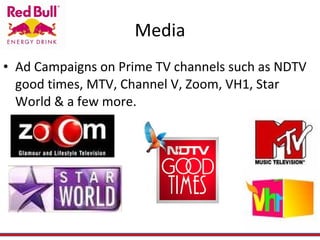
Media Ad Campaigns on Prime TV channels such as NDTV good times, MTV, Channel V, Zoom, VH1, Star World & a few more.
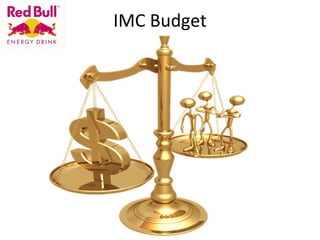
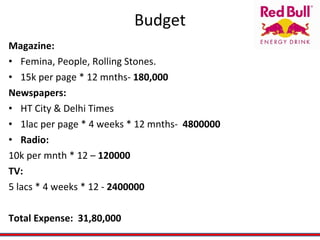
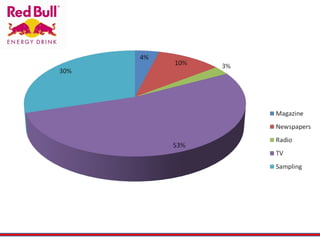
Budget Magazine:  Femina, People, Rolling Stones. 15k per page * 12 mnths-  180,000 Newspapers: HT City & Delhi Times  1lac per page * 4 weeks * 12 mnths-  4800000 Radio: 10k per mnth * 12 –  120000 TV:  5 lacs * 4 weeks * 12 -  2400000 Total Expense:  31,80,000
 
Integrated Marketing Communication Methodologies How do we communicate? How do customers process information?  There are many models & theories. Thorough understanding of the audience's needs, emotions &  activities is essential  to ensure accuracy & relevance of the  message.
Advertising What target market do you want to reach? What image do you want to portray? What product or service do you want to emphasize? How much money can you spend? When is the right time to advertise?
Red Bull has an  aggressive marketing campaign. Red Bull uses all the available media channels, meaning cinema, TV, radio, press and the internet.  In other words the company focuses on the media through which it reaches its primary target market-young people. RB allows the consumers to interpret the product & the moments of use themselves.  Red Bull achieves this by a humorous and witty cartoon campaign, transferring the message that this energy drink helps you to escape by `giving you wings ´.
Consumer Promotions Red Bull sponsors the motorsports or fun sports, but always where Red Bull is needed. Red Bull does event sponsoring. Event sponsoring attracts people’s attention towards the product and connects them.
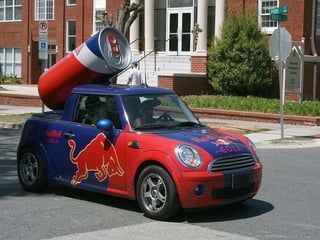
Personal Selling Sampling is another very important part of the three pillar marketing system.  As the major purpose of Red Bull is to energize the company samples at the right place at the right time, where it finds its exact target market. Examples of usage are driving, studying, working night shifts and sports.
 
Media Plan TV: Still a staple medium of advertising. Allows to demonstrate the advantages of RB.  Good Reach.  Magazines: Economical. Provides higher brand awareness.
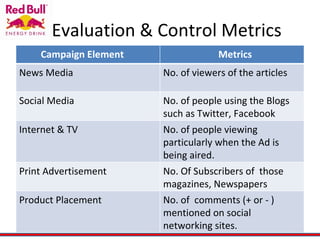
Evaluation & Control Metrics Campaign Element Metrics News Media  No. of viewers of the articles Social Media No. of people using the Blogs such as Twitter, Facebook  Internet & TV No. of people viewing particularly when the Ad is being aired. Print Advertisement No. Of Subscribers of  those magazines, Newspapers Product Placement No. of  comments (+ or - ) mentioned on social networking sites.
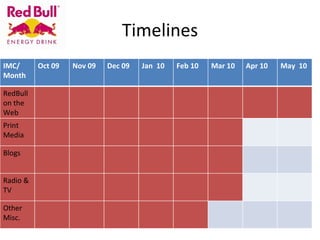
Timelines IMC/ Month Oct 09 Nov 09 Dec 09 Jan  10 Feb 10 Mar 10 Apr 10 May  10 RedBull on the Web Print Media Blogs Radio & TV Other Misc.
DARE TO BE DISCOVERED!!!
 
Sources http://www.rediff.com/money/2006/may/24drink.htm http://www.thestudentroom.co.uk/showthread.php?t=986602 http://www.trcb.com/business/marketing/redbull-marketing-strategy-7375.htm http://www.drawert.com/red_bull_2.php http://energydrinks.factexpert.com/882-energy-drink-industry.php

Redbull Energy Drink

  • 1.
    ItGives You Wiings
  • 2.
    Contents Executive SummarySWOT Analysis Promotion Opportunity Analysis Corporate Strategies Integrated Marketing Communications Management Media Plan Evaluation & Control
  • 3.
    Executive Summary RedBull can be called as a pioneer in the energy drink category worldwide. In India too, Red Bull was the brand that created the energy drink category. The brand came into existence in 1984. The brand came to India in 2003. Although the brand has been keeping a low profile compared to the Cola majors , Red Bull has created a category of energy drinks in the Indian market.
  • 4.
    Contd. According toEconomic Times ( 30.05.08) the energy drink market in India is estimated to be around 100 crores. The market now has two main players Red Bull and Power Horse. RB has an assessed market share of 29% of the global market of energy Drinks. In the U.S., Red Bull enjoys a 47% share of the energy drink market, and now has a 50% share of the German energy drink market.
  • 5.
    SWOT Analysis Market leadership- Within the energy drinks market Red Bull is the industry leader throughout the world. Marketing Efforts- a lot of promotions and well targeted campaigns and sponsorship e.g. formula 1 helps to expand Red bull brand and increase consumer brand awareness. Strong , fresh & fashionable brand identity. Strengths
  • 6.
    Weaknesses Above-average prices.Lack of innovation- there are a lot of competitors in the market and they have their own USP which leaves Red Bull behind. Reliant on small product base- The company only markets one branded product, Red Bull Energy Drink (along with a sugar free variety). Inexperience: is only 6 years old in India. Lack of patent on RB ‘s recipe means anyone can copy it.
  • 7.
    Opportunities Extension ofproduct line- this will help to retain market share. Hardcore Advertising and Promotions. Consumer recognition through sponsorship of sports events. New ventures like partnership with Facebook.
  • 8.
    Threats Health concerns-tougher rules from government on high caffeine content. Consumer awareness of health and well being- people may start to drink other alternatives as it is associated with healthier life style. Drinks might not be accepted in the new markets. Organic energy drinks might steal RB’s market share.
  • 9.
    Promotion Opportunity AnalysisCompetitive Analysis Opportunity Analysis Target Market Analysis Customer Analysis Market Segmentation Strategy
  • 10.
  • 11.
    Share of EnergyDrink Market Red Bull 42.6 Monster 14.4 Rockstar 11.4 Full Throttle 6.9 Sobe No Fear 5.4 Amp 3.6 Sobe Adrenaline Rush 2.9 Tab Energy 2.3 Monster XXL 0.9 Private Label 0.9 Rip It 0.8 Sobe Lean 0.7 BooKoo 0.5 Sobe Superman 0.4 Von Dutch 0.4
  • 12.
    Real Competition Redbull’sreal competitors are the market leaders of cola companies such as : Pepsi & Coca Cola, who have created their brand leadership since several years in the Indian market.
  • 13.
    Opportunity Analysis RBhas a niche market & is yet to percolate in the mass market.
  • 14.
    Target Market AnalysisCore target market segments for RB consists of the core age group of 15 to 60. Energy drinks with high sugar levels are more popular among children and women, while energy drinks with strong taste and flavor are more preferred by male consumers. Recent studies also indicated that 65% of the energy drinks market consists of male consumers.
  • 15.
    Customer Analysis Youngpeople are especially open to determined exhaustion and insufficient energy. More specifically male teenagers & people in their 20s, are also most likely to believe in the authenticity of the energy drinks’. As a result, the majority of energy drinks are developed for and advertised to this younger generation. Appeal to very specialized groups, such as gamers, extreme sports enthusiasts, and the hip-hop crowd.
  • 16.
    Target Consumer DemographicsPsychographics Usage Behavior Consumption collection Age: 15- 60 Content Image Conscious Influenced Spending Power Youth trends Physically Active Eat Out 25% of Indians
  • 17.
    Market Segmentation StrategyRedBull avoided usual methods of marketing, relying more on what is called 'buzz marketing' or word-of-mouth. Red Bull advertised directly to Generation Y , the so-called 'millennial': people born after 1981. ‘ Student brand managers' who would be used to promote Red Bull on university campuses. These students would be encouraged to throw parties at which cases of Red Bull would be distributed.
  • 18.
    Corporate Strategies MissionStatement Our mission is to be the premier marketer and supplier of RedBull in Asia, Europe and other parts of the globe. We will achieve this mission by building long-term relationships with the people who can make it become a reality.
  • 19.
    Vision Statement: People: Be a great place to work where people are inspired to be the best they can be. Portfolio: Bring to the world a portfolio of quality beverage that anticipate and satisfy people's desires and needs. Partners: Nurture a winning network of customers and suppliers, together we create mutual, enduring value. Profit: Maximize long-term return to shareowners while being mindful of our overall responsibilities. Productivity: Be a highly effective, lean and fast-moving organization.
  • 20.
    Brand Development StrategyGreat Strategy Begins with Great Research. Once the brand’s core values have been identified, the road towards effective brand proposition development begins. Development of the brand statement- commencing a Brand development strategy.
  • 21.
  • 22.
    Brand Positioning StrategyClear, Engaging, Unique, & Relevant to the target audience.  Able to incorporate an element of positive emotional attachment that is better than just "good”.  Echoed within business, internally and externally. Consistent across multiple marketing & advertising mediums (print, online presence, etc).  Continually toughened within the organization so that employees consistently deliver what is promised.    Able to adapt to a changing marketplace.
  • 23.
    Distribution Strategy Intensivedistribution aims to provide saturation coverage of the market by using all available outlets such as: Super markets, Gyms, Coffee Houses: Subway, Barista, Costa Coffee, Café Coffee Day In n Out Convenience Stores. Pizza Outlets.
  • 24.
    Media Relations UseTechnology Monitor the Web Create Public Awareness
  • 25.
    Integrated Marketing CommunicationsManagement Sales Promotion: Must encourage the 1 st purchase of the product in a store. Make them aware of the product & its advantages.
  • 26.
    IMC Objectives RedBull’sIMC objective is: Sales Promotions. Create new target markets. Large display in the Departmental stores. Bull Hoof stickers on the floors of departmental stores promoting RB.
  • 27.
  • 28.
    Internet Web sitePromotions through social networking sites such as: facebook, twitter, Hi5. Also, Ad promos on websites such as NDTV, zoom India.
  • 29.
    Media Ad Campaignson Prime TV channels such as NDTV good times, MTV, Channel V, Zoom, VH1, Star World & a few more.
  • 30.
    Budget Magazine: Femina, People, Rolling Stones. 15k per page * 12 mnths- 180,000 Newspapers: HT City & Delhi Times 1lac per page * 4 weeks * 12 mnths- 4800000 Radio: 10k per mnth * 12 – 120000 TV: 5 lacs * 4 weeks * 12 - 2400000 Total Expense: 31,80,000
  • 31.
  • 32.
    Integrated Marketing CommunicationMethodologies How do we communicate? How do customers process information? There are many models & theories. Thorough understanding of the audience's needs, emotions & activities is essential to ensure accuracy & relevance of the message.
  • 33.
    Advertising What targetmarket do you want to reach? What image do you want to portray? What product or service do you want to emphasize? How much money can you spend? When is the right time to advertise?
  • 34.
    Red Bull hasan aggressive marketing campaign. Red Bull uses all the available media channels, meaning cinema, TV, radio, press and the internet. In other words the company focuses on the media through which it reaches its primary target market-young people. RB allows the consumers to interpret the product & the moments of use themselves. Red Bull achieves this by a humorous and witty cartoon campaign, transferring the message that this energy drink helps you to escape by `giving you wings ´.
  • 35.
    Consumer Promotions RedBull sponsors the motorsports or fun sports, but always where Red Bull is needed. Red Bull does event sponsoring. Event sponsoring attracts people’s attention towards the product and connects them.
  • 36.
    Personal Selling Samplingis another very important part of the three pillar marketing system. As the major purpose of Red Bull is to energize the company samples at the right place at the right time, where it finds its exact target market. Examples of usage are driving, studying, working night shifts and sports.
  • 37.
  • 38.
    Media Plan TV:Still a staple medium of advertising. Allows to demonstrate the advantages of RB. Good Reach. Magazines: Economical. Provides higher brand awareness.
  • 39.
    Evaluation & ControlMetrics Campaign Element Metrics News Media No. of viewers of the articles Social Media No. of people using the Blogs such as Twitter, Facebook Internet & TV No. of people viewing particularly when the Ad is being aired. Print Advertisement No. Of Subscribers of those magazines, Newspapers Product Placement No. of comments (+ or - ) mentioned on social networking sites.
  • 40.
    Timelines IMC/ MonthOct 09 Nov 09 Dec 09 Jan 10 Feb 10 Mar 10 Apr 10 May 10 RedBull on the Web Print Media Blogs Radio & TV Other Misc.
  • 41.
    DARE TO BEDISCOVERED!!!
  • 42.
  • 43.
    Sources http://www.rediff.com/money/2006/may/24drink.htm http://www.thestudentroom.co.uk/showthread.php?t=986602http://www.trcb.com/business/marketing/redbull-marketing-strategy-7375.htm http://www.drawert.com/red_bull_2.php http://energydrinks.factexpert.com/882-energy-drink-industry.php

Editor's Notes

  • #9 Denmark and Uruguay – banned RB due to health concerns
  • #10 2.1 Communications Market Analysis 2.1.1 Competitive Analysis 2.1.2 Opportunity Analysis 2.1.3 Target Market Analysis 2.1.4. Customer Analysis 2.2 Market Segmentation Strategy
  • #19 3.1 Corporate Image Strategy 3.2 Brand Development Strategy 3.3 Brand Positioning Strategy 3.4 Distribution Strategy 3.5 Business-to-Business Strategy 3.6 Public Relations Strategy 3.7 Evaluation
  • #23 brand proposition should convey a message
  • #25 One of the age-old prerequisites for good PR is making sure the media picks up the campaign. Social media giants like Facebook, Digg and Youtube are now being heavily used by PR agencies for their clients. Viral marketing and video campaigns are just two of the ways that businesses are reaching a wider audience.
  • #26 4.1 IMC Objectives 4.2 IMC Budget 4.3 Agency Selection 4.4 Internet Web site
  • #34 5.2.1.1 Advertising Goals and Budget
  • #36 5.2.2.1 Budget Allocation 5.2.2.2 Consumer Promotion Selection