



Grama Stella
English Teacher,
Teaching Degree I
“Prometeu-Prim” Lyceum
Chisinau
stellagrama9@gmail.com
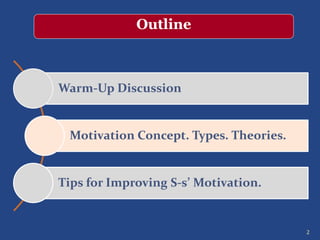
Warm-Up Discussion
Motivation Concept. Types. Theories.
Tips for Improving S-s’ Motivation.
2
Outline
3
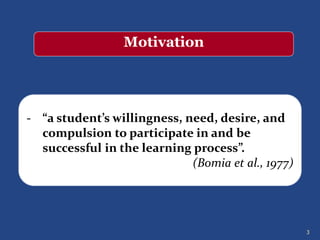
Motivation
- “a student’s willingness, need, desire, and
compulsion to participate in and be
successful in the learning process”.
(Bomia et al., 1977)
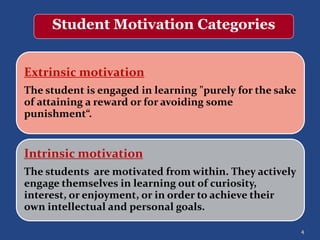
Extrinsic motivation
The student is engaged in learning "purely for the sake
of attaining a reward or for avoiding some
punishment“.
Intrinsic motivation
The students are motivated from within. They actively
engage themselves in learning out of curiosity,
interest, or enjoyment, or in order to achieve their
own intellectual and personal goals.
4
Student Motivation Categories
M1
• Drive Theory;
M2
• Incentive Theory;
M3
• Maslow Theory of Motivation.
5
Theoretical Approaches to Motivation
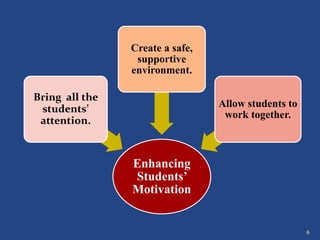
Enhancing
Students’
Motivation
Bring all the
students’
attention.
Create a safe,
supportive
environment.
Allow students to
work together.
6
7
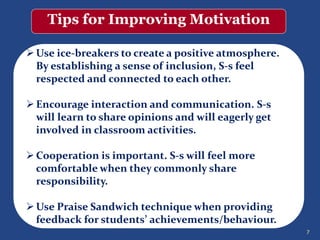
Tips for Improving Motivation
Use ice-breakers to create a positive atmosphere.
By establishing a sense of inclusion, S-s feel
respected and connected to each other.
Encourage interaction and communication. S-s
will learn to share opinions and will eagerly get
involved in classroom activities.
Cooperation is important. S-s will feel more
comfortable when they commonly share
responsibility.
Use Praise Sandwich technique when providing
feedback for students’ achievements/behaviour.
8
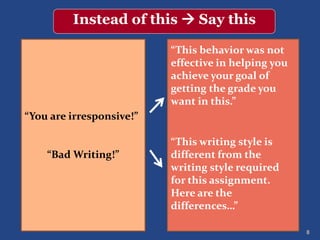
“This behavior was not
effective in helping you
achieve your goal of
getting the grade you
want in this.”
“This writing style is
different from the
writing style required
for this assignment.
Here are the
differences…”
“You are irresponsive!”
“Bad Writing!”
Instead of this  Say this
9
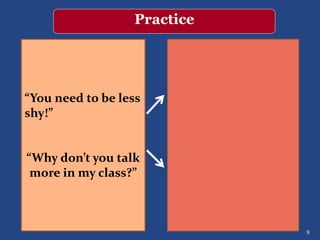
“You need to be less
shy!”
“Why don’t you talk
more in my class?”
Practice
10
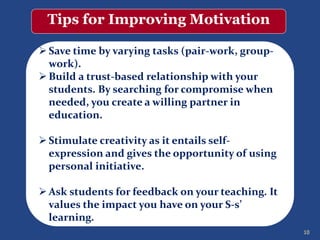
Tips for Improving Motivation
Save time by varying tasks (pair-work, group-
work).
Build a trust-based relationship with your
students. By searching for compromise when
needed, you create a willing partner in
education.
Stimulate creativity as it entails self-
expression and gives the opportunity of using
personal initiative.
Ask students for feedback on your teaching. It
values the impact you have on your S-s’
learning.
11
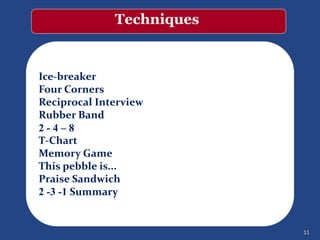
Techniques
Ice-breaker
Four Corners
Reciprocal Interview
Rubber Band
2 - 4 – 8
T-Chart
Memory Game
This pebble is...
Praise Sandwich
2 -3 -1 Summary
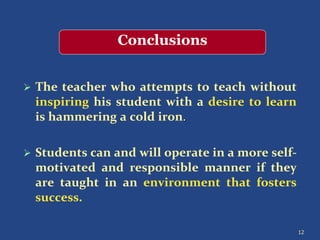
 The teacher who attempts to teach without
inspiring his student with a desire to learn
is hammering a cold iron.
 Students can and will operate in a more self-
motivated and responsible manner if they
are taught in an environment that fosters
success.
12
Conclusions
13
14

Improving Student Learning Motivation Through Interaction_2017

  • 1.
    Grama Stella English Teacher, TeachingDegree I “Prometeu-Prim” Lyceum Chisinau stellagrama9@gmail.com
  • 2.
    Warm-Up Discussion Motivation Concept.Types. Theories. Tips for Improving S-s’ Motivation. 2 Outline
  • 3.
    3 Motivation - “a student’swillingness, need, desire, and compulsion to participate in and be successful in the learning process”. (Bomia et al., 1977)
  • 4.
    Extrinsic motivation The studentis engaged in learning "purely for the sake of attaining a reward or for avoiding some punishment“. Intrinsic motivation The students are motivated from within. They actively engage themselves in learning out of curiosity, interest, or enjoyment, or in order to achieve their own intellectual and personal goals. 4 Student Motivation Categories
  • 5.
    M1 • Drive Theory; M2 •Incentive Theory; M3 • Maslow Theory of Motivation. 5 Theoretical Approaches to Motivation
  • 6.
    Enhancing Students’ Motivation Bring all the students’ attention. Createa safe, supportive environment. Allow students to work together. 6
  • 7.
    7 Tips for ImprovingMotivation Use ice-breakers to create a positive atmosphere. By establishing a sense of inclusion, S-s feel respected and connected to each other. Encourage interaction and communication. S-s will learn to share opinions and will eagerly get involved in classroom activities. Cooperation is important. S-s will feel more comfortable when they commonly share responsibility. Use Praise Sandwich technique when providing feedback for students’ achievements/behaviour.
  • 8.
    8 “This behavior wasnot effective in helping you achieve your goal of getting the grade you want in this.” “This writing style is different from the writing style required for this assignment. Here are the differences…” “You are irresponsive!” “Bad Writing!” Instead of this  Say this
  • 9.
    9 “You need tobe less shy!” “Why don’t you talk more in my class?” Practice
  • 10.
    10 Tips for ImprovingMotivation Save time by varying tasks (pair-work, group- work). Build a trust-based relationship with your students. By searching for compromise when needed, you create a willing partner in education. Stimulate creativity as it entails self- expression and gives the opportunity of using personal initiative. Ask students for feedback on your teaching. It values the impact you have on your S-s’ learning.
  • 11.
    11 Techniques Ice-breaker Four Corners Reciprocal Interview RubberBand 2 - 4 – 8 T-Chart Memory Game This pebble is... Praise Sandwich 2 -3 -1 Summary
  • 12.
     The teacherwho attempts to teach without inspiring his student with a desire to learn is hammering a cold iron.  Students can and will operate in a more self- motivated and responsible manner if they are taught in an environment that fosters success. 12 Conclusions
  • 13.
  • 14.