Motivation in
Classroom Learning
“Do not train children to learn by force and
harshness but direct them to it by what amuses
their minds, so that you may be better able to
discover with accuracy the peculiar bent of the
genius of each.”
- Plato
Motivation
 described as a state that energizes, directs and
sustains behavior.
 involves goals and requires activity.
• Goals provide the impetus for and the direction of
action, while action entails effort: persistence in
order to sustain an activity for a long period of
time.
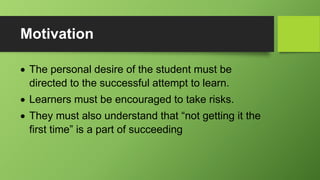
Motivation
 The personal desire of the student must be
directed to the successful attempt to learn.
 Learners must be encouraged to take risks.
 They must also understand that “not getting it the
first time” is a part of succeeding
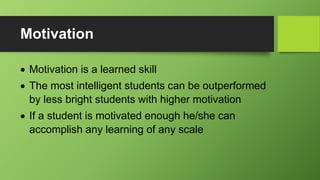
Motivation
 Motivation is a learned skill
 The most intelligent students can be outperformed
by less bright students with higher motivation
 If a student is motivated enough he/she can
accomplish any learning of any scale
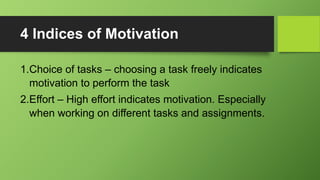
4 Indices of Motivation
1.Choice of tasks – choosing a task freely indicates
motivation to perform the task
2.Effort – High effort indicates motivation. Especially
when working on different tasks and assignments.
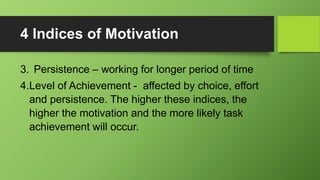
4 Indices of Motivation
3. Persistence – working for longer period of time
4.Level of Achievement - affected by choice, effort
and persistence. The higher these indices, the
higher the motivation and the more likely task
achievement will occur.
2 Types of Motivation
Intrinsic (internal)
- driven by an interest
- exist within the individual
- Is fueled by curiosity, the desire for mastery,
success, a sense of accomplishment, confidence
in ability
- This is a quality many students lose by the time
they reach upper elementary grades.
Extrinsic (external)
- Comes from the outside of an individual
- be used instead as a means to help students
develop internal motivation to learn and behave
instead of the end.
- External rewards result from completing an activity
or behaving in a certain way such as medals,
rankings, badges and etc.
5 ways that teachers unintentionally
discourage students
1.Setting overambitious expectations or standards
that overwhelm students
2.Focusing on mistakes to motivate
3.Comparing one student to another
4.Making pessimistic interpretations
5.Dominating students learning experiences by
helping too much
Motivation Strategies that Work (In a
nutshell)
 Organizing Instruction into integrated thematic
skills
 Using cooperative learning and group
approaches
 Recognizing and teaching to multiple
intelligences
 Accommodating individual learning styles
Motivation Strategies that Work (In a
nutshell)
 Stressing thinking skills over plain memorization
 Harnessing the power of technology
 Practicing authentic assessment of students
learning
 Praising and encouraging students effectively
Motivation Strategies that Work (In a
nutshell)
 Motivating students to value learning
 Acknowledging the importance of active
teaching, engaged time and academic learning
time
 Using wise grouping practices
Different Motivational Theories
1. Psychoanalytical (Freud)
Make your classroom environment as inviting and
comfortable as possible for students.
2. Social Development Theory (Vygotsky)
Activities should be neither too easy nor too hard.
Social Interaction is important!
Different Motivational Theories
3. Hierarchy of Human Needs (Maslow)
If basic needs are not being met, it’s difficult to be
motivated to learn.
4. Psychosocial Theory of Development (Erikson)
Communicate that you respect and value all
cultures, and emphasize the contributions that cultural
differences make to learning.
5. Affective Filter (Krashen)
Reduce the Anxiety. Increase Motivation
How to lower the affective filter in the
classroom.
•Provide both oral and written instructions when
possible.
•Provide activities that are interesting and intriguing.
•Provide materials that relate to the students' real
lives.
•Allow for jokes and relaxed conversation at certain
times
•Refrain from orally correcting students. Don’t expect
perfection!
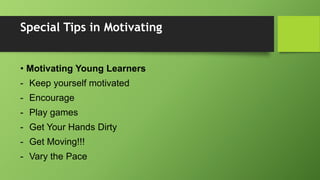
Special Tips in Motivating
• Motivating Young Learners
- Keep yourself motivated
- Encourage
- Play games
- Get Your Hands Dirty
- Get Moving!!!
- Vary the Pace
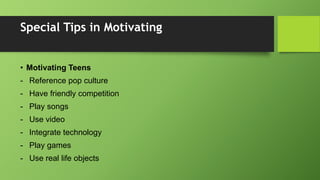
Special Tips in Motivating
• Motivating Teens
- Reference pop culture
- Have friendly competition
- Play songs
- Use video
- Integrate technology
- Play games
- Use real life objects
Special Tips in Motivating
• Motivating Adults
- Survival
- Job Enhancement
- Education
- Social Interaction
Special Tips in Motivating
• Motivating Large Classes
- Keep Yourself Motivated
- Get to Know Your Students’ Names
- Break into smaller groups
- Get Them Moving
- Routine is important!
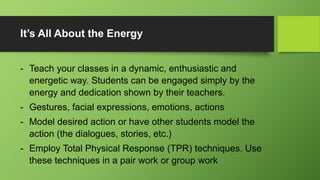
It’s All About the Energy
- Teach your classes in a dynamic, enthusiastic and
energetic way. Students can be engaged simply by the
energy and dedication shown by their teachers.
- Gestures, facial expressions, emotions, actions
- Model desired action or have other students model the
action (the dialogues, stories, etc.)
- Employ Total Physical Response (TPR) techniques. Use
these techniques in a pair work or group work

Motivation in classroom learning

  • 1.
  • 2.
    “Do not trainchildren to learn by force and harshness but direct them to it by what amuses their minds, so that you may be better able to discover with accuracy the peculiar bent of the genius of each.” - Plato
  • 3.
    Motivation  described asa state that energizes, directs and sustains behavior.  involves goals and requires activity. • Goals provide the impetus for and the direction of action, while action entails effort: persistence in order to sustain an activity for a long period of time.
  • 4.
    Motivation  The personaldesire of the student must be directed to the successful attempt to learn.  Learners must be encouraged to take risks.  They must also understand that “not getting it the first time” is a part of succeeding
  • 5.
    Motivation  Motivation isa learned skill  The most intelligent students can be outperformed by less bright students with higher motivation  If a student is motivated enough he/she can accomplish any learning of any scale
  • 6.
    4 Indices ofMotivation 1.Choice of tasks – choosing a task freely indicates motivation to perform the task 2.Effort – High effort indicates motivation. Especially when working on different tasks and assignments.
  • 7.
    4 Indices ofMotivation 3. Persistence – working for longer period of time 4.Level of Achievement - affected by choice, effort and persistence. The higher these indices, the higher the motivation and the more likely task achievement will occur.
  • 8.
    2 Types ofMotivation
  • 9.
    Intrinsic (internal) - drivenby an interest - exist within the individual - Is fueled by curiosity, the desire for mastery, success, a sense of accomplishment, confidence in ability - This is a quality many students lose by the time they reach upper elementary grades.
  • 10.
    Extrinsic (external) - Comesfrom the outside of an individual - be used instead as a means to help students develop internal motivation to learn and behave instead of the end. - External rewards result from completing an activity or behaving in a certain way such as medals, rankings, badges and etc.
  • 11.
    5 ways thatteachers unintentionally discourage students 1.Setting overambitious expectations or standards that overwhelm students 2.Focusing on mistakes to motivate 3.Comparing one student to another 4.Making pessimistic interpretations 5.Dominating students learning experiences by helping too much
  • 12.
    Motivation Strategies thatWork (In a nutshell)  Organizing Instruction into integrated thematic skills  Using cooperative learning and group approaches  Recognizing and teaching to multiple intelligences  Accommodating individual learning styles
  • 13.
    Motivation Strategies thatWork (In a nutshell)  Stressing thinking skills over plain memorization  Harnessing the power of technology  Practicing authentic assessment of students learning  Praising and encouraging students effectively
  • 14.
    Motivation Strategies thatWork (In a nutshell)  Motivating students to value learning  Acknowledging the importance of active teaching, engaged time and academic learning time  Using wise grouping practices
  • 15.
    Different Motivational Theories 1.Psychoanalytical (Freud) Make your classroom environment as inviting and comfortable as possible for students. 2. Social Development Theory (Vygotsky) Activities should be neither too easy nor too hard. Social Interaction is important!
  • 16.
    Different Motivational Theories 3.Hierarchy of Human Needs (Maslow) If basic needs are not being met, it’s difficult to be motivated to learn. 4. Psychosocial Theory of Development (Erikson) Communicate that you respect and value all cultures, and emphasize the contributions that cultural differences make to learning. 5. Affective Filter (Krashen) Reduce the Anxiety. Increase Motivation
  • 17.
    How to lowerthe affective filter in the classroom. •Provide both oral and written instructions when possible. •Provide activities that are interesting and intriguing. •Provide materials that relate to the students' real lives. •Allow for jokes and relaxed conversation at certain times •Refrain from orally correcting students. Don’t expect perfection!
  • 18.
    Special Tips inMotivating • Motivating Young Learners - Keep yourself motivated - Encourage - Play games - Get Your Hands Dirty - Get Moving!!! - Vary the Pace
  • 19.
    Special Tips inMotivating • Motivating Teens - Reference pop culture - Have friendly competition - Play songs - Use video - Integrate technology - Play games - Use real life objects
  • 20.
    Special Tips inMotivating • Motivating Adults - Survival - Job Enhancement - Education - Social Interaction
  • 21.
    Special Tips inMotivating • Motivating Large Classes - Keep Yourself Motivated - Get to Know Your Students’ Names - Break into smaller groups - Get Them Moving - Routine is important!
  • 22.
    It’s All Aboutthe Energy - Teach your classes in a dynamic, enthusiastic and energetic way. Students can be engaged simply by the energy and dedication shown by their teachers. - Gestures, facial expressions, emotions, actions - Model desired action or have other students model the action (the dialogues, stories, etc.) - Employ Total Physical Response (TPR) techniques. Use these techniques in a pair work or group work