Improving Control System Security


     by Chaiyakorn Apiwathanokul
          CISSP, GCFA, IRCA:ISMS
           Chief Security Officer
         PTT ICT Solutions Co., Ltd.
           A Company of PTT Group

                  July 2010
About Speaker
                   Name:           Chaiyakorn Apiwathanokul
                                   ไชยกร อภิวัฒโนกุล
                   Title:          Chief Security Officer (CSO)
                   Company:        PTT ICT Solutions Company Limited
                                   A Company of PTT Group
                   Certificates:   ISC2:CISSP, IRCA:ISMS (ISO27001), SANS:GCFA


• Contribute to Thailand Cyber Crime Act B.E.2550
• Security Sub-commission under Thailand Electronic Transaction Commission
  (ET Act B.E. 2544)
• Workgroup for CA service standard development
• Committee of national standard adoption of ISO27001/ISO27002
• Committee of Thailand Information Security Association (TISA)
• Committee of Cybersecurity taskforce development, Division of Skill
  Development, Ministry of Labour
Sub Topic:
   Examining current security trends and their
    impact for SCADA systems
   Increasing the security and usability of SCADA
    systems
   Understanding tools and techniques to
    mitigate SCADA security risk
See Videos

1. DHS experiment on hacking to destroy a
   generator
2. US Power Grid under attack - Clarke
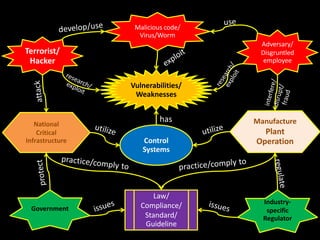
Malicious code/
                   Virus/Worm
                                     Adversary/
Terrorist/                           Disgruntled
 Hacker                               employee


                 Vulnerabilities/
                  Weaknesses


                          has       Manufacture
   National
    Critical                          Plant
Infrastructure      Control         Operation
                    Systems


                        Law/
                                      Industry-
 Government         Compliance/
                                       specific
                     Standard/        Regulator
                     Guideline
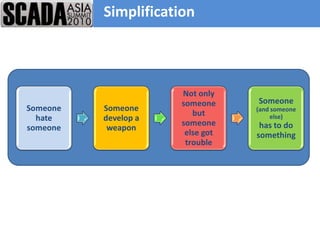
Simplification


                      Not only
                      someone     Someone
Someone   Someone                 (and someone
                         but           else)
  hate    develop a
                      someone      has to do
someone    weapon
                       else got   something
                       trouble
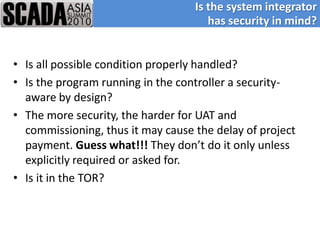
Is the system integrator
                                      has security in mind?


• Is all possible condition properly handled?
• Is the program running in the controller a security-
  aware by design?
• The more security, the harder for UAT and
  commissioning, thus it may cause the delay of project
  payment. Guess what!!! They don’t do it only unless
  explicitly required or asked for.
• Is it in the TOR?
Is the system integrator
                                            has security in mind? (cont.)


“None of the industrial control systems used to monitor
and operate the nation's utilities and factories were
designed with security in mind. Moreover, their very
nature makes them difficult to secure. Linking them to
networks and the public Internet only makes them
harder to protect.”
Said by Joseph Weiss, executive consultant for KEMA
Consulting
http://www.memagazine.org/backissues/dec02/features/scadavs/scadavs.html
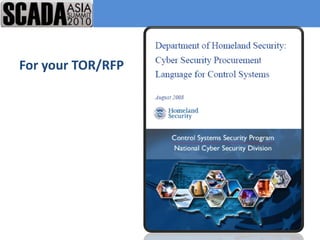
For your TOR/RFP
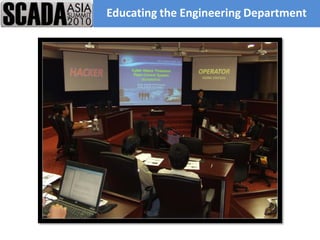
Educating the Engineering Department
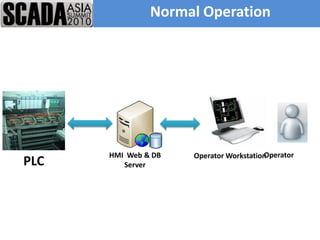
Normal Operation


      HMI Web & DB                      Operator
                     Operator Workstation
PLC      Server
Hacking on Operator workstation

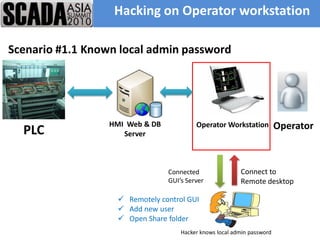
Scenario #1.1 Known local admin password


                  HMI Web & DB            Operator Workstation           Operator
  PLC                Server


                                 Connected                Connect to
                                 GUI‘s Server             Remote desktop

                    Remotely control GUI
                    Add new user
                    Open Share folder
                                     Hacker knows local admin password
Hacking on Operator workstation

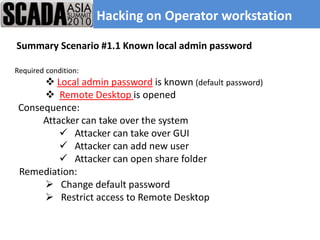
Summary Scenario #1.1 Known local admin password

Required condition:
       Local admin password is known (default password)
       Remote Desktop is opened
 Consequence:
      Attacker can take over the system
           Attacker can take over GUI
           Attacker can add new user
           Attacker can open share folder
 Remediation:
       Change default password
       Restrict access to Remote Desktop
Hacking on Operator workstation

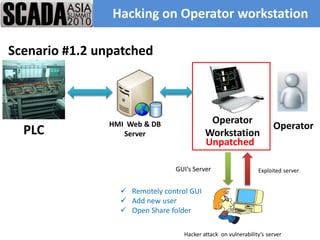
Scenario #1.2 unpatched


                HMI Web & DB                Operator
  PLC                                                                 Operator
                   Server                  Workstation
                                           Unpatched

                                GUI‘s Server                    Exploited server


                   Remotely control GUI
                   Add new user
                   Open Share folder

                                   Hacker attack on vulnerability’s server
Hacking on Operator workstation

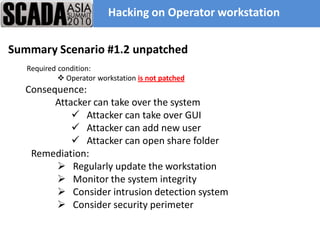
Summary Scenario #1.2 unpatched
   Required condition:
             Operator workstation is not patched
  Consequence:
        Attacker can take over the system
             Attacker can take over GUI
             Attacker can add new user
             Attacker can open share folder
   Remediation:
         Regularly update the workstation
         Monitor the system integrity
         Consider intrusion detection system
         Consider security perimeter
Hacking on Operator workstation

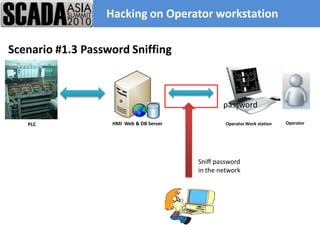
Scenario #1.3 Password Sniffing


                                                 password

   PLC             HMI Web & DB Server            Operator Work station   Operator


                                         Sniff password
                                         in the network
Hacking on Operator workstation

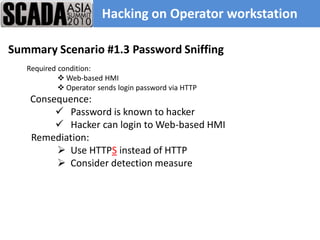
Summary Scenario #1.3 Password Sniffing
   Required condition:
             Web-based HMI
             Operator sends login password via HTTP
    Consequence:
          Password is known to hacker
          Hacker can login to Web-based HMI
    Remediation:
          Use HTTPS instead of HTTP
          Consider detection measure
Hacking on Operator workstation

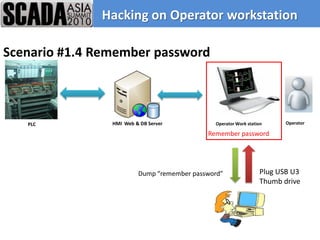
Scenario #1.4 Remember password


   PLC          HMI Web & DB Server           Operator Work station     Operator

                                            Remember password


                         Dump “remember password”                Plug USB U3
                                                                 Thumb drive
Hacking on Operator workstation

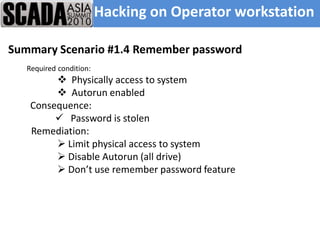
Summary Scenario #1.4 Remember password
   Required condition:
          Physically access to system
          Autorun enabled
    Consequence:
          Password is stolen
    Remediation:
          Limit physical access to system
          Disable Autorun (all drive)
          Don’t use remember password feature
Hacking on HMI Web & DB server

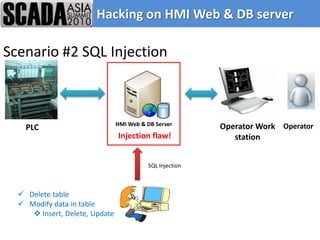
Scenario #2 SQL Injection


                                HMI Web & DB Server       Operator Work Operator
    PLC
                                Injection flaw!              station


                                          SQL Injection


   Delete table
   Modify data in table
      Insert, Delete, Update
Hacking on HMI Web & DB Server

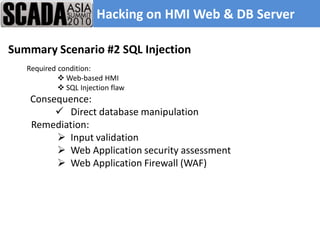
Summary Scenario #2 SQL Injection
   Required condition:
             Web-based HMI
             SQL Injection flaw
    Consequence:
          Direct database manipulation
    Remediation:
          Input validation
          Web Application security assessment
          Web Application Firewall (WAF)
Hacking on PLC

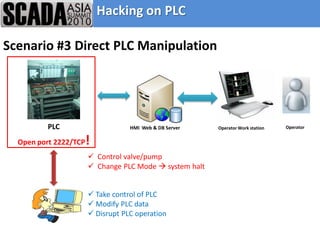
Scenario #3 Direct PLC Manipulation


          PLC                      HMI Web & DB Server   Operator Work station   Operator


  Open port 2222/TCP   !
                        Control valve/pump
                        Change PLC Mode  system halt


                        Take control of PLC
                        Modify PLC data
                        Disrupt PLC operation
Hacking on PLC
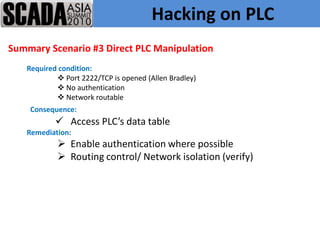
Summary Scenario #3 Direct PLC Manipulation
   Required condition:
            Port 2222/TCP is opened (Allen Bradley)
            No authentication
            Network routable
    Consequence:
            Access PLC’s data table
   Remediation:
            Enable authentication where possible
            Routing control/ Network isolation (verify)
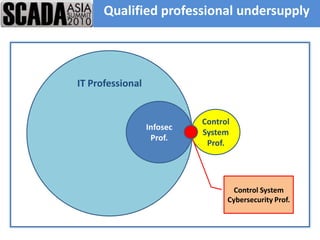
Qualified professional undersupply


IT Professional


                            Control
                  Infosec
                            System
                   Prof.
                             Prof.


                                    Control System
                                  Cybersecurity Prof.
The Implication

• Only small number of professional with right
  competency to help you out
• Collaboration and support from professional
  community is highly needed
Available Guidelines


• 21 Steps to Improve Cyber Security of SCADA
  Networks, US-DOE
• Roadmap to Secure Control Systems in the Chemical
  Sector, US-DHS
• Security Vulnerability Assessment Methodology for
  the Petroleum and Petrochemical Industries, API
• ISA99 - Control Systems Security Model
• ISO27001, ISO27002 (ISO17799)
21 Steps to Improve Cyber Security
                                      of SCADA Networks, US-DOE
1. Identify all connections to SCADA networks               12. Clearly define cyber security roles, responsibilities, and
2. Disconnect unnecessary connections to the SCADA               authorities for managers, system administrators, and
     network                                                     users
3. Evaluate and strengthen the security of any remaining    13. Document network architecture and identify systems that
     connections to the SCADA network                            serve critical functions or contain sensitive information
4. Harden SCADA networks by removing or disabling                that require additional levels of protection
     unnecessary services                                   14. Establish a rigorous, ongoing risk management process
5. Do not rely on proprietary protocols to protect your     15. Establish a network protection strategy based on the
     system                                                      principle of defense-in-depth
6. Implement the security features provided by device       16. Clearly identify cyber security requirements
     and system vendors                                     17. Establish effective configuration management processes
7. Establish strong controls over any medium that is used   18. Conduct routine self-assessments
     as a backdoor into the SCADA network                   19. Establish system backups and disaster recovery plans
8. Implement internal and external intrusion detection      20. Senior organizational leadership should establish
     systems and establish 24-hour-a-day incident                expectations for cyber security
     monitoring.                                            •    performance and hold individuals accountable for their
9. Perform technical audits of SCADA devices and                 performance
     networks, and any other connected networks, to         21. Establish policies and conduct training to minimize the
     identify security concerns                                  likelihood that organizational personnel will inadvertently
10. Conduct physical security surveys and assess all             disclose sensitive information regarding SCADA system
     remote sites connected to the SCADA network to              design, operations, or security controls.
     evaluate their security
11. Establish SCADA “Red Teams” to identify and evaluate
     possible attack scenarios
NIST SP800-82
     NIST Special Publication 800-82: Guide to Industrial
     Control Systems (ICS) Security

    Executive Summary
    1. Introduction
    2. Overview of Industrial Control Systems
    3. ICS Characteristics, Threats and Vulnerabilities
    4. ICS Security Program Development and Deployment
    5. Network Architecture
         ICS Security Controls


http://csrc.nist.gov/publications/drafts/800-82/draft_sp800-82-fpd.pdf
What is Industrial Control Systems                 (ICS),
                                                        SCADA and DCS?


Industrial Control Systems are computer-based
systems that are used by many infrastructures and industries to monitor
and control sensitive processes and physical functions. Typically, control
systems collect sensor measurements and operational data from the
field, process and display this information, and relay control commands
to local or remote equipment.
              There are two primary types of Control Systems.

                  – Distributed Control Systems (DCS) typically are used
                    within a single processing or generating plant or over a
                    small geographic area.

                  – Supervisory Control and Data Acquisition (SCADA)
                    systems typically are used for large, geographically
                    dispersed distribution operations.

             NIST SP800-82 Final Public DRAFT (Sep. 2008)
             http://csrc.nist.gov/publications/drafts/800-82/draft_sp800-82-fpd.pdf
Major ICS Security Objectives

• Restricting logical access to the ICS network and network
  activity
   – This includes using a demilitarized zone (DMZ) network architecture
     with firewalls to prevent network traffic from passing directly
     between the corporate and ICS networks, and having separate
     authentication mechanisms and credentials for users of the
     corporate and ICS networks. The ICS should also use a network
     topology that has multiple layers, with the most critical
     communications occurring in the most secure and reliable layer.
• Restricting physical access to the ICS network and devices
   – Unauthorized physical access to components could cause serious
     disruption of the ICS’s functionality. A combination of physical
     access controls should be used, such as locks, card readers, and/or
     guards.
Key Take Away to Securing ICS

The most successful method for securing an ICS is to:
• Gather industry recommended practices
• Engage in a proactive, collaborative effort between
  management, the controls engineer and operator, the
  IT department, the physical security department, and a
  trusted automation advisor
• Draw upon the wealth of information available from
  ongoing federal government, industry group, vendor
  and standards organizational activities.
ISA 99
ISA SP-99 – Manufacturing and Control Systems Security
 Scope - A Broad View
 • ISA has taken a broad view:
     – Based on function, not industry, type of control or other limited
       views
 • Includes
     –   SCADA/EMS
     –   DCS
     –   PLCs
     –   RTUs/IEDs
     –   Transmitters, meters, control valves, to enterprise wide HMIs, …
     –   Enterprise applications, to the extent they can affect control
 • Not limited to one or a few industries or technologies
     – In other words, a very broad encompassing definition
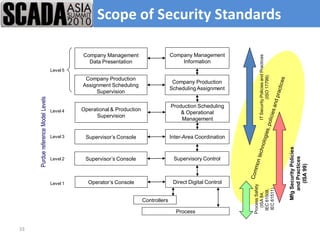
Scope of Security Standards

                                               Company Management                       Company Management


                                                                                                                     IT Security Policies and Practices
                                                 Data Presentation                          Information
                                     Level 5


                                                                                                                                (ISO 17799)
                                                Company Production
                                                                                         Company Production
                                               Assignment Scheduling
                                                                                        Scheduling Assignment
                                                    Supervision
     Purdue reference Model Levels


                                                                                        Production Scheduling
                                     Level 4   Operational & Production
                                                                                            & Operational
                                                     Supervision
                                                                                            Management


                                     Level 3    Supervisor’s Console                    Inter-Area Coordination


                                                                                                                                                          Mfg Security Policies
                                                Supervisor’s Console


                                                                                                                                                             and Practices
                                     Level 2                                             Supervisory Control


                                                                                                                                                                (ISA 99)
                                     Level 1     Operator’s Console                      Direct Digital Control


                                                                                                                  Process Safety


                                                                                                                   IEC 61511)
                                                                                                                   IEC 61508,
                                                                                                                     (ISA 84,
                                                                          Controllers

                                                                                          Process


33
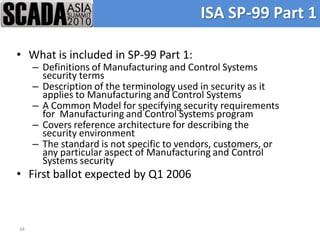
ISA SP-99 Part 1

• What is included in SP-99 Part 1:
     – Definitions of Manufacturing and Control Systems
       security terms
     – Description of the terminology used in security as it
       applies to Manufacturing and Control Systems
     – A Common Model for specifying security requirements
       for Manufacturing and Control Systems program
     – Covers reference architecture for describing the
       security environment
     – The standard is not specific to vendors, customers, or
       any particular aspect of Manufacturing and Control
       Systems security
• First ballot expected by Q1 2006


34
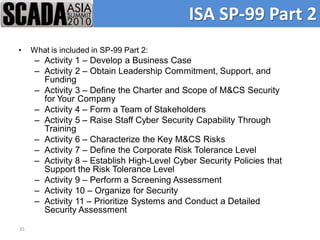
ISA SP-99 Part 2
•    What is included in SP-99 Part 2:
      – Activity 1 – Develop a Business Case
      – Activity 2 – Obtain Leadership Commitment, Support, and
        Funding
      – Activity 3 – Define the Charter and Scope of M&CS Security
        for Your Company
      – Activity 4 – Form a Team of Stakeholders
      – Activity 5 – Raise Staff Cyber Security Capability Through
        Training
      – Activity 6 – Characterize the Key M&CS Risks
      – Activity 7 – Define the Corporate Risk Tolerance Level
      – Activity 8 – Establish High-Level Cyber Security Policies that
        Support the Risk Tolerance Level
      – Activity 9 – Perform a Screening Assessment
      – Activity 10 – Organize for Security
      – Activity 11 – Prioritize Systems and Conduct a Detailed
        Security Assessment

35
ISA SP-99 Part 2, continued

• What is included in SP-99 Part 2, continued:
      – Activity 12 – Develop Detailed M&CS Cyber Security Policies
        & Procedures
      – Activity 13 – Define Standard Set of M&CS Security Risk
        Mitigation Controls
      – Activity 14 – Develop Integrated Cyber Security
        Management System Plan
      – Activity 15 – Quick Fix
      – Activity 16 – Charter, Design, & Execute Cyber Security Risk
        Mitigation Projects
      – Activity 17 – Refine and Implement Cyber Security
        Management System
      – Activity 18 – Adopt Continuous Improvement Operational
        Measures
• First ballot is expected by Q3 2006
 36
TR99.00.01 - Technology Areas


• Authentication and Authorization
• Filtering/Blocking/Access Control
• Encryption and Data Validation
• Audit, Measurement, Monitoring and
  Detection Tools
• Operating Systems
• Physical Security

37
TR99.00.01 Authentication and Authorization


• Role Based Authorization Tools
• Password Authentication
• Challenge Response Authentication
• Physical/Token Authentication
• Smart Card Authentication
• Biometric Authentication
• Location Based Authentication
• Password Distribution and Management
  Technologies
• Device to Device Authentication

38
TR99.00.01 Filtering/Blocking/Access Control


• Dedicated Firewalls (Hardware Based)
• Host-based Firewalls (Software Based)
• Virtual Local Area Networks (VLANs)


39
TR99.00.01 Encryption Technologies
                                     and Data Validation


•    Symmetric (Private) Key Encryption
•    Public Key Encryption and Key Distribution
•    Virtual Private Networks (VPNs)
•    Digital Certificates


40
TR99.00.01 Audit, Measurement,
                    and Monitoring and Detection Tools


•    Log Auditing Utilities
•    Virus/Malicious Code Detection
•    Intrusion Detection Systems
•    Network Vulnerability Scanners
•    Network Forensics and Analysis Tools
•    Host Configuration Management Tools
•    Automated Software Management Tools

41
TR99.00.01 Computer Software


• Server and Workstation Operating Systems
• Real-time and Embedded Operating Systems
• Web and Internet Technologies


42
Summary

• Guidelines and best practices are
  available
• Study and apply those related to your
  specific requirement and circumstances
• Keep update
44

Improving SCADA Security

  • 1.
    Improving Control SystemSecurity by Chaiyakorn Apiwathanokul CISSP, GCFA, IRCA:ISMS Chief Security Officer PTT ICT Solutions Co., Ltd. A Company of PTT Group July 2010
  • 2.
    About Speaker Name: Chaiyakorn Apiwathanokul ไชยกร อภิวัฒโนกุล Title: Chief Security Officer (CSO) Company: PTT ICT Solutions Company Limited A Company of PTT Group Certificates: ISC2:CISSP, IRCA:ISMS (ISO27001), SANS:GCFA • Contribute to Thailand Cyber Crime Act B.E.2550 • Security Sub-commission under Thailand Electronic Transaction Commission (ET Act B.E. 2544) • Workgroup for CA service standard development • Committee of national standard adoption of ISO27001/ISO27002 • Committee of Thailand Information Security Association (TISA) • Committee of Cybersecurity taskforce development, Division of Skill Development, Ministry of Labour
  • 3.
    Sub Topic:  Examining current security trends and their impact for SCADA systems  Increasing the security and usability of SCADA systems  Understanding tools and techniques to mitigate SCADA security risk
  • 4.
    See Videos 1. DHSexperiment on hacking to destroy a generator 2. US Power Grid under attack - Clarke
  • 5.
    Malicious code/ Virus/Worm Adversary/ Terrorist/ Disgruntled Hacker employee Vulnerabilities/ Weaknesses has Manufacture National Critical Plant Infrastructure Control Operation Systems Law/ Industry- Government Compliance/ specific Standard/ Regulator Guideline
  • 6.
    Simplification Not only someone Someone Someone Someone (and someone but else) hate develop a someone has to do someone weapon else got something trouble
  • 7.
    Is the systemintegrator has security in mind? • Is all possible condition properly handled? • Is the program running in the controller a security- aware by design? • The more security, the harder for UAT and commissioning, thus it may cause the delay of project payment. Guess what!!! They don’t do it only unless explicitly required or asked for. • Is it in the TOR?
  • 8.
    Is the systemintegrator has security in mind? (cont.) “None of the industrial control systems used to monitor and operate the nation's utilities and factories were designed with security in mind. Moreover, their very nature makes them difficult to secure. Linking them to networks and the public Internet only makes them harder to protect.” Said by Joseph Weiss, executive consultant for KEMA Consulting http://www.memagazine.org/backissues/dec02/features/scadavs/scadavs.html
  • 9.
  • 10.
  • 11.
    Normal Operation HMI Web & DB Operator Operator Workstation PLC Server
  • 12.
    Hacking on Operatorworkstation Scenario #1.1 Known local admin password HMI Web & DB Operator Workstation Operator PLC Server Connected Connect to GUI‘s Server Remote desktop  Remotely control GUI  Add new user  Open Share folder Hacker knows local admin password
  • 13.
    Hacking on Operatorworkstation Summary Scenario #1.1 Known local admin password Required condition:  Local admin password is known (default password)  Remote Desktop is opened Consequence: Attacker can take over the system  Attacker can take over GUI  Attacker can add new user  Attacker can open share folder Remediation:  Change default password  Restrict access to Remote Desktop
  • 14.
    Hacking on Operatorworkstation Scenario #1.2 unpatched HMI Web & DB Operator PLC Operator Server Workstation Unpatched GUI‘s Server Exploited server  Remotely control GUI  Add new user  Open Share folder Hacker attack on vulnerability’s server
  • 15.
    Hacking on Operatorworkstation Summary Scenario #1.2 unpatched Required condition:  Operator workstation is not patched Consequence: Attacker can take over the system  Attacker can take over GUI  Attacker can add new user  Attacker can open share folder Remediation:  Regularly update the workstation  Monitor the system integrity  Consider intrusion detection system  Consider security perimeter
  • 16.
    Hacking on Operatorworkstation Scenario #1.3 Password Sniffing password PLC HMI Web & DB Server Operator Work station Operator Sniff password in the network
  • 17.
    Hacking on Operatorworkstation Summary Scenario #1.3 Password Sniffing Required condition:  Web-based HMI  Operator sends login password via HTTP Consequence:  Password is known to hacker  Hacker can login to Web-based HMI Remediation:  Use HTTPS instead of HTTP  Consider detection measure
  • 18.
    Hacking on Operatorworkstation Scenario #1.4 Remember password PLC HMI Web & DB Server Operator Work station Operator Remember password Dump “remember password” Plug USB U3 Thumb drive
  • 19.
    Hacking on Operatorworkstation Summary Scenario #1.4 Remember password Required condition:  Physically access to system  Autorun enabled Consequence:  Password is stolen Remediation:  Limit physical access to system  Disable Autorun (all drive)  Don’t use remember password feature
  • 20.
    Hacking on HMIWeb & DB server Scenario #2 SQL Injection HMI Web & DB Server Operator Work Operator PLC Injection flaw! station SQL Injection  Delete table  Modify data in table  Insert, Delete, Update
  • 21.
    Hacking on HMIWeb & DB Server Summary Scenario #2 SQL Injection Required condition:  Web-based HMI  SQL Injection flaw Consequence:  Direct database manipulation Remediation:  Input validation  Web Application security assessment  Web Application Firewall (WAF)
  • 22.
    Hacking on PLC Scenario#3 Direct PLC Manipulation PLC HMI Web & DB Server Operator Work station Operator Open port 2222/TCP !  Control valve/pump  Change PLC Mode  system halt  Take control of PLC  Modify PLC data  Disrupt PLC operation
  • 23.
    Hacking on PLC SummaryScenario #3 Direct PLC Manipulation Required condition:  Port 2222/TCP is opened (Allen Bradley)  No authentication  Network routable Consequence:  Access PLC’s data table Remediation:  Enable authentication where possible  Routing control/ Network isolation (verify)
  • 24.
    Qualified professional undersupply ITProfessional Control Infosec System Prof. Prof. Control System Cybersecurity Prof.
  • 25.
    The Implication • Onlysmall number of professional with right competency to help you out • Collaboration and support from professional community is highly needed
  • 26.
    Available Guidelines • 21Steps to Improve Cyber Security of SCADA Networks, US-DOE • Roadmap to Secure Control Systems in the Chemical Sector, US-DHS • Security Vulnerability Assessment Methodology for the Petroleum and Petrochemical Industries, API • ISA99 - Control Systems Security Model • ISO27001, ISO27002 (ISO17799)
  • 27.
    21 Steps toImprove Cyber Security of SCADA Networks, US-DOE 1. Identify all connections to SCADA networks 12. Clearly define cyber security roles, responsibilities, and 2. Disconnect unnecessary connections to the SCADA authorities for managers, system administrators, and network users 3. Evaluate and strengthen the security of any remaining 13. Document network architecture and identify systems that connections to the SCADA network serve critical functions or contain sensitive information 4. Harden SCADA networks by removing or disabling that require additional levels of protection unnecessary services 14. Establish a rigorous, ongoing risk management process 5. Do not rely on proprietary protocols to protect your 15. Establish a network protection strategy based on the system principle of defense-in-depth 6. Implement the security features provided by device 16. Clearly identify cyber security requirements and system vendors 17. Establish effective configuration management processes 7. Establish strong controls over any medium that is used 18. Conduct routine self-assessments as a backdoor into the SCADA network 19. Establish system backups and disaster recovery plans 8. Implement internal and external intrusion detection 20. Senior organizational leadership should establish systems and establish 24-hour-a-day incident expectations for cyber security monitoring. • performance and hold individuals accountable for their 9. Perform technical audits of SCADA devices and performance networks, and any other connected networks, to 21. Establish policies and conduct training to minimize the identify security concerns likelihood that organizational personnel will inadvertently 10. Conduct physical security surveys and assess all disclose sensitive information regarding SCADA system remote sites connected to the SCADA network to design, operations, or security controls. evaluate their security 11. Establish SCADA “Red Teams” to identify and evaluate possible attack scenarios
  • 28.
    NIST SP800-82 NIST Special Publication 800-82: Guide to Industrial Control Systems (ICS) Security Executive Summary 1. Introduction 2. Overview of Industrial Control Systems 3. ICS Characteristics, Threats and Vulnerabilities 4. ICS Security Program Development and Deployment 5. Network Architecture ICS Security Controls http://csrc.nist.gov/publications/drafts/800-82/draft_sp800-82-fpd.pdf
  • 29.
    What is IndustrialControl Systems (ICS), SCADA and DCS? Industrial Control Systems are computer-based systems that are used by many infrastructures and industries to monitor and control sensitive processes and physical functions. Typically, control systems collect sensor measurements and operational data from the field, process and display this information, and relay control commands to local or remote equipment. There are two primary types of Control Systems. – Distributed Control Systems (DCS) typically are used within a single processing or generating plant or over a small geographic area. – Supervisory Control and Data Acquisition (SCADA) systems typically are used for large, geographically dispersed distribution operations. NIST SP800-82 Final Public DRAFT (Sep. 2008) http://csrc.nist.gov/publications/drafts/800-82/draft_sp800-82-fpd.pdf
  • 30.
    Major ICS SecurityObjectives • Restricting logical access to the ICS network and network activity – This includes using a demilitarized zone (DMZ) network architecture with firewalls to prevent network traffic from passing directly between the corporate and ICS networks, and having separate authentication mechanisms and credentials for users of the corporate and ICS networks. The ICS should also use a network topology that has multiple layers, with the most critical communications occurring in the most secure and reliable layer. • Restricting physical access to the ICS network and devices – Unauthorized physical access to components could cause serious disruption of the ICS’s functionality. A combination of physical access controls should be used, such as locks, card readers, and/or guards.
  • 31.
    Key Take Awayto Securing ICS The most successful method for securing an ICS is to: • Gather industry recommended practices • Engage in a proactive, collaborative effort between management, the controls engineer and operator, the IT department, the physical security department, and a trusted automation advisor • Draw upon the wealth of information available from ongoing federal government, industry group, vendor and standards organizational activities.
  • 32.
    ISA 99 ISA SP-99– Manufacturing and Control Systems Security Scope - A Broad View • ISA has taken a broad view: – Based on function, not industry, type of control or other limited views • Includes – SCADA/EMS – DCS – PLCs – RTUs/IEDs – Transmitters, meters, control valves, to enterprise wide HMIs, … – Enterprise applications, to the extent they can affect control • Not limited to one or a few industries or technologies – In other words, a very broad encompassing definition
  • 33.
    Scope of SecurityStandards Company Management Company Management IT Security Policies and Practices Data Presentation Information Level 5 (ISO 17799) Company Production Company Production Assignment Scheduling Scheduling Assignment Supervision Purdue reference Model Levels Production Scheduling Level 4 Operational & Production & Operational Supervision Management Level 3 Supervisor’s Console Inter-Area Coordination Mfg Security Policies Supervisor’s Console and Practices Level 2 Supervisory Control (ISA 99) Level 1 Operator’s Console Direct Digital Control Process Safety IEC 61511) IEC 61508, (ISA 84, Controllers Process 33
  • 34.
    ISA SP-99 Part1 • What is included in SP-99 Part 1: – Definitions of Manufacturing and Control Systems security terms – Description of the terminology used in security as it applies to Manufacturing and Control Systems – A Common Model for specifying security requirements for Manufacturing and Control Systems program – Covers reference architecture for describing the security environment – The standard is not specific to vendors, customers, or any particular aspect of Manufacturing and Control Systems security • First ballot expected by Q1 2006 34
  • 35.
    ISA SP-99 Part2 • What is included in SP-99 Part 2: – Activity 1 – Develop a Business Case – Activity 2 – Obtain Leadership Commitment, Support, and Funding – Activity 3 – Define the Charter and Scope of M&CS Security for Your Company – Activity 4 – Form a Team of Stakeholders – Activity 5 – Raise Staff Cyber Security Capability Through Training – Activity 6 – Characterize the Key M&CS Risks – Activity 7 – Define the Corporate Risk Tolerance Level – Activity 8 – Establish High-Level Cyber Security Policies that Support the Risk Tolerance Level – Activity 9 – Perform a Screening Assessment – Activity 10 – Organize for Security – Activity 11 – Prioritize Systems and Conduct a Detailed Security Assessment 35
  • 36.
    ISA SP-99 Part2, continued • What is included in SP-99 Part 2, continued: – Activity 12 – Develop Detailed M&CS Cyber Security Policies & Procedures – Activity 13 – Define Standard Set of M&CS Security Risk Mitigation Controls – Activity 14 – Develop Integrated Cyber Security Management System Plan – Activity 15 – Quick Fix – Activity 16 – Charter, Design, & Execute Cyber Security Risk Mitigation Projects – Activity 17 – Refine and Implement Cyber Security Management System – Activity 18 – Adopt Continuous Improvement Operational Measures • First ballot is expected by Q3 2006 36
  • 37.
    TR99.00.01 - TechnologyAreas • Authentication and Authorization • Filtering/Blocking/Access Control • Encryption and Data Validation • Audit, Measurement, Monitoring and Detection Tools • Operating Systems • Physical Security 37
  • 38.
    TR99.00.01 Authentication andAuthorization • Role Based Authorization Tools • Password Authentication • Challenge Response Authentication • Physical/Token Authentication • Smart Card Authentication • Biometric Authentication • Location Based Authentication • Password Distribution and Management Technologies • Device to Device Authentication 38
  • 39.
    TR99.00.01 Filtering/Blocking/Access Control •Dedicated Firewalls (Hardware Based) • Host-based Firewalls (Software Based) • Virtual Local Area Networks (VLANs) 39
  • 40.
    TR99.00.01 Encryption Technologies and Data Validation • Symmetric (Private) Key Encryption • Public Key Encryption and Key Distribution • Virtual Private Networks (VPNs) • Digital Certificates 40
  • 41.
    TR99.00.01 Audit, Measurement, and Monitoring and Detection Tools • Log Auditing Utilities • Virus/Malicious Code Detection • Intrusion Detection Systems • Network Vulnerability Scanners • Network Forensics and Analysis Tools • Host Configuration Management Tools • Automated Software Management Tools 41
  • 42.
    TR99.00.01 Computer Software •Server and Workstation Operating Systems • Real-time and Embedded Operating Systems • Web and Internet Technologies 42
  • 43.
    Summary • Guidelines andbest practices are available • Study and apply those related to your specific requirement and circumstances • Keep update
  • 44.