Arnaud SOULLIE
Alexandrine TORRENTS
Who are we?
Senior security auditor
 Windows Active Directory
Can a Windows AD be secured ? JSSI 2014
(French, sorry)
 SCADA stuff (BHEU/HIP/BSIDES/…)
 Wine tasting / Motorbike riding
(we’re not going to talk about it today)
 Sorry for the French accent
interests
@arnaudsoullie
Who are we?
Student at Télécom
ParisTech
 Communication and System Security
Master at EURECOM
 SCADA stuff (BHEU, project SCADA in the
Cloud)
 Security challenges (W3Challs)
 Tanning (well, I live in Sophia Antipolis)
interests
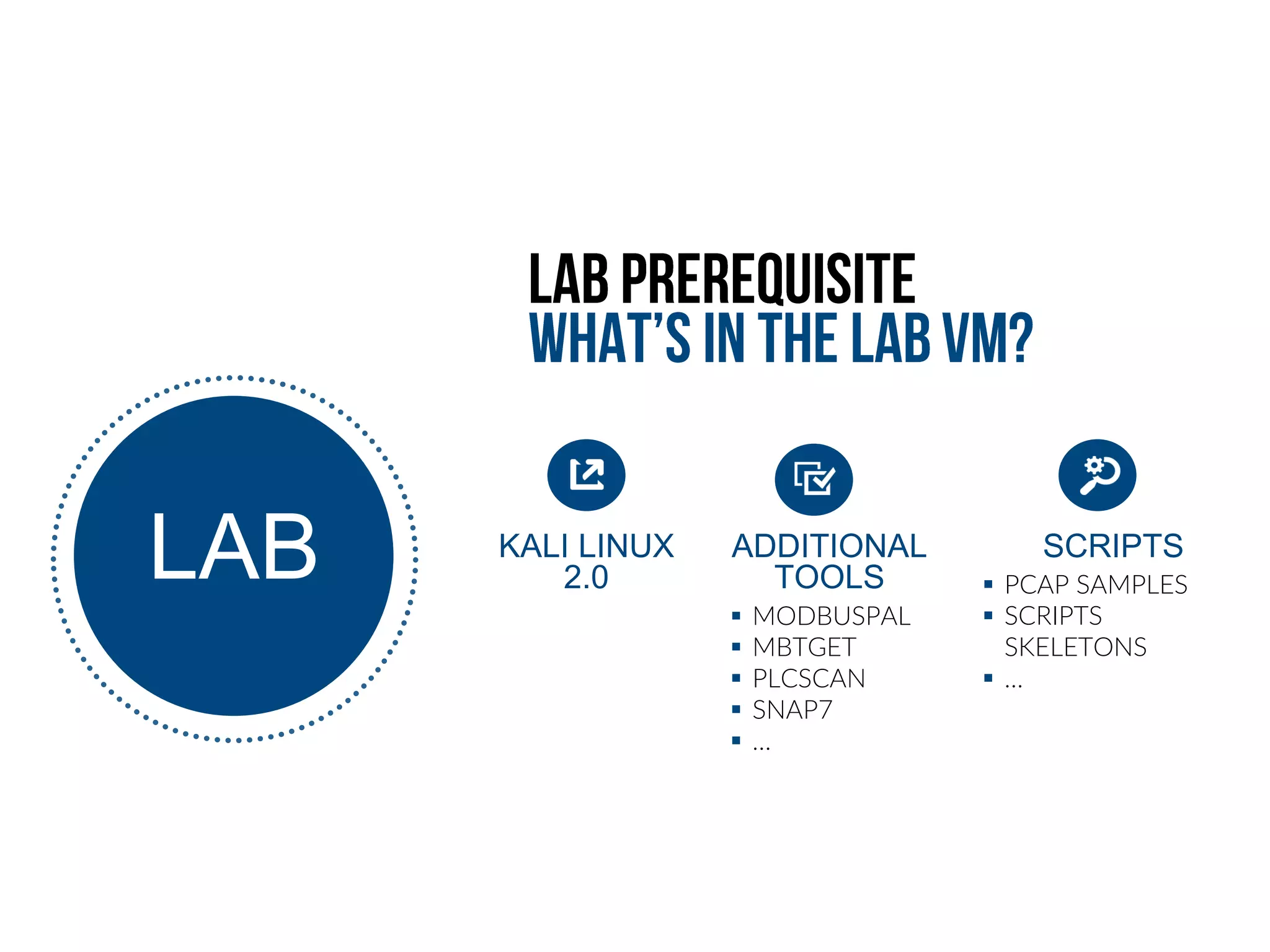
KALI LINUX
2.0
 MODBUSPAL
 MBTGET
 PLCSCAN
 SNAP7
 …
ADDITIONAL
TOOLS  PCAP SAMPLES
 SCRIPTS
SKELETONS
 …
SCRIPTS
LAB
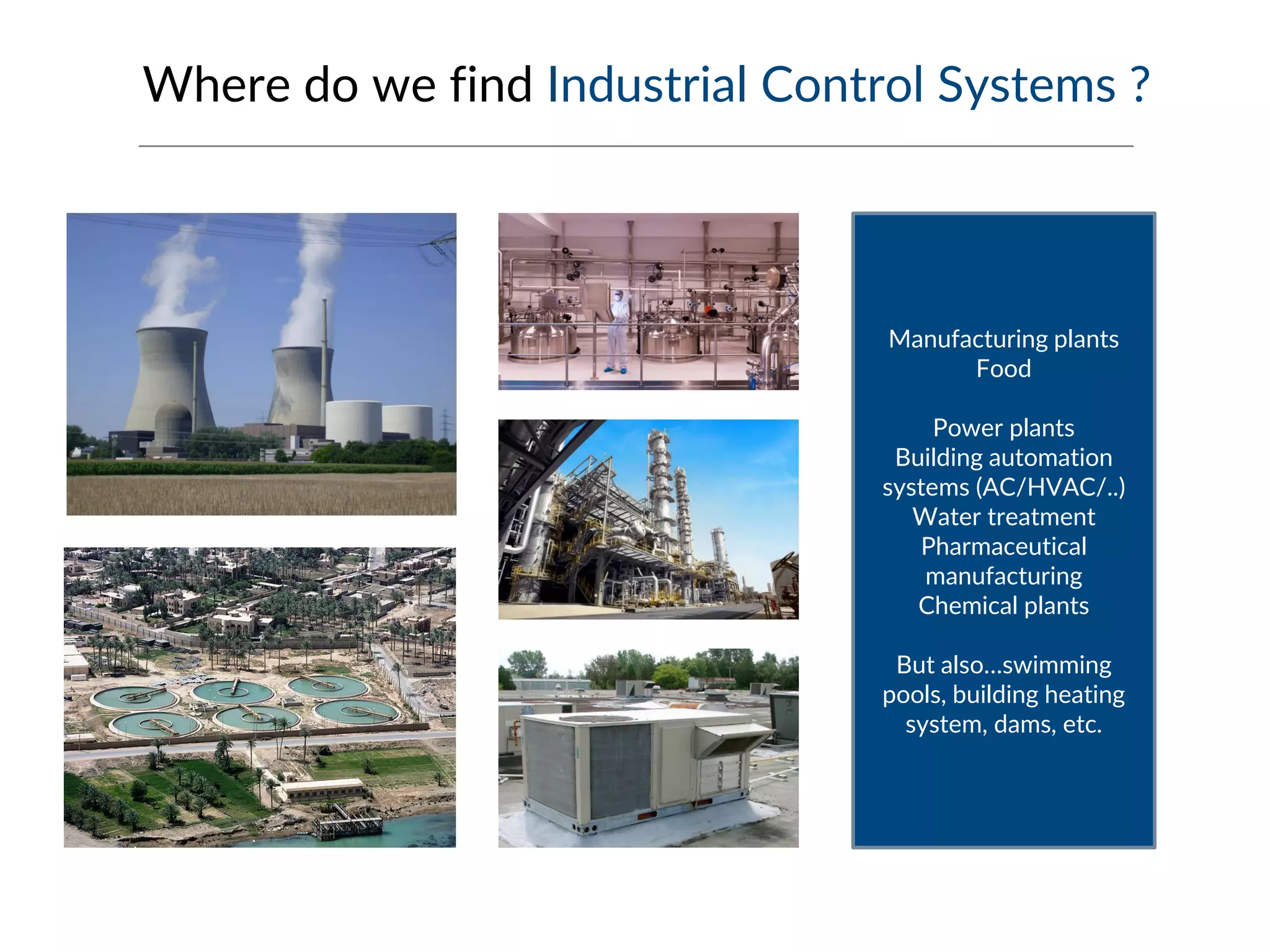
Where do we find Industrial Control Systems ?
Manufacturing plants
Food
Power plants
Building automation
systems (AC/HVAC/..)
Water treatment
Pharmaceutical
manufacturing
Chemical plants
But also…swimming
pools, building heating
system, dams, etc.
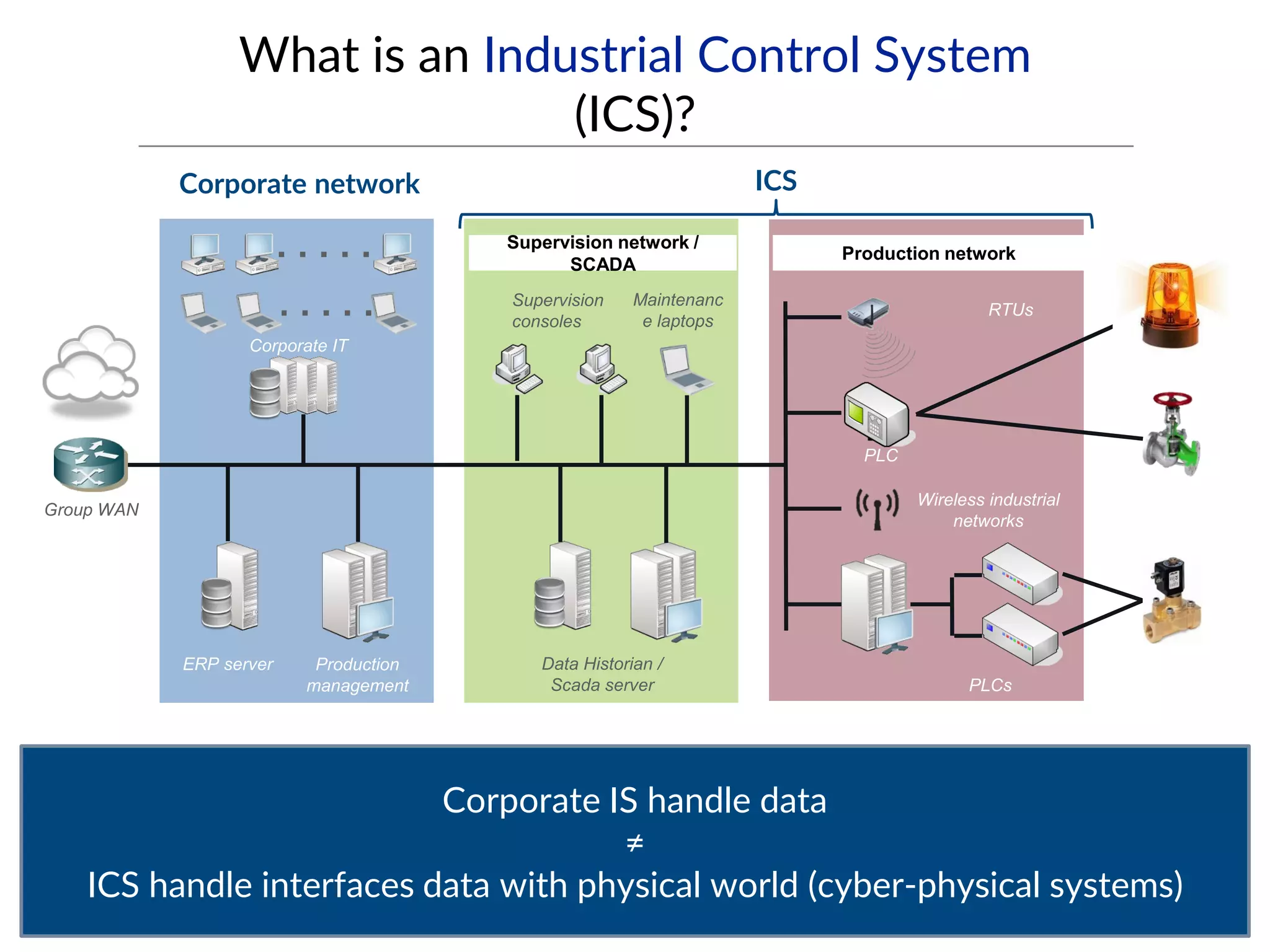
What is an Industrial Control System
(ICS)?
Group WAN
Production
management
ERP server
Corporate IT
Corporate network
Data Historian /
Scada server
Maintenanc
e laptops
Supervision
consoles
Supervision network /
SCADA
PLCs
RTUs
Production network
ICS
PLC
Wireless industrial
networks
Corporate IS handle data
≠
ICS handle interfaces data with physical world (cyber-physical systems)
What about IoT / smart stuff ?

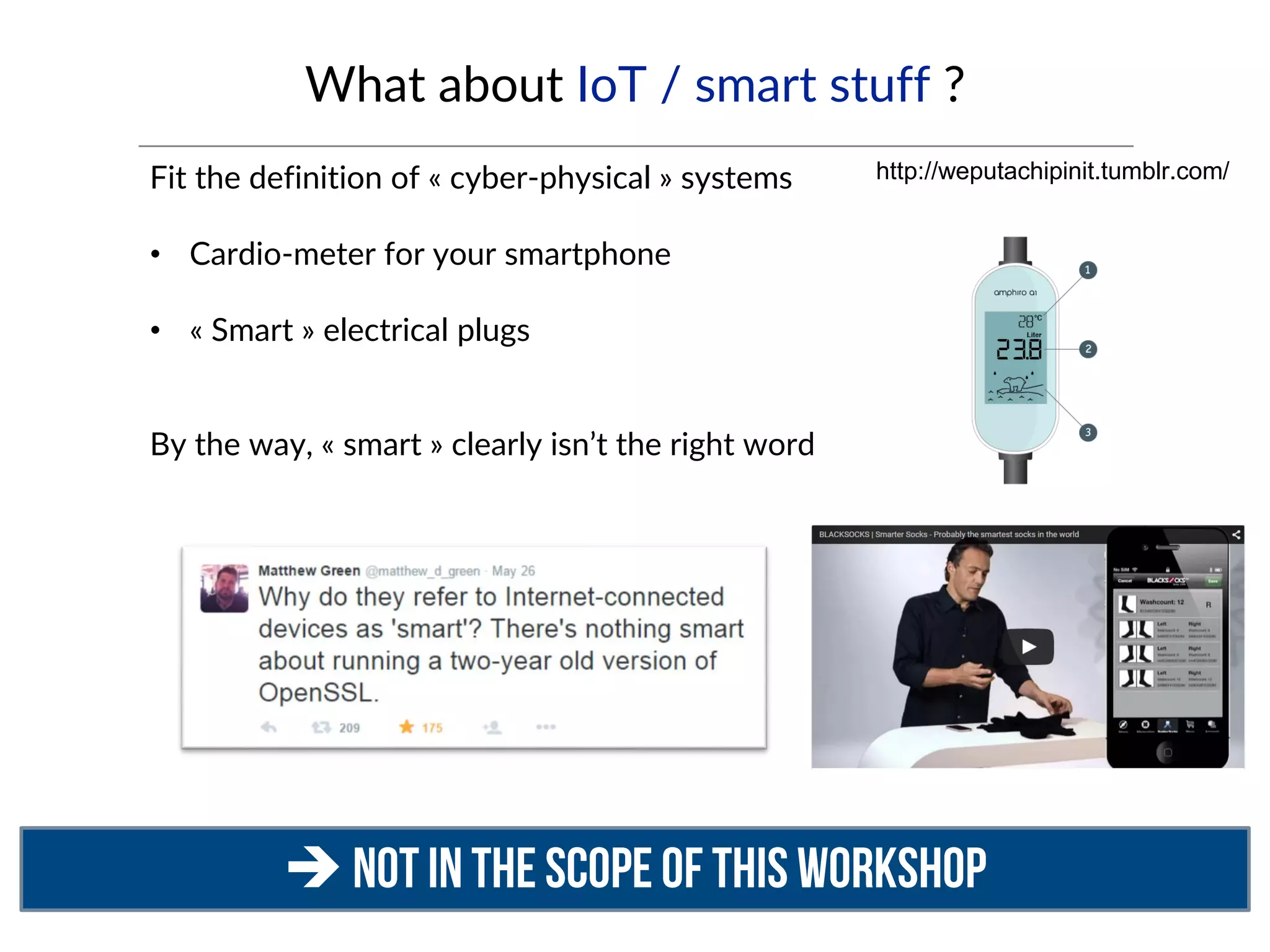
Fit the definition of « cyber-physical » systems
• Cardio-meter for your smartphone
• « Smart » electrical plugs
By the way, « smart » clearly isn’t the right word
http://weputachipinit.tumblr.com/
Evolution of ICS
 Started with electrical relays  hard wired automation, no update possible
 Then moved to programmable electronics
 Then to IP-network enabled devices
 Now and future is more and more COTS
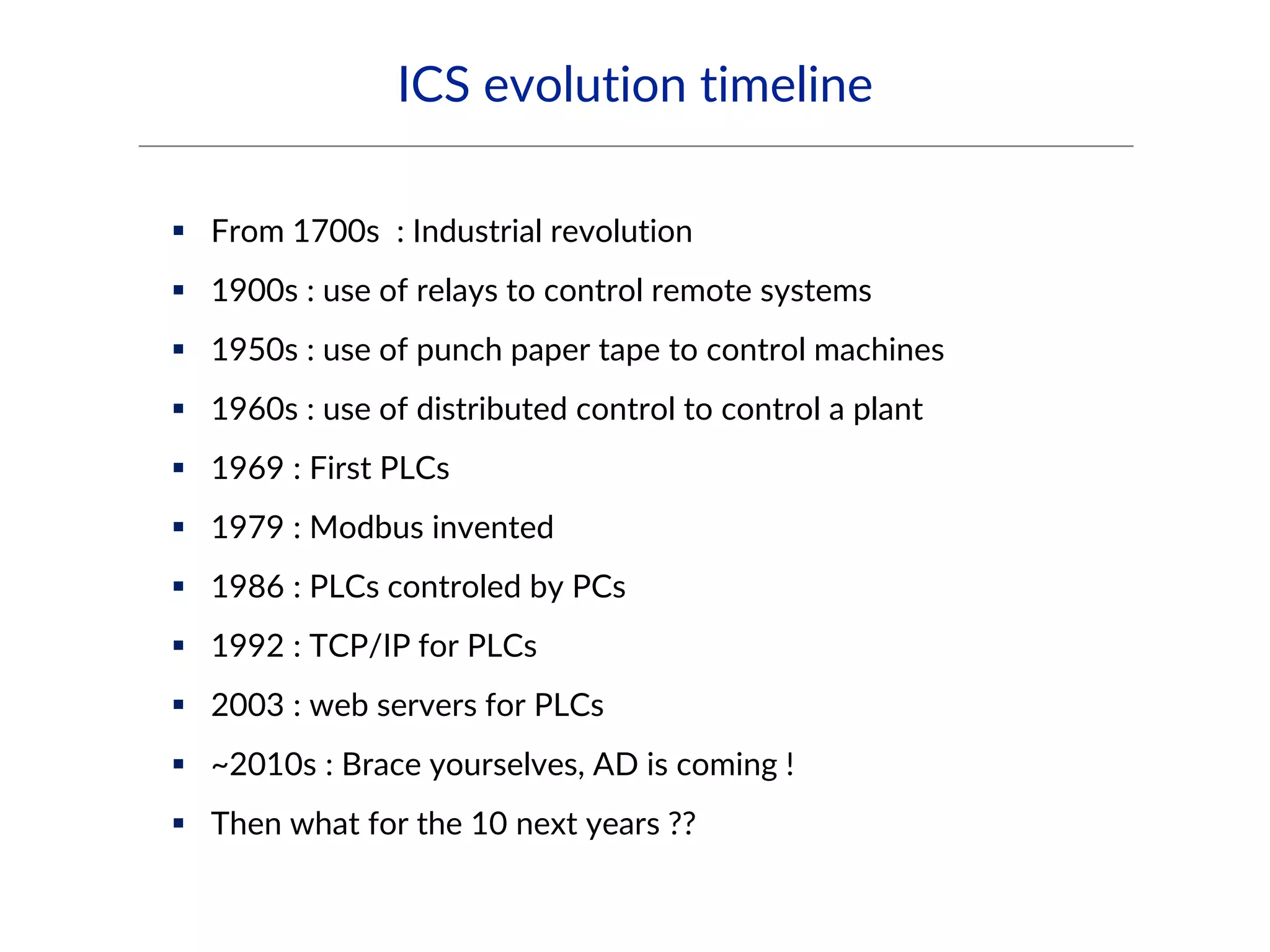
ICS evolution timeline
 From 1700s : Industrial revolution
 1900s : use of relays to control remote systems
 1950s : use of punch paper tape to control machines
 1960s : use of distributed control to control a plant
 1969 : First PLCs
 1979 : Modbus invented
 1986 : PLCs controled by PCs
 1992 : TCP/IP for PLCs
 2003 : web servers for PLCs
 ~2010s : Brace yourselves, AD is coming !
 Then what for the 10 next years ??
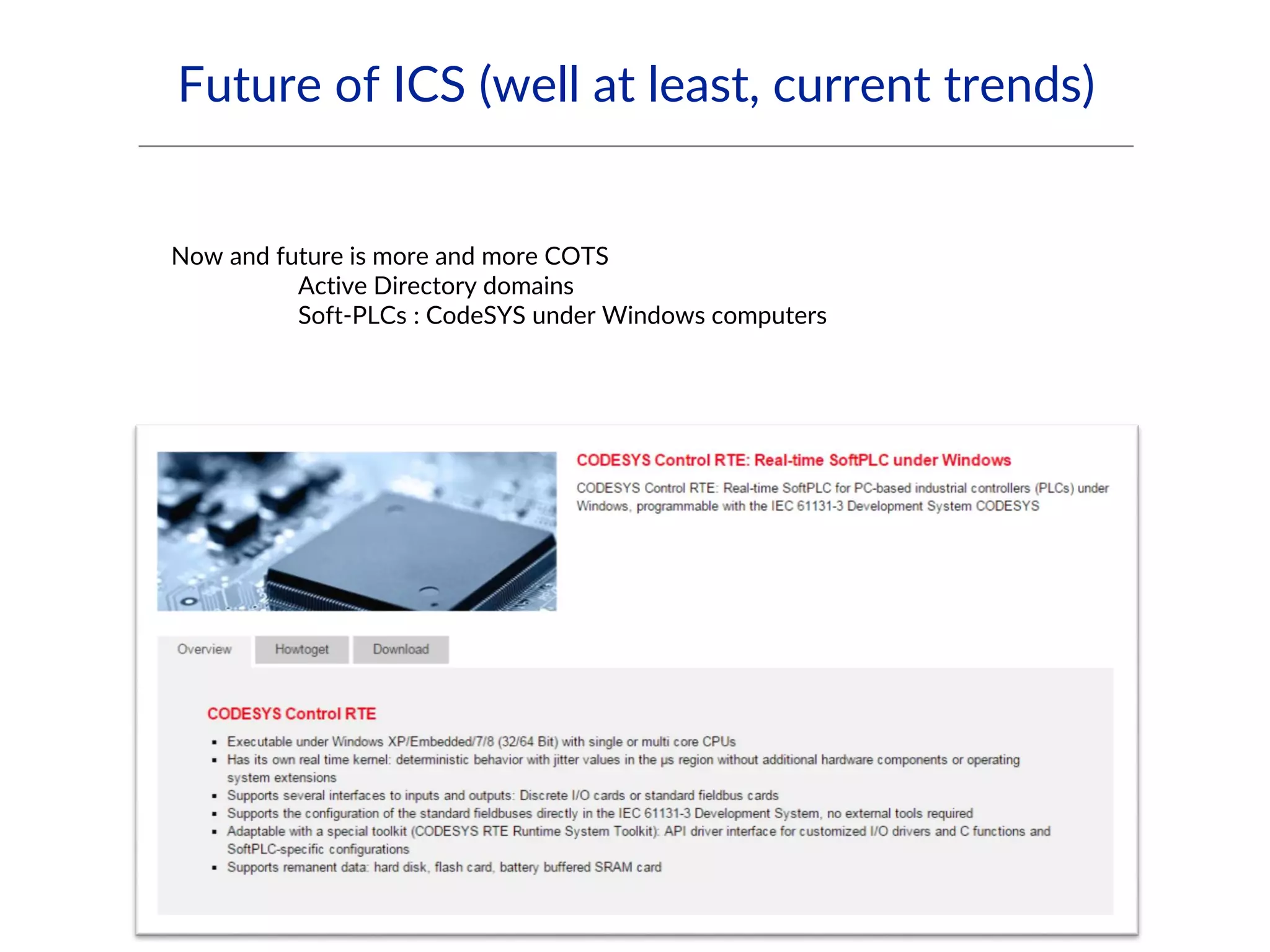
Future of ICS (well at least, current trends)
Now and future is more and more COTS
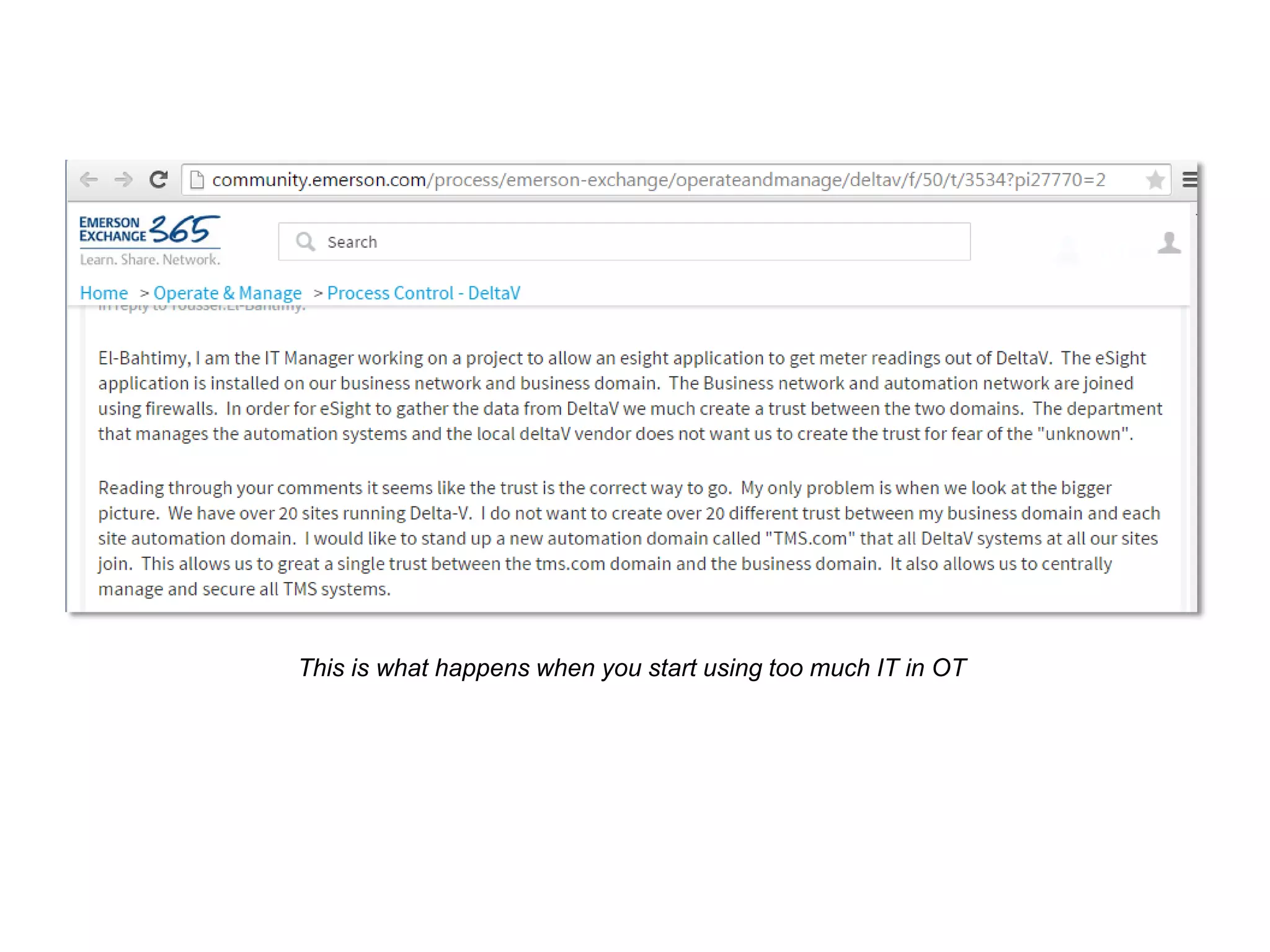
Active Directory domains
Soft-PLCs : CodeSYS under Windows computers
This is what happens when you start using too much IT in OT
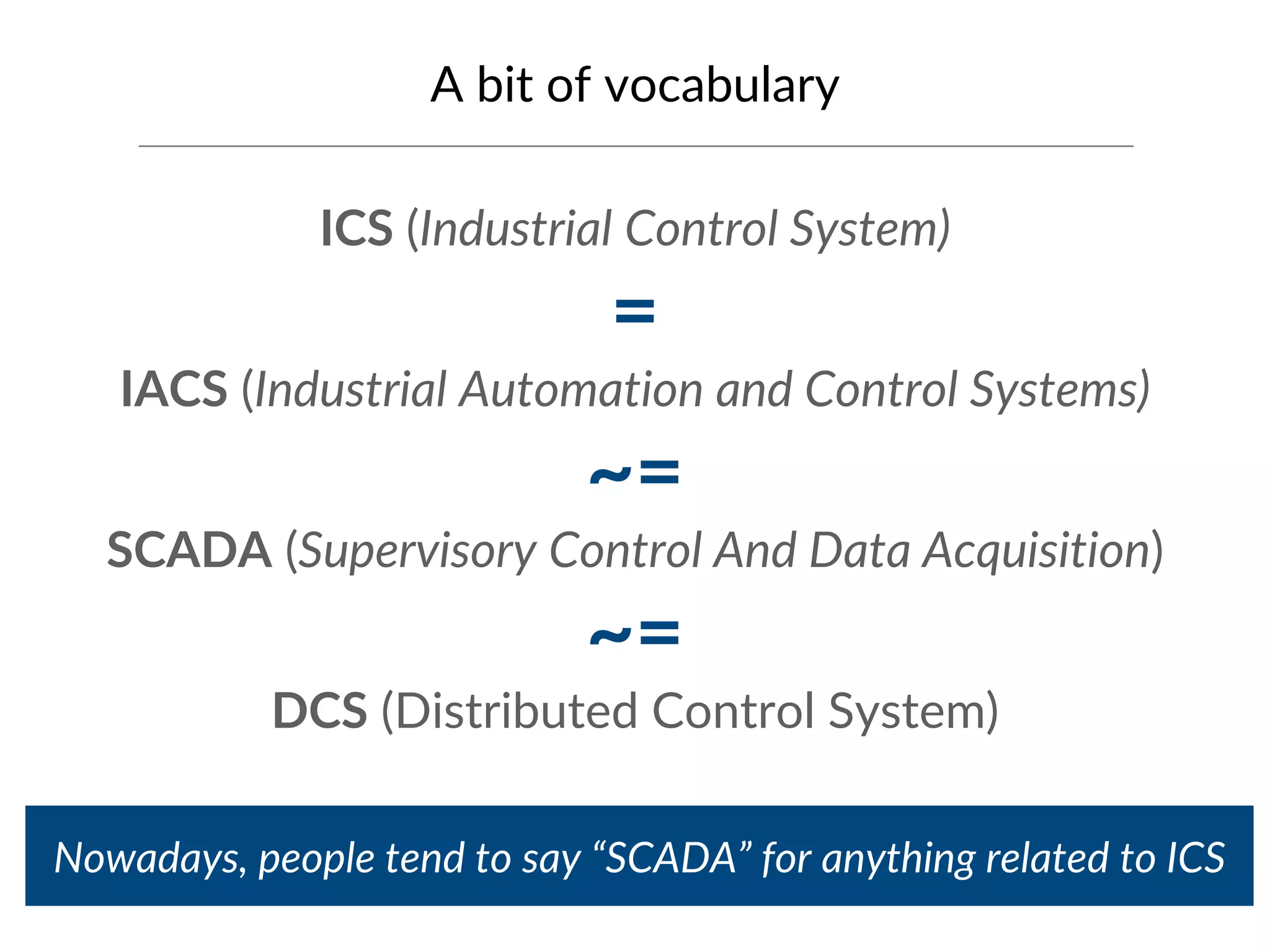
A bit of vocabulary
ICS (Industrial Control System)
=
IACS (Industrial Automation and Control Systems)
~=
SCADA (Supervisory Control And Data Acquisition)
~=
DCS (Distributed Control System)
Nowadays, people tend to say “SCADA” for anything related to ICS
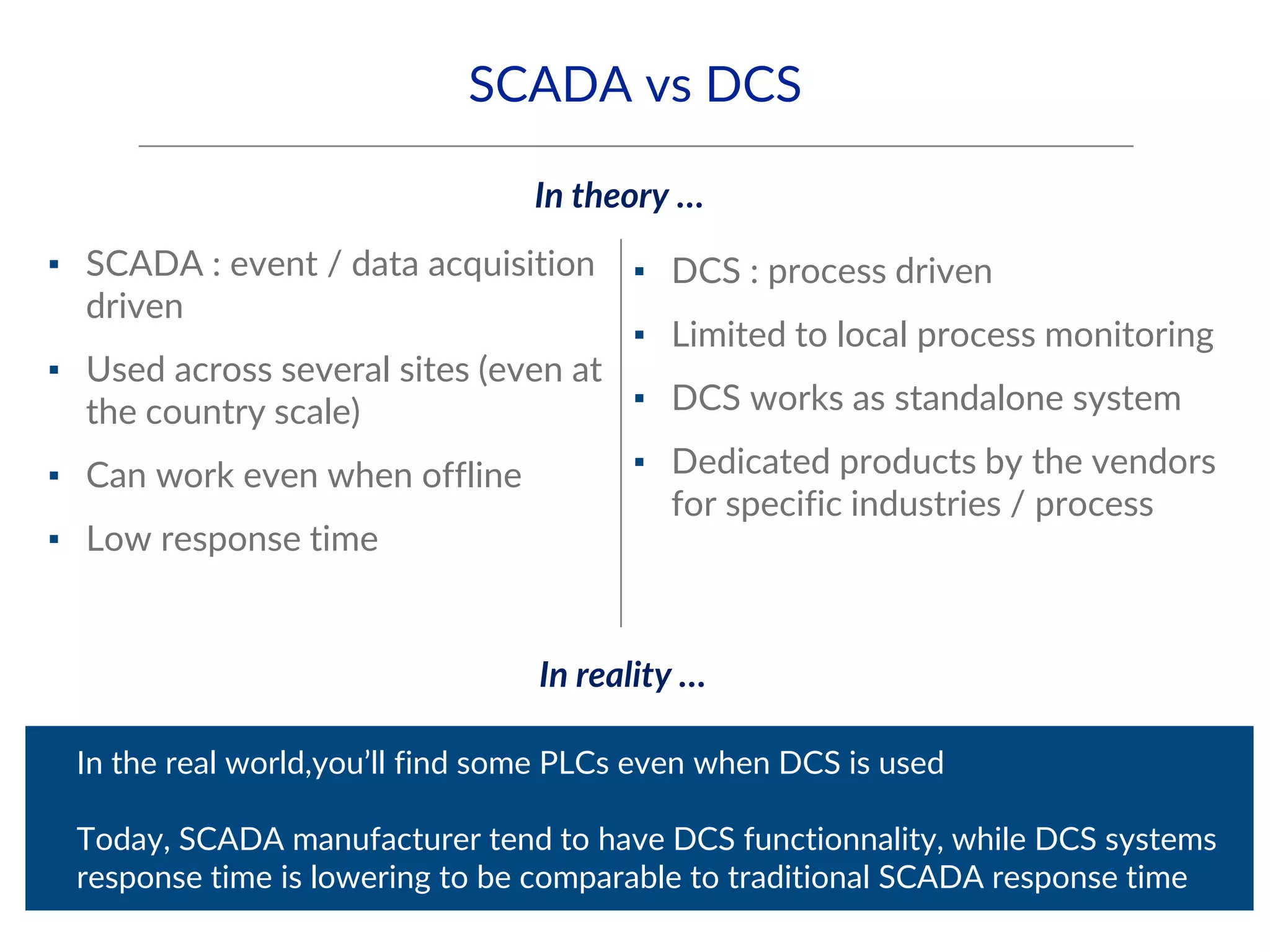
SCADA vs DCS
▪ SCADA : event / data acquisition
driven
▪ Used across several sites (even at
the country scale)
▪ Can work even when offline
▪ Low response time
▪ DCS : process driven
▪ Limited to local process monitoring
▪ DCS works as standalone system
▪ Dedicated products by the vendors
for specific industries / process
▪ In the real world,you’ll find some PLCs even when DCS is used
▪ Today, SCADA manufacturer tend to have DCS functionnality, while DCS systems
response time is lowering to be comparable to traditional SCADA response time
In theory …
In reality …
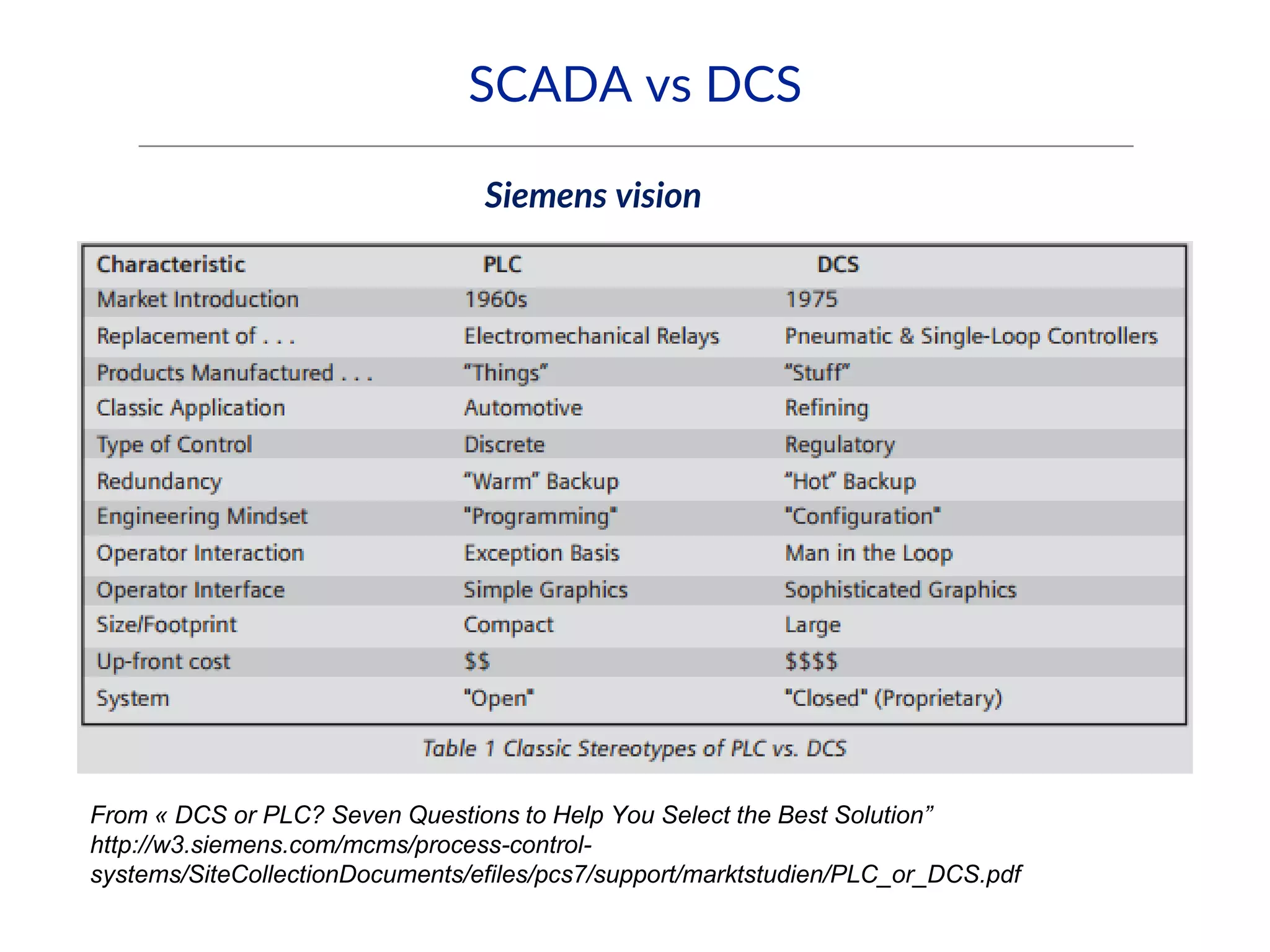
SCADA vs DCS
Siemens vision
From « DCS or PLC? Seven Questions to Help You Select the Best Solution”
http://w3.siemens.com/mcms/process-control-
systems/SiteCollectionDocuments/efiles/pcs7/support/marktstudien/PLC_or_DCS.pdf
ICS COMPONENTS
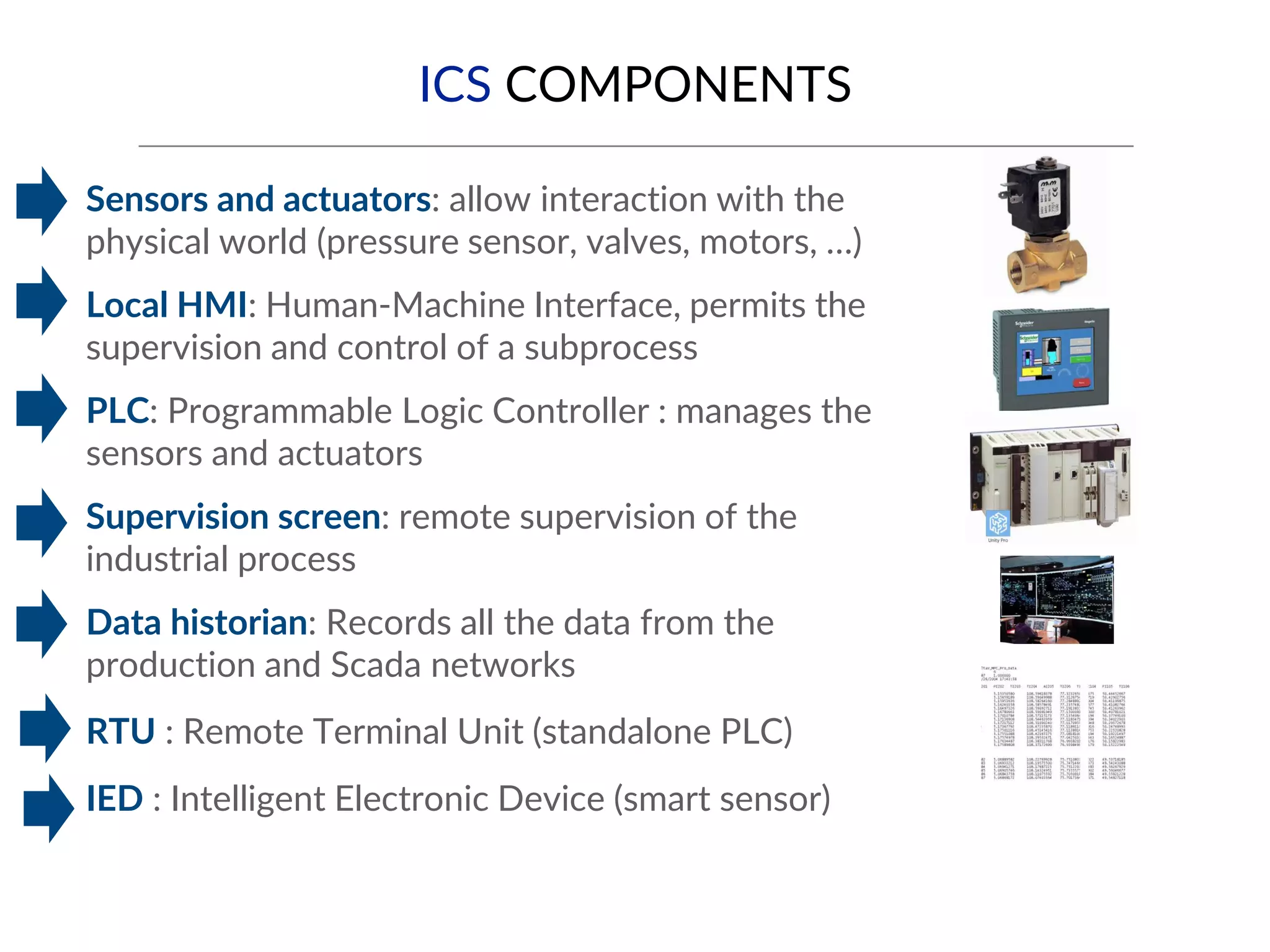
▪ Sensors and actuators: allow interaction with the
physical world (pressure sensor, valves, motors, …)
▪ Local HMI: Human-Machine Interface, permits the
supervision and control of a subprocess
▪ PLC: Programmable Logic Controller : manages the
sensors and actuators
▪ Supervision screen: remote supervision of the
industrial process
▪ Data historian: Records all the data from the
production and Scada networks
▪ RTU : Remote Terminal Unit (standalone PLC)
▪ IED : Intelligent Electronic Device (smart sensor)
Industrial protocols
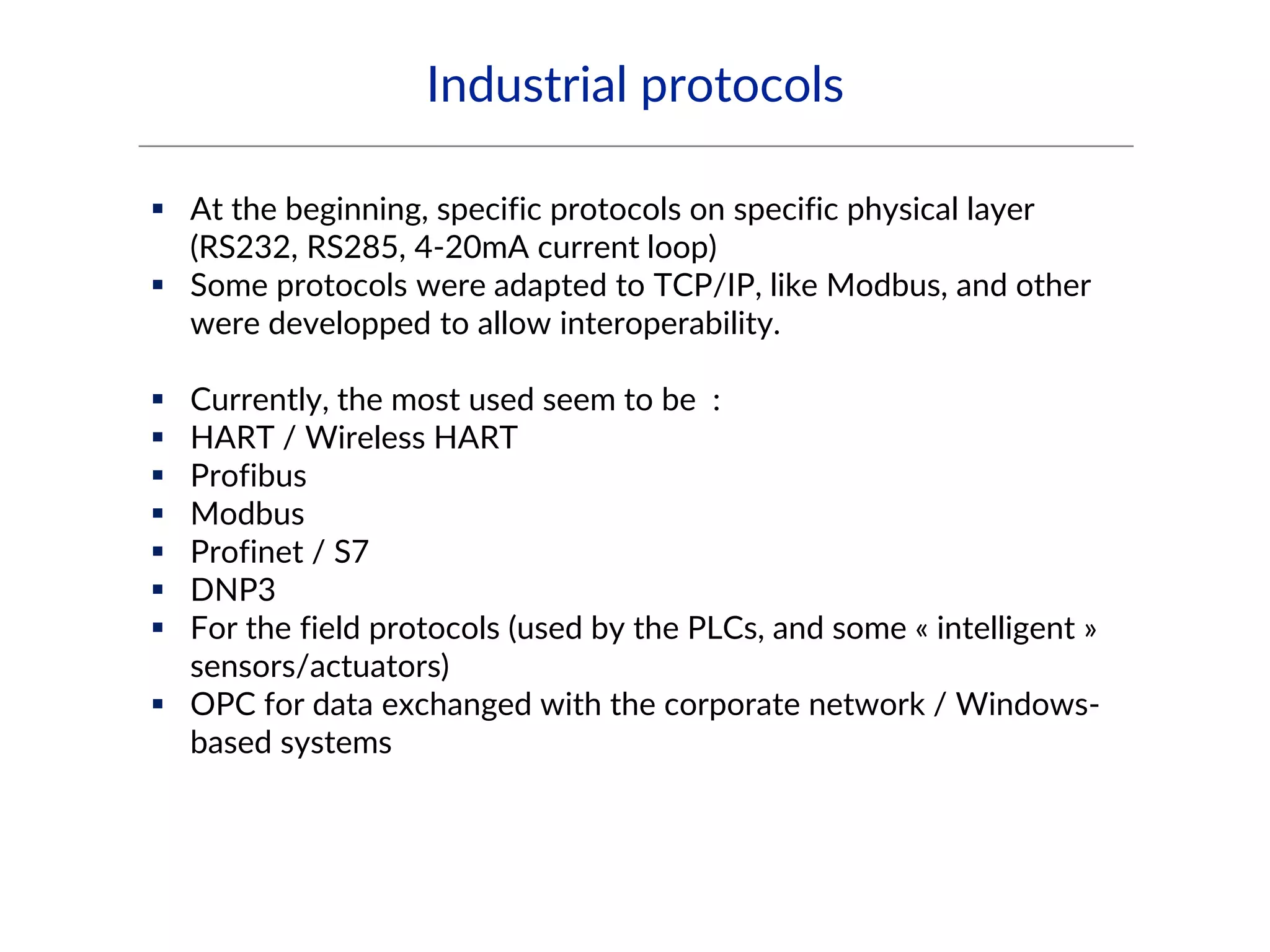
 At the beginning, specific protocols on specific physical layer
(RS232, RS285, 4-20mA current loop)
 Some protocols were adapted to TCP/IP, like Modbus, and other
were developped to allow interoperability.
 Currently, the most used seem to be :
 HART / Wireless HART
 Profibus
 Modbus
 Profinet / S7
 DNP3
 For the field protocols (used by the PLCs, and some « intelligent »
sensors/actuators)
 OPC for data exchanged with the corporate network / Windows-
based systems
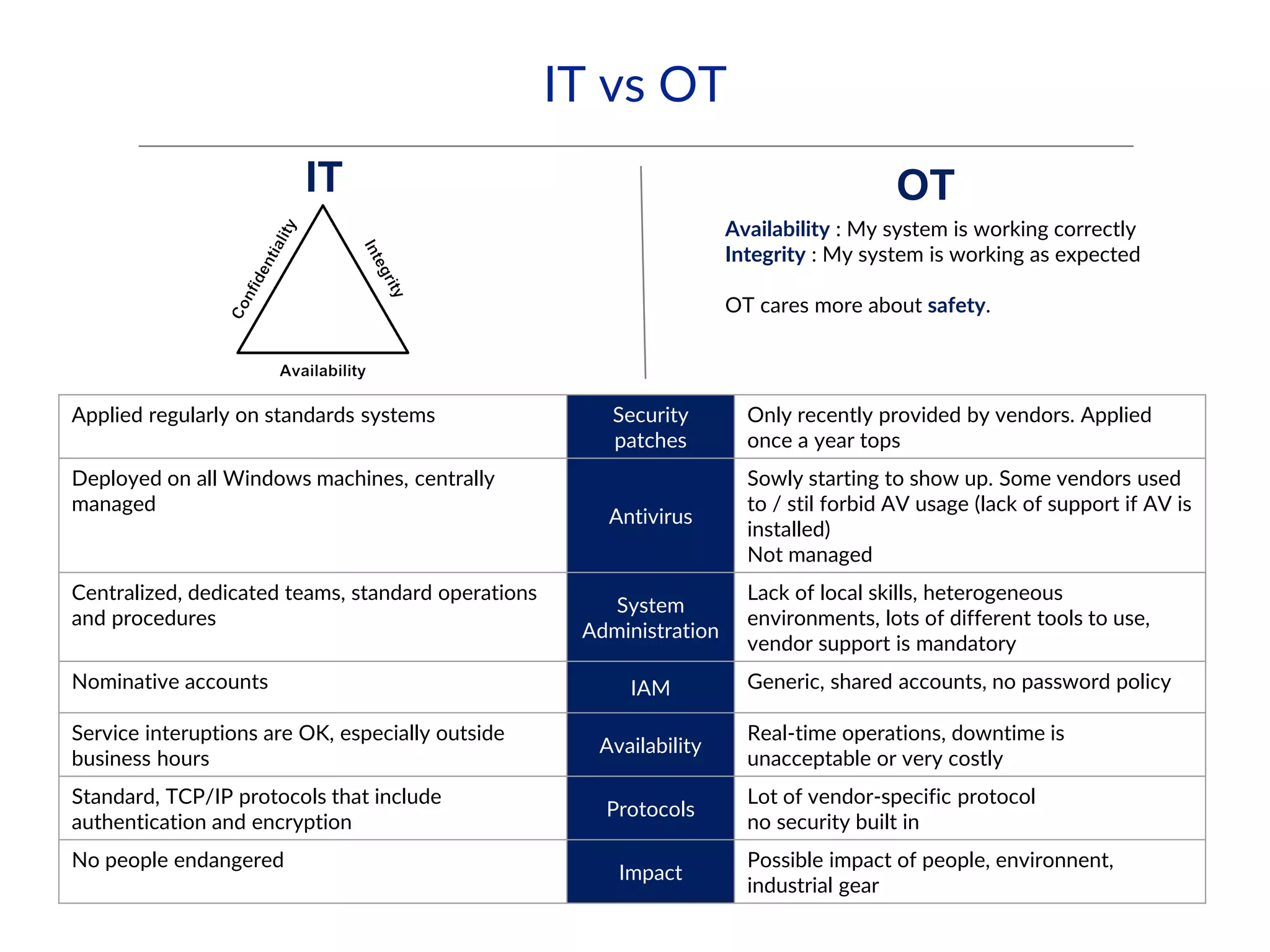
IT vs OT
IT OT
Availability : My system is working correctly
Integrity : My system is working as expected
OT cares more about safety.
Applied regularly on standards systems Security
patches
Only recently provided by vendors. Applied
once a year tops
Deployed on all Windows machines, centrally
managed
Antivirus
Sowly starting to show up. Some vendors used
to / stil forbid AV usage (lack of support if AV is
installed)
Not managed
Centralized, dedicated teams, standard operations
and procedures
System
Administration
Lack of local skills, heterogeneous
environments, lots of different tools to use,
vendor support is mandatory
Nominative accounts IAM Generic, shared accounts, no password policy
Service interuptions are OK, especially outside
business hours
Availability
Real-time operations, downtime is
unacceptable or very costly
Standard, TCP/IP protocols that include
authentication and encryption
Protocols
Lot of vendor-specific protocol
no security built in
No people endangered
Impact
Possible impact of people, environnent,
industrial gear
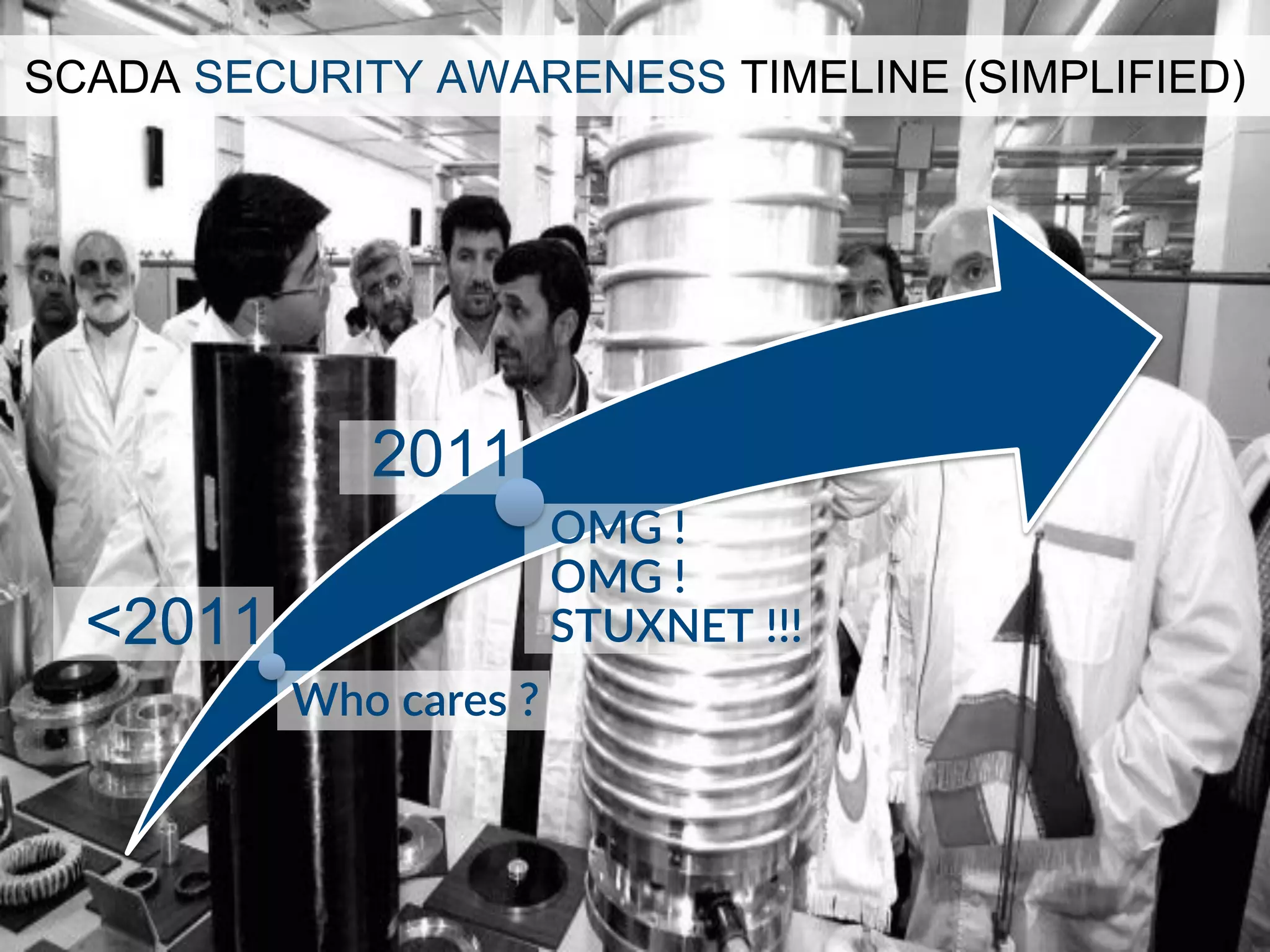
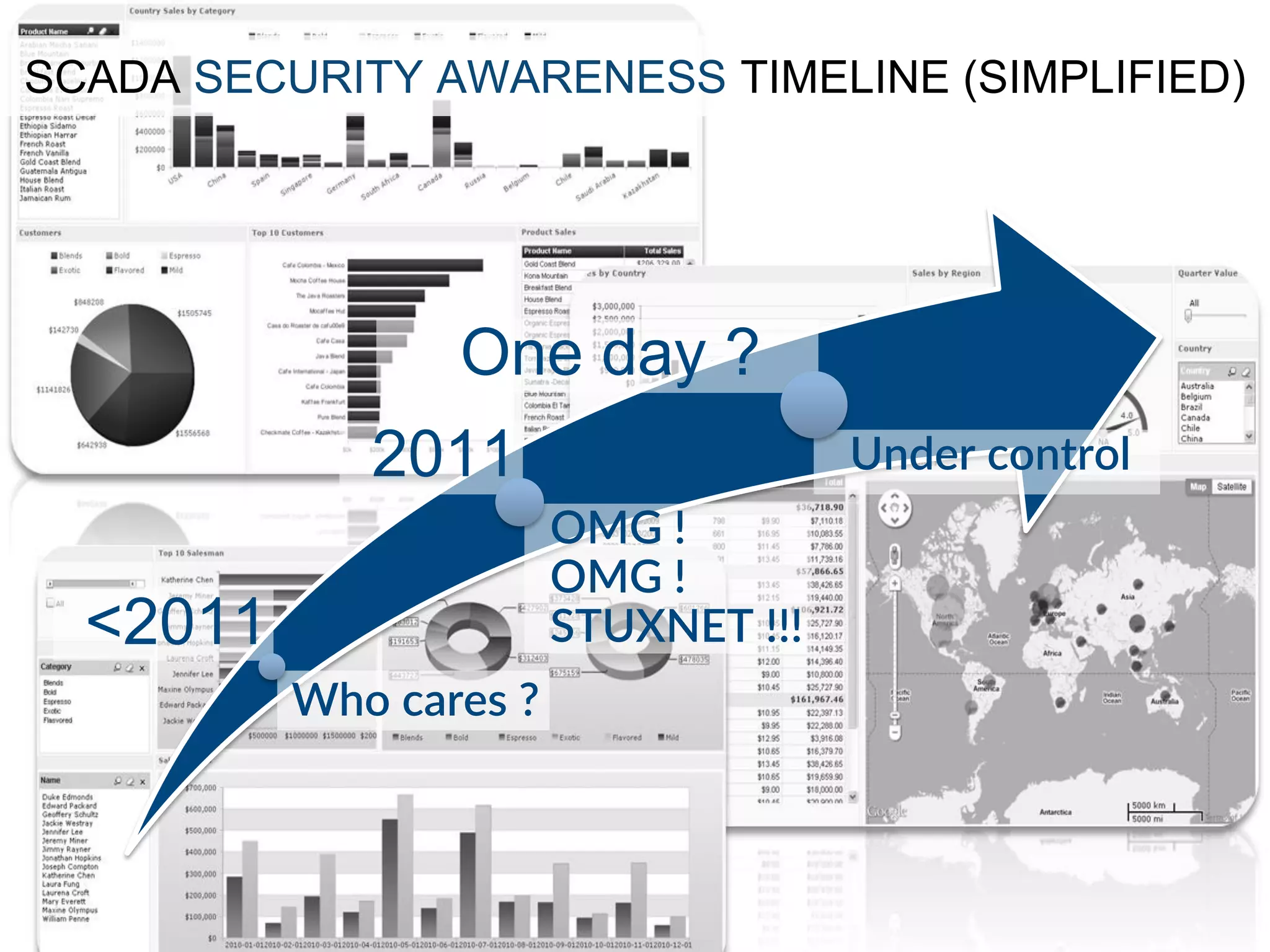
Who cares ?
<2011
September 5, 2014
SCADA SECURITY AWARENESS TIMELINE (SIMPLIFIED)
Who cares ?
OMG !
OMG !
STUXNET !!!
2011
<2011
SCADA SECURITY AWARENESS TIMELINE (SIMPLIFIED)
Who cares ?
OMG !
OMG !
STUXNET !!!
Under control2011
<2011
One day ?
SCADA SECURITY AWARENESS TIMELINE (SIMPLIFIED)
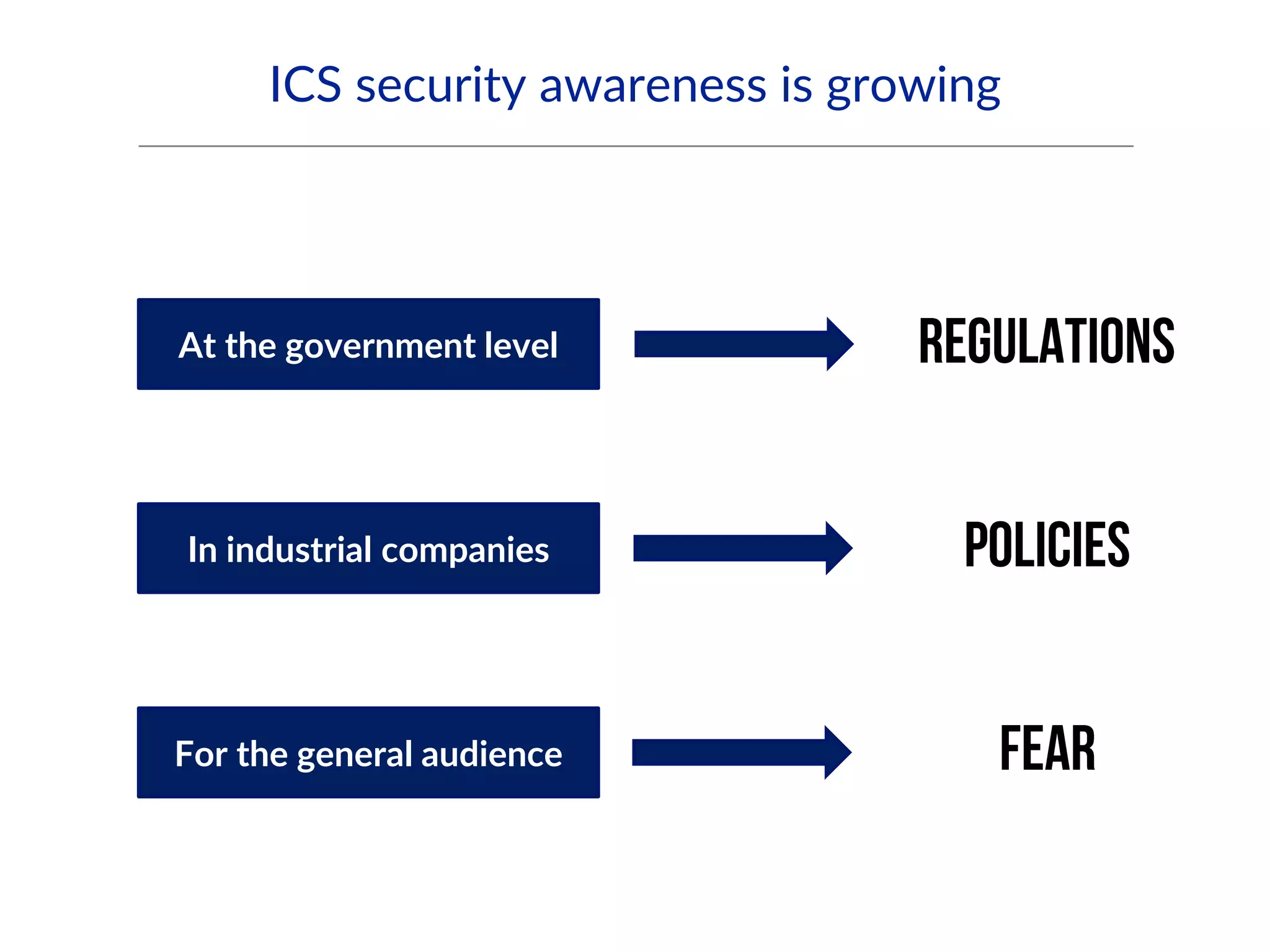
ICS security awareness is growing
At the government level
In industrial companies
For the general audience
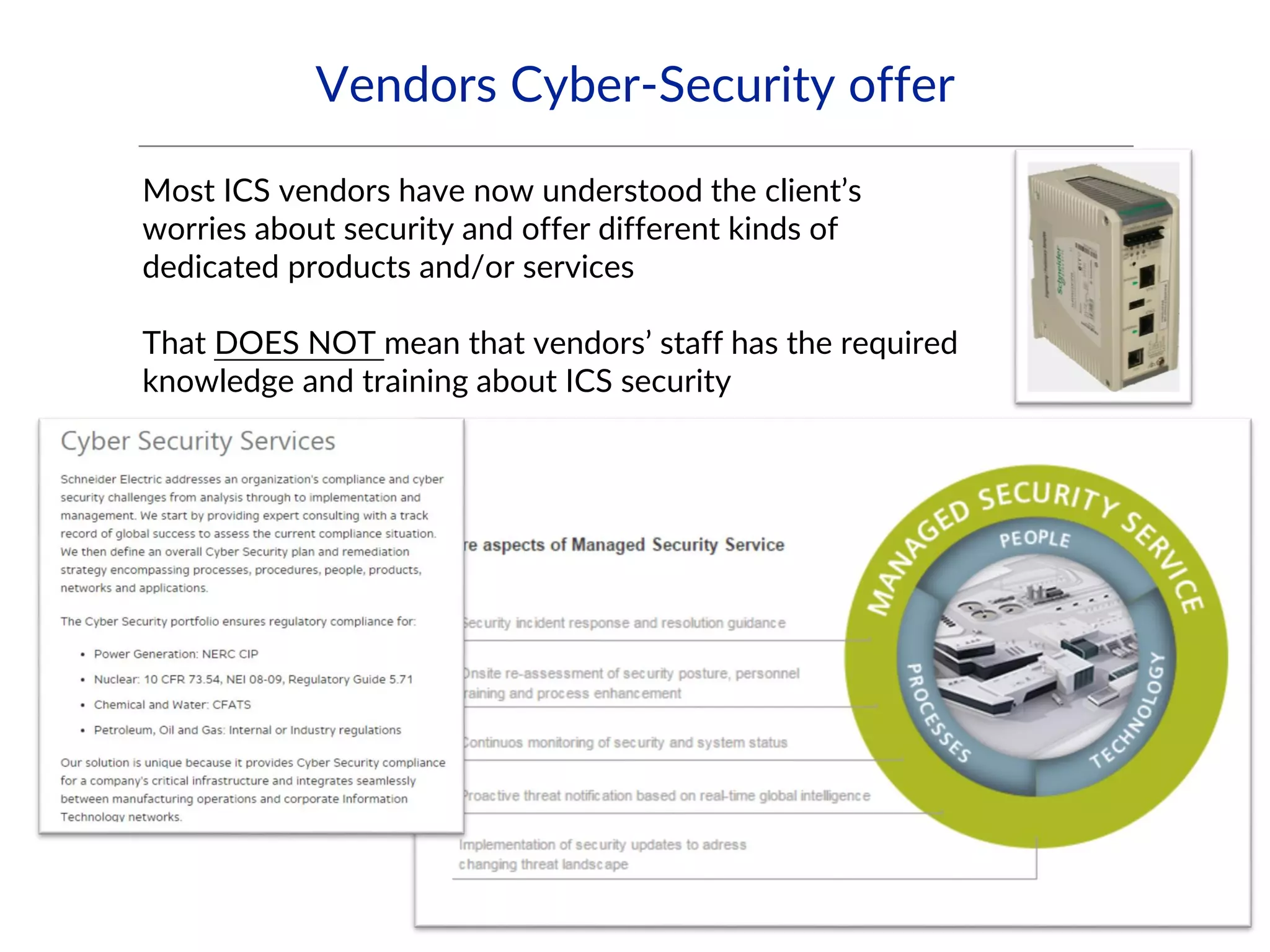
Vendors Cyber-Security offer
Most ICS vendors have now understood the client’s
worries about security and offer different kinds of
dedicated products and/or services
That DOES NOT mean that vendors’ staff has the required
knowledge and training about ICS security
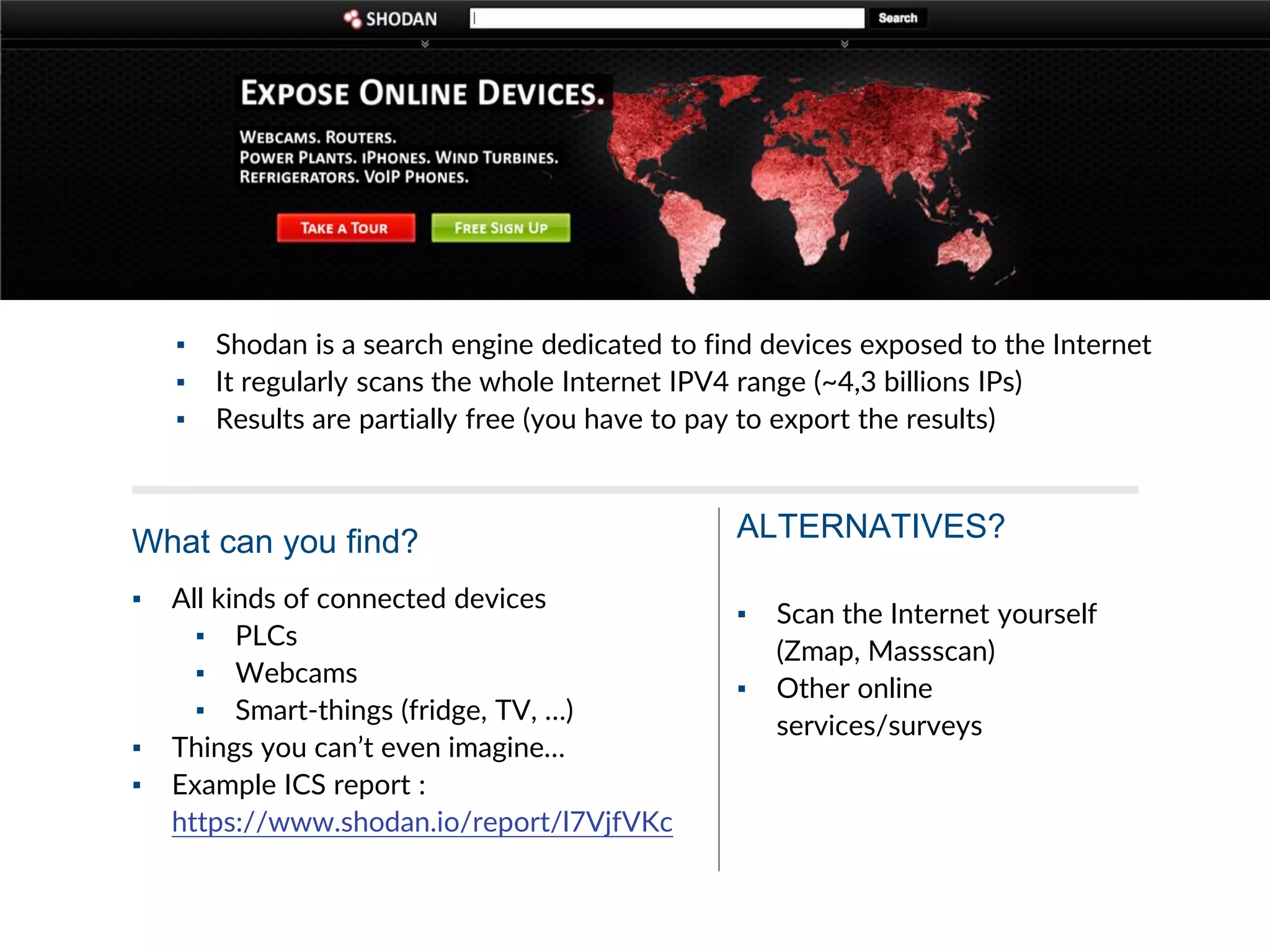
▪ Shodan is a search engine dedicated to find devices exposed to the Internet
▪ It regularly scans the whole Internet IPV4 range (~4,3 billions IPs)
▪ Results are partially free (you have to pay to export the results)
▪ All kinds of connected devices
▪ PLCs
▪ Webcams
▪ Smart-things (fridge, TV, …)
▪ Things you can’t even imagine…
▪ Example ICS report :
https://www.shodan.io/report/l7VjfVKc
What can you find?
▪ Scan the Internet yourself
(Zmap, Massscan)
▪ Other online
services/surveys
ALTERNATIVES?
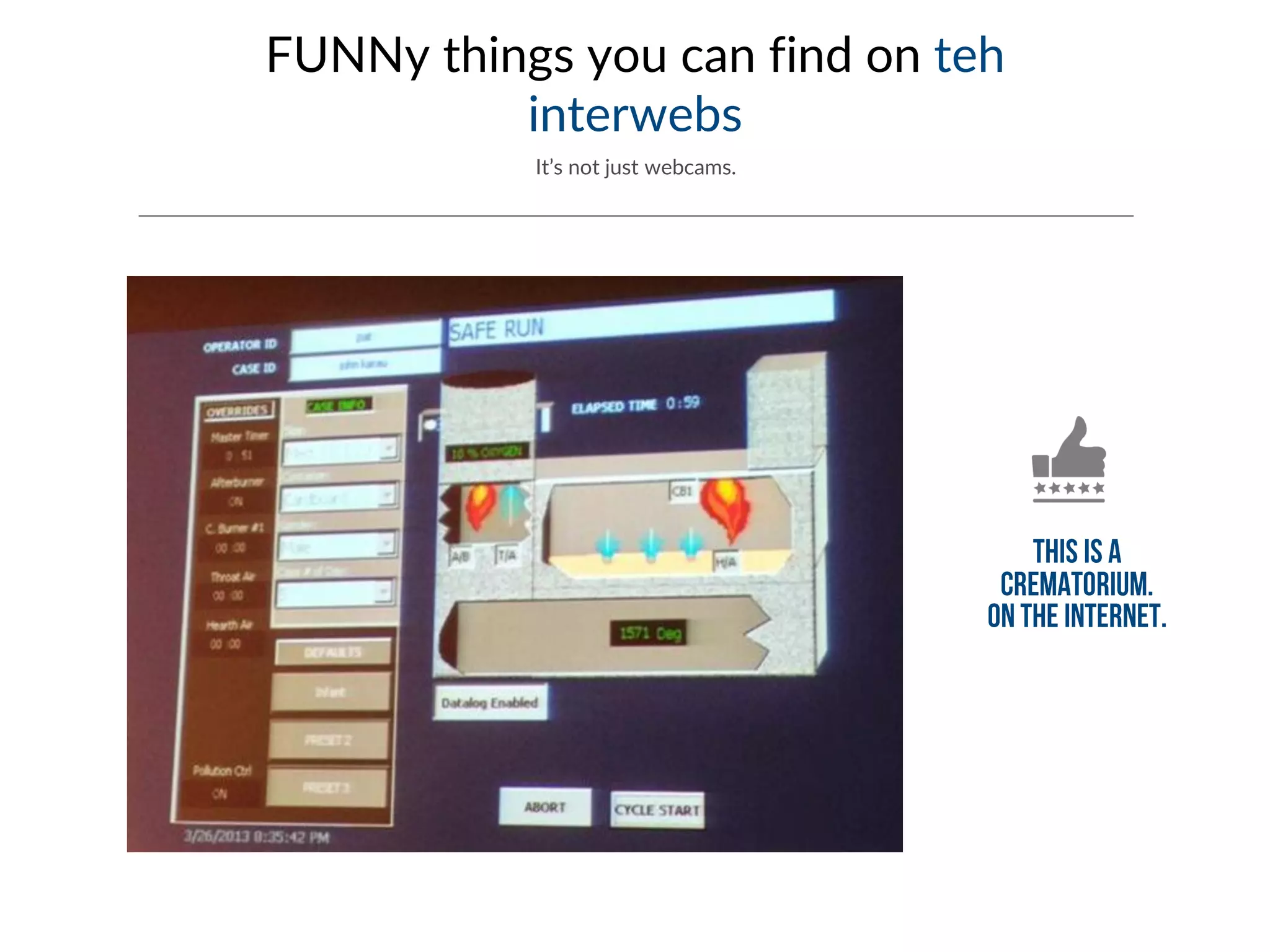
FUNNy things you can find on teh
interwebs
It’s not just webcams.
#foreverdays
#foreverdays is a term coined by @reverseics
Very important concept when talking about ICS
The highest vulnerabilities are not patched.
So it is really worth considering the effort of
patch management of ICS equipement when
you know
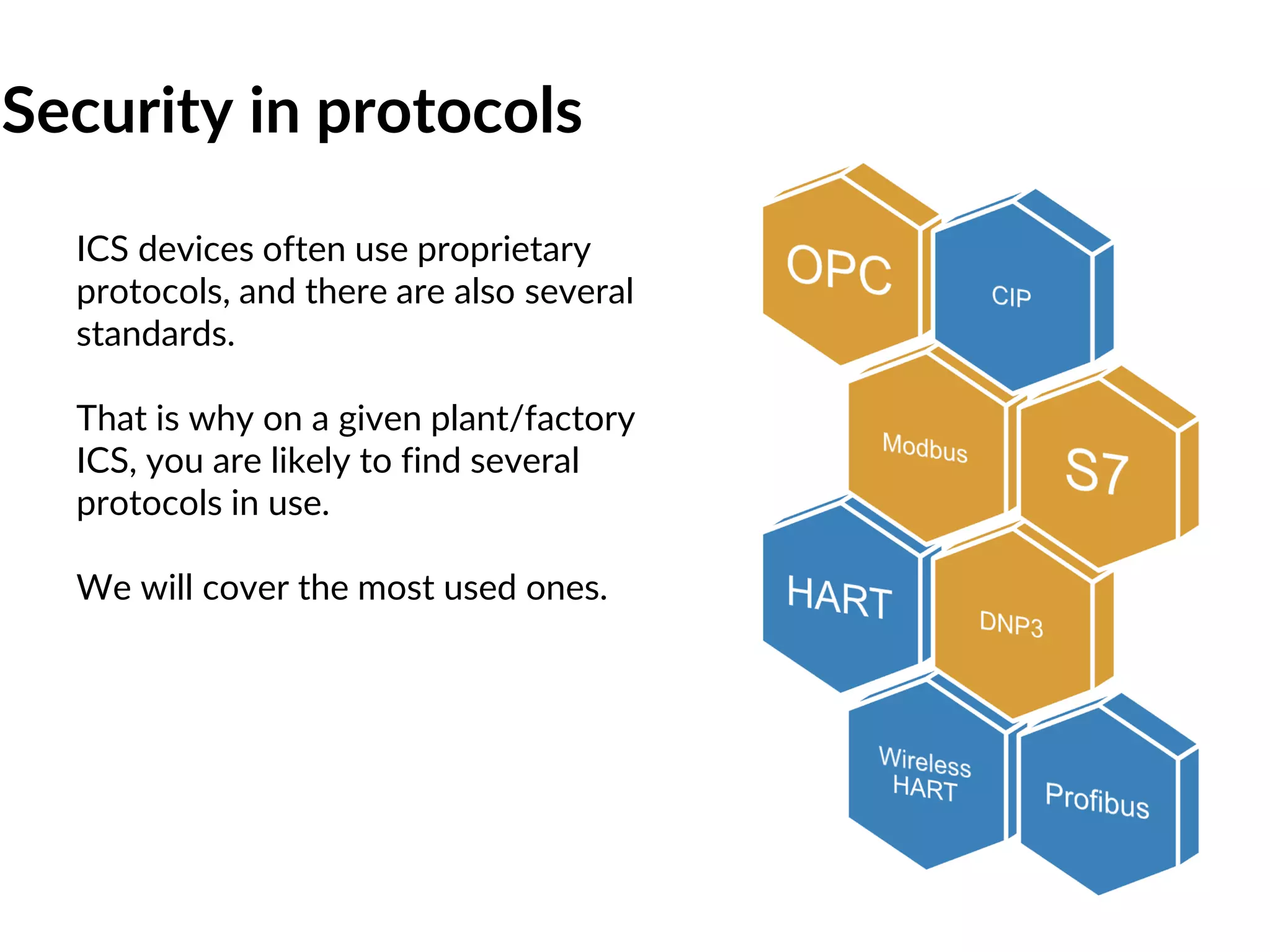
Security in protocols
ICS devices often use proprietary
protocols, and there are also several
standards.
That is why on a given plant/factory
ICS, you are likely to find several
protocols in use.
We will cover the most used ones.
MODBUS Protocol
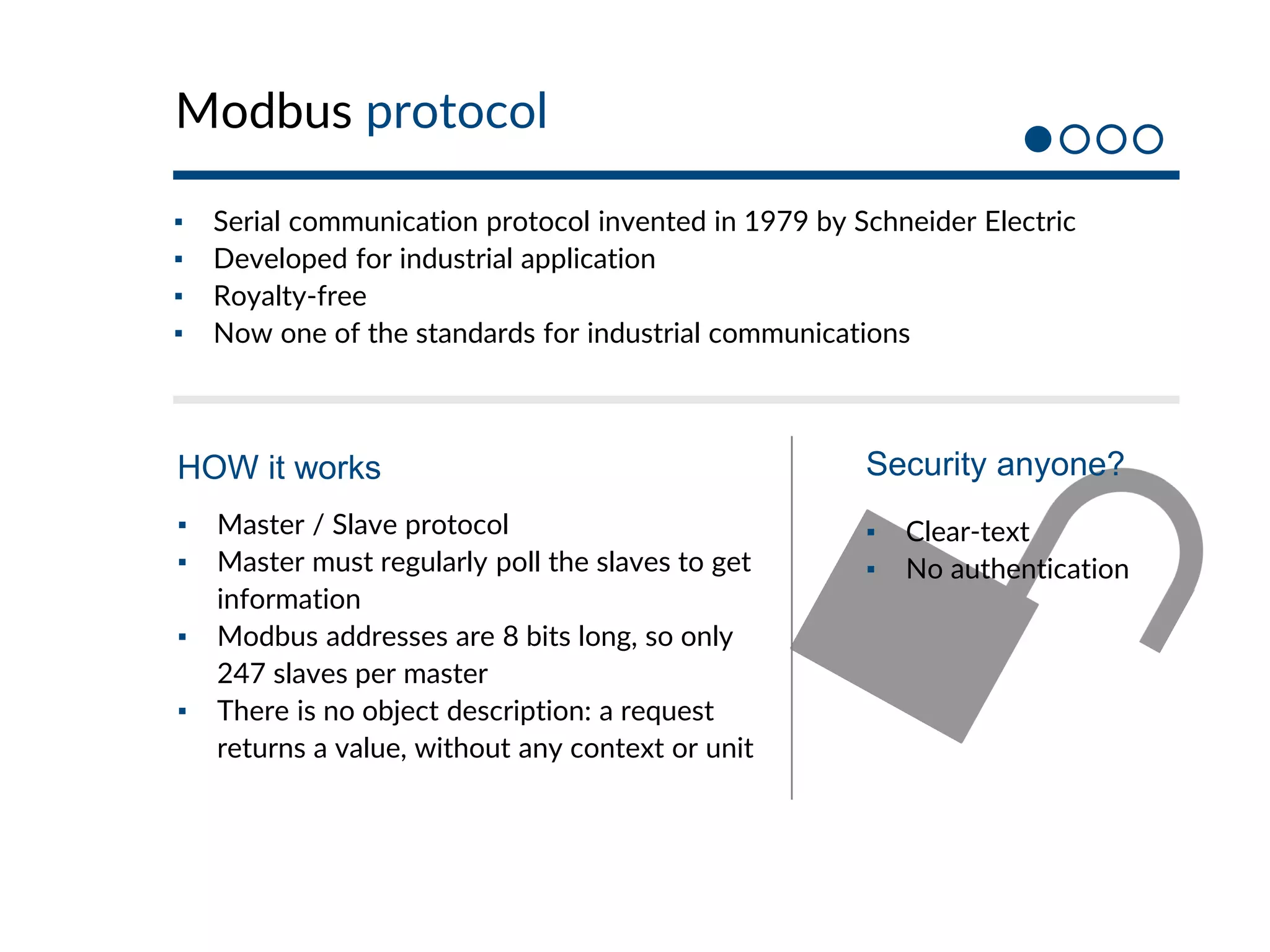
Modbus protocol
▪ Serial communication protocol invented in 1979 by Schneider Electric
▪ Developed for industrial application
▪ Royalty-free
▪ Now one of the standards for industrial communications
▪ Master / Slave protocol
▪ Master must regularly poll the slaves to get
information
▪ Modbus addresses are 8 bits long, so only
247 slaves per master
▪ There is no object description: a request
returns a value, without any context or unit
HOW it works
▪ Clear-text
▪ No authentication
Security anyone?
Modbus
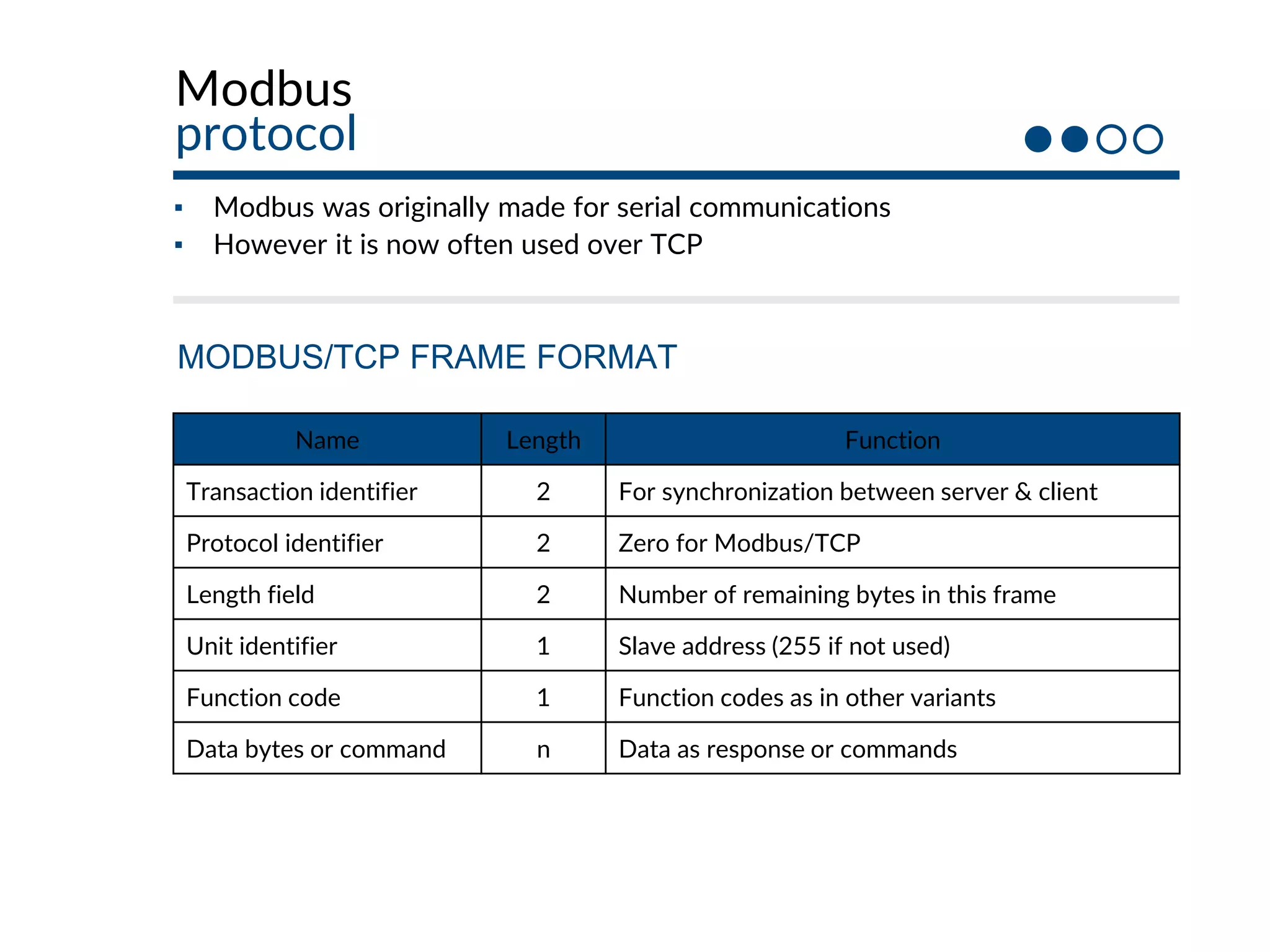
protocol
▪ Modbus was originally made for serial communications
▪ However it is now often used over TCP
MODBUS/TCP FRAME FORMAT
Name Length Function
Transaction identifier 2 For synchronization between server & client
Protocol identifier 2 Zero for Modbus/TCP
Length field 2 Number of remaining bytes in this frame
Unit identifier 1 Slave address (255 if not used)
Function code 1 Function codes as in other variants
Data bytes or command n Data as response or commands
Modbus
protocol
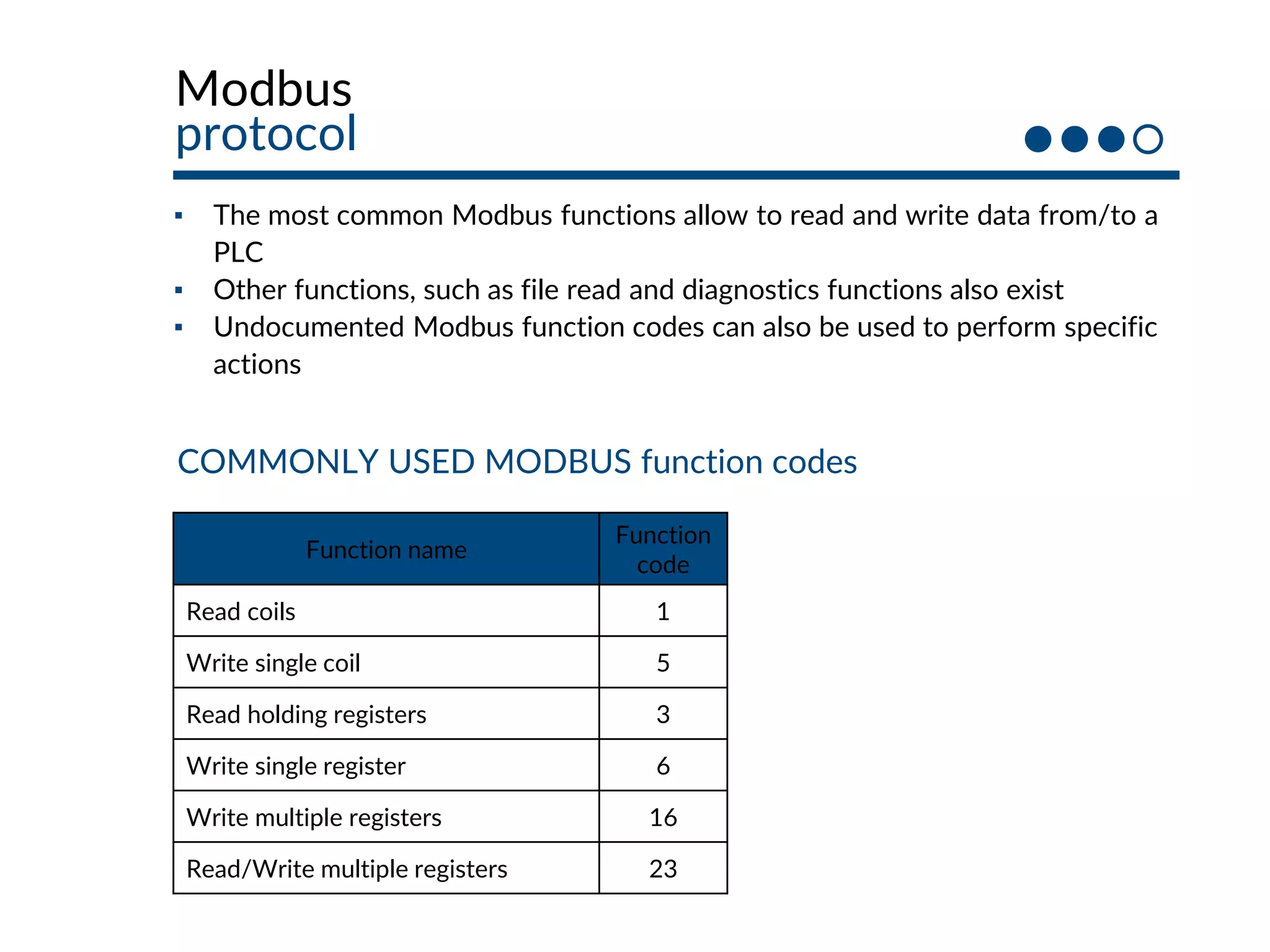
▪ The most common Modbus functions allow to read and write data from/to a
PLC
▪ Other functions, such as file read and diagnostics functions also exist
▪ Undocumented Modbus function codes can also be used to perform specific
actions
COMMONLY USED MODBUS function codes
Function name
Function
code
Read coils 1
Write single coil 5
Read holding registers 3
Write single register 6
Write multiple registers 16
Read/Write multiple registers 23
Modbus
protocol
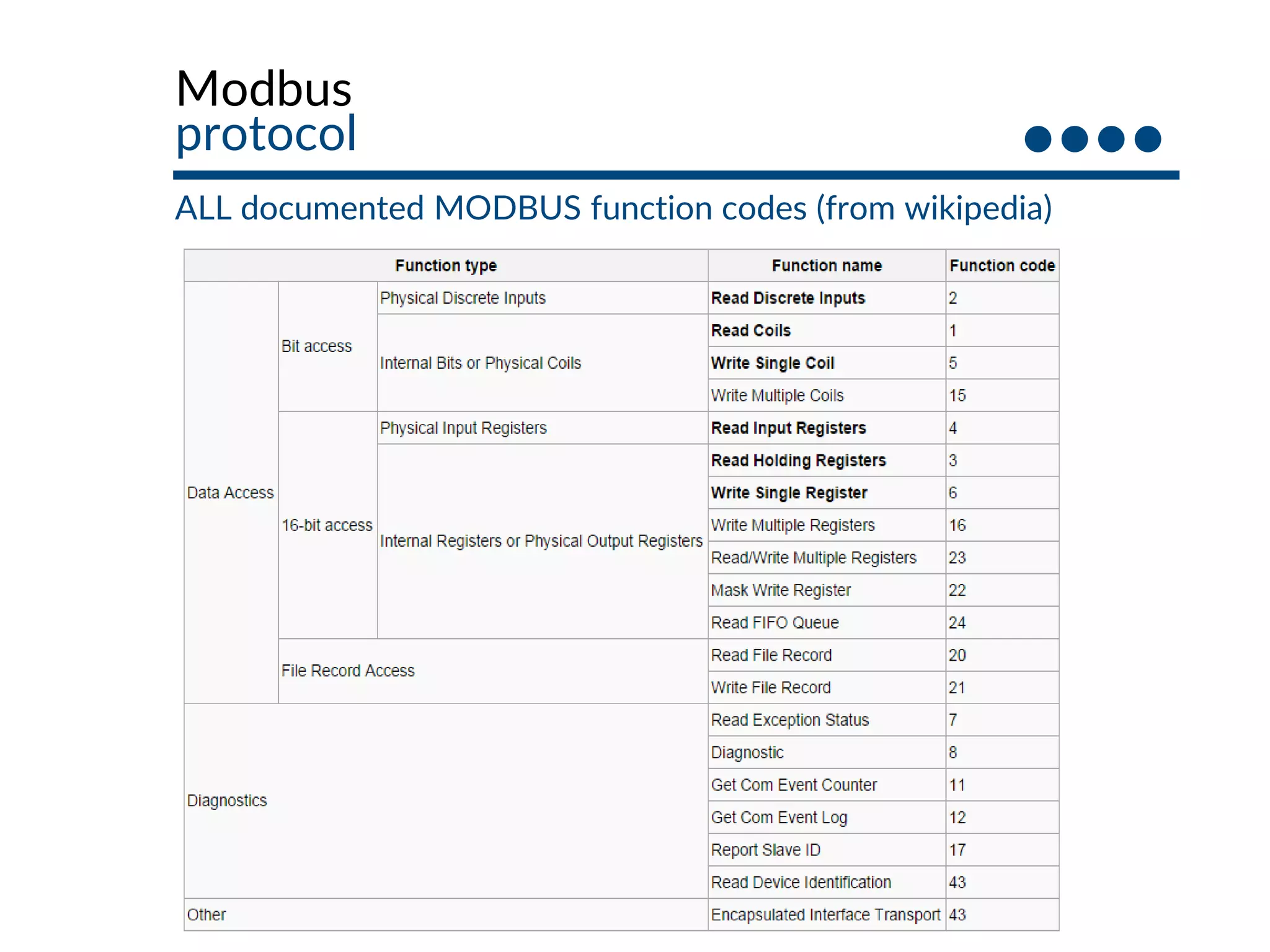
ALL documented MODBUS function codes (from wikipedia)
S7
protocol
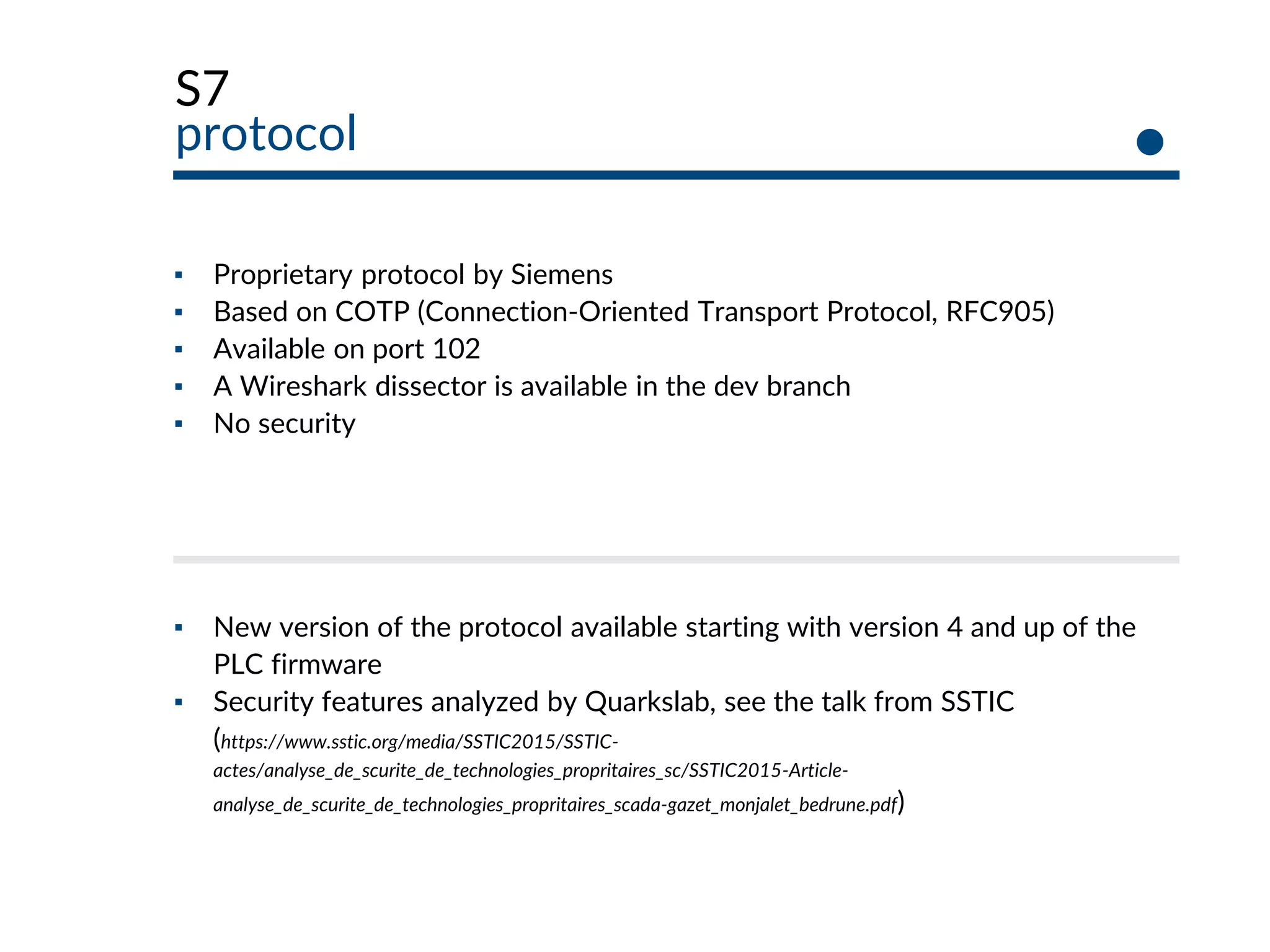
▪ Proprietary protocol by Siemens
▪ Based on COTP (Connection-Oriented Transport Protocol, RFC905)
▪ Available on port 102
▪ A Wireshark dissector is available in the dev branch
▪ No security
▪ New version of the protocol available starting with version 4 and up of the
PLC firmware
▪ Security features analyzed by Quarkslab, see the talk from SSTIC
(https://www.sstic.org/media/SSTIC2015/SSTIC-
actes/analyse_de_scurite_de_technologies_propritaires_sc/SSTIC2015-Article-
analyse_de_scurite_de_technologies_propritaires_scada-gazet_monjalet_bedrune.pdf)
Pentesting PLCs
● What is a PLC ?
● Attack surface
o SNMP
o Portscan
● Talking industrial protocols
o Modbus
o S7
o Known vulnerabilities ?
What is
A PLC?
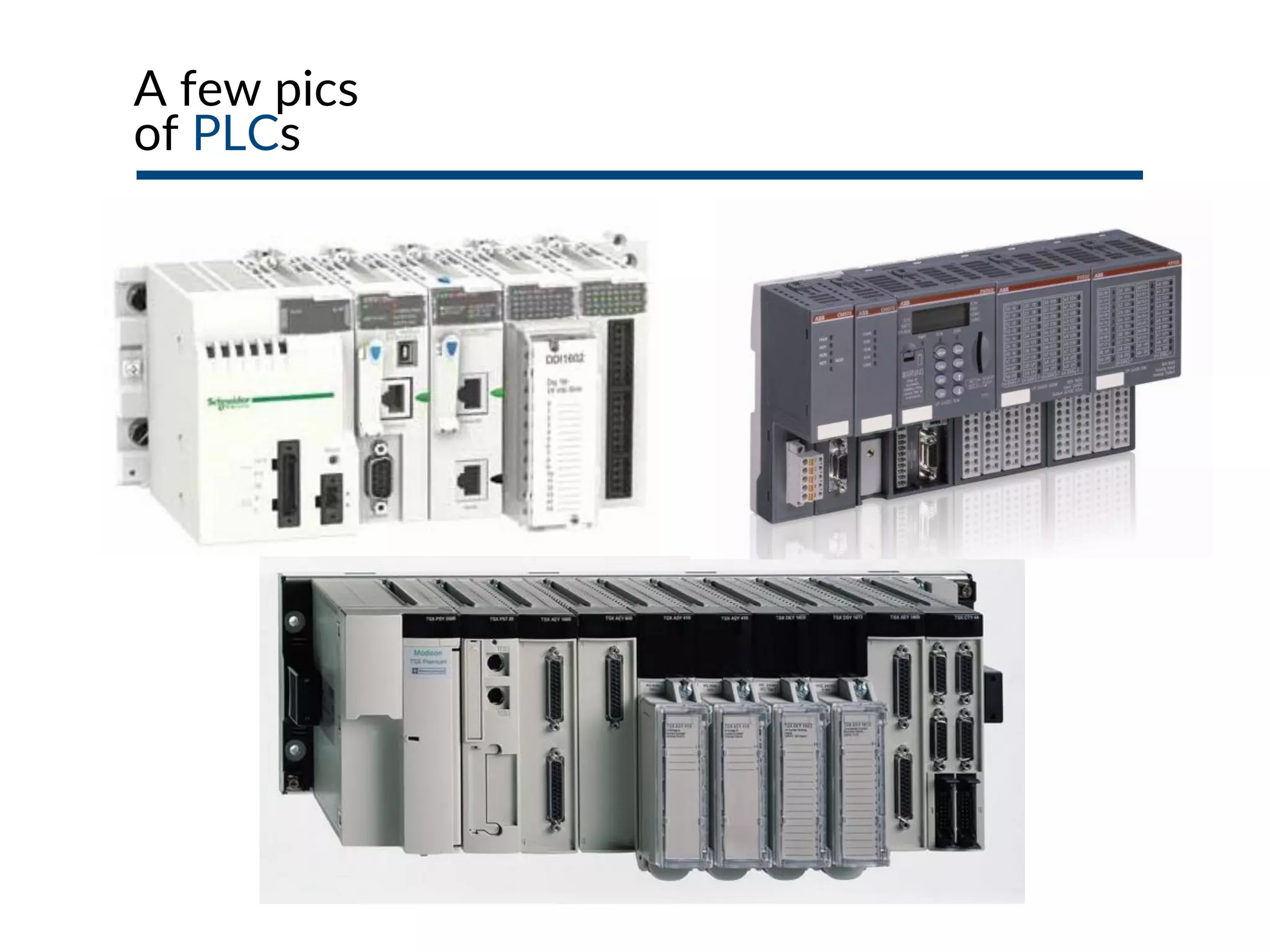
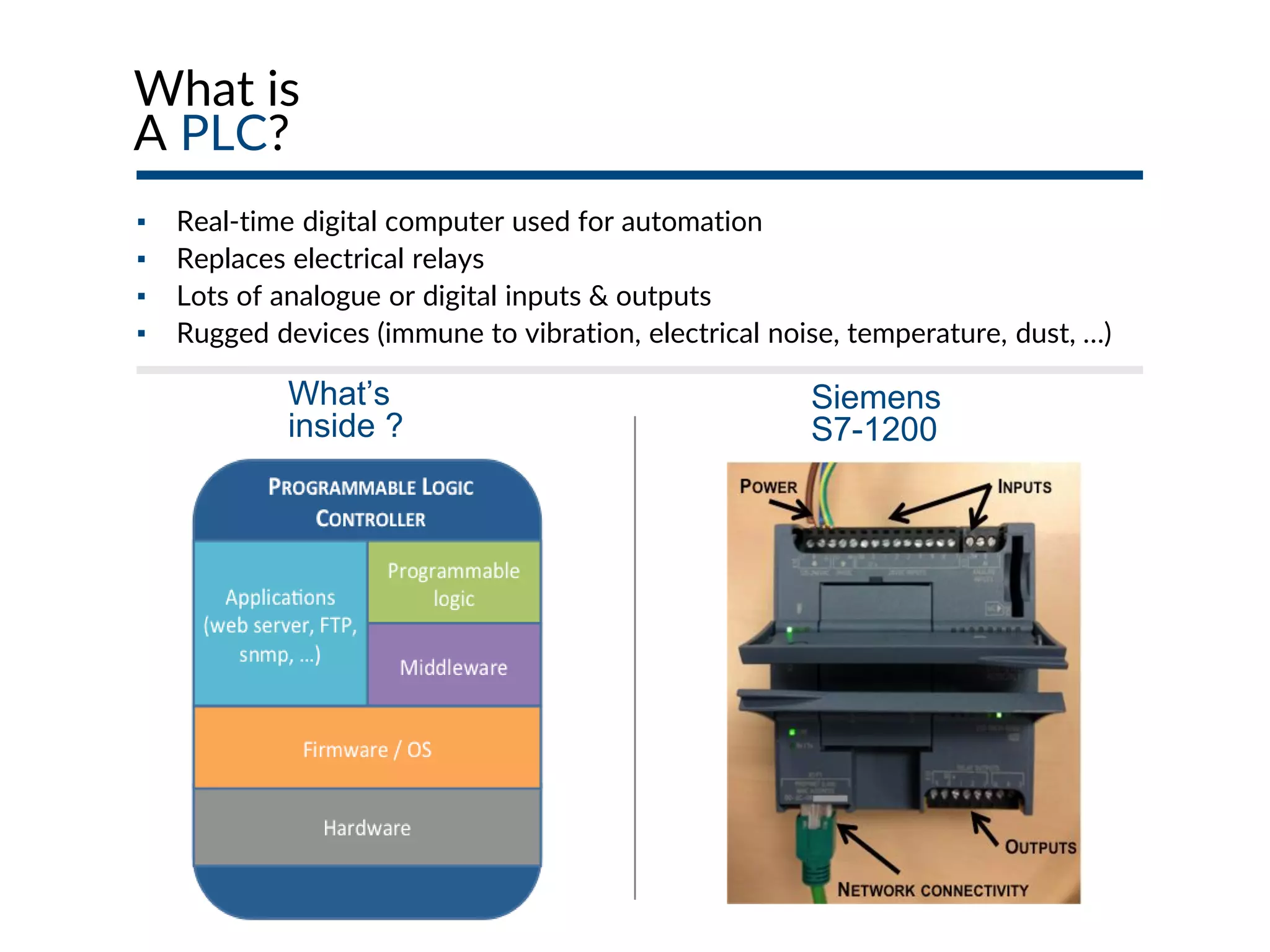
▪ Real-time digital computer used for automation
▪ Replaces electrical relays
▪ Lots of analogue or digital inputs & outputs
▪ Rugged devices (immune to vibration, electrical noise, temperature, dust, …)
What’s
inside ?
Siemens
S7-1200
A few pics
of PLCs
PLC
programming
▪ “Ladder Logic” was the first programming language for PLC, as it mimics the
real-life circuits
▪ IEC 61131-3 defines 5 programming languages for PLCs
▪ LD: Ladder Diagram
▪ FBD: Function Block Diagram
▪ ST: Structured Text
▪ IL: Instruction List
▪ SFC: Sequential Function Chart
Ladder diagram
example
Structured text
example
(* simple state machine *)
TxtState :=
STATES[StateMachine];
CASE StateMachine OF
1: ClosingValve();
ELSE
;; BadCase();
END_CASE;
LD Speed
GT 1000
JMPCN VOLTS_OK
LD Volts
VOLTS_OK LD 1
ST %Q75
Instruction list
example
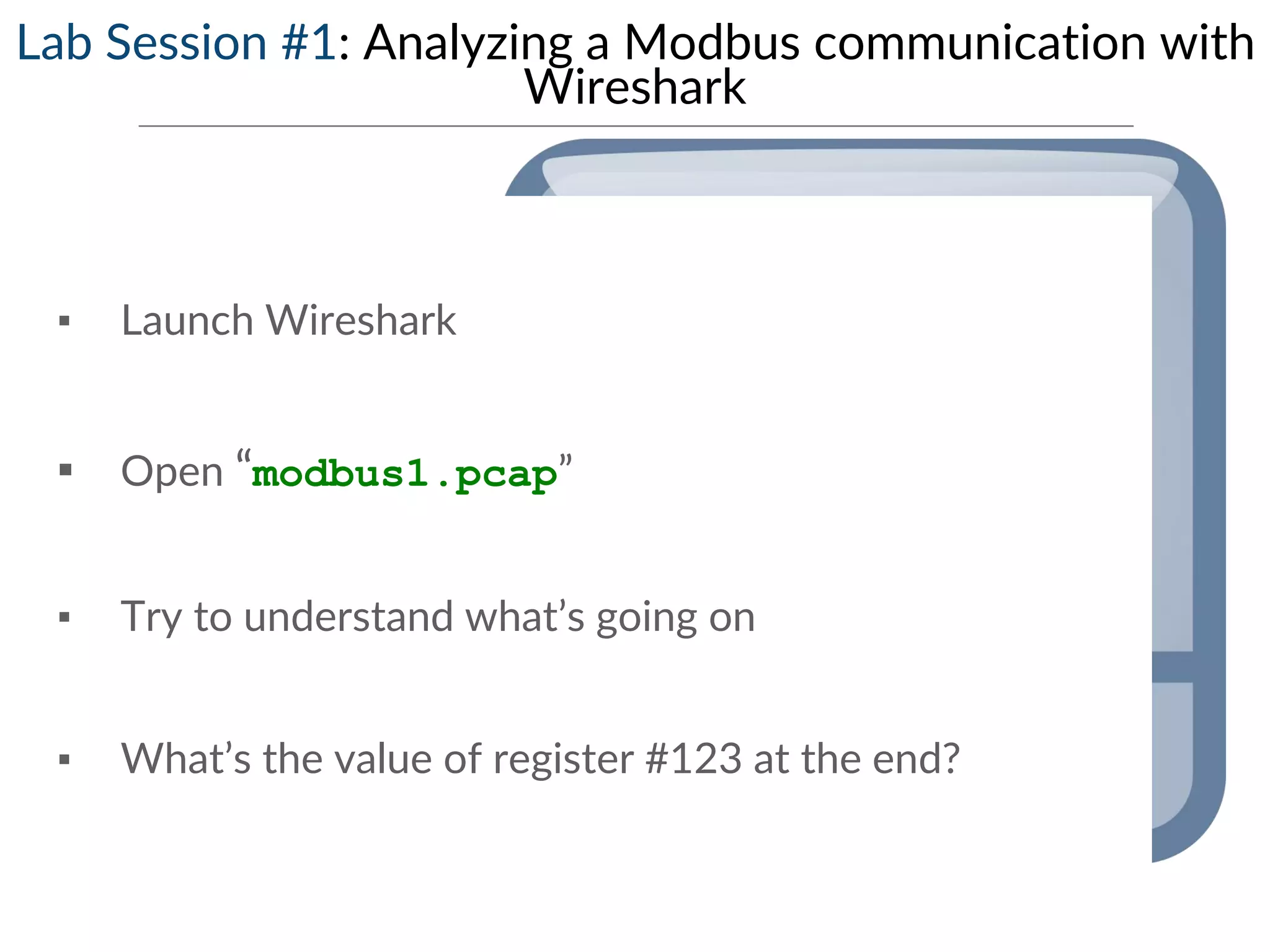
Lab Session #1: Analyzing a Modbus communication with
Wireshark
▪ Launch Wireshark
▪ Open “modbus1.pcap”
▪ Try to understand what’s going on
▪ What’s the value of register #123 at the end?
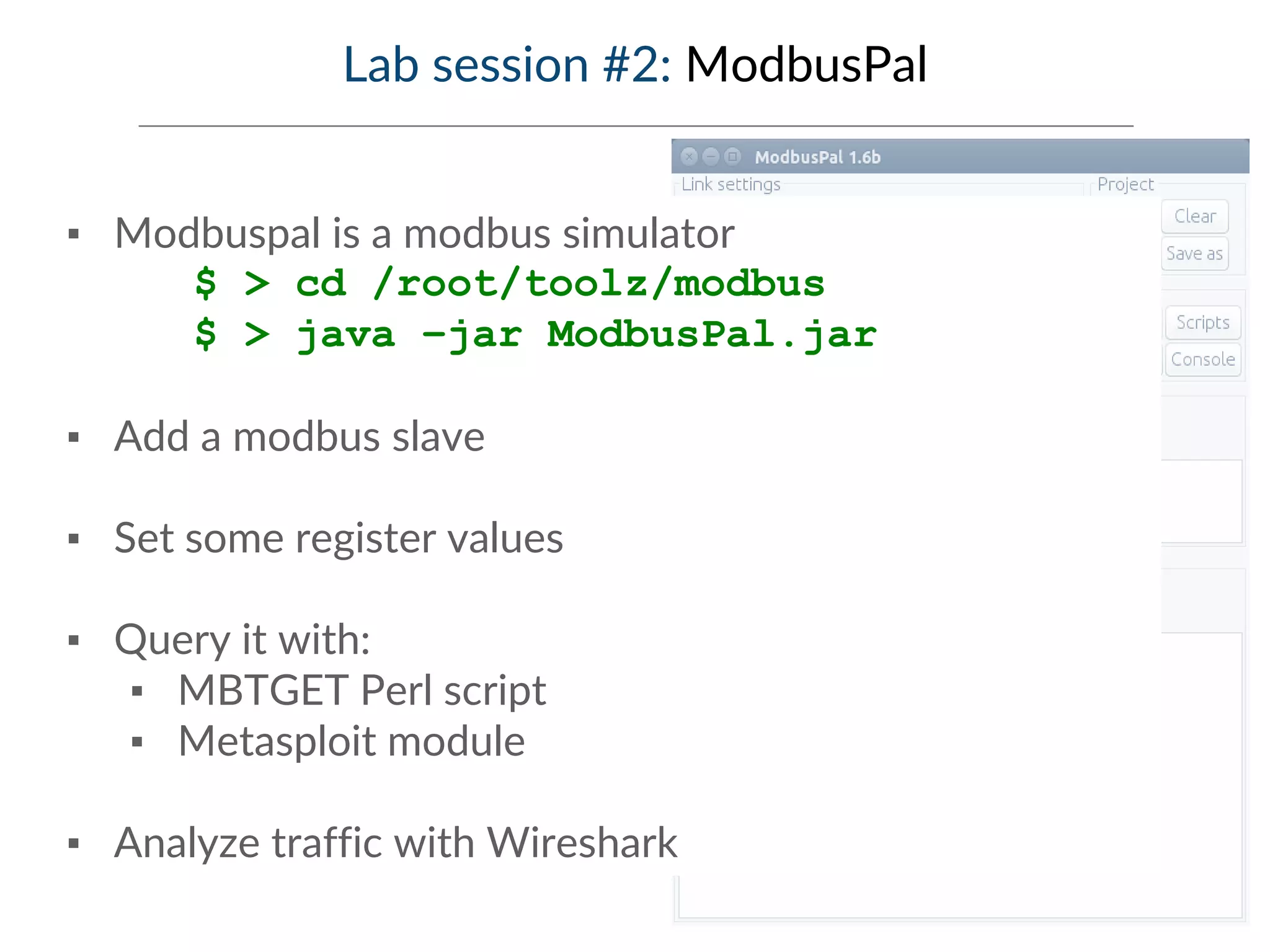
Lab session #2: ModbusPal
▪ Modbuspal is a modbus simulator
$ > cd /root/toolz/modbus
$ > java –jar ModbusPal.jar
▪ Add a modbus slave
▪ Set some register values
▪ Query it with:
▪ MBTGET Perl script
▪ Metasploit module
▪ Analyze traffic with Wireshark
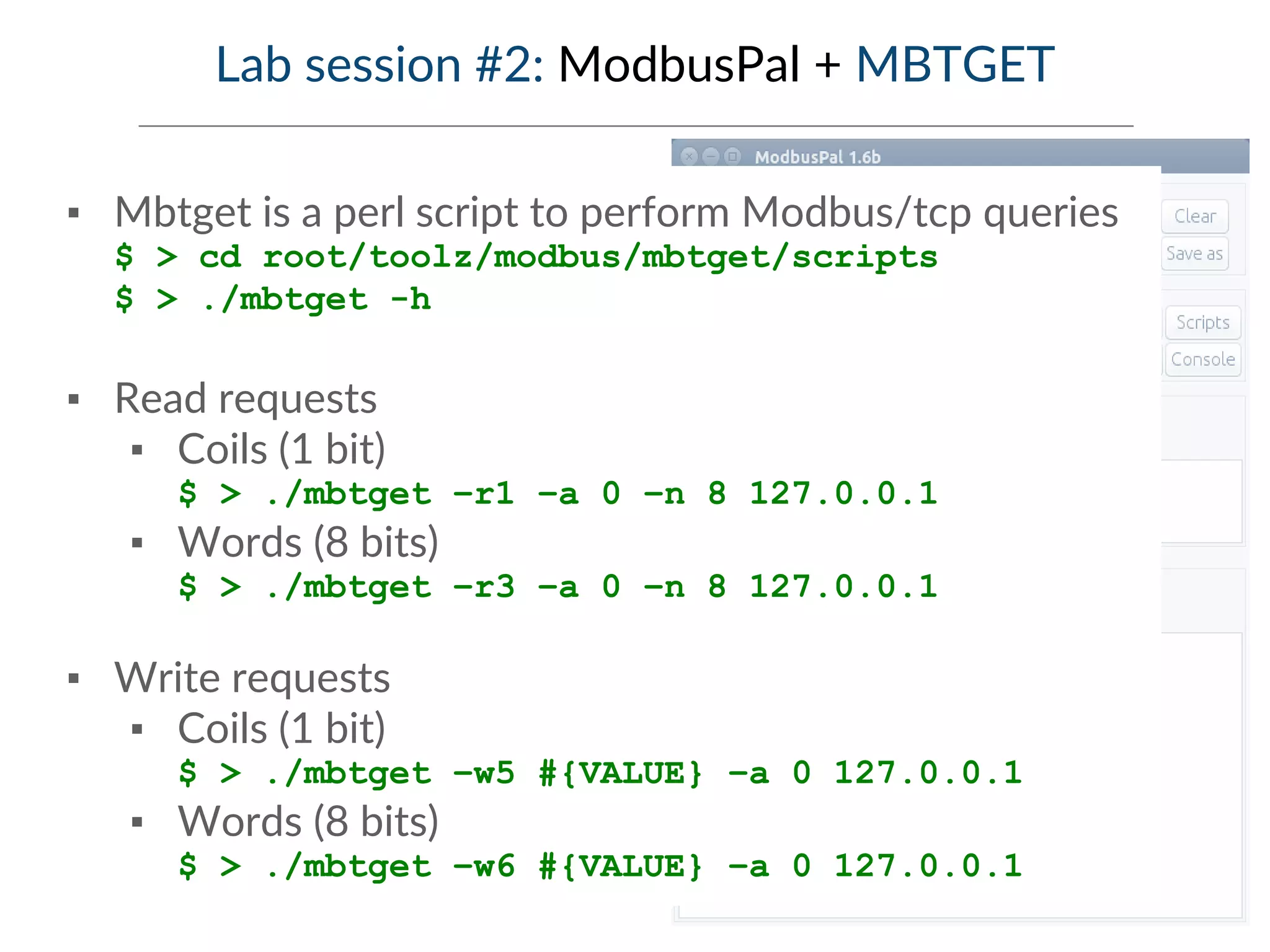
Lab session #2: ModbusPal + MBTGET
▪ Mbtget is a perl script to perform Modbus/tcp queries
$ > cd root/toolz/modbus/mbtget/scripts
$ > ./mbtget -h
▪ Read requests
▪ Coils (1 bit)
$ > ./mbtget –r1 –a 0 –n 8 127.0.0.1
▪ Words (8 bits)
$ > ./mbtget –r3 –a 0 –n 8 127.0.0.1
▪ Write requests
▪ Coils (1 bit)
$ > ./mbtget –w5 #{VALUE} –a 0 127.0.0.1
▪ Words (8 bits)
$ > ./mbtget –w6 #{VALUE} –a 0 127.0.0.1
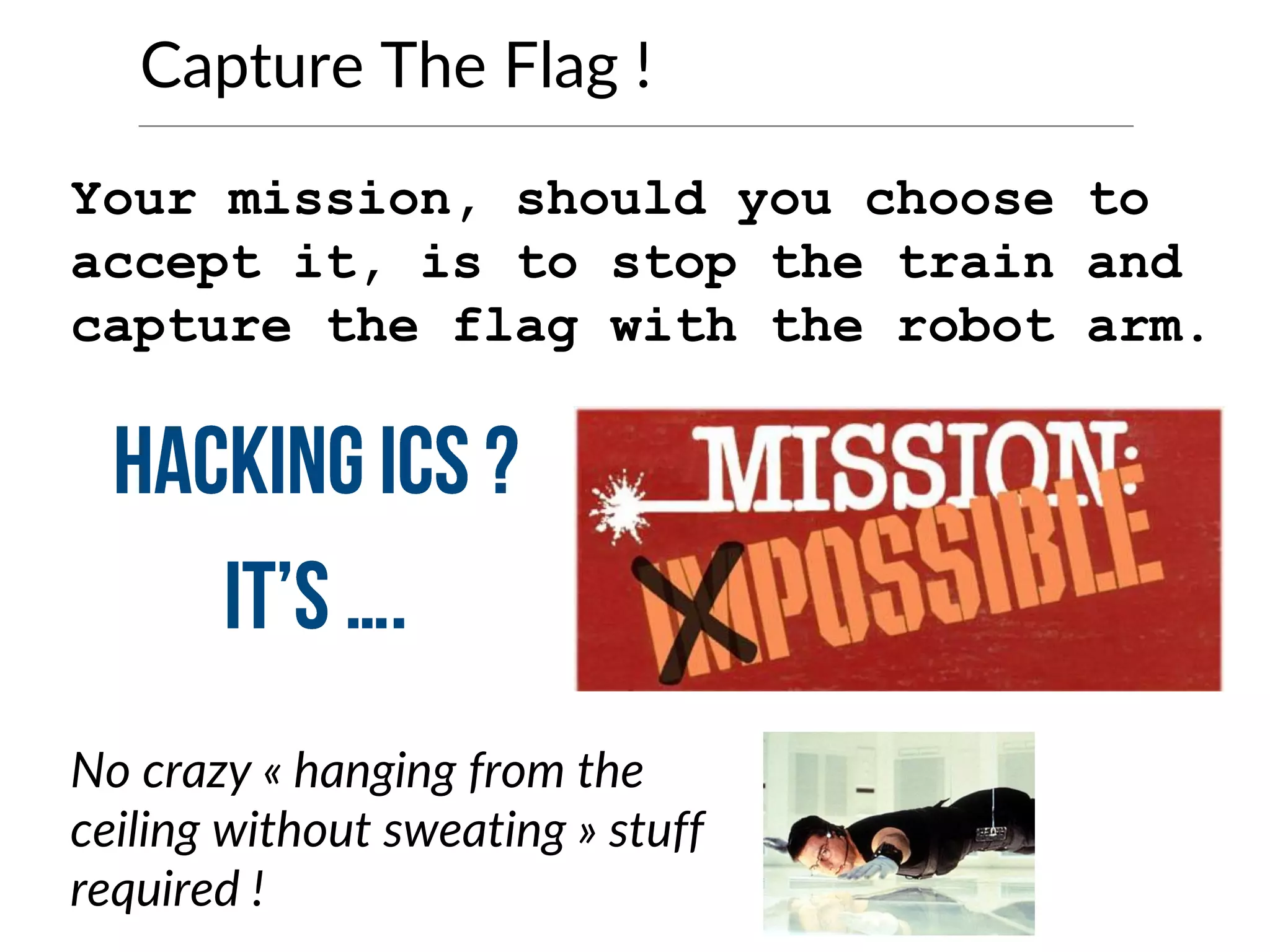
Capture The Flag !
Your mission, should you choose to
accept it, is to stop the train and
capture the flag with the robot arm.
No crazy « hanging from the
ceiling without sweating » stuff
required !
ng
plcs
Never do this
on LIVE production systems
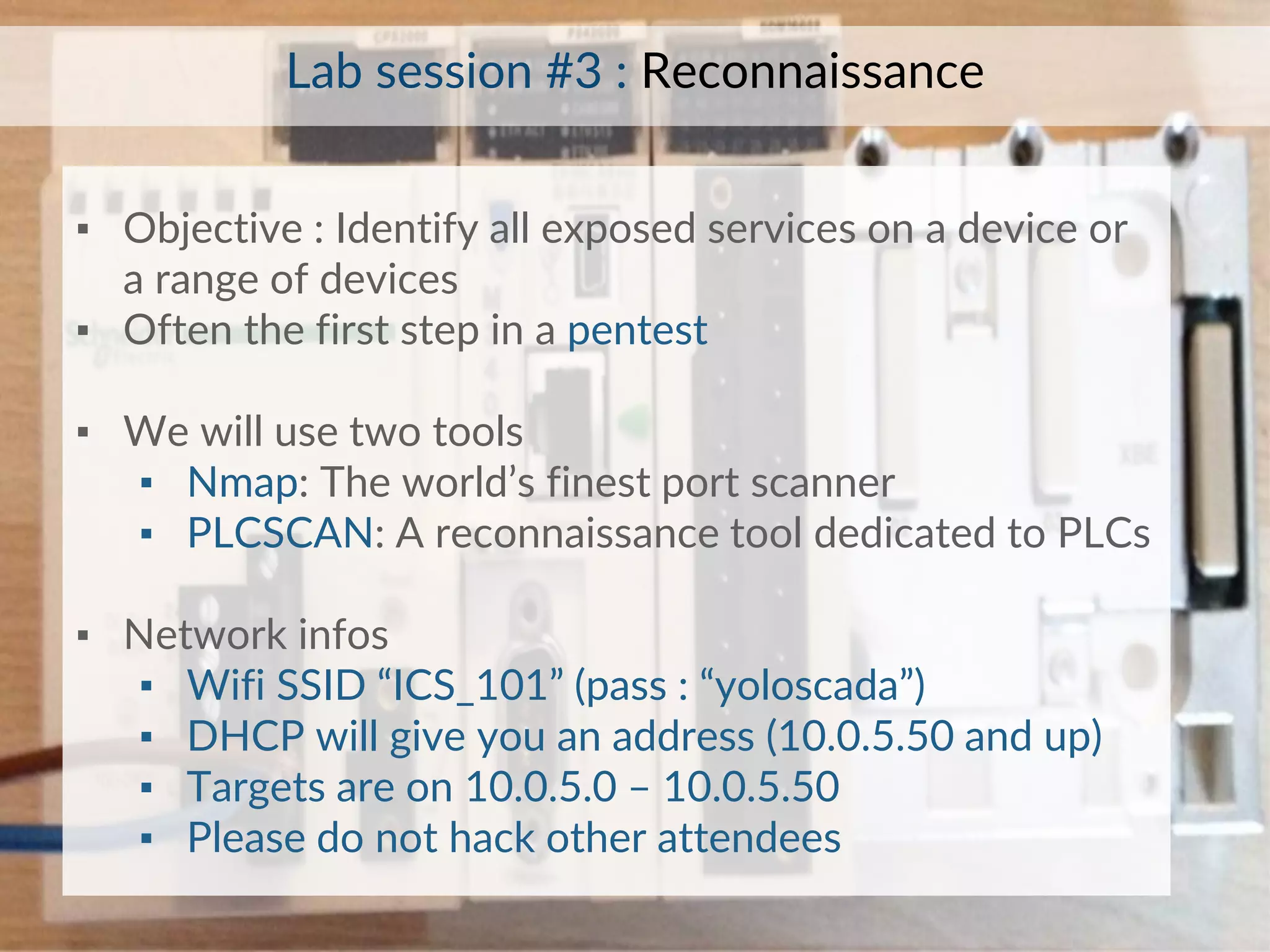
▪ Objective : Identify all exposed services on a device or
a range of devices
▪ Often the first step in a pentest
▪ We will use two tools
▪ Nmap: The world’s finest port scanner
▪ PLCSCAN: A reconnaissance tool dedicated to PLCs
▪ Network infos
▪ Wifi SSID “ICS_101” (pass : “yoloscada”)
▪ DHCP will give you an address (10.0.5.50 and up)
▪ Targets are on 10.0.5.0 – 10.0.5.50
▪ Please do not hack other attendees
Lab session #3 : Reconnaissance
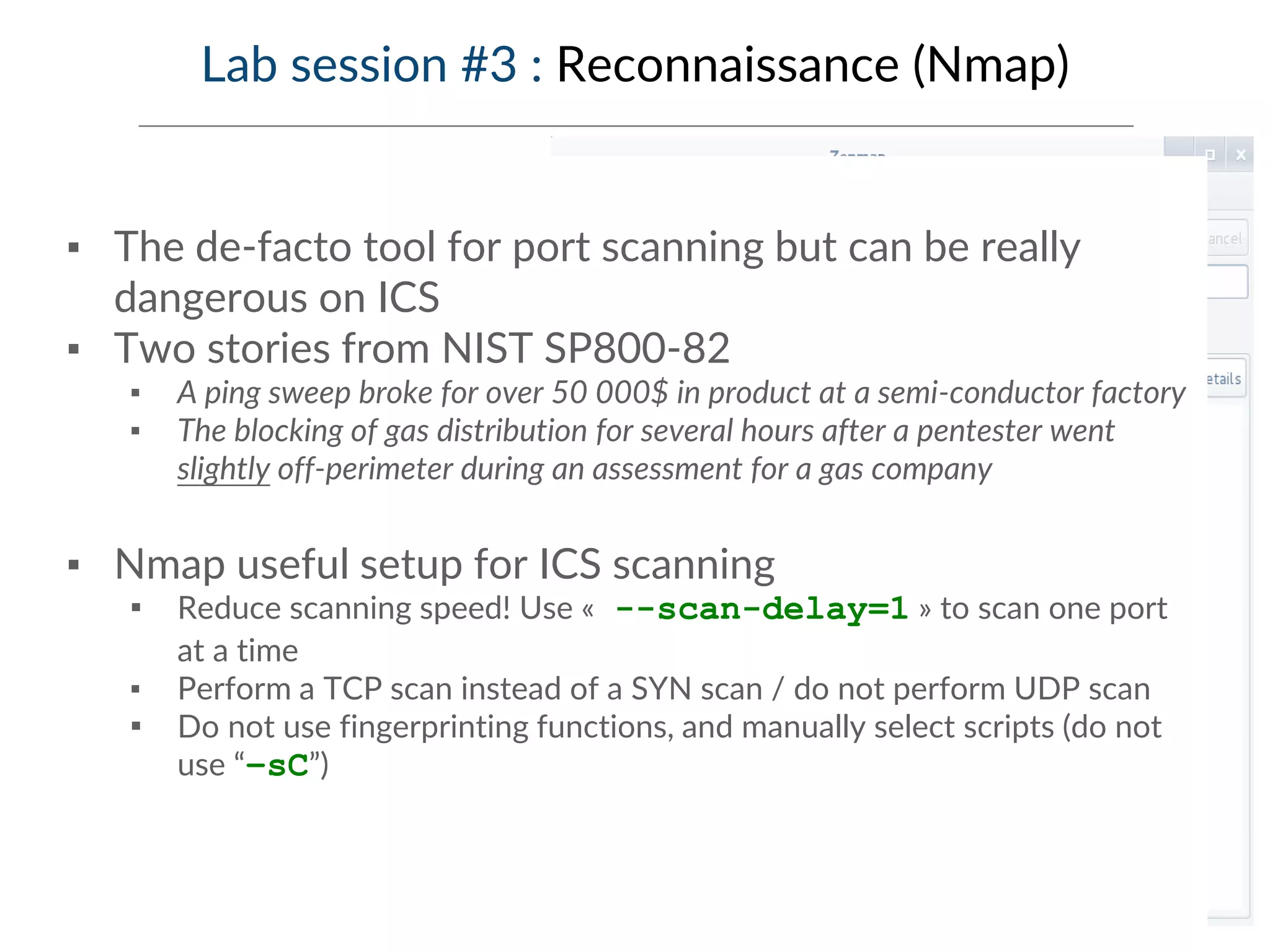
Lab session #3 : Reconnaissance (Nmap)
▪ The de-facto tool for port scanning but can be really
dangerous on ICS
▪ Two stories from NIST SP800-82
▪ A ping sweep broke for over 50 000$ in product at a semi-conductor factory
▪ The blocking of gas distribution for several hours after a pentester went
slightly off-perimeter during an assessment for a gas company
▪ Nmap useful setup for ICS scanning
▪ Reduce scanning speed! Use « --scan-delay=1 » to scan one port
at a time
▪ Perform a TCP scan instead of a SYN scan / do not perform UDP scan
▪ Do not use fingerprinting functions, and manually select scripts (do not
use “–sC”)
Lab session #3 : Reconnaissance (PLCSCAN)
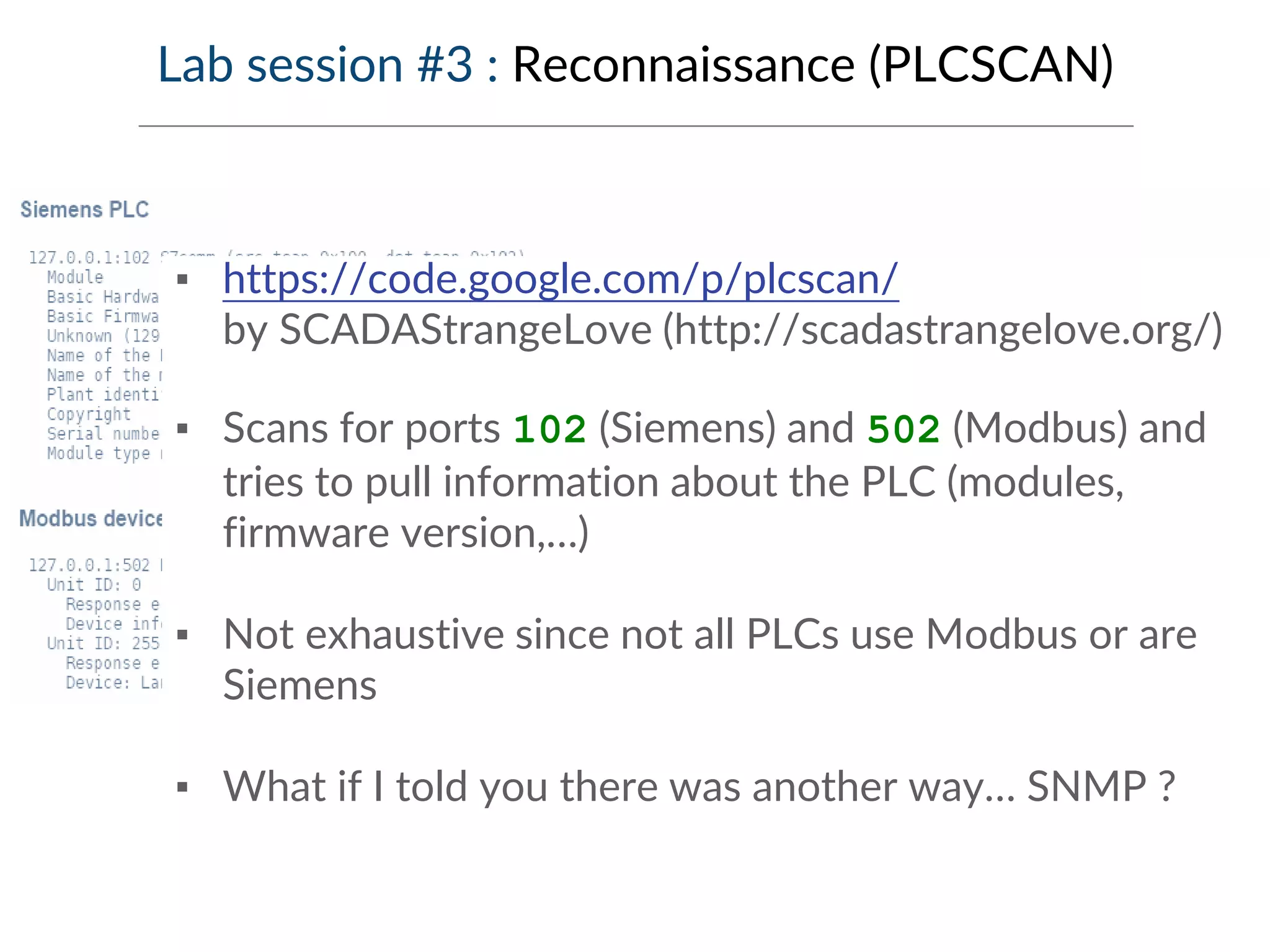
▪ https://code.google.com/p/plcscan/
by SCADAStrangeLove (http://scadastrangelove.org/)
▪ Scans for ports 102 (Siemens) and 502 (Modbus) and
tries to pull information about the PLC (modules,
firmware version,…)
▪ Not exhaustive since not all PLCs use Modbus or are
Siemens
▪ What if I told you there was another way… SNMP ?
Attacking standard services
▪ Most PLCs have standard interfaces, such as HTTP and
FTP
▪ Lets’ say security was not the first thing in mind when
introducing these features …
Lab session #5 : Attacking ICS protocols
▪ Modbus
▪ Scan for registry values using mbtget
▪ You can also use Metasploit, or pymodbus/rmodbus
▪ Siemens S7-1200
▪ Read inputs/outputs using Snap7 python scripts or
demos
▪ Unauthenticated actions (M340/Premium/Quantum)
▪ STOP/RUN
msf > use auxiliary/admin/scada/modicon_command
▪ Logic download/upload
msf > use
auxiliary/admin/scada/modicon_stux_transfer
Lab session #6 : Speaking S7
▪ Snap7 is an open-source library implementing the Siemens
S7 protocol
▪ It is quite complete for “old” PLCs, but not all functions
work on newer PLCS (S7-1200, S7-1500)
▪ You can read the inputs and outputs of the PLC
python s7-read-new.py XX.XX.XX.XX
▪ You can also write outputs values
python s7-writeoutputs-new.py XX.XX.XX.XX
▪ There is also a GUI
./clientdemo
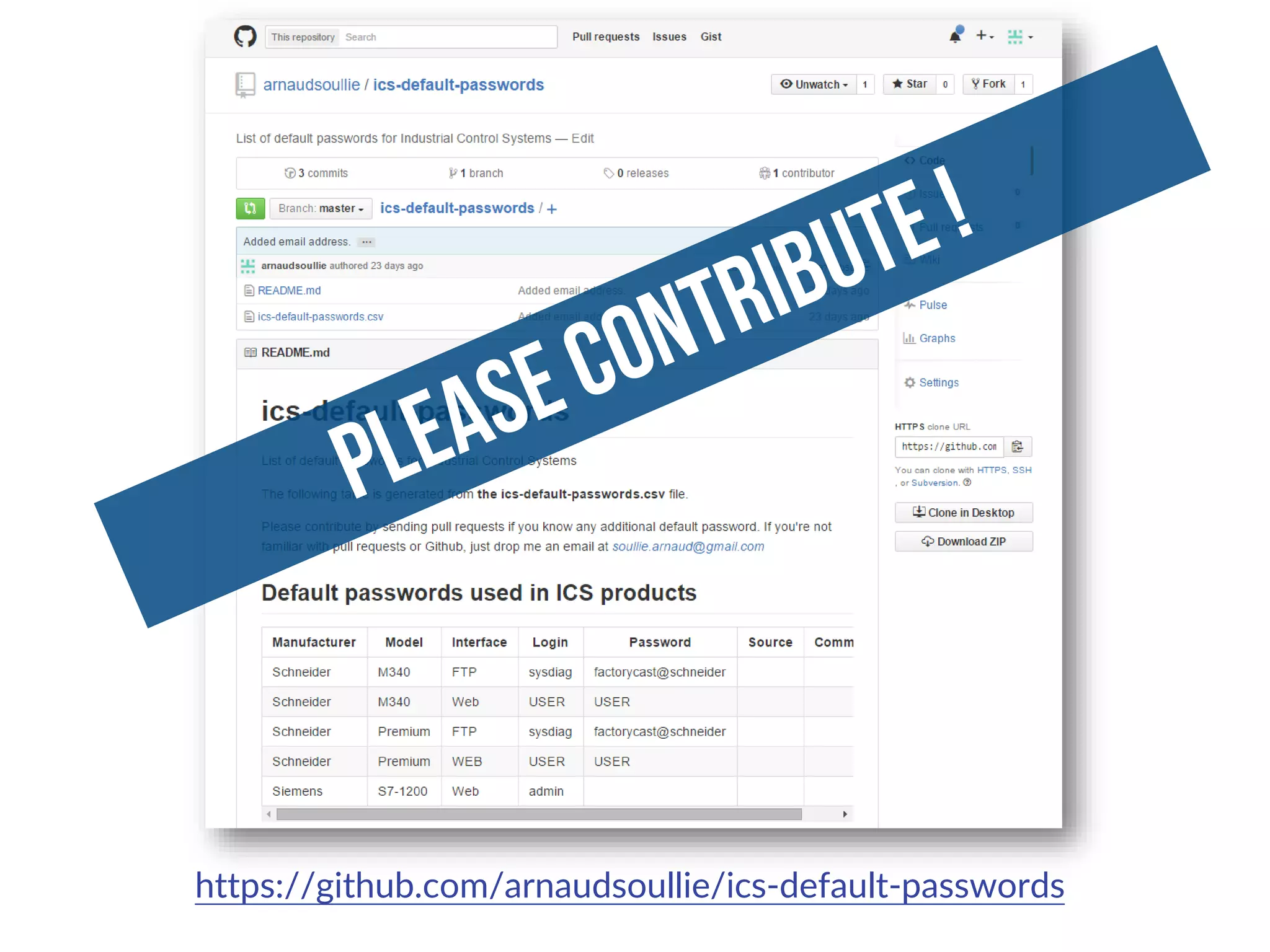
https://github.com/arnaudsoullie/ics-default-passwords

BruCON 2015 - Pentesting ICS 101

  • 1.
  • 2.
    Who are we? Seniorsecurity auditor  Windows Active Directory Can a Windows AD be secured ? JSSI 2014 (French, sorry)  SCADA stuff (BHEU/HIP/BSIDES/…)  Wine tasting / Motorbike riding (we’re not going to talk about it today)  Sorry for the French accent interests @arnaudsoullie
  • 3.
    Who are we? Studentat Télécom ParisTech  Communication and System Security Master at EURECOM  SCADA stuff (BHEU, project SCADA in the Cloud)  Security challenges (W3Challs)  Tanning (well, I live in Sophia Antipolis) interests
  • 4.
    KALI LINUX 2.0  MODBUSPAL MBTGET  PLCSCAN  SNAP7  … ADDITIONAL TOOLS  PCAP SAMPLES  SCRIPTS SKELETONS  … SCRIPTS LAB
  • 7.
    Where do wefind Industrial Control Systems ? Manufacturing plants Food Power plants Building automation systems (AC/HVAC/..) Water treatment Pharmaceutical manufacturing Chemical plants But also…swimming pools, building heating system, dams, etc.
  • 8.
    What is anIndustrial Control System (ICS)? Group WAN Production management ERP server Corporate IT Corporate network Data Historian / Scada server Maintenanc e laptops Supervision consoles Supervision network / SCADA PLCs RTUs Production network ICS PLC Wireless industrial networks Corporate IS handle data ≠ ICS handle interfaces data with physical world (cyber-physical systems)
  • 9.
    What about IoT/ smart stuff ?  Fit the definition of « cyber-physical » systems • Cardio-meter for your smartphone • « Smart » electrical plugs By the way, « smart » clearly isn’t the right word http://weputachipinit.tumblr.com/
  • 10.
    Evolution of ICS Started with electrical relays  hard wired automation, no update possible  Then moved to programmable electronics  Then to IP-network enabled devices  Now and future is more and more COTS
  • 11.
    ICS evolution timeline From 1700s : Industrial revolution  1900s : use of relays to control remote systems  1950s : use of punch paper tape to control machines  1960s : use of distributed control to control a plant  1969 : First PLCs  1979 : Modbus invented  1986 : PLCs controled by PCs  1992 : TCP/IP for PLCs  2003 : web servers for PLCs  ~2010s : Brace yourselves, AD is coming !  Then what for the 10 next years ??
  • 12.
    Future of ICS(well at least, current trends) Now and future is more and more COTS Active Directory domains Soft-PLCs : CodeSYS under Windows computers
  • 13.
    This is whathappens when you start using too much IT in OT
  • 14.
    A bit ofvocabulary ICS (Industrial Control System) = IACS (Industrial Automation and Control Systems) ~= SCADA (Supervisory Control And Data Acquisition) ~= DCS (Distributed Control System) Nowadays, people tend to say “SCADA” for anything related to ICS
  • 15.
    SCADA vs DCS ▪SCADA : event / data acquisition driven ▪ Used across several sites (even at the country scale) ▪ Can work even when offline ▪ Low response time ▪ DCS : process driven ▪ Limited to local process monitoring ▪ DCS works as standalone system ▪ Dedicated products by the vendors for specific industries / process ▪ In the real world,you’ll find some PLCs even when DCS is used ▪ Today, SCADA manufacturer tend to have DCS functionnality, while DCS systems response time is lowering to be comparable to traditional SCADA response time In theory … In reality …
  • 16.
    SCADA vs DCS Siemensvision From « DCS or PLC? Seven Questions to Help You Select the Best Solution” http://w3.siemens.com/mcms/process-control- systems/SiteCollectionDocuments/efiles/pcs7/support/marktstudien/PLC_or_DCS.pdf
  • 17.
    ICS COMPONENTS ▪ Sensorsand actuators: allow interaction with the physical world (pressure sensor, valves, motors, …) ▪ Local HMI: Human-Machine Interface, permits the supervision and control of a subprocess ▪ PLC: Programmable Logic Controller : manages the sensors and actuators ▪ Supervision screen: remote supervision of the industrial process ▪ Data historian: Records all the data from the production and Scada networks ▪ RTU : Remote Terminal Unit (standalone PLC) ▪ IED : Intelligent Electronic Device (smart sensor)
  • 18.
    Industrial protocols  Atthe beginning, specific protocols on specific physical layer (RS232, RS285, 4-20mA current loop)  Some protocols were adapted to TCP/IP, like Modbus, and other were developped to allow interoperability.  Currently, the most used seem to be :  HART / Wireless HART  Profibus  Modbus  Profinet / S7  DNP3  For the field protocols (used by the PLCs, and some « intelligent » sensors/actuators)  OPC for data exchanged with the corporate network / Windows- based systems
  • 19.
    IT vs OT ITOT Availability : My system is working correctly Integrity : My system is working as expected OT cares more about safety. Applied regularly on standards systems Security patches Only recently provided by vendors. Applied once a year tops Deployed on all Windows machines, centrally managed Antivirus Sowly starting to show up. Some vendors used to / stil forbid AV usage (lack of support if AV is installed) Not managed Centralized, dedicated teams, standard operations and procedures System Administration Lack of local skills, heterogeneous environments, lots of different tools to use, vendor support is mandatory Nominative accounts IAM Generic, shared accounts, no password policy Service interuptions are OK, especially outside business hours Availability Real-time operations, downtime is unacceptable or very costly Standard, TCP/IP protocols that include authentication and encryption Protocols Lot of vendor-specific protocol no security built in No people endangered Impact Possible impact of people, environnent, industrial gear
  • 20.
    Who cares ? <2011 September5, 2014 SCADA SECURITY AWARENESS TIMELINE (SIMPLIFIED)
  • 21.
    Who cares ? OMG! OMG ! STUXNET !!! 2011 <2011 SCADA SECURITY AWARENESS TIMELINE (SIMPLIFIED)
  • 22.
    Who cares ? OMG! OMG ! STUXNET !!! Under control2011 <2011 One day ? SCADA SECURITY AWARENESS TIMELINE (SIMPLIFIED)
  • 23.
    ICS security awarenessis growing At the government level In industrial companies For the general audience
  • 24.
    Vendors Cyber-Security offer MostICS vendors have now understood the client’s worries about security and offer different kinds of dedicated products and/or services That DOES NOT mean that vendors’ staff has the required knowledge and training about ICS security
  • 27.
    ▪ Shodan isa search engine dedicated to find devices exposed to the Internet ▪ It regularly scans the whole Internet IPV4 range (~4,3 billions IPs) ▪ Results are partially free (you have to pay to export the results) ▪ All kinds of connected devices ▪ PLCs ▪ Webcams ▪ Smart-things (fridge, TV, …) ▪ Things you can’t even imagine… ▪ Example ICS report : https://www.shodan.io/report/l7VjfVKc What can you find? ▪ Scan the Internet yourself (Zmap, Massscan) ▪ Other online services/surveys ALTERNATIVES?
  • 28.
    FUNNy things youcan find on teh interwebs It’s not just webcams.
  • 29.
    #foreverdays #foreverdays is aterm coined by @reverseics Very important concept when talking about ICS The highest vulnerabilities are not patched. So it is really worth considering the effort of patch management of ICS equipement when you know
  • 30.
    Security in protocols ICSdevices often use proprietary protocols, and there are also several standards. That is why on a given plant/factory ICS, you are likely to find several protocols in use. We will cover the most used ones.
  • 31.
  • 32.
    Modbus protocol ▪ Serialcommunication protocol invented in 1979 by Schneider Electric ▪ Developed for industrial application ▪ Royalty-free ▪ Now one of the standards for industrial communications ▪ Master / Slave protocol ▪ Master must regularly poll the slaves to get information ▪ Modbus addresses are 8 bits long, so only 247 slaves per master ▪ There is no object description: a request returns a value, without any context or unit HOW it works ▪ Clear-text ▪ No authentication Security anyone?
  • 33.
    Modbus protocol ▪ Modbus wasoriginally made for serial communications ▪ However it is now often used over TCP MODBUS/TCP FRAME FORMAT Name Length Function Transaction identifier 2 For synchronization between server & client Protocol identifier 2 Zero for Modbus/TCP Length field 2 Number of remaining bytes in this frame Unit identifier 1 Slave address (255 if not used) Function code 1 Function codes as in other variants Data bytes or command n Data as response or commands
  • 34.
    Modbus protocol ▪ The mostcommon Modbus functions allow to read and write data from/to a PLC ▪ Other functions, such as file read and diagnostics functions also exist ▪ Undocumented Modbus function codes can also be used to perform specific actions COMMONLY USED MODBUS function codes Function name Function code Read coils 1 Write single coil 5 Read holding registers 3 Write single register 6 Write multiple registers 16 Read/Write multiple registers 23
  • 35.
    Modbus protocol ALL documented MODBUSfunction codes (from wikipedia)
  • 36.
    S7 protocol ▪ Proprietary protocolby Siemens ▪ Based on COTP (Connection-Oriented Transport Protocol, RFC905) ▪ Available on port 102 ▪ A Wireshark dissector is available in the dev branch ▪ No security ▪ New version of the protocol available starting with version 4 and up of the PLC firmware ▪ Security features analyzed by Quarkslab, see the talk from SSTIC (https://www.sstic.org/media/SSTIC2015/SSTIC- actes/analyse_de_scurite_de_technologies_propritaires_sc/SSTIC2015-Article- analyse_de_scurite_de_technologies_propritaires_scada-gazet_monjalet_bedrune.pdf)
  • 38.
    Pentesting PLCs ● Whatis a PLC ? ● Attack surface o SNMP o Portscan ● Talking industrial protocols o Modbus o S7 o Known vulnerabilities ?
  • 39.
    What is A PLC? ▪Real-time digital computer used for automation ▪ Replaces electrical relays ▪ Lots of analogue or digital inputs & outputs ▪ Rugged devices (immune to vibration, electrical noise, temperature, dust, …) What’s inside ? Siemens S7-1200
  • 40.
  • 41.
    PLC programming ▪ “Ladder Logic”was the first programming language for PLC, as it mimics the real-life circuits ▪ IEC 61131-3 defines 5 programming languages for PLCs ▪ LD: Ladder Diagram ▪ FBD: Function Block Diagram ▪ ST: Structured Text ▪ IL: Instruction List ▪ SFC: Sequential Function Chart Ladder diagram example Structured text example (* simple state machine *) TxtState := STATES[StateMachine]; CASE StateMachine OF 1: ClosingValve(); ELSE ;; BadCase(); END_CASE; LD Speed GT 1000 JMPCN VOLTS_OK LD Volts VOLTS_OK LD 1 ST %Q75 Instruction list example
  • 42.
    Lab Session #1:Analyzing a Modbus communication with Wireshark ▪ Launch Wireshark ▪ Open “modbus1.pcap” ▪ Try to understand what’s going on ▪ What’s the value of register #123 at the end?
  • 43.
    Lab session #2:ModbusPal ▪ Modbuspal is a modbus simulator $ > cd /root/toolz/modbus $ > java –jar ModbusPal.jar ▪ Add a modbus slave ▪ Set some register values ▪ Query it with: ▪ MBTGET Perl script ▪ Metasploit module ▪ Analyze traffic with Wireshark
  • 44.
    Lab session #2:ModbusPal + MBTGET ▪ Mbtget is a perl script to perform Modbus/tcp queries $ > cd root/toolz/modbus/mbtget/scripts $ > ./mbtget -h ▪ Read requests ▪ Coils (1 bit) $ > ./mbtget –r1 –a 0 –n 8 127.0.0.1 ▪ Words (8 bits) $ > ./mbtget –r3 –a 0 –n 8 127.0.0.1 ▪ Write requests ▪ Coils (1 bit) $ > ./mbtget –w5 #{VALUE} –a 0 127.0.0.1 ▪ Words (8 bits) $ > ./mbtget –w6 #{VALUE} –a 0 127.0.0.1
  • 45.
    Capture The Flag! Your mission, should you choose to accept it, is to stop the train and capture the flag with the robot arm. No crazy « hanging from the ceiling without sweating » stuff required !
  • 46.
    ng plcs Never do this onLIVE production systems
  • 47.
    ▪ Objective :Identify all exposed services on a device or a range of devices ▪ Often the first step in a pentest ▪ We will use two tools ▪ Nmap: The world’s finest port scanner ▪ PLCSCAN: A reconnaissance tool dedicated to PLCs ▪ Network infos ▪ Wifi SSID “ICS_101” (pass : “yoloscada”) ▪ DHCP will give you an address (10.0.5.50 and up) ▪ Targets are on 10.0.5.0 – 10.0.5.50 ▪ Please do not hack other attendees Lab session #3 : Reconnaissance
  • 48.
    Lab session #3: Reconnaissance (Nmap) ▪ The de-facto tool for port scanning but can be really dangerous on ICS ▪ Two stories from NIST SP800-82 ▪ A ping sweep broke for over 50 000$ in product at a semi-conductor factory ▪ The blocking of gas distribution for several hours after a pentester went slightly off-perimeter during an assessment for a gas company ▪ Nmap useful setup for ICS scanning ▪ Reduce scanning speed! Use « --scan-delay=1 » to scan one port at a time ▪ Perform a TCP scan instead of a SYN scan / do not perform UDP scan ▪ Do not use fingerprinting functions, and manually select scripts (do not use “–sC”)
  • 49.
    Lab session #3: Reconnaissance (PLCSCAN) ▪ https://code.google.com/p/plcscan/ by SCADAStrangeLove (http://scadastrangelove.org/) ▪ Scans for ports 102 (Siemens) and 502 (Modbus) and tries to pull information about the PLC (modules, firmware version,…) ▪ Not exhaustive since not all PLCs use Modbus or are Siemens ▪ What if I told you there was another way… SNMP ?
  • 50.
    Attacking standard services ▪Most PLCs have standard interfaces, such as HTTP and FTP ▪ Lets’ say security was not the first thing in mind when introducing these features …
  • 51.
    Lab session #5: Attacking ICS protocols ▪ Modbus ▪ Scan for registry values using mbtget ▪ You can also use Metasploit, or pymodbus/rmodbus ▪ Siemens S7-1200 ▪ Read inputs/outputs using Snap7 python scripts or demos ▪ Unauthenticated actions (M340/Premium/Quantum) ▪ STOP/RUN msf > use auxiliary/admin/scada/modicon_command ▪ Logic download/upload msf > use auxiliary/admin/scada/modicon_stux_transfer
  • 52.
    Lab session #6: Speaking S7 ▪ Snap7 is an open-source library implementing the Siemens S7 protocol ▪ It is quite complete for “old” PLCs, but not all functions work on newer PLCS (S7-1200, S7-1500) ▪ You can read the inputs and outputs of the PLC python s7-read-new.py XX.XX.XX.XX ▪ You can also write outputs values python s7-writeoutputs-new.py XX.XX.XX.XX ▪ There is also a GUI ./clientdemo
  • 54.