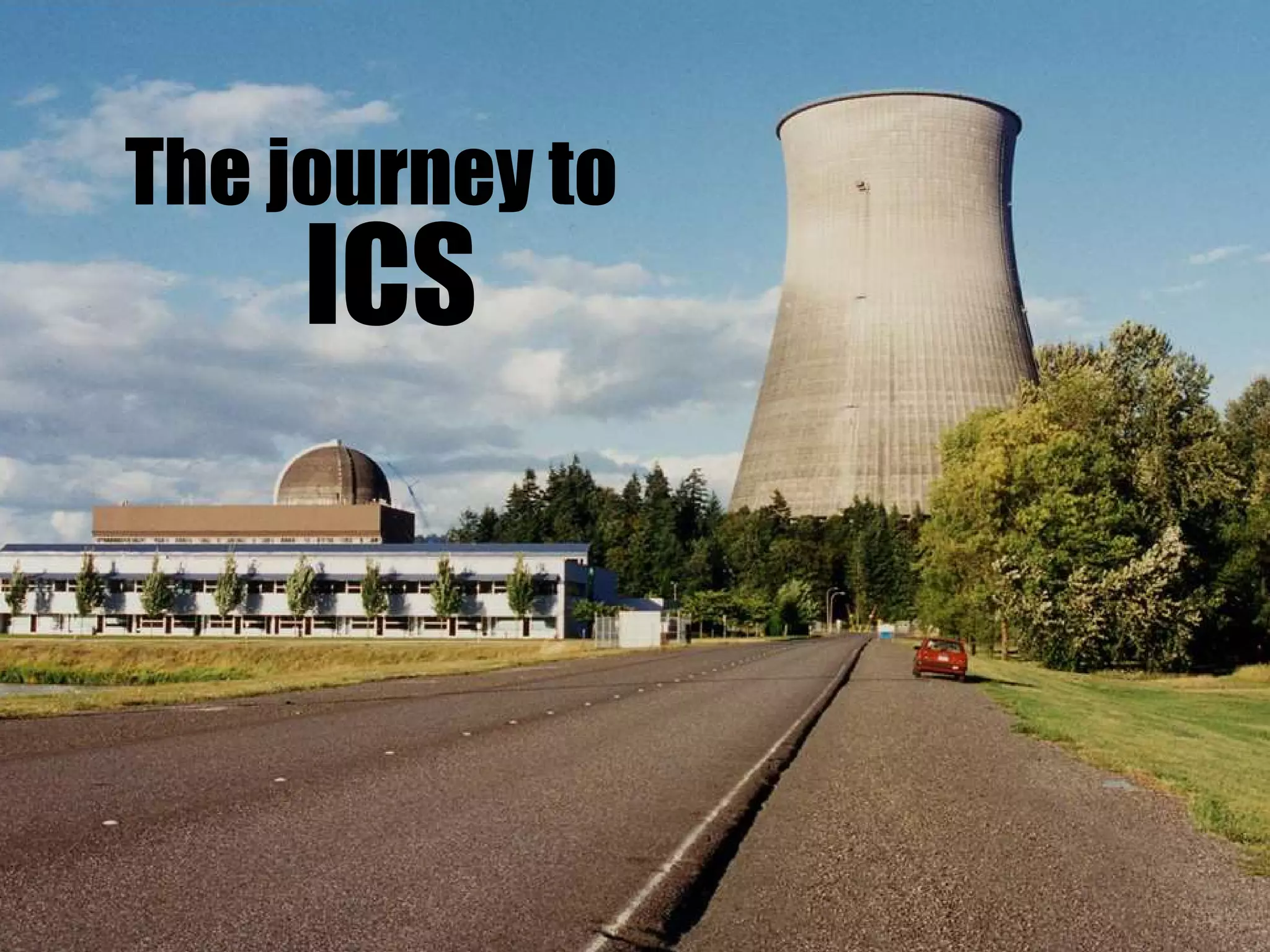
The journey to
ICS
Disclaimer
I am employed in the Infosec industry
but not authorised to speak on behalf of my
employer or clients.
Everything I say is from a personal point of
view.
About me
@lvandenaweele
- Security consultant at PwC Belgium
- +5 years information security
- +2 years within Industrial Security
- Travel, food, beer
..not an expert yet, but eager to learn.
Special thanks to
@chrissistrunk
- Proving Ground Mentor
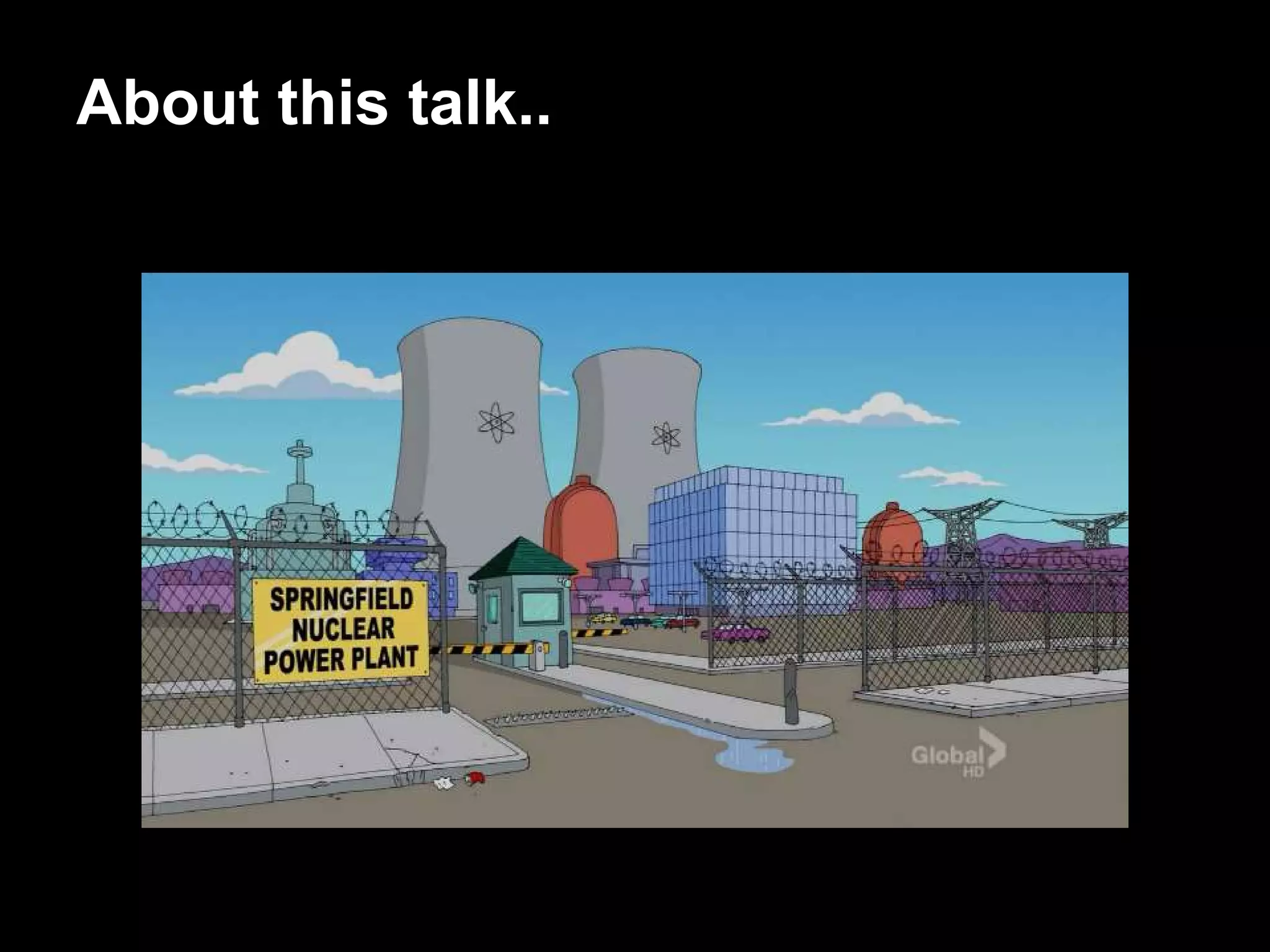
About this talk..
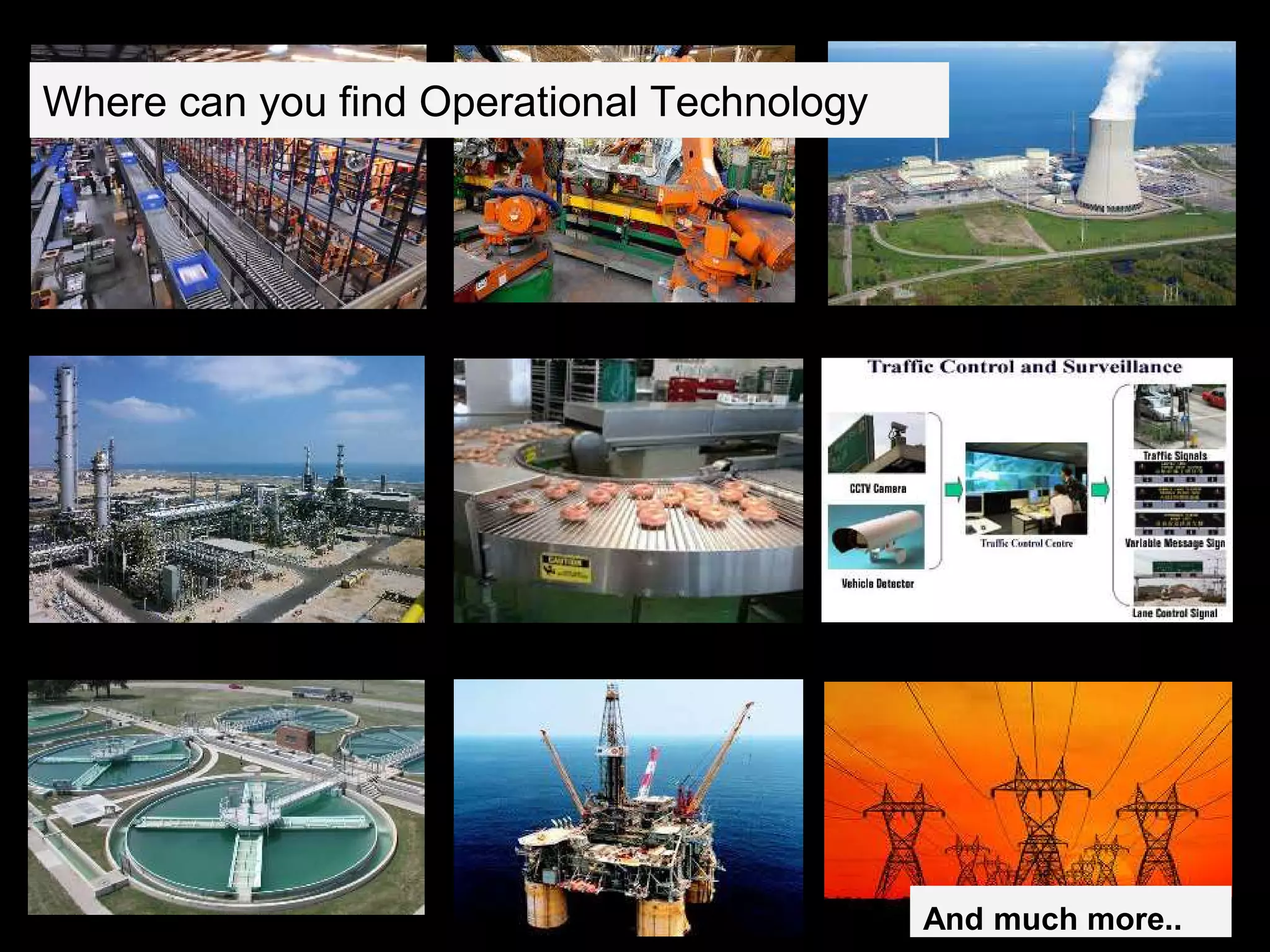
Where can you find Operational Technology
And much more..
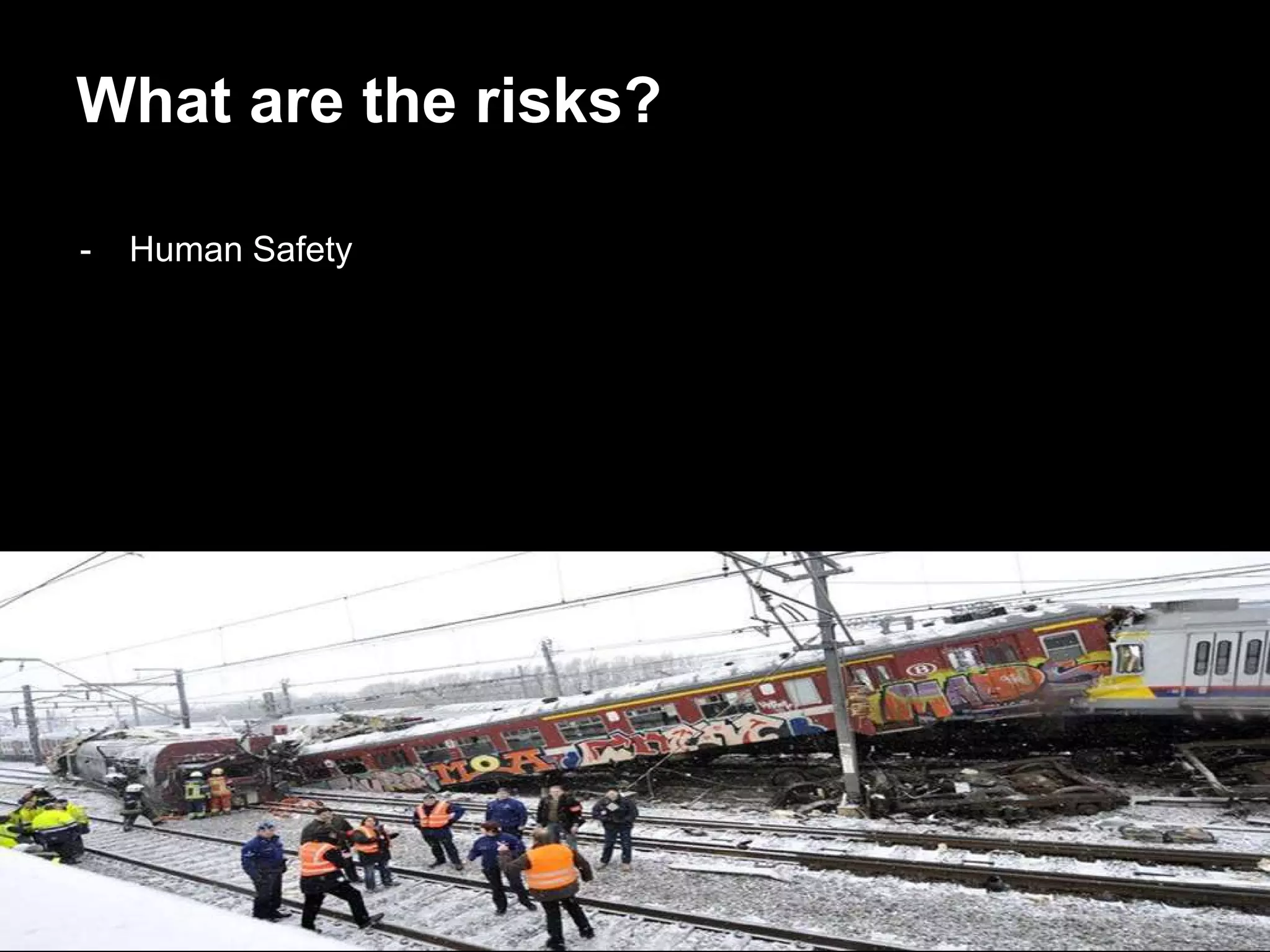
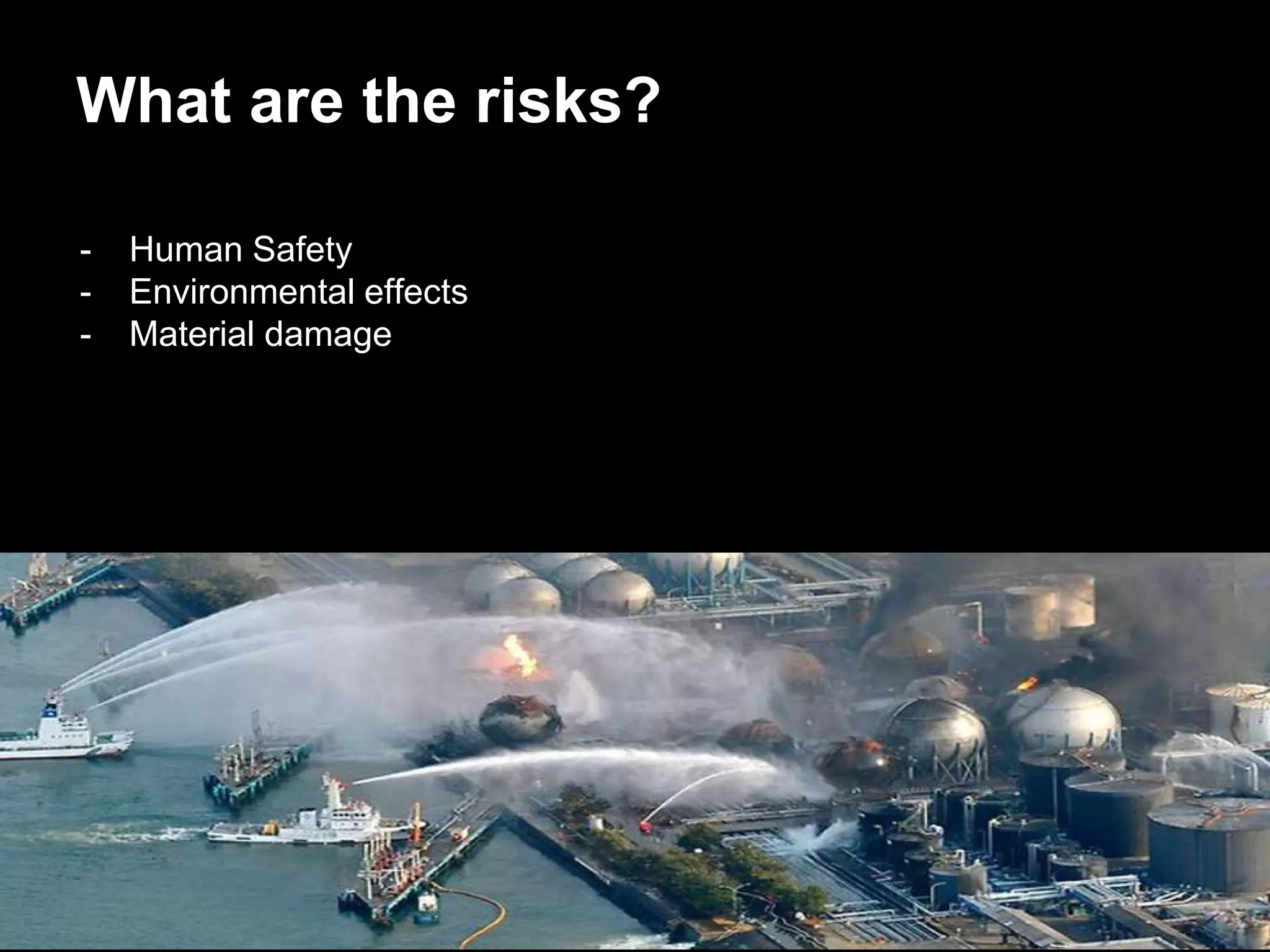
What are the risks?
- Human Safety
- Human Safety
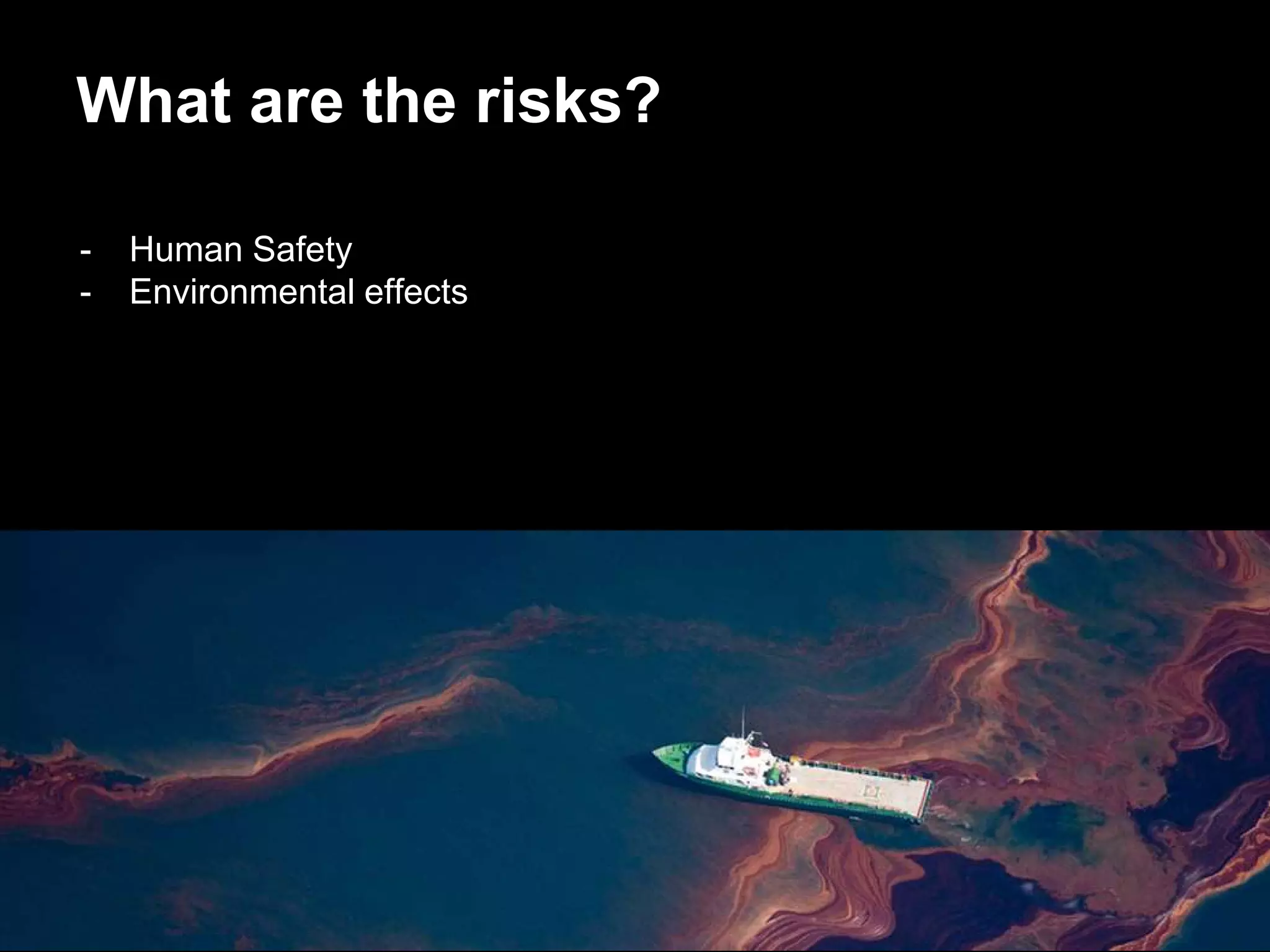
- Environmental effects
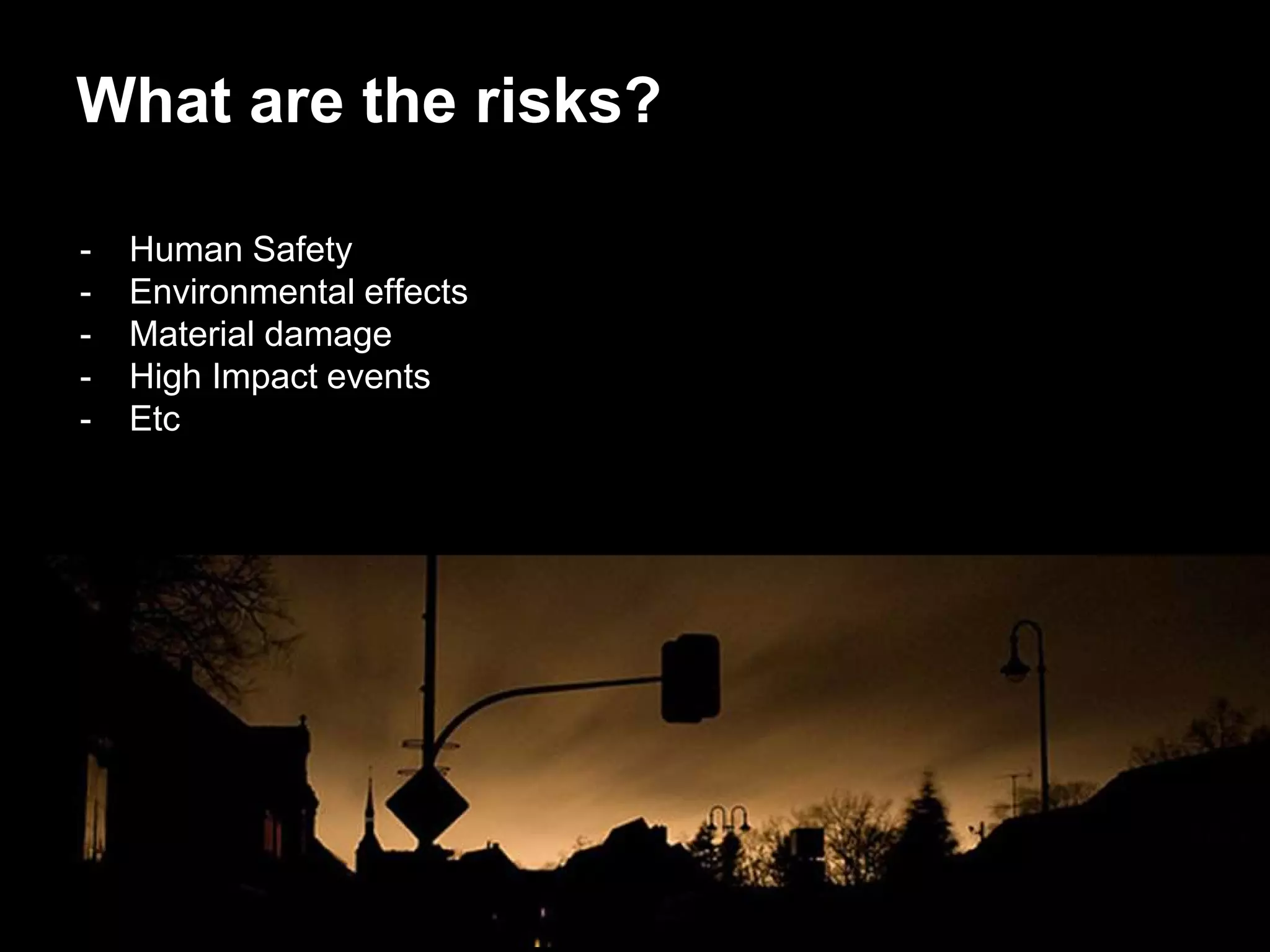
What are the risks?
- Human Safety
- Environmental effects
- Material damage
What are the risks?
- Human Safety
- Environmental effects
- Material damage
- High Impact events
- Etc
What are the risks?
OT Clichés
- Built to last for decades
- Uses specific means of communication
- Availability is key, above security
- At some point, human interaction
(e.g. operators watching the grid)
Operational Technology [OT]
Operational
Technology
Industrial
Control
Systems [ICS]
Network
Other
components
(apps,
systems)
Some Vocabulary
- PCS - Process Control System
- BMS - Building Management System
- EMS - Energy Management System
- DMS - Distribution Management System
- DCS - Distributed Control System
- SCADA - Supervisory Control and Data Acquisition
- PLC - Programmable Logic Controller
- MTU - Master Terminal Unit
- HMI - Human Machine Interface
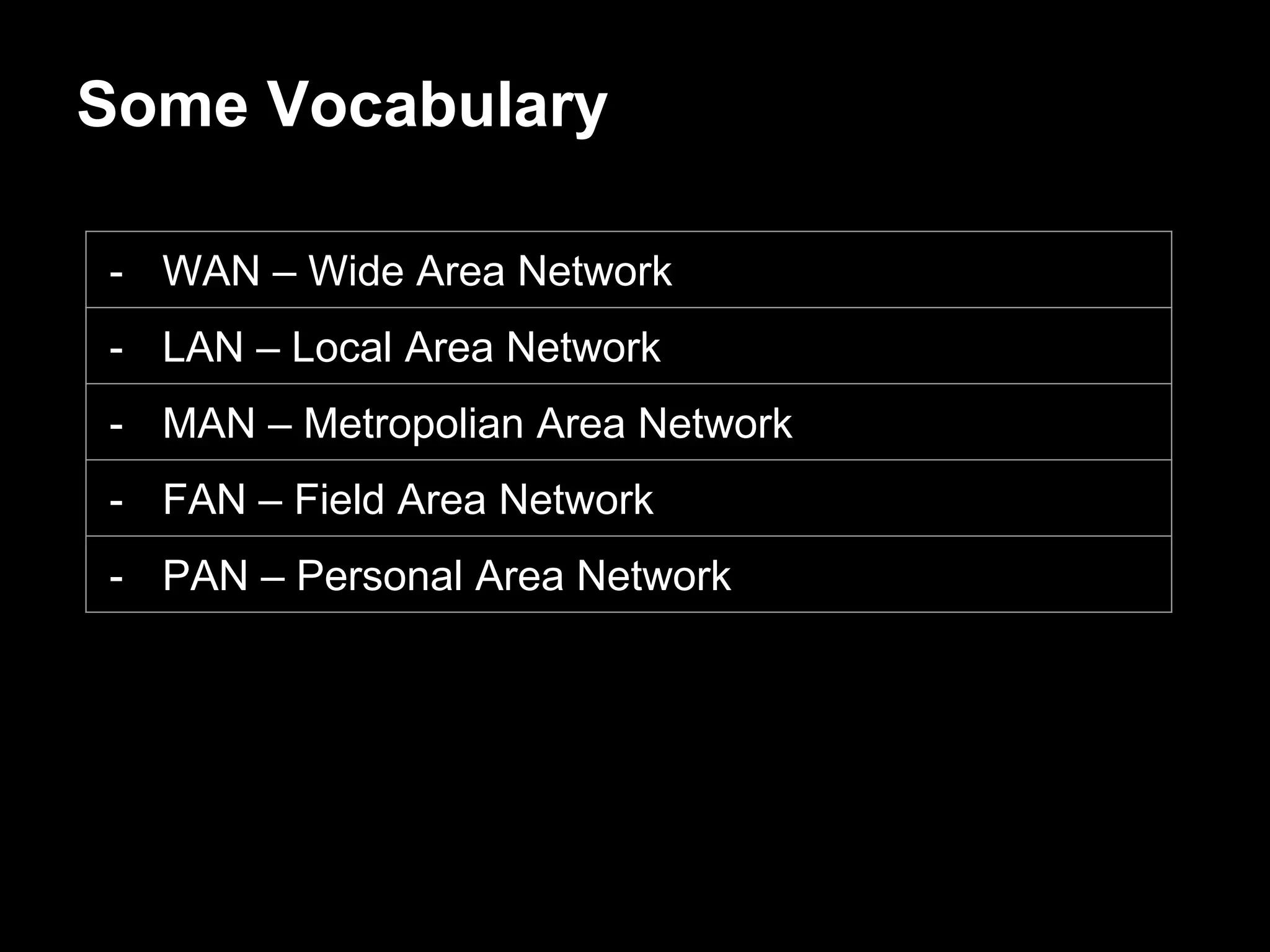
- WAN – Wide Area Network
- LAN – Local Area Network
- MAN – Metropolian Area Network
- FAN – Field Area Network
- PAN – Personal Area Network
Some Vocabulary
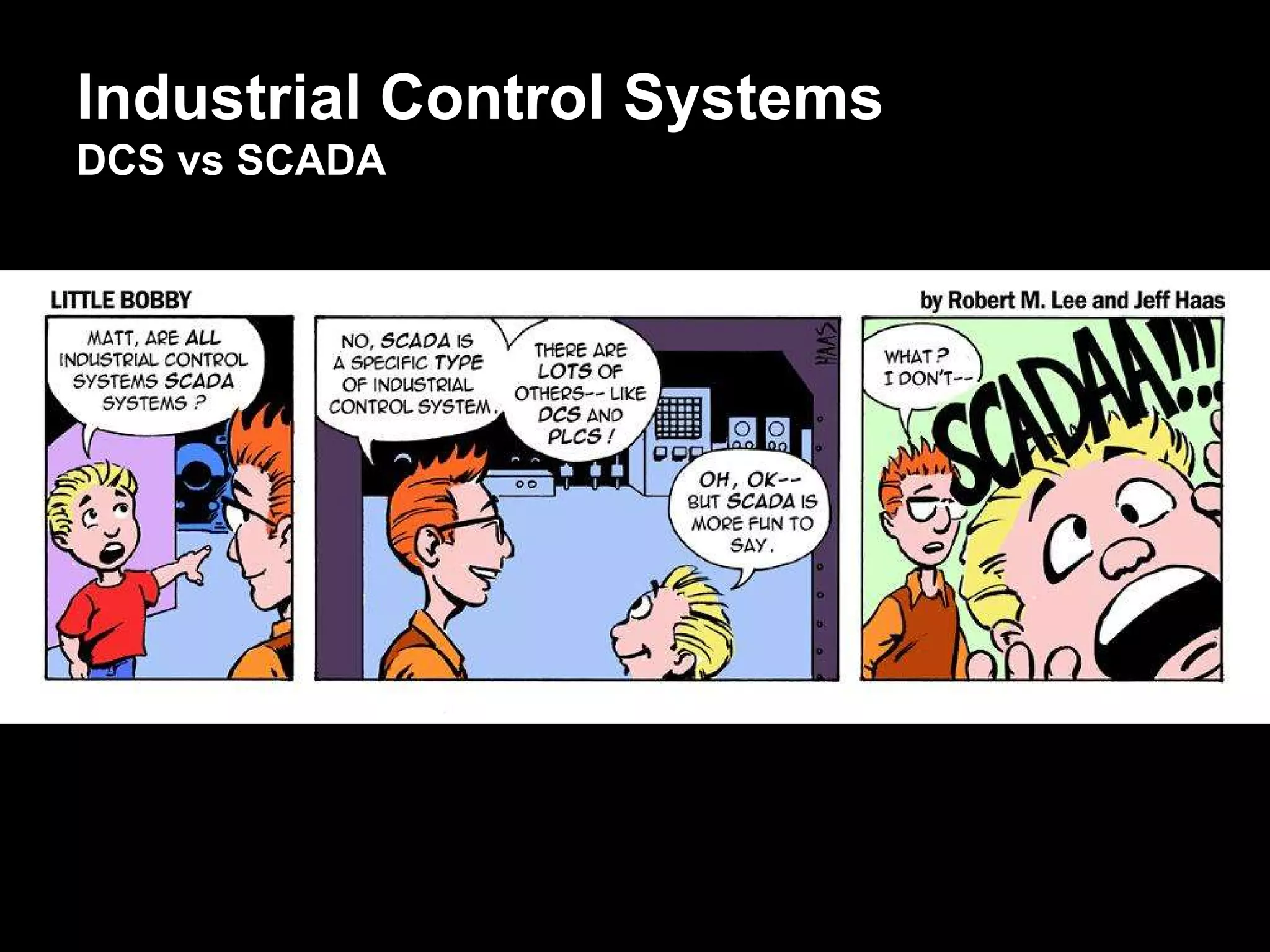
Industrial Control Systems
DCS vs SCADA
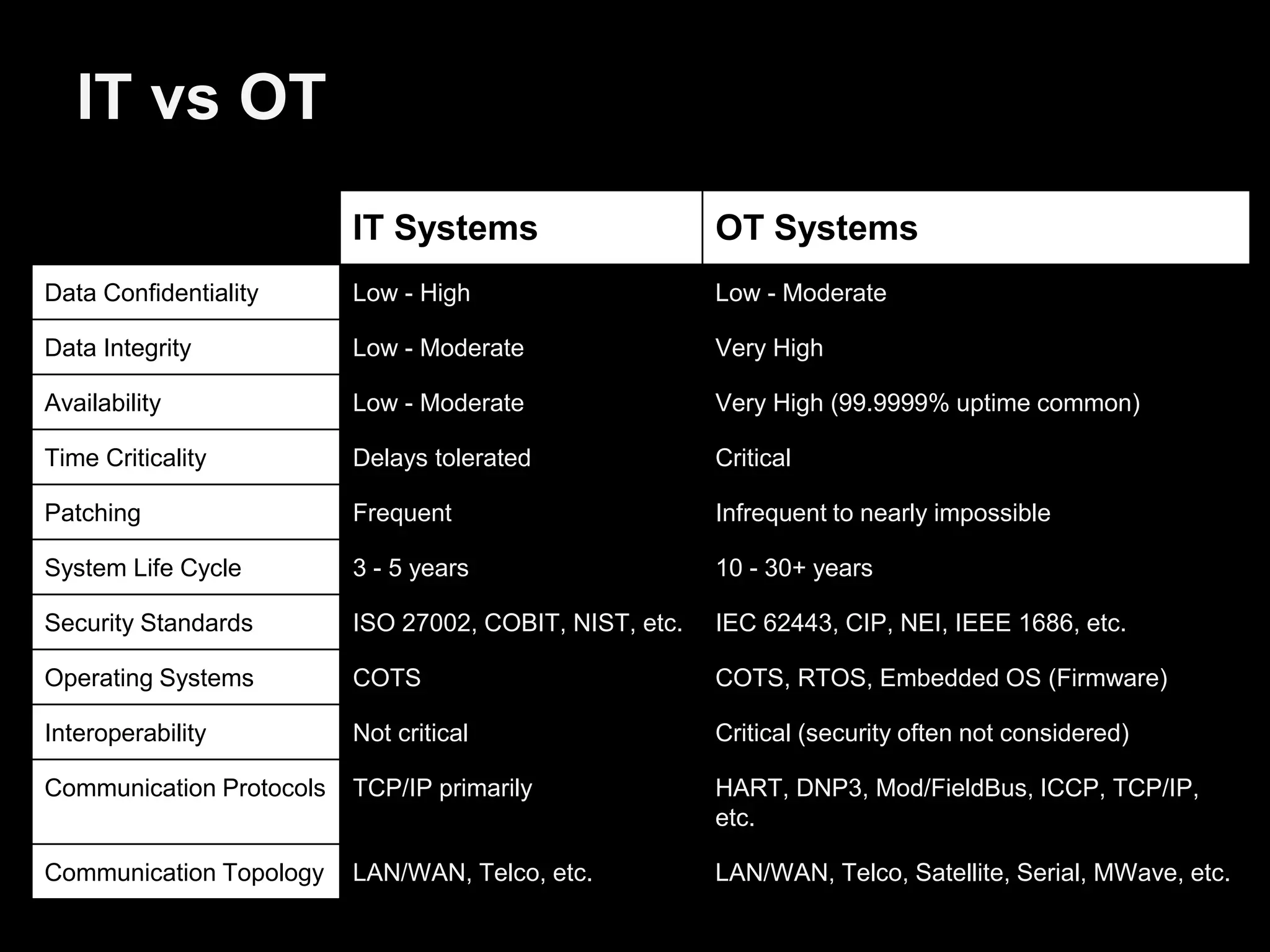
IT vs OT
IT Systems OT Systems
Data Confidentiality Low - High Low - Moderate
Data Integrity Low - Moderate Very High
Availability Low - Moderate Very High (99.9999% uptime common)
Time Criticality Delays tolerated Critical
Patching Frequent Infrequent to nearly impossible
System Life Cycle 3 - 5 years 10 - 30+ years
Security Standards ISO 27002, COBIT, NIST, etc. IEC 62443, CIP, NEI, IEEE 1686, etc.
Operating Systems COTS COTS, RTOS, Embedded OS (Firmware)
Interoperability Not critical Critical (security often not considered)
Communication Protocols TCP/IP primarily HART, DNP3, Mod/FieldBus, ICCP, TCP/IP,
etc.
Communication Topology LAN/WAN, Telco, etc. LAN/WAN, Telco, Satellite, Serial, MWave, etc.
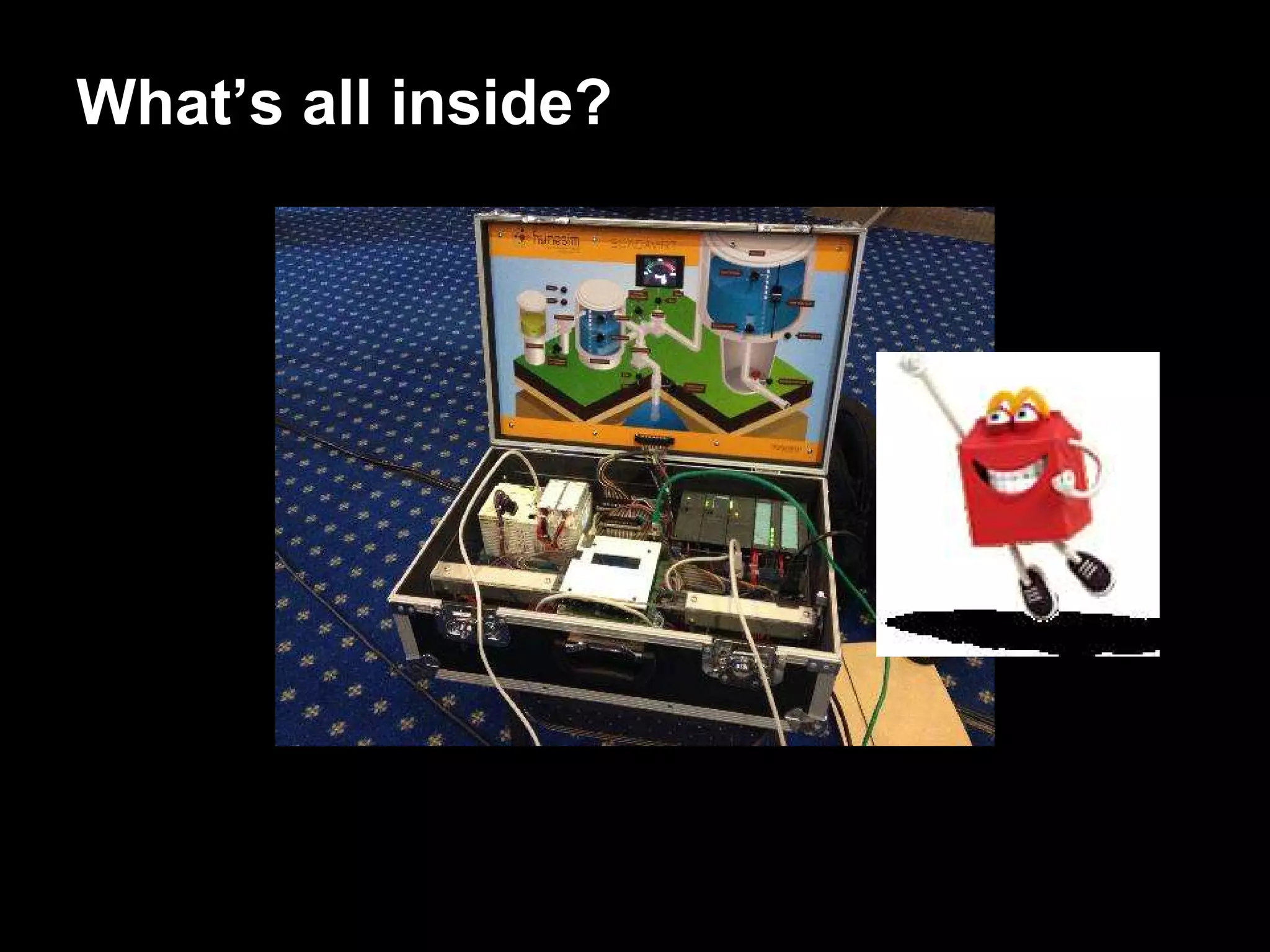
What’s all inside?
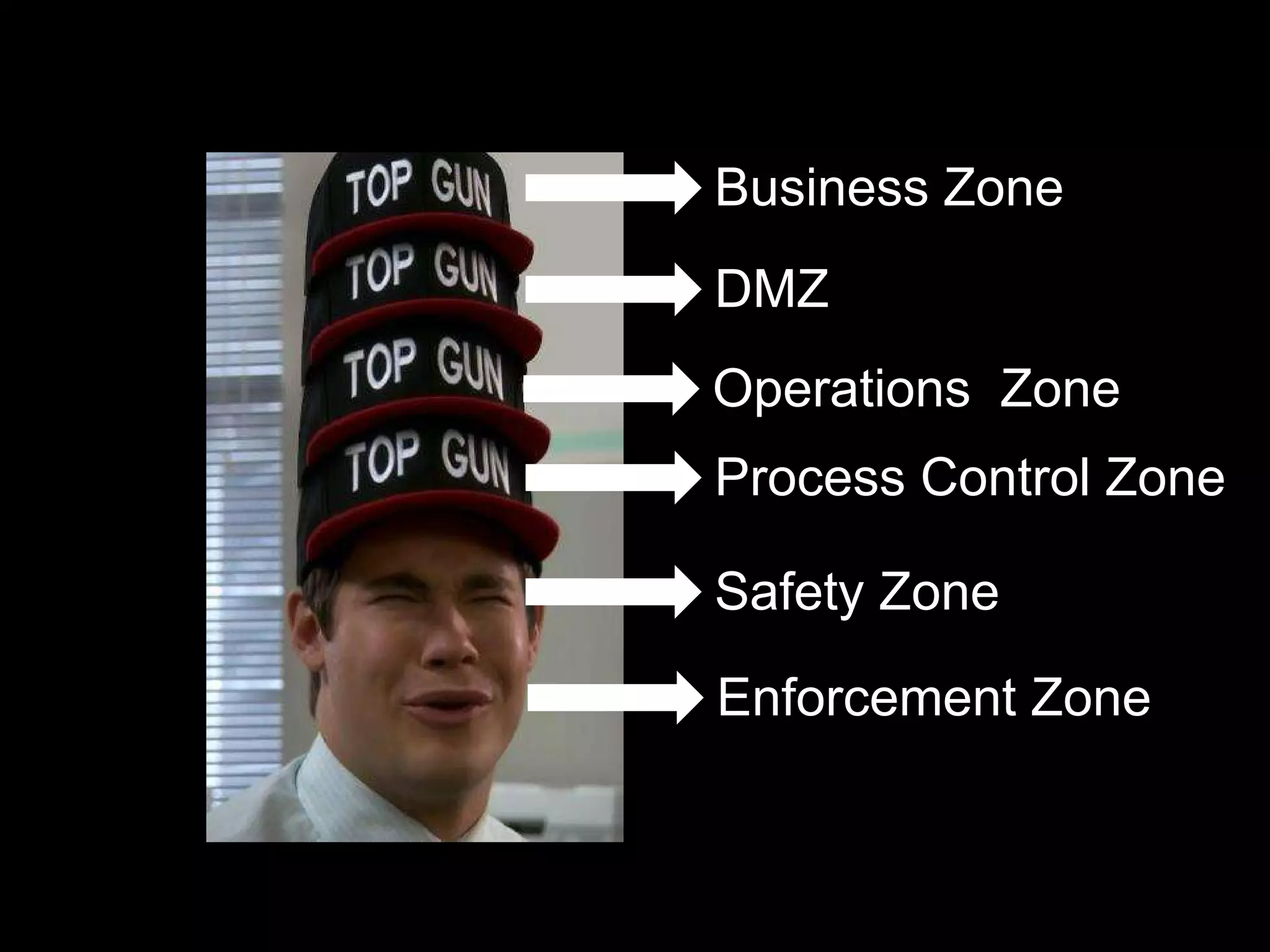
Business Zone
DMZ
Operations Zone
Process Control Zone
Safety Zone
Enforcement Zone
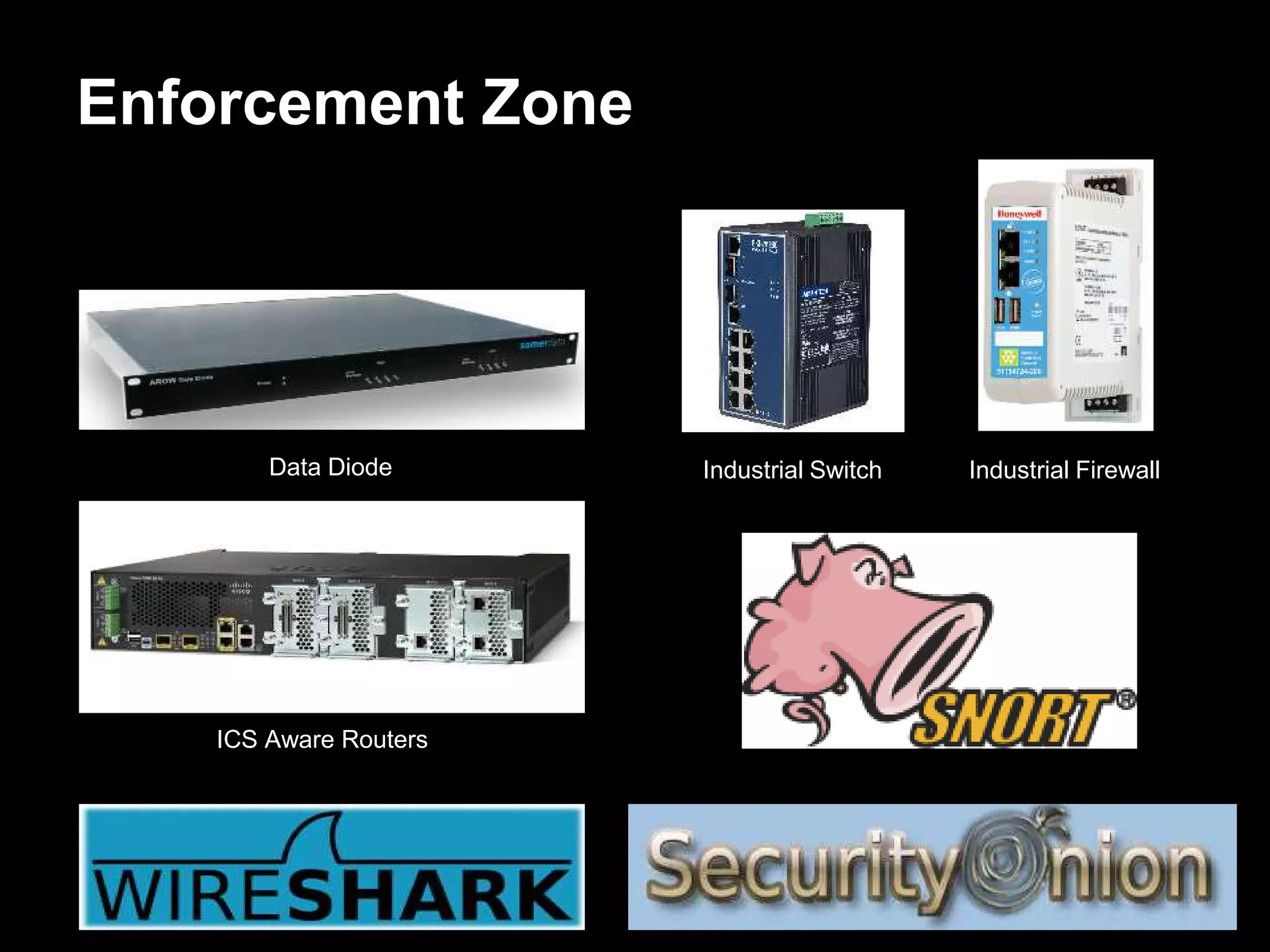
Enforcement Zone
Industrial Switch Industrial FirewallData Diode
ICS Aware Routers
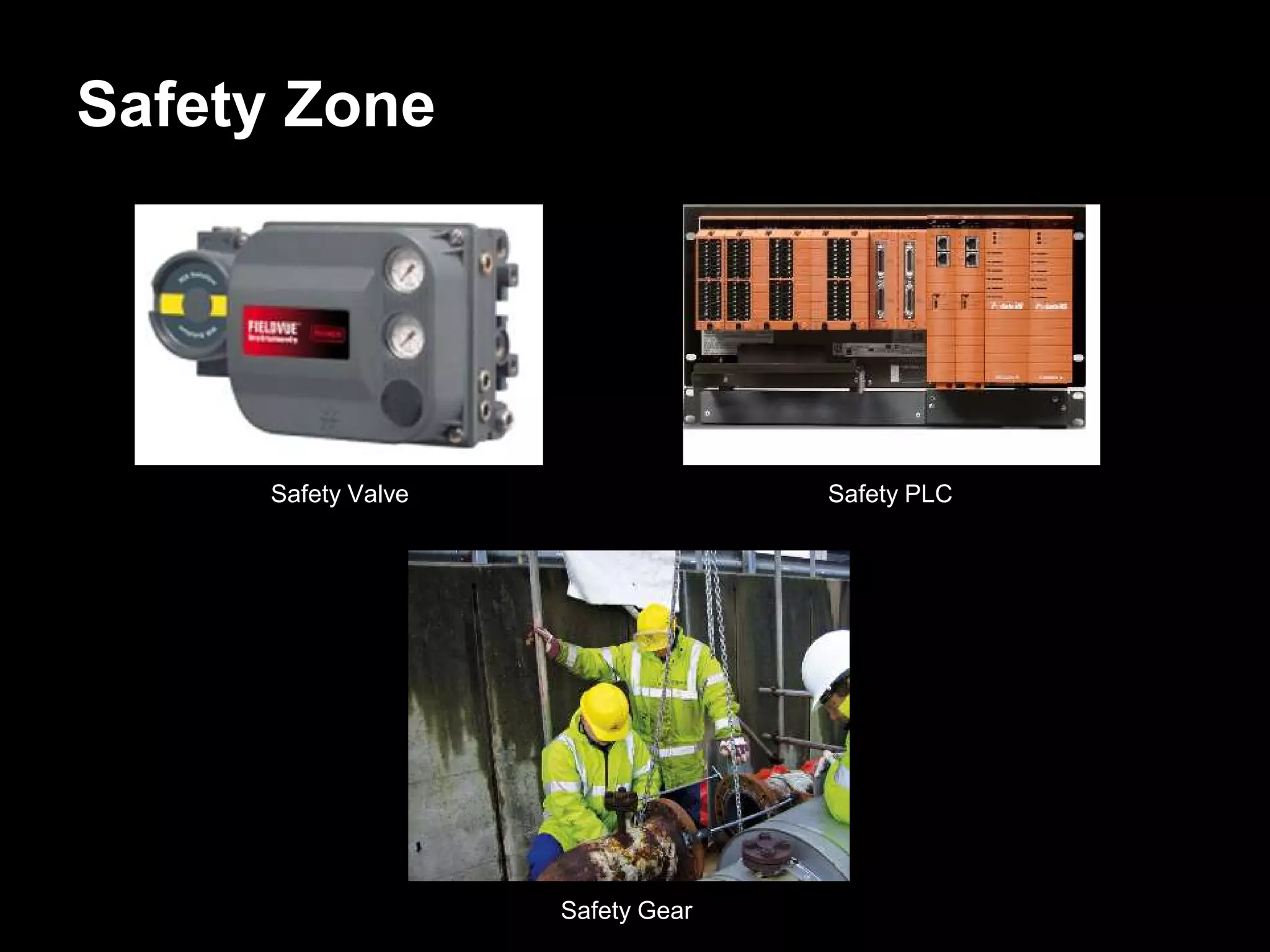
Safety Zone
Safety Valve Safety PLC
Safety Gear
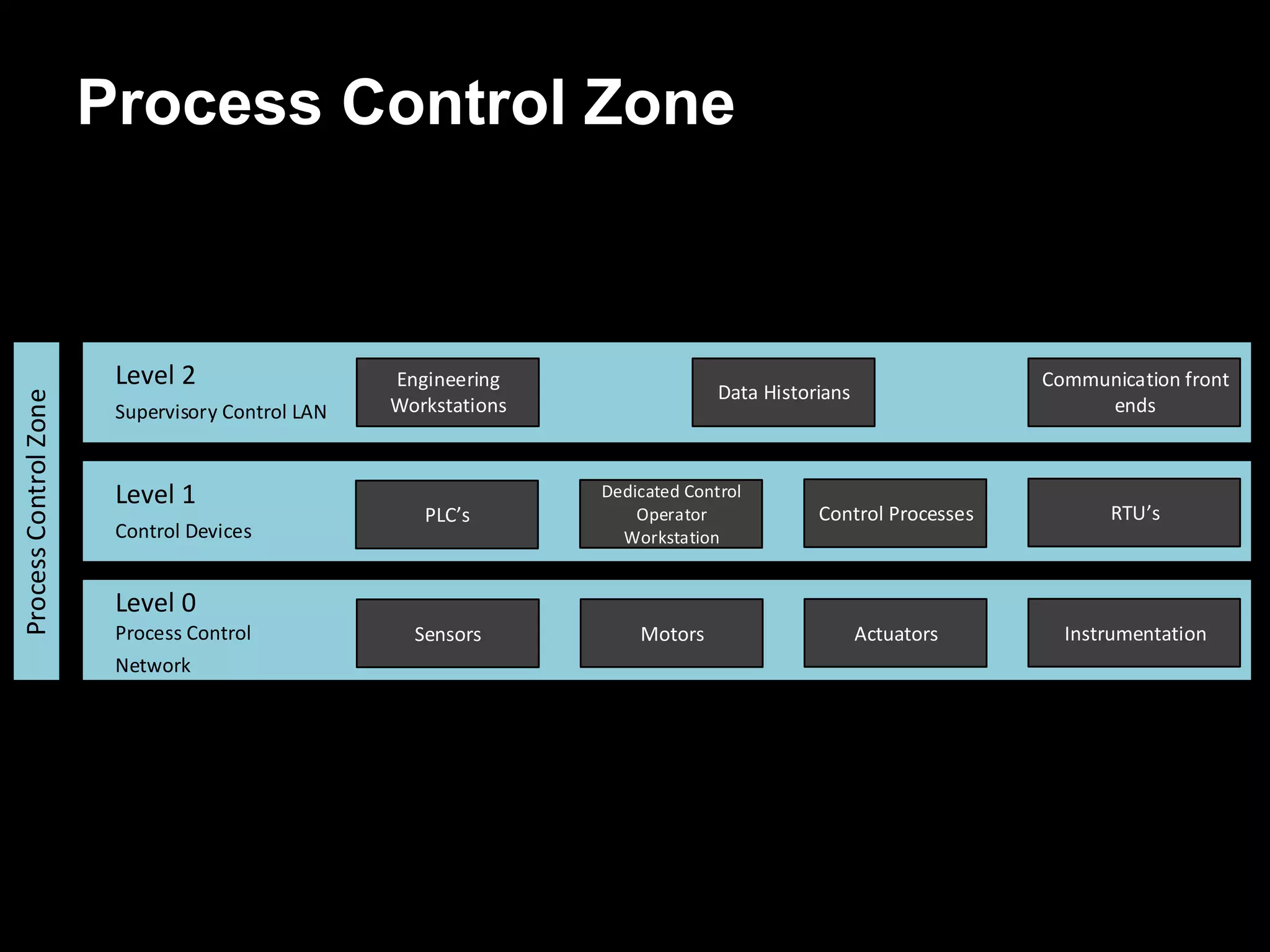
Process Control Zone
Sensors Motors Actuators Instrumentation
PLC s
Dedicated Control
Operator
Workstation
Control Processes RTU s
Data Historians
Engineering
Workstations
Communication front
ends
Level 0
Process Control
Network
Level 1
Control Devices
Level 2
Supervisory Control LAN
ProcessControlZone
Process Control Zone
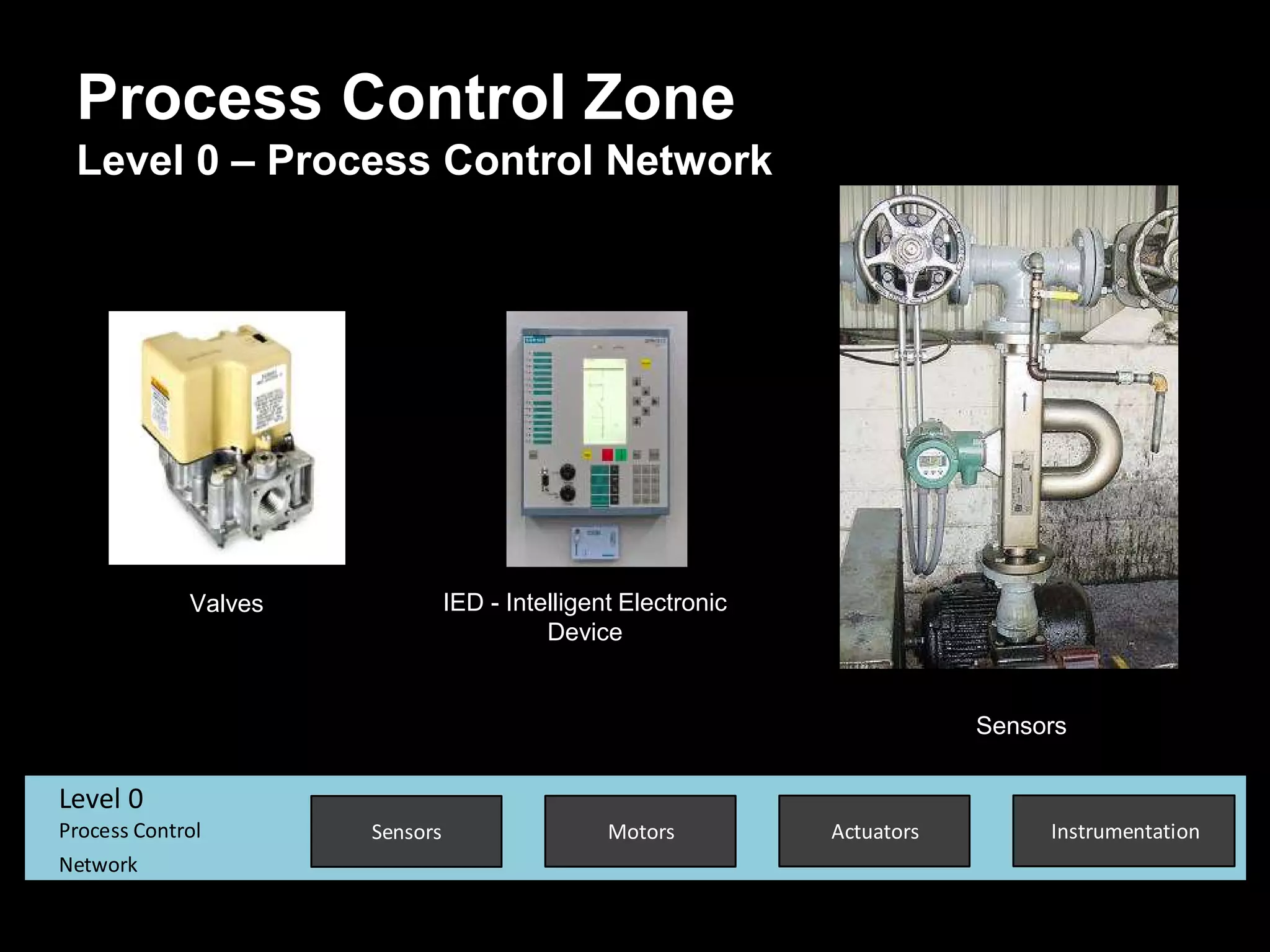
Level 0 – Process Control Network
Sensors Motors Actuators Instrumentation
Level 0
Process Control
Network
Valves IED - Intelligent Electronic
Device
Sensors
Process Control Zone
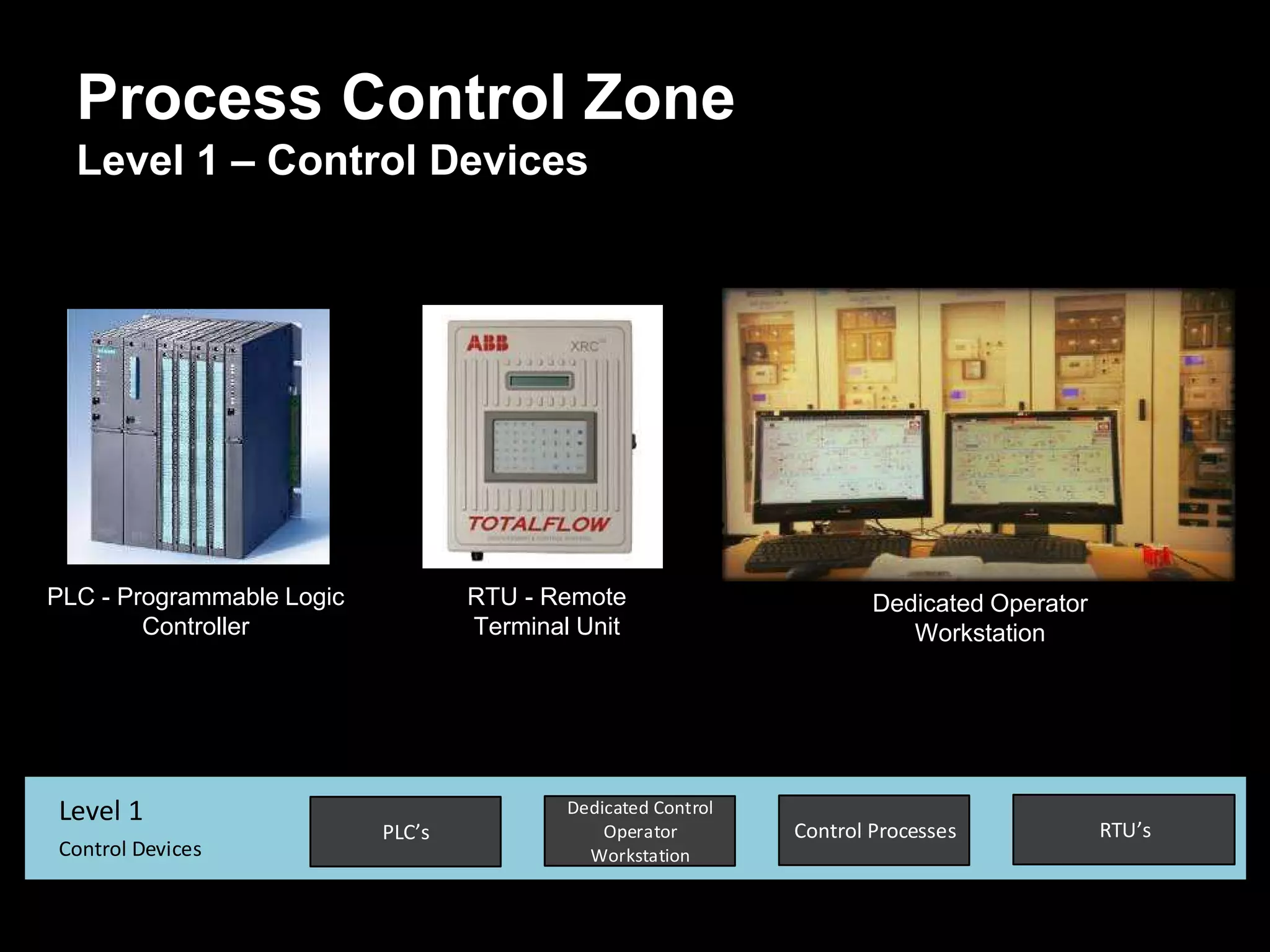
Level 1 – Control Devices
PLC s
Dedicated Control
Operator
Workstation
Control Processes RTU s
Level 1
Control Devices
PLC - Programmable Logic
Controller
RTU - Remote
Terminal Unit
Dedicated Operator
Workstation
Process Control Zone
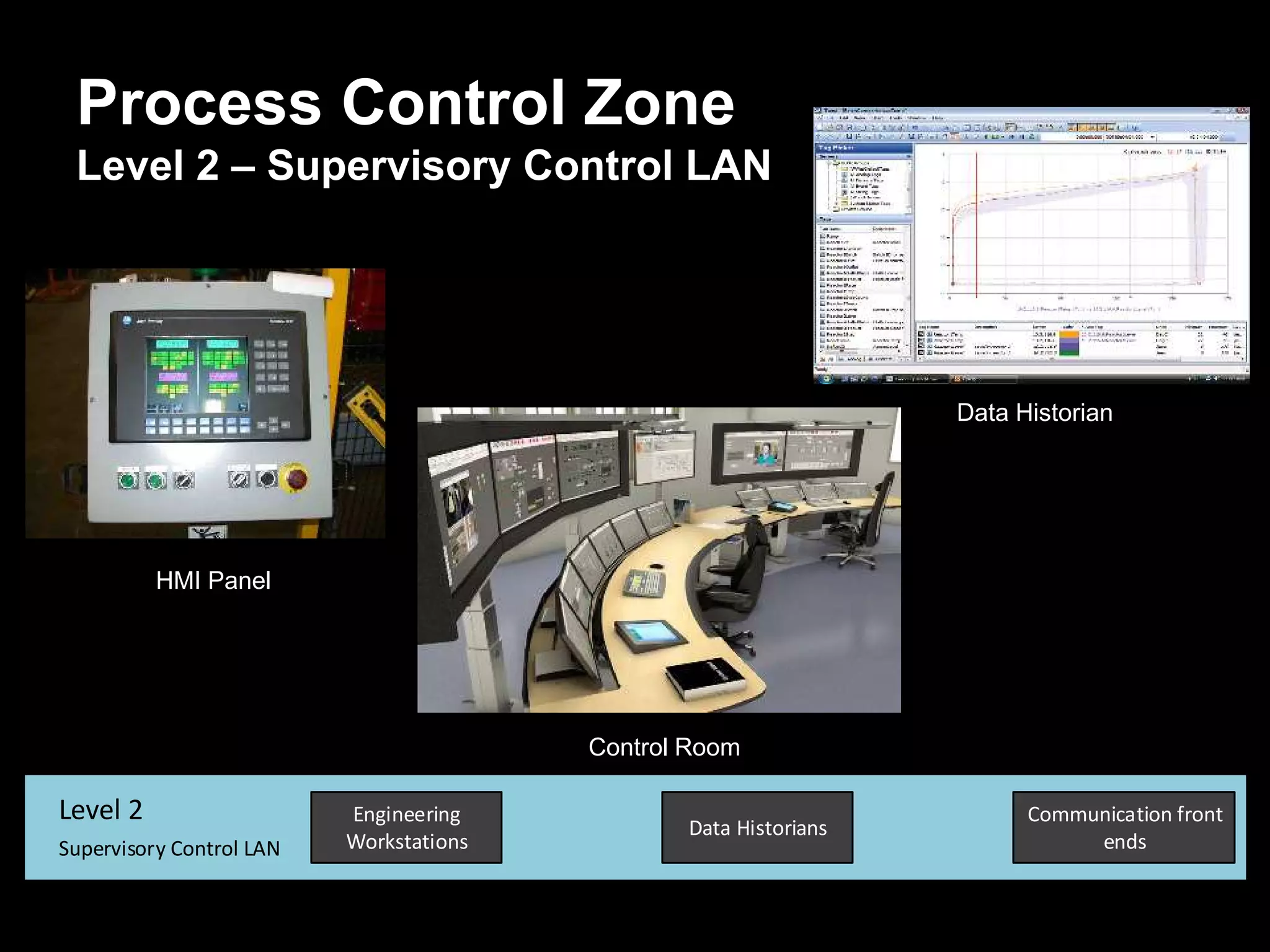
Level 2 – Supervisory Control LAN
Data Historians
Engineering
Workstations
Communication front
ends
Level 2
Supervisory Control LAN
Data Historian
Control Room
HMI Panel
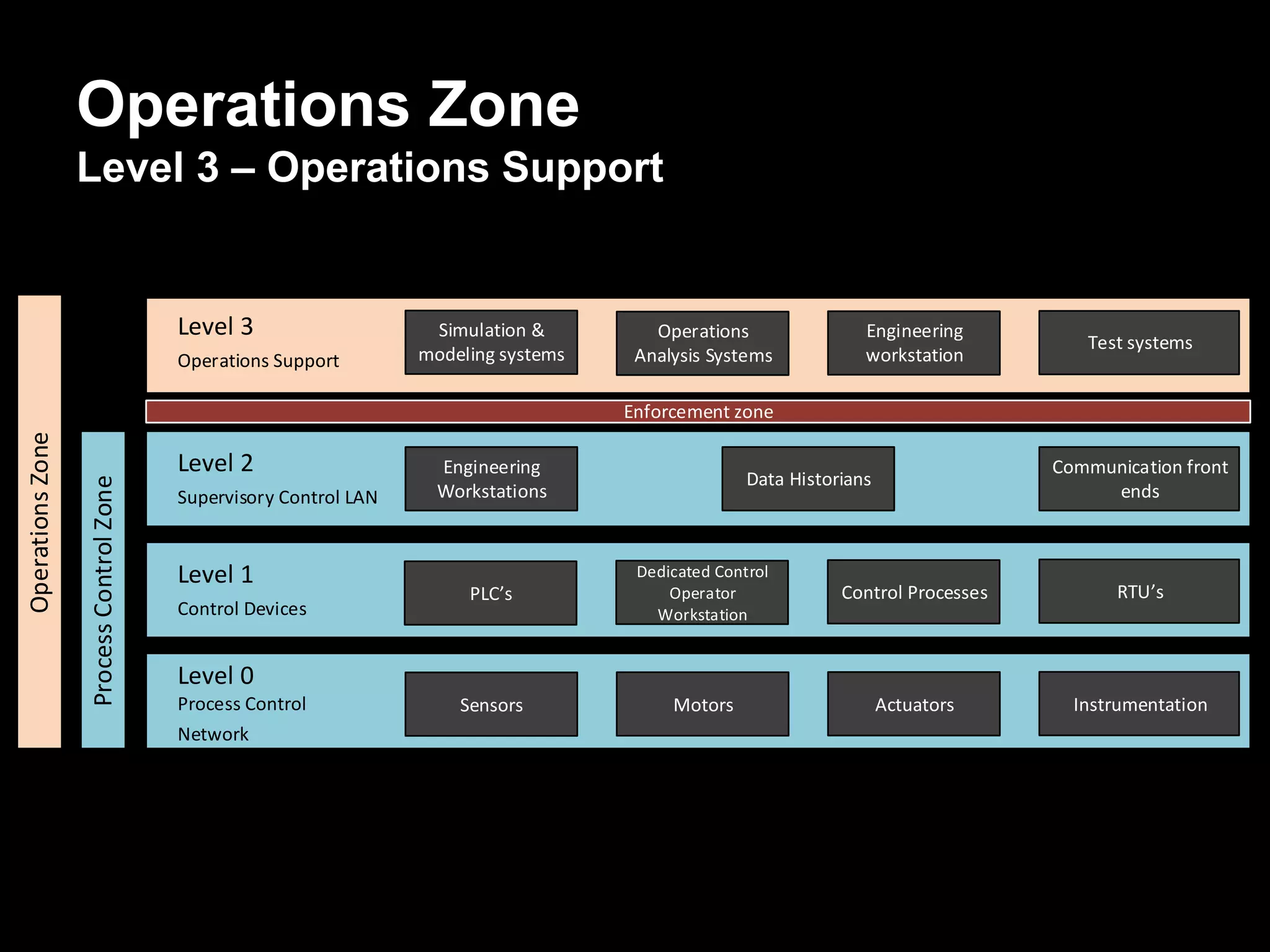
Operations Zone
Level 3 – Operations Support
Sensors Motors Actuators Instrumentation
PLC s
Dedicated Control
Operator
Workstation
Control Processes RTU s
Data Historians
Engineering
Workstations
Communication front
ends
Simulation &
modeling systems
Operations
Analysis Systems
Engineering
workstation
Test systems
Level 0
Process Control
Network
Level 1
Control Devices
Level 2
Supervisory Control LAN
Level 3
Operations Support
Enforcement zone
ProcessControlZone
OperationsZone
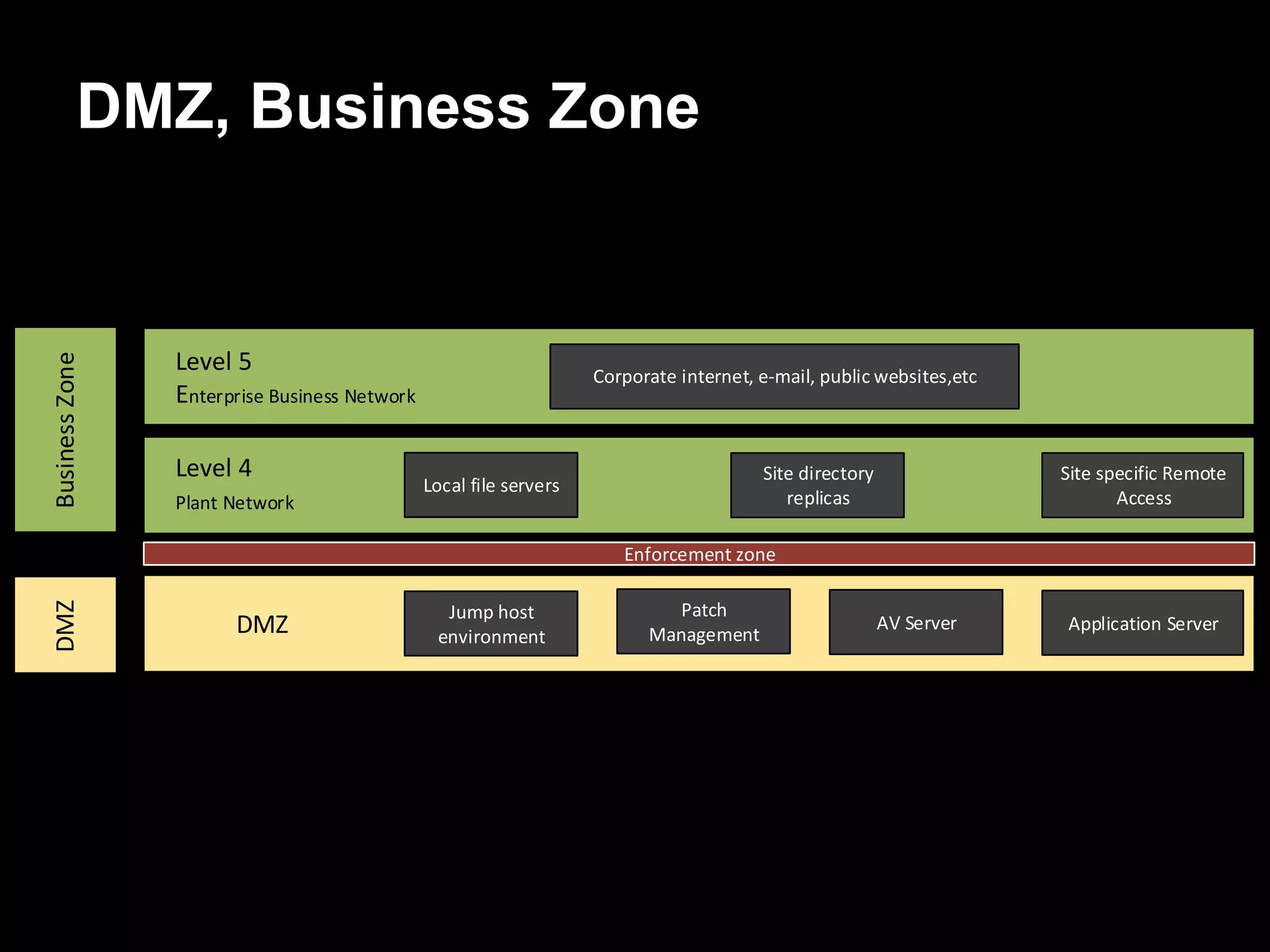
DMZ, Business Zone
Jump host
environment
Patch
Management
AV Server Application Server
Enforcement zone
Site directory
replicas
Local file servers
Site specific Remote
Access
Corporate internet, e-mail, public websites,etc
DMZ
Level 4
Plant Network
Level 5
Enterprise Business Network
DMZBusinessZone
Sensors Motors Actuators Instrumentation
PLC s
Dedicated Control
Operator
Workstation
Control Processes RTU s
Data Historians
Engineering
Workstations
Communication front
ends
Simulation &
modeling systems
Operations
Analysis Systems
Engineering
workstation
Test systems
Jump host
environment
Patch
Management
AV Server Application Server
Enforcement zone
Site directory
replicas
Local file servers
Site specific Remote
Access
Corporate internet, e-mail, public websites,etc
Level 0
Process Control
Network
Level 1
Control Devices
Level 2
Supervisory Control LAN
Level 3
Operations Support
DMZ
Level 4
Plant Network
Level 5
Enterprise Business Network
Enforcement zone
Enforcement zone
ProcessControlZone
OperationsZone
DMZBusinessZone
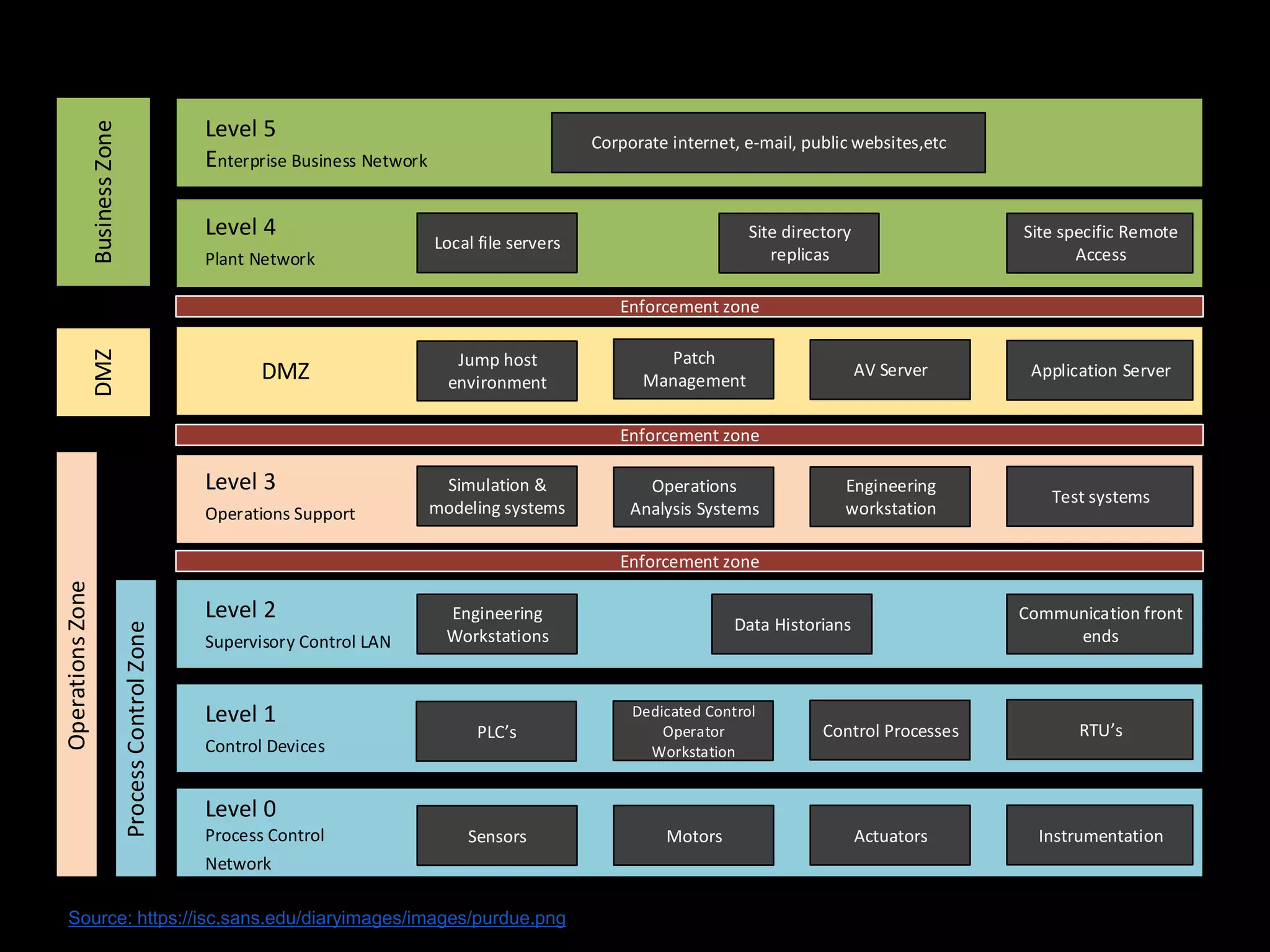
Source: https://isc.sans.edu/diaryimages/images/purdue.png
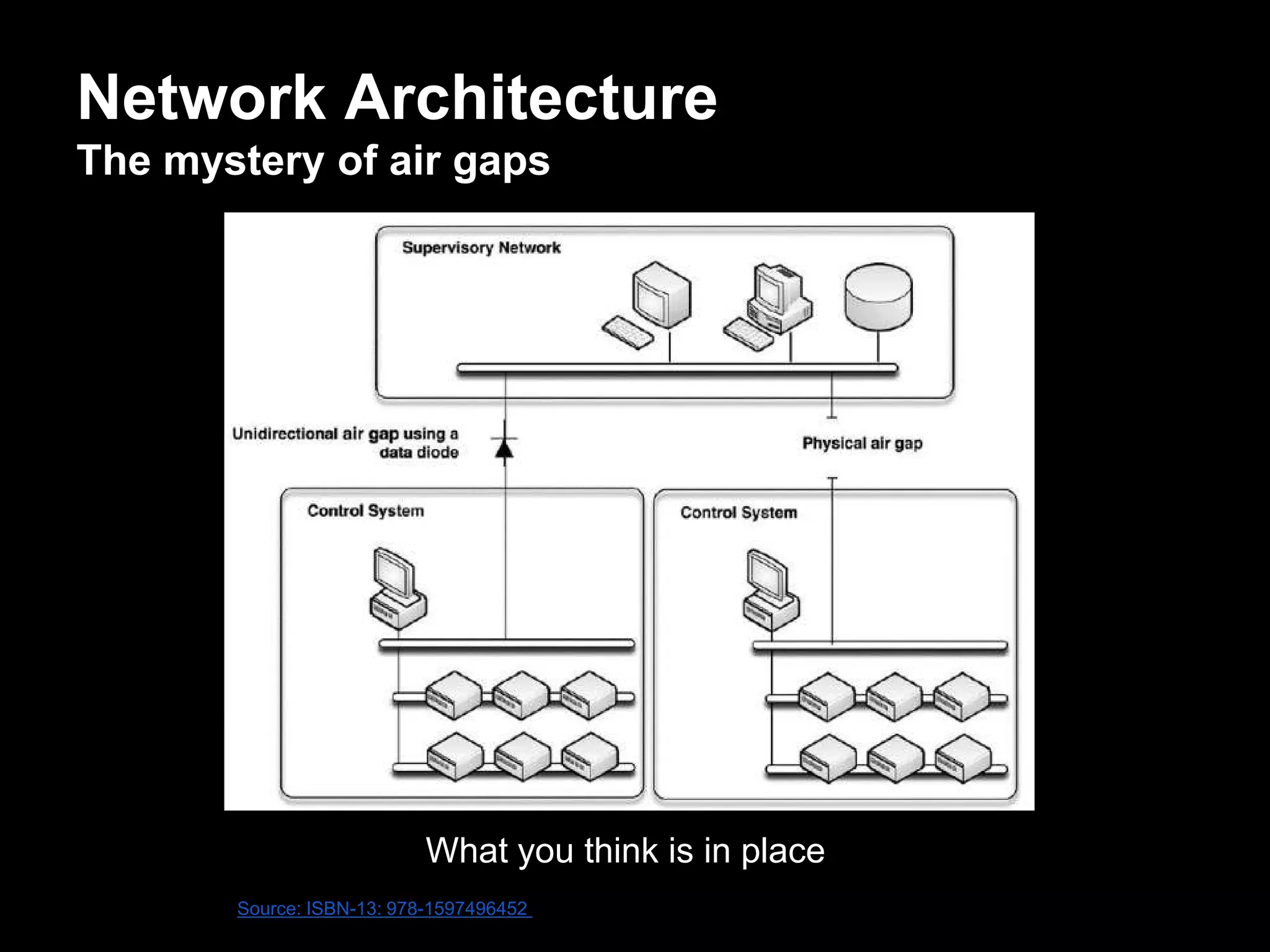
Network Architecture
The mystery of air gaps
What you think is in place
Source: ISBN-13: 978-1597496452
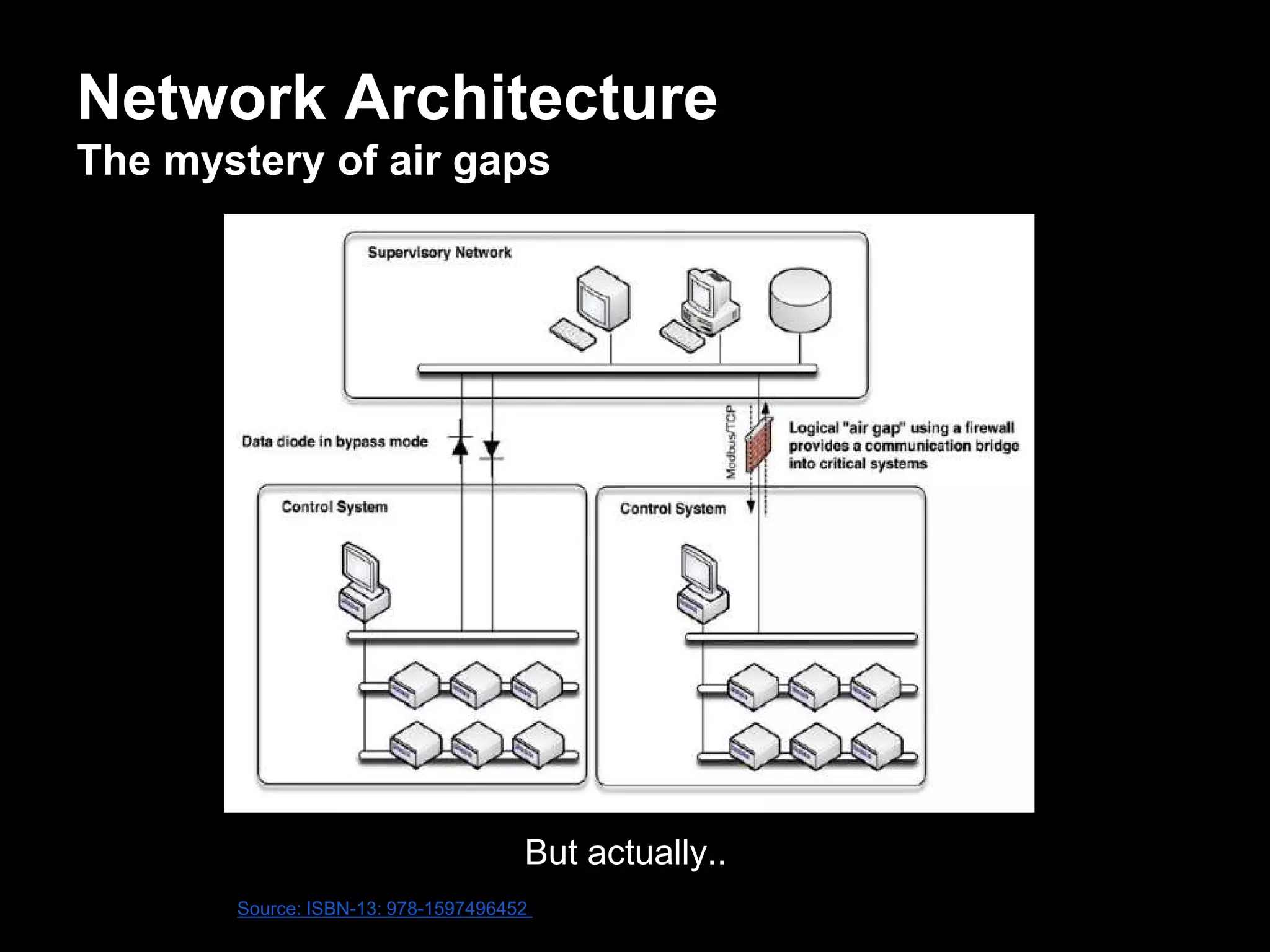
Network Architecture
The mystery of air gaps
But actually..
Source: ISBN-13: 978-1597496452
Network Architecture
Protocols
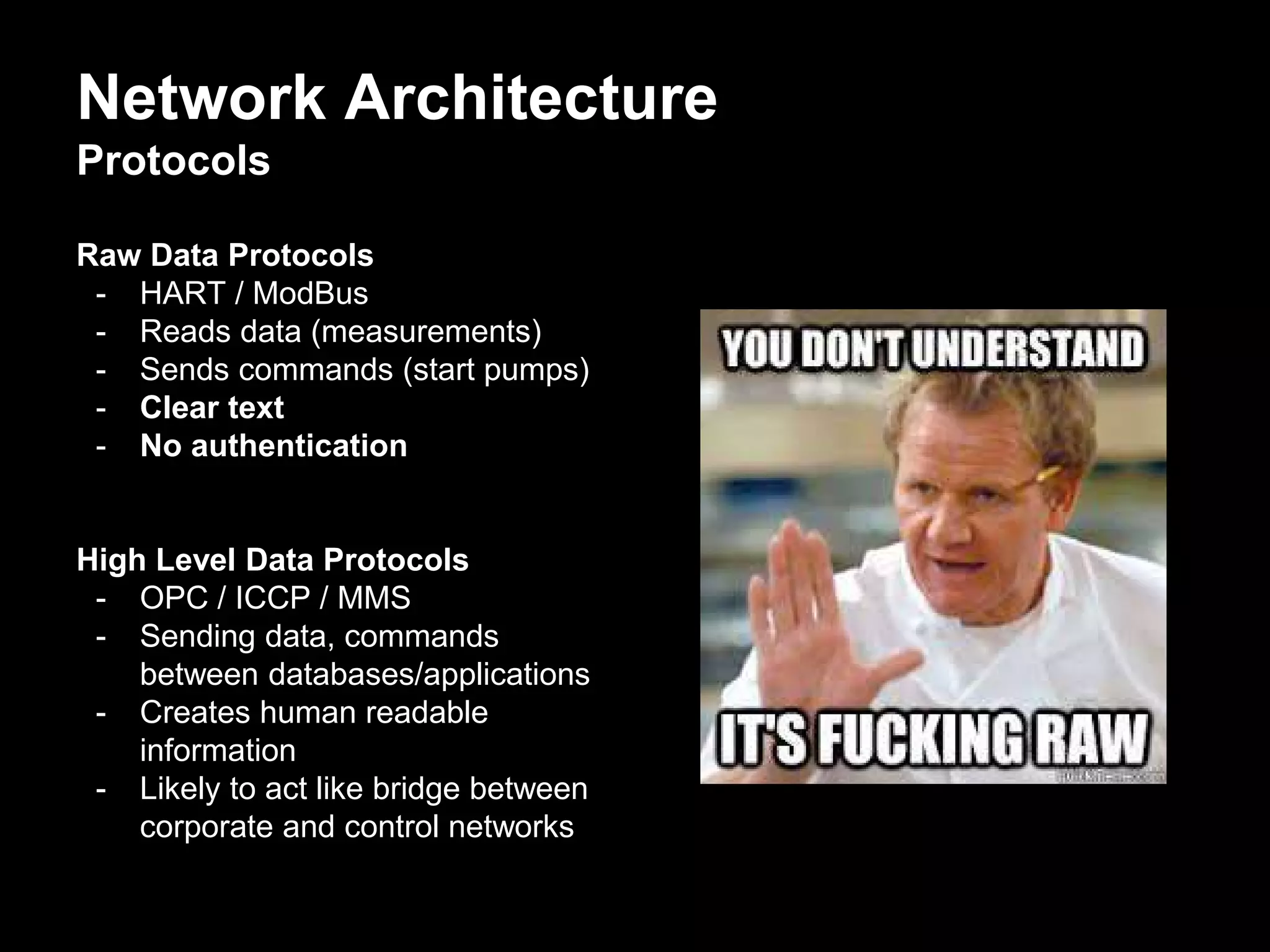
Raw Data Protocols
- HART / ModBus
- Reads data (measurements)
- Sends commands (start pumps)
- Clear text
- No authentication
High Level Data Protocols
- OPC / ICCP / MMS
- Sending data, commands
between databases/applications
- Creates human readable
information
- Likely to act like bridge between
corporate and control networks
Network Architecture
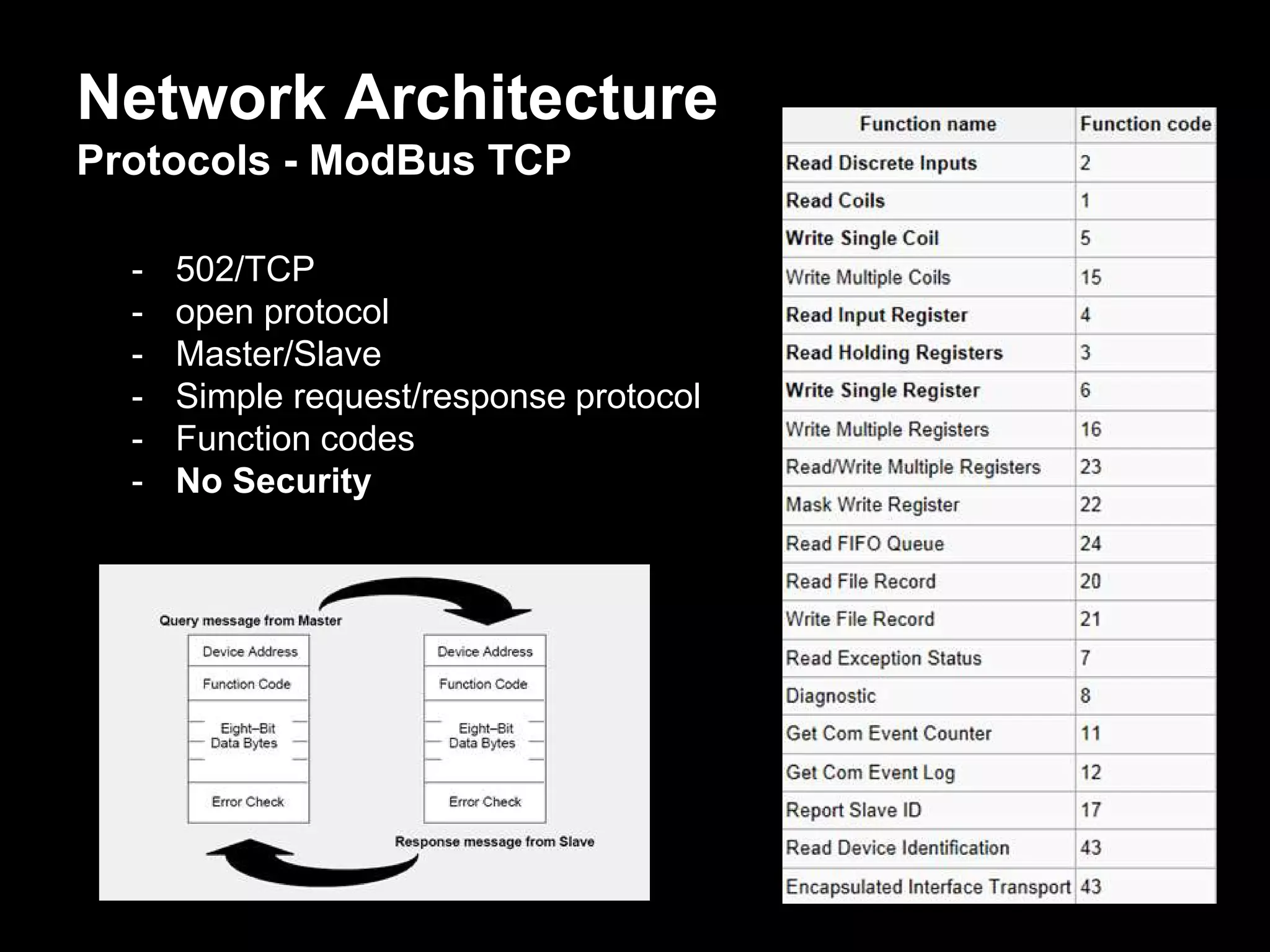
Protocols - ModBus TCP
- 502/TCP
- open protocol
- Master/Slave
- Simple request/response protocol
- Function codes
- No Security
Network Architecture
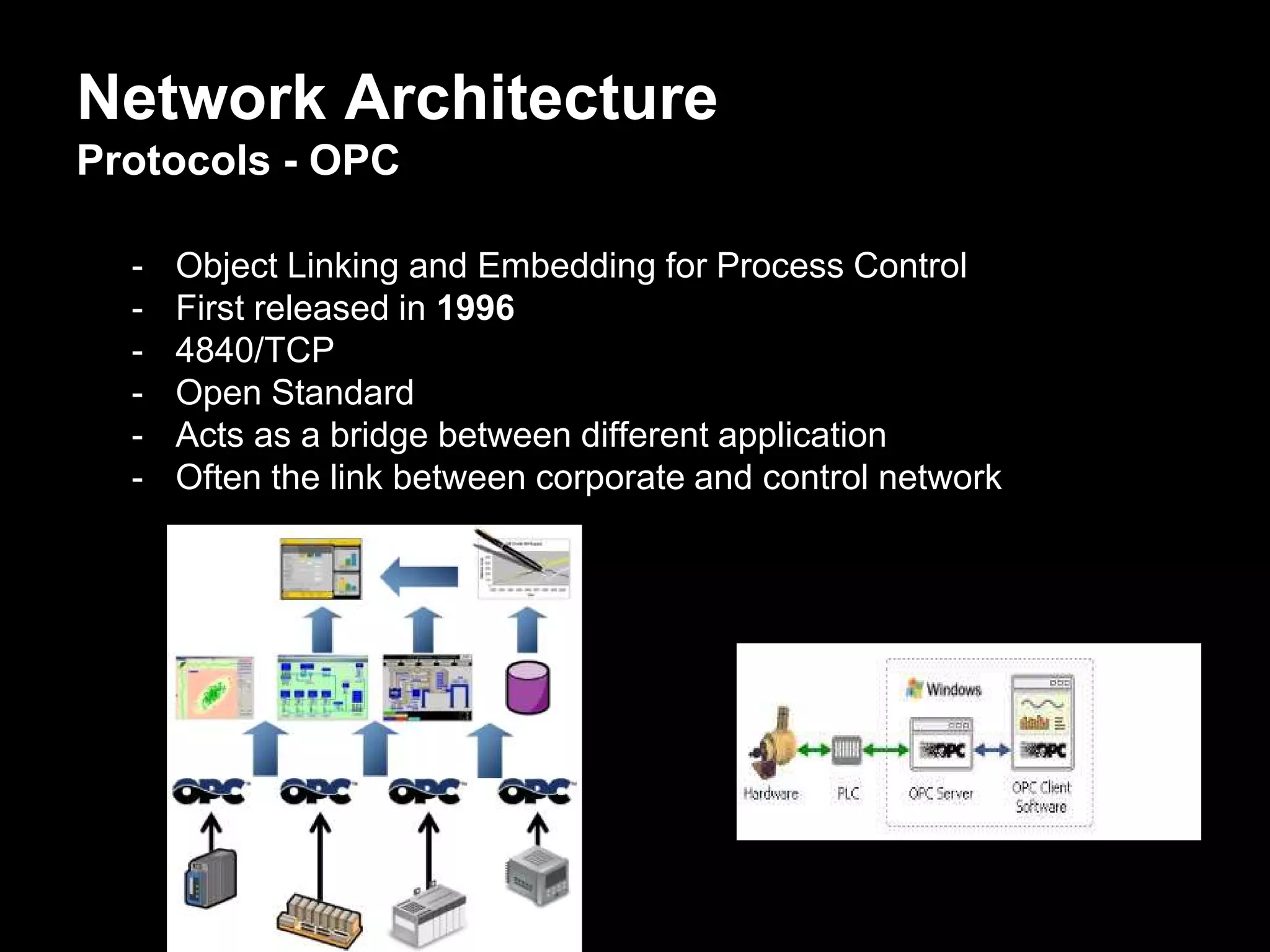
Protocols - OPC
- Object Linking and Embedding for Process Control
- First released in 1996
- 4840/TCP
- Open Standard
- Acts as a bridge between different application
- Often the link between corporate and control network
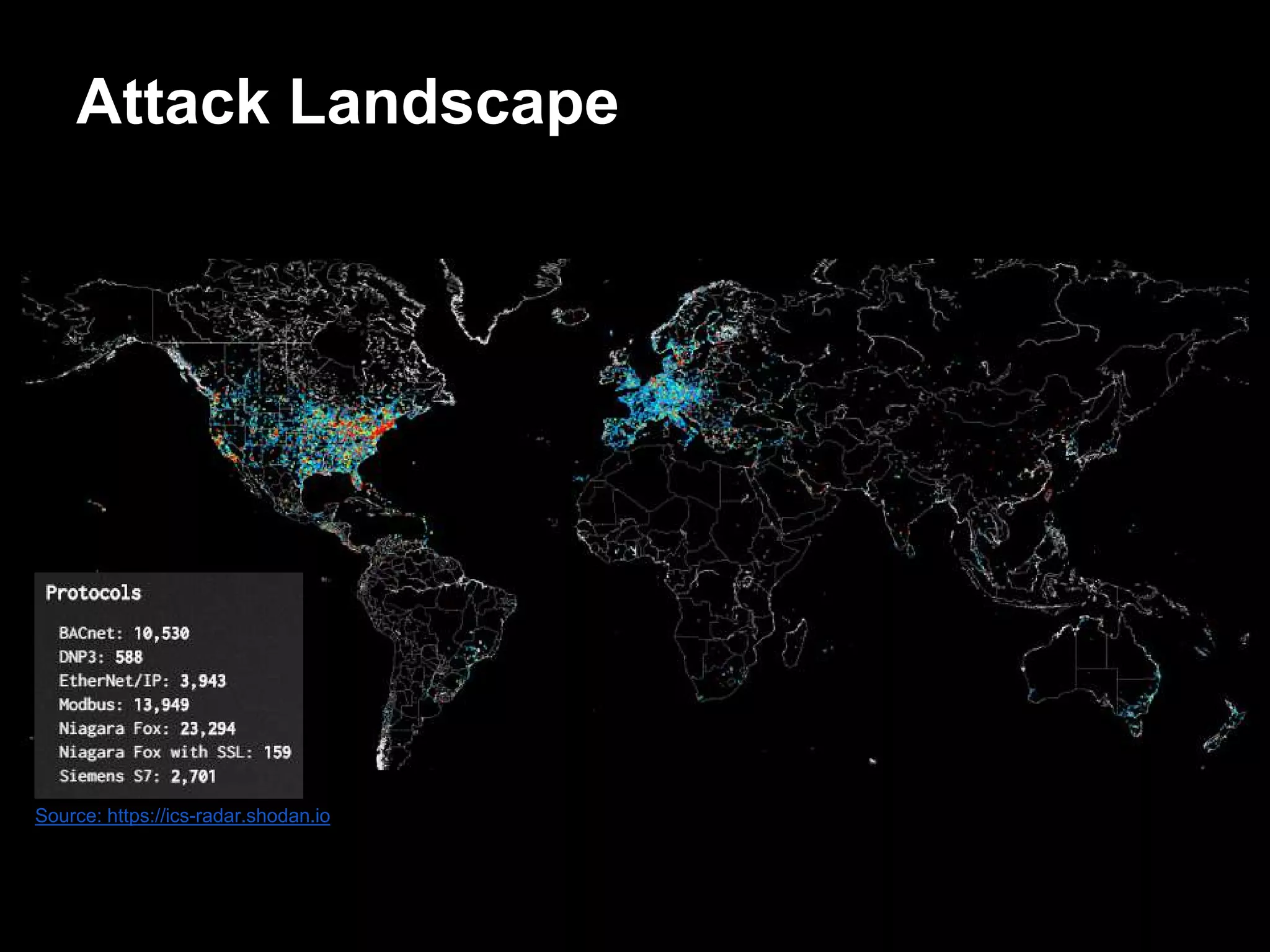
Attack Landscape
Source: https://ics-radar.shodan.io
Attack Landscape
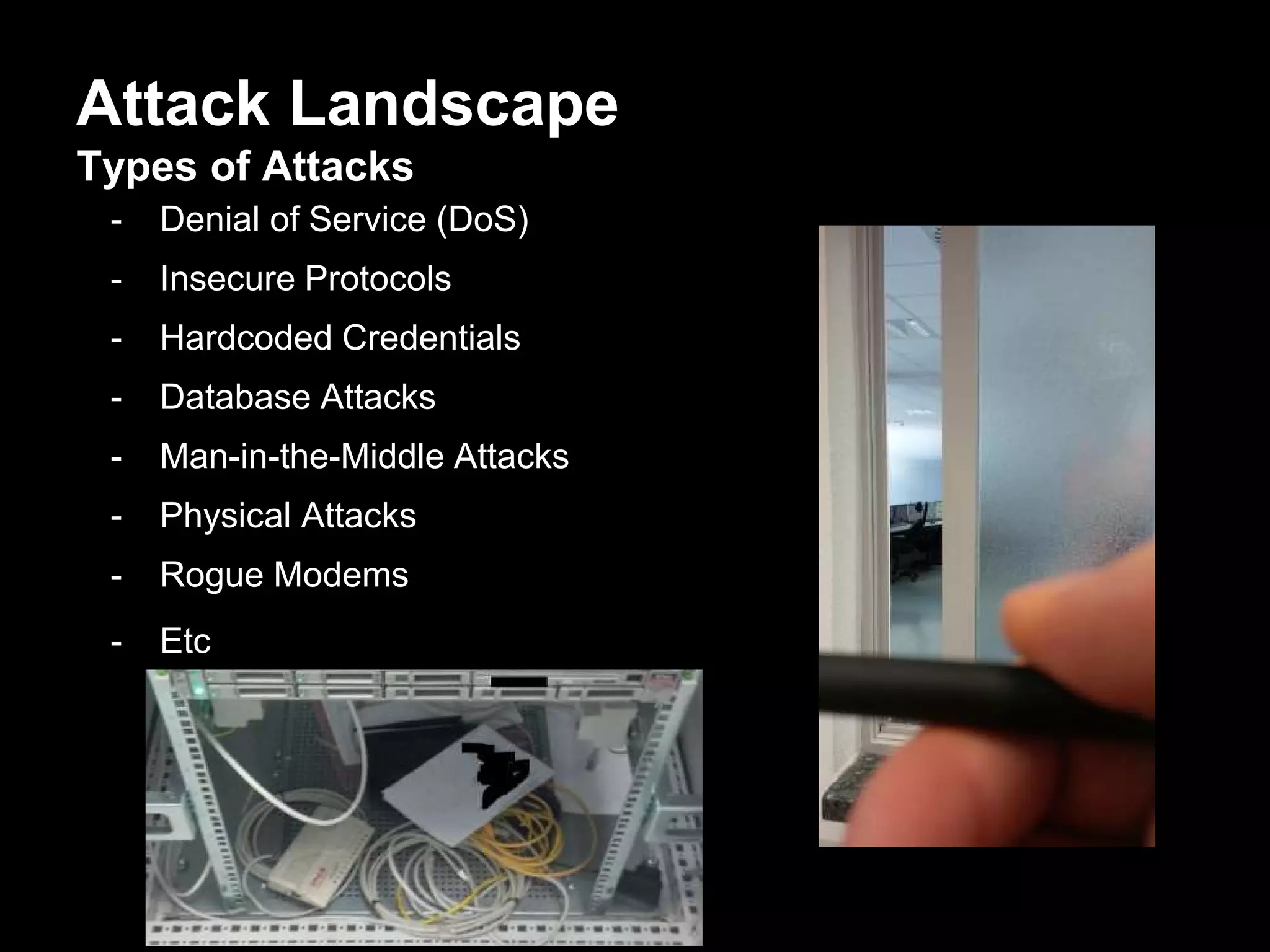
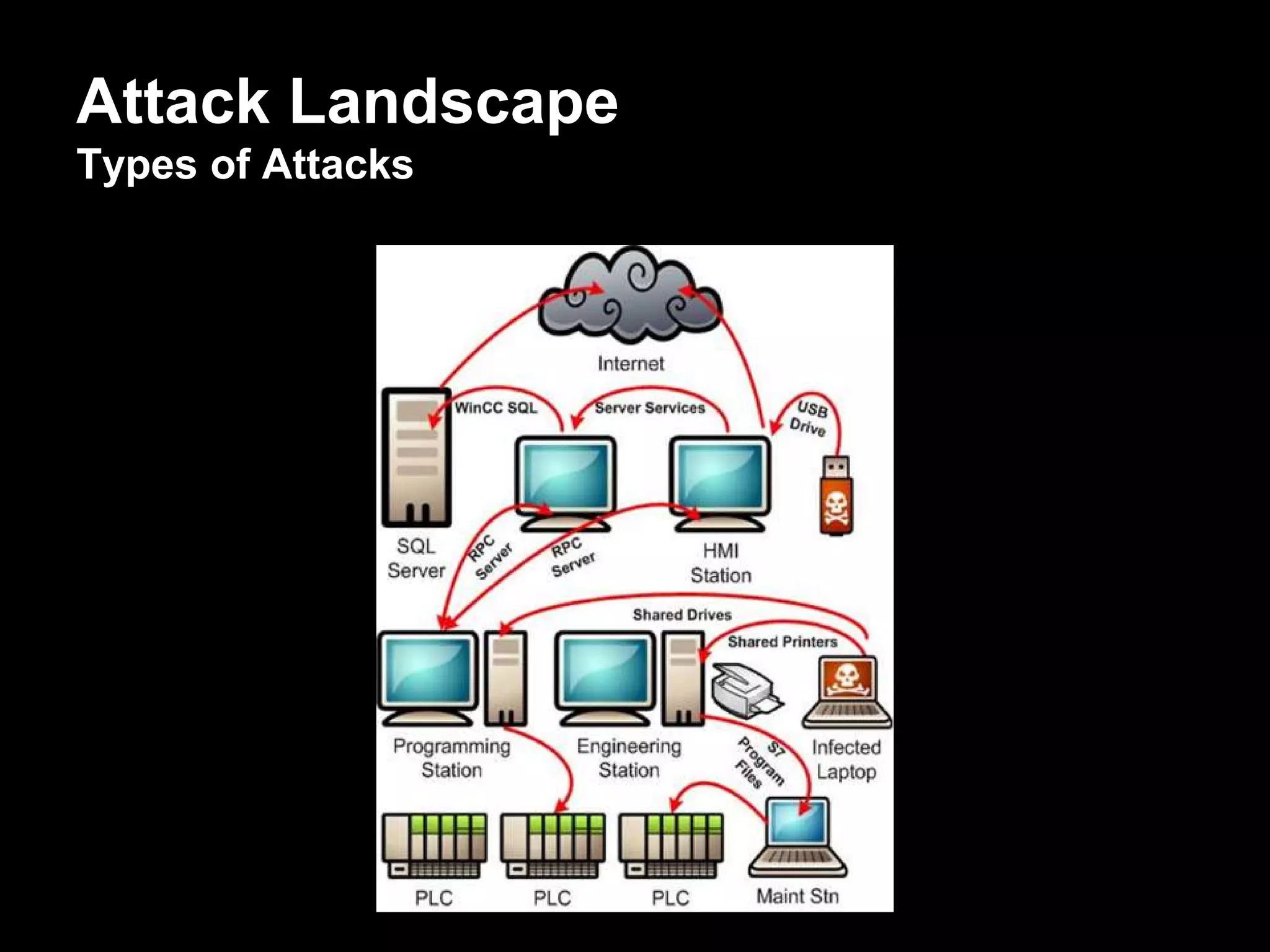
Types of Attacks
- Denial of Service (DoS)
- Insecure Protocols
- Hardcoded Credentials
- Database Attacks
- Man-in-the-Middle Attacks
- Physical Attacks
- Rogue Modems
- Etc
Attack Landscape
Types of Attacks
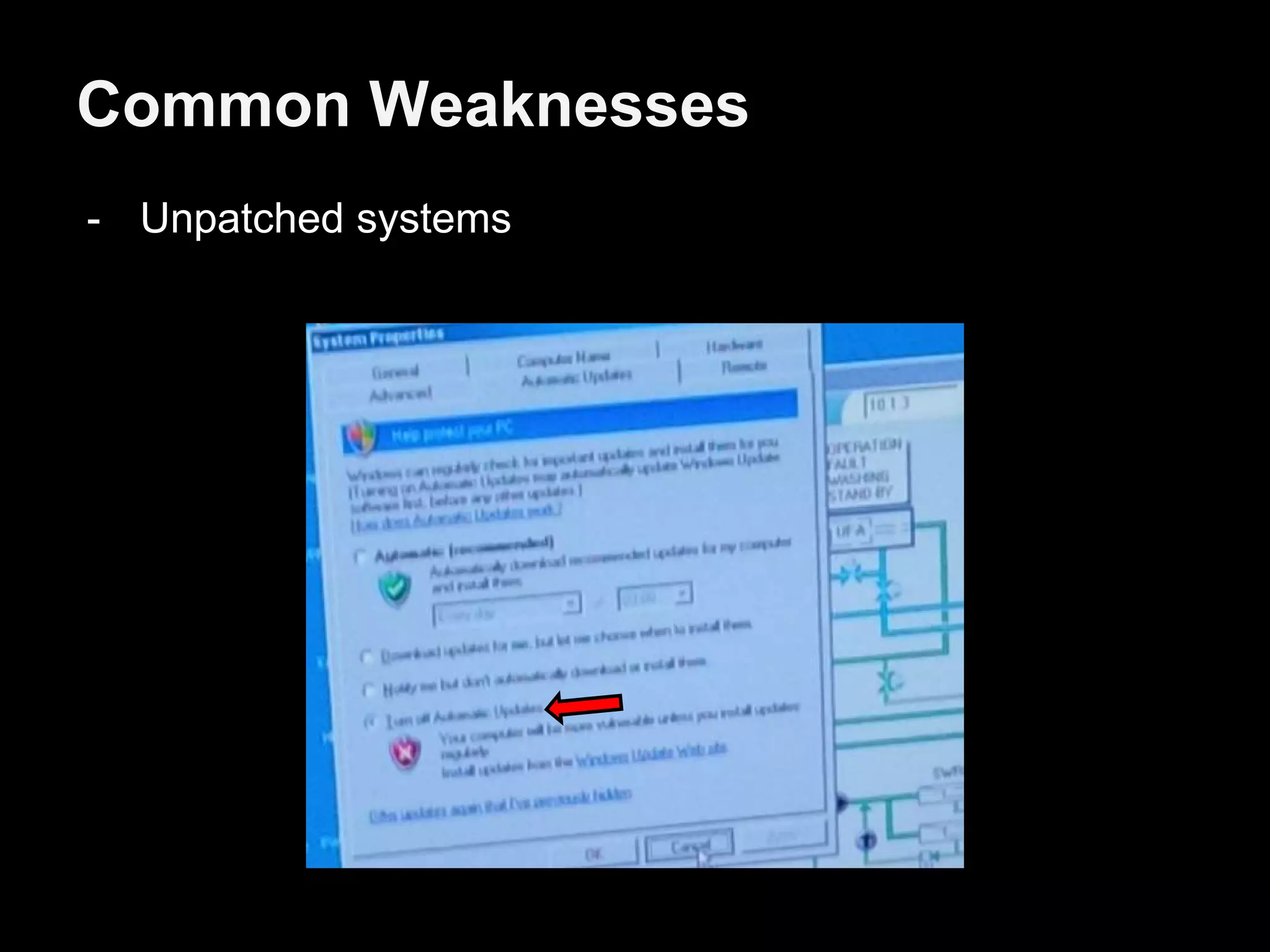
Common Weaknesses
- Unpatched systems
Common Weaknesses
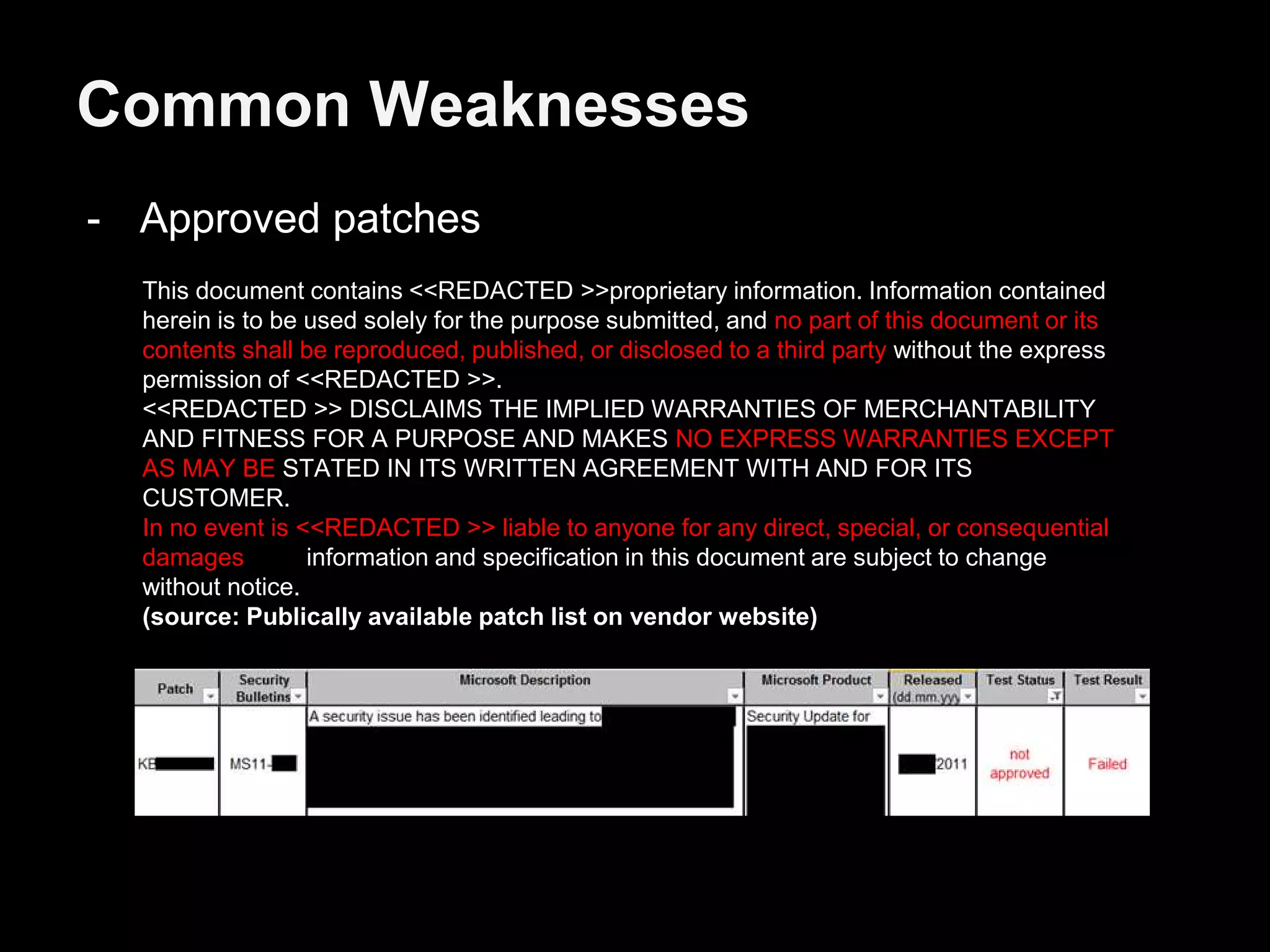
- Approved patches
This document contains <<REDACTED >>proprietary information. Information contained
herein is to be used solely for the purpose submitted, and no part of this document or its
contents shall be reproduced, published, or disclosed to a third party without the express
permission of <<REDACTED >>.
<<REDACTED >> DISCLAIMS THE IMPLIED WARRANTIES OF MERCHANTABILITY
AND FITNESS FOR A PURPOSE AND MAKES NO EXPRESS WARRANTIES EXCEPT
AS MAY BE STATED IN ITS WRITTEN AGREEMENT WITH AND FOR ITS
CUSTOMER.
In no event is <<REDACTED >> liable to anyone for any direct, special, or consequential
damages. The information and specification in this document are subject to change
without notice.
(source: Publically available patch list on vendor website)
Common Weaknesses
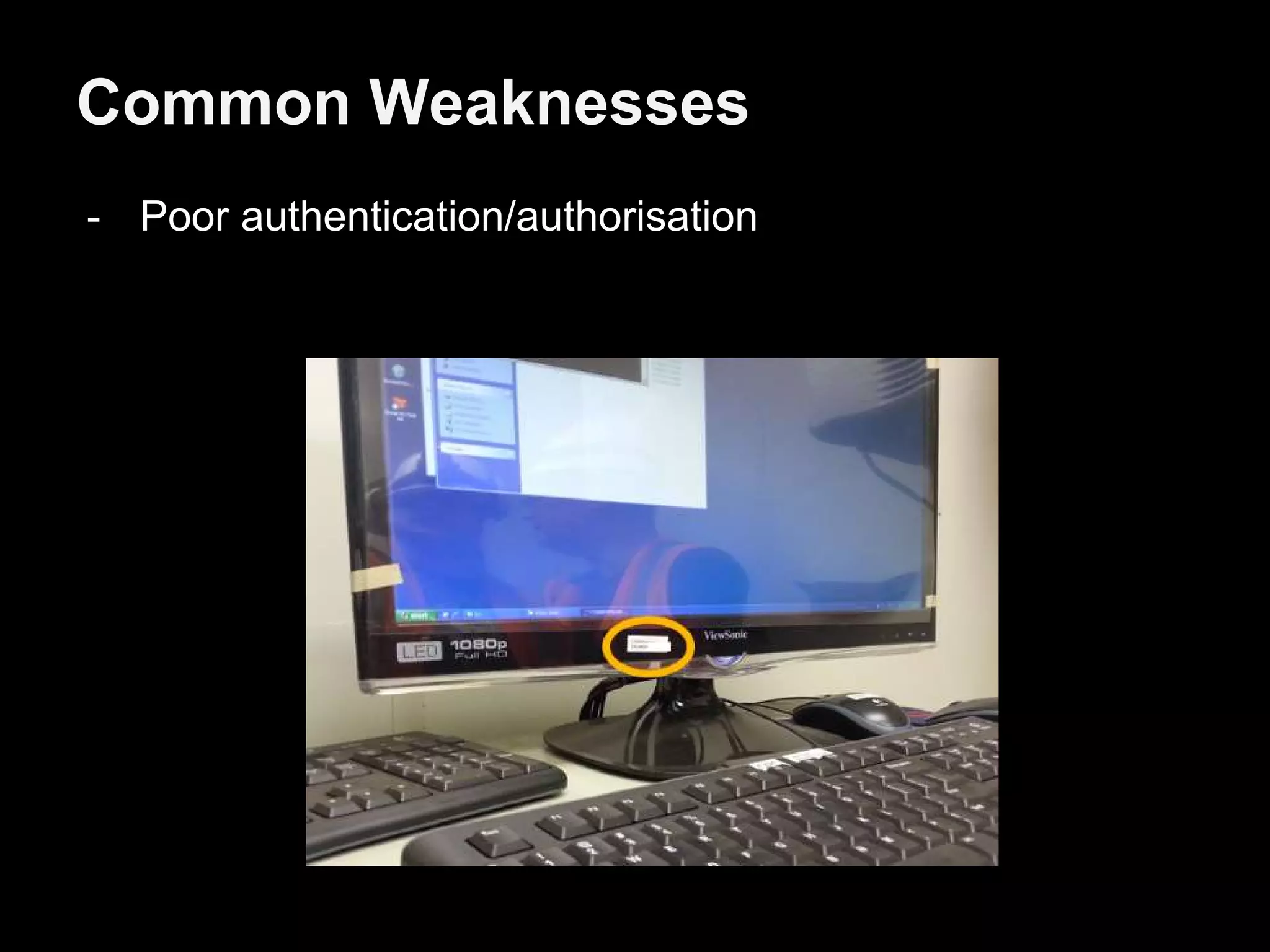
- Poor authentication/authorisation
Common Weaknesses
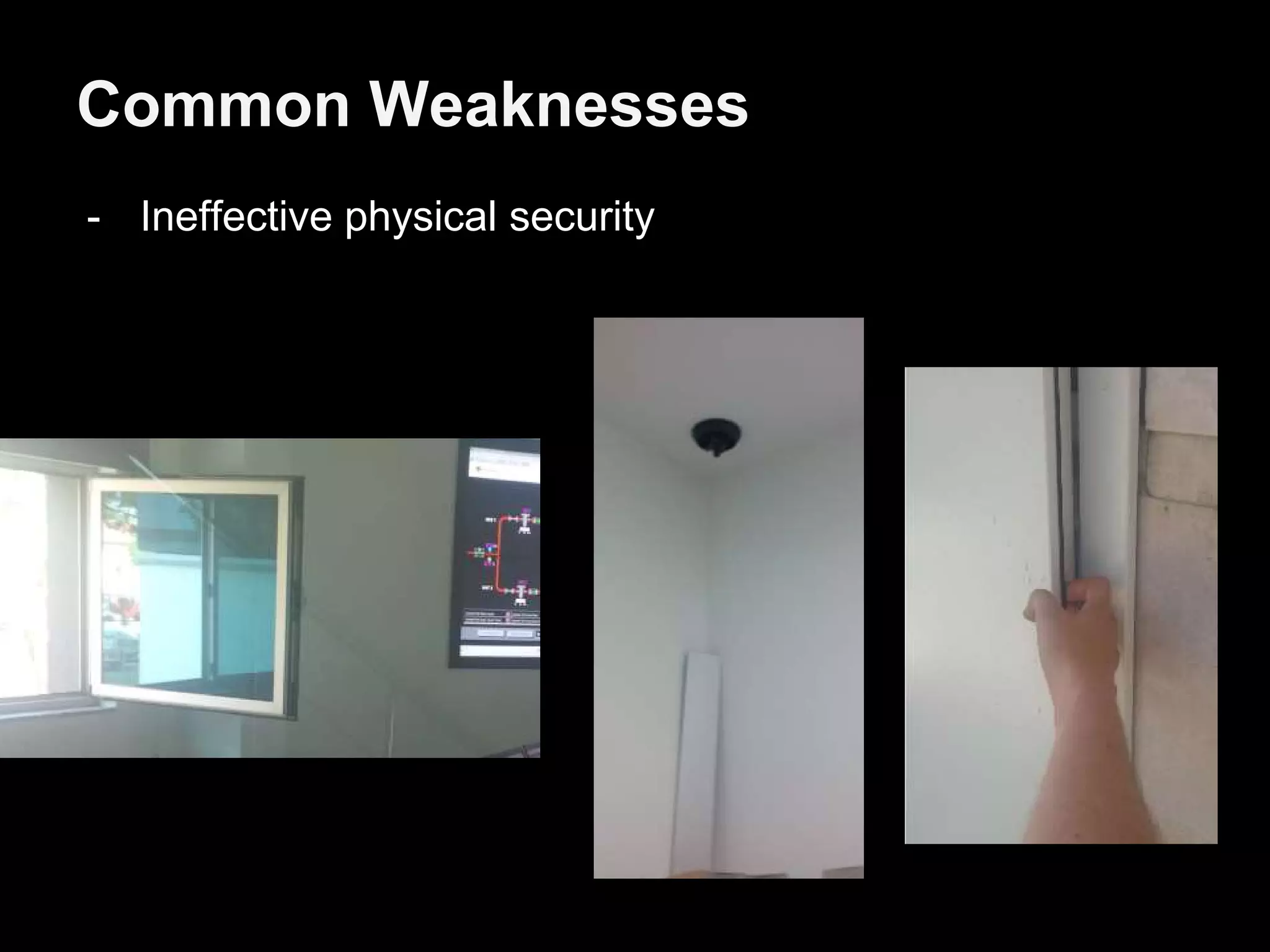
- Ineffective physical security
Common Weaknesses
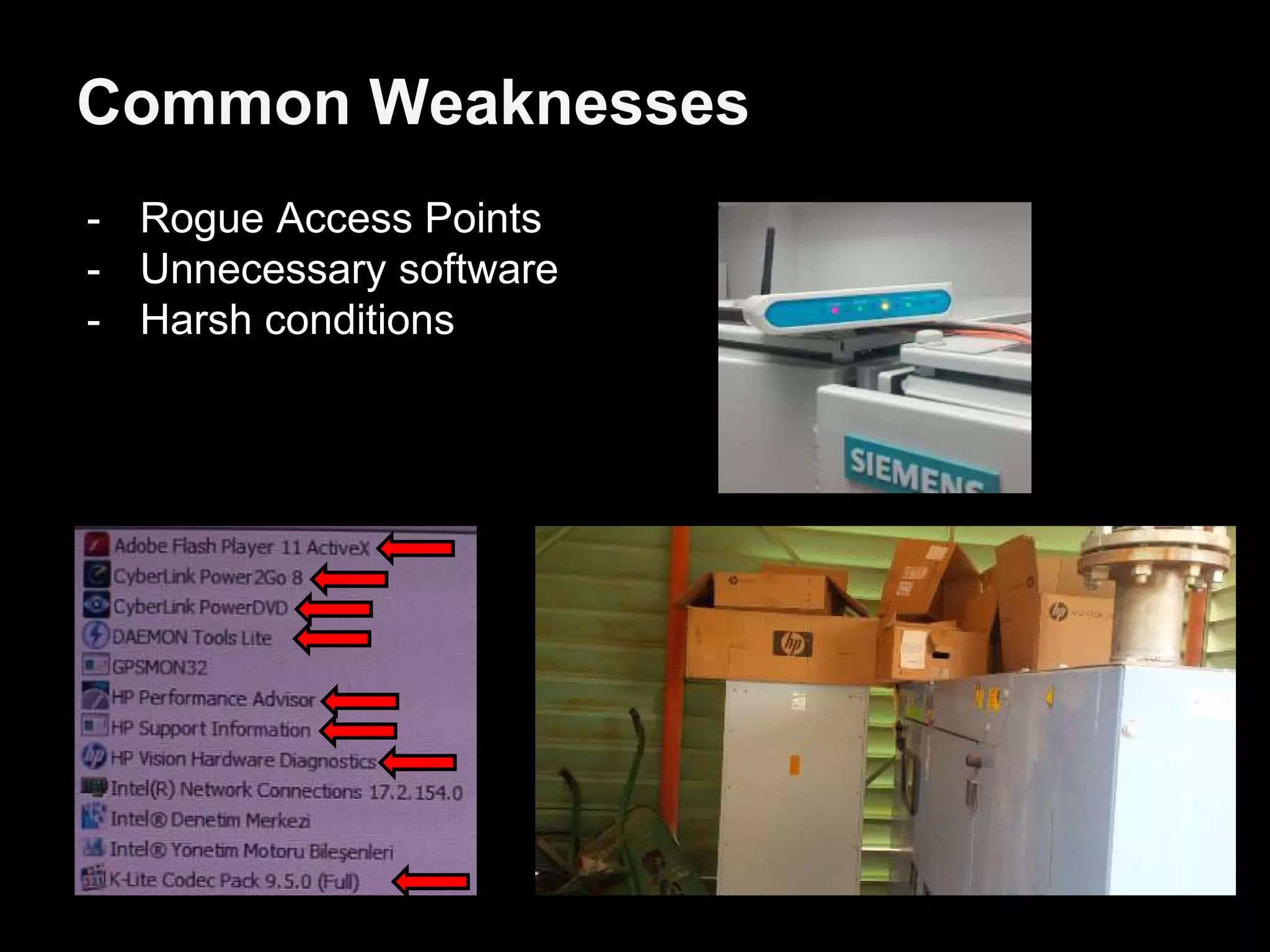
- Rogue Access Points
- Unnecessary software
- Harsh conditions
Common Weaknesses
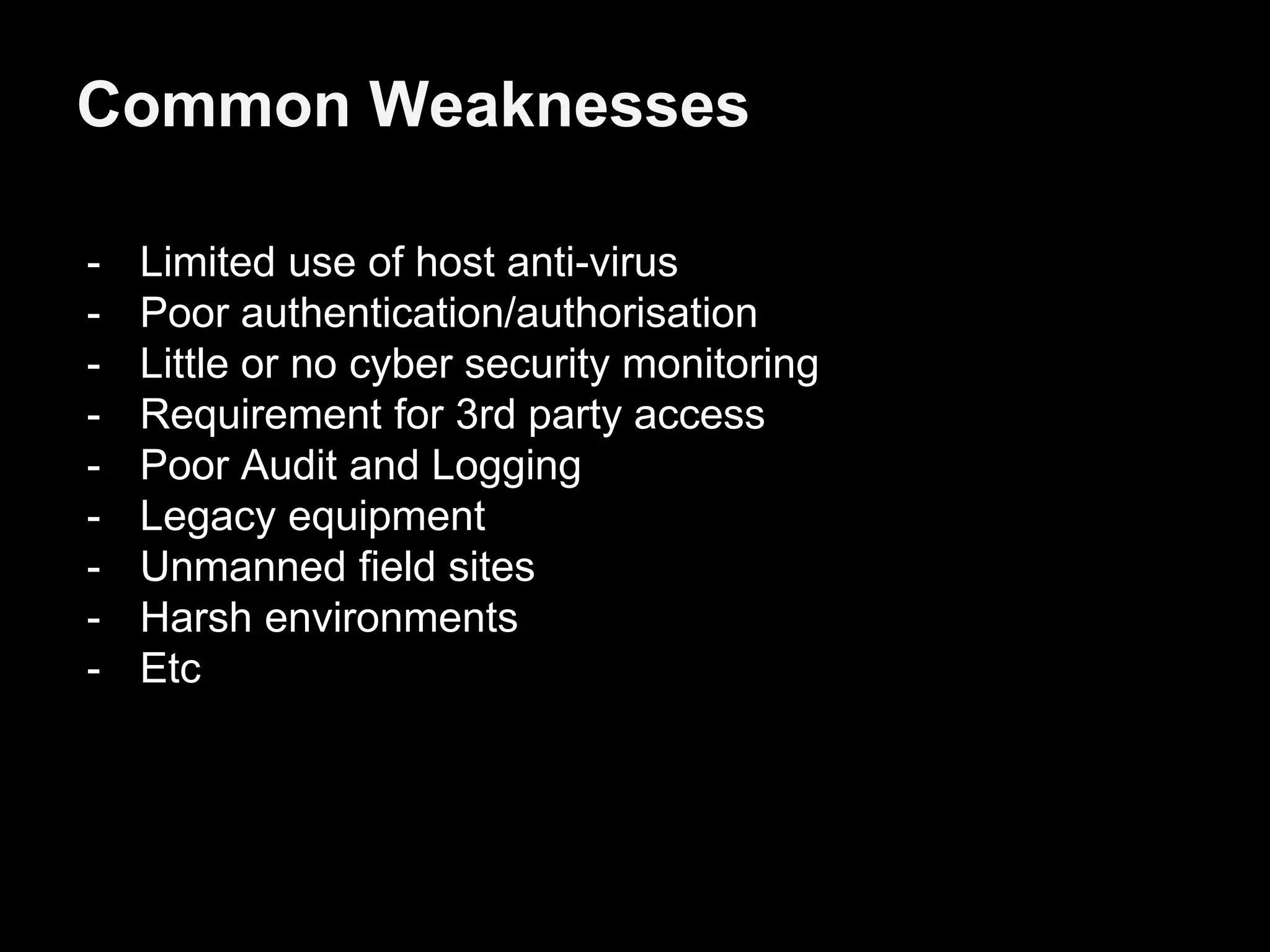
- Limited use of host anti-virus
- Poor authentication/authorisation
- Little or no cyber security monitoring
- Requirement for 3rd party access
- Poor Audit and Logging
- Legacy equipment
- Unmanned field sites
- Harsh environments
- Etc
- Preferably in test environment or during FAT/SAT
(Things will break!)
- Know your toolbox
- Capture traffic across different levels
- Close communication with control center
Assessing Control Systems
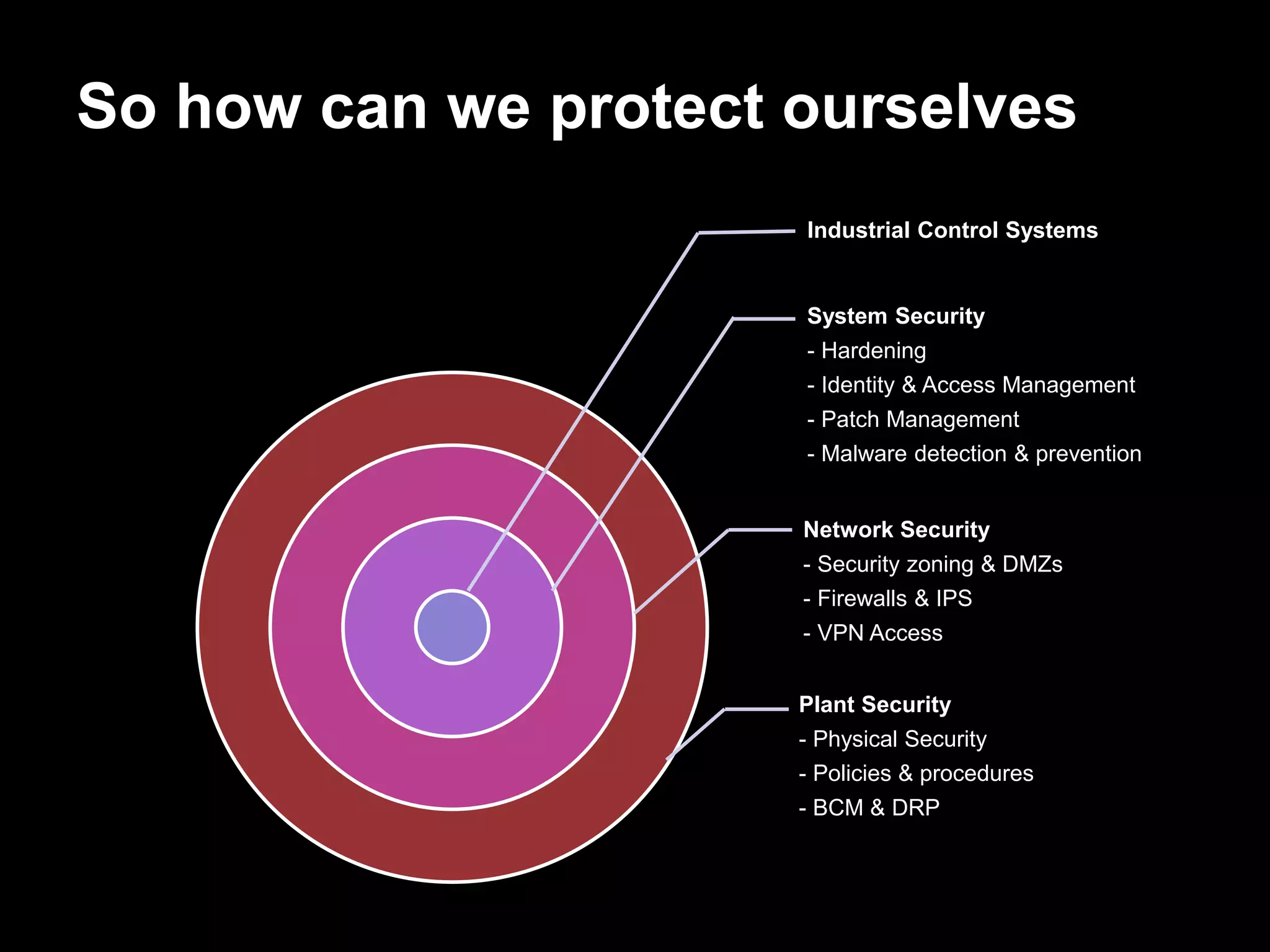
So how can we protect ourselves
Industrial Control Systems
System Security
- Hardening
- Identity & Access Management
- Patch Management
- Malware detection & prevention
Network Security
- Security zoning & DMZs
- Firewalls & IPS
- VPN Access
Plant Security
- Physical Security
- Policies & procedures
- BCM & DRP
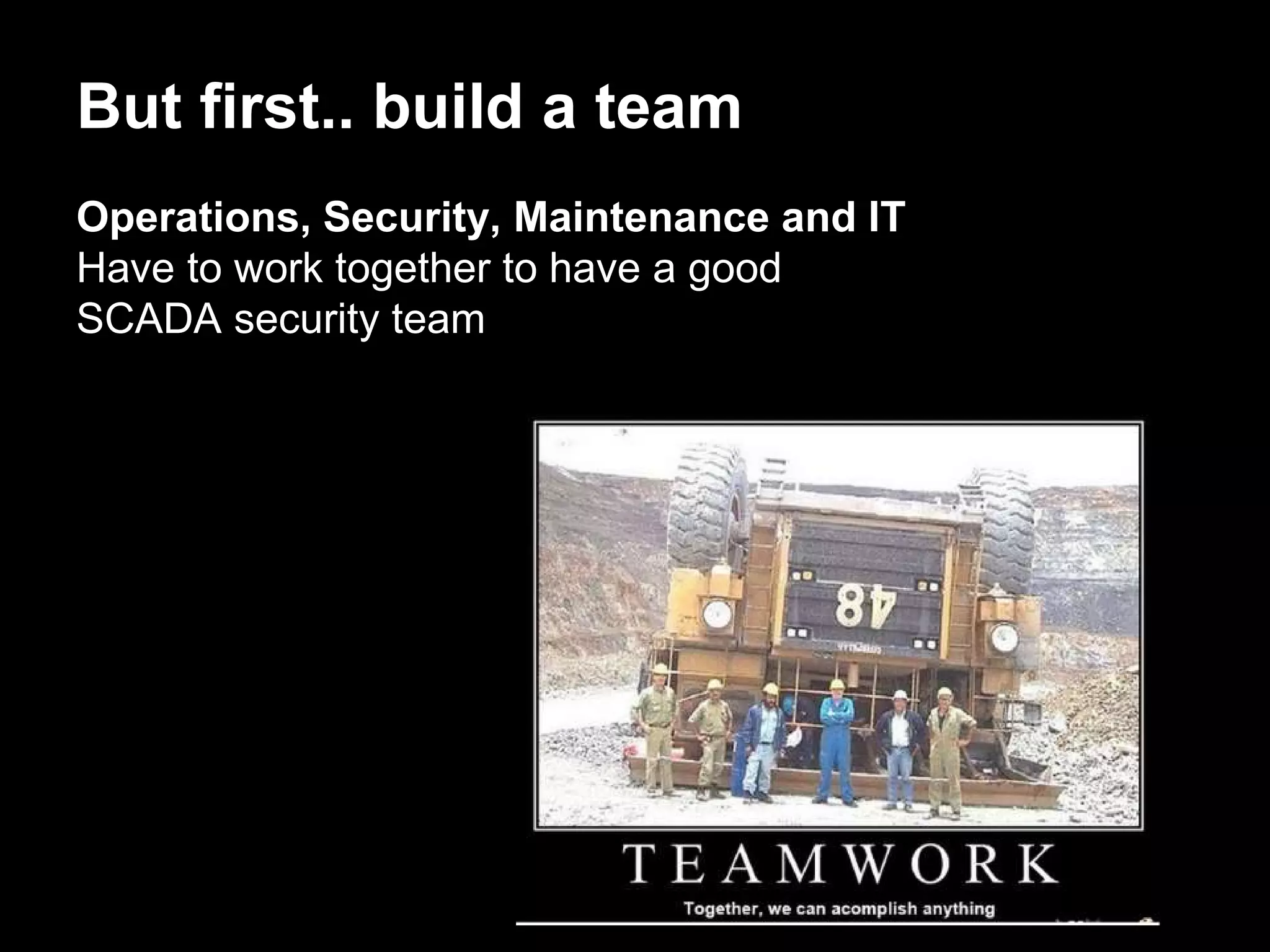
But first.. build a team
Operations, Security, Maintenance and IT
Have to work together to have a good
SCADA security team
Insight on current situation
- Create an Inventory
- Determine and verify current security levels
- Policies and Procedures
- Regulatory compliance
- Create awareness
- Talk to people
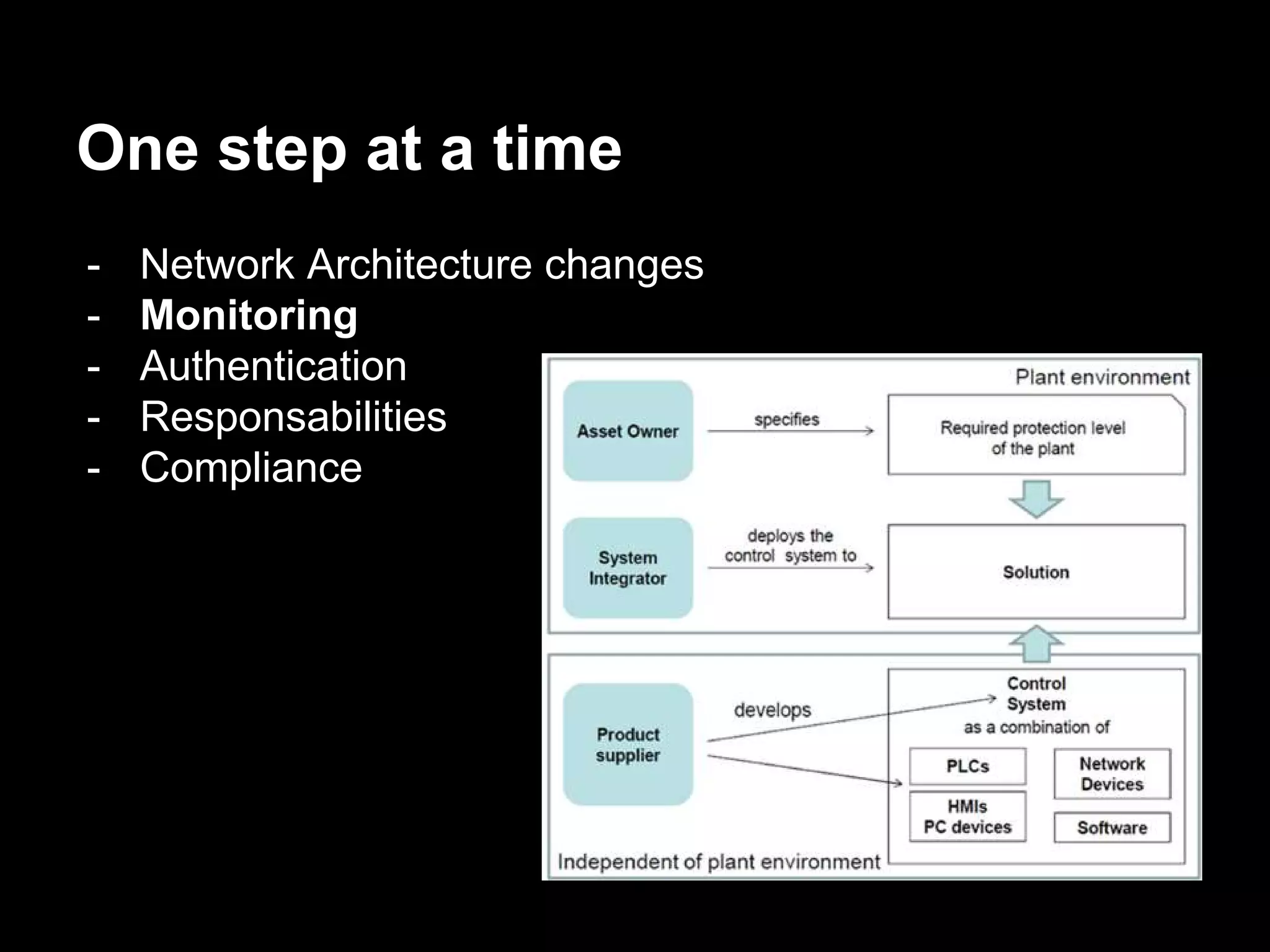
One step at a time
- Network Architecture changes
- Monitoring
- Authentication
- Responsabilities
- Compliance
Common pitfalls
- Compliance vs effectiveness
- Non-flexible approach
- Throwing money at the problem
- Lack of communication
Standards
- NERC CIP
- IEC 62443 (ISA99)
- IEEE 1686
- NIST SP800-82 rev 2
- Etc [link]
Questions

The journey to ICS - Extended

  • 1.
  • 2.
    Disclaimer I am employedin the Infosec industry but not authorised to speak on behalf of my employer or clients. Everything I say is from a personal point of view.
  • 3.
    About me @lvandenaweele - Securityconsultant at PwC Belgium - +5 years information security - +2 years within Industrial Security - Travel, food, beer ..not an expert yet, but eager to learn.
  • 4.
  • 5.
  • 6.
    Where can youfind Operational Technology And much more..
  • 7.
    What are therisks? - Human Safety
  • 8.
    - Human Safety -Environmental effects What are the risks?
  • 9.
    - Human Safety -Environmental effects - Material damage What are the risks?
  • 10.
    - Human Safety -Environmental effects - Material damage - High Impact events - Etc What are the risks?
  • 11.
    OT Clichés - Builtto last for decades - Uses specific means of communication - Availability is key, above security - At some point, human interaction (e.g. operators watching the grid)
  • 12.
  • 13.
    Some Vocabulary - PCS- Process Control System - BMS - Building Management System - EMS - Energy Management System - DMS - Distribution Management System - DCS - Distributed Control System - SCADA - Supervisory Control and Data Acquisition - PLC - Programmable Logic Controller - MTU - Master Terminal Unit - HMI - Human Machine Interface
  • 14.
    - WAN –Wide Area Network - LAN – Local Area Network - MAN – Metropolian Area Network - FAN – Field Area Network - PAN – Personal Area Network Some Vocabulary
  • 15.
  • 16.
    IT vs OT ITSystems OT Systems Data Confidentiality Low - High Low - Moderate Data Integrity Low - Moderate Very High Availability Low - Moderate Very High (99.9999% uptime common) Time Criticality Delays tolerated Critical Patching Frequent Infrequent to nearly impossible System Life Cycle 3 - 5 years 10 - 30+ years Security Standards ISO 27002, COBIT, NIST, etc. IEC 62443, CIP, NEI, IEEE 1686, etc. Operating Systems COTS COTS, RTOS, Embedded OS (Firmware) Interoperability Not critical Critical (security often not considered) Communication Protocols TCP/IP primarily HART, DNP3, Mod/FieldBus, ICCP, TCP/IP, etc. Communication Topology LAN/WAN, Telco, etc. LAN/WAN, Telco, Satellite, Serial, MWave, etc.
  • 17.
  • 18.
    Business Zone DMZ Operations Zone ProcessControl Zone Safety Zone Enforcement Zone
  • 19.
    Enforcement Zone Industrial SwitchIndustrial FirewallData Diode ICS Aware Routers
  • 20.
    Safety Zone Safety ValveSafety PLC Safety Gear
  • 21.
    Process Control Zone SensorsMotors Actuators Instrumentation PLC s Dedicated Control Operator Workstation Control Processes RTU s Data Historians Engineering Workstations Communication front ends Level 0 Process Control Network Level 1 Control Devices Level 2 Supervisory Control LAN ProcessControlZone
  • 22.
    Process Control Zone Level0 – Process Control Network Sensors Motors Actuators Instrumentation Level 0 Process Control Network Valves IED - Intelligent Electronic Device Sensors
  • 23.
    Process Control Zone Level1 – Control Devices PLC s Dedicated Control Operator Workstation Control Processes RTU s Level 1 Control Devices PLC - Programmable Logic Controller RTU - Remote Terminal Unit Dedicated Operator Workstation
  • 24.
    Process Control Zone Level2 – Supervisory Control LAN Data Historians Engineering Workstations Communication front ends Level 2 Supervisory Control LAN Data Historian Control Room HMI Panel
  • 25.
    Operations Zone Level 3– Operations Support Sensors Motors Actuators Instrumentation PLC s Dedicated Control Operator Workstation Control Processes RTU s Data Historians Engineering Workstations Communication front ends Simulation & modeling systems Operations Analysis Systems Engineering workstation Test systems Level 0 Process Control Network Level 1 Control Devices Level 2 Supervisory Control LAN Level 3 Operations Support Enforcement zone ProcessControlZone OperationsZone
  • 26.
    DMZ, Business Zone Jumphost environment Patch Management AV Server Application Server Enforcement zone Site directory replicas Local file servers Site specific Remote Access Corporate internet, e-mail, public websites,etc DMZ Level 4 Plant Network Level 5 Enterprise Business Network DMZBusinessZone
  • 27.
    Sensors Motors ActuatorsInstrumentation PLC s Dedicated Control Operator Workstation Control Processes RTU s Data Historians Engineering Workstations Communication front ends Simulation & modeling systems Operations Analysis Systems Engineering workstation Test systems Jump host environment Patch Management AV Server Application Server Enforcement zone Site directory replicas Local file servers Site specific Remote Access Corporate internet, e-mail, public websites,etc Level 0 Process Control Network Level 1 Control Devices Level 2 Supervisory Control LAN Level 3 Operations Support DMZ Level 4 Plant Network Level 5 Enterprise Business Network Enforcement zone Enforcement zone ProcessControlZone OperationsZone DMZBusinessZone Source: https://isc.sans.edu/diaryimages/images/purdue.png
  • 28.
    Network Architecture The mysteryof air gaps What you think is in place Source: ISBN-13: 978-1597496452
  • 29.
    Network Architecture The mysteryof air gaps But actually.. Source: ISBN-13: 978-1597496452
  • 30.
    Network Architecture Protocols Raw DataProtocols - HART / ModBus - Reads data (measurements) - Sends commands (start pumps) - Clear text - No authentication High Level Data Protocols - OPC / ICCP / MMS - Sending data, commands between databases/applications - Creates human readable information - Likely to act like bridge between corporate and control networks
  • 31.
    Network Architecture Protocols -ModBus TCP - 502/TCP - open protocol - Master/Slave - Simple request/response protocol - Function codes - No Security
  • 32.
    Network Architecture Protocols -OPC - Object Linking and Embedding for Process Control - First released in 1996 - 4840/TCP - Open Standard - Acts as a bridge between different application - Often the link between corporate and control network
  • 33.
  • 34.
    Attack Landscape Types ofAttacks - Denial of Service (DoS) - Insecure Protocols - Hardcoded Credentials - Database Attacks - Man-in-the-Middle Attacks - Physical Attacks - Rogue Modems - Etc
  • 35.
  • 36.
  • 37.
    Common Weaknesses - Approvedpatches This document contains <<REDACTED >>proprietary information. Information contained herein is to be used solely for the purpose submitted, and no part of this document or its contents shall be reproduced, published, or disclosed to a third party without the express permission of <<REDACTED >>. <<REDACTED >> DISCLAIMS THE IMPLIED WARRANTIES OF MERCHANTABILITY AND FITNESS FOR A PURPOSE AND MAKES NO EXPRESS WARRANTIES EXCEPT AS MAY BE STATED IN ITS WRITTEN AGREEMENT WITH AND FOR ITS CUSTOMER. In no event is <<REDACTED >> liable to anyone for any direct, special, or consequential damages. The information and specification in this document are subject to change without notice. (source: Publically available patch list on vendor website)
  • 38.
    Common Weaknesses - Poorauthentication/authorisation
  • 39.
  • 40.
    Common Weaknesses - RogueAccess Points - Unnecessary software - Harsh conditions
  • 41.
    Common Weaknesses - Limiteduse of host anti-virus - Poor authentication/authorisation - Little or no cyber security monitoring - Requirement for 3rd party access - Poor Audit and Logging - Legacy equipment - Unmanned field sites - Harsh environments - Etc
  • 43.
    - Preferably intest environment or during FAT/SAT (Things will break!) - Know your toolbox - Capture traffic across different levels - Close communication with control center Assessing Control Systems
  • 44.
    So how canwe protect ourselves Industrial Control Systems System Security - Hardening - Identity & Access Management - Patch Management - Malware detection & prevention Network Security - Security zoning & DMZs - Firewalls & IPS - VPN Access Plant Security - Physical Security - Policies & procedures - BCM & DRP
  • 45.
    But first.. builda team Operations, Security, Maintenance and IT Have to work together to have a good SCADA security team
  • 46.
    Insight on currentsituation - Create an Inventory - Determine and verify current security levels - Policies and Procedures - Regulatory compliance - Create awareness - Talk to people
  • 47.
    One step ata time - Network Architecture changes - Monitoring - Authentication - Responsabilities - Compliance
  • 48.
    Common pitfalls - Compliancevs effectiveness - Non-flexible approach - Throwing money at the problem - Lack of communication
  • 49.
    Standards - NERC CIP -IEC 62443 (ISA99) - IEEE 1686 - NIST SP800-82 rev 2 - Etc [link]
  • 50.