Security Testing in Critical Systems

       An Ethical Hacker’s View


                            Peter Wood
                        Chief Executive Officer
                      First•Base Technologies
Who am I ?

 • Worked in computers & electronics since 1969
 • Founded First•Base Technologies in 1989
          (one of the first ethical hacking firms)
 • Primary roles:
          - Social engineer & penetration tester
          - Conference speaker
          - TV and radio security ‘expert’
          - Member of ISACA Security Advisory Group
          - ISACA Conference Task Force member
          - Expert at the Corporate Executive Programme
          - Chair of Advisory board at CSA UK & Ireland


Slide 2                                                   © First Base Technologies 2011
Agenda


          • Overview of critical systems
          • Vulnerabilities and concerns
          • Security testing
          • Summary and conclusions


Slide 3                              © First Base Technologies 2011
Agenda


          • Overview of critical systems
          • Vulnerabilities and concerns
          • Security testing
          • Summary and conclusions


Slide 4                              © First Base Technologies 2011
Industrial Control Systems

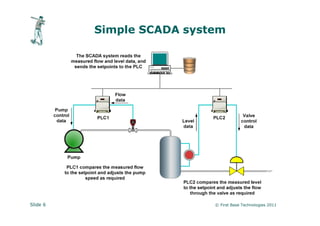
      • Supervisory Control And Data Acquisition (SCADA)
          - computer systems that monitor and control industrial,
            infrastructure, or facility-based processes
      • Programmable Logic Controller (PLC)
          - a computer used for automation of electromechanical
            processes, such as control of machinery
      • Programmable Automation Controller (PAC)
          - a compact controller that combines the features and
            capabilities of a PC-based control system with that of a
            typical PLC
      • Remote Terminal Unit (RTU) or Intelligent Electronic
        Device (IED)
          - a microprocessor-controlled device that interfaces objects in
            the physical world to a distributed control system or SCADA

Slide 5                                                © First Base Technologies 2011
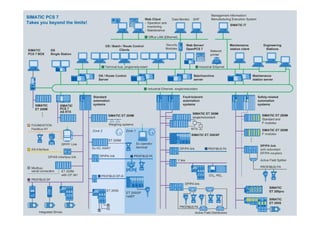
Simple SCADA system


Slide 6                    © First Base Technologies 2011
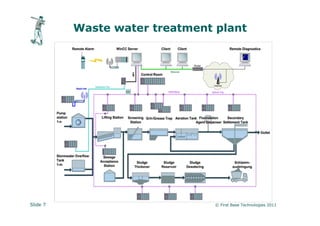
Waste water treatment plant


Slide 7                         © First Base Technologies 2011
Network Architecture

          • RTUs and IEDs are proprietary devices running
            embedded operating systems
          • These originally used serial communications with field
            bus protocols such as Modbus, BITBUS, PROFIBUS etc.
          • Field bus protocols are now frequently encapsulated in
            TCP/IP
          • SCADA controllers manage communications, analyse
            data and display the alerts and events
          • Industrial systems now use UNIX or Windows in
            controllers and embedded in some field devices
          • This has exposed industrial systems to the same IT
            security challenges as commercial systems


Slide 9                                              © First Base Technologies 2011
Agenda


           • Overview of critical systems
           • Vulnerabilities and concerns
           • Security testing
           • Summary and conclusions


Slide 10                              © First Base Technologies 2011
Authentication Problems


           • Default (manufacturer) passwords
           • Very poor quality passwords
           • Passwords never changed
           • Passwords common across many devices
           • Shared credentials
           • No passwords / anonymous logins
           • Remote access via modem
           • Systems replaced less often than commercial
             systems: no cleanup, more opportunity for
             information leakage


Slide 11                                        © First Base Technologies 2011
Systems not Patched or Hardened

           • Many systems running on legacy (unsupported)
             operating systems
           • Patching can break applications
           • Patching can violate some vendors’ service contracts
           • Systems never taken off-line, as downtime can
             cause massive problems
           • Systems are rarely hardened as it is believed this
             may impact the application
           • SCADA applications themselves often contain
             vulnerabilities
           • Frequently no anti-malware software


Slide 12                                             © First Base Technologies 2011
Insecure Protocols


           • Field bus protocols were not designed to be secure
           • Most field devices use proprietary IP stacks that are
             prone to DoS attacks and buffer overflows
           • Field bus protocols designed for serial comms, so
             no built in authentication – all legitimate packets
             will be processed
           • Most communication is in plain text


           • Default SNMP strings …


Slide 13                                             © First Base Technologies 2011
Lack of Segmentation


           • Firewalls usually only between the corporate
             network and the industrial network (if at all)
           • Firewalls may be badly configured, industrial
             protocols difficult to control
              - All field bus traffic may be on one port
              - Cannot risk blocking critical messages
           • Wireless can bypass firewalls
           • Traditionally SCADA systems were isolated … not
             any more
           • Systems therefore vulnerable to malware,
             especially worms


Slide 14                                                   © First Base Technologies 2011
Stuxnet (you had to ask)

      •    Self-replicates through removable drives exploiting a vulnerability allowing auto-
           execution
      •    Spreads in a LAN through a vulnerability in the Windows Print Spooler
      •    Spreads through SMB by exploiting the Microsoft Windows Server Service RPC
           Handling Remote Code Execution Vulnerability
      •    Copies and executes itself on remote computers through network shares
      •    Copies and executes itself on remote computers running a WinCC database server
      •    Copies itself into Step 7 projects in such a way that it automatically executes when
           the Step 7 project is loaded
      •    Updates itself through a peer-to-peer mechanism within a LAN
      •    Exploits a total of four unpatched Microsoft vulnerabilities, two of which are
           previously mentioned vulnerabilities for self-replication and the other two are
           escalation of privilege vulnerabilities that have yet to be disclosed
      •    Contacts a command and control server that allows the hacker to download and
           execute code, including updated versions
      •    Contains a Windows rootkit that hide its binaries
      •    Attempts to bypass security products
      •    Fingerprints a specific industrial control system and modifies code on the Siemens
           PLCs to potentially sabotage the system
      •    Hides modified code on PLCs, essentially a rootkit for PLCs

                                          Symantec: W32.Stuxnet Dossier version 1.4 (February 2011)

Slide 15                                                                © First Base Technologies 2011
Agenda


           • Overview of critical systems
           • Vulnerabilities and concerns
           • Security testing
           • Summary and conclusions


Slide 16                              © First Base Technologies 2011
Problems with Testing


           While a ping sweep was being performed on an active
           SCADA network that controlled 9-foot robotic arms, it
           was noticed that one arm became active and swung
           around 180 degrees.
           The controller for the arm was in standby mode before
           the ping sweep was initiated.


                                                    NIST Special Publication 800-82
                          Guide to Supervisory Control and Data Acquisition (SCADA)
                                             and Industrial Control Systems Security


Slide 17                                                      © First Base Technologies 2011
Problems with Testing


       A ping sweep was being performed on an ICS network to
       identify all hosts that were attached to the network, for
       inventory purposes.
       It caused a system controlling the creation of integrated
       circuits in the fabrication plant to hang.
       This test resulted in the destruction of $50,000 worth of
       wafers.

                                                  NIST Special Publication 800-82
                        Guide to Supervisory Control and Data Acquisition (SCADA)
                                           and Industrial Control Systems Security


Slide 18                                                    © First Base Technologies 2011
Problems with Testing


       A gas utility hired an IT security consulting organization to
       conduct penetration testing on its corporate IT network.
       The consulting organization carelessly ventured into a part
       of the network that was directly connected to the SCADA
       system.
       The penetration test locked up the SCADA system and the
       utility was not able to send gas through its pipelines for
       four hours.
       The outcome was the loss of service to its customer base
       for those four hours.

                                                  NIST Special Publication 800-82
                        Guide to Supervisory Control and Data Acquisition (SCADA)
                                           and Industrial Control Systems Security


Slide 19                                                    © First Base Technologies 2011
Areas for Review


           • Perimeter
           • Network infrastructure
           • Active Directory etc.
           • Host operating systems
           • Applications
           • PLCs, RTUs, IEDs, etc.


Slide 20                              © First Base Technologies 2011
Security Review / Audit


           • Identification of devices and networks:
              - Router configs, router tables, switch tables, physical
                cable checks, packet sniffing
           • Identification of services:
              - Local port verification (netstat), scan of test or
                development system
           • Identification of vulnerabilities:
              - Local banner grabbing, scan of test or development
                system

                                Penetration Testing of Industrial Control Systems
                                                    Sandia National Laboratories


Slide 21                                                     © First Base Technologies 2011
Perimeter


           • Identify all external connections
           • Review firewall rules
           • Review remote access methods
           • Check for wireless networks
           • Check physical access


           • If if doubt: test duplicate systems


Slide 22                                    © First Base Technologies 2011
Network Infrastructure


           • Review router configs
           • Review switch tables
           • Conduct physical cable checks
           • Conduct packet sniffing and analysis


           • If if doubt: test duplicate systems


Slide 23                                     © First Base Technologies 2011
Active Directory


           • Audit Active Directory
             - Manual inspection
             - Interviews
             - Offline inspection


Slide 24                                © First Base Technologies 2011
Host Operating Systems


           • Review hardening
           • Review patch levels
           • Review password quality
           • Review share and directory permissions
           • Review remote access


           • If if doubt: test duplicate systems


Slide 25                                    © First Base Technologies 2011
Applications


           • Review ports and services
           • Review OS credentials
           • Review password quality
           • Review remote access
           • Consider code review


           • If if doubt: test duplicate systems


Slide 26                                    © First Base Technologies 2011
PLCs, RTUs, IEDs, etc.


           • Review hardening
           • Review patch levels
           • Review password quality (if any)
           • Conduct packet sniffing


           • If if doubt: test duplicate systems


Slide 27                                    © First Base Technologies 2011
Agenda


           • Overview of critical systems
           • Vulnerabilities and concerns
           • Security testing
           • Summary and conclusions


Slide 28                              © First Base Technologies 2011
Summary and Conclusions

       • Industrial systems now use UNIX or Windows exposing them
         to the same IT security challenges as commercial systems
       • Systems still considered to be isolated, but they are not
       • Systems not patched or hardened
       • All devices will have authentication problems
       • Systems replaced less often than commercial systems: no
         cleanup, more opportunity for information leakage
       • Field bus protocols were not designed to be secure
       • Poor segmentation and firewalling


       • Conventional scanning and testing can cause serious problems
       • Audit and careful manual inspection rather than pen test


Slide 29                                                 © First Base Technologies 2011
Need more information?


              Peter Wood
           Chief Executive Officer
      First•Base Technologies LLP

           peterw@firstbase.co.uk
             Twitter: peterwoodx
           Blog: fpws.blogspot.com
            http://firstbase.co.uk
           http://white-hats.co.uk
            http://peterwood.com


Slide 30                             © First Base Technologies 2011

Security testing in critical systems

  • 1.
    Security Testing inCritical Systems An Ethical Hacker’s View Peter Wood Chief Executive Officer First•Base Technologies
  • 2.
    Who am I? • Worked in computers & electronics since 1969 • Founded First•Base Technologies in 1989 (one of the first ethical hacking firms) • Primary roles: - Social engineer & penetration tester - Conference speaker - TV and radio security ‘expert’ - Member of ISACA Security Advisory Group - ISACA Conference Task Force member - Expert at the Corporate Executive Programme - Chair of Advisory board at CSA UK & Ireland Slide 2 © First Base Technologies 2011
  • 3.
    Agenda • Overview of critical systems • Vulnerabilities and concerns • Security testing • Summary and conclusions Slide 3 © First Base Technologies 2011
  • 4.
    Agenda • Overview of critical systems • Vulnerabilities and concerns • Security testing • Summary and conclusions Slide 4 © First Base Technologies 2011
  • 5.
    Industrial Control Systems • Supervisory Control And Data Acquisition (SCADA) - computer systems that monitor and control industrial, infrastructure, or facility-based processes • Programmable Logic Controller (PLC) - a computer used for automation of electromechanical processes, such as control of machinery • Programmable Automation Controller (PAC) - a compact controller that combines the features and capabilities of a PC-based control system with that of a typical PLC • Remote Terminal Unit (RTU) or Intelligent Electronic Device (IED) - a microprocessor-controlled device that interfaces objects in the physical world to a distributed control system or SCADA Slide 5 © First Base Technologies 2011
  • 6.
    Simple SCADA system Slide6 © First Base Technologies 2011
  • 7.
    Waste water treatmentplant Slide 7 © First Base Technologies 2011
  • 9.
    Network Architecture • RTUs and IEDs are proprietary devices running embedded operating systems • These originally used serial communications with field bus protocols such as Modbus, BITBUS, PROFIBUS etc. • Field bus protocols are now frequently encapsulated in TCP/IP • SCADA controllers manage communications, analyse data and display the alerts and events • Industrial systems now use UNIX or Windows in controllers and embedded in some field devices • This has exposed industrial systems to the same IT security challenges as commercial systems Slide 9 © First Base Technologies 2011
  • 10.
    Agenda • Overview of critical systems • Vulnerabilities and concerns • Security testing • Summary and conclusions Slide 10 © First Base Technologies 2011
  • 11.
    Authentication Problems • Default (manufacturer) passwords • Very poor quality passwords • Passwords never changed • Passwords common across many devices • Shared credentials • No passwords / anonymous logins • Remote access via modem • Systems replaced less often than commercial systems: no cleanup, more opportunity for information leakage Slide 11 © First Base Technologies 2011
  • 12.
    Systems not Patchedor Hardened • Many systems running on legacy (unsupported) operating systems • Patching can break applications • Patching can violate some vendors’ service contracts • Systems never taken off-line, as downtime can cause massive problems • Systems are rarely hardened as it is believed this may impact the application • SCADA applications themselves often contain vulnerabilities • Frequently no anti-malware software Slide 12 © First Base Technologies 2011
  • 13.
    Insecure Protocols • Field bus protocols were not designed to be secure • Most field devices use proprietary IP stacks that are prone to DoS attacks and buffer overflows • Field bus protocols designed for serial comms, so no built in authentication – all legitimate packets will be processed • Most communication is in plain text • Default SNMP strings … Slide 13 © First Base Technologies 2011
  • 14.
    Lack of Segmentation • Firewalls usually only between the corporate network and the industrial network (if at all) • Firewalls may be badly configured, industrial protocols difficult to control - All field bus traffic may be on one port - Cannot risk blocking critical messages • Wireless can bypass firewalls • Traditionally SCADA systems were isolated … not any more • Systems therefore vulnerable to malware, especially worms Slide 14 © First Base Technologies 2011
  • 15.
    Stuxnet (you hadto ask) • Self-replicates through removable drives exploiting a vulnerability allowing auto- execution • Spreads in a LAN through a vulnerability in the Windows Print Spooler • Spreads through SMB by exploiting the Microsoft Windows Server Service RPC Handling Remote Code Execution Vulnerability • Copies and executes itself on remote computers through network shares • Copies and executes itself on remote computers running a WinCC database server • Copies itself into Step 7 projects in such a way that it automatically executes when the Step 7 project is loaded • Updates itself through a peer-to-peer mechanism within a LAN • Exploits a total of four unpatched Microsoft vulnerabilities, two of which are previously mentioned vulnerabilities for self-replication and the other two are escalation of privilege vulnerabilities that have yet to be disclosed • Contacts a command and control server that allows the hacker to download and execute code, including updated versions • Contains a Windows rootkit that hide its binaries • Attempts to bypass security products • Fingerprints a specific industrial control system and modifies code on the Siemens PLCs to potentially sabotage the system • Hides modified code on PLCs, essentially a rootkit for PLCs Symantec: W32.Stuxnet Dossier version 1.4 (February 2011) Slide 15 © First Base Technologies 2011
  • 16.
    Agenda • Overview of critical systems • Vulnerabilities and concerns • Security testing • Summary and conclusions Slide 16 © First Base Technologies 2011
  • 17.
    Problems with Testing While a ping sweep was being performed on an active SCADA network that controlled 9-foot robotic arms, it was noticed that one arm became active and swung around 180 degrees. The controller for the arm was in standby mode before the ping sweep was initiated. NIST Special Publication 800-82 Guide to Supervisory Control and Data Acquisition (SCADA) and Industrial Control Systems Security Slide 17 © First Base Technologies 2011
  • 18.
    Problems with Testing A ping sweep was being performed on an ICS network to identify all hosts that were attached to the network, for inventory purposes. It caused a system controlling the creation of integrated circuits in the fabrication plant to hang. This test resulted in the destruction of $50,000 worth of wafers. NIST Special Publication 800-82 Guide to Supervisory Control and Data Acquisition (SCADA) and Industrial Control Systems Security Slide 18 © First Base Technologies 2011
  • 19.
    Problems with Testing A gas utility hired an IT security consulting organization to conduct penetration testing on its corporate IT network. The consulting organization carelessly ventured into a part of the network that was directly connected to the SCADA system. The penetration test locked up the SCADA system and the utility was not able to send gas through its pipelines for four hours. The outcome was the loss of service to its customer base for those four hours. NIST Special Publication 800-82 Guide to Supervisory Control and Data Acquisition (SCADA) and Industrial Control Systems Security Slide 19 © First Base Technologies 2011
  • 20.
    Areas for Review • Perimeter • Network infrastructure • Active Directory etc. • Host operating systems • Applications • PLCs, RTUs, IEDs, etc. Slide 20 © First Base Technologies 2011
  • 21.
    Security Review /Audit • Identification of devices and networks: - Router configs, router tables, switch tables, physical cable checks, packet sniffing • Identification of services: - Local port verification (netstat), scan of test or development system • Identification of vulnerabilities: - Local banner grabbing, scan of test or development system Penetration Testing of Industrial Control Systems Sandia National Laboratories Slide 21 © First Base Technologies 2011
  • 22.
    Perimeter • Identify all external connections • Review firewall rules • Review remote access methods • Check for wireless networks • Check physical access • If if doubt: test duplicate systems Slide 22 © First Base Technologies 2011
  • 23.
    Network Infrastructure • Review router configs • Review switch tables • Conduct physical cable checks • Conduct packet sniffing and analysis • If if doubt: test duplicate systems Slide 23 © First Base Technologies 2011
  • 24.
    Active Directory • Audit Active Directory - Manual inspection - Interviews - Offline inspection Slide 24 © First Base Technologies 2011
  • 25.
    Host Operating Systems • Review hardening • Review patch levels • Review password quality • Review share and directory permissions • Review remote access • If if doubt: test duplicate systems Slide 25 © First Base Technologies 2011
  • 26.
    Applications • Review ports and services • Review OS credentials • Review password quality • Review remote access • Consider code review • If if doubt: test duplicate systems Slide 26 © First Base Technologies 2011
  • 27.
    PLCs, RTUs, IEDs,etc. • Review hardening • Review patch levels • Review password quality (if any) • Conduct packet sniffing • If if doubt: test duplicate systems Slide 27 © First Base Technologies 2011
  • 28.
    Agenda • Overview of critical systems • Vulnerabilities and concerns • Security testing • Summary and conclusions Slide 28 © First Base Technologies 2011
  • 29.
    Summary and Conclusions • Industrial systems now use UNIX or Windows exposing them to the same IT security challenges as commercial systems • Systems still considered to be isolated, but they are not • Systems not patched or hardened • All devices will have authentication problems • Systems replaced less often than commercial systems: no cleanup, more opportunity for information leakage • Field bus protocols were not designed to be secure • Poor segmentation and firewalling • Conventional scanning and testing can cause serious problems • Audit and careful manual inspection rather than pen test Slide 29 © First Base Technologies 2011
  • 30.
    Need more information? Peter Wood Chief Executive Officer First•Base Technologies LLP peterw@firstbase.co.uk Twitter: peterwoodx Blog: fpws.blogspot.com http://firstbase.co.uk http://white-hats.co.uk http://peterwood.com Slide 30 © First Base Technologies 2011