Man in the middle attacks on IEC 
60870-5-104 
Pete Maynard 
@pgmaynard 
ORCID 0000-0002-6267-7530
2 
Introduction 
● Pete Maynard 
● PhD Student 
● CSIT Queen's University Belfast, UK 
● Industrial Control System Security 
● Partnership with PRECYSE
3 
What I do 
● Attacks on SCADA protocols 
– Replay, MITM, DoS 
● Develop detection and prevention methods 
● Anomaly detection via machine learning
4 
PRECYSE 
● European FP7 Project 
● Prevention, protection and REaction to CYber 
attackS to critical infrastructurEs 
● LINZ STROM GmbH (Electrical Distribution 
Operator)
5 
Talk Overview 
● What's SCADA Used for 
● SCADA Threats 
● Introduction IEC 104 
● Attacking IEC 104
6 
What's SCADA Used for?
7 
How is SCADA used 
[1] 
● MODBUS, DNP3, IEC104, 61850, Profibus … 
[1] S. Mohagheghi, J. Stoupis, and Z. Wang. Communication protocols and networks for power 
systems-current status and future trends. In Power Systems Conference and Exposition, 
2009. PSCE ’09. IEEE/PES, pages 1–9, March 2009.
8 
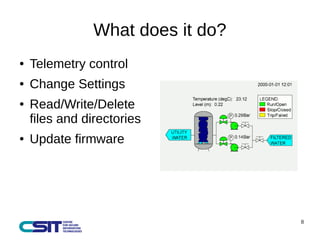
What does it do? 
● Telemetry control 
● Change Settings 
● Read/Write/Delete 
files and directories 
● Update firmware
9 
SCADA Threats
10 
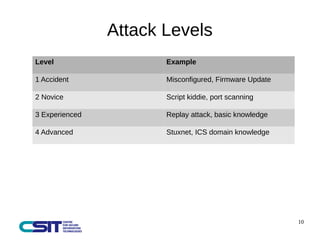
Attack Levels 
Level Example 
1 Accident Misconfigured, Firmware Update 
2 Novice Script kiddie, port scanning 
3 Experienced Replay attack, basic knowledge 
4 Advanced Stuxnet, ICS domain knowledge
11 
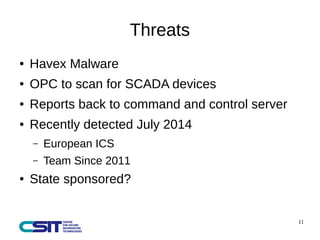
Threats 
● Havex Malware 
● OPC to scan for SCADA devices 
● Reports back to command and control server 
● Recently detected July 2014 
– European ICS 
– Team Since 2011 
● State sponsored?
12 
Scanning for SCADA devices 
● Readily available 
scanners 
– SCADA StrangeLove[1] 
● Simple Python Script 
● Return Device name, 
IP, software version 
[1] https://github.com/atimorin/scada-tools
13 
SCADA Fuzzers 
● Protocol Fuzzers 
● Project Robus[1] 
– DNP3 
– Identified many vulnerabilities 
● Fuzzing can kill 
[1] http://www.automatak.com/robus/
14 
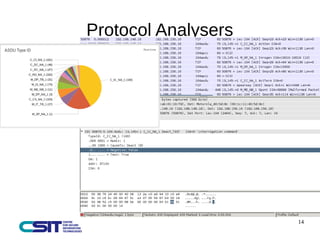
Protocol Analysers
15 
Introduction IEC 104
16 
Introduction IEC 60870-5-104 
● International Electrotechnical Commission 
(IEC) 
● IEC 60870 developed periodically between the 
years 1988 and 2000 
● 6 Main Parts and four companion sections 
● Open Standard 
● 60870-5-104 defines transmission over 
TCP/IP
17 
IEC 60870-5-104 Security Issues 
● Ported from serial links to TCP/IP 
● No authentication 
● No encryption 
● Uses IP address white-list 
– Defined on the slave 
● TLS encryption recommended 
– In practice not implemented
18 
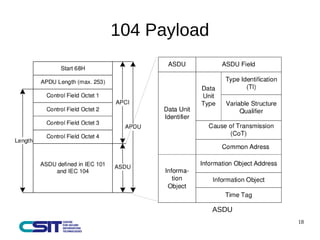
104 Payload 
ASDU
19 
Attacking IEC 104
20 
Capturing Packets 
● SPAN Port 
● DNS Poisoning 
● Content Addressable Memory (CAM) table 
overflow 
● ARP Spoofing
21 
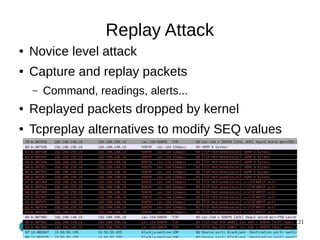
Replay Attack 
● Novice level attack 
● Capture and replay packets 
– Command, readings, alerts... 
● Replayed packets dropped by kernel 
● Tcpreplay alternatives to modify SEQ values
22 
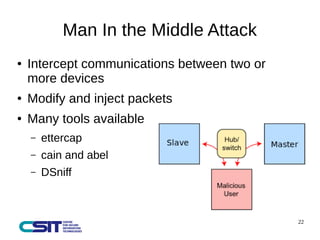
Man In the Middle Attack 
● Intercept communications between two or 
more devices 
● Modify and inject packets 
● Many tools available 
– ettercap 
– cain and abel 
– DSniff
23 
104 MITM Lab Experiment 
● Modify Cause of transmission (CoT) field 
● Intercept and set an invalid CoT value 
● Detection with SNORT
24 
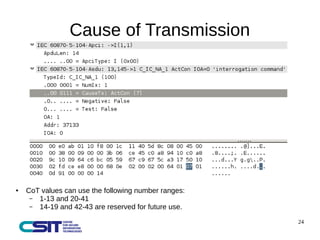
Cause of Transmission 
● CoT values can use the following number ranges: 
– 1-13 and 20-41 
– 14-19 and 42-43 are reserved for future use.
25 
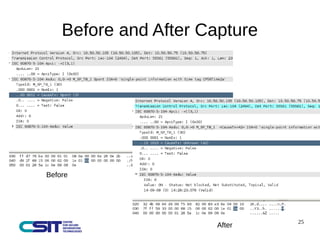
Before and After Capture 
Before 
After
Rule 
alert tcp $104_CLIENT any -> $104_SERVER $104_PORTS (flow: established; content:"|68|"; 
offset:0; depth:1; pcre:"/[Ss]{5}(x2D|x2E|x2F|x30|x64|x65)/iAR"; content:!"|06|"; offset: 8; 
depth: 1; msg:"17: SCADA_IDS: IEC 60870-5-104 – Suspicious Value of Transmission Cause 
Field"; classtype:bad-unknown; sid:6666617; rev:1; priority:2;) 
26 
SNORT Alert 
Alert 
[**] [1:6666617:1] 17: SCADA_IDS: IEC 60870-5-104 – Suspicious Value of Transmission 
Cause Field [**] 
[Classification: Potentially Bad Traffic] [Priority: 2] 
09/09-14:06:10.462288 10.50.50.105:40734 -> 10.50.50.75:22 
TCP TTL:64 TOS:0x0 ID:60033 IpLen:20 DgmLen:60 DF 
******S* Seq: 0x9A0C38A1 Ack: 0x0 Win: 0x3908 TcpLen: 40 
TCP Options (5) => MSS: 1460 SackOK TS: 1382076960 0 NOP WS: 7
27 
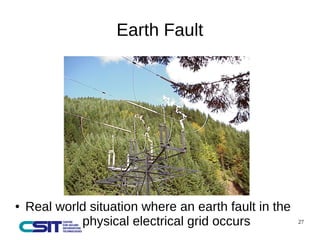
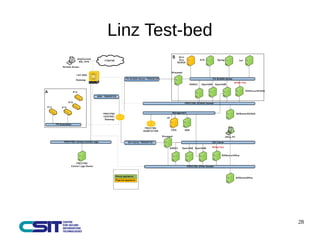
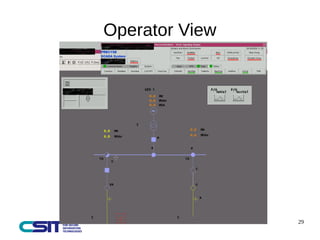
Earth Fault 
● Real world situation where an earth fault in the 
physical electrical grid occurs
28 
Linz Test-bed
29 
Operator View
30 
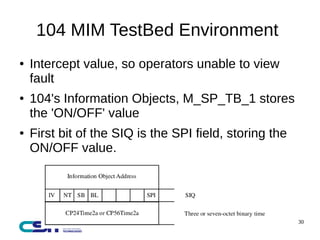
104 MIM TestBed Environment 
● Intercept value, so operators unable to view 
fault 
● 104's Information Objects, M_SP_TB_1 stores 
the 'ON/OFF' value 
● First bit of the SIQ is the SPI field, storing the 
ON/OFF value.
31 
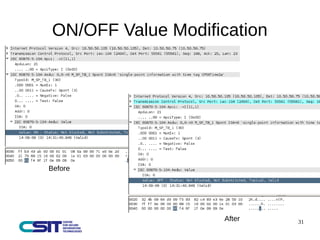
ON/OFF Value Modification 
Before 
After
32 
Conclusion 
● Attackers with varying skill levels can 
compromise SCADA systems 
– Man-In-The-Middle attacks hiding an earth fault 
● New implementations of ICS need to take 
precautions 
● Monitor logs, network, everything 
● Enable attack mitigations
33 
Future Work 
● Identify features of the IEC104 protocol for 
anomaly detection 
● Propose to develop an Anomaly Detection 
module for the IEC104 protocol 
– Detect similar network attacks 
● Work on MITM attack for IEC 61850
34 
Questions

Man in the middle attacks on IEC 60870-5-104

  • 1.
    Man in themiddle attacks on IEC 60870-5-104 Pete Maynard @pgmaynard ORCID 0000-0002-6267-7530
  • 2.
    2 Introduction ●Pete Maynard ● PhD Student ● CSIT Queen's University Belfast, UK ● Industrial Control System Security ● Partnership with PRECYSE
  • 3.
    3 What Ido ● Attacks on SCADA protocols – Replay, MITM, DoS ● Develop detection and prevention methods ● Anomaly detection via machine learning
  • 4.
    4 PRECYSE ●European FP7 Project ● Prevention, protection and REaction to CYber attackS to critical infrastructurEs ● LINZ STROM GmbH (Electrical Distribution Operator)
  • 5.
    5 Talk Overview ● What's SCADA Used for ● SCADA Threats ● Introduction IEC 104 ● Attacking IEC 104
  • 6.
    6 What's SCADAUsed for?
  • 7.
    7 How isSCADA used [1] ● MODBUS, DNP3, IEC104, 61850, Profibus … [1] S. Mohagheghi, J. Stoupis, and Z. Wang. Communication protocols and networks for power systems-current status and future trends. In Power Systems Conference and Exposition, 2009. PSCE ’09. IEEE/PES, pages 1–9, March 2009.
  • 8.
    8 What doesit do? ● Telemetry control ● Change Settings ● Read/Write/Delete files and directories ● Update firmware
  • 9.
  • 10.
    10 Attack Levels Level Example 1 Accident Misconfigured, Firmware Update 2 Novice Script kiddie, port scanning 3 Experienced Replay attack, basic knowledge 4 Advanced Stuxnet, ICS domain knowledge
  • 11.
    11 Threats ●Havex Malware ● OPC to scan for SCADA devices ● Reports back to command and control server ● Recently detected July 2014 – European ICS – Team Since 2011 ● State sponsored?
  • 12.
    12 Scanning forSCADA devices ● Readily available scanners – SCADA StrangeLove[1] ● Simple Python Script ● Return Device name, IP, software version [1] https://github.com/atimorin/scada-tools
  • 13.
    13 SCADA Fuzzers ● Protocol Fuzzers ● Project Robus[1] – DNP3 – Identified many vulnerabilities ● Fuzzing can kill [1] http://www.automatak.com/robus/
  • 14.
  • 15.
  • 16.
    16 Introduction IEC60870-5-104 ● International Electrotechnical Commission (IEC) ● IEC 60870 developed periodically between the years 1988 and 2000 ● 6 Main Parts and four companion sections ● Open Standard ● 60870-5-104 defines transmission over TCP/IP
  • 17.
    17 IEC 60870-5-104Security Issues ● Ported from serial links to TCP/IP ● No authentication ● No encryption ● Uses IP address white-list – Defined on the slave ● TLS encryption recommended – In practice not implemented
  • 18.
  • 19.
  • 20.
    20 Capturing Packets ● SPAN Port ● DNS Poisoning ● Content Addressable Memory (CAM) table overflow ● ARP Spoofing
  • 21.
    21 Replay Attack ● Novice level attack ● Capture and replay packets – Command, readings, alerts... ● Replayed packets dropped by kernel ● Tcpreplay alternatives to modify SEQ values
  • 22.
    22 Man Inthe Middle Attack ● Intercept communications between two or more devices ● Modify and inject packets ● Many tools available – ettercap – cain and abel – DSniff
  • 23.
    23 104 MITMLab Experiment ● Modify Cause of transmission (CoT) field ● Intercept and set an invalid CoT value ● Detection with SNORT
  • 24.
    24 Cause ofTransmission ● CoT values can use the following number ranges: – 1-13 and 20-41 – 14-19 and 42-43 are reserved for future use.
  • 25.
    25 Before andAfter Capture Before After
  • 26.
    Rule alert tcp$104_CLIENT any -> $104_SERVER $104_PORTS (flow: established; content:"|68|"; offset:0; depth:1; pcre:"/[Ss]{5}(x2D|x2E|x2F|x30|x64|x65)/iAR"; content:!"|06|"; offset: 8; depth: 1; msg:"17: SCADA_IDS: IEC 60870-5-104 – Suspicious Value of Transmission Cause Field"; classtype:bad-unknown; sid:6666617; rev:1; priority:2;) 26 SNORT Alert Alert [**] [1:6666617:1] 17: SCADA_IDS: IEC 60870-5-104 – Suspicious Value of Transmission Cause Field [**] [Classification: Potentially Bad Traffic] [Priority: 2] 09/09-14:06:10.462288 10.50.50.105:40734 -> 10.50.50.75:22 TCP TTL:64 TOS:0x0 ID:60033 IpLen:20 DgmLen:60 DF ******S* Seq: 0x9A0C38A1 Ack: 0x0 Win: 0x3908 TcpLen: 40 TCP Options (5) => MSS: 1460 SackOK TS: 1382076960 0 NOP WS: 7
  • 27.
    27 Earth Fault ● Real world situation where an earth fault in the physical electrical grid occurs
  • 28.
  • 29.
  • 30.
    30 104 MIMTestBed Environment ● Intercept value, so operators unable to view fault ● 104's Information Objects, M_SP_TB_1 stores the 'ON/OFF' value ● First bit of the SIQ is the SPI field, storing the ON/OFF value.
  • 31.
    31 ON/OFF ValueModification Before After
  • 32.
    32 Conclusion ●Attackers with varying skill levels can compromise SCADA systems – Man-In-The-Middle attacks hiding an earth fault ● New implementations of ICS need to take precautions ● Monitor logs, network, everything ● Enable attack mitigations
  • 33.
    33 Future Work ● Identify features of the IEC104 protocol for anomaly detection ● Propose to develop an Anomaly Detection module for the IEC104 protocol – Detect similar network attacks ● Work on MITM attack for IEC 61850
  • 34.