BUSINESS PROCESS
 IMPROVEMENT
   (Process Innovation)


       MICHAEL T. LIGAYO
ENTREP, S63, TUE, 6:00PM-9:00PM
What is a Business Process?
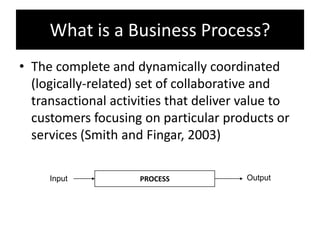
• The complete and dynamically coordinated
  (logically-related) set of collaborative and
  transactional activities that deliver value to
  customers focusing on particular products or
  services (Smith and Fingar, 2003)

     Input           PROCESS            Output
What is a Business Process?
• Specific ordering of work activities across time
  and place, with a beginning and an end, and
  with clearly identified inputs and outputs – a
  structure for action (Davenport, 1998)
• Examples of business processes are:
  purchasing, manufacturing, warehousing, trai
  ning, recruitment and many others
What is a Business Process
            Improvement?
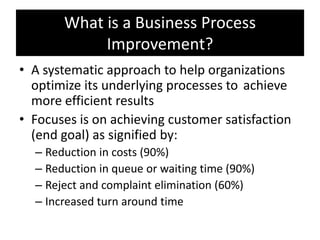
• A systematic approach to help organizations
  optimize its underlying processes to achieve
  more efficient results
• Focuses is on achieving customer satisfaction
  (end goal) as signified by:
  – Reduction in costs (90%)
  – Reduction in queue or waiting time (90%)
  – Reject and complaint elimination (60%)
  – Increased turn around time
What is a Business Process
            Improvement?
• Works by:
  – Defining the organization’s strategic goals and
    purposes
  – Determining the organization’s customers
  – Aligning the business processes to realize the
    organization’s goals
• Usually project-based so implementation is
  through project management
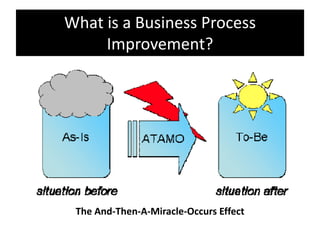
What is a Business Process
     Improvement?


 The And-Then-A-Miracle-Occurs Effect
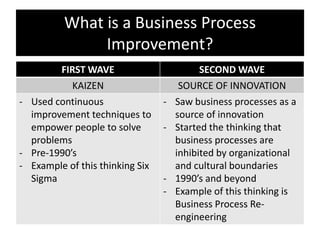
What is a Business Process
               Improvement?
         FIRST WAVE                       SECOND WAVE
           KAIZEN                     SOURCE OF INNOVATION
- Used continuous                -   Saw business processes as a
  improvement techniques to          source of innovation
  empower people to solve        -   Started the thinking that
  problems                           business processes are
- Pre-1990’s                         inhibited by organizational
- Example of this thinking Six       and cultural boundaries
  Sigma                          -   1990’s and beyond
                                 -   Example of this thinking is
                                     Business Process Re-
                                     engineering
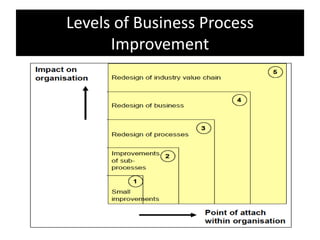
Levels of Business Process
      Improvement
Levels of Business Process
                 Improvement
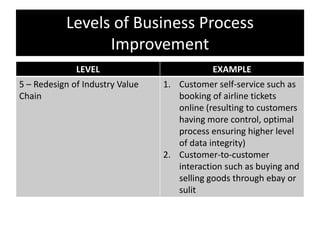
              LEVEL                         EXAMPLE
5 – Redesign of Industry Value   1. Customer self-service such as
Chain                               booking of airline tickets
                                    online (resulting to customers
                                    having more control, optimal
                                    process ensuring higher level
                                    of data integrity)
                                 2. Customer-to-customer
                                    interaction such as buying and
                                    selling goods through ebay or
                                    sulit
Levels of Business Process
                 Improvement
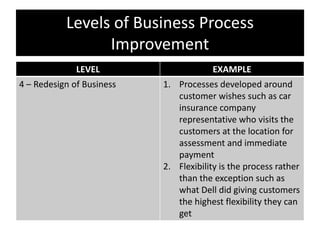
              LEVEL                     EXAMPLE
4 – Redesign of Business   1. Processes developed around
                              customer wishes such as car
                              insurance company
                              representative who visits the
                              customers at the location for
                              assessment and immediate
                              payment
                           2. Flexibility is the process rather
                              than the exception such as
                              what Dell did giving customers
                              the highest flexibility they can
                              get
Levels of Business Process
                 Improvement
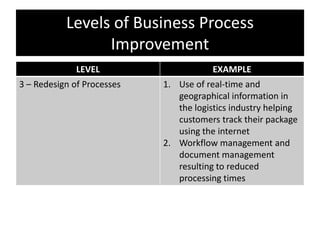
              LEVEL                     EXAMPLE
3 – Redesign of Processes   1. Use of real-time and
                               geographical information in
                               the logistics industry helping
                               customers track their package
                               using the internet
                            2. Workflow management and
                               document management
                               resulting to reduced
                               processing times
Levels of Business Process
                 Improvement
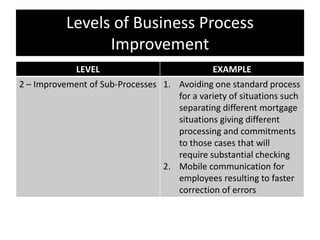
             LEVEL                            EXAMPLE
2 – Improvement of Sub-Processes 1. Avoiding one standard process
                                    for a variety of situations such
                                    separating different mortgage
                                    situations giving different
                                    processing and commitments
                                    to those cases that will
                                    require substantial checking
                                 2. Mobile communication for
                                    employees resulting to faster
                                    correction of errors
Levels of Business Process
              Improvement
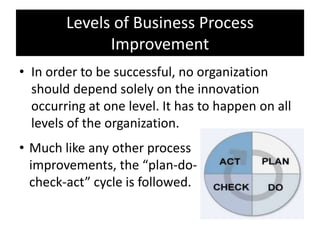
• In order to be successful, no organization
  should depend solely on the innovation
  occurring at one level. It has to happen on all
  levels of the organization.
• Much like any other process
  improvements, the “plan-do-
  check-act” cycle is followed.
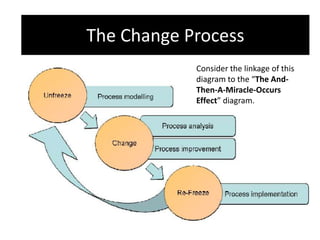
The Change Process
            Consider the linkage of this
            diagram to the “The And-
            Then-A-Miracle-Occurs
            Effect” diagram.
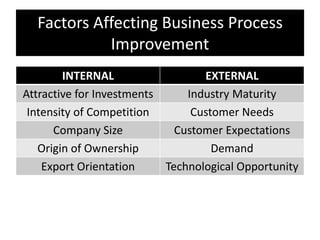
Factors Affecting Business Process
            Improvement
        INTERNAL                  EXTERNAL
Attractive for Investments     Industry Maturity
 Intensity of Competition       Customer Needs
      Company Size           Customer Expectations
   Origin of Ownership              Demand
    Export Orientation     Technological Opportunity
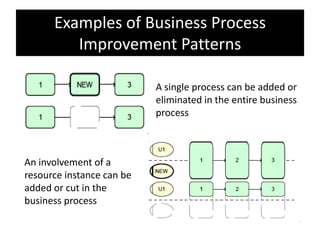
Examples of Business Process
         Improvement Patterns

                           A single process can be added or
                           eliminated in the entire business
                           process


An involvement of a
resource instance can be
added or cut in the
business process
Examples of Business Process
         Improvement Patterns
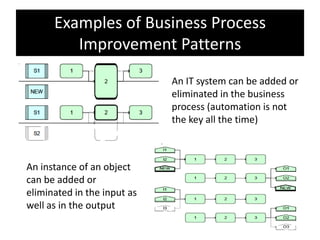
                             An IT system can be added or
                             eliminated in the business
                             process (automation is not
                             the key all the time)


An instance of an object
can be added or
eliminated in the input as
well as in the output
Implementing Business Process
            Improvements
• The most difficult part of business process
  improvements is the implementation.
• Some keys to successful implementation are:
  – Main the step-by-step approach and do not skip steps
  – Set clear timelines
  – Do not spread resources thinly and focus on the short term
    payoff
  – Management and primary stakeholders should be involved
  – Maintain customer focus
  – Establish process owners, business leaders, operational
    manager, process operator
Measuring Effectiveness of Business
     Process Improvements
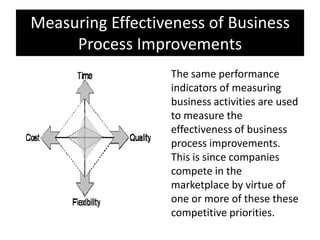
                  The same performance
                  indicators of measuring
                  business activities are used
                  to measure the
                  effectiveness of business
                  process improvements.
                  This is since companies
                  compete in the
                  marketplace by virtue of
                  one or more of these these
                  competitive priorities.
Blockers to Business Process
             Improvements
• “Around the Edges” syndrome where the processes
  and associated people are treated like sacred
  objects (untouchables)
• “Black Box” syndrome where executives don’t know
  the details but somehow the processes produce
  outcomes
• Many initiatives are not aligned with the
  organization’s strategy
• Many organizations take ad-hoc and isolated
  initiatives for process improvements
• Failing to obtain the benefits of the initiatives
Some Tools to Conduct Business
  Process Improvements (Strategies)
Six Sigma
• A business management strategy seeking to improve
  the quality of process outputs by identifying and
  removing causes of defects (errors) and minimizing
  variability
• Uses a set of quality management
  methods, including statistical methods
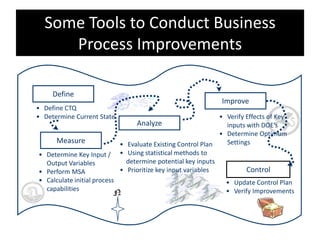
• D-M-A-I-C
Some Tools to Conduct Business
     Process Improvements

     Define
                                                                Improve
• Define CTQ
• Determine Current State                                      • Verify Effects of Key
                                   Analyze                       inputs with DOE’s
                                                               • Determine Optimum
      Measure                 • Evaluate Existing Control Plan   Settings
• Determine Key Input /       • Using statistical methods to
  Output Variables              determine potential key inputs
• Perform MSA                 • Prioritize key input variables          Control
• Calculate initial process                                      • Update Control Plan
  capabilities                                                   • Verify Improvements
                          N
Some Tools to Conduct Business
   Process Improvements (Strategies)
Lean Manufacturing / Operations / Enterprise
• A production practice that considers the
  expenditure of resources for any goal other than the
  creation of value for the end customer to be
  wasteful, and thus a target for elimination
• Derived from the Toyota Production System
• Aimed at removing the 7 wastes:
  transportation, inventory, motion, waiting, over-
  processing, over-production and defects
Some Tools to Conduct Business
   Process Improvements (Strategies)
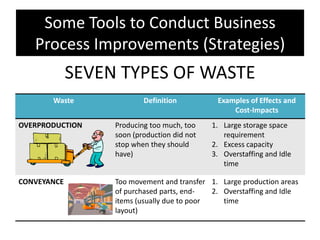
             SEVEN TYPES OF WASTE
       Waste              Definition          Examples of Effects and
                                                  Cost-Impacts
OVERPRODUCTION    Producing too much, too    1. Large storage space
                  soon (production did not      requirement
                  stop when they should      2. Excess capacity
                  have)                      3. Overstaffing and Idle
                                                time

CONVEYANCE        Too movement and transfer 1. Large production areas
                  of purchased parts, end-   2. Overstaffing and Idle
                  items (usually due to poor    time
                  layout)
Some Tools to Conduct Business
   Process Improvements (Strategies)
            SEVEN TYPES OF WASTE
        Cause            Definition         Examples of Effects and
                                                Cost-Impacts
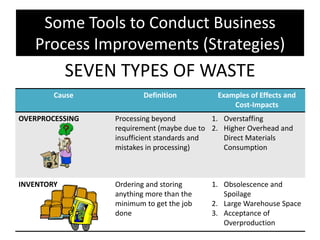
OVERPROCESSING   Processing beyond          1. Overstaffing
                 requirement (maybe due to 2. Higher Overhead and
                 insufficient standards and    Direct Materials
                 mistakes in processing)       Consumption


INVENTORY        Ordering and storing      1. Obsolescence and
                 anything more than the       Spoilage
                 minimum to get the job    2. Large Warehouse Space
                 done                      3. Acceptance of
                                              Overproduction
Some Tools to Conduct Business
    Process Improvements (Strategies)
            SEVEN TYPES OF WASTE
          Cause           Definition            Examples of Effects and
                                                    Cost-Impacts
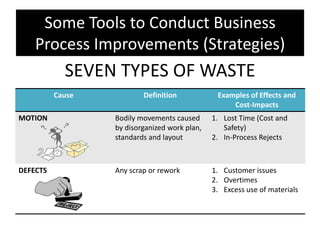
MOTION            Bodily movements caused      1. Lost Time (Cost and
                  by disorganized work plan,      Safety)
                  standards and layout         2. In-Process Rejects


DEFECTS           Any scrap or rework          1. Customer issues
                                               2. Overtimes
                                               3. Excess use of materials
Some Tools to Conduct Business
   Process Improvements (Strategies)
            SEVEN TYPES OF WASTE
          Cause            Definition             Examples of Effects and
                                                      Cost-Impacts
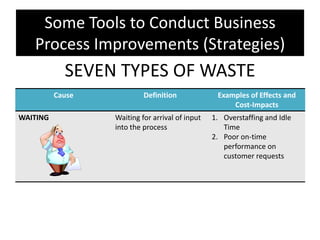
WAITING           Waiting for arrival of input   1. Overstaffing and Idle
                  into the process                  Time
                                                 2. Poor on-time
                                                    performance on
                                                    customer requests
Some Tools to Conduct Business
Process Improvements (Strategies)
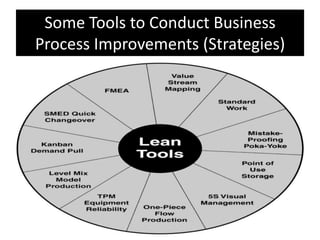
Some Tools to Conduct Business
   Process Improvements (Strategies)
Total Quality Management
• An integrative philosophy of management for
  continuously improving the quality of products and
  processes
• Functions on the premise that the quality of
  products and processes is the responsibility of
  everyone who is involved in the creation or
  consumption of the products or services offered by
  an organization
Some Tools to Conduct Business
  Process Improvements (Strategies)
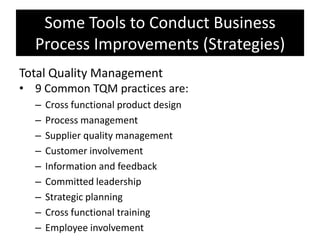
Total Quality Management
• 9 Common TQM practices are:
  –   Cross functional product design
  –   Process management
  –   Supplier quality management
  –   Customer involvement
  –   Information and feedback
  –   Committed leadership
  –   Strategic planning
  –   Cross functional training
  –   Employee involvement
Some Tools to Conduct Business
  Process Improvements (Strategies)
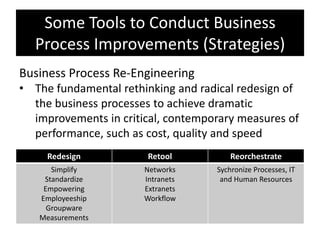
Business Process Re-Engineering
• The fundamental rethinking and radical redesign of
  the business processes to achieve dramatic
  improvements in critical, contemporary measures of
  performance, such as cost, quality and speed
     Redesign           Retool          Reorchestrate
      Simplify         Networks     Sychronize Processes, IT
    Standardize        Intranets     and Human Resources
    Empowering         Extranets
   Employeeship        Workflow
     Groupware
   Measurements
Some Tools to Conduct Business
  Process Improvements (Strategies)
Business Process Re-Engineering
• Characteristics of Outcome
  – Several jobs combined into one
  – Decision making becomes part of he job of the employees
  – Steps in the processes are performed in natural order, some
    simultaneuosly
  – Processes have multiple versions
  – Work is performed when it makes the most sense
  – Controls and checks and other non-value adding work is
    minimized
  – A single point of contact is provided to customers
  – A hybrid centralized / decentralized operation is used
Some Tools to Conduct Business
  Process Improvements (Strategies)
Business Process Re-Engineering
• Key Actions for Implementation
  – Selection of the strategic (added-value) processes for redesign
  – Simplify new processes, minimize steps, optimize efficiency
  – Organize team of employees for each process and assign a role
    for process coordinator
  – Organize the workflow – document transfer and control
  – Assign responsibilities and roles of each process
  – Automate
  – Train the process team to efficiently manage and operate the
    new process
  – Introduce the redesigned process
Some Tools to Conduct Business
   Process Improvements (Strategies)
               OTHER SETS OF TOOLS

• Quality Control Circles (QC Stories)
• Total Productive / Preventive Maintenance (TPM)
• Kaizen (Continuous Improvement)
• Quality Deployment (House of Quality)
• Quality Tools (Pareto, Cause-and-
Effect, Checksheet, Control Chart, Histogram, Scatter
Diagram, Stratification)
• Many others…
References
• Building and Maintaining Competitive Advantage Through
  Collaborative Business Process Innovation.
  www.boardwalktech.com
• Forster, Florian. The Idea Behind Business Process
  Improvement: Toward a Business Process Improvement
  Pattern Framework. www.bptrends.com
• Graham, Ben. Business Process Improvement: The Devil’s in
  the Detail. The Ben Graham Corporation.
• Jeston, John and Johan Neils. Down Under: Process
  Innovation. www.bptrends.com
• McElheran, Kristina. Do Market Leaders Lead in Business
  Process Innovation? The Case of E-Business Adoption. Harvard
  Business School.
References
• Moller, Charles. The Conceptual Framework for Business
  Process Innovation – Towards A Research Program on Global
  Supply Chain Intelligence. Informatics Research Group.
• Zakic, Nebojsa, Jovanovic, Ana and Milan Stamatovic. External
  and Internal Factors Affecting The Product and Business
  Process Innovation. Facta Universitatis.
• Zigiaris, Sotiris. Business Process Re-Engineering. BPR Hellas
  SA.
• http://en.wikipedia.org/wiki/Business_process_improvement
• http://en.wikipedia.org/wiki/Lean_manufacturing
• http://asq.org/learn-about-quality/seven-basic-quality-
  tools/overview/overview.html

Business process improvement (special report) presentation

  • 1.
    BUSINESS PROCESS IMPROVEMENT (Process Innovation) MICHAEL T. LIGAYO ENTREP, S63, TUE, 6:00PM-9:00PM
  • 2.
    What is aBusiness Process? • The complete and dynamically coordinated (logically-related) set of collaborative and transactional activities that deliver value to customers focusing on particular products or services (Smith and Fingar, 2003) Input PROCESS Output
  • 3.
    What is aBusiness Process? • Specific ordering of work activities across time and place, with a beginning and an end, and with clearly identified inputs and outputs – a structure for action (Davenport, 1998) • Examples of business processes are: purchasing, manufacturing, warehousing, trai ning, recruitment and many others
  • 4.
    What is aBusiness Process Improvement? • A systematic approach to help organizations optimize its underlying processes to achieve more efficient results • Focuses is on achieving customer satisfaction (end goal) as signified by: – Reduction in costs (90%) – Reduction in queue or waiting time (90%) – Reject and complaint elimination (60%) – Increased turn around time
  • 5.
    What is aBusiness Process Improvement? • Works by: – Defining the organization’s strategic goals and purposes – Determining the organization’s customers – Aligning the business processes to realize the organization’s goals • Usually project-based so implementation is through project management
  • 6.
    What is aBusiness Process Improvement? The And-Then-A-Miracle-Occurs Effect
  • 7.
    What is aBusiness Process Improvement? FIRST WAVE SECOND WAVE KAIZEN SOURCE OF INNOVATION - Used continuous - Saw business processes as a improvement techniques to source of innovation empower people to solve - Started the thinking that problems business processes are - Pre-1990’s inhibited by organizational - Example of this thinking Six and cultural boundaries Sigma - 1990’s and beyond - Example of this thinking is Business Process Re- engineering
  • 8.
    Levels of BusinessProcess Improvement
  • 9.
    Levels of BusinessProcess Improvement LEVEL EXAMPLE 5 – Redesign of Industry Value 1. Customer self-service such as Chain booking of airline tickets online (resulting to customers having more control, optimal process ensuring higher level of data integrity) 2. Customer-to-customer interaction such as buying and selling goods through ebay or sulit
  • 10.
    Levels of BusinessProcess Improvement LEVEL EXAMPLE 4 – Redesign of Business 1. Processes developed around customer wishes such as car insurance company representative who visits the customers at the location for assessment and immediate payment 2. Flexibility is the process rather than the exception such as what Dell did giving customers the highest flexibility they can get
  • 11.
    Levels of BusinessProcess Improvement LEVEL EXAMPLE 3 – Redesign of Processes 1. Use of real-time and geographical information in the logistics industry helping customers track their package using the internet 2. Workflow management and document management resulting to reduced processing times
  • 12.
    Levels of BusinessProcess Improvement LEVEL EXAMPLE 2 – Improvement of Sub-Processes 1. Avoiding one standard process for a variety of situations such separating different mortgage situations giving different processing and commitments to those cases that will require substantial checking 2. Mobile communication for employees resulting to faster correction of errors
  • 13.
    Levels of BusinessProcess Improvement • In order to be successful, no organization should depend solely on the innovation occurring at one level. It has to happen on all levels of the organization. • Much like any other process improvements, the “plan-do- check-act” cycle is followed.
  • 14.
    The Change Process Consider the linkage of this diagram to the “The And- Then-A-Miracle-Occurs Effect” diagram.
  • 15.
    Factors Affecting BusinessProcess Improvement INTERNAL EXTERNAL Attractive for Investments Industry Maturity Intensity of Competition Customer Needs Company Size Customer Expectations Origin of Ownership Demand Export Orientation Technological Opportunity
  • 16.
    Examples of BusinessProcess Improvement Patterns A single process can be added or eliminated in the entire business process An involvement of a resource instance can be added or cut in the business process
  • 17.
    Examples of BusinessProcess Improvement Patterns An IT system can be added or eliminated in the business process (automation is not the key all the time) An instance of an object can be added or eliminated in the input as well as in the output
  • 18.
    Implementing Business Process Improvements • The most difficult part of business process improvements is the implementation. • Some keys to successful implementation are: – Main the step-by-step approach and do not skip steps – Set clear timelines – Do not spread resources thinly and focus on the short term payoff – Management and primary stakeholders should be involved – Maintain customer focus – Establish process owners, business leaders, operational manager, process operator
  • 19.
    Measuring Effectiveness ofBusiness Process Improvements The same performance indicators of measuring business activities are used to measure the effectiveness of business process improvements. This is since companies compete in the marketplace by virtue of one or more of these these competitive priorities.
  • 20.
    Blockers to BusinessProcess Improvements • “Around the Edges” syndrome where the processes and associated people are treated like sacred objects (untouchables) • “Black Box” syndrome where executives don’t know the details but somehow the processes produce outcomes • Many initiatives are not aligned with the organization’s strategy • Many organizations take ad-hoc and isolated initiatives for process improvements • Failing to obtain the benefits of the initiatives
  • 21.
    Some Tools toConduct Business Process Improvements (Strategies) Six Sigma • A business management strategy seeking to improve the quality of process outputs by identifying and removing causes of defects (errors) and minimizing variability • Uses a set of quality management methods, including statistical methods • D-M-A-I-C
  • 22.
    Some Tools toConduct Business Process Improvements Define Improve • Define CTQ • Determine Current State • Verify Effects of Key Analyze inputs with DOE’s • Determine Optimum Measure • Evaluate Existing Control Plan Settings • Determine Key Input / • Using statistical methods to Output Variables determine potential key inputs • Perform MSA • Prioritize key input variables Control • Calculate initial process • Update Control Plan capabilities • Verify Improvements N
  • 23.
    Some Tools toConduct Business Process Improvements (Strategies) Lean Manufacturing / Operations / Enterprise • A production practice that considers the expenditure of resources for any goal other than the creation of value for the end customer to be wasteful, and thus a target for elimination • Derived from the Toyota Production System • Aimed at removing the 7 wastes: transportation, inventory, motion, waiting, over- processing, over-production and defects
  • 24.
    Some Tools toConduct Business Process Improvements (Strategies) SEVEN TYPES OF WASTE Waste Definition Examples of Effects and Cost-Impacts OVERPRODUCTION Producing too much, too 1. Large storage space soon (production did not requirement stop when they should 2. Excess capacity have) 3. Overstaffing and Idle time CONVEYANCE Too movement and transfer 1. Large production areas of purchased parts, end- 2. Overstaffing and Idle items (usually due to poor time layout)
  • 25.
    Some Tools toConduct Business Process Improvements (Strategies) SEVEN TYPES OF WASTE Cause Definition Examples of Effects and Cost-Impacts OVERPROCESSING Processing beyond 1. Overstaffing requirement (maybe due to 2. Higher Overhead and insufficient standards and Direct Materials mistakes in processing) Consumption INVENTORY Ordering and storing 1. Obsolescence and anything more than the Spoilage minimum to get the job 2. Large Warehouse Space done 3. Acceptance of Overproduction
  • 26.
    Some Tools toConduct Business Process Improvements (Strategies) SEVEN TYPES OF WASTE Cause Definition Examples of Effects and Cost-Impacts MOTION Bodily movements caused 1. Lost Time (Cost and by disorganized work plan, Safety) standards and layout 2. In-Process Rejects DEFECTS Any scrap or rework 1. Customer issues 2. Overtimes 3. Excess use of materials
  • 27.
    Some Tools toConduct Business Process Improvements (Strategies) SEVEN TYPES OF WASTE Cause Definition Examples of Effects and Cost-Impacts WAITING Waiting for arrival of input 1. Overstaffing and Idle into the process Time 2. Poor on-time performance on customer requests
  • 28.
    Some Tools toConduct Business Process Improvements (Strategies)
  • 29.
    Some Tools toConduct Business Process Improvements (Strategies) Total Quality Management • An integrative philosophy of management for continuously improving the quality of products and processes • Functions on the premise that the quality of products and processes is the responsibility of everyone who is involved in the creation or consumption of the products or services offered by an organization
  • 30.
    Some Tools toConduct Business Process Improvements (Strategies) Total Quality Management • 9 Common TQM practices are: – Cross functional product design – Process management – Supplier quality management – Customer involvement – Information and feedback – Committed leadership – Strategic planning – Cross functional training – Employee involvement
  • 31.
    Some Tools toConduct Business Process Improvements (Strategies) Business Process Re-Engineering • The fundamental rethinking and radical redesign of the business processes to achieve dramatic improvements in critical, contemporary measures of performance, such as cost, quality and speed Redesign Retool Reorchestrate Simplify Networks Sychronize Processes, IT Standardize Intranets and Human Resources Empowering Extranets Employeeship Workflow Groupware Measurements
  • 32.
    Some Tools toConduct Business Process Improvements (Strategies) Business Process Re-Engineering • Characteristics of Outcome – Several jobs combined into one – Decision making becomes part of he job of the employees – Steps in the processes are performed in natural order, some simultaneuosly – Processes have multiple versions – Work is performed when it makes the most sense – Controls and checks and other non-value adding work is minimized – A single point of contact is provided to customers – A hybrid centralized / decentralized operation is used
  • 33.
    Some Tools toConduct Business Process Improvements (Strategies) Business Process Re-Engineering • Key Actions for Implementation – Selection of the strategic (added-value) processes for redesign – Simplify new processes, minimize steps, optimize efficiency – Organize team of employees for each process and assign a role for process coordinator – Organize the workflow – document transfer and control – Assign responsibilities and roles of each process – Automate – Train the process team to efficiently manage and operate the new process – Introduce the redesigned process
  • 34.
    Some Tools toConduct Business Process Improvements (Strategies) OTHER SETS OF TOOLS • Quality Control Circles (QC Stories) • Total Productive / Preventive Maintenance (TPM) • Kaizen (Continuous Improvement) • Quality Deployment (House of Quality) • Quality Tools (Pareto, Cause-and- Effect, Checksheet, Control Chart, Histogram, Scatter Diagram, Stratification) • Many others…
  • 35.
    References • Building andMaintaining Competitive Advantage Through Collaborative Business Process Innovation. www.boardwalktech.com • Forster, Florian. The Idea Behind Business Process Improvement: Toward a Business Process Improvement Pattern Framework. www.bptrends.com • Graham, Ben. Business Process Improvement: The Devil’s in the Detail. The Ben Graham Corporation. • Jeston, John and Johan Neils. Down Under: Process Innovation. www.bptrends.com • McElheran, Kristina. Do Market Leaders Lead in Business Process Innovation? The Case of E-Business Adoption. Harvard Business School.
  • 36.
    References • Moller, Charles.The Conceptual Framework for Business Process Innovation – Towards A Research Program on Global Supply Chain Intelligence. Informatics Research Group. • Zakic, Nebojsa, Jovanovic, Ana and Milan Stamatovic. External and Internal Factors Affecting The Product and Business Process Innovation. Facta Universitatis. • Zigiaris, Sotiris. Business Process Re-Engineering. BPR Hellas SA. • http://en.wikipedia.org/wiki/Business_process_improvement • http://en.wikipedia.org/wiki/Lean_manufacturing • http://asq.org/learn-about-quality/seven-basic-quality- tools/overview/overview.html