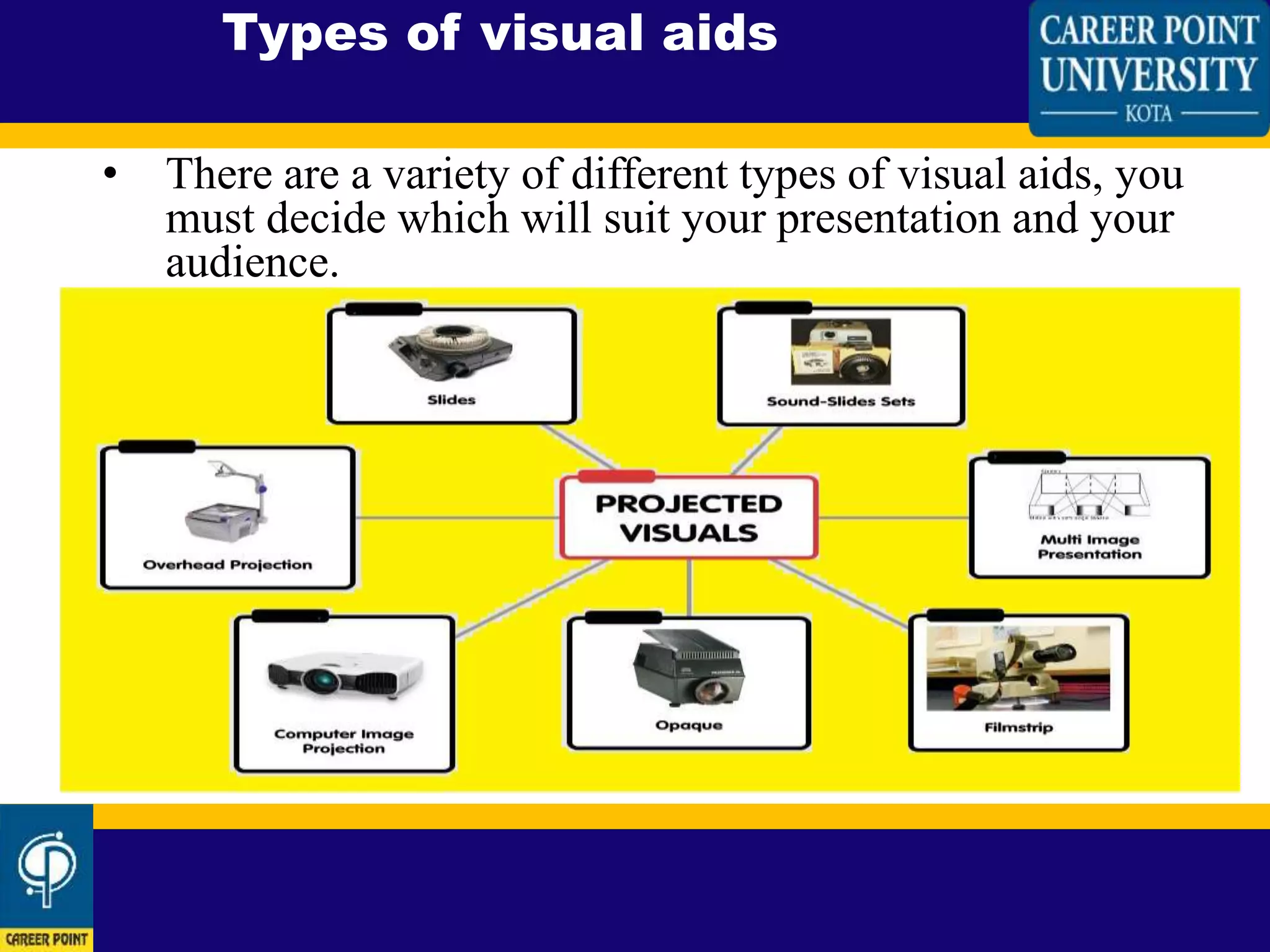
• There are a variety of different types of visual aids, you
must decide which will suit your presentation and your
audience.
Types of visual aids
• Microsoft PowerPoint is widely
used for presentations because it's
easy to create attractive and
professional presentations and it's
simple to modify and reorganise
content compared to other visual
aids. You can insert a range of
visual items into the slides which
will improve the audience's focus.
Also, the audience can generally
see slideshows better than other
visual aids and you don't have to
face away from them. However,
your presentation can look
unprofessional if this software is
used poorly.
PowerPoint
• Tips:
• Have a clear and simple background.
• Avoid using too many different types of fonts
or font sizes.
• Only use animations for a purpose, such as,
to reveal the stages of a process, otherwise
this can be distracting and look amateurish.
• Use a large font size - a minimum of 24pt.
• Use bullet points to summarise key points.
• Consider providing handouts of diagrams
because the audience will find the diagrams
easier to read.
• Avoid putting too much text on a slide.
• Avoid using red or green text as it's difficult
to read.
• There should only be one key point for each
slide.
• Always have a back-up plan in case there is a
technical issue and you cannot show the
visuals on the day, for example, bring
handouts or a poster.
PowerPoint
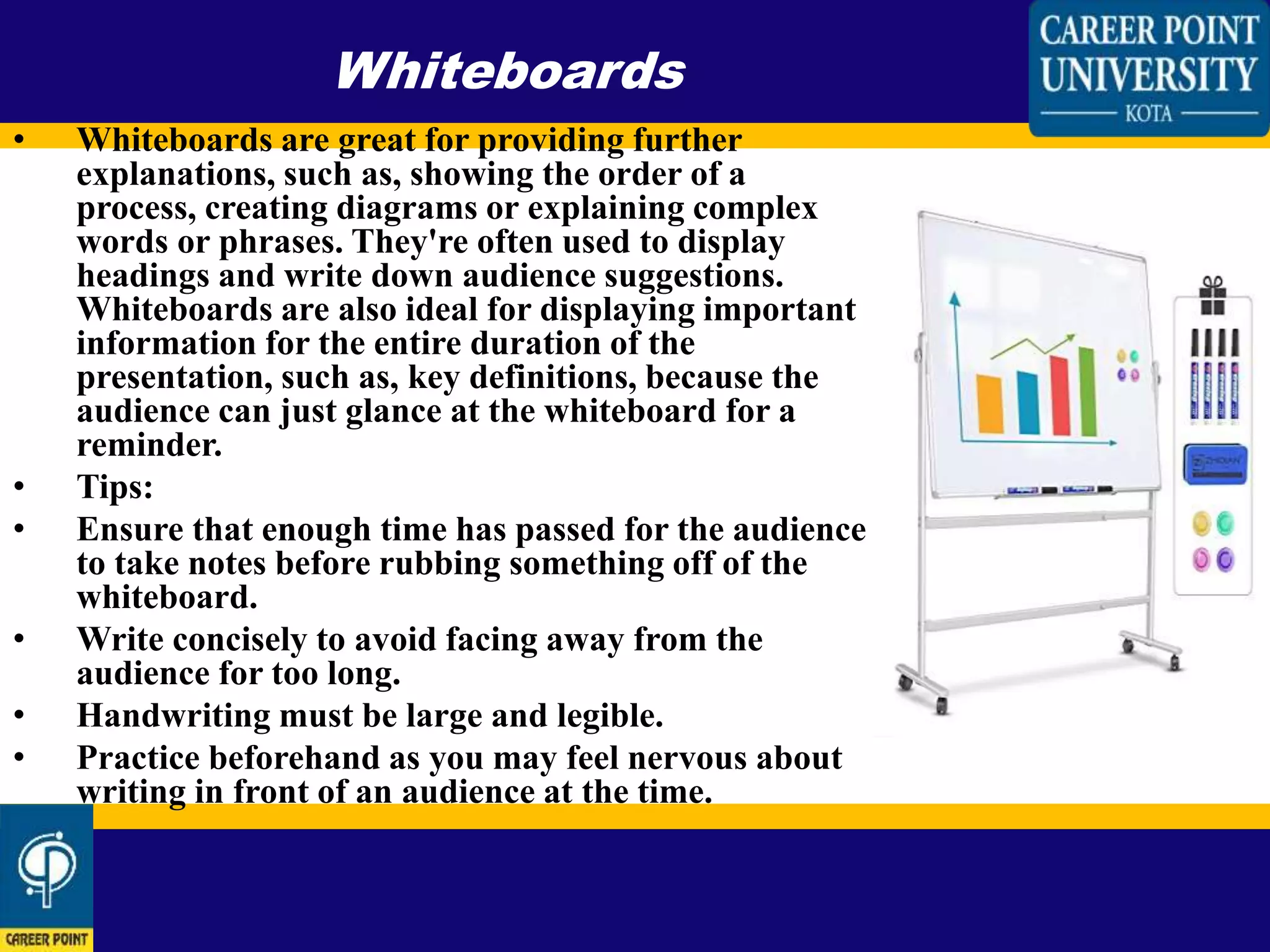
• Whiteboards are great for providing further
explanations, such as, showing the order of a
process, creating diagrams or explaining complex
words or phrases. They're often used to display
headings and write down audience suggestions.
Whiteboards are also ideal for displaying important
information for the entire duration of the
presentation, such as, key definitions, because the
audience can just glance at the whiteboard for a
reminder.
• Tips:
• Ensure that enough time has passed for the audience
to take notes before rubbing something off of the
whiteboard.
• Write concisely to avoid facing away from the
audience for too long.
• Handwriting must be large and legible.
• Practice beforehand as you may feel nervous about
writing in front of an audience at the time.
Whiteboards
Using videos are a great wait to engage audience and increase their interest. Use
video to bring motion, images and audio into your presentation.
• Tips:
• Ensure that any videos used are relevant to the presentation's content.
• Only show as much of the video as necessary.
• Never show a really long clip.
• Videos can be difficult to fit into the structure of a presentation so ensure
that you tell that audience why you're showing them a clip and tell them
what to look for.
• Inform the audience how long the video will last.
Video clips
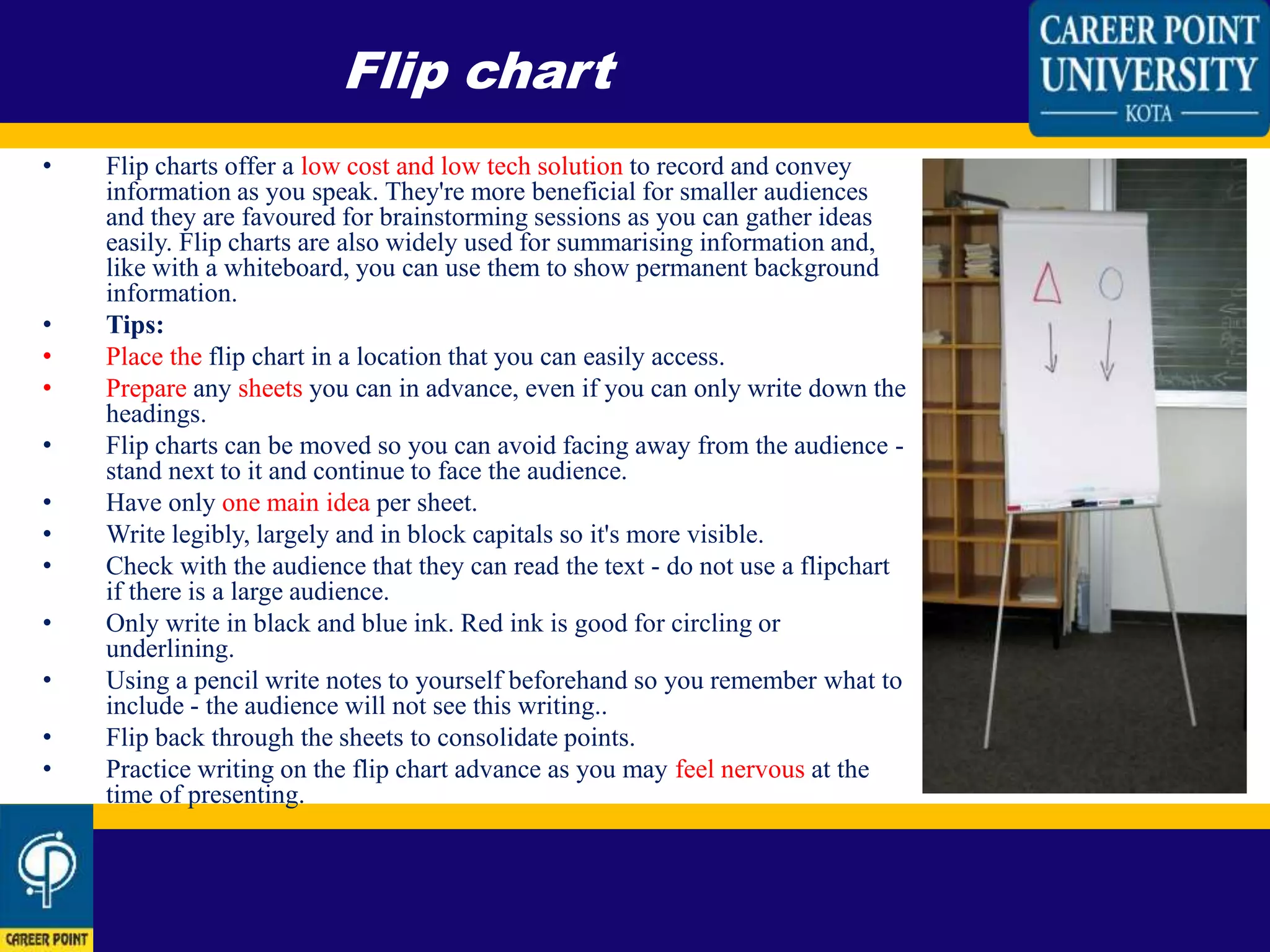
• Flip charts offer a low cost and low tech solution to record and convey
information as you speak. They're more beneficial for smaller audiences
and they are favoured for brainstorming sessions as you can gather ideas
easily. Flip charts are also widely used for summarising information and,
like with a whiteboard, you can use them to show permanent background
information.
• Tips:
• Place the flip chart in a location that you can easily access.
• Prepare any sheets you can in advance, even if you can only write down the
headings.
• Flip charts can be moved so you can avoid facing away from the audience -
stand next to it and continue to face the audience.
• Have only one main idea per sheet.
• Write legibly, largely and in block capitals so it's more visible.
• Check with the audience that they can read the text - do not use a flipchart
if there is a large audience.
• Only write in black and blue ink. Red ink is good for circling or
underlining.
• Using a pencil write notes to yourself beforehand so you remember what to
include - the audience will not see this writing..
• Flip back through the sheets to consolidate points.
• Practice writing on the flip chart advance as you may feel nervous at the
time of presenting.
Flip chart
• Poster boards can be created using a variety of visual
devices, such as graphs and images. They're generally quite
portable and you can make them as elaborate as you want.
However, they can be expensive to produce if the poster is
quite complex.
• Tips:
• Use colour
• Use block capitals
• One poster per message or theme
• Avoid using posters when presenting to large audiences as
they will not be able to see the content
Posters
• Handouts are papers that contain key information from your presentation or
they may provide further information. They prevent you from overwhelming the
audience as there will be less information on the slides and therefore less
information they need to write down.
• Tips:
• You must consider when you want to give the audience the handouts:
• If given at the beginning and middle of your presentation the audience may be
reading rather than listening to you or they might not pay attention to what
you're saying as they already have the information.
• If given at the end of your presentation the audience may be trying to take lots
of notes which may reduce the amount of information they are actually
understanding.
• To manage this, provide the audience with partially completed handouts so they
will have to listen to what you're saying to be able to fill in the gaps. Providing
the audience with graphs and charts beforehand is also beneficial because the
audience will find them easier to read than, for example, from a slide.
Handouts
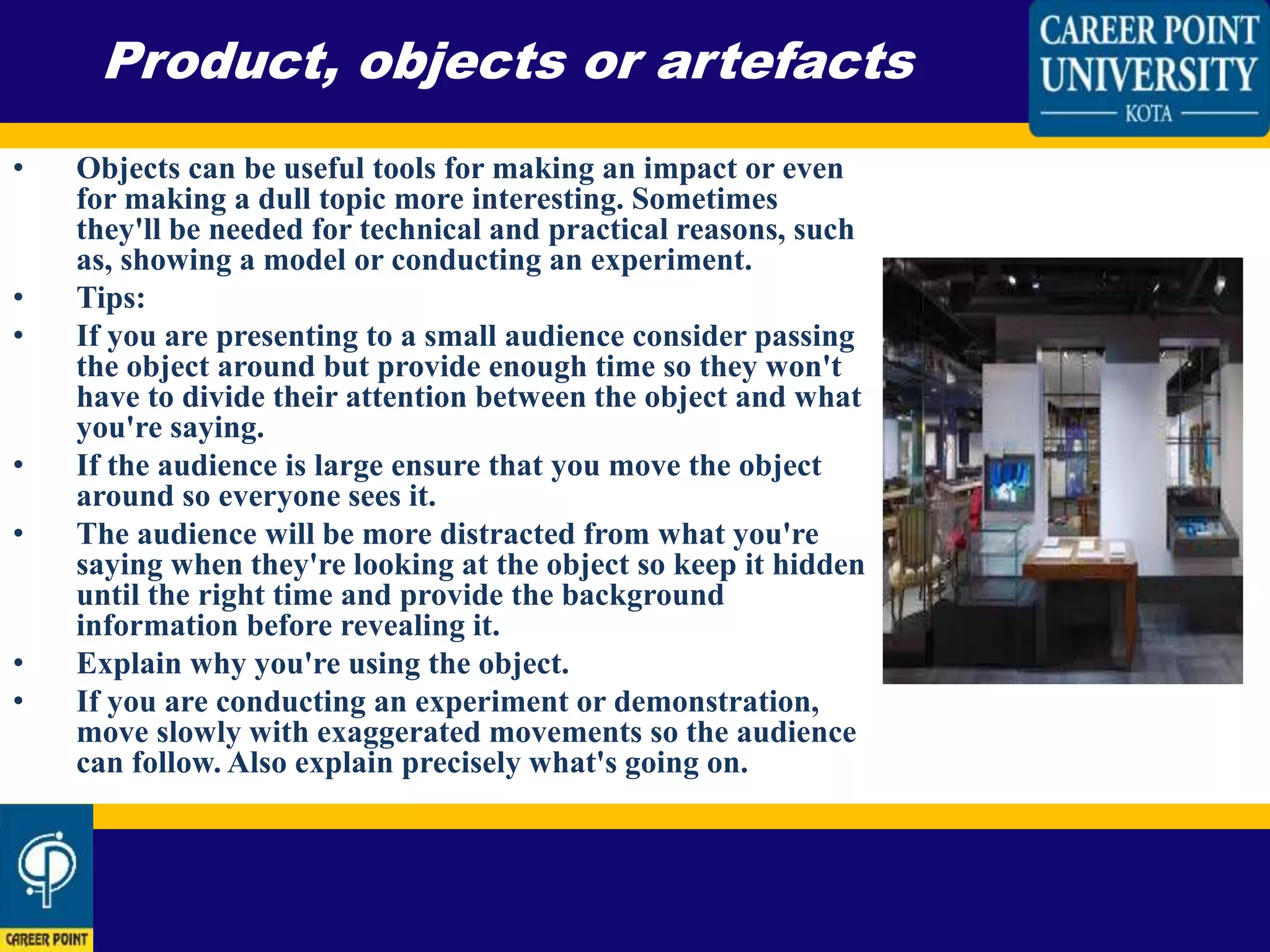
• Objects can be useful tools for making an impact or even
for making a dull topic more interesting. Sometimes
they'll be needed for technical and practical reasons, such
as, showing a model or conducting an experiment.
• Tips:
• If you are presenting to a small audience consider passing
the object around but provide enough time so they won't
have to divide their attention between the object and what
you're saying.
• If the audience is large ensure that you move the object
around so everyone sees it.
• The audience will be more distracted from what you're
saying when they're looking at the object so keep it hidden
until the right time and provide the background
information before revealing it.
• Explain why you're using the object.
• If you are conducting an experiment or demonstration,
move slowly with exaggerated movements so the audience
can follow. Also explain precisely what's going on.
Product, objects or artefacts
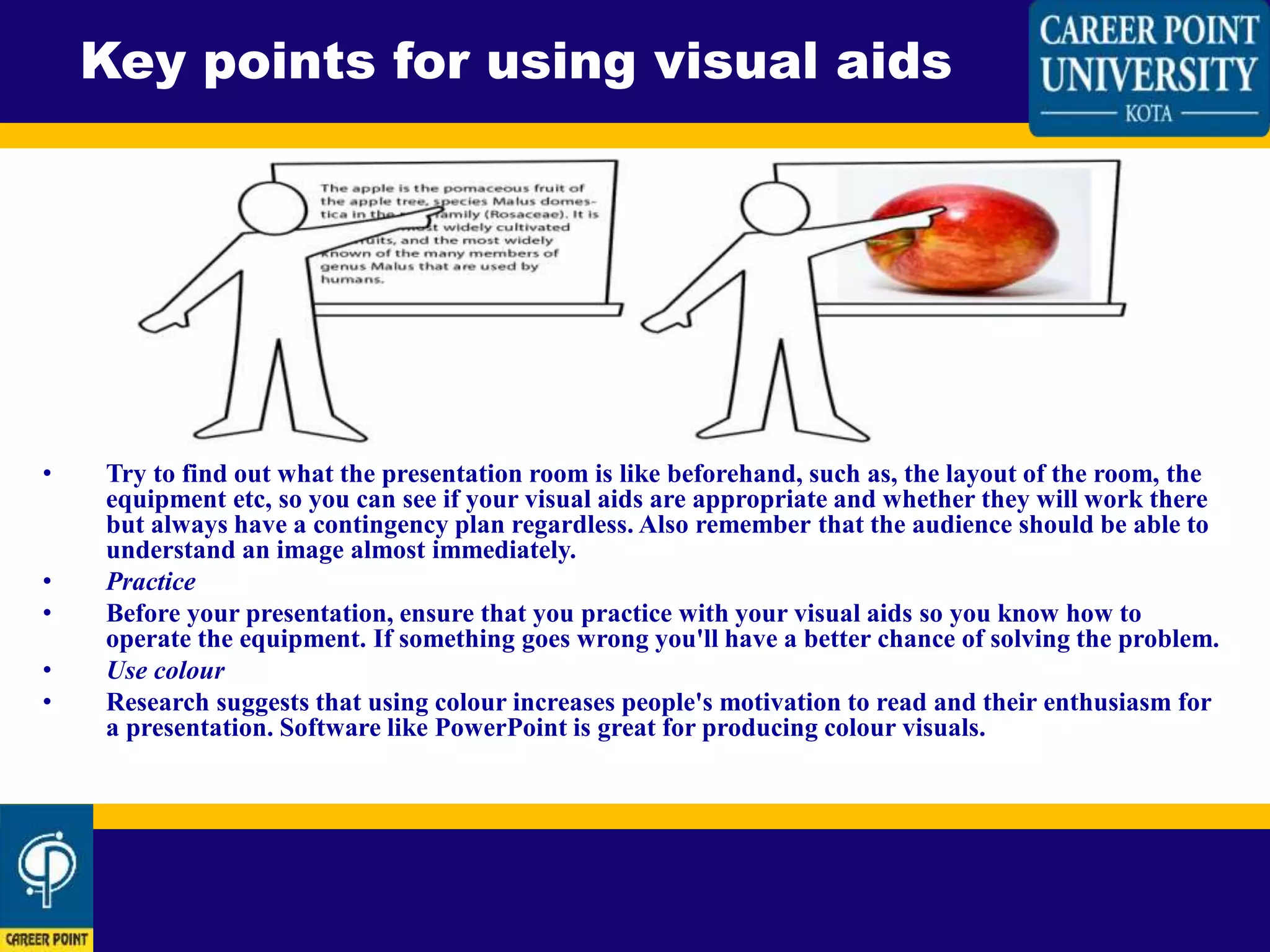
• Try to find out what the presentation room is like beforehand, such as, the layout of the room, the
equipment etc, so you can see if your visual aids are appropriate and whether they will work there
but always have a contingency plan regardless. Also remember that the audience should be able to
understand an image almost immediately.
• Practice
• Before your presentation, ensure that you practice with your visual aids so you know how to
operate the equipment. If something goes wrong you'll have a better chance of solving the problem.
• Use colour
• Research suggests that using colour increases people's motivation to read and their enthusiasm for
a presentation. Software like PowerPoint is great for producing colour visuals.
Key points for using visual aids
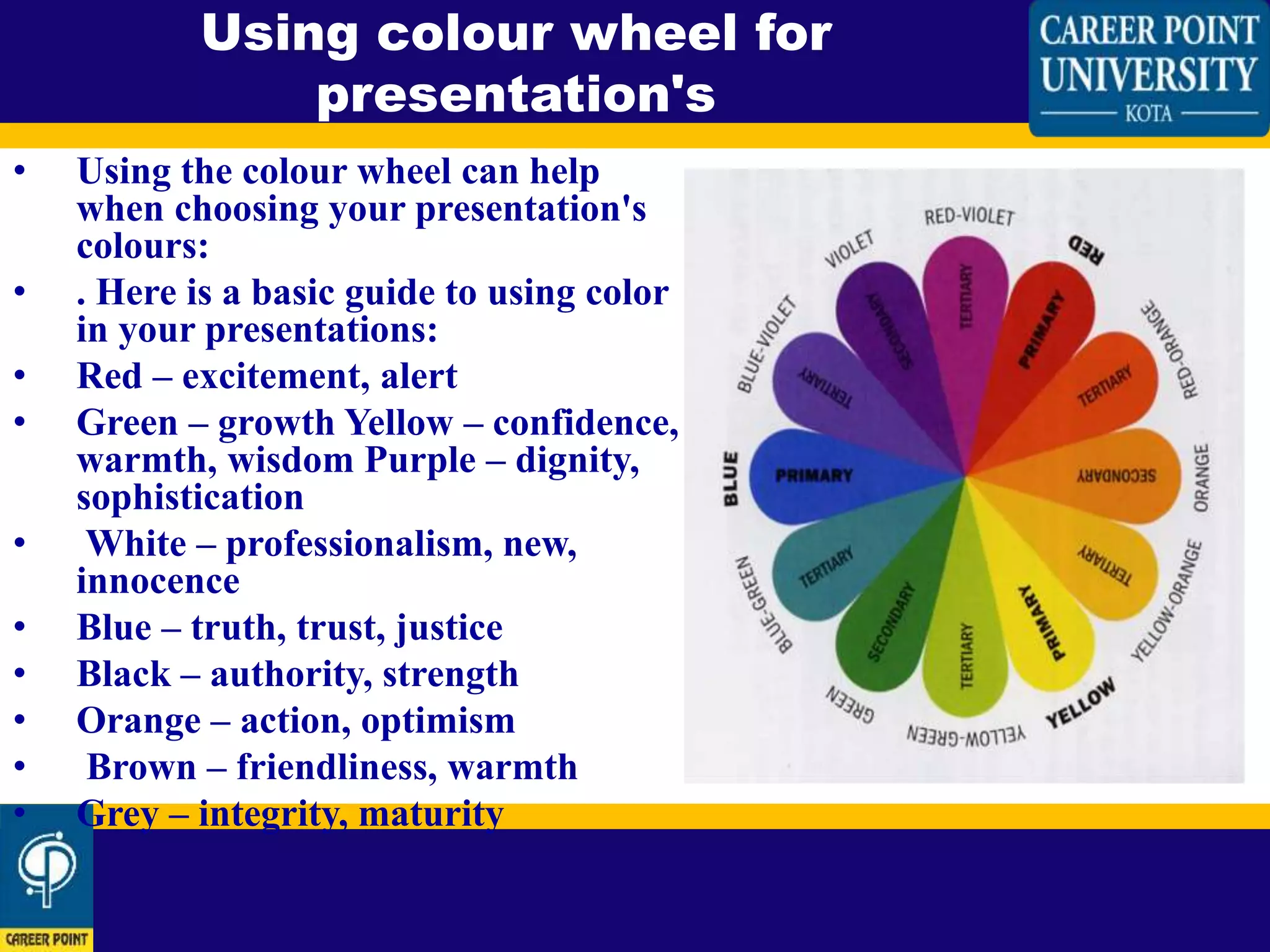
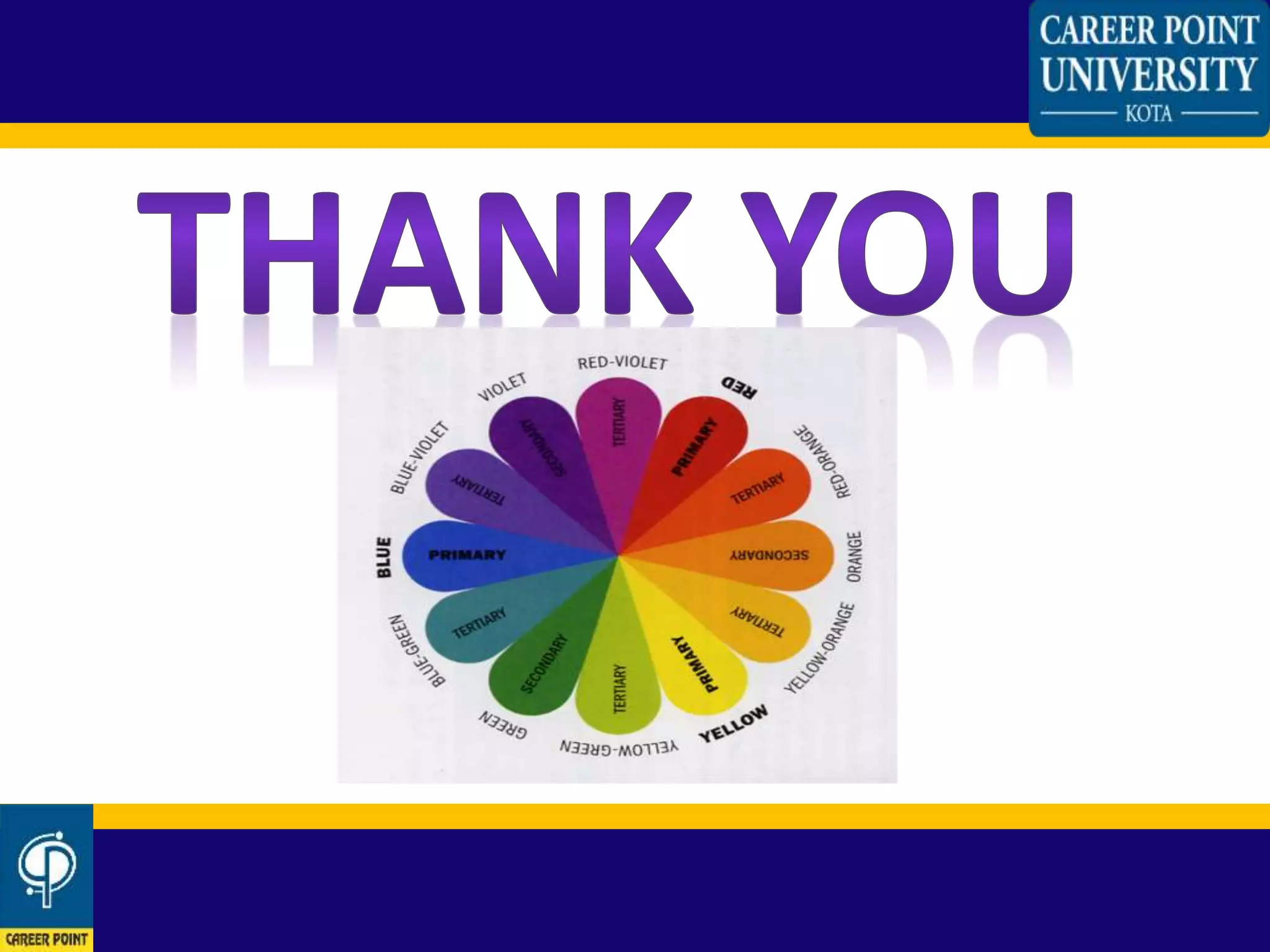
• Using the colour wheel can help
when choosing your presentation's
colours:
• . Here is a basic guide to using color
in your presentations:
• Red – excitement, alert
• Green – growth Yellow – confidence,
warmth, wisdom Purple – dignity,
sophistication
• White – professionalism, new,
innocence
• Blue – truth, trust, justice
• Black – authority, strength
• Orange – action, optimism
• Brown – friendliness, warmth
• Grey – integrity, maturity
Using colour wheel for
presentation's
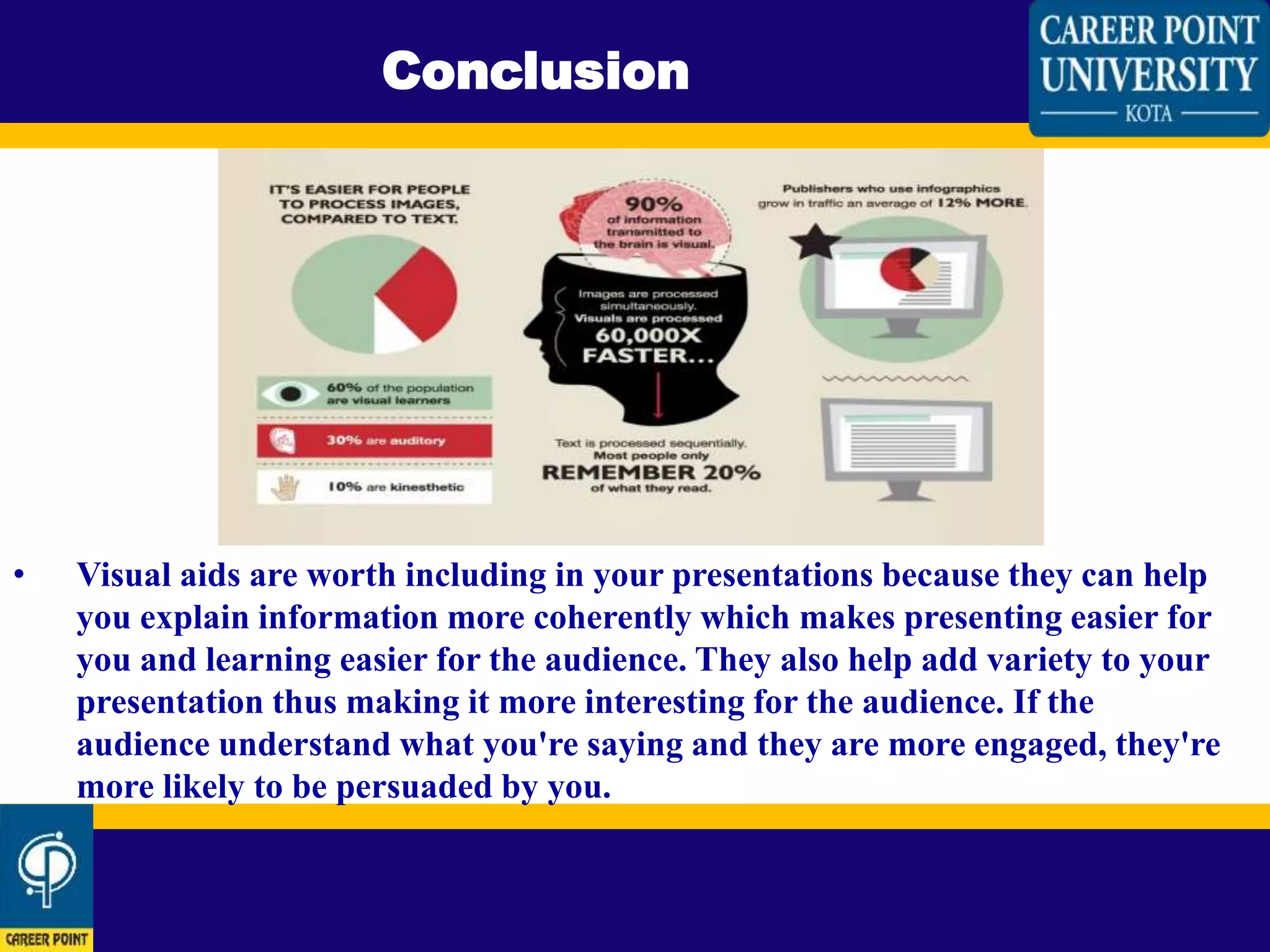
• Visual aids are worth including in your presentations because they can help
you explain information more coherently which makes presenting easier for
you and learning easier for the audience. They also help add variety to your
presentation thus making it more interesting for the audience. If the
audience understand what you're saying and they are more engaged, they're
more likely to be persuaded by you.
Conclusion
Importance of visual aids || Part I ||

Importance of visual aids || Part I ||

  • 2.
    • There area variety of different types of visual aids, you must decide which will suit your presentation and your audience. Types of visual aids
  • 3.
    • Microsoft PowerPointis widely used for presentations because it's easy to create attractive and professional presentations and it's simple to modify and reorganise content compared to other visual aids. You can insert a range of visual items into the slides which will improve the audience's focus. Also, the audience can generally see slideshows better than other visual aids and you don't have to face away from them. However, your presentation can look unprofessional if this software is used poorly. PowerPoint
  • 4.
    • Tips: • Havea clear and simple background. • Avoid using too many different types of fonts or font sizes. • Only use animations for a purpose, such as, to reveal the stages of a process, otherwise this can be distracting and look amateurish. • Use a large font size - a minimum of 24pt. • Use bullet points to summarise key points. • Consider providing handouts of diagrams because the audience will find the diagrams easier to read. • Avoid putting too much text on a slide. • Avoid using red or green text as it's difficult to read. • There should only be one key point for each slide. • Always have a back-up plan in case there is a technical issue and you cannot show the visuals on the day, for example, bring handouts or a poster. PowerPoint
  • 5.
    • Whiteboards aregreat for providing further explanations, such as, showing the order of a process, creating diagrams or explaining complex words or phrases. They're often used to display headings and write down audience suggestions. Whiteboards are also ideal for displaying important information for the entire duration of the presentation, such as, key definitions, because the audience can just glance at the whiteboard for a reminder. • Tips: • Ensure that enough time has passed for the audience to take notes before rubbing something off of the whiteboard. • Write concisely to avoid facing away from the audience for too long. • Handwriting must be large and legible. • Practice beforehand as you may feel nervous about writing in front of an audience at the time. Whiteboards
  • 6.
    Using videos area great wait to engage audience and increase their interest. Use video to bring motion, images and audio into your presentation. • Tips: • Ensure that any videos used are relevant to the presentation's content. • Only show as much of the video as necessary. • Never show a really long clip. • Videos can be difficult to fit into the structure of a presentation so ensure that you tell that audience why you're showing them a clip and tell them what to look for. • Inform the audience how long the video will last. Video clips
  • 7.
    • Flip chartsoffer a low cost and low tech solution to record and convey information as you speak. They're more beneficial for smaller audiences and they are favoured for brainstorming sessions as you can gather ideas easily. Flip charts are also widely used for summarising information and, like with a whiteboard, you can use them to show permanent background information. • Tips: • Place the flip chart in a location that you can easily access. • Prepare any sheets you can in advance, even if you can only write down the headings. • Flip charts can be moved so you can avoid facing away from the audience - stand next to it and continue to face the audience. • Have only one main idea per sheet. • Write legibly, largely and in block capitals so it's more visible. • Check with the audience that they can read the text - do not use a flipchart if there is a large audience. • Only write in black and blue ink. Red ink is good for circling or underlining. • Using a pencil write notes to yourself beforehand so you remember what to include - the audience will not see this writing.. • Flip back through the sheets to consolidate points. • Practice writing on the flip chart advance as you may feel nervous at the time of presenting. Flip chart
  • 8.
    • Poster boardscan be created using a variety of visual devices, such as graphs and images. They're generally quite portable and you can make them as elaborate as you want. However, they can be expensive to produce if the poster is quite complex. • Tips: • Use colour • Use block capitals • One poster per message or theme • Avoid using posters when presenting to large audiences as they will not be able to see the content Posters
  • 9.
    • Handouts arepapers that contain key information from your presentation or they may provide further information. They prevent you from overwhelming the audience as there will be less information on the slides and therefore less information they need to write down. • Tips: • You must consider when you want to give the audience the handouts: • If given at the beginning and middle of your presentation the audience may be reading rather than listening to you or they might not pay attention to what you're saying as they already have the information. • If given at the end of your presentation the audience may be trying to take lots of notes which may reduce the amount of information they are actually understanding. • To manage this, provide the audience with partially completed handouts so they will have to listen to what you're saying to be able to fill in the gaps. Providing the audience with graphs and charts beforehand is also beneficial because the audience will find them easier to read than, for example, from a slide. Handouts
  • 10.
    • Objects canbe useful tools for making an impact or even for making a dull topic more interesting. Sometimes they'll be needed for technical and practical reasons, such as, showing a model or conducting an experiment. • Tips: • If you are presenting to a small audience consider passing the object around but provide enough time so they won't have to divide their attention between the object and what you're saying. • If the audience is large ensure that you move the object around so everyone sees it. • The audience will be more distracted from what you're saying when they're looking at the object so keep it hidden until the right time and provide the background information before revealing it. • Explain why you're using the object. • If you are conducting an experiment or demonstration, move slowly with exaggerated movements so the audience can follow. Also explain precisely what's going on. Product, objects or artefacts
  • 11.
    • Try tofind out what the presentation room is like beforehand, such as, the layout of the room, the equipment etc, so you can see if your visual aids are appropriate and whether they will work there but always have a contingency plan regardless. Also remember that the audience should be able to understand an image almost immediately. • Practice • Before your presentation, ensure that you practice with your visual aids so you know how to operate the equipment. If something goes wrong you'll have a better chance of solving the problem. • Use colour • Research suggests that using colour increases people's motivation to read and their enthusiasm for a presentation. Software like PowerPoint is great for producing colour visuals. Key points for using visual aids
  • 12.
    • Using thecolour wheel can help when choosing your presentation's colours: • . Here is a basic guide to using color in your presentations: • Red – excitement, alert • Green – growth Yellow – confidence, warmth, wisdom Purple – dignity, sophistication • White – professionalism, new, innocence • Blue – truth, trust, justice • Black – authority, strength • Orange – action, optimism • Brown – friendliness, warmth • Grey – integrity, maturity Using colour wheel for presentation's
  • 13.
    • Visual aidsare worth including in your presentations because they can help you explain information more coherently which makes presenting easier for you and learning easier for the audience. They also help add variety to your presentation thus making it more interesting for the audience. If the audience understand what you're saying and they are more engaged, they're more likely to be persuaded by you. Conclusion