Importance of Training
Eduroof.com
Chapter 1- Certificate in Training & Development.
Post Graduate Diploma in Human Resources & Administration
Gyan Daan Sarvashreshtha Daan
 The Best Donation or Gift that you can give a person if of Knowledge. Because
if you give food, the donation would be consumed immediately and the
demand would arise in 12 hours again.
 If you give money, it would again have a limited period effectiveness.
 But if you give the knowledge to a person, the knowledge would be used for
entire life and the same would be passed on to n number of people and
generations all together.
 It will multiply and grows continuously.
The benefits of Training
 Efficient results
 Better skill sets
 Increases Employability of a person and the society in total
 Better industrial quality.
 Economic wellbeing.
 Improvised Society.
What is Training
 Organized activity aimed at imparting information and/or instructions to
improve the recipient's performance or to help him or her attain a required
level of knowledge or skill.
 The Training Process comprises of a series of steps that needs to be followed
systematically to have an efficient training program. The Training is a
systematic activity performed to modify the skills, attitudes and the behavior
of an employee to perform a particular job.
When do we need training
 Plug the gap between high and low performance groups.
 Continuous improvement.
 New Product or Process launch.
Who needs the training
All Levels in the Hierarchy
and the processes. The
trainer has to identify the
deficiencies and plug them.
• know the subject wellKnowledge
• employ techniques to
transfer knowledgeEnvironment
• involvement skills to create
learning climateInvolvement
 Training ought to deliver results
 Learning shows not in test performance but in action
 Role & skills of trainer are critical in this regard
 Three factors influence learning
Role & Skills of Trainer 7
Evaluator
Individual Development
Counselor
Instruction Writer Instructor
Manager of T & D
Group Facilitator
Marketer Media Specialist
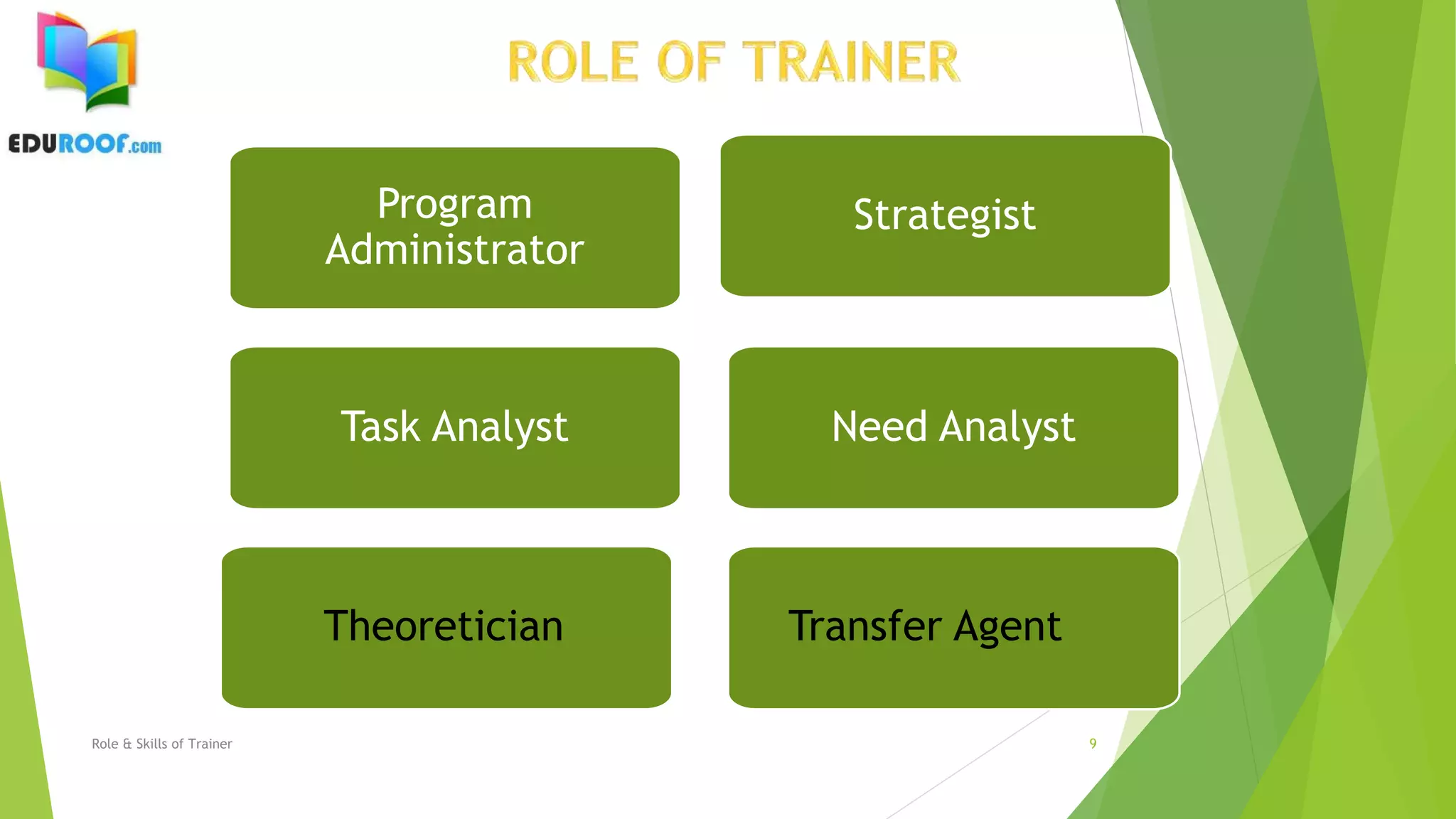
American Society of T & D listed key roles of trainer as:
Role & Skills of Trainer 8
Program
Administrator
Task Analyst Need Analyst
Strategist
Transfer AgentTheoretician
Role & Skills of Trainer 9
Identify training needs
Identify knowledge &
skills required for job
Performance assessment
before & after training
Evaluating instructional
methods
Applying adult learning
theories
Determining training
contents
Establish behavioral
objectives
Determining program
structure
Designing training
programs
Match performance
gape & training solution
Role & Skills of Trainer 10
Conducting training
programs
Conducting on-the-job
training
Using simulation &
games techniques
Handling challenging
participants
Employing successful
delivery skills
Communicating
effectively
Preparing budget People skills
Establishing good
working relations with
managers
Revising programs based
on feedback
Role & Skills of Trainer 11
Adaptability
Sense of humor
Understanding group
dynamics
Establishing rapport
Understanding non-
verbal behavior
Change management
Facilitation skills Self managing expertise
Business / commercial
awareness
Creativity
Role & Skills of Trainer 12

Importance of training

  • 1.
    Importance of Training Eduroof.com Chapter1- Certificate in Training & Development. Post Graduate Diploma in Human Resources & Administration
  • 2.
    Gyan Daan SarvashreshthaDaan  The Best Donation or Gift that you can give a person if of Knowledge. Because if you give food, the donation would be consumed immediately and the demand would arise in 12 hours again.  If you give money, it would again have a limited period effectiveness.  But if you give the knowledge to a person, the knowledge would be used for entire life and the same would be passed on to n number of people and generations all together.  It will multiply and grows continuously.
  • 3.
    The benefits ofTraining  Efficient results  Better skill sets  Increases Employability of a person and the society in total  Better industrial quality.  Economic wellbeing.  Improvised Society.
  • 4.
    What is Training Organized activity aimed at imparting information and/or instructions to improve the recipient's performance or to help him or her attain a required level of knowledge or skill.  The Training Process comprises of a series of steps that needs to be followed systematically to have an efficient training program. The Training is a systematic activity performed to modify the skills, attitudes and the behavior of an employee to perform a particular job.
  • 5.
    When do weneed training  Plug the gap between high and low performance groups.  Continuous improvement.  New Product or Process launch.
  • 6.
    Who needs thetraining All Levels in the Hierarchy and the processes. The trainer has to identify the deficiencies and plug them.
  • 7.
    • know thesubject wellKnowledge • employ techniques to transfer knowledgeEnvironment • involvement skills to create learning climateInvolvement  Training ought to deliver results  Learning shows not in test performance but in action  Role & skills of trainer are critical in this regard  Three factors influence learning Role & Skills of Trainer 7
  • 8.
    Evaluator Individual Development Counselor Instruction WriterInstructor Manager of T & D Group Facilitator Marketer Media Specialist American Society of T & D listed key roles of trainer as: Role & Skills of Trainer 8
  • 9.
    Program Administrator Task Analyst NeedAnalyst Strategist Transfer AgentTheoretician Role & Skills of Trainer 9
  • 10.
    Identify training needs Identifyknowledge & skills required for job Performance assessment before & after training Evaluating instructional methods Applying adult learning theories Determining training contents Establish behavioral objectives Determining program structure Designing training programs Match performance gape & training solution Role & Skills of Trainer 10
  • 11.
    Conducting training programs Conducting on-the-job training Usingsimulation & games techniques Handling challenging participants Employing successful delivery skills Communicating effectively Preparing budget People skills Establishing good working relations with managers Revising programs based on feedback Role & Skills of Trainer 11
  • 12.
    Adaptability Sense of humor Understandinggroup dynamics Establishing rapport Understanding non- verbal behavior Change management Facilitation skills Self managing expertise Business / commercial awareness Creativity Role & Skills of Trainer 12