TRAINING &
DEVELOPMENT
SYLLABUS
• UNIT I Introduction - Evolution of training, Concept, Role, Need and Importance of training, Objectives of training and
development, Overview of training functions, Designing an HRD programme, Types of training. Training philosophy,
Principles of Training, Principles of Learning, Cognitive learning, Developing an integrated approach of Learning and
Training programme,Future Trends in learning and development.
• UNIT 2 Training Need Identification / Assessment (TNI/TNA) - Concept, Scope and Importance, Methods and Techniques of
Training Need Assessment, Process of training, identification of job competencies, Criteria for identifying training needs
(manpower analysis – task analysis – organization analysis) – Approaches to Training Needs Assessment, Recent scenario
of TNI, Technology’s Influence on Training and Learning.
• UNIT 3 Designing and Conducting Training and Development Programmes - Factors affecting Training Design,
Considerations in Designing Effective Training Programs, Trainer Competencies, Trainer’s Role, The Trainer as Planner,
Trainer’s Encourage Objectivity and Creativity, Conducting Training and development Programme, Advantages of Designing
Training and Development Programme, Designing a Training module, Training Audit, Training Research , Budgeting of
training. Budgeting Process, Preparation of training proposals.
• UNIT 4 Evaluation of Training and Development Programme - Concept, Types of Evaluation, Different methods of training,
Factors Influencing Transfer of Training, Reasons for Evaluating Training, Evaluation Process, Pre-training Evaluation,
Evaluation during Training Post-Training Evaluation - Determining Outcomes, Evaluation Techniques-Models of Training
Evaluation - Kirk Patrick Model of evaluation – CIRO model – Cost Benefit analysis – ROI of training, Strategies for Effective
Training Transfer, IBM Model, Uirle Patrick Approach
• UNIT 5 Management Development - Focus and approach to Management Development, Knowledge and Skill of the
Manager, Need and Importance of Management Development, Training for Executive Level Management, Components of
Training for Management Development Programme, Selection of Techniques, Management Development Process,
Company Strategies for Providing Development.
EVOLUTION OF TRAINING
• rooted in the origins of education itself
• An examination of the history of education from the beginning shows
a continuum of human progress from survival-driven learning; to
education rooted in antiquity, the classics, and religious beliefs; to the
influences of war and military strategy on scientific and technical
education; to the job skills training and scientific management
spawned by the industrial revolution; to the post–World War II era
leadership development programs and the training of teams; and,
finally, to the development of individuals, organizations, and
communities for a variety of work-related purposes
EVOLUTION OF TRAINING
• in the U.S - emerged in the period during and after its involvement in World War II
• During this period, there was a dramatic increase in the demand for trained
workers brought on by the expanding wartime economy and by technological
innovations.
• During the post-war period, industry gradually adopted the lessons learned about
effective training during the war and acquired a major funding partner, the U.S.
military.
• The dominant forms of training during this period were classroom training and on-
the-job training.
EVOLUTION OF TRAINING
• One of the first widely adopted models for designing training was the instructional systems
development (ISD) model (Campbell, 1984). Unlike prior training methods, the ISD model
emphasized the importance of needs assessment before training and evaluating its
effectiveness after training.
• The five phases of the ISD model—analyze, design, develop, implement, and evaluate—gave
rise to the acronym, ADDIE, the popular term used for this training model.
• The ISD model was widely regarded as providing systematic rigor to training that, prior to its
introduction, was often amorphous and unreliable. The widespread use of structured
approaches to training was accompanied by calls for their refinements including
recommendations to decrease the lengthy, pre-training analysis phase and better integrate
learning with working.
EVOLUTION OF TRAINING
• With roots in the 1980s, the perception of employee training as a value-
added function today still depends on the ability to demonstrate its
return on investment, especially during periods of reduced business
spending.
• Despite greater awareness of the importance of justifying education and
training expenses, the challenges associated with these methods limit
their use.
• The 1990s witnessed the influence of the performance paradigm and
emphasis on training’s ability to improve performance.
• Training became more diverse and sophisticated and included
employee skills inventories, just-in-time training, independent training
consultants and vendors, and advanced methods to measure the
behavioral and financial results of training.
• As the appeal of investing in training grew among employers, its funding
increased.
EVOLUTION OF TRAINING
• In the 1990s, the widespread use of personal computers and the
introduction of computer-based training prompted the rethinking of
traditional models of employee training.
• Its speed, visual display, and accessibility of multiple learning resources
from a single computer facilitated the rapid adoption of computer-
based training.
• Training options expanded in the late 1980s and early 1990s to include
more computer-based options, including electronic performance
support systems (EPSSs) and automated performance support (APS) that
were designed to balance learning and performance value with ease of
use for non-computer experts.
• The emergence of the Internet and computer based training during this
period provided the foundation for today’s elaborate e-learning systems
DEFINITION
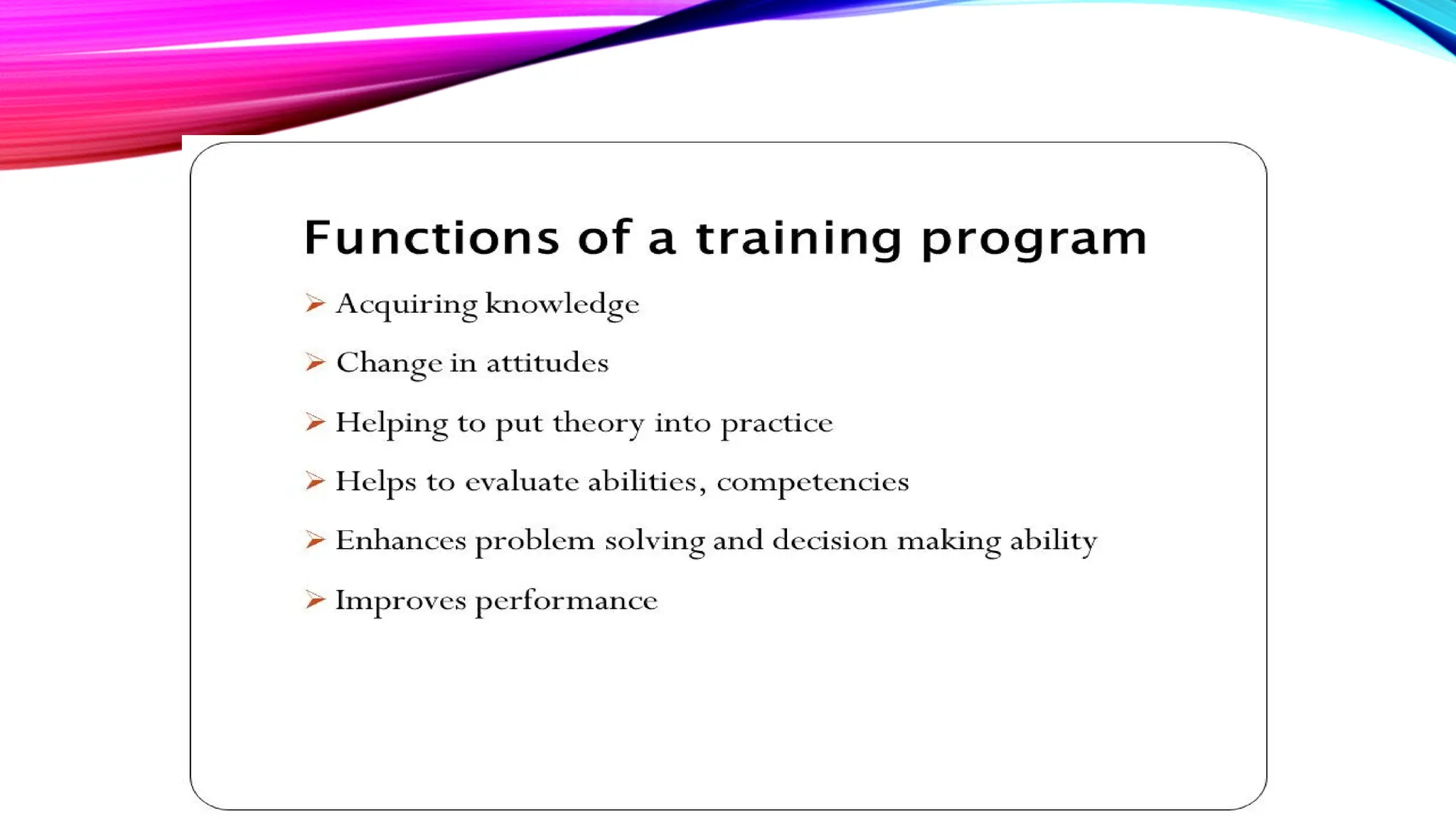
● According to Edwin B. Flippo, “training is
the act of increasing the knowledge and skills
of an employee for doing a particular job.”
● Whereas, Development refers to the overall
holistic and educational growth and maturity
of people in managerial positions. The
process of development is in relation to
insights, attitudes,
adaptability, leadership and human relations.
ROLE OF TRAINING:
● Increase in Efficiency.
● Increase in Morale of Employees.
● Better Human Relations.
● Reduced Supervision.
● Increased Organisational Viability and Flexibility
● Introduction of new strategies and working methods in the
organisation
● Advancement in technology
● Organisational Policy
NEED AND IMPORTANCE OF TRAINING
● Rapid technological innovations impacting the workplace have made it necessary for people to constantly
update their knowledge and skills
● Change in the style of management
● Lack of proper and scientific selection procedure
● For career advancement
● For higher motivation and productivity
● For employee motivation and retention and self development
● To improve organisational climate
● To help the organisation to fulfil its future manpower needs
● To keep pace with times
● To bridge the gap between skills requirement and skills availability
● For the survival and growth of the organisation
OBJECTIVES OF TRAINING
1. To increase the knowledge of workers in doing specific jobs.
2. To systematically impart new skills to the human resources so that they learn
quickly.
3. To bring about change in the attitudes of the workers towards fellow workers,
supervisor and the organization.
4. To improve the overall performance of the organization.
5. To make the employees handle materials, machines and equipment
efficiently and thus to check wastage of time and resources.
6. To reduce the number of accidents by providing safety training to
employees.
7. To prepare employees for higher jobs by developing advanced skills in them.
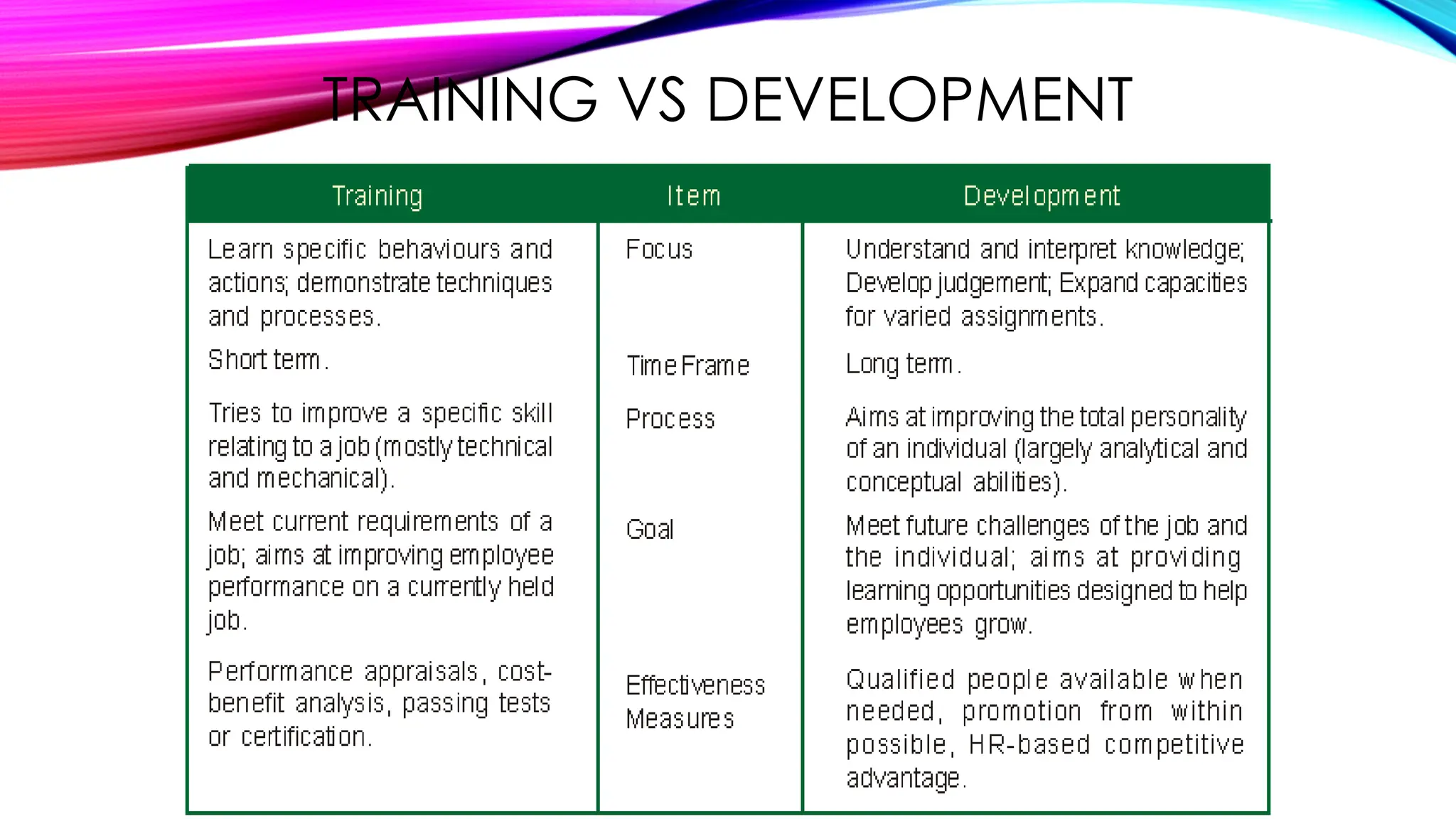
TRAINING VS DEVELOPMENT
OVERVIEW OF TRAINING
FUNCTIONS
• The primary function of training and development is to prepare employees
with the tools and skills needed to do productive and high-quality work that
will allow the company to serve its customers effectively.
• Training also serves to help your company stay competitive and innovative
through the use of ongoing learning activities in response to changes and
practices in the industry.
• In the long term, training helps with succession planning since your company
can identify possible successors early on and provide development activities
that prepare candidates for future leadership positions.
TYPES OF TRAINING
There are different types of training, they are as following.
1. Communications training
2. Computer skills training
3. Customer service training
4. Diversity training
5. Ethics training
6. Human relations training
7. Quality training
8. Safety training
9. Sexual harassment prevention training
TRAINING PHILOSOPHY
• Every organisation has different philosophy on training depending on its objectives, strategies, culture, and climate.
Philosophy means putting the nature of universe, including meaning, people and relationships into an understandable and
explainable perspective.
• The training philosophy of an organisation expresses the degree of importance it attaches to training and development of
human resources. Organisation with positive philosophy understands that they live in a world where effectiveness is
achieved by having competent employees and organisational performance cannot be improved they invest in developing the
skills and competencies of their employees. The organisation need to set concrete objectives for training in terms of a return
on investment and the training philosophy should reflect this. These areas which such philosophy should be developed are
as follows:
• Relevance
• Problem based
• Action oriented
• Performance related training
• Continuous development.
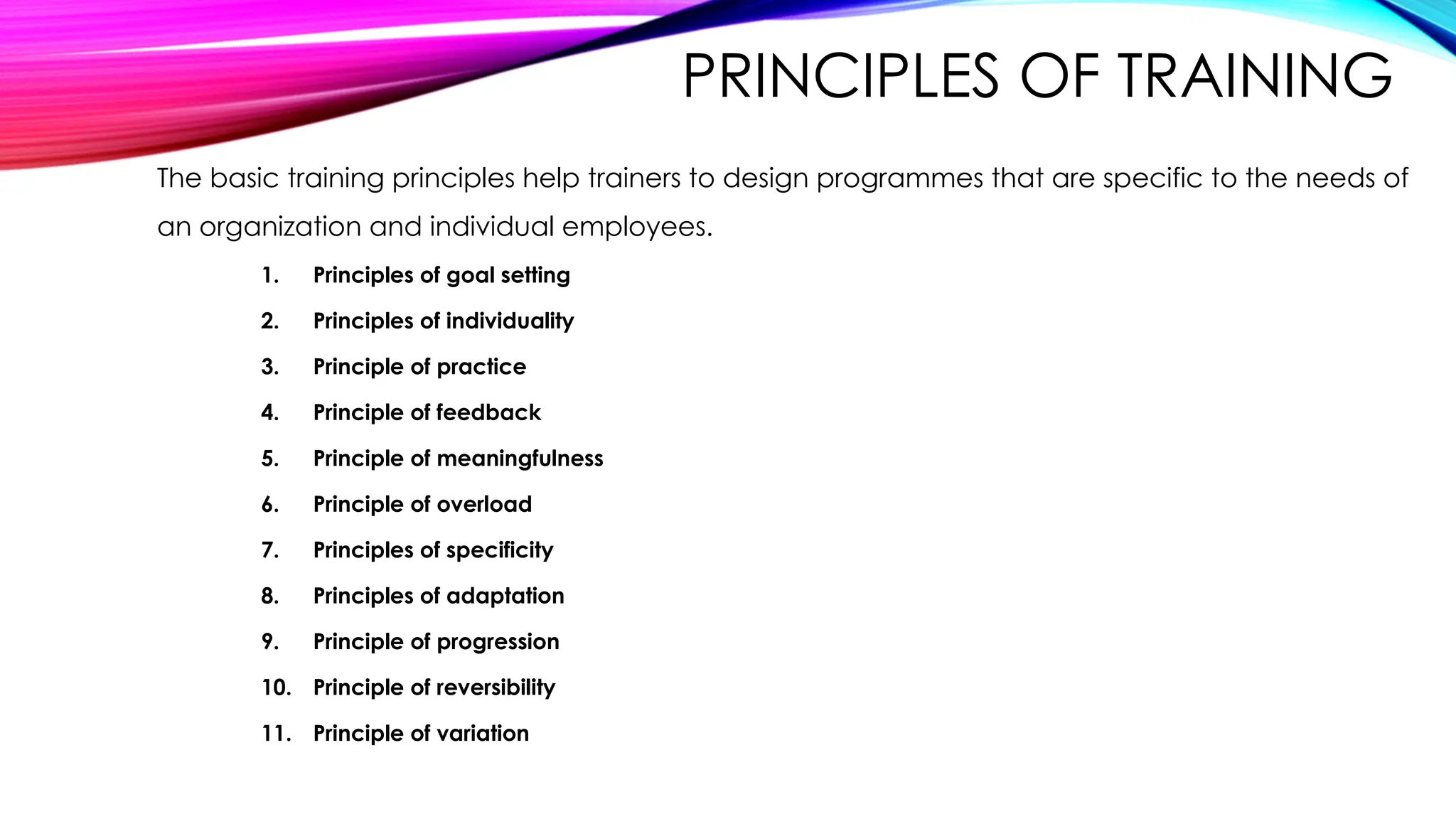
PRINCIPLES OF TRAINING
The basic training principles help trainers to design programmes that are specific to the needs of
an organization and individual employees.
1. Principles of goal setting
2. Principles of individuality
3. Principle of practice
4. Principle of feedback
5. Principle of meaningfulness
6. Principle of overload
7. Principles of specificity
8. Principles of adaptation
9. Principle of progression
10. Principle of reversibility
11. Principle of variation
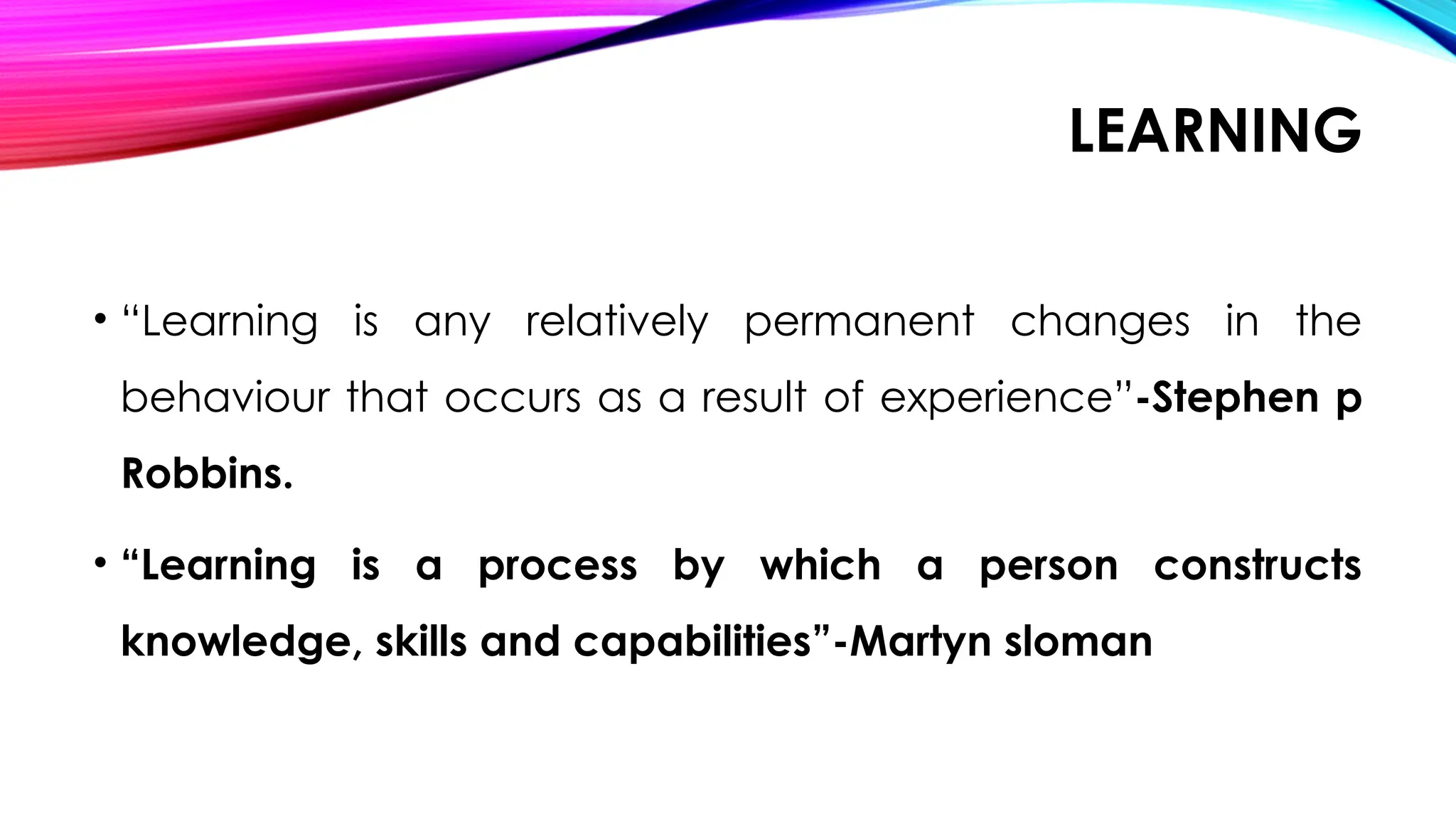
LEARNING
• “Learning is any relatively permanent changes in the
behaviour that occurs as a result of experience”-Stephen p
Robbins.
• “Learning is a process by which a person constructs
knowledge, skills and capabilities”-Martyn sloman
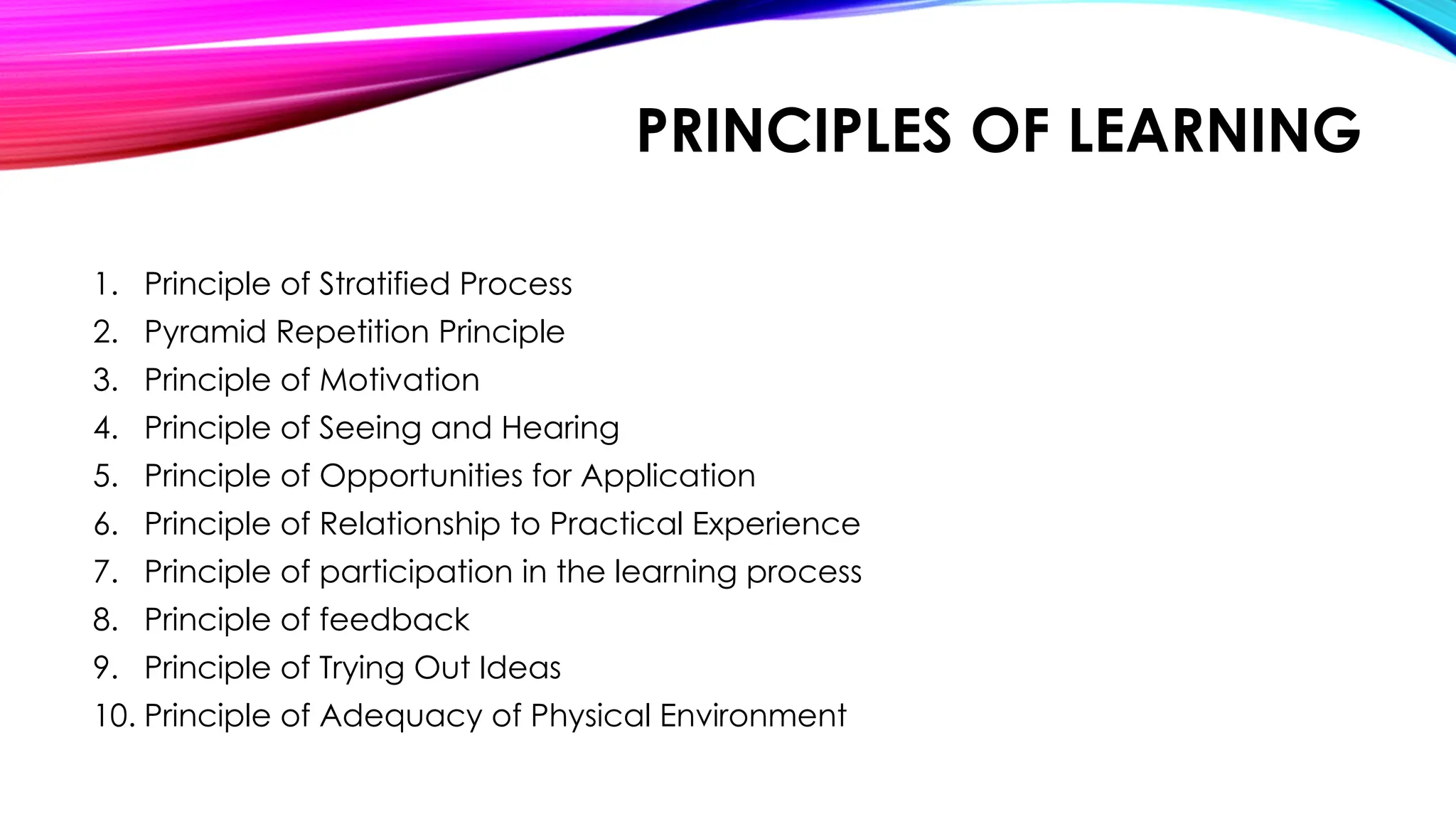
PRINCIPLES OF LEARNING
1. Principle of Stratified Process
2. Pyramid Repetition Principle
3. Principle of Motivation
4. Principle of Seeing and Hearing
5. Principle of Opportunities for Application
6. Principle of Relationship to Practical Experience
7. Principle of participation in the learning process
8. Principle of feedback
9. Principle of Trying Out Ideas
10. Principle of Adequacy of Physical Environment
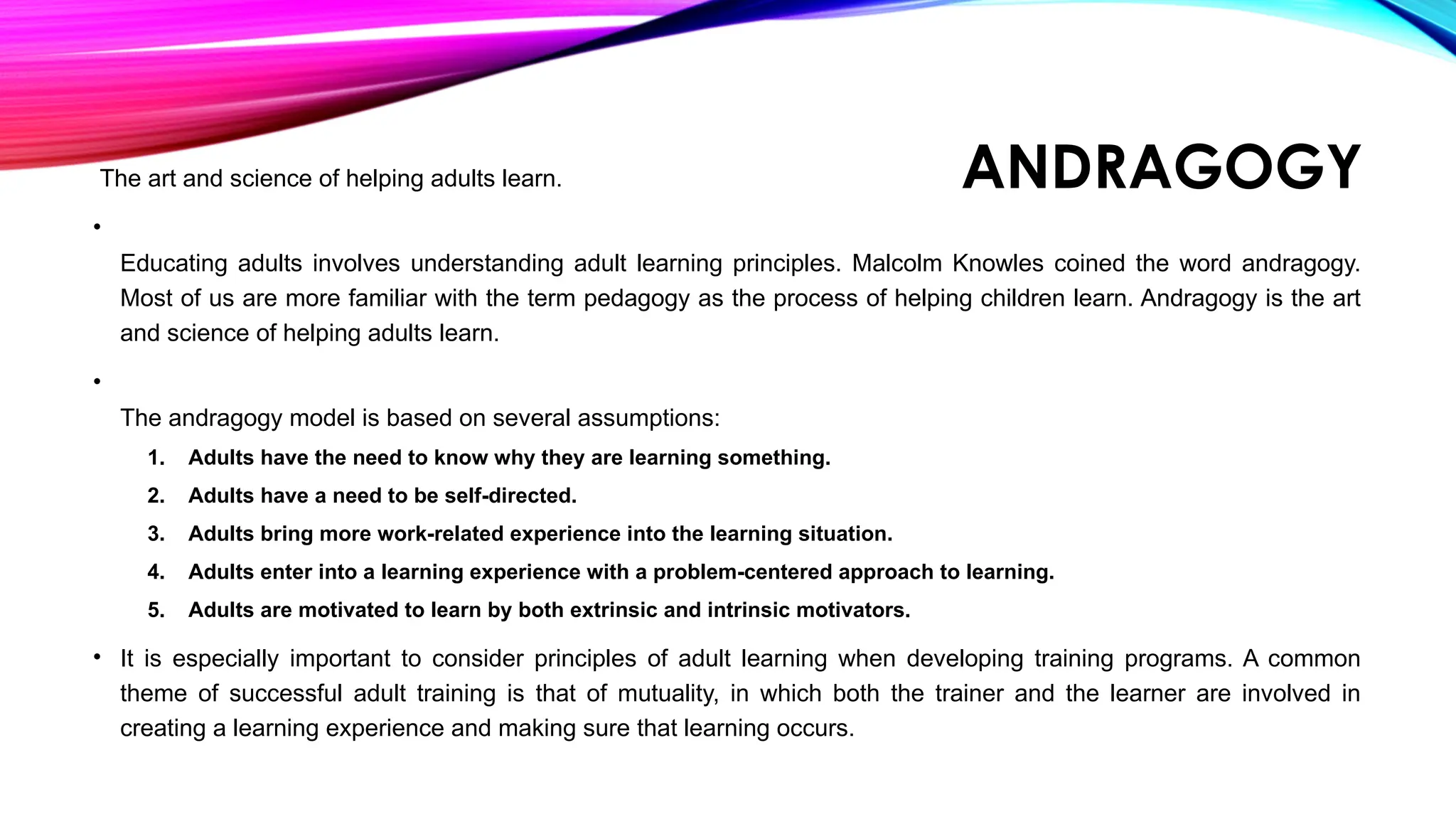
ANDRAGOGY
The art and science of helping adults learn.
•
Educating adults involves understanding adult learning principles. Malcolm Knowles coined the word andragogy.
Most of us are more familiar with the term pedagogy as the process of helping children learn. Andragogy is the art
and science of helping adults learn.
•
The andragogy model is based on several assumptions:
1. Adults have the need to know why they are learning something.
2. Adults have a need to be self-directed.
3. Adults bring more work-related experience into the learning situation.
4. Adults enter into a learning experience with a problem-centered approach to learning.
5. Adults are motivated to learn by both extrinsic and intrinsic motivators.
• It is especially important to consider principles of adult learning when developing training programs. A common
theme of successful adult training is that of mutuality, in which both the trainer and the learner are involved in
creating a learning experience and making sure that learning occurs.
COGNITIVE LEARNING
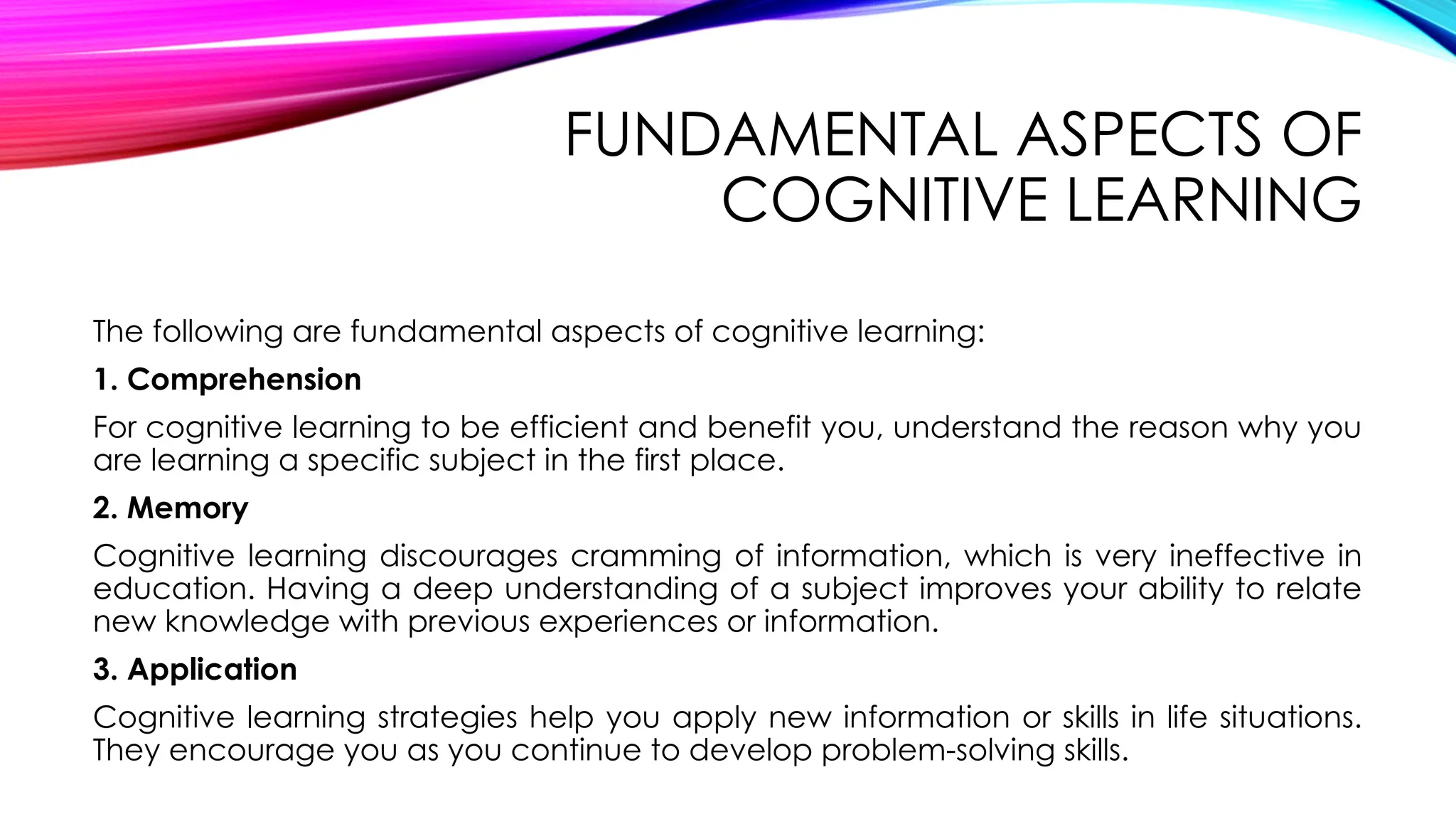
Cognitive learning is an active style of learning that focuses
on helping you learn how to maximize your brain’s potential.
It makes it easier for you to connect new information with
existing ideas hence deepening your memory and retention
capacity.
The ability of the brain’s mental processes to absorb and
retain information through experience, senses, and thought is
known as cognition.
FUNDAMENTAL ASPECTS OF
COGNITIVE LEARNING
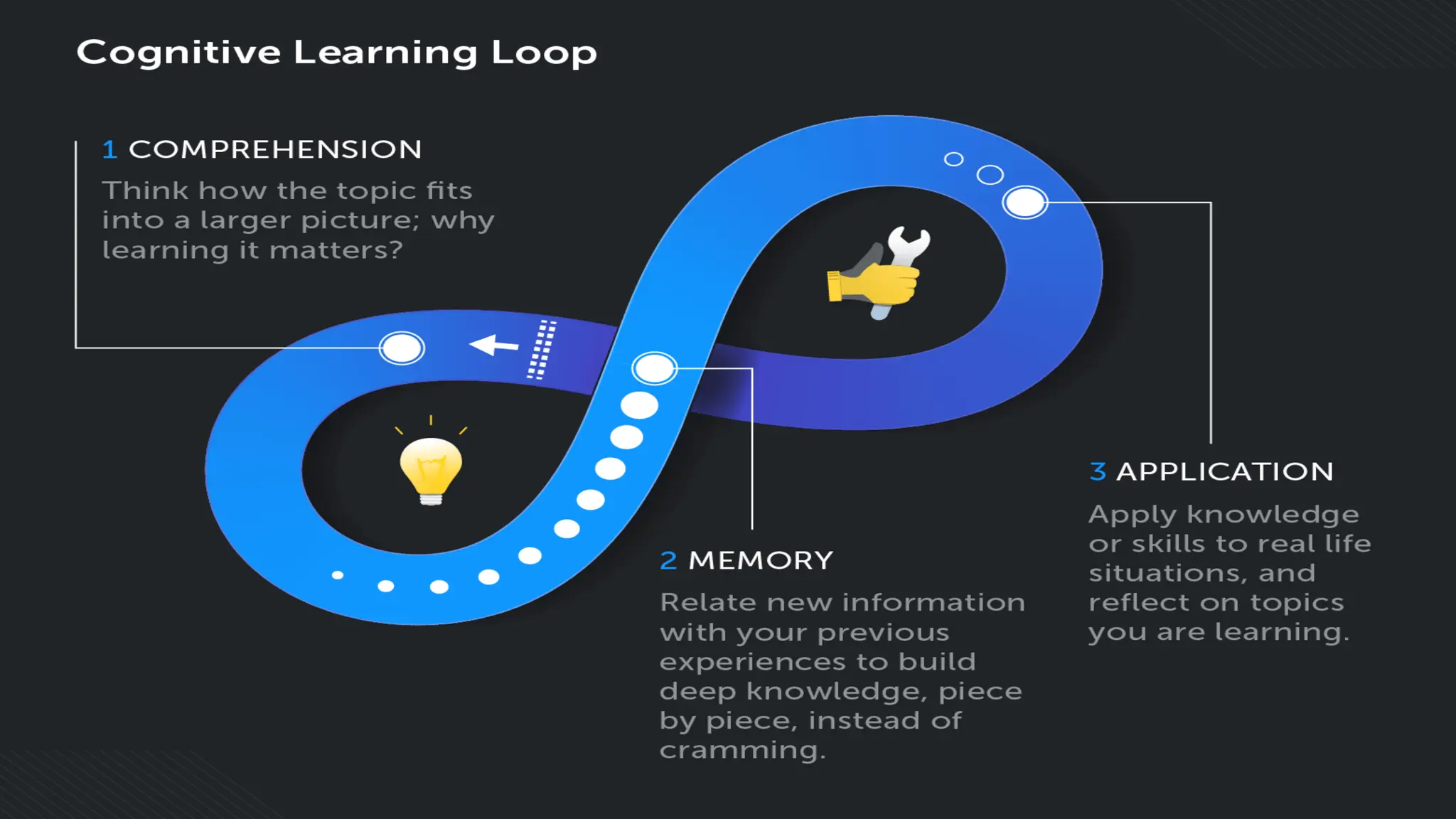
The following are fundamental aspects of cognitive learning:
1. Comprehension
For cognitive learning to be efficient and benefit you, understand the reason why you
are learning a specific subject in the first place.
2. Memory
Cognitive learning discourages cramming of information, which is very ineffective in
education. Having a deep understanding of a subject improves your ability to relate
new knowledge with previous experiences or information.
3. Application
Cognitive learning strategies help you apply new information or skills in life situations.
They encourage you as you continue to develop problem-solving skills.
COGNITIVE LEARNING THEORY
• Cognitive learning theory explains how internal and external factors influence an individual’s mental
processes to supplement learning.
• Delays and difficulties in learning are seen when cognitive processes are not working regularly. These
processes are such as attention, observation, retrieval from long-term memory, and categorization.
• researcher by the name Jean Piaget recognized that the environment plays a huge role and also
focused on changes that take place in the internal cognitive structure.
• Jean Piaget termed learning as relating information to already existing knowledge. And each learner
starts with their own knowledge and experience.
• According to his theories, learning begins with the accumulation of some basic knowledge and
advancing deeper into the field with time.
COGNITIVE LEARNING THEORY
Piaget suggested three vital components of learning:
1. Accommodation - taking new information into account by modifying what we already know.
2. Assimilation - the arrangement of new knowledge inside our heads beside what we know.
3. Equilibration - balancing what we already know with the new information that we are trying to
acquire.
Each company should develop their training programs with a personalized learning approach to
make it engaging for their employees to achieve better results.
BENEFITS OF COGNITIVE LEARNING
The following are the major positive effects of cognitive learning:
1. Enhances learning
Cognitive learning theory enhances lifelong learning. Workers can build upon previous ideas and apply new concepts to already existing knowledge.
2. Boosts confidence
Employees become more confident in approaching tasks as they get a deeper understanding of new topics and learn new skills.
3. Enhances Comprehension
Cognitive learning improves learners’ comprehension of acquiring new information. They can develop a deeper understanding of new learning
materials.
4. Improves problem-solving skills
Cognitive learning equips employees with the skills they need to learn effectively. They are thereby able to develop problem-solving skills they can apply
under challenging tasks.
5. Help learn new things faster
Through the experience of learning, the employee will be able to recycle and use the same learning methods that worked previously. This will help them
learn new things a lot faster as they already know what works for them when it comes to obtaining new knowledge.
6. Teaches to form concept formation (think abstract)
Cognitive learning can also teach your employees to form a range of different concepts such as easily perceiving and interpreting information that
could boost creativity and lead to innovations at the workplace
NEED FOR INTEGRATED APPROACH
TO LEARNING IN TRAINING
• In a training programme, learning is a complex and multidimensional
programme.
• There are several factors and conditions that influence the learning process.
• In this process the main players are – the participants, trainers, support staffs
etc.
• Your task as trainer is to ensure that all these factors and components are in
accord with one another in a way that strengthens and promotes the
learning process.
NEED FOR INTEGRATED APPROACH
TO LEARNING IN TRAINING
Four Ways in Which a Participant Learns
1. Affirmations and endorsement of existing learning.
2. Building on present level of competencies.
3. Development of new knowledge and competencies.
4. Learning after going through a process of de-learning.
METHODS OF LEARNING IN A
TRAINING PROGRAMME
In a training programme, trainers are not only the source of learning for the participants.
Learning can become lop-sided if they depend largely on the inputs provided by the
trainers. This may also prevent of using all available avenues for learning.
The trainer should promote other learning methods and also promote interaction among
the participants through suitable training activities. Also it is not limited to classrooms and
goes beyond precincts.
Five methods of learning are:
1. Direct input by the trainer.
2. Learning through sharing within the training group.
3. Learning through practice and exercise.
4. Formal or informal methods of observation.
5. Out-of-session exchanges with participants and trainers.
8 LEARNING & DEVELOPMENT
(L&D) TRENDS TO WATCH IN 2022
1. Upskilling & Reskilling for the Digital Workplace
2. Content Repurposing
3. In-App Experiences
4. Learning in the Moment of Need
5. Microlearning
6. Knowledge-Sharing Ecosystem
7. Behavioral Data
8. Real-Time Employee Feedback
https://whatfix.com/blog/learning-development-trends/

TRAINING & DEVELOPMENT UNIT 1 kerala university kerala university

  • 1.
  • 2.
    SYLLABUS • UNIT IIntroduction - Evolution of training, Concept, Role, Need and Importance of training, Objectives of training and development, Overview of training functions, Designing an HRD programme, Types of training. Training philosophy, Principles of Training, Principles of Learning, Cognitive learning, Developing an integrated approach of Learning and Training programme,Future Trends in learning and development. • UNIT 2 Training Need Identification / Assessment (TNI/TNA) - Concept, Scope and Importance, Methods and Techniques of Training Need Assessment, Process of training, identification of job competencies, Criteria for identifying training needs (manpower analysis – task analysis – organization analysis) – Approaches to Training Needs Assessment, Recent scenario of TNI, Technology’s Influence on Training and Learning. • UNIT 3 Designing and Conducting Training and Development Programmes - Factors affecting Training Design, Considerations in Designing Effective Training Programs, Trainer Competencies, Trainer’s Role, The Trainer as Planner, Trainer’s Encourage Objectivity and Creativity, Conducting Training and development Programme, Advantages of Designing Training and Development Programme, Designing a Training module, Training Audit, Training Research , Budgeting of training. Budgeting Process, Preparation of training proposals. • UNIT 4 Evaluation of Training and Development Programme - Concept, Types of Evaluation, Different methods of training, Factors Influencing Transfer of Training, Reasons for Evaluating Training, Evaluation Process, Pre-training Evaluation, Evaluation during Training Post-Training Evaluation - Determining Outcomes, Evaluation Techniques-Models of Training Evaluation - Kirk Patrick Model of evaluation – CIRO model – Cost Benefit analysis – ROI of training, Strategies for Effective Training Transfer, IBM Model, Uirle Patrick Approach • UNIT 5 Management Development - Focus and approach to Management Development, Knowledge and Skill of the Manager, Need and Importance of Management Development, Training for Executive Level Management, Components of Training for Management Development Programme, Selection of Techniques, Management Development Process, Company Strategies for Providing Development.
  • 3.
    EVOLUTION OF TRAINING •rooted in the origins of education itself • An examination of the history of education from the beginning shows a continuum of human progress from survival-driven learning; to education rooted in antiquity, the classics, and religious beliefs; to the influences of war and military strategy on scientific and technical education; to the job skills training and scientific management spawned by the industrial revolution; to the post–World War II era leadership development programs and the training of teams; and, finally, to the development of individuals, organizations, and communities for a variety of work-related purposes
  • 4.
    EVOLUTION OF TRAINING •in the U.S - emerged in the period during and after its involvement in World War II • During this period, there was a dramatic increase in the demand for trained workers brought on by the expanding wartime economy and by technological innovations. • During the post-war period, industry gradually adopted the lessons learned about effective training during the war and acquired a major funding partner, the U.S. military. • The dominant forms of training during this period were classroom training and on- the-job training.
  • 5.
    EVOLUTION OF TRAINING •One of the first widely adopted models for designing training was the instructional systems development (ISD) model (Campbell, 1984). Unlike prior training methods, the ISD model emphasized the importance of needs assessment before training and evaluating its effectiveness after training. • The five phases of the ISD model—analyze, design, develop, implement, and evaluate—gave rise to the acronym, ADDIE, the popular term used for this training model. • The ISD model was widely regarded as providing systematic rigor to training that, prior to its introduction, was often amorphous and unreliable. The widespread use of structured approaches to training was accompanied by calls for their refinements including recommendations to decrease the lengthy, pre-training analysis phase and better integrate learning with working.
  • 6.
    EVOLUTION OF TRAINING •With roots in the 1980s, the perception of employee training as a value- added function today still depends on the ability to demonstrate its return on investment, especially during periods of reduced business spending. • Despite greater awareness of the importance of justifying education and training expenses, the challenges associated with these methods limit their use. • The 1990s witnessed the influence of the performance paradigm and emphasis on training’s ability to improve performance. • Training became more diverse and sophisticated and included employee skills inventories, just-in-time training, independent training consultants and vendors, and advanced methods to measure the behavioral and financial results of training. • As the appeal of investing in training grew among employers, its funding increased.
  • 7.
    EVOLUTION OF TRAINING •In the 1990s, the widespread use of personal computers and the introduction of computer-based training prompted the rethinking of traditional models of employee training. • Its speed, visual display, and accessibility of multiple learning resources from a single computer facilitated the rapid adoption of computer- based training. • Training options expanded in the late 1980s and early 1990s to include more computer-based options, including electronic performance support systems (EPSSs) and automated performance support (APS) that were designed to balance learning and performance value with ease of use for non-computer experts. • The emergence of the Internet and computer based training during this period provided the foundation for today’s elaborate e-learning systems
  • 8.
    DEFINITION ● According toEdwin B. Flippo, “training is the act of increasing the knowledge and skills of an employee for doing a particular job.” ● Whereas, Development refers to the overall holistic and educational growth and maturity of people in managerial positions. The process of development is in relation to insights, attitudes, adaptability, leadership and human relations.
  • 9.
    ROLE OF TRAINING: ●Increase in Efficiency. ● Increase in Morale of Employees. ● Better Human Relations. ● Reduced Supervision. ● Increased Organisational Viability and Flexibility ● Introduction of new strategies and working methods in the organisation ● Advancement in technology ● Organisational Policy
  • 10.
    NEED AND IMPORTANCEOF TRAINING ● Rapid technological innovations impacting the workplace have made it necessary for people to constantly update their knowledge and skills ● Change in the style of management ● Lack of proper and scientific selection procedure ● For career advancement ● For higher motivation and productivity ● For employee motivation and retention and self development ● To improve organisational climate ● To help the organisation to fulfil its future manpower needs ● To keep pace with times ● To bridge the gap between skills requirement and skills availability ● For the survival and growth of the organisation
  • 11.
    OBJECTIVES OF TRAINING 1.To increase the knowledge of workers in doing specific jobs. 2. To systematically impart new skills to the human resources so that they learn quickly. 3. To bring about change in the attitudes of the workers towards fellow workers, supervisor and the organization. 4. To improve the overall performance of the organization. 5. To make the employees handle materials, machines and equipment efficiently and thus to check wastage of time and resources. 6. To reduce the number of accidents by providing safety training to employees. 7. To prepare employees for higher jobs by developing advanced skills in them.
  • 12.
  • 14.
    OVERVIEW OF TRAINING FUNCTIONS •The primary function of training and development is to prepare employees with the tools and skills needed to do productive and high-quality work that will allow the company to serve its customers effectively. • Training also serves to help your company stay competitive and innovative through the use of ongoing learning activities in response to changes and practices in the industry. • In the long term, training helps with succession planning since your company can identify possible successors early on and provide development activities that prepare candidates for future leadership positions.
  • 16.
    TYPES OF TRAINING Thereare different types of training, they are as following. 1. Communications training 2. Computer skills training 3. Customer service training 4. Diversity training 5. Ethics training 6. Human relations training 7. Quality training 8. Safety training 9. Sexual harassment prevention training
  • 17.
    TRAINING PHILOSOPHY • Everyorganisation has different philosophy on training depending on its objectives, strategies, culture, and climate. Philosophy means putting the nature of universe, including meaning, people and relationships into an understandable and explainable perspective. • The training philosophy of an organisation expresses the degree of importance it attaches to training and development of human resources. Organisation with positive philosophy understands that they live in a world where effectiveness is achieved by having competent employees and organisational performance cannot be improved they invest in developing the skills and competencies of their employees. The organisation need to set concrete objectives for training in terms of a return on investment and the training philosophy should reflect this. These areas which such philosophy should be developed are as follows: • Relevance • Problem based • Action oriented • Performance related training • Continuous development.
  • 18.
    PRINCIPLES OF TRAINING Thebasic training principles help trainers to design programmes that are specific to the needs of an organization and individual employees. 1. Principles of goal setting 2. Principles of individuality 3. Principle of practice 4. Principle of feedback 5. Principle of meaningfulness 6. Principle of overload 7. Principles of specificity 8. Principles of adaptation 9. Principle of progression 10. Principle of reversibility 11. Principle of variation
  • 19.
    LEARNING • “Learning isany relatively permanent changes in the behaviour that occurs as a result of experience”-Stephen p Robbins. • “Learning is a process by which a person constructs knowledge, skills and capabilities”-Martyn sloman
  • 20.
    PRINCIPLES OF LEARNING 1.Principle of Stratified Process 2. Pyramid Repetition Principle 3. Principle of Motivation 4. Principle of Seeing and Hearing 5. Principle of Opportunities for Application 6. Principle of Relationship to Practical Experience 7. Principle of participation in the learning process 8. Principle of feedback 9. Principle of Trying Out Ideas 10. Principle of Adequacy of Physical Environment
  • 21.
    ANDRAGOGY The art andscience of helping adults learn. • Educating adults involves understanding adult learning principles. Malcolm Knowles coined the word andragogy. Most of us are more familiar with the term pedagogy as the process of helping children learn. Andragogy is the art and science of helping adults learn. • The andragogy model is based on several assumptions: 1. Adults have the need to know why they are learning something. 2. Adults have a need to be self-directed. 3. Adults bring more work-related experience into the learning situation. 4. Adults enter into a learning experience with a problem-centered approach to learning. 5. Adults are motivated to learn by both extrinsic and intrinsic motivators. • It is especially important to consider principles of adult learning when developing training programs. A common theme of successful adult training is that of mutuality, in which both the trainer and the learner are involved in creating a learning experience and making sure that learning occurs.
  • 22.
    COGNITIVE LEARNING Cognitive learningis an active style of learning that focuses on helping you learn how to maximize your brain’s potential. It makes it easier for you to connect new information with existing ideas hence deepening your memory and retention capacity. The ability of the brain’s mental processes to absorb and retain information through experience, senses, and thought is known as cognition.
  • 23.
    FUNDAMENTAL ASPECTS OF COGNITIVELEARNING The following are fundamental aspects of cognitive learning: 1. Comprehension For cognitive learning to be efficient and benefit you, understand the reason why you are learning a specific subject in the first place. 2. Memory Cognitive learning discourages cramming of information, which is very ineffective in education. Having a deep understanding of a subject improves your ability to relate new knowledge with previous experiences or information. 3. Application Cognitive learning strategies help you apply new information or skills in life situations. They encourage you as you continue to develop problem-solving skills.
  • 25.
    COGNITIVE LEARNING THEORY •Cognitive learning theory explains how internal and external factors influence an individual’s mental processes to supplement learning. • Delays and difficulties in learning are seen when cognitive processes are not working regularly. These processes are such as attention, observation, retrieval from long-term memory, and categorization. • researcher by the name Jean Piaget recognized that the environment plays a huge role and also focused on changes that take place in the internal cognitive structure. • Jean Piaget termed learning as relating information to already existing knowledge. And each learner starts with their own knowledge and experience. • According to his theories, learning begins with the accumulation of some basic knowledge and advancing deeper into the field with time.
  • 26.
    COGNITIVE LEARNING THEORY Piagetsuggested three vital components of learning: 1. Accommodation - taking new information into account by modifying what we already know. 2. Assimilation - the arrangement of new knowledge inside our heads beside what we know. 3. Equilibration - balancing what we already know with the new information that we are trying to acquire. Each company should develop their training programs with a personalized learning approach to make it engaging for their employees to achieve better results.
  • 27.
    BENEFITS OF COGNITIVELEARNING The following are the major positive effects of cognitive learning: 1. Enhances learning Cognitive learning theory enhances lifelong learning. Workers can build upon previous ideas and apply new concepts to already existing knowledge. 2. Boosts confidence Employees become more confident in approaching tasks as they get a deeper understanding of new topics and learn new skills. 3. Enhances Comprehension Cognitive learning improves learners’ comprehension of acquiring new information. They can develop a deeper understanding of new learning materials. 4. Improves problem-solving skills Cognitive learning equips employees with the skills they need to learn effectively. They are thereby able to develop problem-solving skills they can apply under challenging tasks. 5. Help learn new things faster Through the experience of learning, the employee will be able to recycle and use the same learning methods that worked previously. This will help them learn new things a lot faster as they already know what works for them when it comes to obtaining new knowledge. 6. Teaches to form concept formation (think abstract) Cognitive learning can also teach your employees to form a range of different concepts such as easily perceiving and interpreting information that could boost creativity and lead to innovations at the workplace
  • 28.
    NEED FOR INTEGRATEDAPPROACH TO LEARNING IN TRAINING • In a training programme, learning is a complex and multidimensional programme. • There are several factors and conditions that influence the learning process. • In this process the main players are – the participants, trainers, support staffs etc. • Your task as trainer is to ensure that all these factors and components are in accord with one another in a way that strengthens and promotes the learning process.
  • 29.
    NEED FOR INTEGRATEDAPPROACH TO LEARNING IN TRAINING Four Ways in Which a Participant Learns 1. Affirmations and endorsement of existing learning. 2. Building on present level of competencies. 3. Development of new knowledge and competencies. 4. Learning after going through a process of de-learning.
  • 30.
    METHODS OF LEARNINGIN A TRAINING PROGRAMME In a training programme, trainers are not only the source of learning for the participants. Learning can become lop-sided if they depend largely on the inputs provided by the trainers. This may also prevent of using all available avenues for learning. The trainer should promote other learning methods and also promote interaction among the participants through suitable training activities. Also it is not limited to classrooms and goes beyond precincts. Five methods of learning are: 1. Direct input by the trainer. 2. Learning through sharing within the training group. 3. Learning through practice and exercise. 4. Formal or informal methods of observation. 5. Out-of-session exchanges with participants and trainers.
  • 31.
    8 LEARNING &DEVELOPMENT (L&D) TRENDS TO WATCH IN 2022 1. Upskilling & Reskilling for the Digital Workplace 2. Content Repurposing 3. In-App Experiences 4. Learning in the Moment of Need 5. Microlearning 6. Knowledge-Sharing Ecosystem 7. Behavioral Data 8. Real-Time Employee Feedback https://whatfix.com/blog/learning-development-trends/

Editor's Notes

  • #3 The earliest history of training and development and organization development (OD) is rooted in the origins of education itself. An examination of the history of education from the beginning shows a continuum of human progress from survival-driven learning; to education rooted in antiquity, the classics, and religious beliefs; to the influences of war and military strategy on scientific and technical education; to the job skills training and scientific management spawned by the industrial revolution; to the post–World War II era leadership development programs and the training of teams; and, finally, to the development of individuals, organizations, and communities for a variety of work-related purposes   Training and development in the United States emerged in the period during and after its involvement in World War II. During this period, there was a dramatic increase in the demand for trained workers brought on by the expanding wartime economy and by technological innovations. The rise of the U.S. labor movement during this period also contributed to the growth of employee training and development.   During the post-war period, industry gradually adopted the lessons learned about effective training during the war and acquired a major funding partner, the U.S. military. The dominant forms of training during this period were classroom training and on-the-job training. One of the first widely adopted models for designing training was the instructional systems development (ISD) model (Campbell, 1984). Unlike prior training methods, the ISD model emphasized the importance of needs assessment before training and evaluating its effectiveness after training. The five phases of the ISD model—analyze, design, develop, implement, and evaluate—gave rise to the acronym, ADDIE, the popular term used for this training model.   During the 1980s and early 1990s, refinements to the ISD model were made and applications of the model beyond the classroom appeared (i.e., workplace, laboratory, field settings) (Gagne, Briggs, & Wager, 1992). The training for performance system (TPS) is an adaptation of this model that combines the five phases of development with a strong work performance orientation. An additional advancement was the application of instructional technology to the workplace through structured on the-job training which offered an efficient, cost-effective means of providing most types of job skills training . The ISD model was widely regarded as providing systematic rigor to training that, prior to its introduction, was often amorphous and unreliable. The widespread use of structured approaches to training was accompanied by calls for their refinements including recommendations to decrease the lengthy, pre-training analysis phase and better integrate learning with working. With roots in the 1980s, the perception of employee training as a value-added function today still depends on the ability to demonstrate its return on investment, especially during periods of reduced business spending. Despite greater awareness of the importance of justifying education and training expenses, the challenges associated with these methods limit their use.   The 1990s witnessed the influence of the performance paradigm and emphasis on training’s ability to improve performance. Training became more diverse and sophisticated and included employee skills inventories, just-in-time training, independent training consultants and vendors, and advanced methods to measure the behavioral and financial results of training. As the appeal of investing in training grew among employers, its funding increased and employers.   In the 1990s, the widespread use of personal computers and the introduction of computer-based training prompted the rethinking of traditional models of employee training. Its speed, visual display, and accessibility of multiple learning resources from a single computer facilitated the rapid adoption of computer-based training. Training options expanded in the late 1980s and early 1990s to include more computer-based options, including electronic performance support systems (EPSSs) and automated performance support (APS) that were designed to balance learning and performance value with ease of use for non-computer experts. The emergence of the Internet and computer based training during this period provided the foundation for today’s elaborate e-learning systems
  • #4 The earliest history of training and development and organization development (OD) is rooted in the origins of education itself. An examination of the history of education from the beginning shows a continuum of human progress from survival-driven learning; to education rooted in antiquity, the classics, and religious beliefs; to the influences of war and military strategy on scientific and technical education; to the job skills training and scientific management spawned by the industrial revolution; to the post–World War II era leadership development programs and the training of teams; and, finally, to the development of individuals, organizations, and communities for a variety of work-related purposes   Training and development in the United States emerged in the period during and after its involvement in World War II. During this period, there was a dramatic increase in the demand for trained workers brought on by the expanding wartime economy and by technological innovations. The rise of the U.S. labor movement during this period also contributed to the growth of employee training and development.   During the post-war period, industry gradually adopted the lessons learned about effective training during the war and acquired a major funding partner, the U.S. military. The dominant forms of training during this period were classroom training and on-the-job training. One of the first widely adopted models for designing training was the instructional systems development (ISD) model (Campbell, 1984). Unlike prior training methods, the ISD model emphasized the importance of needs assessment before training and evaluating its effectiveness after training. The five phases of the ISD model—analyze, design, develop, implement, and evaluate—gave rise to the acronym, ADDIE, the popular term used for this training model.   During the 1980s and early 1990s, refinements to the ISD model were made and applications of the model beyond the classroom appeared (i.e., workplace, laboratory, field settings) (Gagne, Briggs, & Wager, 1992). The training for performance system (TPS) is an adaptation of this model that combines the five phases of development with a strong work performance orientation. An additional advancement was the application of instructional technology to the workplace through structured on the-job training which offered an efficient, cost-effective means of providing most types of job skills training . The ISD model was widely regarded as providing systematic rigor to training that, prior to its introduction, was often amorphous and unreliable. The widespread use of structured approaches to training was accompanied by calls for their refinements including recommendations to decrease the lengthy, pre-training analysis phase and better integrate learning with working. With roots in the 1980s, the perception of employee training as a value-added function today still depends on the ability to demonstrate its return on investment, especially during periods of reduced business spending. Despite greater awareness of the importance of justifying education and training expenses, the challenges associated with these methods limit their use.   The 1990s witnessed the influence of the performance paradigm and emphasis on training’s ability to improve performance. Training became more diverse and sophisticated and included employee skills inventories, just-in-time training, independent training consultants and vendors, and advanced methods to measure the behavioral and financial results of training. As the appeal of investing in training grew among employers, its funding increased and employers.   In the 1990s, the widespread use of personal computers and the introduction of computer-based training prompted the rethinking of traditional models of employee training. Its speed, visual display, and accessibility of multiple learning resources from a single computer facilitated the rapid adoption of computer-based training. Training options expanded in the late 1980s and early 1990s to include more computer-based options, including electronic performance support systems (EPSSs) and automated performance support (APS) that were designed to balance learning and performance value with ease of use for non-computer experts. The emergence of the Internet and computer based training during this period provided the foundation for today’s elaborate e-learning systems
  • #16 TYPES OF TRAINING There are different types of training, they are as following. Communications training The increasing diversity of today’s workforce brings a wide variety of languages and customs. This requires initiation of communication training for effective communications in the organization. Computer skills training Computer skills are becoming a necessity for conducting administrative, shop floor and office tasks. Therefore,computer training helps employees and organization to take advantage of computer technology. Customer service training Increased competition in today’s global marketplace makes it critical that employees understand and meet the needs of customers.     Diversity training Diversity training usually includes explanation about how people have different perspectives and views, and includes techniques to value diversity. Ethics training Today’s society has increasing expectations about corporate social responsibility.Also, today’s diverse workforce brings a wide variety of values and morals to the workforce.Ethics training helps managers and employees to adhere to the ethical norms of the organization and helps improves corporate image.’Ethical ‘business is’ good’ business. Human relations training The increased stresses of today’s workplace can include misunderstandings and conflict.Training can facilitate people to get along well in the workplace. Quality training Initiatives such as total quality management ,quality circles,benchmarking, etc. require basic training about quality concepts,guidelines and standard for quality,etc .Quality is the hallmark of doing business successfully. Safety training Safe working is necessary to prevent accident. Unplanned and unintended loss of men, money and morale. Safety training is critical where working with heavy equipment,hazardous chemicals etc. but can also be useful with practical advice for avoiding assaults,etc. Sexual harassment prevention training Given increasing number of women joining the workforce, It is important to conduct sexual harassment prevention training. Such training usually includes careful description of the organization’s policies and certified standing orders about sexual harassment, especially about what are inappropriate behaviours.
  • #18 Principle of Goal Setting Training should be based on specific needs and objectives of the organization as well as employees. Determination of goals pertaining to development of skills, knowledge and behaviour helps in improving organizational performance. Principles of individuality The learning needs and styles of each individual employee are different from another. Trainees respond differently to the same training. Principles of practice Employees must be accorded opportunity to practice what they have learnt in training programme so that training can be transferred to workplace efficiently and results in performance improvement. Principle of feedback Employees/trainees needs to be given non-critical feedback so as to reinforce what they have learnt in the training for effective skill transfer to the job. Principle of meaningfulness  Training should focus on job relevant skills, knowledge and information. This helps in achieving objectives of training. Principles of overload Training should not provide so many details to employees/trainees that it overloads the employee/trainee resulting in loss of learning retention. Principles of specificity Training must be specific to the needs of individual employees and jobs. What is relevant for a particular job as per job description should be focused. Principles of adaptation Training programmes must be adapted for specific individual employees or group of employees keeping in view their competence, personal profile, job requirements and job conditions. Principles of progression Training should be imparted in a progressive manner from simple to difficult part in a rationale and logical flow. Principles of reversibility The adaptations that take place as a result of training are all reversible. Adaptations to endurance training can be lost more quickly than it takes to achieve them. 11. Principles of variation If training programmes are repetitious, employees/trainees can soon become bored and lose their motivation to learn.
  • #20 Principles of Stratified process Learning principle is that human learning does not take place on a single level, but is a stratified process. This characteristic is worldwide accepted as a didactic principle. It means that there is a sequence that is to be observed in employee’s learning. Pyramid Repetition Principle A ‘pyramid of repetition’ has to be constructed. This means that a learner must start by repeating a limited amount of material many times over and over. Without building this ‘pyramid of repetition’ first ,later learning will always be time consuming and prone of failure. Principle of Motivation Learning is an individual experience, employees must perceive the relevance of what they learn to their personal and professional interest. Principle of Seeing and Hearing Employees tend to learn best when they can see as well as hear what is being taught. It means that learning method should include accompanying visual material such as overhead transparencies or slides or power point presentations. Principle of Opportunities for Application An employee is learning to master the knowledge and skills; he should already be given opportunities to apply these skills. The opportunity to practice what is being taught facilitates learning. Principle of Relationship to Practical Experience Learning is facilitated when the training and development materials can easily be related to the practical experience of the learners. Principle of participation in the learning process Employees should know from the start what the learning objectives are and be given the opportunity to test the learning content against these objectives.   Principle of feedback Employees need feedback on their own results (how well they are doing ) and positive reinforcement. Principle of Trying Out Ideas It is a part of the individual process of internalizing new information, knowledge and skills and its application. It can be achieved through small peer group discussions. Principle of Adequacy of Physical Environment The training facility and equipment should be sympathetic to the learners, allowing them, for e.g: to see visual materials and to work effectively in small groups.
  • #21 Andragogy: The art and science of helping adults learn. Educating adults involves understanding adult learning principles.Malcolm Knowles coined the word andragogy. Most of us are more familiar with the term pedagogy as the process of helping children learn. Andragogy is the art and science of helping adults learn. The andragogy model is based on several assumptions:  Adults have the need to know why they are learning something. Adults have a need to be self-directed. Adults bring more work-related experience into the learning situation. Adults enter into a learning experience with a problem-centered approach to learning. Adults are motivated to learn by both extrinsic and intrinsic motivators. It is especially important to consider principles of adult learning when developing training programs. A common theme of successful adult training is that of mutuality, in which both the trainer and the learner are involved in creating a learning experience and making sure that learning occurs.
  • #25 Cognitive Learning Theory Cognitive learning theory explains how internal and external factors influence an individual’s mental processes to supplement learning. Delays and difficulties in learning are seen when cognitive processes are not working regularly. These processes are such as attention, observation, retrieval from long-term memory, and categorization. researcher by the name Jean Piaget recognized that the environment plays a huge role and also focused on changes that take place in the internal cognitive structure. Jean Piaget termed learning as relating information to already existing knowledge. And each learner starts with their own knowledge and experience. According to his theories, learning begins with the accumulation of some basic knowledge and advancing deeper into the field with time. Piaget suggested three vital components of learning: Accommodation - taking new information into account by modifying what we already know. Assimilation - the arrangement of new knowledge inside our heads beside what we know. Equilibration - balancing what we already know with the new information that we are trying to acquire. Each company should develop their training programs with a personalized learning approach to make it engaging for their employees to achieve better results.
  • #26 Cognitive Learning Theory Cognitive learning theory explains how internal and external factors influence an individual’s mental processes to supplement learning. Delays and difficulties in learning are seen when cognitive processes are not working regularly. These processes are such as attention, observation, retrieval from long-term memory, and categorization. researcher by the name Jean Piaget recognized that the environment plays a huge role and also focused on changes that take place in the internal cognitive structure. Jean Piaget termed learning as relating information to already existing knowledge. And each learner starts with their own knowledge and experience. According to his theories, learning begins with the accumulation of some basic knowledge and advancing deeper into the field with time. Piaget suggested three vital components of learning: Accommodation - taking new information into account by modifying what we already know. Assimilation - the arrangement of new knowledge inside our heads beside what we know. Equilibration - balancing what we already know with the new information that we are trying to acquire. Each company should develop their training programs with a personalized learning approach to make it engaging for their employees to achieve better results.
  • #27 Benefits of Cognitive Learning   The following are the major positive effects of cognitive learning:   1. Enhances learning Cognitive learning theory enhances lifelong learning. Workers can build upon previous ideas and apply new concepts to already existing knowledge. 2. Boosts confidence Employees become more confident in approaching tasks as they get a deeper understanding of new topics and learn new skills. 3. Enhances Comprehension Cognitive learning improves learners’ comprehension of acquiring new information. They can develop a deeper understanding of new learning materials. 4. Improves problem-solving skills Cognitive learning equips employees with the skills they need to learn effectively. They are thereby able to develop problem-solving skills they can apply under challenging tasks. 5. Help learn new things faster Through the experience of learning, the employee will be able to recycle and use the same learning methods that worked previously. This will help them learn new things a lot faster as they already know what works for them when it comes to obtaining new knowledge. 6. Teaches to form concept formation (think abstract) Cognitive learning can also teach your employees to form a range of different concepts such as easily perceiving and interpreting information that could boost creativity and lead to innovations at the workplace
  • #31 In a post-COVID world, organizations have adapted to new workplace challenges – many around how to manage a remote workforce. Perhaps no department met tougher challenges than corporate learning and development (L&D) teams.  L&D teams were tasked with implementing new remote onboarding and training programs, monitoring team member productivity and performance for virtual teams, and identifying cutting-edge, unproven digital processes and software tools to facilitate and support a high-performing, hybrid workplace.