China – A Giant in Semiconductors As China moves to establish as a leader in Semiconductors,  -- An Impact Study  by Arun Kottolli
Government Policy Initiatives Make China nearly self-reliant in semiconductors Enable to source its own chips domestically for everything from tape recorders to computers. Beijing designated the semiconductor industry as one of China's pillars of economic growth. Government is funding and bankrolling construction of new “Fabs”. Provide the world with 20% foundry capacity.
Venture Capital  Chinese Government is establishing a 1 Billion Yuan (per year) Venture fund to support semiconductor startups Walburg Pincus LCC, an US Venture Capital firm has invested $70million in Datanag Microelectronics based in Beijing – to design chips for cell phones The fund would mainly target chip design and research companies Government is considering giving domestic chip producers an income-tax holiday for their first five profitable years
Tax Incentives Chip makers pay no income tax in the first five years of investment. Pay half of the regular tax in the next five years The standard income-tax rate is 15% Well below that of many developed countries, including Taiwan's 25% income tax rate These tax incentives, along with lower land and labor costs, give Chinese companies a 10% cost advantage
Industry Consolidates in China International semiconductor giants are consolidating their businesses in China Fujitsu Microelectronics Co has a new Fab operating in Shanghai Infineon Technologies AG built chip packaging & testing plant in Suzhou City ST Microelectronics will build a 12-inch wafer plant IBM plans to set up a new Fab in 2005 Powerchip Semiconductors of Taiwan plans to build a 8” memory fab in China in 2005
China has huge Fab Capacity SMIC, China's largest manufacturer has 3 eight-inch Fabs in Shanghai & will increase capacity by 70% this year. A 12-inch Fab in Beijing will go online in the 4th quarter, and two more 12-inch Fabs scheduled for 2005 and 2006 Chinese will increase Fab capacity by 60% in 2004 Chinese fabs hold about 9% of foundry market's capacity today China is expected to produce 15% of the world’s chips by the end of 2004, and over 20% in 2005.
SMIC – China’s Leading Fab SMIC has built capacity to process ~150,000 wafers per month More than 70% of wafers was for Logic chips Fab1 at Shanghai went from ground breaking to production in just 1.5 years SMIC is ISO9001:2000, ISO/TS16949 certified; TL9000 certification will be completed in Q12005 Plans 90nm process by Q2 2005, & 65nm process by Q1 2007 130mn process is currently in full production SMIC also offer mask making, packaging, testing & ASIC design services
Massive Investments Firms have invested more than $10Billion Additional $5Billion investments  is being committed for years 2004-2005 19 new fabs will be operational this year New fabs use cutting edge 0.13 micron technology or smaller on 300mm wafers China is concentrating on memory chips & ASIC’s
Public Funding Chinese Fabs are planning to go public in 2005.  Proceeds from the IPO will be used to expand capacity ASMC (Advanced Semiconductor Manufacturing Corp) is planning an IPO in Hong Kong in Q1 2005 SMIC went public in 2004 CSMC is stated to go public in Q2 2005
Industry is also adding Capacity TSMC is raising its capital expenditure by 60 percent this year to $2 billion UMC, the world's second-largest foundry is spending $1.5 billion TI is building a new Fab in Dallas for $3 billion Intel is expanding capacity & spending $4.8 billion Sony is spending $1.1 billion on a 65nm Fab in Japan
Some New Players in China TSMC Shanghai – Subsidiary of TSMC Grace Semiconductor -- Shanghai He Jian Technology -- Suzhou SMIC -- Shanghai, Beijing, and Tianjin CSMC Technologies -- Wuxi, Jiangsu Province Shanghai Hua Hong NEC -- Shanghai
Demand Grows China imports 80% of its needs Current Government Policy is to    encourage domestic production Large Domestic Market exists for    home entertainment products, cell   phones and computers OEM & Contract Manufacturing    adds to drive up demand
Current Demand China is the 2 nd  Largest Consumer of IC’s Almost 80% of China's demand, totaling  $22 billion in 2003 was imported Chinese government hopes to raise self-sufficiency above 50% in the coming years World market is expected to grow less than 20% this year & 13% in 2005 Enormous increase in supply, but demand growth remains slow
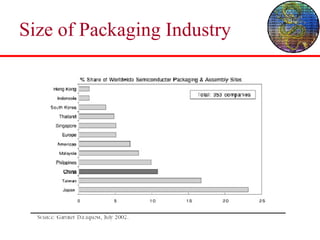
Related Industries China is a major power in semiconductor testing & packaging. Greater Beijing and Shanghai has about 25 IC testing  & packaging plants Low wages, cheap credit & active government support offsets a relative lack of infrastructure Japanese & Taiwanese firms are providing high tech photo masks, manufacturing equipment, training support. Huge supply of engineering talent is fueling a fast growing IC design industry
Size of Packaging Industry
Design Capability Currently China lags US, Taiwan & Japan in design Capability – but is rapidly catching up Philips, Intel, Infineon have setup design centers in China Datanag Microelectronics based in Beijing is designing chips for 3G cell phones Spreadtrum Communications became the first company to develop a chip to run mobile phones using TD-SCDMA, a Chinese standard for 3G wireless services  Market-research firm iSuppli Corp. estimates that China has nearly 500 semiconductor-design companies iSuppli expects China's chip-design industry to grow at an average of 30% a year through 2008
Alliances with others Chinese Fabs are actively establishing tie ups with leading IP vendors:- ARM, Artisan, Chip Idea, Synopsys, MIPS etc. Chinese Fabs are forming strategic alliances with leading semiconductor companies to develop new manufacturing technologies; Freescale, Infinion, Toshiba, Elpida, Fujitsu have R&D tie up with SMIC Leading customers such as TI, Samsung, ST etc are helping Chinese fabs to ramp up on new technology
Quality Improvements Chinese Fabs are aggressively pursuing International Quality certification; By end of 2005 all fabs in China will have: ISO9000-2001 certification ISO14001 certification OHSAS18001 certification for auto parts TL9000 certification Continuous quality improvement has led to higher yields and yield in 2005 will be same as global standards Chinese fabs are investing massively in employee training to reduce defects, improve yield & win user acceptance
Protection of IP Chinese fabs are taking steps to protect Intellectual property Chinese government has implemented new set of laws to enforce protection of Patents, Trademarks & Copyrights Customs has been empowered to seize goods which are suspected of IP infringement Companies are using firewall, encryption and VPN technologies to protect 3 rd  party IP
Education Initiatives  The School of Microelectronics at Shanghai's Fudan University has tie ups with Agilent technologies & Novellus Systems  Fudan University recently unveiled a Digital TV chip designed in collaboration with Industry Tsinghua University has tied up with Chartered Semiconductors to develop 0.18um RF process  East China Science and Technology (S&T) University is building a nanotech Fab at a cost of $217 million Government is actively encouraging University – Industry tie ups to promote Design engineering skills
Universities in China Hong Kong University of Science and Technology National Natural Science Foundation of China  University of Electronic Science and Technology of China  Peking University, Xidian University  Institute of Semiconductors & Microelectronics Nanjing University  Zhejiang University & Tsinghua University
Employee profile  China graduates more engineers per year than the US This has enabled Chinese fabs to recruit the best talent SMIC has ~150 employees with PhD (~2% of staff) ~15% of employees have Master’s Degree ~30% of employees have bachelor degree Abundant supply of talent has kept wages low. Average salary for an engineer is only $16,000
Likely short term Impact Chinese chip making Overcapacity will hurt others "The pricing power of Taiwan's foundries in this sector should just about disappear" says Morris Chang CEO of TSMC Will cause a serious glut that will drive down prices, slash profit margins and suppress ROE China foundries sell at about 20-30%  lower than the industry as a whole Foundries are unlikely to see a return to the days of ROEs in the 20%  range. An Industry wide recession possible in Q2-4 2005. 2-5% revenue drop in 2005, mainly caused by excess supply Industry will enter into a corrective stage in 2005 as companies apply brakes on capital spending
Medium Term Impact Foreign companies will have tie ups with Chinese fabs to procure semiconductors Support infrastructure industry for semiconductors – Equipment makers, test houses etc, will develop rapidly in China China will develop a solid chip design capability Chinese Fabs will ramp up capacity in 2006-2007 China will use its success in semiconductors as a springboard into Nanotech
Impact on Asian Countries In short term, foundries in Singapore, S.Korea, Taiwan will be hard pressed for profits Glut in ASIC and memory supply will bring down profits for other manufacturers Existing manufacturers in Asia will move to more specialized, proprietarily semiconductors, leaving generic markets for China India, Taiwan & Singapore will develop a large fabless semiconductor industry Singapore, Korea & Taiwan can benefit from providing supporting services, photo masks etc to China
Impact on US  US will see further migration of semiconductor manufacturing to China US ability to maintain technology lead Semiconductor technology will be at risk  Shortage of design engineers & High cost of R&D US may maintain technology leadership, but manufacturing will be in China Most US firms will go Fabless Intel, IBM, TI & Micron being the exceptions
Impact on Europe European manufacturers have already moved their manufacturing to China and will be remain competitive due to their Chinese plants Globally Distributed R&D will help keep European firms from maintaining their current status Semiconductors from China will increase competition for US & European Firms European Firms will see a drop in market share
Long Term Impact China’s rise in semiconductor design & manufacturing will change industry landscape Asia-Pacific is already the largest market for semiconductors, soon it will be the largest manufacturer US lead in semiconductor technology will erode US firms may move to Nano-technology to maintain their margins Rise of Fabless IC vendors will continue with new firms emerging from India, Singapore, Korea
Thank You This presentation is a work in Progress More information will be added as more data is revealed

China A Giant In Semiconductors

  • 1.
    China – AGiant in Semiconductors As China moves to establish as a leader in Semiconductors, -- An Impact Study by Arun Kottolli
  • 2.
    Government Policy InitiativesMake China nearly self-reliant in semiconductors Enable to source its own chips domestically for everything from tape recorders to computers. Beijing designated the semiconductor industry as one of China's pillars of economic growth. Government is funding and bankrolling construction of new “Fabs”. Provide the world with 20% foundry capacity.
  • 3.
    Venture Capital Chinese Government is establishing a 1 Billion Yuan (per year) Venture fund to support semiconductor startups Walburg Pincus LCC, an US Venture Capital firm has invested $70million in Datanag Microelectronics based in Beijing – to design chips for cell phones The fund would mainly target chip design and research companies Government is considering giving domestic chip producers an income-tax holiday for their first five profitable years
  • 4.
    Tax Incentives Chipmakers pay no income tax in the first five years of investment. Pay half of the regular tax in the next five years The standard income-tax rate is 15% Well below that of many developed countries, including Taiwan's 25% income tax rate These tax incentives, along with lower land and labor costs, give Chinese companies a 10% cost advantage
  • 5.
    Industry Consolidates inChina International semiconductor giants are consolidating their businesses in China Fujitsu Microelectronics Co has a new Fab operating in Shanghai Infineon Technologies AG built chip packaging & testing plant in Suzhou City ST Microelectronics will build a 12-inch wafer plant IBM plans to set up a new Fab in 2005 Powerchip Semiconductors of Taiwan plans to build a 8” memory fab in China in 2005
  • 6.
    China has hugeFab Capacity SMIC, China's largest manufacturer has 3 eight-inch Fabs in Shanghai & will increase capacity by 70% this year. A 12-inch Fab in Beijing will go online in the 4th quarter, and two more 12-inch Fabs scheduled for 2005 and 2006 Chinese will increase Fab capacity by 60% in 2004 Chinese fabs hold about 9% of foundry market's capacity today China is expected to produce 15% of the world’s chips by the end of 2004, and over 20% in 2005.
  • 7.
    SMIC – China’sLeading Fab SMIC has built capacity to process ~150,000 wafers per month More than 70% of wafers was for Logic chips Fab1 at Shanghai went from ground breaking to production in just 1.5 years SMIC is ISO9001:2000, ISO/TS16949 certified; TL9000 certification will be completed in Q12005 Plans 90nm process by Q2 2005, & 65nm process by Q1 2007 130mn process is currently in full production SMIC also offer mask making, packaging, testing & ASIC design services
  • 8.
    Massive Investments Firmshave invested more than $10Billion Additional $5Billion investments is being committed for years 2004-2005 19 new fabs will be operational this year New fabs use cutting edge 0.13 micron technology or smaller on 300mm wafers China is concentrating on memory chips & ASIC’s
  • 9.
    Public Funding ChineseFabs are planning to go public in 2005. Proceeds from the IPO will be used to expand capacity ASMC (Advanced Semiconductor Manufacturing Corp) is planning an IPO in Hong Kong in Q1 2005 SMIC went public in 2004 CSMC is stated to go public in Q2 2005
  • 10.
    Industry is alsoadding Capacity TSMC is raising its capital expenditure by 60 percent this year to $2 billion UMC, the world's second-largest foundry is spending $1.5 billion TI is building a new Fab in Dallas for $3 billion Intel is expanding capacity & spending $4.8 billion Sony is spending $1.1 billion on a 65nm Fab in Japan
  • 11.
    Some New Playersin China TSMC Shanghai – Subsidiary of TSMC Grace Semiconductor -- Shanghai He Jian Technology -- Suzhou SMIC -- Shanghai, Beijing, and Tianjin CSMC Technologies -- Wuxi, Jiangsu Province Shanghai Hua Hong NEC -- Shanghai
  • 12.
    Demand Grows Chinaimports 80% of its needs Current Government Policy is to encourage domestic production Large Domestic Market exists for home entertainment products, cell phones and computers OEM & Contract Manufacturing adds to drive up demand
  • 13.
    Current Demand Chinais the 2 nd Largest Consumer of IC’s Almost 80% of China's demand, totaling $22 billion in 2003 was imported Chinese government hopes to raise self-sufficiency above 50% in the coming years World market is expected to grow less than 20% this year & 13% in 2005 Enormous increase in supply, but demand growth remains slow
  • 14.
    Related Industries Chinais a major power in semiconductor testing & packaging. Greater Beijing and Shanghai has about 25 IC testing & packaging plants Low wages, cheap credit & active government support offsets a relative lack of infrastructure Japanese & Taiwanese firms are providing high tech photo masks, manufacturing equipment, training support. Huge supply of engineering talent is fueling a fast growing IC design industry
  • 15.
  • 16.
    Design Capability CurrentlyChina lags US, Taiwan & Japan in design Capability – but is rapidly catching up Philips, Intel, Infineon have setup design centers in China Datanag Microelectronics based in Beijing is designing chips for 3G cell phones Spreadtrum Communications became the first company to develop a chip to run mobile phones using TD-SCDMA, a Chinese standard for 3G wireless services Market-research firm iSuppli Corp. estimates that China has nearly 500 semiconductor-design companies iSuppli expects China's chip-design industry to grow at an average of 30% a year through 2008
  • 17.
    Alliances with othersChinese Fabs are actively establishing tie ups with leading IP vendors:- ARM, Artisan, Chip Idea, Synopsys, MIPS etc. Chinese Fabs are forming strategic alliances with leading semiconductor companies to develop new manufacturing technologies; Freescale, Infinion, Toshiba, Elpida, Fujitsu have R&D tie up with SMIC Leading customers such as TI, Samsung, ST etc are helping Chinese fabs to ramp up on new technology
  • 18.
    Quality Improvements ChineseFabs are aggressively pursuing International Quality certification; By end of 2005 all fabs in China will have: ISO9000-2001 certification ISO14001 certification OHSAS18001 certification for auto parts TL9000 certification Continuous quality improvement has led to higher yields and yield in 2005 will be same as global standards Chinese fabs are investing massively in employee training to reduce defects, improve yield & win user acceptance
  • 19.
    Protection of IPChinese fabs are taking steps to protect Intellectual property Chinese government has implemented new set of laws to enforce protection of Patents, Trademarks & Copyrights Customs has been empowered to seize goods which are suspected of IP infringement Companies are using firewall, encryption and VPN technologies to protect 3 rd party IP
  • 20.
    Education Initiatives The School of Microelectronics at Shanghai's Fudan University has tie ups with Agilent technologies & Novellus Systems Fudan University recently unveiled a Digital TV chip designed in collaboration with Industry Tsinghua University has tied up with Chartered Semiconductors to develop 0.18um RF process East China Science and Technology (S&T) University is building a nanotech Fab at a cost of $217 million Government is actively encouraging University – Industry tie ups to promote Design engineering skills
  • 21.
    Universities in ChinaHong Kong University of Science and Technology National Natural Science Foundation of China University of Electronic Science and Technology of China Peking University, Xidian University Institute of Semiconductors & Microelectronics Nanjing University Zhejiang University & Tsinghua University
  • 22.
    Employee profile China graduates more engineers per year than the US This has enabled Chinese fabs to recruit the best talent SMIC has ~150 employees with PhD (~2% of staff) ~15% of employees have Master’s Degree ~30% of employees have bachelor degree Abundant supply of talent has kept wages low. Average salary for an engineer is only $16,000
  • 23.
    Likely short termImpact Chinese chip making Overcapacity will hurt others "The pricing power of Taiwan's foundries in this sector should just about disappear" says Morris Chang CEO of TSMC Will cause a serious glut that will drive down prices, slash profit margins and suppress ROE China foundries sell at about 20-30% lower than the industry as a whole Foundries are unlikely to see a return to the days of ROEs in the 20% range. An Industry wide recession possible in Q2-4 2005. 2-5% revenue drop in 2005, mainly caused by excess supply Industry will enter into a corrective stage in 2005 as companies apply brakes on capital spending
  • 24.
    Medium Term ImpactForeign companies will have tie ups with Chinese fabs to procure semiconductors Support infrastructure industry for semiconductors – Equipment makers, test houses etc, will develop rapidly in China China will develop a solid chip design capability Chinese Fabs will ramp up capacity in 2006-2007 China will use its success in semiconductors as a springboard into Nanotech
  • 25.
    Impact on AsianCountries In short term, foundries in Singapore, S.Korea, Taiwan will be hard pressed for profits Glut in ASIC and memory supply will bring down profits for other manufacturers Existing manufacturers in Asia will move to more specialized, proprietarily semiconductors, leaving generic markets for China India, Taiwan & Singapore will develop a large fabless semiconductor industry Singapore, Korea & Taiwan can benefit from providing supporting services, photo masks etc to China
  • 26.
    Impact on US US will see further migration of semiconductor manufacturing to China US ability to maintain technology lead Semiconductor technology will be at risk Shortage of design engineers & High cost of R&D US may maintain technology leadership, but manufacturing will be in China Most US firms will go Fabless Intel, IBM, TI & Micron being the exceptions
  • 27.
    Impact on EuropeEuropean manufacturers have already moved their manufacturing to China and will be remain competitive due to their Chinese plants Globally Distributed R&D will help keep European firms from maintaining their current status Semiconductors from China will increase competition for US & European Firms European Firms will see a drop in market share
  • 28.
    Long Term ImpactChina’s rise in semiconductor design & manufacturing will change industry landscape Asia-Pacific is already the largest market for semiconductors, soon it will be the largest manufacturer US lead in semiconductor technology will erode US firms may move to Nano-technology to maintain their margins Rise of Fabless IC vendors will continue with new firms emerging from India, Singapore, Korea
  • 29.
    Thank You Thispresentation is a work in Progress More information will be added as more data is revealed