MIT OpenCourseWare
____________
http://ocw.mit.edu


2.830J / 6.780J / ESD.63J Control of Manufacturing Processes (SMA 6303)
Spring 2008


                                                                         ________________
For information about citing these materials or our Terms of Use, visit: http://ocw.mit.edu/terms.
Control of
  Manufacturing Processes
                Subject 2.830/6.780/ESD.63
                       Spring 2008
                        Lecture #1

                     Introduction

                     February 5, 2008


Manufacturing                                1
Background
•   Pre-requisites
•   Your Background and Interests
•   Relevant Experience
•   Course Schedule


    Manufacturing                   2
Expectations
• Assignments ~ Weekly
• 2 Quizzes in Class
• Group Project
   – End of term presentation
   – Report


  Manufacturing                  3
Syllabus Details
• Lecturers
   – Duane Boning
   – David Hardt
• Course Secretary: Sharlene Blake


  Manufacturing                      4
Syllabus Details
• Prerequisites: One of the following :
   – 2.008 or 2.810 Manufacturing
   – 2.751J or 6.152J or 6.041 or 15.064J
• Required Texts:
   – Montgomery, D.C., Introduction to Statistical Quality Control,
     5th Ed. Wiley, 2005
   – May and Spanos, Fundamentals of Semiconductor
     Manufacturing and Process Control, John Wiley, 2006.
• Grading:
   – Problem sets 40%
   – Quizzes 40%
   – Team Projects 20%
• Assignments:         All except project are to be
                      individual efforts
• Final exam:          No final exam
• Course URL:         (Registration and Certificate Required)

   Manufacturing                                                  5
Team Projects
• Topics:
   –   Process Diagnosis
   –   Process Improvement
   –   Process Optimization / Robustness
   –   Advanced Applications

• Expectations
   –   Background research on process and problem
   –   Use of existing data or generation of new data
   –   Oral presentation of results
   –   Project report from group


  Manufacturing                                         6
Main Topics
• Physical Origins of Variation
   – Process Sensitivities
• Statistical Models and Interpretation
   – Process as a Random Variable(s)
   – Diagnosis of Problems
• Effects Models and Designed Experiments
   – Input - Output Empirical Models
• Process Optimization (Robustness)
   – Ideal Operating Points


  Manufacturing                             7
Manufacturing Process Control
• Process Goals
   –   Cost
   –   Quality
   –   Rate
   –   Flexibility


  Manufacturing                         8
Focus
• Unit Operations
• (1) Maximizing Quality
   – Conformance to Specifications
• (2) Improving Throughput
• (3) Improving Flexibility
• (4) Reducing Cost


  Manufacturing                      9
Typical Process Control Problems

• Minimum feature size on a semiconductor
  chip has too much variability
• DNA diagnostic chip has uneven flow
  channels
• Toys never fit when assembled at home!
• Next generation high density electrical
  connector cannot be made reliably


 Manufacturing                              10
Typical Process Control Problems
• Airframe skin needs trimming and bending to
  fit frame
• Web thickness of a machined panel is non-
  uniform
• Plastic throttle bodies for fuel injection are out
  of round
• Submarine hull welds need constant rework
  in production


 Manufacturing                                     11
Other Related Problems –
           Cost, Rate and Flexibility:
• 100% inspection with high scrap rates
     – low throughput
     – high costs

• 100% inspection with frequent rework
     – low throughput
     – high costs

• High variability at changeover
     – Reluctance to changeover
     – low flexibility

Manufacturing                             12
Manufacturing Processes

• How are they defined?
• How do they do their thing?
• How can they be categorized?

• Why don’t they always get it right?


  Manufacturing                             13
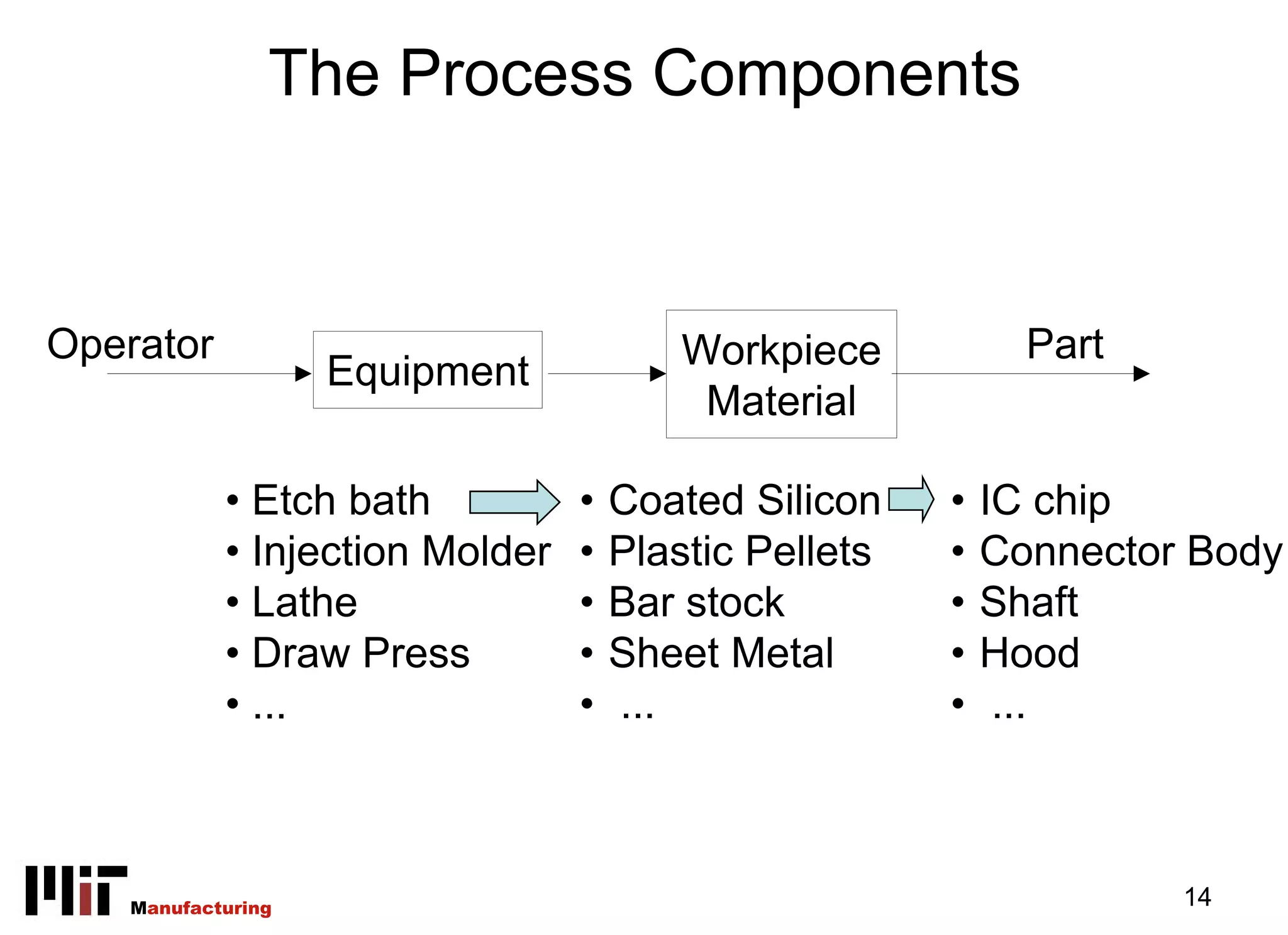
The Process Components


Operator                                 Workpiece           Part
                    Equipment
                                          Material

            • Etch bath          •   Coated Silicon    •   IC chip
            • Injection Molder   •   Plastic Pellets   •   Connector Body
            • Lathe              •   Bar stock         •   Shaft
            • Draw Press         •   Sheet Metal       •   Hood
            • ...                •   ...               •    ...


    Manufacturing                                                   14
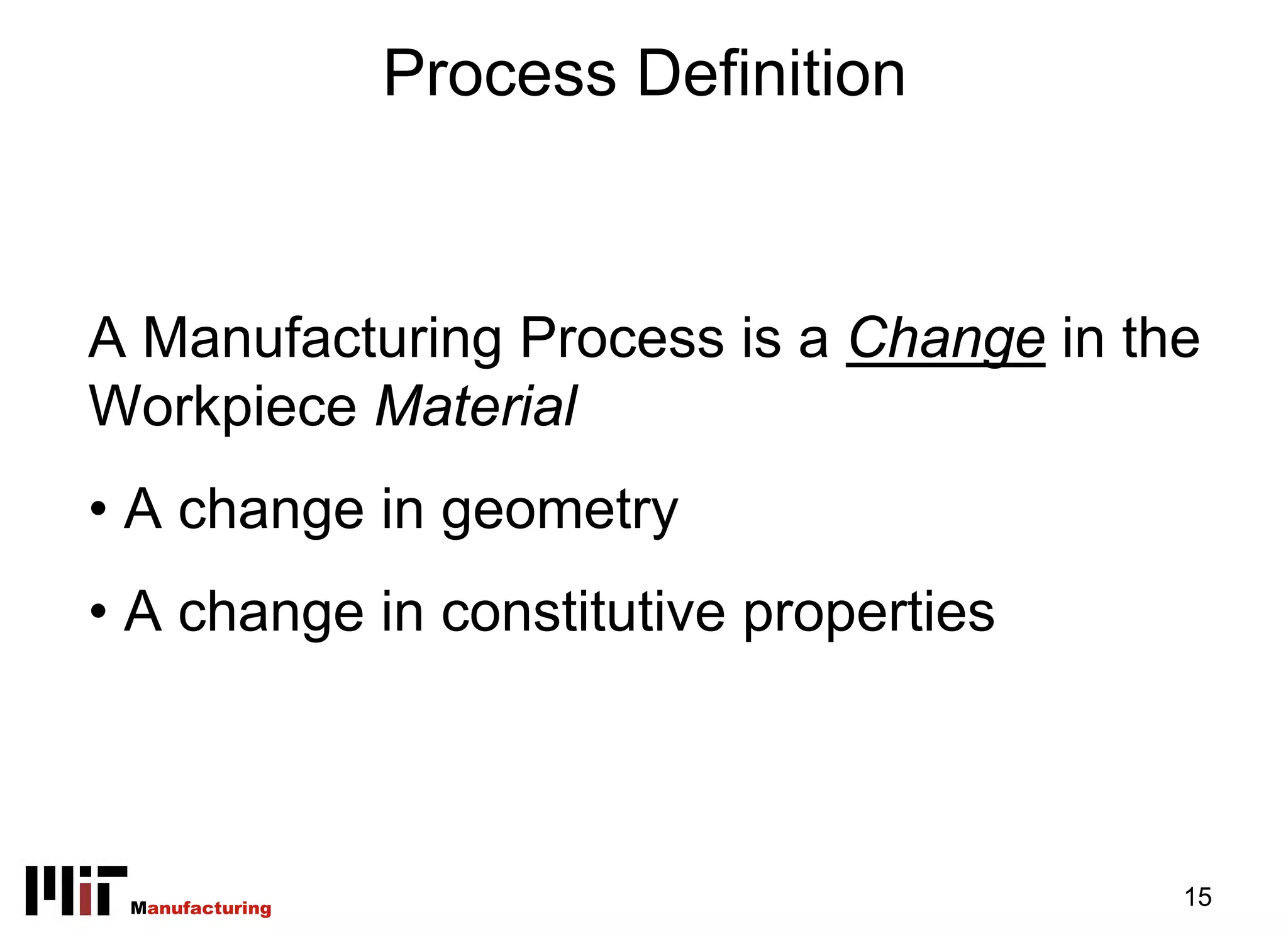
Process Definition


A Manufacturing Process is a Change in the
Workpiece Material
• A change in geometry
• A change in constitutive properties


 Manufacturing                           15
Conceptual Semiconductor Process Model


                 Image removed due to copyright restrictions. Please see Fig.
                 1 in Boning, D. S., et al. “A General Semiconductor Process
                 Modeling Framework.” IEEE Transactions on Semiconductor
                 Manufacturing 5 (November 1992): 266-280.


                                                                                Boning et al., c. 1990

 Manufacturing                                                                                    16
Simplified Conceptual Semiconductor
              Process Model


                Image removed due to copyright restrictions. Please see Fig.
                15 in Boning, D. S., et al. “A General Semiconductor
                Process Modeling Framework.” IEEE Transactions on
                Semiconductor Manufacturing 5 (November 1992): 266-280.


Manufacturing                                                                  17
Example: Oxidation

Wafer states


                  Image removed due to copyright restrictions. Please see Fig.
                  17 in Boning, D. S., et al. “A General Semiconductor
                  Process Modeling Framework.” IEEE Transactions on
                  Semiconductor Manufacturing 5 (November 1992): 266-280.


 Manufacturing                                                                   18
Example: Oxidation
Treatment (wafer environment)


                     Image removed due to copyright restrictions. Please see Fig.
                     18 in Boning, D. S., et al. “A General Semiconductor
                     Process Modeling Framework.” IEEE Transactions on
                     Semiconductor Manufacturing 5 (November 1992): 266-280.


   Manufacturing                                                                    19
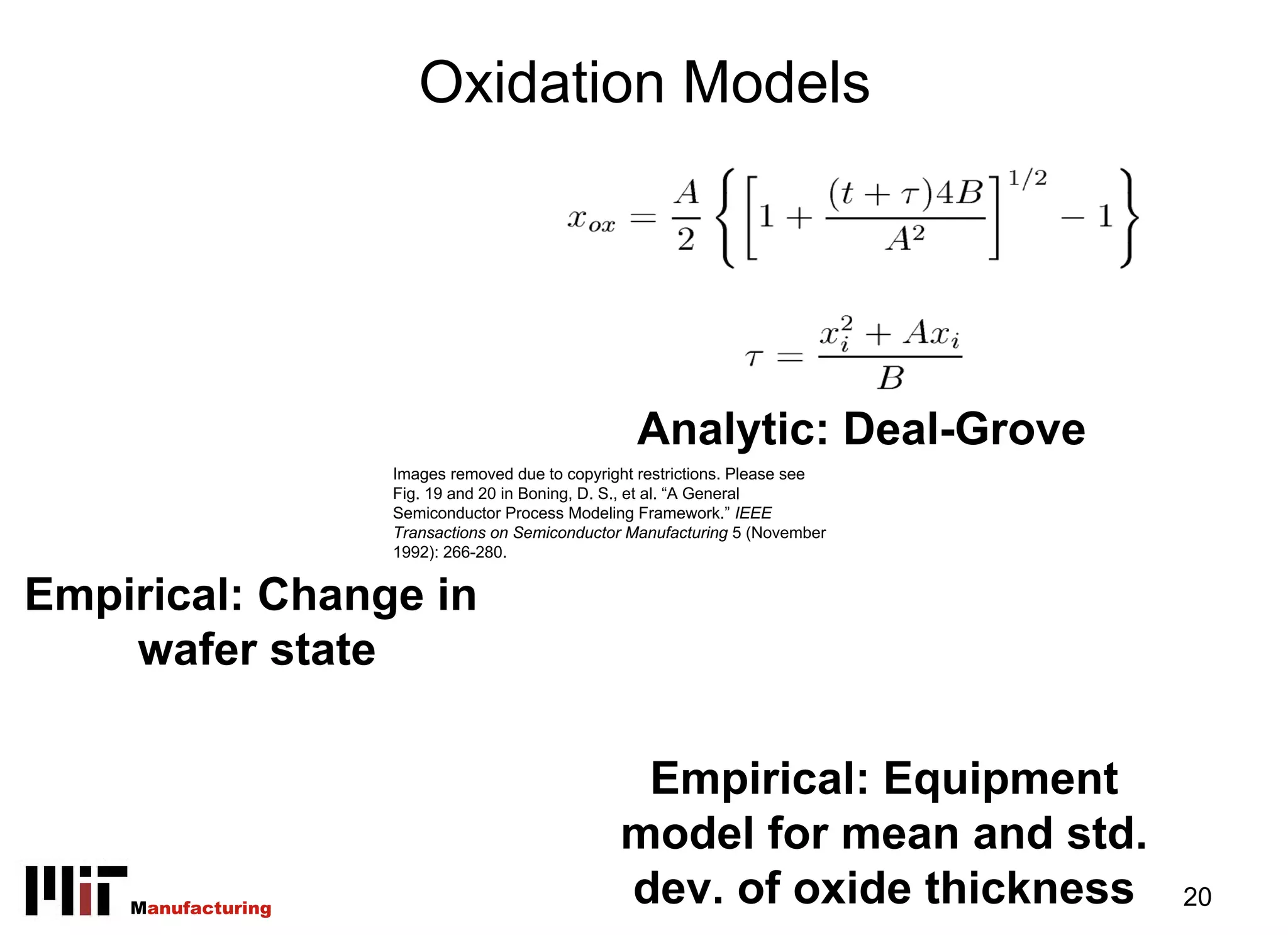
Oxidation Models


                                                   Analytic: Deal-Grove
                    Images removed due to copyright restrictions. Please see
                    Fig. 19 and 20 in Boning, D. S., et al. “A General
                    Semiconductor Process Modeling Framework.” IEEE
                    Transactions on Semiconductor Manufacturing 5 (November
                    1992): 266-280.


Empirical: Change in
    wafer state

                                                  Empirical: Equipment
                                                 model for mean and std.
    Manufacturing
                                                 dev. of oxide thickness       20
(Semiconductor) Manufacturing
                       Process Control


                     Image removed due to copyright restrictions. Please see Fig.
                     26 in Boning, D. S., et al. “A General Semiconductor
                     Process Modeling Framework.” IEEE Transactions on
                     Semiconductor Manufacturing 5 (November 1992): 266-280.


Manufacturing                                                                       21
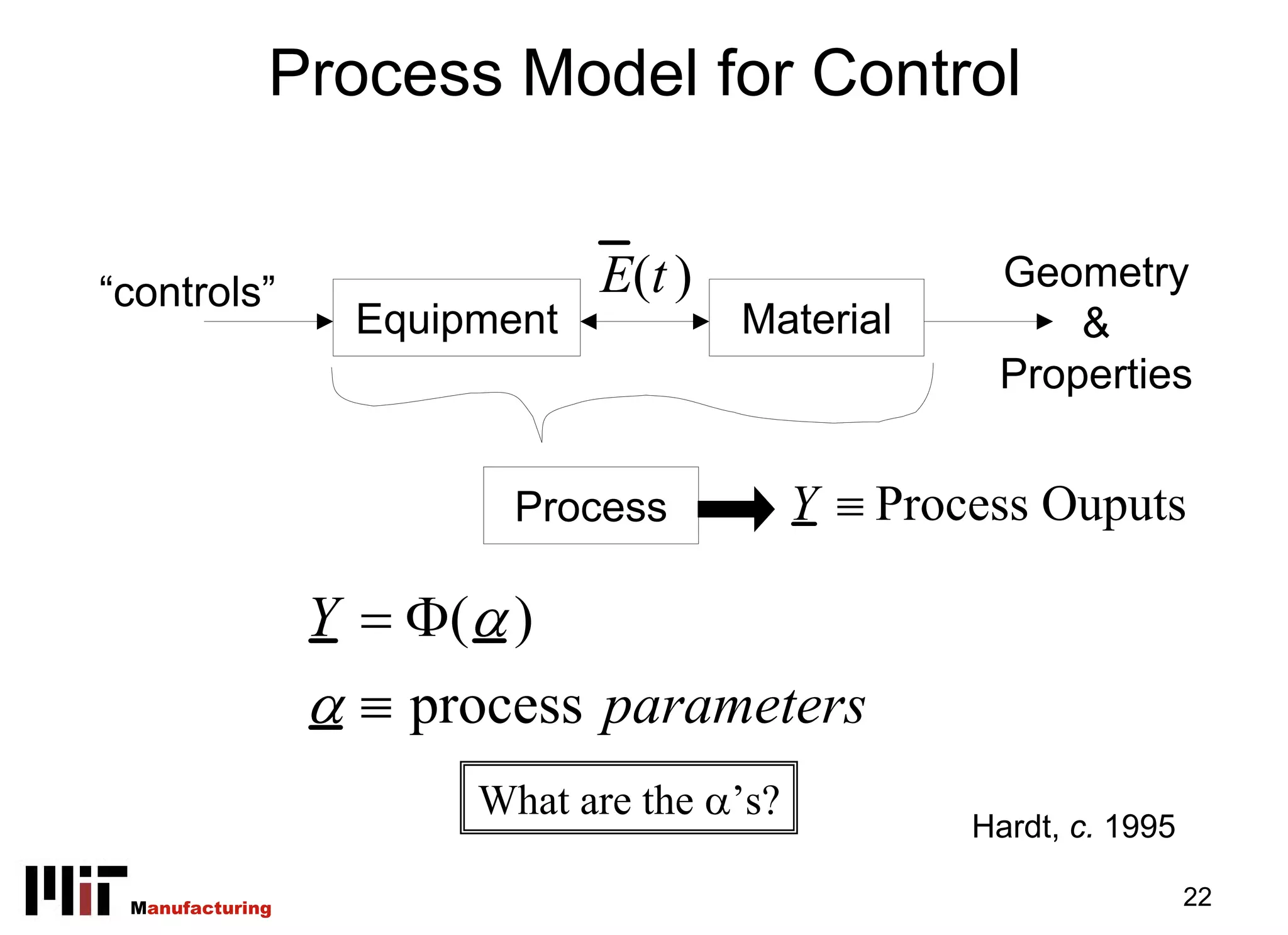
Process Model for Control


“controls”                    E(t )                 Geometry
                  Equipment           Material          &
                                                    Properties


                         Process           Y ≡ Process Ouputs

                 Y = Φ(α )
                 α ≡ process parameters
                       What are the α’s?
                                                   Hardt, c. 1995

 Manufacturing                                                      22
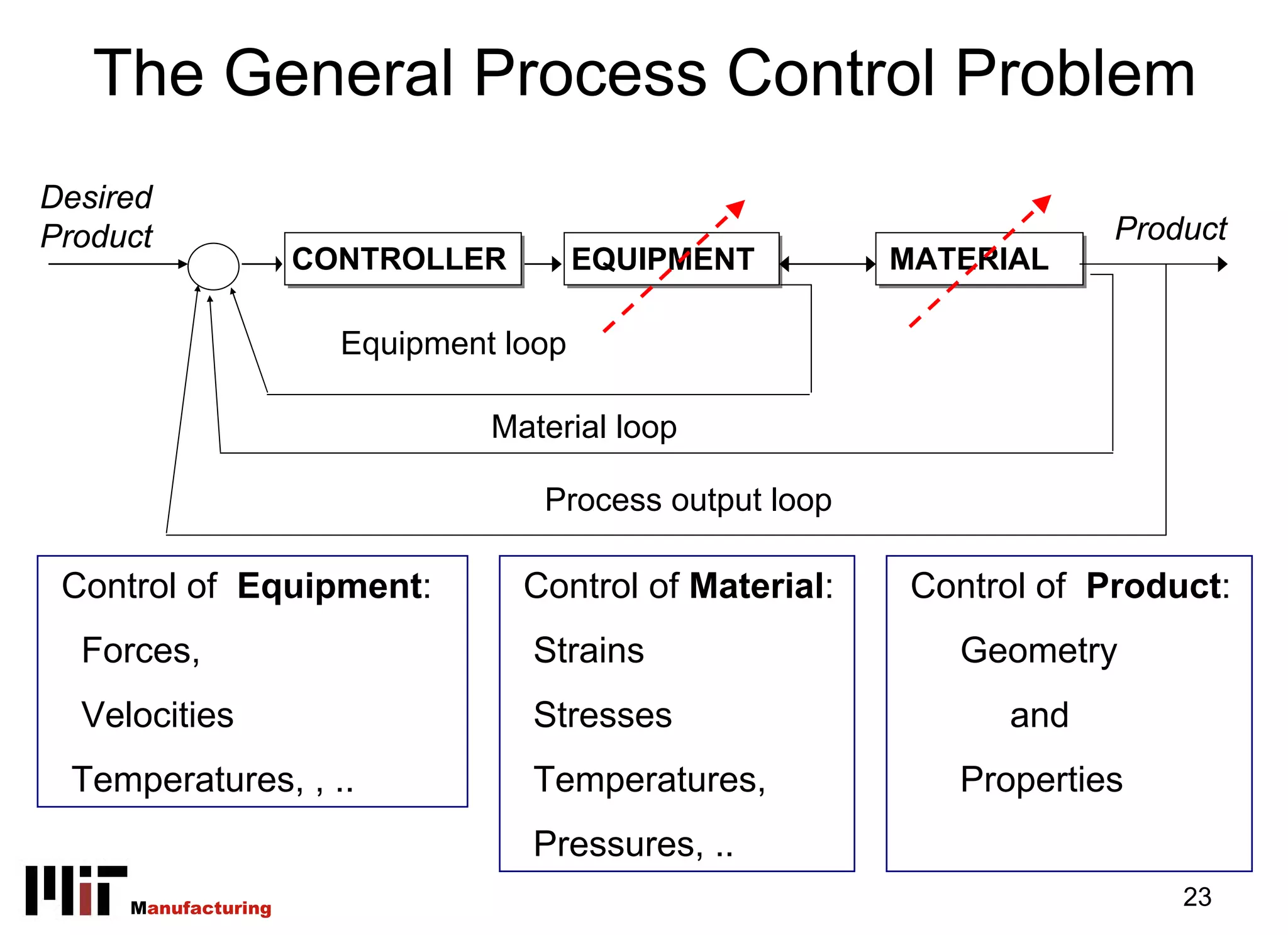
The General Process Control Problem
Desired
Product                                                               Product
                     CONTROLLER
                     CONTROLLER         EQUIPMENT
                                        EQUIPMENT        MATERIAL
                                                         MATERIAL

                       Equipment loop

                                Material loop

                                   Process output loop

 Control of Equipment:            Control of Material:    Control of Product:
  Forces,                         Strains                   Geometry
  Velocities                      Stresses                     and
 Temperatures, , ..               Temperatures,             Properties
                                  Pressures, ..
     Manufacturing                                                        23
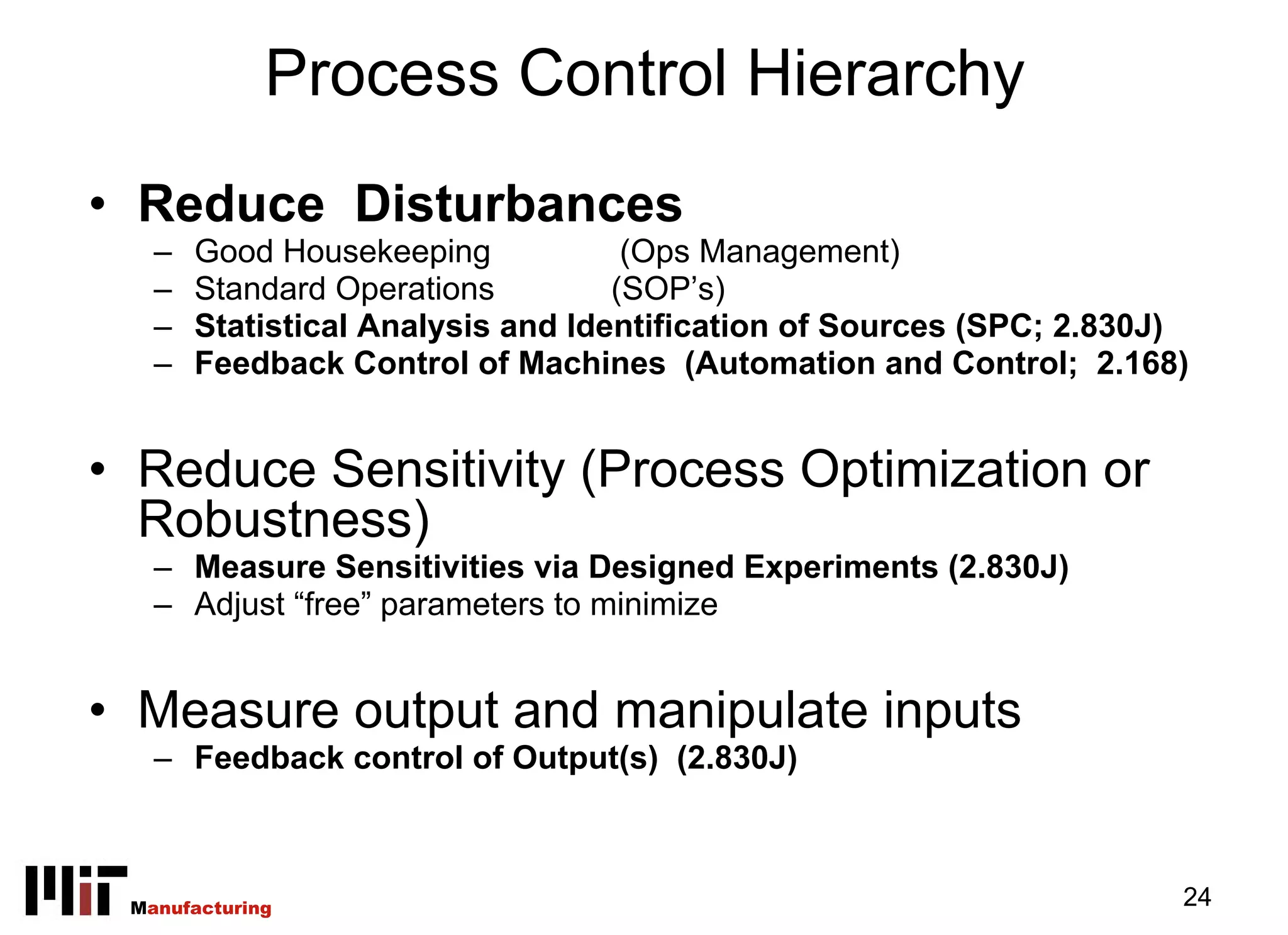
Process Control Hierarchy
• Reduce Disturbances
   –   Good Housekeeping            (Ops Management)
   –   Standard Operations         (SOP’s)
   –   Statistical Analysis and Identification of Sources (SPC; 2.830J)
   –   Feedback Control of Machines (Automation and Control; 2.168)


• Reduce Sensitivity (Process Optimization or
  Robustness)
   – Measure Sensitivities via Designed Experiments (2.830J)
   – Adjust “free” parameters to minimize


• Measure output and manipulate inputs
   – Feedback control of Output(s) (2.830J)


 Manufacturing                                                        24
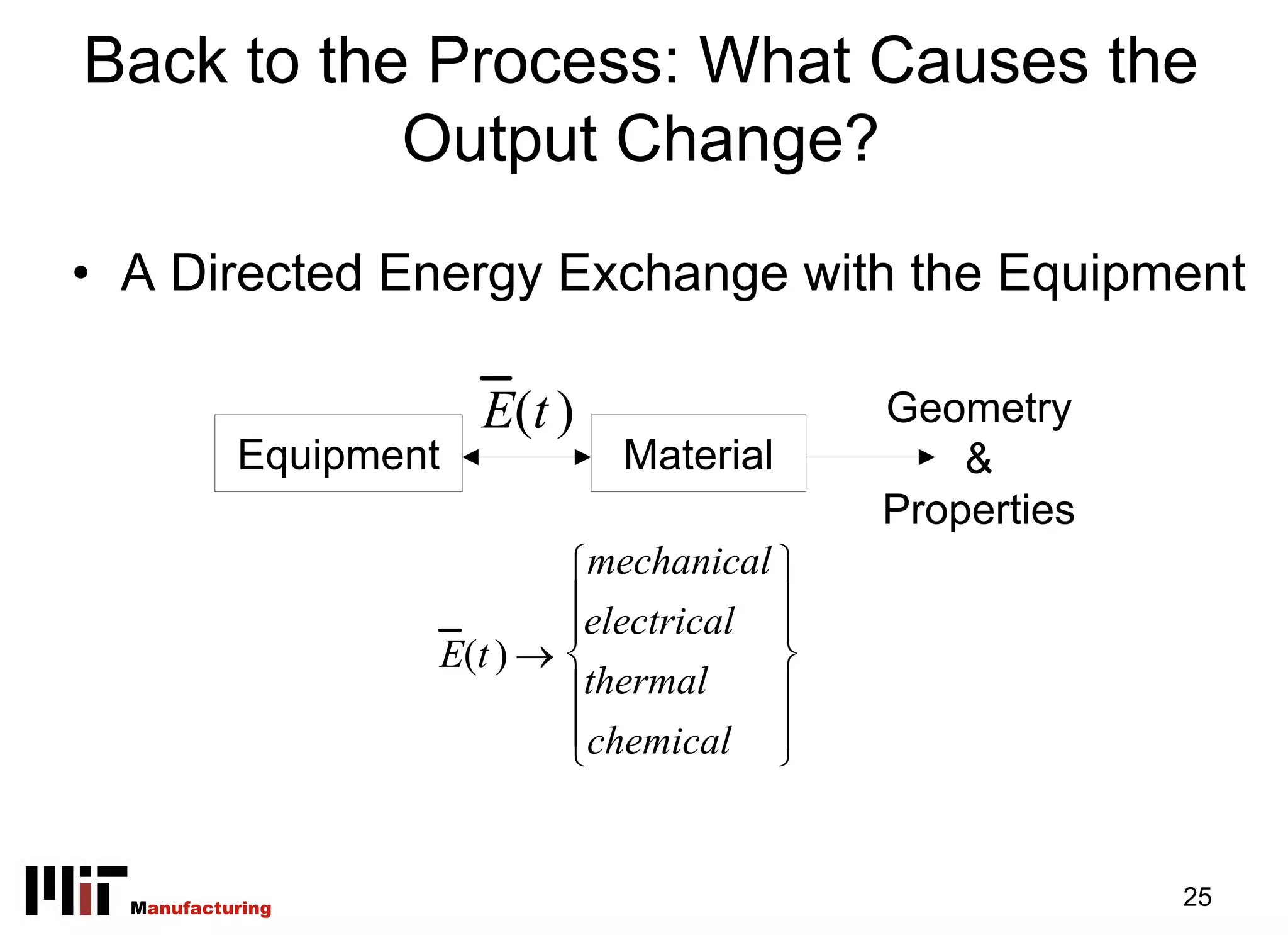
Back to the Process: What Causes the
           Output Change?
• A Directed Energy Exchange with the Equipment

                       E(t )               Geometry
           Equipment           Material        &
                                           Properties
                           ⎧mechanical ⎫
                           ⎪electrical ⎪
                           ⎪           ⎪
                   E(t ) → ⎨           ⎬
                           ⎪thermal    ⎪
                           ⎪chemical ⎪
                           ⎩           ⎭


  Manufacturing                                         25
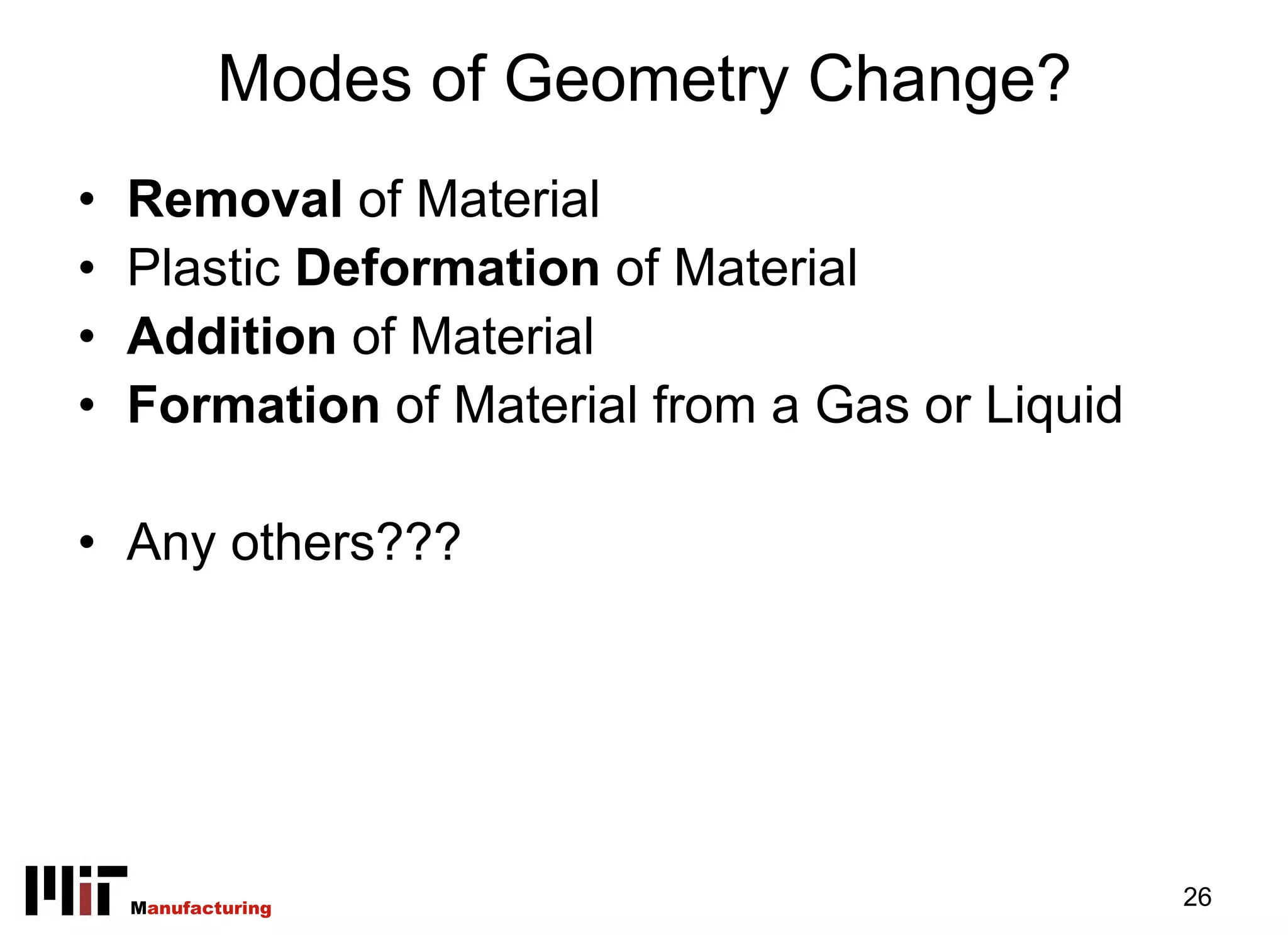
Modes of Geometry Change?
•   Removal of Material
•   Plastic Deformation of Material
•   Addition of Material
•   Formation of Material from a Gas or Liquid

• Any others???


    Manufacturing                                26
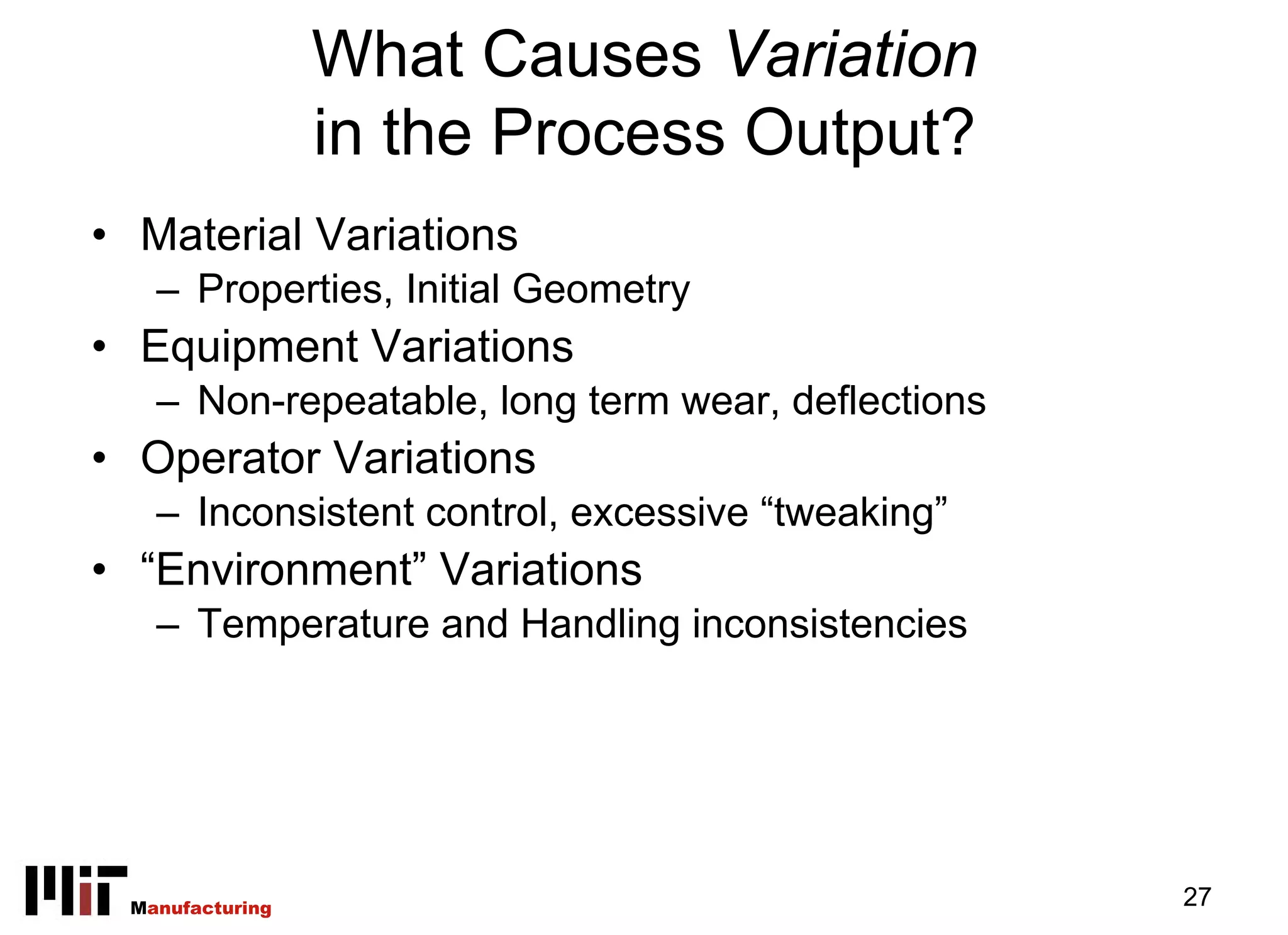
What Causes Variation
                 in the Process Output?
• Material Variations
   – Properties, Initial Geometry
• Equipment Variations
   – Non-repeatable, long term wear, deflections
• Operator Variations
   – Inconsistent control, excessive “tweaking”
• “Environment” Variations
   – Temperature and Handling inconsistencies


 Manufacturing                                     27
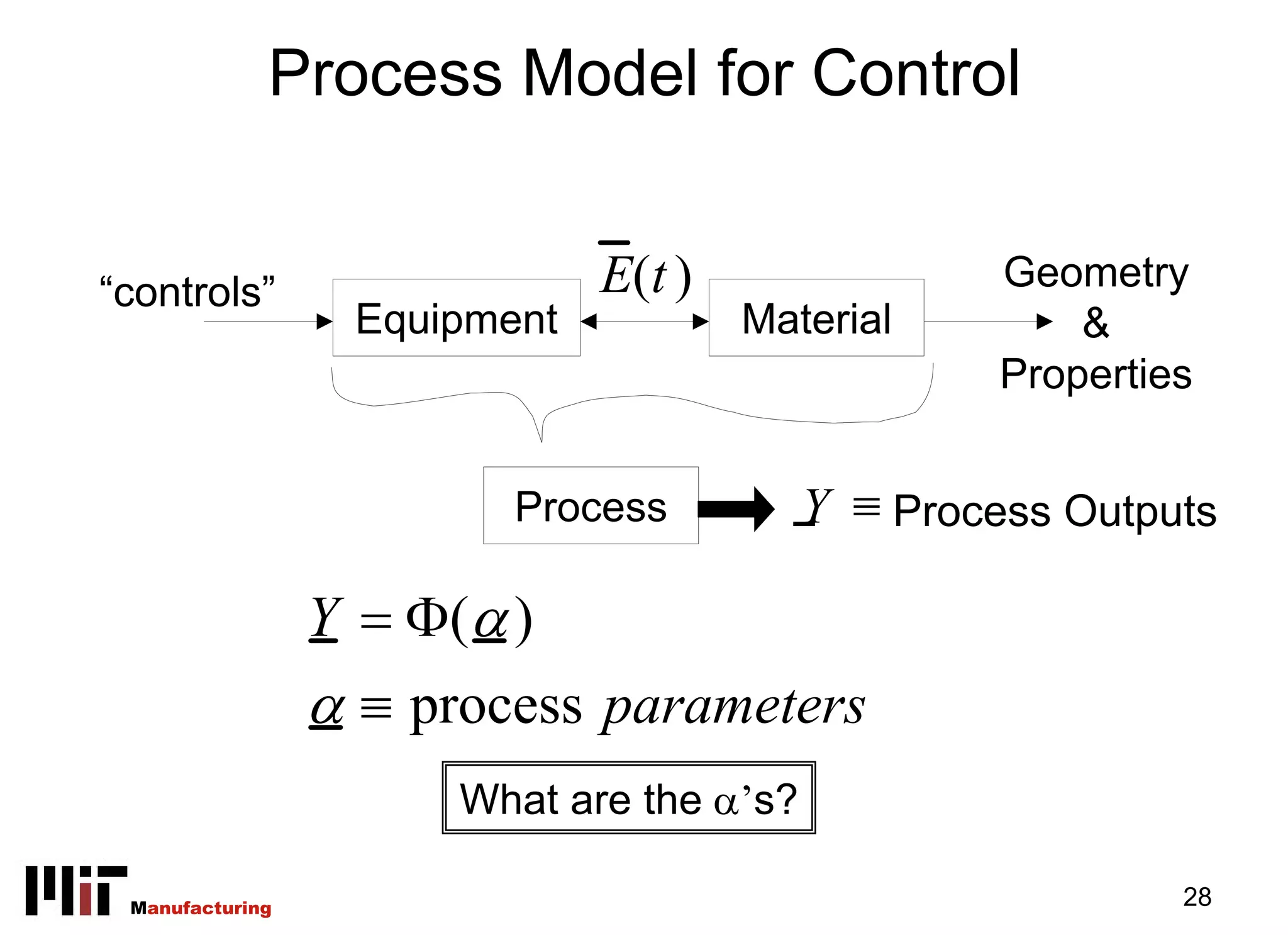
Process Model for Control


“controls”                    E(t )                 Geometry
                  Equipment           Material          &
                                                    Properties


                         Process           Y ≡ Process Outputs

                 Y = Φ(α )
                 α ≡ process parameters
                       What are the α’s?

 Manufacturing                                               28
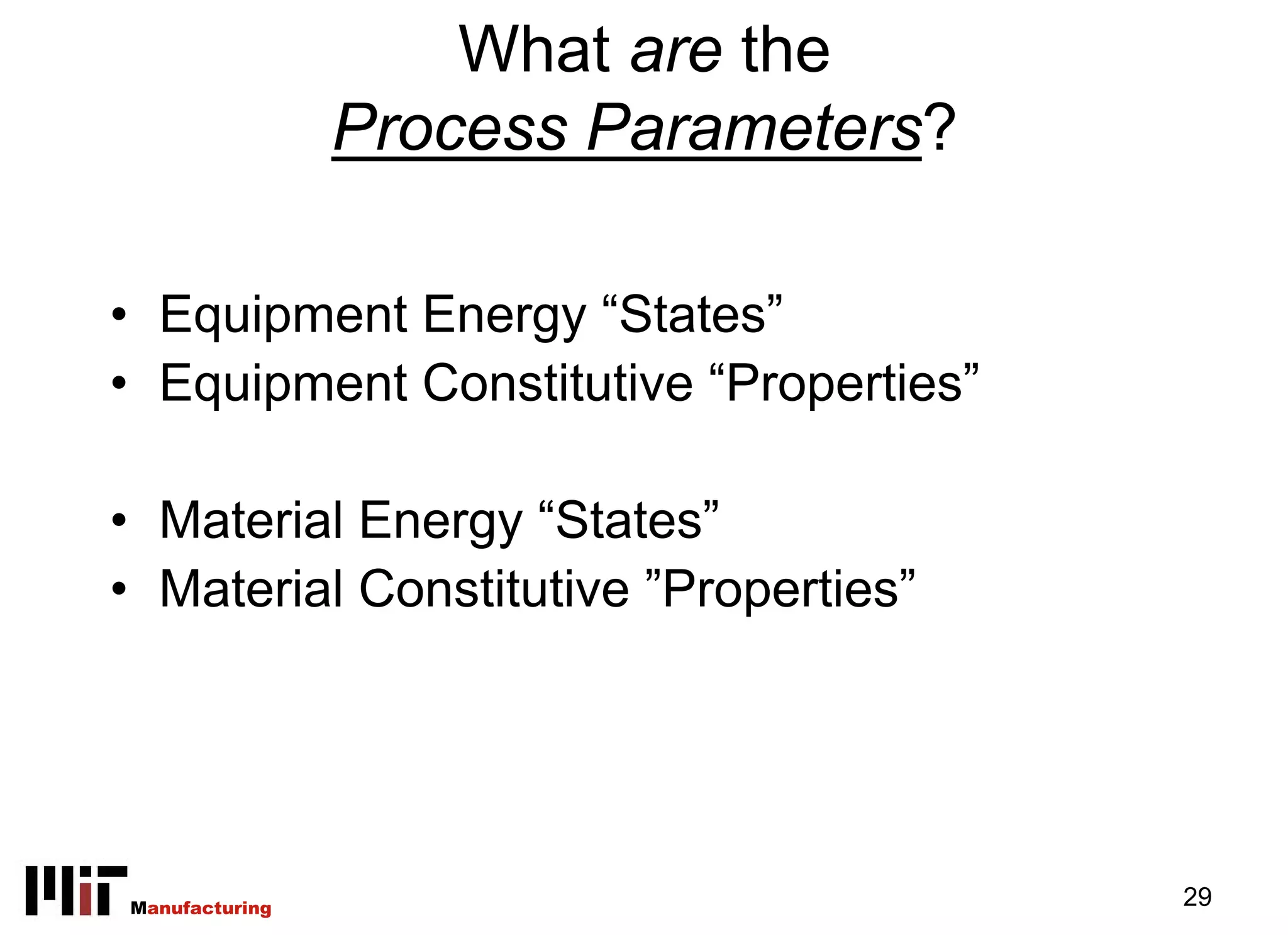
What are the
                Process Parameters?

• Equipment Energy “States”
• Equipment Constitutive “Properties”

• Material Energy “States”
• Material Constitutive ”Properties”


Manufacturing                           29
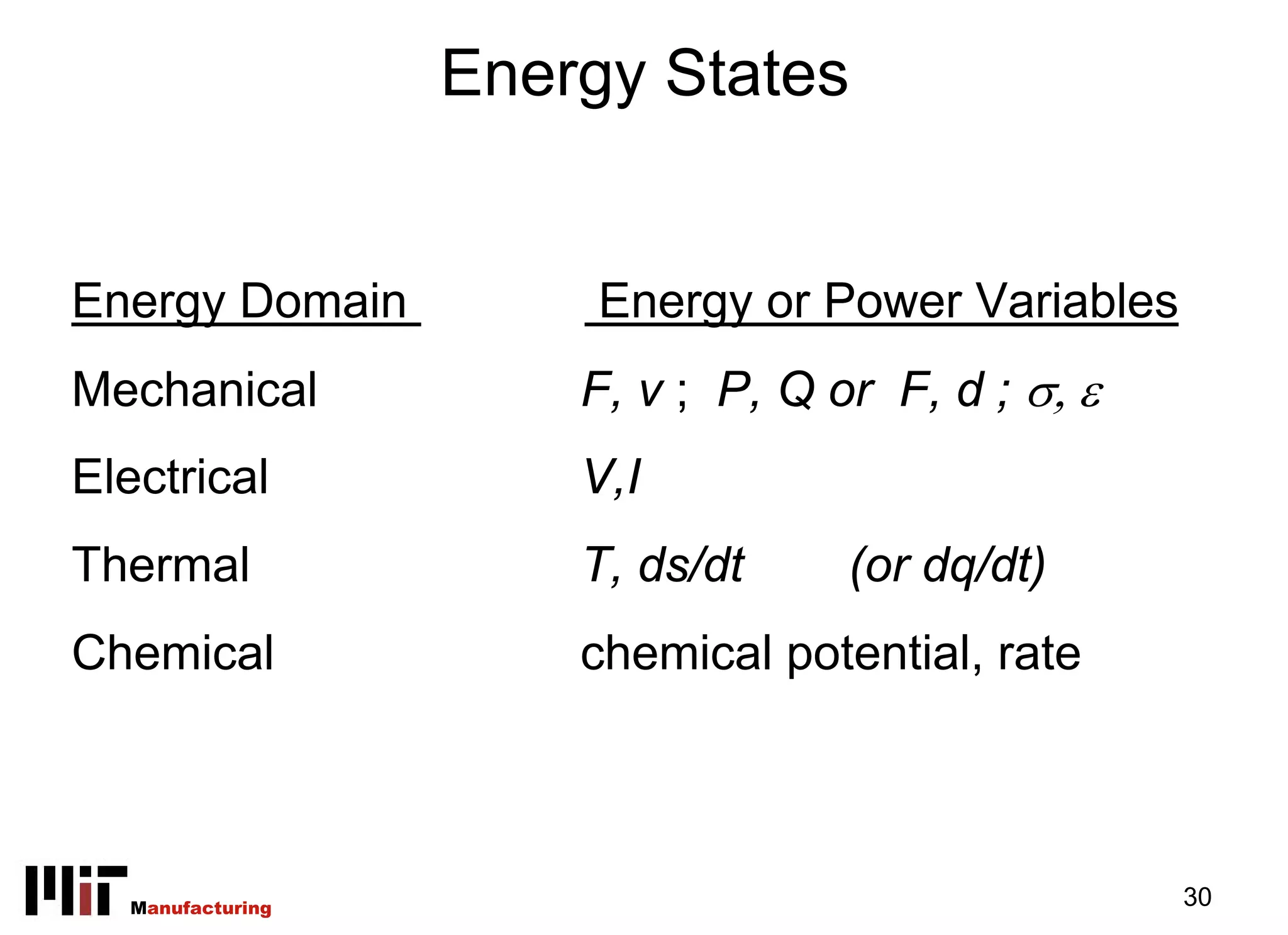
Energy States


Energy Domain          Energy or Power Variables
Mechanical            F, v ; P, Q or F, d ; σ, ε
Electrical            V,I
Thermal               T, ds/dt     (or dq/dt)
Chemical              chemical potential, rate


  Manufacturing                                    30
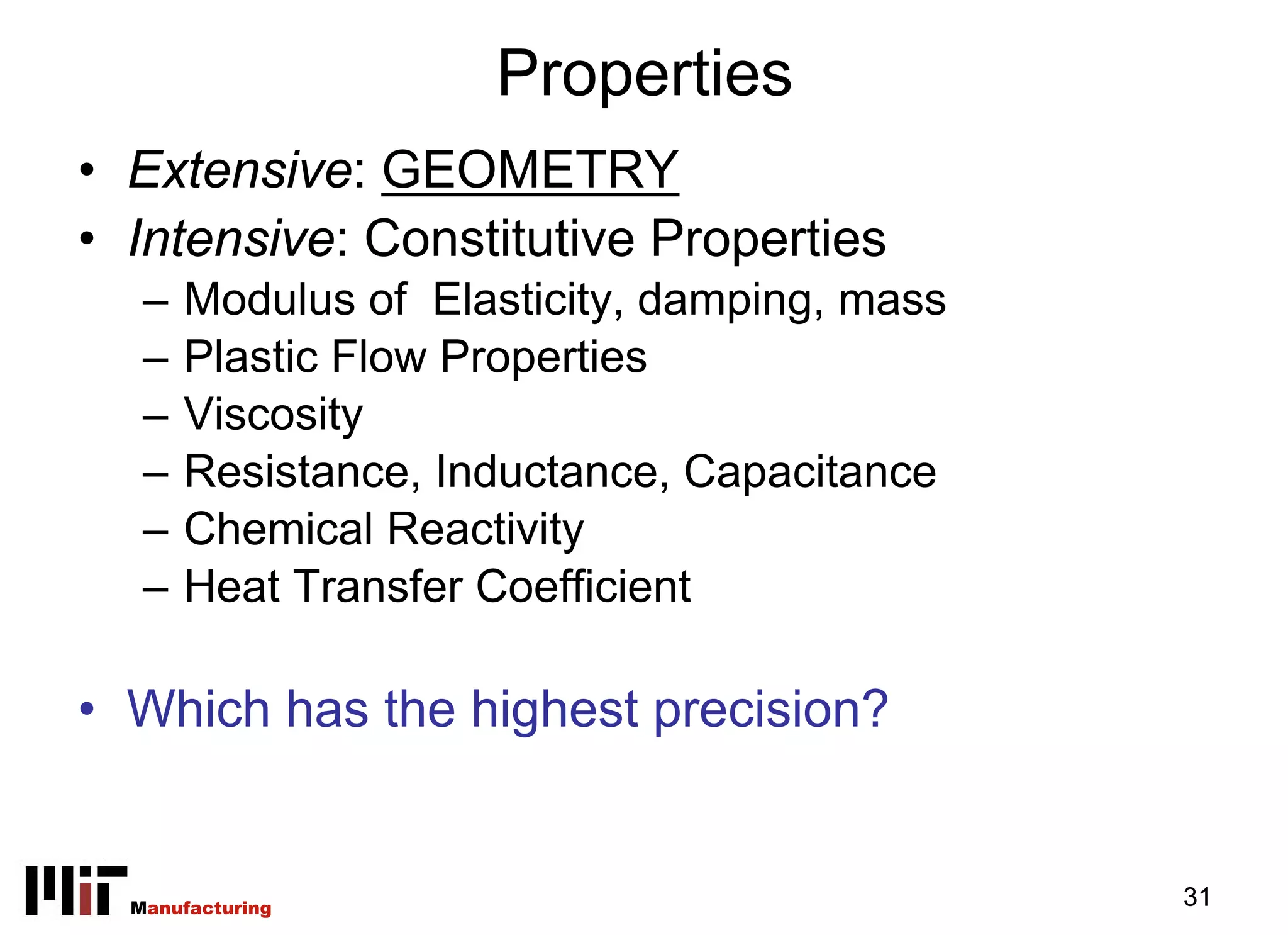
Properties
• Extensive: GEOMETRY
• Intensive: Constitutive Properties
   –   Modulus of Elasticity, damping, mass
   –   Plastic Flow Properties
   –   Viscosity
   –   Resistance, Inductance, Capacitance
   –   Chemical Reactivity
   –   Heat Transfer Coefficient

• Which has the highest precision?


  Manufacturing                               31
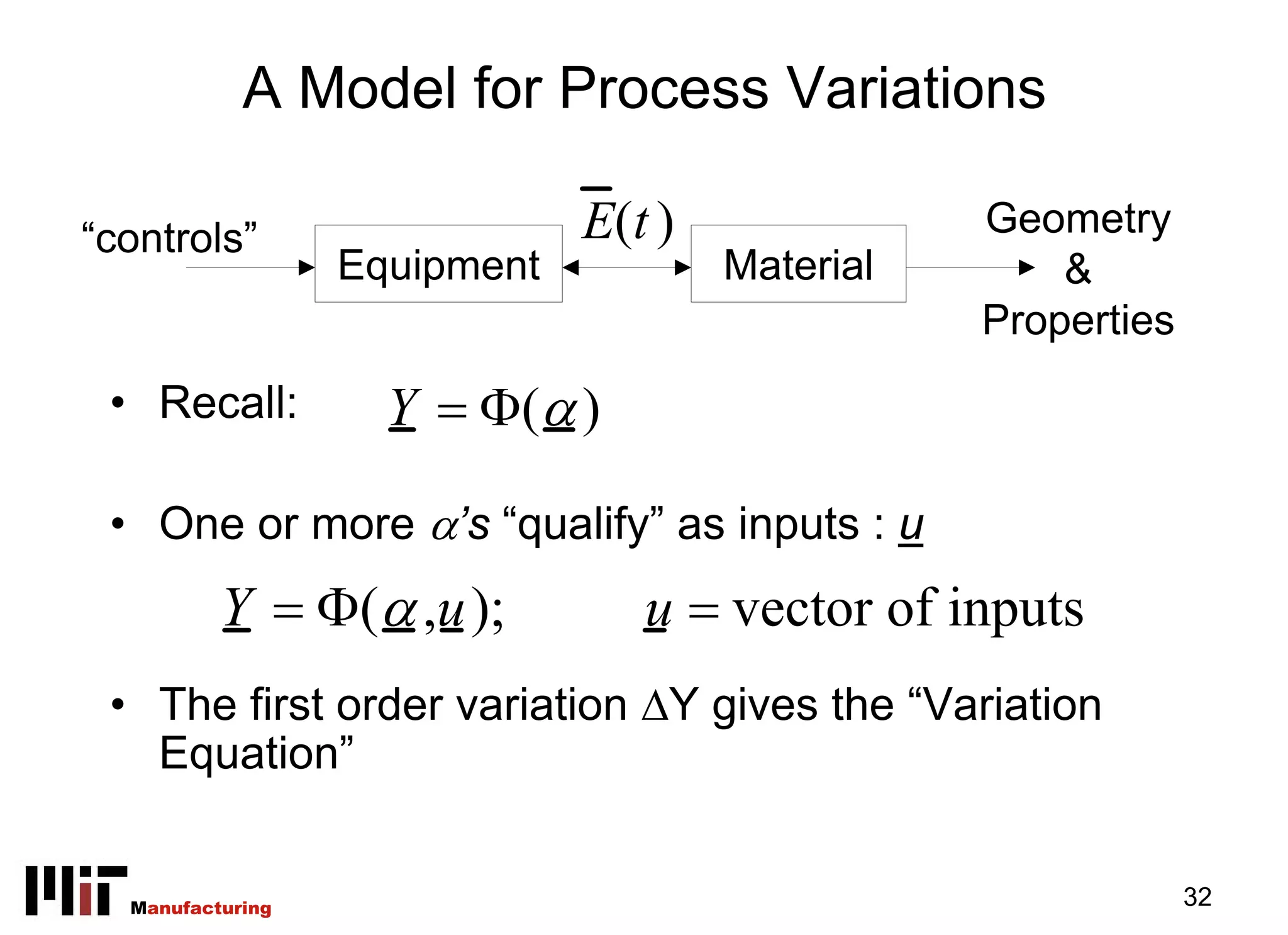
A Model for Process Variations

“controls”                    E(t )              Geometry
                  Equipment           Material       &
                                                 Properties
 • Recall:          Y = Φ(α )

 • One or more α’s “qualify” as inputs : u
          Y = Φ(α ,u );          u = vector of inputs
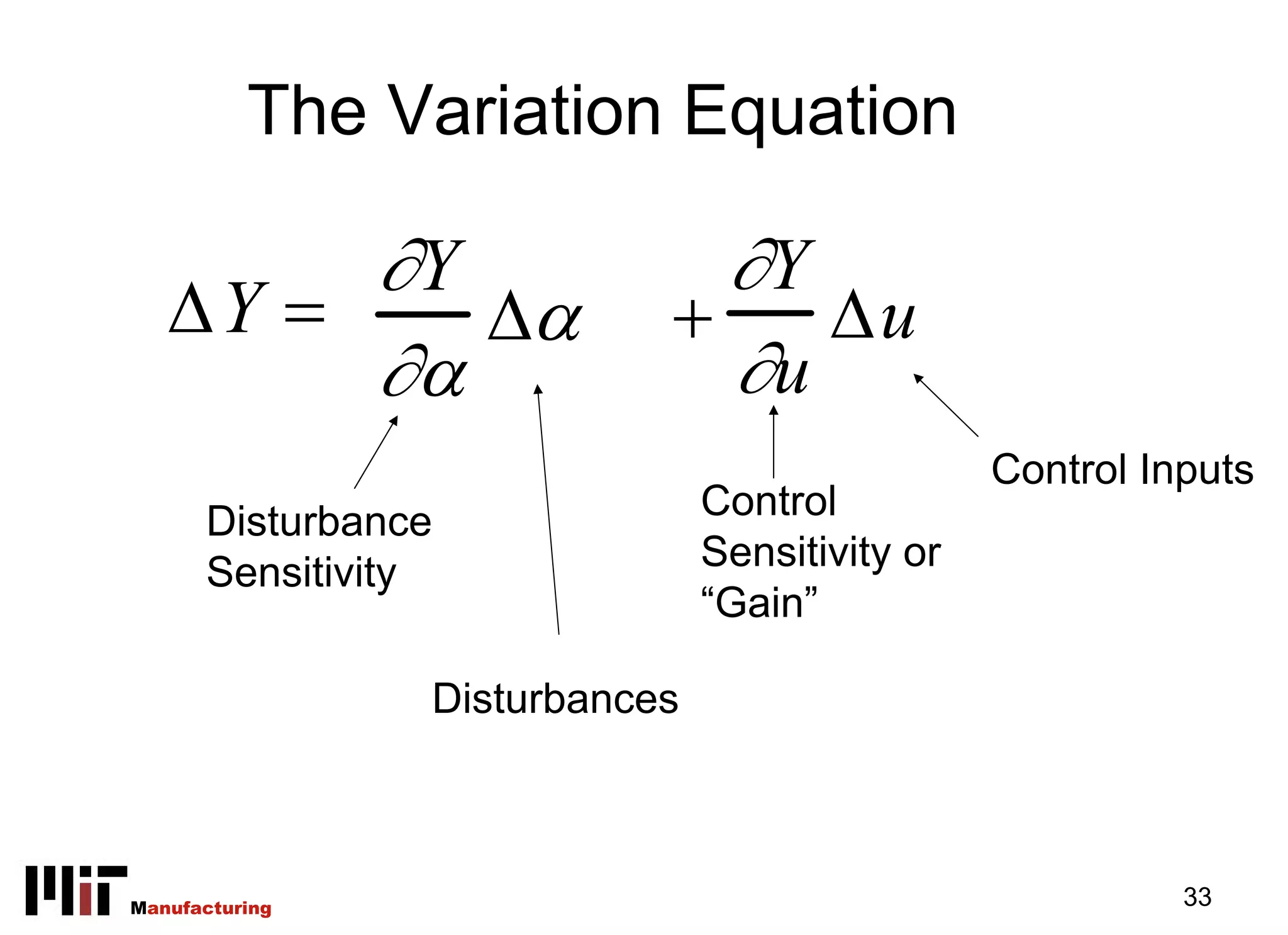
 • The first order variation ΔY gives the “Variation
   Equation”


  Manufacturing                                               32
The Variation Equation

        ∂Y                   ∂Y
   ΔY =    Δα              +    Δu
        ∂α                   ∂u
                                                Control Inputs
      Disturbance              Control
      Sensitivity              Sensitivity or
                               “Gain”

                Disturbances


Manufacturing                                             33
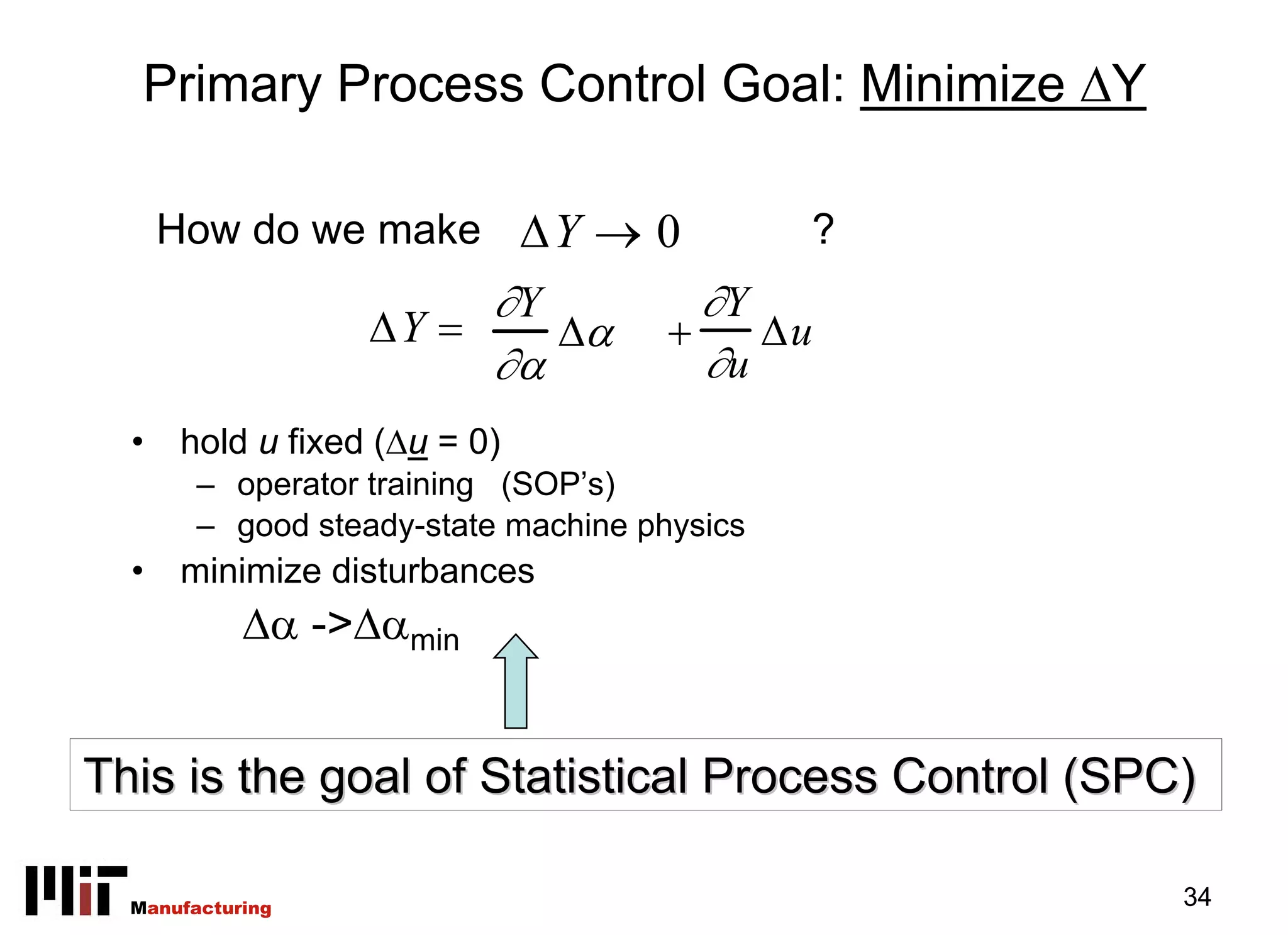
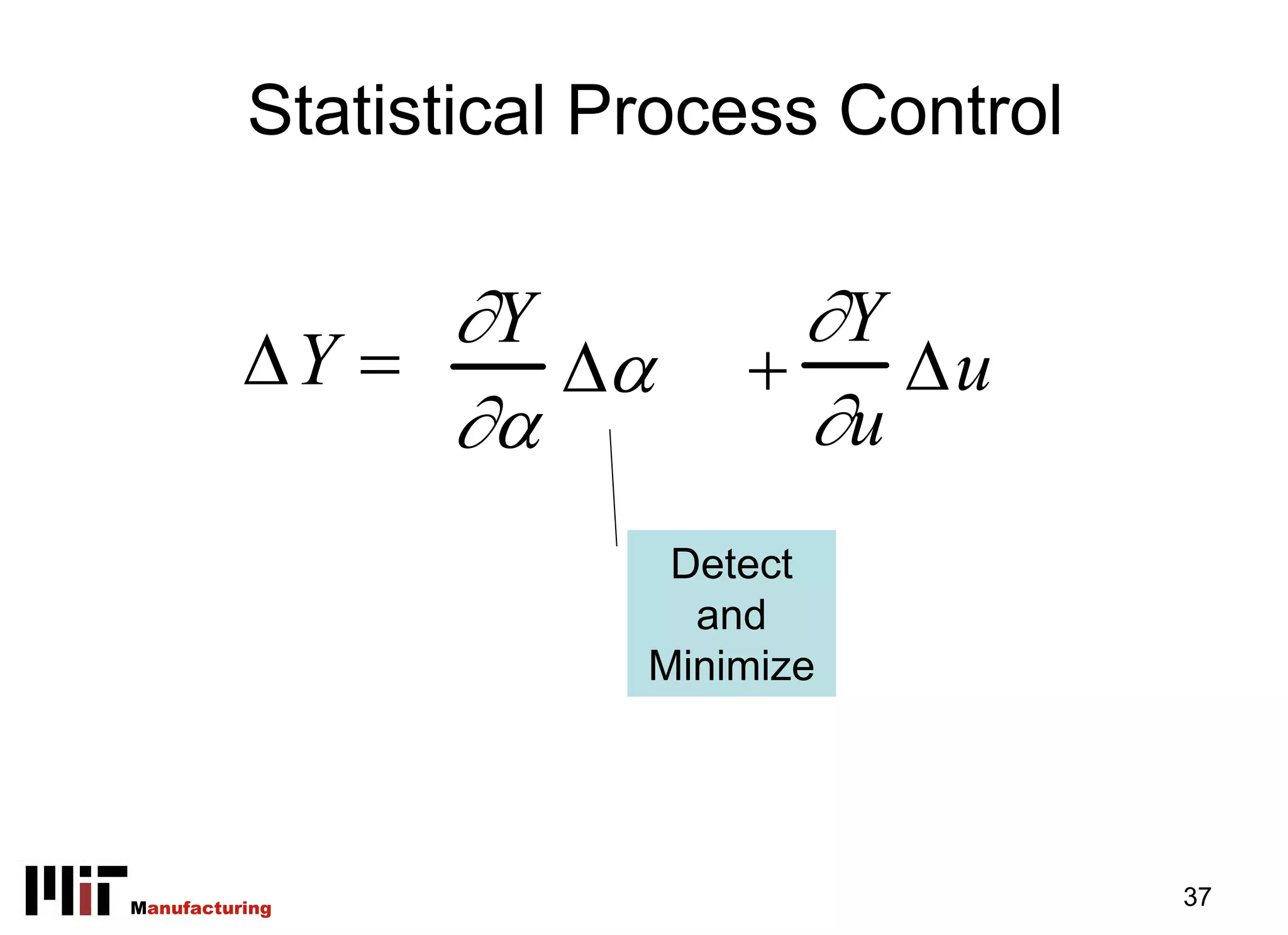
Primary Process Control Goal: Minimize ΔY

      How do we make ΔY → 0                   ?
                        ∂Y              ∂Y
                   ΔY =    Δα         +    Δu
                        ∂α              ∂u
  •   hold u fixed (Δu = 0)
        – operator training (SOP’s)
        – good steady-state machine physics
  •   minimize disturbances
            Δα ->Δαmin


This is the goal of Statistical Process Control (SPC)

  Manufacturing                                     34
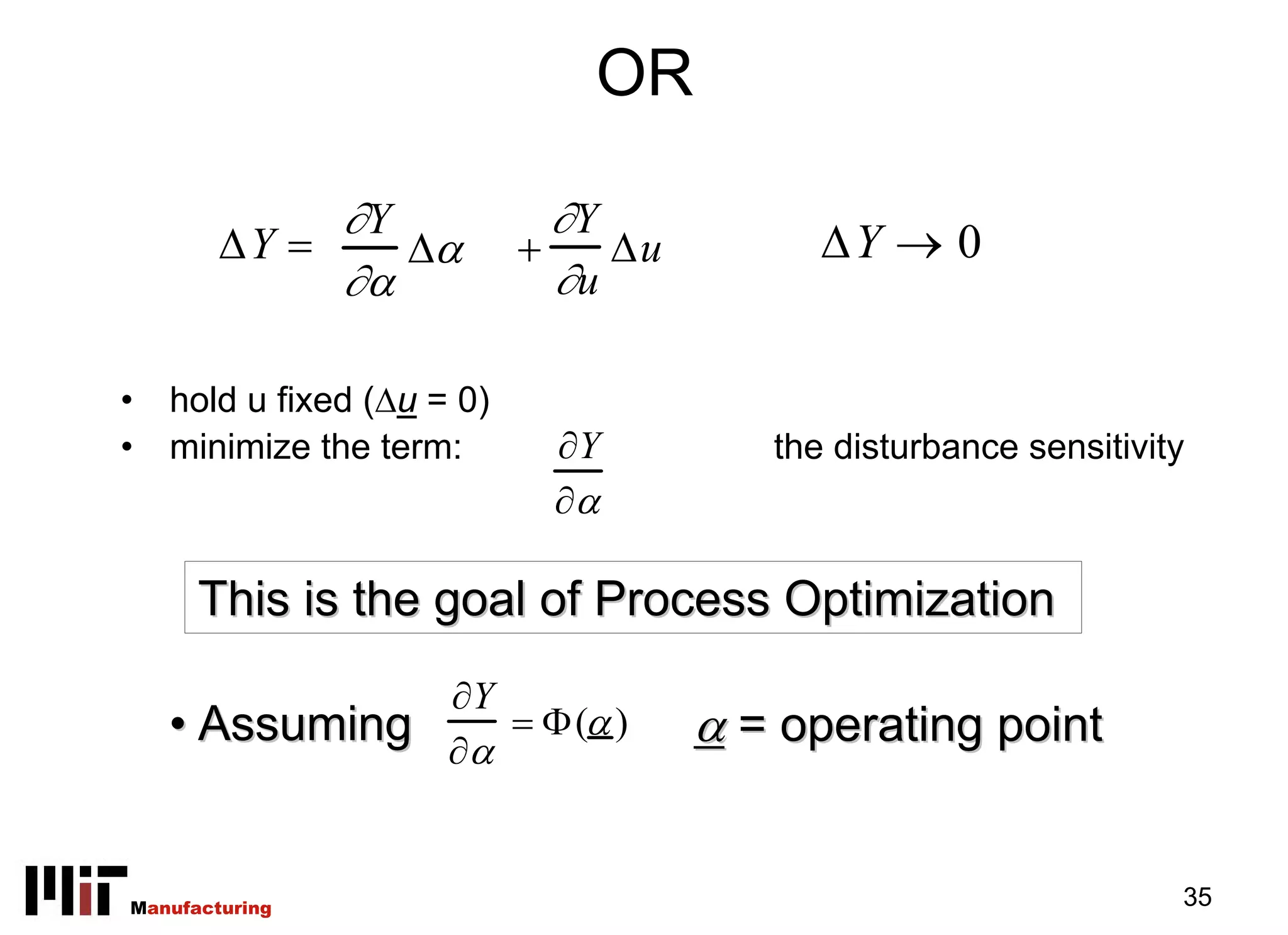
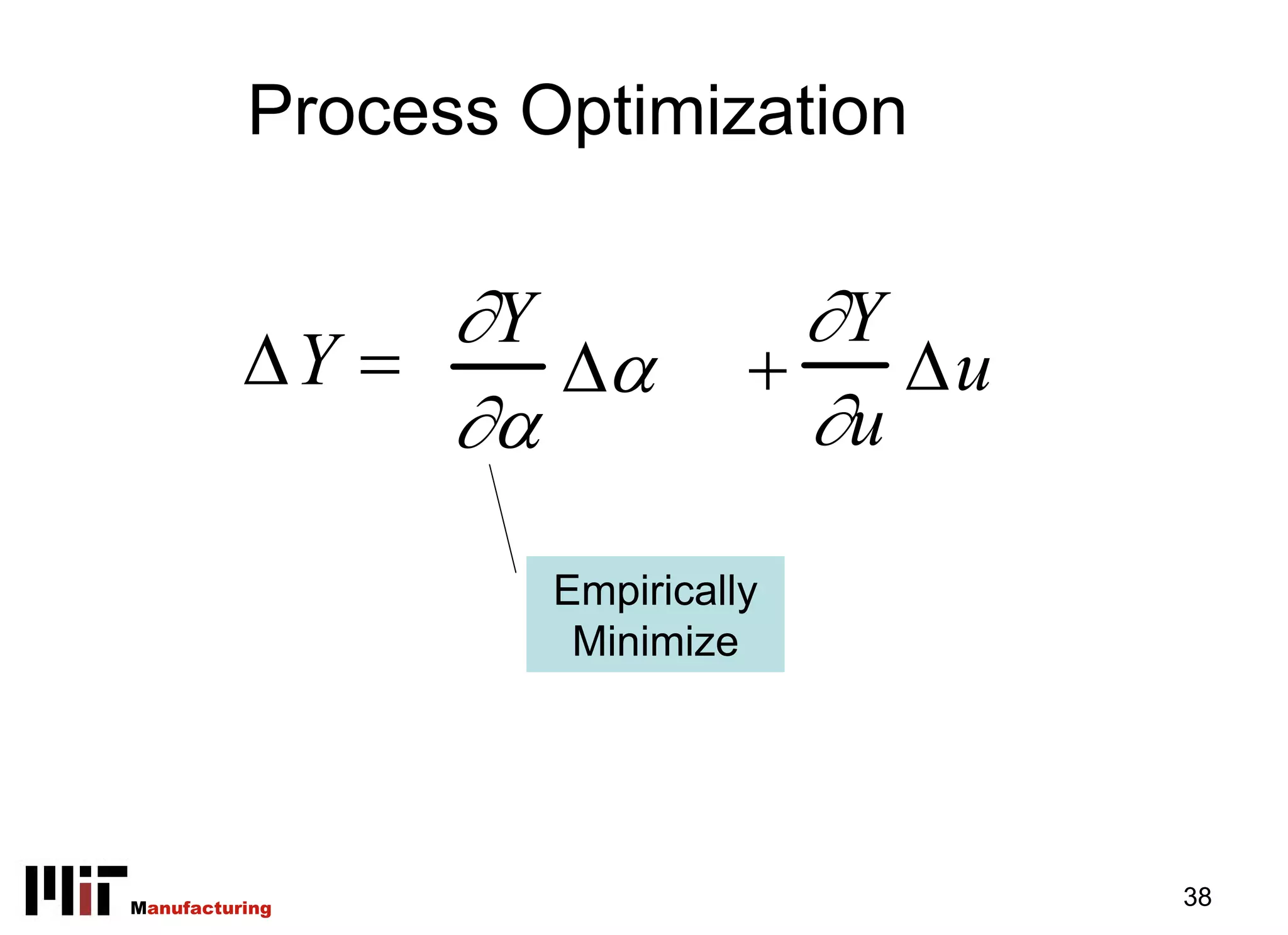
OR

             ∂Y               ∂Y
        ΔY =    Δα          +    Δu         ΔY → 0
             ∂α               ∂u

•   hold u fixed (Δu = 0)
•   minimize the term:       ∂Y          the disturbance sensitivity
                             ∂α

      This is the goal of Process Optimization
                      ∂Y
    • Assuming        ∂α
                         = Φ(α )      α = operating point


Manufacturing                                                      35
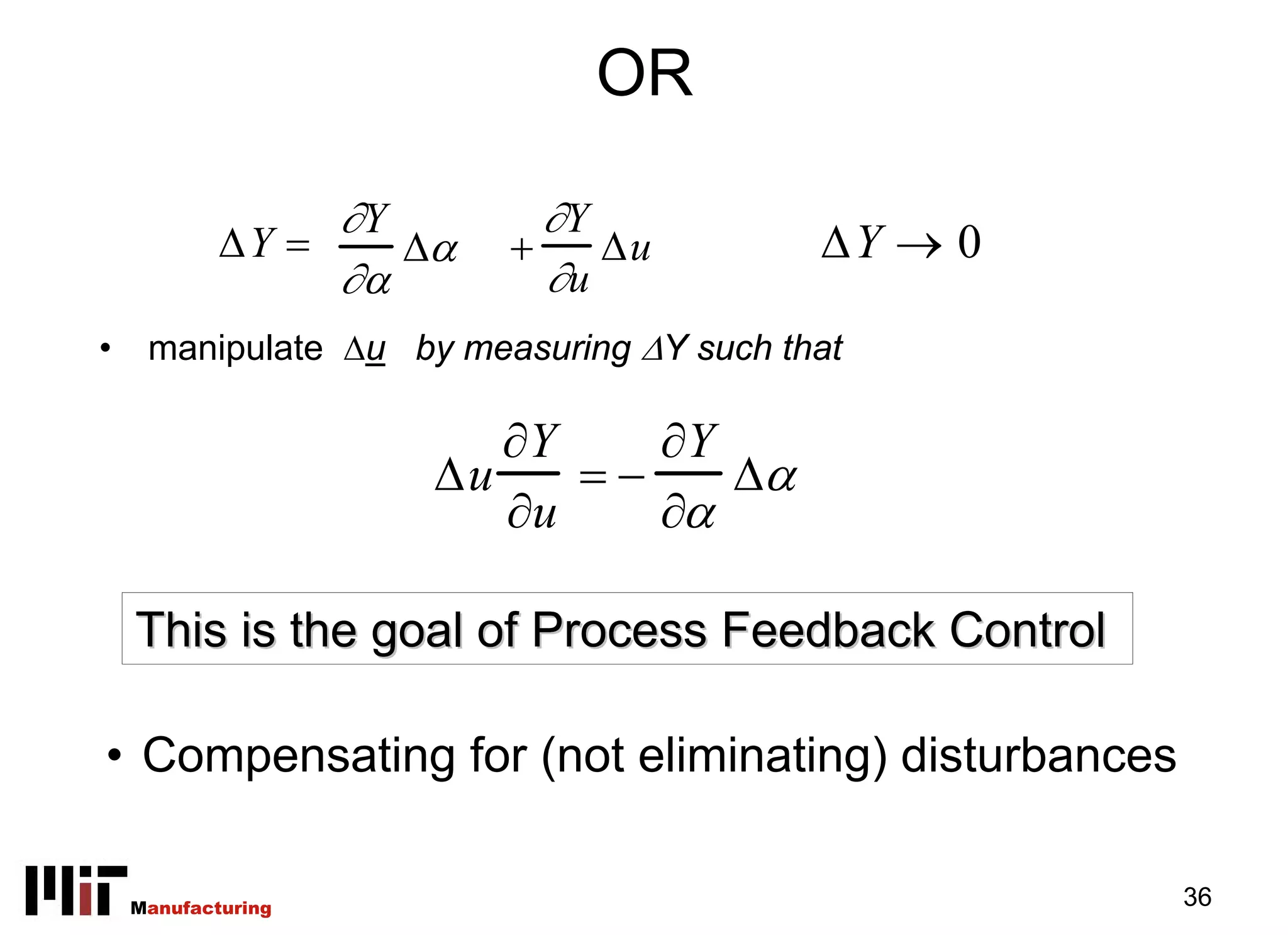
OR

                 ∂Y        ∂Y
            ΔY =    Δα   +    Δu          ΔY → 0
                 ∂α        ∂u
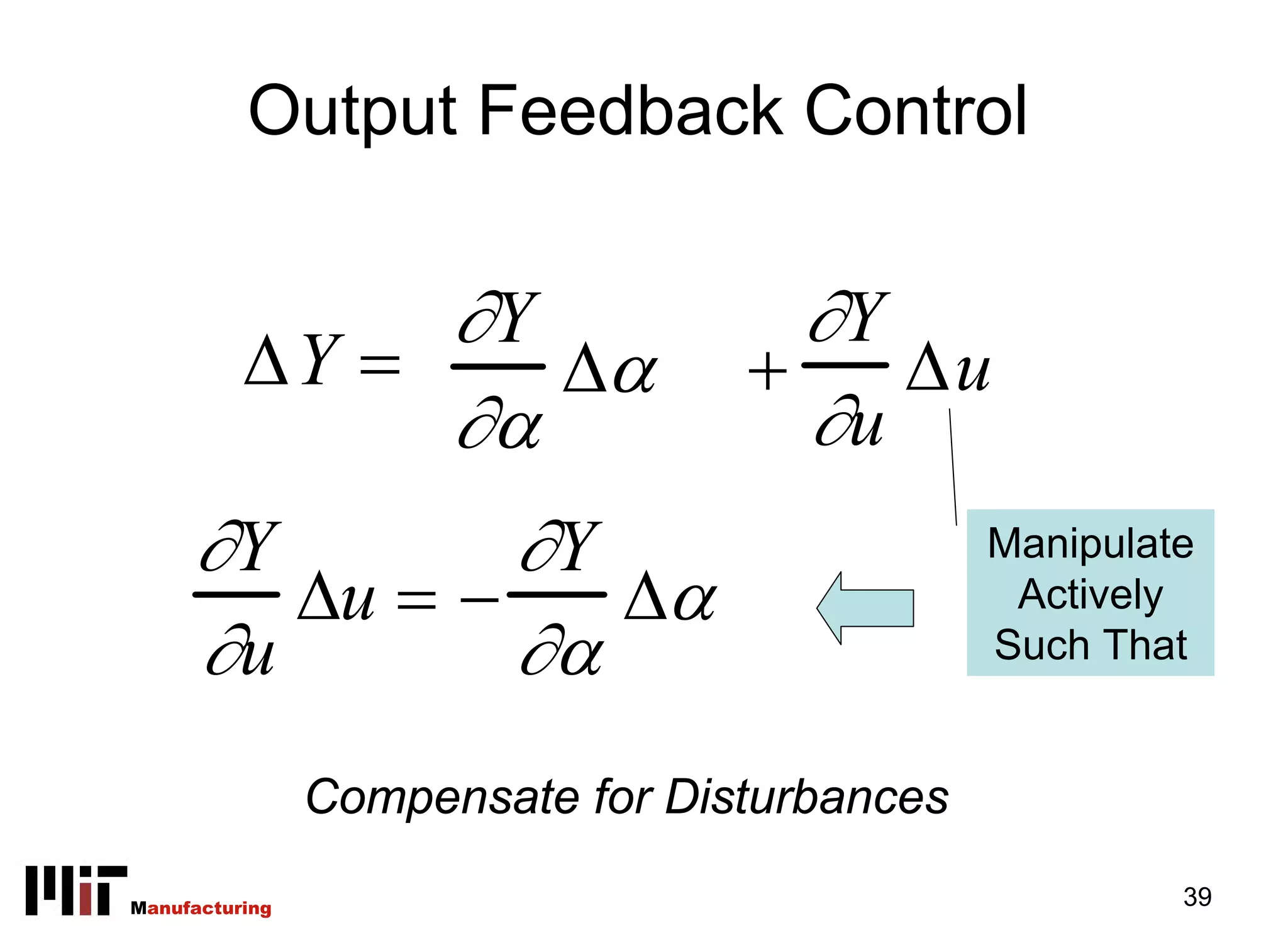
•    manipulate Δu by measuring ΔY such that

                        ∂Y    ∂Y
                     Δu    =−    Δα
                        ∂u    ∂α

    This is the goal of Process Feedback Control

• Compensating for (not eliminating) disturbances

    Manufacturing                                   36
Statistical Process Control

               ∂Y            ∂Y
          ΔY =    Δα       +    Δu
               ∂α            ∂u
                        Detect
                         and
                       Minimize


Manufacturing                           37
Process Optimization

               ∂Y              ∂Y
          ΔY =    Δα         +    Δu
               ∂α              ∂u

                   Empirically
                    Minimize


Manufacturing                          38
Output Feedback Control

               ∂Y                   ∂Y
          ΔY =    Δα              +    Δu
               ∂α                   ∂u
     ∂Y        ∂Y                             Manipulate
        Δu = −    Δα                           Actively
     ∂u        ∂α                             Such That


                Compensate for Disturbances

Manufacturing                                          39
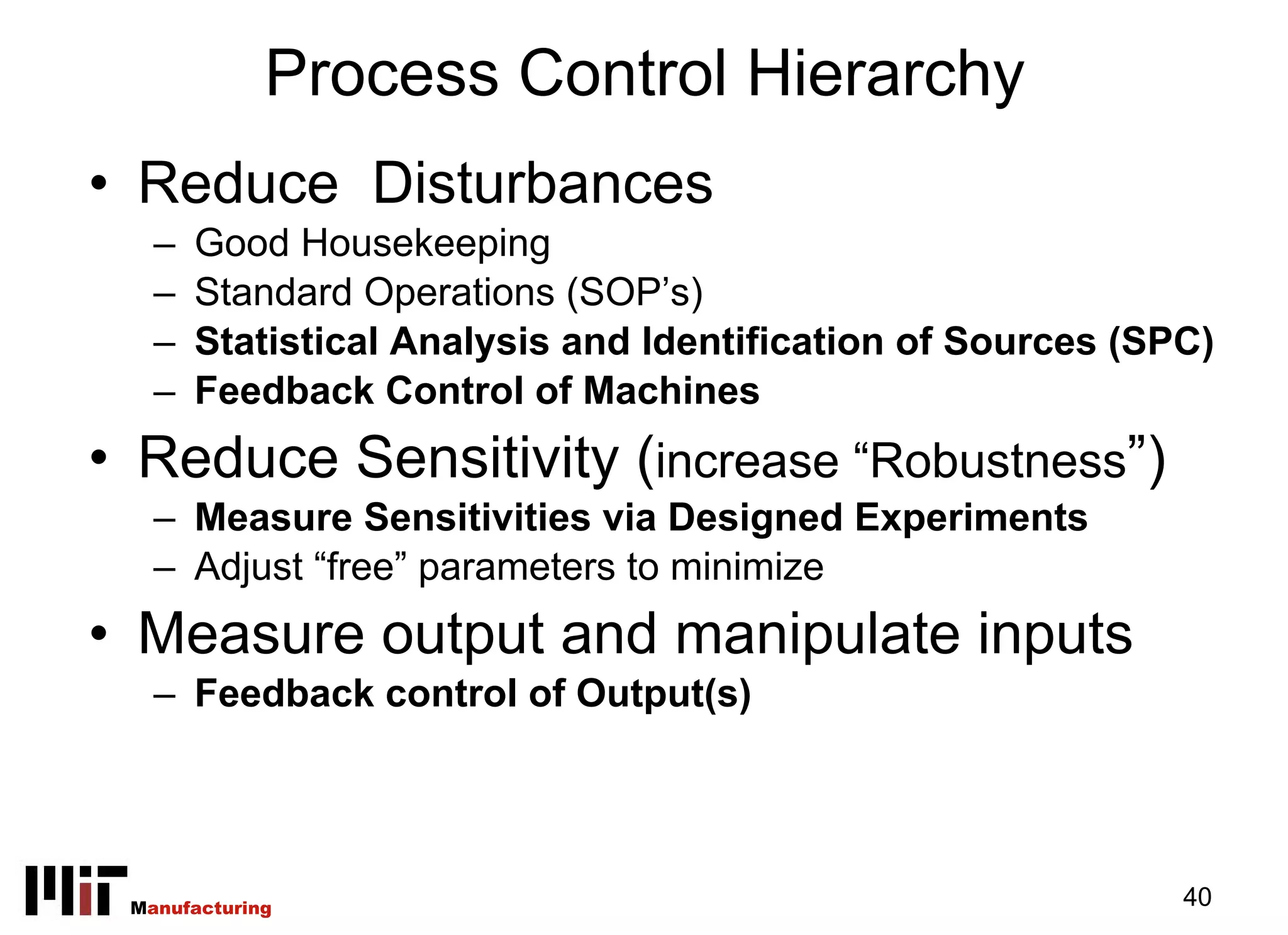
Process Control Hierarchy
• Reduce Disturbances
   –   Good Housekeeping
   –   Standard Operations (SOP’s)
   –   Statistical Analysis and Identification of Sources (SPC)
   –   Feedback Control of Machines
• Reduce Sensitivity (increase “Robustness”)
   – Measure Sensitivities via Designed Experiments
   – Adjust “free” parameters to minimize
• Measure output and manipulate inputs
   – Feedback control of Output(s)


 Manufacturing                                               40

Control of Manufacturing Processes

  • 1.
    MIT OpenCourseWare ____________ http://ocw.mit.edu 2.830J /6.780J / ESD.63J Control of Manufacturing Processes (SMA 6303) Spring 2008 ________________ For information about citing these materials or our Terms of Use, visit: http://ocw.mit.edu/terms.
  • 2.
    Control of Manufacturing Processes Subject 2.830/6.780/ESD.63 Spring 2008 Lecture #1 Introduction February 5, 2008 Manufacturing 1
  • 3.
    Background • Pre-requisites • Your Background and Interests • Relevant Experience • Course Schedule Manufacturing 2
  • 4.
    Expectations • Assignments ~Weekly • 2 Quizzes in Class • Group Project – End of term presentation – Report Manufacturing 3
  • 5.
    Syllabus Details • Lecturers – Duane Boning – David Hardt • Course Secretary: Sharlene Blake Manufacturing 4
  • 6.
    Syllabus Details • Prerequisites:One of the following : – 2.008 or 2.810 Manufacturing – 2.751J or 6.152J or 6.041 or 15.064J • Required Texts: – Montgomery, D.C., Introduction to Statistical Quality Control, 5th Ed. Wiley, 2005 – May and Spanos, Fundamentals of Semiconductor Manufacturing and Process Control, John Wiley, 2006. • Grading: – Problem sets 40% – Quizzes 40% – Team Projects 20% • Assignments: All except project are to be individual efforts • Final exam: No final exam • Course URL: (Registration and Certificate Required) Manufacturing 5
  • 7.
    Team Projects • Topics: – Process Diagnosis – Process Improvement – Process Optimization / Robustness – Advanced Applications • Expectations – Background research on process and problem – Use of existing data or generation of new data – Oral presentation of results – Project report from group Manufacturing 6
  • 8.
    Main Topics • PhysicalOrigins of Variation – Process Sensitivities • Statistical Models and Interpretation – Process as a Random Variable(s) – Diagnosis of Problems • Effects Models and Designed Experiments – Input - Output Empirical Models • Process Optimization (Robustness) – Ideal Operating Points Manufacturing 7
  • 9.
    Manufacturing Process Control •Process Goals – Cost – Quality – Rate – Flexibility Manufacturing 8
  • 10.
    Focus • Unit Operations •(1) Maximizing Quality – Conformance to Specifications • (2) Improving Throughput • (3) Improving Flexibility • (4) Reducing Cost Manufacturing 9
  • 11.
    Typical Process ControlProblems • Minimum feature size on a semiconductor chip has too much variability • DNA diagnostic chip has uneven flow channels • Toys never fit when assembled at home! • Next generation high density electrical connector cannot be made reliably Manufacturing 10
  • 12.
    Typical Process ControlProblems • Airframe skin needs trimming and bending to fit frame • Web thickness of a machined panel is non- uniform • Plastic throttle bodies for fuel injection are out of round • Submarine hull welds need constant rework in production Manufacturing 11
  • 13.
    Other Related Problems– Cost, Rate and Flexibility: • 100% inspection with high scrap rates – low throughput – high costs • 100% inspection with frequent rework – low throughput – high costs • High variability at changeover – Reluctance to changeover – low flexibility Manufacturing 12
  • 14.
    Manufacturing Processes • Howare they defined? • How do they do their thing? • How can they be categorized? • Why don’t they always get it right? Manufacturing 13
  • 15.
    The Process Components Operator Workpiece Part Equipment Material • Etch bath • Coated Silicon • IC chip • Injection Molder • Plastic Pellets • Connector Body • Lathe • Bar stock • Shaft • Draw Press • Sheet Metal • Hood • ... • ... • ... Manufacturing 14
  • 16.
    Process Definition A ManufacturingProcess is a Change in the Workpiece Material • A change in geometry • A change in constitutive properties Manufacturing 15
  • 17.
    Conceptual Semiconductor ProcessModel Image removed due to copyright restrictions. Please see Fig. 1 in Boning, D. S., et al. “A General Semiconductor Process Modeling Framework.” IEEE Transactions on Semiconductor Manufacturing 5 (November 1992): 266-280. Boning et al., c. 1990 Manufacturing 16
  • 18.
    Simplified Conceptual Semiconductor Process Model Image removed due to copyright restrictions. Please see Fig. 15 in Boning, D. S., et al. “A General Semiconductor Process Modeling Framework.” IEEE Transactions on Semiconductor Manufacturing 5 (November 1992): 266-280. Manufacturing 17
  • 19.
    Example: Oxidation Wafer states Image removed due to copyright restrictions. Please see Fig. 17 in Boning, D. S., et al. “A General Semiconductor Process Modeling Framework.” IEEE Transactions on Semiconductor Manufacturing 5 (November 1992): 266-280. Manufacturing 18
  • 20.
    Example: Oxidation Treatment (waferenvironment) Image removed due to copyright restrictions. Please see Fig. 18 in Boning, D. S., et al. “A General Semiconductor Process Modeling Framework.” IEEE Transactions on Semiconductor Manufacturing 5 (November 1992): 266-280. Manufacturing 19
  • 21.
    Oxidation Models Analytic: Deal-Grove Images removed due to copyright restrictions. Please see Fig. 19 and 20 in Boning, D. S., et al. “A General Semiconductor Process Modeling Framework.” IEEE Transactions on Semiconductor Manufacturing 5 (November 1992): 266-280. Empirical: Change in wafer state Empirical: Equipment model for mean and std. Manufacturing dev. of oxide thickness 20
  • 22.
    (Semiconductor) Manufacturing Process Control Image removed due to copyright restrictions. Please see Fig. 26 in Boning, D. S., et al. “A General Semiconductor Process Modeling Framework.” IEEE Transactions on Semiconductor Manufacturing 5 (November 1992): 266-280. Manufacturing 21
  • 23.
    Process Model forControl “controls” E(t ) Geometry Equipment Material & Properties Process Y ≡ Process Ouputs Y = Φ(α ) α ≡ process parameters What are the α’s? Hardt, c. 1995 Manufacturing 22
  • 24.
    The General ProcessControl Problem Desired Product Product CONTROLLER CONTROLLER EQUIPMENT EQUIPMENT MATERIAL MATERIAL Equipment loop Material loop Process output loop Control of Equipment: Control of Material: Control of Product: Forces, Strains Geometry Velocities Stresses and Temperatures, , .. Temperatures, Properties Pressures, .. Manufacturing 23
  • 25.
    Process Control Hierarchy •Reduce Disturbances – Good Housekeeping (Ops Management) – Standard Operations (SOP’s) – Statistical Analysis and Identification of Sources (SPC; 2.830J) – Feedback Control of Machines (Automation and Control; 2.168) • Reduce Sensitivity (Process Optimization or Robustness) – Measure Sensitivities via Designed Experiments (2.830J) – Adjust “free” parameters to minimize • Measure output and manipulate inputs – Feedback control of Output(s) (2.830J) Manufacturing 24
  • 26.
    Back to theProcess: What Causes the Output Change? • A Directed Energy Exchange with the Equipment E(t ) Geometry Equipment Material & Properties ⎧mechanical ⎫ ⎪electrical ⎪ ⎪ ⎪ E(t ) → ⎨ ⎬ ⎪thermal ⎪ ⎪chemical ⎪ ⎩ ⎭ Manufacturing 25
  • 27.
    Modes of GeometryChange? • Removal of Material • Plastic Deformation of Material • Addition of Material • Formation of Material from a Gas or Liquid • Any others??? Manufacturing 26
  • 28.
    What Causes Variation in the Process Output? • Material Variations – Properties, Initial Geometry • Equipment Variations – Non-repeatable, long term wear, deflections • Operator Variations – Inconsistent control, excessive “tweaking” • “Environment” Variations – Temperature and Handling inconsistencies Manufacturing 27
  • 29.
    Process Model forControl “controls” E(t ) Geometry Equipment Material & Properties Process Y ≡ Process Outputs Y = Φ(α ) α ≡ process parameters What are the α’s? Manufacturing 28
  • 30.
    What are the Process Parameters? • Equipment Energy “States” • Equipment Constitutive “Properties” • Material Energy “States” • Material Constitutive ”Properties” Manufacturing 29
  • 31.
    Energy States Energy Domain Energy or Power Variables Mechanical F, v ; P, Q or F, d ; σ, ε Electrical V,I Thermal T, ds/dt (or dq/dt) Chemical chemical potential, rate Manufacturing 30
  • 32.
    Properties • Extensive: GEOMETRY •Intensive: Constitutive Properties – Modulus of Elasticity, damping, mass – Plastic Flow Properties – Viscosity – Resistance, Inductance, Capacitance – Chemical Reactivity – Heat Transfer Coefficient • Which has the highest precision? Manufacturing 31
  • 33.
    A Model forProcess Variations “controls” E(t ) Geometry Equipment Material & Properties • Recall: Y = Φ(α ) • One or more α’s “qualify” as inputs : u Y = Φ(α ,u ); u = vector of inputs • The first order variation ΔY gives the “Variation Equation” Manufacturing 32
  • 34.
    The Variation Equation ∂Y ∂Y ΔY = Δα + Δu ∂α ∂u Control Inputs Disturbance Control Sensitivity Sensitivity or “Gain” Disturbances Manufacturing 33
  • 35.
    Primary Process ControlGoal: Minimize ΔY How do we make ΔY → 0 ? ∂Y ∂Y ΔY = Δα + Δu ∂α ∂u • hold u fixed (Δu = 0) – operator training (SOP’s) – good steady-state machine physics • minimize disturbances Δα ->Δαmin This is the goal of Statistical Process Control (SPC) Manufacturing 34
  • 36.
    OR ∂Y ∂Y ΔY = Δα + Δu ΔY → 0 ∂α ∂u • hold u fixed (Δu = 0) • minimize the term: ∂Y the disturbance sensitivity ∂α This is the goal of Process Optimization ∂Y • Assuming ∂α = Φ(α ) α = operating point Manufacturing 35
  • 37.
    OR ∂Y ∂Y ΔY = Δα + Δu ΔY → 0 ∂α ∂u • manipulate Δu by measuring ΔY such that ∂Y ∂Y Δu =− Δα ∂u ∂α This is the goal of Process Feedback Control • Compensating for (not eliminating) disturbances Manufacturing 36
  • 38.
    Statistical Process Control ∂Y ∂Y ΔY = Δα + Δu ∂α ∂u Detect and Minimize Manufacturing 37
  • 39.
    Process Optimization ∂Y ∂Y ΔY = Δα + Δu ∂α ∂u Empirically Minimize Manufacturing 38
  • 40.
    Output Feedback Control ∂Y ∂Y ΔY = Δα + Δu ∂α ∂u ∂Y ∂Y Manipulate Δu = − Δα Actively ∂u ∂α Such That Compensate for Disturbances Manufacturing 39
  • 41.
    Process Control Hierarchy •Reduce Disturbances – Good Housekeeping – Standard Operations (SOP’s) – Statistical Analysis and Identification of Sources (SPC) – Feedback Control of Machines • Reduce Sensitivity (increase “Robustness”) – Measure Sensitivities via Designed Experiments – Adjust “free” parameters to minimize • Measure output and manipulate inputs – Feedback control of Output(s) Manufacturing 40