SUMMARY OF THE FIRST WEEK
 oogenesis and ovulation
 Spermatogenesis
 After an oocyte is penetrated by a sperm,
completes the second meiotic division
 A mature oocyte and a second polar body are
formed.
 female pronucleus
 male pronucleus
 Fertilization is complete when the male and
female pronuclei unite and the maternal and
paternal chromosomes intermingle
Contd…
 cleavage (a series of mitotic cell divisions) into a
number of smaller cells-blastomeres.
 Approximately 3 days after fertilization, morula-enters
the uterus.
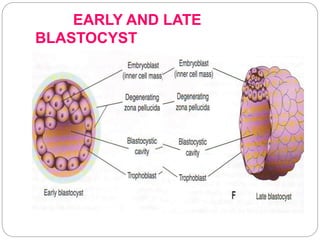
 A cavity forms in the morula, converting it into a
blastocyst consisting of the embryoblast, a
blastocystic cavity, and the trophoblast.
 the zona pellucida is shed and the trophoblast
adjacent to the embryoblast attaches to the
endometrial epithelium and implantation begins
(interstitial)
TWO, FOUR, EIGHT, AND SIXTEEN CELL
STAGE ZYGOTE
EARLY AND LATE
BLASTOCYST
STAGES OF IMPLANTATION
2nd week of development
 Implantation of the blastocyst
begins at the end of the 1st week
completes by the end of the 2nd week.
 Normal site of implantation: along the
anterior or posterior wall of the body of the
uterus near the fundus
 Development of embryo from fertilization up
to 2nd week is described as the pre-
organogenesis period as no organs are as
yet recognizable.
Day 8
 Partially embedded in endometrial stroma.
 Trophoblast differentiates into
 cytotrophoblast
 syncytiotrophoblast which produces a hormone-
human chorionic gonadotrophin (hCG)
Contd…
 By the end of 2nd week enough hCG give a
+pregnancy test
 inner cell mass or embryoblast also
differentiate into two layers forming bilaminar
embryonic disc
hypoblast (cuboidal cells )
epiblast (high columnar cells)
 a small cavity appears within the epiblast. This
cavity enlarges to become the amniotic cavity.
 Epiblast cells adjacent to the cytotrophoblast
are called amnioblasts.
Day 9; Lacunar stage
 Deeply embedded in
endometrium
 Vacuoles fuse to form
lacunae, thus called
lacunar stage
 a thin membrane,
exocoelomic (Heuser)
membrane lines the
inner surface
cytotrophoblast
 Now the blasocyst
cavity lined with
Heuser’s membrane is
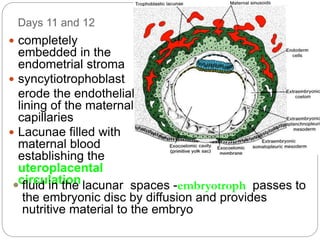
Days 11 and 12
 completely
embedded in the
endometrial stroma
 syncytiotrophoblast
erode the endothelial
lining of the maternal
capillaries
 Lacunae filled with
maternal blood
establishing the
uteroplacental
circulation
 fluid in the lacunar spaces -embryotroph passes to
the embryonic disc by diffusion and provides
nutritive material to the embryo
Contd…
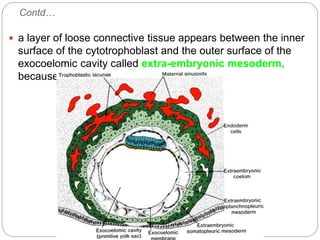
 a layer of loose connective tissue appears between the inner
surface of the cytotrophoblast and the outer surface of the
exocoelomic cavity called extra-embryonic mesoderm,
because it lies outside the embryonic disc
Contd…
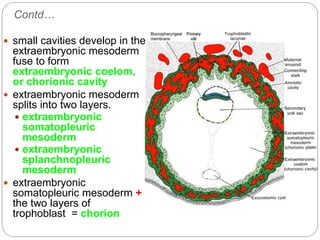
 small cavities develop in the
extraembryonic mesoderm
fuse to form
extraembryonic coelom,
or chorionic cavity
 extraembryonic mesoderm
splits into two layers.
 extraembryonic
somatopleuric
mesoderm
 extraembryonic
splanchnopleuric
mesoderm
 extraembryonic
somatopleuric mesoderm +
the two layers of
trophoblast = chorion
Contd…
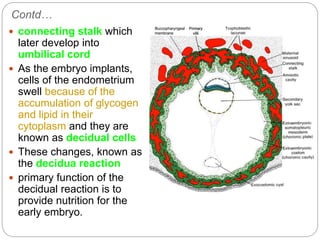
 connecting stalk which
later develop into
umbilical cord
 As the embryo implants,
cells of the endometrium
swell because of the
accumulation of glycogen
and lipid in their
cytoplasm and they are
known as decidual cells
 These changes, known as
the decidua reaction
 primary function of the
decidual reaction is to
provide nutrition for the
early embryo.
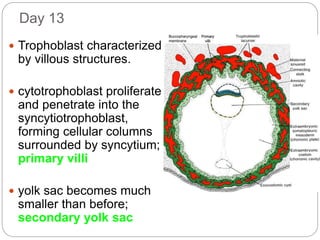
Day 13
 Trophoblast characterized
by villous structures.
 cytotrophoblast proliferate
and penetrate into the
syncytiotrophoblast,
forming cellular columns
surrounded by syncytium;
primary villi
 yolk sac becomes much
smaller than before;
secondary yolk sac
2nd week : Week of two
 The Trophoblast differentiates into two layer
 Cytotrophoblast and Syncytiotrophoblast
 The embryoblast differentiates into 2 layers together
forming a bilaminar disc
 Epiblast and Hypoblast
 Formation of two cavity
 amniotic cavity superior to the epiblast layer
 Yolk sac
 The extraembryonic mesoderm splits into two layers,
 Somatopleuric mesoderm
 splanchnopleurc mesoderm
Summary of 2nd week
 The Trophoblast differentiates into
 an inner, layer, Cytotrophoblast, and
 an outer layer, Syncytiotrophoblast
 Primitive uteroplacental circulation begins
 The cytotrophoblast, forms cellular columns
surrounded by the syncytium - primary villi
 The Inner cell mass or embryoblast differentiates
into 2 layers together forming a bilaminar disc
 the Epiblast and
 the Hypoblast
 Epiblast cells give rise to amnioblasts that line the
amniotic cavity superior to the epiblast layer.
 Hypoblast cells are continuous with the Heuser’s
membrane, and together they surround the primitive
yolk sac
Contd…
 Extraembryonic mesoderm appears between the
inner surface of the cytotrophoblast and the outer
surface of the exocoelomic cavity.
 When vacuoles develop in this tissue, the
extraembryonic coelom or chorionic cavity forms
 The extraembryonic mesoderm splits into two
layers,
 Somatopleuric mesoderm
 splanchnopleurc mesoderm
 Implantation may also occur outside the uterus,
such as in the rectouterine pouch, on the
mesentery, in the uterine tube, or in the ovary -
ectopic pregnancies
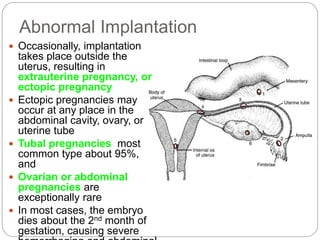
Abnormal Implantation
 Occasionally, implantation
takes place outside the
uterus, resulting in
extrauterine pregnancy, or
ectopic pregnancy
 Ectopic pregnancies may
occur at any place in the
abdominal cavity, ovary, or
uterine tube
 Tubal pregnancies most
common type about 95%,
and
 Ovarian or abdominal
pregnancies are
exceptionally rare
 In most cases, the embryo
dies about the 2nd month of
gestation, causing severe
Contd…
 Occasionally, the
blastocyst implants close to
the internal os (opening),
so that later in
development, the placenta
bridges the opening and
 the condition is called
placenta previa- a
placenta that partially or
completely covers the os
and causes severe, even
life-threatening bleeding
during delivery
2nd week-implantation.ppt

2nd week-implantation.ppt

  • 2.
    SUMMARY OF THEFIRST WEEK  oogenesis and ovulation  Spermatogenesis  After an oocyte is penetrated by a sperm, completes the second meiotic division  A mature oocyte and a second polar body are formed.  female pronucleus  male pronucleus  Fertilization is complete when the male and female pronuclei unite and the maternal and paternal chromosomes intermingle
  • 3.
    Contd…  cleavage (aseries of mitotic cell divisions) into a number of smaller cells-blastomeres.  Approximately 3 days after fertilization, morula-enters the uterus.  A cavity forms in the morula, converting it into a blastocyst consisting of the embryoblast, a blastocystic cavity, and the trophoblast.  the zona pellucida is shed and the trophoblast adjacent to the embryoblast attaches to the endometrial epithelium and implantation begins (interstitial)
  • 4.
    TWO, FOUR, EIGHT,AND SIXTEEN CELL STAGE ZYGOTE
  • 5.
  • 6.
  • 7.
    2nd week ofdevelopment  Implantation of the blastocyst begins at the end of the 1st week completes by the end of the 2nd week.  Normal site of implantation: along the anterior or posterior wall of the body of the uterus near the fundus  Development of embryo from fertilization up to 2nd week is described as the pre- organogenesis period as no organs are as yet recognizable.
  • 8.
    Day 8  Partiallyembedded in endometrial stroma.  Trophoblast differentiates into  cytotrophoblast  syncytiotrophoblast which produces a hormone- human chorionic gonadotrophin (hCG)
  • 9.
    Contd…  By theend of 2nd week enough hCG give a +pregnancy test  inner cell mass or embryoblast also differentiate into two layers forming bilaminar embryonic disc hypoblast (cuboidal cells ) epiblast (high columnar cells)  a small cavity appears within the epiblast. This cavity enlarges to become the amniotic cavity.  Epiblast cells adjacent to the cytotrophoblast are called amnioblasts.
  • 10.
    Day 9; Lacunarstage  Deeply embedded in endometrium  Vacuoles fuse to form lacunae, thus called lacunar stage  a thin membrane, exocoelomic (Heuser) membrane lines the inner surface cytotrophoblast  Now the blasocyst cavity lined with Heuser’s membrane is
  • 11.
    Days 11 and12  completely embedded in the endometrial stroma  syncytiotrophoblast erode the endothelial lining of the maternal capillaries  Lacunae filled with maternal blood establishing the uteroplacental circulation  fluid in the lacunar spaces -embryotroph passes to the embryonic disc by diffusion and provides nutritive material to the embryo
  • 12.
    Contd…  a layerof loose connective tissue appears between the inner surface of the cytotrophoblast and the outer surface of the exocoelomic cavity called extra-embryonic mesoderm, because it lies outside the embryonic disc
  • 13.
    Contd…  small cavitiesdevelop in the extraembryonic mesoderm fuse to form extraembryonic coelom, or chorionic cavity  extraembryonic mesoderm splits into two layers.  extraembryonic somatopleuric mesoderm  extraembryonic splanchnopleuric mesoderm  extraembryonic somatopleuric mesoderm + the two layers of trophoblast = chorion
  • 14.
    Contd…  connecting stalkwhich later develop into umbilical cord  As the embryo implants, cells of the endometrium swell because of the accumulation of glycogen and lipid in their cytoplasm and they are known as decidual cells  These changes, known as the decidua reaction  primary function of the decidual reaction is to provide nutrition for the early embryo.
  • 15.
    Day 13  Trophoblastcharacterized by villous structures.  cytotrophoblast proliferate and penetrate into the syncytiotrophoblast, forming cellular columns surrounded by syncytium; primary villi  yolk sac becomes much smaller than before; secondary yolk sac
  • 16.
    2nd week :Week of two  The Trophoblast differentiates into two layer  Cytotrophoblast and Syncytiotrophoblast  The embryoblast differentiates into 2 layers together forming a bilaminar disc  Epiblast and Hypoblast  Formation of two cavity  amniotic cavity superior to the epiblast layer  Yolk sac  The extraembryonic mesoderm splits into two layers,  Somatopleuric mesoderm  splanchnopleurc mesoderm
  • 17.
    Summary of 2ndweek  The Trophoblast differentiates into  an inner, layer, Cytotrophoblast, and  an outer layer, Syncytiotrophoblast  Primitive uteroplacental circulation begins  The cytotrophoblast, forms cellular columns surrounded by the syncytium - primary villi  The Inner cell mass or embryoblast differentiates into 2 layers together forming a bilaminar disc  the Epiblast and  the Hypoblast  Epiblast cells give rise to amnioblasts that line the amniotic cavity superior to the epiblast layer.  Hypoblast cells are continuous with the Heuser’s membrane, and together they surround the primitive yolk sac
  • 18.
    Contd…  Extraembryonic mesodermappears between the inner surface of the cytotrophoblast and the outer surface of the exocoelomic cavity.  When vacuoles develop in this tissue, the extraembryonic coelom or chorionic cavity forms  The extraembryonic mesoderm splits into two layers,  Somatopleuric mesoderm  splanchnopleurc mesoderm  Implantation may also occur outside the uterus, such as in the rectouterine pouch, on the mesentery, in the uterine tube, or in the ovary - ectopic pregnancies
  • 19.
    Abnormal Implantation  Occasionally,implantation takes place outside the uterus, resulting in extrauterine pregnancy, or ectopic pregnancy  Ectopic pregnancies may occur at any place in the abdominal cavity, ovary, or uterine tube  Tubal pregnancies most common type about 95%, and  Ovarian or abdominal pregnancies are exceptionally rare  In most cases, the embryo dies about the 2nd month of gestation, causing severe
  • 20.
    Contd…  Occasionally, the blastocystimplants close to the internal os (opening), so that later in development, the placenta bridges the opening and  the condition is called placenta previa- a placenta that partially or completely covers the os and causes severe, even life-threatening bleeding during delivery