Dr R Viswa Chandra MDS;DNB
Reader
Department of Periodontics
SVS Institute of Dental Sciences
Mahabubnagar AP
Key Principles of Implant Surgery
• Atraumatic bone
preparation with attention
to minimizing heat
production: constant
irrigation.
• Primary surgical stability
achieved with bicortical
stabilization where possible.
• Allow undisturbed
osseointegration.
Basic surgical principles
•Preoperative mouthwash (0.2% CHX).
•Perioral skin disinfection (Povidone
Iodine is preferred).
•Antibiotic prophylaxis 1-2 hrs prior to
surgery.
•Sterile and disinfected surgery
protocols.
•Minimal zone of contamination.
Anaesthesia and Pain Control
•Nerve Block anesthesia is the
most efficient.
•Infiltration anesthesia can be
preferred so that the patient
“feels” the proximity to vital
structures and thus avoiding
potential damage to nerves. Its
usage is controversial though.*
Juodzbalys G et al. Injury of the Inferior Alveolar Nerve during Implant Placement: a Literature Review.
J Oral Maxillofac Res 2011 (Jan-Mar);2(1):e1.
Anaesthesia and Pain Control
•Studies* have demonstrated that preoperative administration
of analgesics delays the onset of pain (by more than 100
minutes compared with placebo) and lessened the severity of
postoperative dental pain as the effect of the local anesthetic
dissipated, without increased side effects.
•The use of pre-operative analgesics is highly recommended in
Implant Dentistry**
*Dionne RA et al. Suppression of postoperative pain by preoperative administration of ibuprofen in comparison to
placebo, acetaminophen, and acetaminophen plus codeine. J Clin Pharmacol. 1983;23(1):37-43.
**Richard M. Palmer, Leslie Howe, Brian Smith. Implants in Clinical Dentistry. 1st ed .Taylor & Francis.
The objective is to expose the bone where the osteotomy is to be
placed and to minimize vascular disruption to sensitive bone
areas.
IMPLANT PLACEMENT
Entry Incision
Two StageSingle Stage
IMPLANT PLACEMENT
The Osteotomy
BASIC PRINCIPLES
• Sharp drills.
• Correct RPM: 1200-2500 rpm for cortical & D1 bone; 800-
1200 for expanding the osteotomy sites.
• Copious irrigation to avoid heat necrosis.
• Intermittent drilling/BONE DANCING.
• Correct torque values (15-23 N).
• Bone tap to avoid compression necrosis.
• Bone spreading to obtain as much bone as possible.
IMPLANT PLACEMENT
The Osteotomy
•Mark/
check
position
•Assess
bone
quality
Osteotomy
position
and angle
Sets osteotomy
depth first and
width next
Removes
cortical
bone at
ridge crest
to facilitate
pressure-
free seating
of implant
Prepares
dense
cortical
bone for
implant
threads
The implant fixture may be placed by hand using a
hand/torque wrench or with a driver utilizing a
controlled drill speed.
IMPLANT PLACEMENT
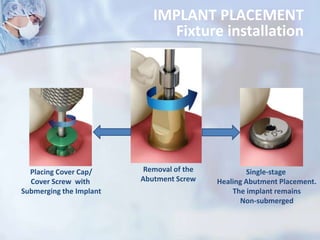
Fixture installation
IMPLANT PLACEMENT
Fixture installation
Removal of the
Abutment Screw
Placing Cover Cap/
Cover Screw with
Submerging the Implant
Single-stage
Healing Abutment Placement.
The implant remains
Non-submerged
Case
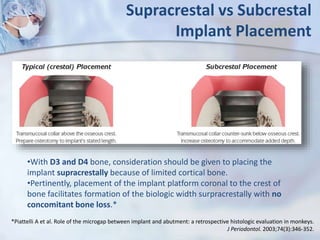
Supracrestal vs Subcrestal
Implant Placement
•With D3 and D4 bone, consideration should be given to placing the
implant supracrestally because of limited cortical bone.
•Pertinently, placement of the implant platform coronal to the crest of
bone facilitates formation of the biologic width surpracrestally with no
concomitant bone loss.*
*Piattelli A et al. Role of the microgap between implant and abutment: a retrospective histologic evaluation in monkeys.
J Periodontol. 2003;74(3):346-352.
During drilling, care must be taken NOT TO
•Underdrill of site depth: This can result in thread stripping
•Use Excess drill speed: Burns bone, kills osteocytes, and results in early fixture
loss
•Tip the drill as it widens the osteotomy site compromising initial stability.
•Overdrilling depth or irregular uneven osteotomy can lead to an “disappearing
implant”
•Pull on the Bone Tap to remove it from the site: Can disrupt the threads created
for implant engagement
During implant fixture installation, care must be taken NOT TO
Use an unmetered ratchet wrench: fracture buccal plates and/or strip threading
or overcompress site.
Start with high torque of 40 N/cm: The lowest torque required should be used.
Use a hex-driver to seat an implant: can damage the internal hex of the implant.
PROBLEM ALTERATION BENEFIT
Lack of Primary Stability Deeper Osteotomy Gain Implant Area
Lack of Primary Stability Wider Osteotomy Gain Implant Area
Limited Cortical Bone Supracrestal placement Preserves Crestal Bone
Soft Bone Bone Compression Compresses soft bone
Soft Bone Undersize osteotomy site Tighter fit
Soft Bone Submerge Implant Protects Implant
Soft Bone Tapered Implant* Increased Primary Stability
*the theory is that if a small osteotomy is created, a tapered implant will compress the bone, especially
in the coronal region, thereby improving initial stability of the implant.
Implant placement

Implant placement

  • 1.
    Dr R ViswaChandra MDS;DNB Reader Department of Periodontics SVS Institute of Dental Sciences Mahabubnagar AP
  • 2.
    Key Principles ofImplant Surgery • Atraumatic bone preparation with attention to minimizing heat production: constant irrigation. • Primary surgical stability achieved with bicortical stabilization where possible. • Allow undisturbed osseointegration.
  • 3.
    Basic surgical principles •Preoperativemouthwash (0.2% CHX). •Perioral skin disinfection (Povidone Iodine is preferred). •Antibiotic prophylaxis 1-2 hrs prior to surgery. •Sterile and disinfected surgery protocols. •Minimal zone of contamination.
  • 4.
    Anaesthesia and PainControl •Nerve Block anesthesia is the most efficient. •Infiltration anesthesia can be preferred so that the patient “feels” the proximity to vital structures and thus avoiding potential damage to nerves. Its usage is controversial though.* Juodzbalys G et al. Injury of the Inferior Alveolar Nerve during Implant Placement: a Literature Review. J Oral Maxillofac Res 2011 (Jan-Mar);2(1):e1.
  • 5.
    Anaesthesia and PainControl •Studies* have demonstrated that preoperative administration of analgesics delays the onset of pain (by more than 100 minutes compared with placebo) and lessened the severity of postoperative dental pain as the effect of the local anesthetic dissipated, without increased side effects. •The use of pre-operative analgesics is highly recommended in Implant Dentistry** *Dionne RA et al. Suppression of postoperative pain by preoperative administration of ibuprofen in comparison to placebo, acetaminophen, and acetaminophen plus codeine. J Clin Pharmacol. 1983;23(1):37-43. **Richard M. Palmer, Leslie Howe, Brian Smith. Implants in Clinical Dentistry. 1st ed .Taylor & Francis.
  • 6.
    The objective isto expose the bone where the osteotomy is to be placed and to minimize vascular disruption to sensitive bone areas. IMPLANT PLACEMENT Entry Incision Two StageSingle Stage
  • 7.
    IMPLANT PLACEMENT The Osteotomy BASICPRINCIPLES • Sharp drills. • Correct RPM: 1200-2500 rpm for cortical & D1 bone; 800- 1200 for expanding the osteotomy sites. • Copious irrigation to avoid heat necrosis. • Intermittent drilling/BONE DANCING. • Correct torque values (15-23 N). • Bone tap to avoid compression necrosis. • Bone spreading to obtain as much bone as possible.
  • 8.
    IMPLANT PLACEMENT The Osteotomy •Mark/ check position •Assess bone quality Osteotomy position andangle Sets osteotomy depth first and width next Removes cortical bone at ridge crest to facilitate pressure- free seating of implant Prepares dense cortical bone for implant threads
  • 9.
    The implant fixturemay be placed by hand using a hand/torque wrench or with a driver utilizing a controlled drill speed. IMPLANT PLACEMENT Fixture installation
  • 10.
    IMPLANT PLACEMENT Fixture installation Removalof the Abutment Screw Placing Cover Cap/ Cover Screw with Submerging the Implant Single-stage Healing Abutment Placement. The implant remains Non-submerged
  • 11.
  • 12.
    Supracrestal vs Subcrestal ImplantPlacement •With D3 and D4 bone, consideration should be given to placing the implant supracrestally because of limited cortical bone. •Pertinently, placement of the implant platform coronal to the crest of bone facilitates formation of the biologic width surpracrestally with no concomitant bone loss.* *Piattelli A et al. Role of the microgap between implant and abutment: a retrospective histologic evaluation in monkeys. J Periodontol. 2003;74(3):346-352.
  • 13.
    During drilling, caremust be taken NOT TO •Underdrill of site depth: This can result in thread stripping •Use Excess drill speed: Burns bone, kills osteocytes, and results in early fixture loss •Tip the drill as it widens the osteotomy site compromising initial stability. •Overdrilling depth or irregular uneven osteotomy can lead to an “disappearing implant” •Pull on the Bone Tap to remove it from the site: Can disrupt the threads created for implant engagement
  • 14.
    During implant fixtureinstallation, care must be taken NOT TO Use an unmetered ratchet wrench: fracture buccal plates and/or strip threading or overcompress site. Start with high torque of 40 N/cm: The lowest torque required should be used. Use a hex-driver to seat an implant: can damage the internal hex of the implant.
  • 15.
    PROBLEM ALTERATION BENEFIT Lackof Primary Stability Deeper Osteotomy Gain Implant Area Lack of Primary Stability Wider Osteotomy Gain Implant Area Limited Cortical Bone Supracrestal placement Preserves Crestal Bone Soft Bone Bone Compression Compresses soft bone Soft Bone Undersize osteotomy site Tighter fit Soft Bone Submerge Implant Protects Implant Soft Bone Tapered Implant* Increased Primary Stability *the theory is that if a small osteotomy is created, a tapered implant will compress the bone, especially in the coronal region, thereby improving initial stability of the implant.

Editor's Notes