OSSEODENSIFICATION
CONTENTS
Introduction
Definition
Concept of osseodensification
Characteristics of densah bur
Osseodensification vs conventional osteotomy
Advantages
Disadvantages
Conclusion
References
Primary stability is accomplished when there
is no micro-movement of implant in its
completely seated position. This allows the
implant to mechanically interlock with the
bone tissue until secondary stability is
achieved.
PRIMARY AND SECONDARY STABILITY
Due to surgical trauma, 1 mm of bone around
the implant body gets devitalised, resorbed and
remodelled in the initial period of
osseointegration, this will decrease the primary
stability.
Later bone starts forming around implant
body, thereby increasing the BIC
This biologic stability of the implant known
as secondary stability leads to an
osseointegrated implant .
IMPLANT STABILITY
SECONDARY STABILITY
•PRIMARY STABILITY
•BONE REMODLLING
•IMPLANT SURFACE
CHARACTERISTICS
PRIMARY STABILITY
•IMPLANT DESIGN
•BONE QUANTITY/QUALITY
•SURGICAL TECHNIQUE
During osteotomy preparation, the
maintenance and preservation of bone leads
to enhanced primary mechanical stability,
enhanced Bone to Implant Contact (BIC),
thereby enhancing the implant secondary
stability.
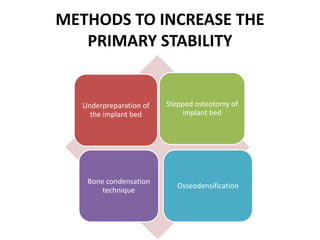
METHODS TO INCREASE THE
PRIMARY STABILITY
Underpreparation of
the implant bed
Stepped osteotomy of
implant bed
Bone condensation
technique
Osseodensification
Standard drill designs applied during osteotomies
are made to excavate bone to create room for
implant placement. They remove away the bone
effectively, however, typically do not produce a
precise circumferential osteotomy.
Unlike traditional bone drilling technologies, Osseo
densification (OD) does not excavate bone tissue.
The drill designing in OD creates an environment
which enhances the initial primary stability through
densification of the osteotomy site walls by
autografting of bone.
DEFINITION
Osseo densification (OD) is a newly developed
technique which creates an autograft layer of
condensed bone at the periphery of the
implant bed with the help of particularly
designed burs.
CONCEPT OF OSSEODENSIFICATION
OD is a novel, biomechanical, non excavation
osteotomy preparation technique developed
by Salah Huwais in 2013. For this purpose,
Huwais invented specially designed densifying
burs called Densah burs.
The rationale behind OD is the densification of
the bone that will be in immediate contact to
the implant results in higher degree of
primary stability. Due to physical interlocking
between the bone and device, faster new
bone growth formation due to osteoblasts
nucleating on instrumented bone that is in
close proximity with the implant.
BUR TECHNOLOGY
• Specially designed densah burs precisely cut
bone in the clockwise direction and densify
bone in a non cutting counterclockwise
direction combined with copious irrigation
which facilitates the surgical technique during
implant placement.
• Rotates at 800-1500 RPM ,has multiple flutes
within tapered geometry.
• This taper design controls the expansion process, as
the bur enters deeper into the osteotomy.
• The apical end includes atleast one lip to grind bone
when rotated in the counterclockwise/non-
cutting/burnishing direction and cut bone when
rotated in clockwise/cutting/drilling direction.
• Hence, rather than removing the bone chips and
debris, they work to move forward the bone chips
and debris inwards the implant bed.
TRADITIONAL VS
OSSEODENSIFICATION
TECHNIQUE OSSEODENSIFICATION
TECHNIQUE
TRADITIONAL DRILLING
TECHNIQUE
Bone
excavation
Non- excavation, bone
preservation method- autografting
of bone
Involves cutting and excavation
Bur design Taper design with more than four
lands and flutes to guide
osteotomy without chatter
Regular twist drills with only two
to four lands to guide osteotomy
Osteotomy Precise , 0.5mm smaller than
traditional drilling.
Not always precise may be
elliptical or elongated.
Heat
generation
Reduced with copious saline
irrigation and bouncing pumping
motion of bur.
During rotatory cutting is crucial
factor in osseointegration
Narrow
ridges
Facilitates expansion of narrow
ridges and facilitates larger
diameter implant placement
Larger diameter implant
placement can result in bone
dehiscence and fenestration
PROCEDURE
Densifying burs can be used with standard surgical engine
rotating at 800-1500 rpm in the counterclockwise, non
cutting/ burnishing direction (Densifying mode) to densify
bone or in the clockwise cutting direction (Cutting mode) as
a drill to cleanly cut the bone if needed.
A downward surgical pressure coupled with profuse
saline irrigation at the point of contact creates a
compression wave inside the osteotomy such that the
bone is compressed laterally by continuously rotating
and advancing the bur.
A densified layer is created along the walls and base
of the osteotomy, through compaction and
autografting the surrounding bone while plastically
expanding the bony ridge at the same time
• This allows the saline irrigation to gently pressurize
the bone walls and facilitates increased bone
plasticity and bone expansion.
• According to the study of inventors, the OD
technique increased the IT of implants to 49 Ncm
approximately in low density bone when compared
to 25 Ncm in standard conventional drilling
technique
ADVANTAGES
ENHANCES BONE DENSITY:
 A study conducted by Huwais S and Meyer EG
confirmed the hypothesis that the OD technique
increase primary stability, bone mineral density
and the percentage of bone at the implant surface.
 They also concluded that, by reserving bulk bone,
healing process would be accelerated due to bone
matrix, cells and biochemicals maintained and
autografted along the osteotomy surface site.
POST OPERATIVE BONE DENSITY
RESIDUAL RIDGE EXPANSION
 The dual use capability of densifying bur in
both cutting and noncutting direction may enable
the clinician to autograft the maxillary sinus and
expands any ridge in maxilla and mandible.
 Osseo densification facilitates ridge expansion
while maintaining alveolar ridge integrity, thereby
allowing for total implant length placement in
autogenous bone with adequate primary stability
and promotes a shorter waiting period to the
restoration.
INCREASES RESIDUAL STRAIN
 According to the manufacturer, the
bouncing motion (in and out movement) helps
to create a rate dependent stress to produce a
rate dependent strain and allows saline
irrigation to gently pressurize the bone walls.
 These together facilitate increased bone
plasticity and bone expansion.
INCREASES IMPLANT STABILITY
 The densah™ bur technology facilitates ridge
expansion with maintained alveolar ridge
integrity and also allows for complete implant
length placement in autogenous bone with
adequate primary stability.
 Despite compromised bone anatomy, OD
preserved bone bulk and promoted a shorter
waiting period to the restoration.
DISADVANTAGES
OD does not work with dense cortical bone as
cortical bone is a non dynamic tissue which lacks
plasticity.
Densification of xenografts should be avoided
because they behave biomechanically different
than the bone tissue, as they have only inorganic
content and they just provide the bulk without
any viscoelasticity.
Expensive procedure, requires additional
armamentarium &clinical expertise
DISCUSSION
 Trisi et al. has shown that Osseodensification technique is
able to increase the percent bone volume by
approximately 30% around dental implants inserted in
low-density bone in respect to conventional implant
drilling techniques, which may play a role in enhancing
implant stability and reduce micromotion.
 Lahen B et al., in their study examined the effect of OD on
the primary stability and early osseointegration of
implants. After 6 weeks histometric analysis was done
which showed positive effects.
 Lopez CD et al., in their study assessed the
biomechanical and histological effects of OD surgical
instrumentation in a spine model animal study and
concluded that this technique can potentially improve
the safety and success rates of bony drilling at all sites
of low bone density and limited bone volume.
 Falco et al 2016,Salah Huwais (2015) reported a case
of ridge expansion in a Seibert Class I ridge deficiency
using osseodensification burs. Two implants were
placed and at 1 year follow-up, radiographic
examination revealed maintained crestal bone level
and bone density
CONCLUSION
OD is a promising concept which creates an
autograft layer of condensed bone at the
periphery of the implant bed with the use of
densah burs that rotate in a clockwise and
anti-clockwise direction, thereby enhancing
implant stability and success with decreased
treatment time.
REFERENCES
• Huwais S, Meyer EG. Osseodensification: A novel approach in
implant preparation to increase primary stability, bone mineral
density and bone to implant contact. Int J Oral Maxillofac Implants.
2017;32(1):27-36.
• Huwais S, Meyer EG. A novel osseous densification approach in
implant osteotomy preparation to increase biomechanical primary
stability, bone mineral density and bone-to-implant contact. Int J
Oral Maxillofac Implants. 2017;32(1):27-36.
• Trisi P, Berardini M, Falco A, Vulpiani MP. New Osseo densification
implant site preparation method to increase bone density in low-
density bone: in vivo evaluation in sheep. Implant Dent.
2016;25(1):24-31.
• Gayathri S. “Osseo densification Technique – A Novel Bone
Preservation Method to Enhance Implant Stability”. Acta Scientific
Dental Sciences 2.12 (2018): 17-22.
OSSEODENSIFICATION

OSSEODENSIFICATION

  • 1.
  • 2.
    CONTENTS Introduction Definition Concept of osseodensification Characteristicsof densah bur Osseodensification vs conventional osteotomy Advantages Disadvantages Conclusion References
  • 4.
    Primary stability isaccomplished when there is no micro-movement of implant in its completely seated position. This allows the implant to mechanically interlock with the bone tissue until secondary stability is achieved.
  • 5.
    PRIMARY AND SECONDARYSTABILITY Due to surgical trauma, 1 mm of bone around the implant body gets devitalised, resorbed and remodelled in the initial period of osseointegration, this will decrease the primary stability. Later bone starts forming around implant body, thereby increasing the BIC This biologic stability of the implant known as secondary stability leads to an osseointegrated implant .
  • 6.
    IMPLANT STABILITY SECONDARY STABILITY •PRIMARYSTABILITY •BONE REMODLLING •IMPLANT SURFACE CHARACTERISTICS PRIMARY STABILITY •IMPLANT DESIGN •BONE QUANTITY/QUALITY •SURGICAL TECHNIQUE
  • 7.
    During osteotomy preparation,the maintenance and preservation of bone leads to enhanced primary mechanical stability, enhanced Bone to Implant Contact (BIC), thereby enhancing the implant secondary stability.
  • 8.
    METHODS TO INCREASETHE PRIMARY STABILITY Underpreparation of the implant bed Stepped osteotomy of implant bed Bone condensation technique Osseodensification
  • 10.
    Standard drill designsapplied during osteotomies are made to excavate bone to create room for implant placement. They remove away the bone effectively, however, typically do not produce a precise circumferential osteotomy. Unlike traditional bone drilling technologies, Osseo densification (OD) does not excavate bone tissue. The drill designing in OD creates an environment which enhances the initial primary stability through densification of the osteotomy site walls by autografting of bone.
  • 11.
    DEFINITION Osseo densification (OD)is a newly developed technique which creates an autograft layer of condensed bone at the periphery of the implant bed with the help of particularly designed burs.
  • 13.
    CONCEPT OF OSSEODENSIFICATION ODis a novel, biomechanical, non excavation osteotomy preparation technique developed by Salah Huwais in 2013. For this purpose, Huwais invented specially designed densifying burs called Densah burs.
  • 14.
    The rationale behindOD is the densification of the bone that will be in immediate contact to the implant results in higher degree of primary stability. Due to physical interlocking between the bone and device, faster new bone growth formation due to osteoblasts nucleating on instrumented bone that is in close proximity with the implant.
  • 15.
    BUR TECHNOLOGY • Speciallydesigned densah burs precisely cut bone in the clockwise direction and densify bone in a non cutting counterclockwise direction combined with copious irrigation which facilitates the surgical technique during implant placement. • Rotates at 800-1500 RPM ,has multiple flutes within tapered geometry.
  • 18.
    • This taperdesign controls the expansion process, as the bur enters deeper into the osteotomy. • The apical end includes atleast one lip to grind bone when rotated in the counterclockwise/non- cutting/burnishing direction and cut bone when rotated in clockwise/cutting/drilling direction. • Hence, rather than removing the bone chips and debris, they work to move forward the bone chips and debris inwards the implant bed.
  • 19.
  • 20.
    TECHNIQUE OSSEODENSIFICATION TECHNIQUE TRADITIONAL DRILLING TECHNIQUE Bone excavation Non-excavation, bone preservation method- autografting of bone Involves cutting and excavation Bur design Taper design with more than four lands and flutes to guide osteotomy without chatter Regular twist drills with only two to four lands to guide osteotomy Osteotomy Precise , 0.5mm smaller than traditional drilling. Not always precise may be elliptical or elongated. Heat generation Reduced with copious saline irrigation and bouncing pumping motion of bur. During rotatory cutting is crucial factor in osseointegration Narrow ridges Facilitates expansion of narrow ridges and facilitates larger diameter implant placement Larger diameter implant placement can result in bone dehiscence and fenestration
  • 21.
    PROCEDURE Densifying burs canbe used with standard surgical engine rotating at 800-1500 rpm in the counterclockwise, non cutting/ burnishing direction (Densifying mode) to densify bone or in the clockwise cutting direction (Cutting mode) as a drill to cleanly cut the bone if needed. A downward surgical pressure coupled with profuse saline irrigation at the point of contact creates a compression wave inside the osteotomy such that the bone is compressed laterally by continuously rotating and advancing the bur. A densified layer is created along the walls and base of the osteotomy, through compaction and autografting the surrounding bone while plastically expanding the bony ridge at the same time
  • 25.
    • This allowsthe saline irrigation to gently pressurize the bone walls and facilitates increased bone plasticity and bone expansion. • According to the study of inventors, the OD technique increased the IT of implants to 49 Ncm approximately in low density bone when compared to 25 Ncm in standard conventional drilling technique
  • 26.
  • 27.
    ENHANCES BONE DENSITY: A study conducted by Huwais S and Meyer EG confirmed the hypothesis that the OD technique increase primary stability, bone mineral density and the percentage of bone at the implant surface.  They also concluded that, by reserving bulk bone, healing process would be accelerated due to bone matrix, cells and biochemicals maintained and autografted along the osteotomy surface site.
  • 28.
  • 29.
    RESIDUAL RIDGE EXPANSION The dual use capability of densifying bur in both cutting and noncutting direction may enable the clinician to autograft the maxillary sinus and expands any ridge in maxilla and mandible.  Osseo densification facilitates ridge expansion while maintaining alveolar ridge integrity, thereby allowing for total implant length placement in autogenous bone with adequate primary stability and promotes a shorter waiting period to the restoration.
  • 31.
    INCREASES RESIDUAL STRAIN According to the manufacturer, the bouncing motion (in and out movement) helps to create a rate dependent stress to produce a rate dependent strain and allows saline irrigation to gently pressurize the bone walls.  These together facilitate increased bone plasticity and bone expansion.
  • 32.
    INCREASES IMPLANT STABILITY The densah™ bur technology facilitates ridge expansion with maintained alveolar ridge integrity and also allows for complete implant length placement in autogenous bone with adequate primary stability.  Despite compromised bone anatomy, OD preserved bone bulk and promoted a shorter waiting period to the restoration.
  • 34.
    DISADVANTAGES OD does notwork with dense cortical bone as cortical bone is a non dynamic tissue which lacks plasticity. Densification of xenografts should be avoided because they behave biomechanically different than the bone tissue, as they have only inorganic content and they just provide the bulk without any viscoelasticity. Expensive procedure, requires additional armamentarium &clinical expertise
  • 35.
    DISCUSSION  Trisi etal. has shown that Osseodensification technique is able to increase the percent bone volume by approximately 30% around dental implants inserted in low-density bone in respect to conventional implant drilling techniques, which may play a role in enhancing implant stability and reduce micromotion.  Lahen B et al., in their study examined the effect of OD on the primary stability and early osseointegration of implants. After 6 weeks histometric analysis was done which showed positive effects.
  • 36.
     Lopez CDet al., in their study assessed the biomechanical and histological effects of OD surgical instrumentation in a spine model animal study and concluded that this technique can potentially improve the safety and success rates of bony drilling at all sites of low bone density and limited bone volume.  Falco et al 2016,Salah Huwais (2015) reported a case of ridge expansion in a Seibert Class I ridge deficiency using osseodensification burs. Two implants were placed and at 1 year follow-up, radiographic examination revealed maintained crestal bone level and bone density
  • 37.
    CONCLUSION OD is apromising concept which creates an autograft layer of condensed bone at the periphery of the implant bed with the use of densah burs that rotate in a clockwise and anti-clockwise direction, thereby enhancing implant stability and success with decreased treatment time.
  • 38.
    REFERENCES • Huwais S,Meyer EG. Osseodensification: A novel approach in implant preparation to increase primary stability, bone mineral density and bone to implant contact. Int J Oral Maxillofac Implants. 2017;32(1):27-36. • Huwais S, Meyer EG. A novel osseous densification approach in implant osteotomy preparation to increase biomechanical primary stability, bone mineral density and bone-to-implant contact. Int J Oral Maxillofac Implants. 2017;32(1):27-36. • Trisi P, Berardini M, Falco A, Vulpiani MP. New Osseo densification implant site preparation method to increase bone density in low- density bone: in vivo evaluation in sheep. Implant Dent. 2016;25(1):24-31. • Gayathri S. “Osseo densification Technique – A Novel Bone Preservation Method to Enhance Implant Stability”. Acta Scientific Dental Sciences 2.12 (2018): 17-22.