By, T.MYTHREYEE ROOT CONDITIONING AGENTS
Periodontium-Gingiva,Alveolar bone,Periodontal ligament,Cementum. Periodontal diseases-main etiological agent-’’BACTERIA’’. On the root surface bacteria are mostly gram –ve bacteria.
 
These bacteria in the cementum of teeth with untreated periodontal disease Endotoxins(have potent inflammatory agents) Prevent the growth of FIBROBLASTS and are CYTOTOXIC.
These changes create obstacle to new ATTACHMENT. So the root must be cleaned of cementum bound endotoxins. In vitro mechanical removal of cementum is possible and showed new growth of cells(Aleo,et al 1975;Cogen et al 1983,1984)
ATTACHMENT LOSS
Root planing removes diseased cementum but it produces a ‘’smear layer’’. In vivo total removal of cementum is not possible and trace amounts of endotoxins are left behind(JONES and O’HEARY,1978).
TOPICAL CHEMOTHERAPUTIC AGENTS:for detoxification and enhancement of new attachment in: Cosmetic gingival reconstruction(Miller,1985) Bone augmentation(Yukna,1980) Overcome rapid rate of epithelial proliferation down along the root.
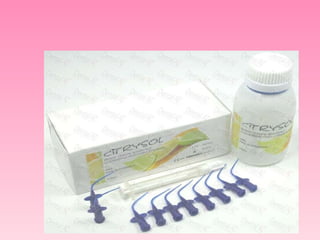
Use of acids-1 st  reported in NEWYORK DENTAL RECORD in 1846,later YOUNGER(1893) Several substances have been used for ROOT CONDITIONING- These include Citric acid,Fibronectin,Tetracycline.
CITRIC ACID Studies by Urist showed formation of new bone or cementum on partially or totally  demineralised dentin matrix or allogenic bone. pH-1.0-1.4 Application time-2or 3 min.
 
MODE OF ACTION Removal of smear layer formed after root planing This creates a mat like collagen surface with exposed dentinal tubules PDL cells and gingival FIBROBLASTS adhere better to demineralized root surface.
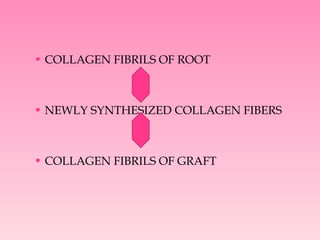
CITRIC ACID MECHANISM FOR GAINING ROOT COVERAGE EXPOSED ROOT SURFACE CITRIC ACID Ph 1.0 4microns DEMINERALIZED SURFACE EXPOSED COLLAGEN FIBRILS +EXPOSED COLLAGEN FIBRILS OF FLAP OR GRAFT. PLASMA FIBRONECTIN FACTOR,FACTOR 13 FIBRIN COVALENT LINKAGE
COLLAGEN FIBRILS OF ROOT NEWLY SYNTHESIZED COLLAGEN FIBERS COLLAGEN FIBRILS OF GRAFT
ACTIONS Accelerated healing and new cementum formation. No significant action on non-root planed roots,after root planing-4mm deep demineralized zone is created. Antibacterial effect.(Daly,1982) Root detoxification(Aleo et al,1975) Prevents migration of epithelium . Enhanced fibroblast growth and stability(Boyko et al ,1980) Attachment by direct linkage.
TECHNIQUE OF APPLICATION
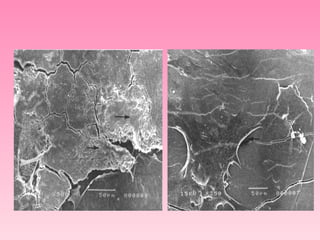
TETRACYCLINE HCL Actions- Antibacterial,exposure of root collagen and opening of the dentinal tubules Demineralization Detoxification Attachment by direct linkage
Other advantages
  DISADVANTAGES Requires high concentrations(>0-5%) Longer application times(>5min) Not so effective as CA in root demineralization and removal of smear layer. No human histologic or clinical studies show +ve results as CA.
FIBRONECTIN It  is a glycoprotein that  fibroblasts require to attach to root surfaces. Addition of fibronectin-promotes new attachment. Fibronectin-fibrin sealing system helps in healing of PERIODONTAL SURGICAL WOUNDS Commercially available in Europe as ‘’TISSUCOL’’.
 
ACTIONS Enhances the effect of demineralization with regard to new attachment Enhances cell proliferation from PDL and SUPRACRESTAL area Conc-0.38/ml saline,has also been used as a substitute for sutures Chemotactic effect on fibroblasts and mesenchymal cells.
 
 
APPLICATIONS COSMETIC GINGIVAL RECONSTRUCTION PRIOR TO PLACEMENT OF BONE IMPLANTS INFRABONY DEFECTS IMPLANT ADDITIVE(TTC) PRIMARY TREATMENT FOR CL2 FURCATIONS.
CONCLUSION Although not yet fully supported by research on humans,CA and TTC have significant benefits that cannot be achieved by scaling and root planing alone. In future they may provide a surface substrate for use of’’ PROTEIN MODIFIERS’’. Note:’’SYNTHETIC BIOLOGIC PROTEIN MODIFIERS’’-artificially stimulate tissue regeneration.
Hope u liked it…THANK YOU!

Root conditioning agents

  • 1.
    By, T.MYTHREYEE ROOTCONDITIONING AGENTS
  • 2.
    Periodontium-Gingiva,Alveolar bone,Periodontal ligament,Cementum.Periodontal diseases-main etiological agent-’’BACTERIA’’. On the root surface bacteria are mostly gram –ve bacteria.
  • 3.
  • 4.
    These bacteria inthe cementum of teeth with untreated periodontal disease Endotoxins(have potent inflammatory agents) Prevent the growth of FIBROBLASTS and are CYTOTOXIC.
  • 5.
    These changes createobstacle to new ATTACHMENT. So the root must be cleaned of cementum bound endotoxins. In vitro mechanical removal of cementum is possible and showed new growth of cells(Aleo,et al 1975;Cogen et al 1983,1984)
  • 6.
  • 7.
    Root planing removesdiseased cementum but it produces a ‘’smear layer’’. In vivo total removal of cementum is not possible and trace amounts of endotoxins are left behind(JONES and O’HEARY,1978).
  • 8.
    TOPICAL CHEMOTHERAPUTIC AGENTS:fordetoxification and enhancement of new attachment in: Cosmetic gingival reconstruction(Miller,1985) Bone augmentation(Yukna,1980) Overcome rapid rate of epithelial proliferation down along the root.
  • 9.
    Use of acids-1st reported in NEWYORK DENTAL RECORD in 1846,later YOUNGER(1893) Several substances have been used for ROOT CONDITIONING- These include Citric acid,Fibronectin,Tetracycline.
  • 10.
    CITRIC ACID Studiesby Urist showed formation of new bone or cementum on partially or totally demineralised dentin matrix or allogenic bone. pH-1.0-1.4 Application time-2or 3 min.
  • 11.
  • 12.
    MODE OF ACTIONRemoval of smear layer formed after root planing This creates a mat like collagen surface with exposed dentinal tubules PDL cells and gingival FIBROBLASTS adhere better to demineralized root surface.
  • 13.
    CITRIC ACID MECHANISMFOR GAINING ROOT COVERAGE EXPOSED ROOT SURFACE CITRIC ACID Ph 1.0 4microns DEMINERALIZED SURFACE EXPOSED COLLAGEN FIBRILS +EXPOSED COLLAGEN FIBRILS OF FLAP OR GRAFT. PLASMA FIBRONECTIN FACTOR,FACTOR 13 FIBRIN COVALENT LINKAGE
  • 14.
    COLLAGEN FIBRILS OFROOT NEWLY SYNTHESIZED COLLAGEN FIBERS COLLAGEN FIBRILS OF GRAFT
  • 15.
    ACTIONS Accelerated healingand new cementum formation. No significant action on non-root planed roots,after root planing-4mm deep demineralized zone is created. Antibacterial effect.(Daly,1982) Root detoxification(Aleo et al,1975) Prevents migration of epithelium . Enhanced fibroblast growth and stability(Boyko et al ,1980) Attachment by direct linkage.
  • 16.
  • 17.
    TETRACYCLINE HCL Actions-Antibacterial,exposure of root collagen and opening of the dentinal tubules Demineralization Detoxification Attachment by direct linkage
  • 18.
  • 19.
    DISADVANTAGESRequires high concentrations(>0-5%) Longer application times(>5min) Not so effective as CA in root demineralization and removal of smear layer. No human histologic or clinical studies show +ve results as CA.
  • 20.
    FIBRONECTIN It is a glycoprotein that fibroblasts require to attach to root surfaces. Addition of fibronectin-promotes new attachment. Fibronectin-fibrin sealing system helps in healing of PERIODONTAL SURGICAL WOUNDS Commercially available in Europe as ‘’TISSUCOL’’.
  • 21.
  • 22.
    ACTIONS Enhances theeffect of demineralization with regard to new attachment Enhances cell proliferation from PDL and SUPRACRESTAL area Conc-0.38/ml saline,has also been used as a substitute for sutures Chemotactic effect on fibroblasts and mesenchymal cells.
  • 23.
  • 24.
  • 25.
    APPLICATIONS COSMETIC GINGIVALRECONSTRUCTION PRIOR TO PLACEMENT OF BONE IMPLANTS INFRABONY DEFECTS IMPLANT ADDITIVE(TTC) PRIMARY TREATMENT FOR CL2 FURCATIONS.
  • 26.
    CONCLUSION Although notyet fully supported by research on humans,CA and TTC have significant benefits that cannot be achieved by scaling and root planing alone. In future they may provide a surface substrate for use of’’ PROTEIN MODIFIERS’’. Note:’’SYNTHETIC BIOLOGIC PROTEIN MODIFIERS’’-artificially stimulate tissue regeneration.
  • 27.
    Hope u likedit…THANK YOU!