GINGIVAL   CURETTAGE PARTH M THAKKAR DENTOMEDIA
   gingival curettage    curette    subgingival curettage
CURETTAGE :  scraping of the gingival wall of a  periodontal pocket to separate the diseased soft tissue GINGIVAL   CURETTAGE : removal of the inflamed soft tissue lateral to the pocket wall SUBGINGIVAL   CURETTAGE : performed apical to the  epithelial attachment, severing the C.T. attachment to the osseous crest INADVERTANT   CURETTAGE : some degree of  curettage done unintentionally during scaling and root planings AIM : to reduce pocket depth by enhancing gingival  shrinkage, new C.T. attachment or both
   gingival curettage    subgingival curettage
RATIONALE/ BASIS/ PRINCIPLE:    removal of chronically inflamed granulat n  tissue that  forms in the lateral wall of the periodontal pocket. This contains granulat n  tissue, chronic infl n , pieces of  dislodged calculus & bacterial colonies inflamed granulat n  tissue is lined by epithelium    root planing   major source of bact. disappears &  pocket pathologic changes resolve. Existing granulat n tissue is slowly resorbed & bact. are destroyed    it may also eliminate all or most of the epithelium that lines the pocket wall and the J.E. purpose of curettage is valid particularly when attempt is made at new attachment esp in infrabony pockets
INDICATIONS  to   eliminate shallow suprabony pockets  located in accessible areas & have an inflamed oedematous pocket wall that shrinks to sulcus depth after Rx    as part of new attachment attempt in  moderately deep infrabony pockets  in inaccessible areas (close surgery) as a  non- definitive procedure  prior to flap surgery to reduce infln or in whom more aggressive surgical  techq’s are c/I due to age, systemic problem,etc.  as  maintenance treatment   on recall visits for areas of    recurrent infln & pocket depth  AIMS:     to   eliminate periodontal pocket to restore gingiva to normal health w.r.t. colour, contour,  consistency, surface texture    to eliminate infl n  in v. deep pockets before doing any surgery
CONTRA  INDICATIONS Local where pockets are tortuous where opening of pocket is narrow & base is broad molars are tilted  soft ts wall is fibrotic (hyperplasia in pt. on dilantin sodium in  epilepsy) furcation involvement Systemic H/o bld dyscrasias, diabetes or any other debilitating  disease Drug history- pt. on corticosteroid or allergy to l.a.
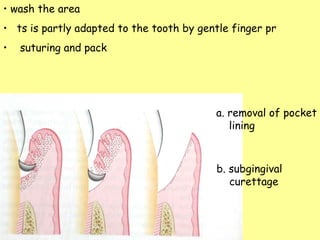
PROCEDURE Basic   technique: Armamentarium- Gracey curettes L.A- surface anesthesia (superficial curettage)   infiltrate (deep curettage) before doing curettage, S/RP shd be done thoroughly L.A. curette selection insert the inst so as to engage the inner lining of the pocket  wall & is carried along the soft tissue  usually in a  horizontal stroke . The pocket wall may be supported by  gentle finger pressure on external surface. subgingival curettage–  ts attached b/w the bottom of the  pocket & alv crest are removed with a scooping motion  of the instrument to the tooth surface
wash the area  ts is partly adapted to the tooth by gentle finger pr suturing and pack a. removal of pocket lining b. subgingival  curettage
OTHER   TECHNIQUES Excisional New Attachment Procedure (ENAP)–   a definitive subgingival procedure performed with a knife after adequate L.A., mark the pocket with a perio probe  With a surgical blade make an internal bevel incision  from the free gingiva apical to a point below the  bottom of the pocket carrying it I/P on both facial &  lingual sides remove the excised ts with a curette root planing (preserve all c.t. fibres that remain attached  to the root surface) irrigate  approximate  the wound edges (recontour bone if required) sutures and dressing
ay also eliminate all o
Ultrasonic curettage-  using ultrasonic devices ultrasonic vibrations disrupt ts continuity & lift off the epithelium results in a narrow band of necrotic ts  ed infl n  & less removal of C.T These inst’s are not as effective as hand inst’s in  removing c.t. & leaving a smooth pocket wall Chemical curettage-  using caustic drugs sodium sulfide alk sodium hypochlorite phenol These were discarded after studies showed their  ineffectiveness The extent of ts destruction cannot be controlled They may    rather than reduce the amount of ts to be  removed by enzymes & phagocytes
HEALING:    immediately after curettage, a bld clot fills the  pocket area ( this is organized into granul n  ts) haemorrhage in ts (dilated cap’s) &    PMNL’s on  wound surface    rapid proliferation of granul n  ts    ts maturation (   smal bld vs)    epithelization of sulcus takes 2-7 days CLINICAL APPEARANCE: immediately after curettage, gingiva appears hemorrhagic &  bright red after 1 wk, gingiva is slightly redder than normal   apical shift in position of marginal gingiva after 2wk, normal color, contour, consistency, s.t.  gingival margin well adapted
COMPLICATIONS: Dev of sensitivity-  assure the pt.that it disappears as the denuded root gets new attachment & J.E If it does not disappear by few days, then  prescribe desensitizing T/P  local application of 8% zinc chloride 10% strontium chloride 5% sodium fluoride 2. Pain on percussion-  bec   of infl n  in pdl fibres 3. Bleeding can also occur

Gingival curettage

  • 1.
    GINGIVAL CURETTAGE PARTH M THAKKAR DENTOMEDIA
  • 2.
     gingival curettage  curette  subgingival curettage
  • 3.
    CURETTAGE : scraping of the gingival wall of a periodontal pocket to separate the diseased soft tissue GINGIVAL CURETTAGE : removal of the inflamed soft tissue lateral to the pocket wall SUBGINGIVAL CURETTAGE : performed apical to the epithelial attachment, severing the C.T. attachment to the osseous crest INADVERTANT CURETTAGE : some degree of curettage done unintentionally during scaling and root planings AIM : to reduce pocket depth by enhancing gingival shrinkage, new C.T. attachment or both
  • 4.
     gingival curettage  subgingival curettage
  • 5.
    RATIONALE/ BASIS/ PRINCIPLE: removal of chronically inflamed granulat n tissue that forms in the lateral wall of the periodontal pocket. This contains granulat n tissue, chronic infl n , pieces of dislodged calculus & bacterial colonies inflamed granulat n tissue is lined by epithelium  root planing  major source of bact. disappears & pocket pathologic changes resolve. Existing granulat n tissue is slowly resorbed & bact. are destroyed  it may also eliminate all or most of the epithelium that lines the pocket wall and the J.E. purpose of curettage is valid particularly when attempt is made at new attachment esp in infrabony pockets
  • 6.
    INDICATIONS  to eliminate shallow suprabony pockets located in accessible areas & have an inflamed oedematous pocket wall that shrinks to sulcus depth after Rx  as part of new attachment attempt in moderately deep infrabony pockets in inaccessible areas (close surgery) as a non- definitive procedure prior to flap surgery to reduce infln or in whom more aggressive surgical techq’s are c/I due to age, systemic problem,etc. as maintenance treatment on recall visits for areas of recurrent infln & pocket depth AIMS:  to eliminate periodontal pocket to restore gingiva to normal health w.r.t. colour, contour, consistency, surface texture  to eliminate infl n in v. deep pockets before doing any surgery
  • 7.
    CONTRA INDICATIONSLocal where pockets are tortuous where opening of pocket is narrow & base is broad molars are tilted soft ts wall is fibrotic (hyperplasia in pt. on dilantin sodium in epilepsy) furcation involvement Systemic H/o bld dyscrasias, diabetes or any other debilitating disease Drug history- pt. on corticosteroid or allergy to l.a.
  • 8.
    PROCEDURE Basic technique: Armamentarium- Gracey curettes L.A- surface anesthesia (superficial curettage) infiltrate (deep curettage) before doing curettage, S/RP shd be done thoroughly L.A. curette selection insert the inst so as to engage the inner lining of the pocket wall & is carried along the soft tissue usually in a horizontal stroke . The pocket wall may be supported by gentle finger pressure on external surface. subgingival curettage– ts attached b/w the bottom of the pocket & alv crest are removed with a scooping motion of the instrument to the tooth surface
  • 9.
    wash the area ts is partly adapted to the tooth by gentle finger pr suturing and pack a. removal of pocket lining b. subgingival curettage
  • 10.
    OTHER TECHNIQUES Excisional New Attachment Procedure (ENAP)– a definitive subgingival procedure performed with a knife after adequate L.A., mark the pocket with a perio probe With a surgical blade make an internal bevel incision from the free gingiva apical to a point below the bottom of the pocket carrying it I/P on both facial & lingual sides remove the excised ts with a curette root planing (preserve all c.t. fibres that remain attached to the root surface) irrigate approximate the wound edges (recontour bone if required) sutures and dressing
  • 11.
  • 12.
    Ultrasonic curettage- using ultrasonic devices ultrasonic vibrations disrupt ts continuity & lift off the epithelium results in a narrow band of necrotic ts  ed infl n & less removal of C.T These inst’s are not as effective as hand inst’s in removing c.t. & leaving a smooth pocket wall Chemical curettage- using caustic drugs sodium sulfide alk sodium hypochlorite phenol These were discarded after studies showed their ineffectiveness The extent of ts destruction cannot be controlled They may  rather than reduce the amount of ts to be removed by enzymes & phagocytes
  • 13.
    HEALING:  immediately after curettage, a bld clot fills the pocket area ( this is organized into granul n ts) haemorrhage in ts (dilated cap’s) &  PMNL’s on wound surface  rapid proliferation of granul n ts  ts maturation (  smal bld vs)  epithelization of sulcus takes 2-7 days CLINICAL APPEARANCE: immediately after curettage, gingiva appears hemorrhagic & bright red after 1 wk, gingiva is slightly redder than normal apical shift in position of marginal gingiva after 2wk, normal color, contour, consistency, s.t. gingival margin well adapted
  • 14.
    COMPLICATIONS: Dev ofsensitivity- assure the pt.that it disappears as the denuded root gets new attachment & J.E If it does not disappear by few days, then prescribe desensitizing T/P local application of 8% zinc chloride 10% strontium chloride 5% sodium fluoride 2. Pain on percussion- bec of infl n in pdl fibres 3. Bleeding can also occur

Editor's Notes