Industrial Revolution
Philosophers
New economic ideas.
Laissez – Faire Economics






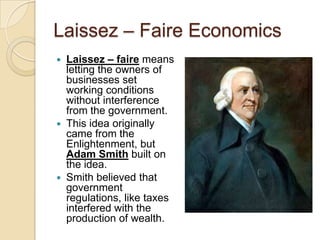
Laissez – faire means
letting the owners of
businesses set
working conditions
without interference
from the government.
This idea originally
came from the
Enlightenment, but
Adam Smith built on
the idea.
Smith believed that
government
regulations, like taxes
interfered with the
production of wealth.
Malthus, Ricardo, and
Capitalism!




Thomas Malthus and
David Ricardo
agreed with Smith’s
ideas.
They took Smith’s
ideas further which
led to modern day
capitalism a system
in which money is
invested in business
ventures with the
goal of making a
profit.
Malthus Further
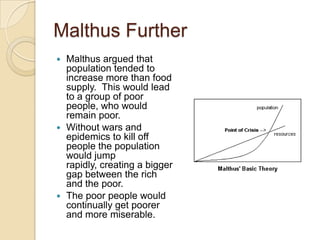
Malthus argued that
population tended to
increase more than food
supply. This would lead
to a group of poor
people, who would
remain poor.
 Without wars and
epidemics to kill off
people the population
would jump
rapidly, creating a bigger
gap between the rich
and the poor.
 The poor people would
continually get poorer
and more miserable.

Ricardo Further






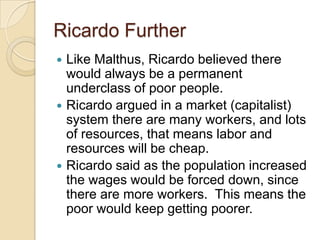
Like Malthus, Ricardo believed there
would always be a permanent
underclass of poor people.
Ricardo argued in a market (capitalist)
system there are many workers, and lots
of resources, that means labor and
resources will be cheap.
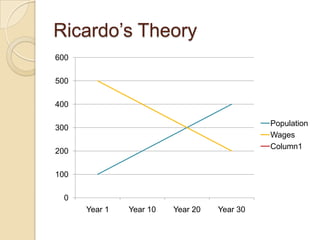
Ricardo said as the population increased
the wages would be forced down, since
there are more workers. This means the
poor would keep getting poorer.
Ricardo’s Theory
600
500
400
Population
Wages
Column1

300
200
100
0
Year 1

Year 10

Year 20

Year 30
Utilitarianism






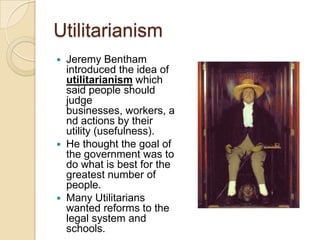
Jeremy Bentham
introduced the idea of
utilitarianism which
said people should
judge
businesses, workers, a
nd actions by their
utility (usefulness).
He thought the goal of
the government was to
do what is best for the
greatest number of
people.
Many Utilitarians
wanted reforms to the
legal system and
schools.
Utopian Ideas






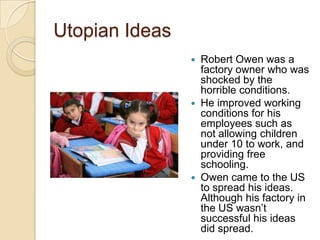
Robert Owen was a
factory owner who was
shocked by the
horrible conditions.
He improved working
conditions for his
employees such as
not allowing children
under 10 to work, and
providing free
schooling.
Owen came to the US
to spread his ideas.
Although his factory in
the US wasn’t
successful his ideas
did spread.
Socialism




French reformers
wanted to balance the
effects of
industrialization with
socialism in which the
factors of production
are owned by the
public and operate for
the welfare of all.
What that means is
the government owns
the resources that
businesses needed for
industrialization.
Socialism Further






The basic belief behind socialism was
that the government should actively plan
the economy rather than letting the
market determine what will happen.
Socialists believed if the government
controlled and regulated
resources, factories, and other key
industries that poverty could be
abolished, and equality would be
promoted.
Socialists had a positive view of people
and the future.
Communism




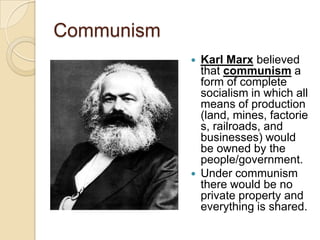
Karl Marx believed
that communism a
form of complete
socialism in which all
means of production
(land, mines, factorie
s, railroads, and
businesses) would
be owned by the
people/government.
Under communism
there would be no
private property and
everything is shared.
Communism Further










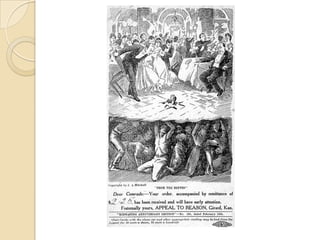
Marx believed economics to be the cause of every
problem in society.
Marx believed there were two types of people:
bourgeoisie or the proletariat.
In his book The Communist Manifesto Marx said the
bourgeoisie were the people that had everything they
needed and held down the proletariat who were the
have-nots. The wealthy controlled the means of
production and help the poor down.
Marx believed the capitalist system produced by the
Industrial Revolution would eventually destroy itself and
communism would spread.
Marx’s ideas inspired many attempted revolutions
throughout Europe in 1848 – 1849 that were put down
by European leaders.
Despite these failures Marx’s idea continued to spread .
..
Rise of Unions
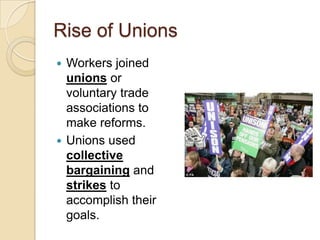
Workers joined
unions or
voluntary trade
associations to
make reforms.
 Unions used
collective
bargaining and
strikes to
accomplish their
goals.


Industrial revolution philosophers

  • 1.
  • 2.
    Laissez – FaireEconomics    Laissez – faire means letting the owners of businesses set working conditions without interference from the government. This idea originally came from the Enlightenment, but Adam Smith built on the idea. Smith believed that government regulations, like taxes interfered with the production of wealth.
  • 3.
    Malthus, Ricardo, and Capitalism!   ThomasMalthus and David Ricardo agreed with Smith’s ideas. They took Smith’s ideas further which led to modern day capitalism a system in which money is invested in business ventures with the goal of making a profit.
  • 4.
    Malthus Further Malthus arguedthat population tended to increase more than food supply. This would lead to a group of poor people, who would remain poor.  Without wars and epidemics to kill off people the population would jump rapidly, creating a bigger gap between the rich and the poor.  The poor people would continually get poorer and more miserable. 
  • 5.
    Ricardo Further    Like Malthus,Ricardo believed there would always be a permanent underclass of poor people. Ricardo argued in a market (capitalist) system there are many workers, and lots of resources, that means labor and resources will be cheap. Ricardo said as the population increased the wages would be forced down, since there are more workers. This means the poor would keep getting poorer.
  • 6.
  • 7.
    Utilitarianism    Jeremy Bentham introduced theidea of utilitarianism which said people should judge businesses, workers, a nd actions by their utility (usefulness). He thought the goal of the government was to do what is best for the greatest number of people. Many Utilitarians wanted reforms to the legal system and schools.
  • 8.
    Utopian Ideas    Robert Owenwas a factory owner who was shocked by the horrible conditions. He improved working conditions for his employees such as not allowing children under 10 to work, and providing free schooling. Owen came to the US to spread his ideas. Although his factory in the US wasn’t successful his ideas did spread.
  • 9.
    Socialism   French reformers wanted tobalance the effects of industrialization with socialism in which the factors of production are owned by the public and operate for the welfare of all. What that means is the government owns the resources that businesses needed for industrialization.
  • 10.
    Socialism Further    The basicbelief behind socialism was that the government should actively plan the economy rather than letting the market determine what will happen. Socialists believed if the government controlled and regulated resources, factories, and other key industries that poverty could be abolished, and equality would be promoted. Socialists had a positive view of people and the future.
  • 11.
    Communism   Karl Marx believed thatcommunism a form of complete socialism in which all means of production (land, mines, factorie s, railroads, and businesses) would be owned by the people/government. Under communism there would be no private property and everything is shared.
  • 12.
    Communism Further       Marx believedeconomics to be the cause of every problem in society. Marx believed there were two types of people: bourgeoisie or the proletariat. In his book The Communist Manifesto Marx said the bourgeoisie were the people that had everything they needed and held down the proletariat who were the have-nots. The wealthy controlled the means of production and help the poor down. Marx believed the capitalist system produced by the Industrial Revolution would eventually destroy itself and communism would spread. Marx’s ideas inspired many attempted revolutions throughout Europe in 1848 – 1849 that were put down by European leaders. Despite these failures Marx’s idea continued to spread . ..
  • 14.
    Rise of Unions Workersjoined unions or voluntary trade associations to make reforms.  Unions used collective bargaining and strikes to accomplish their goals. 