IMMUNOMODULATORS
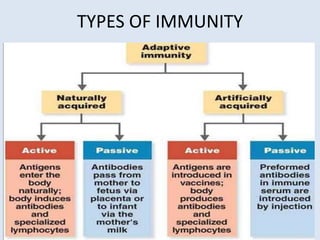
TYPES OF IMMUNITY
Immune System
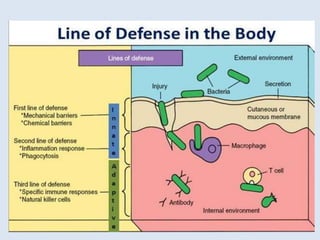
• Immune System A biochemical complex that
protects the body against Pathogenic organisms,
Foreign bodies and Its own cells that become
cancerous.
• Immunity: Innate, Natural -Complement,
Granulocytes, Monocytes /macrophages, NK
cells, Mast cells, Basophils Adaptive, Learned - B
and T lymphocytes, B: antibodies, T : helper,
cytolytic , suppressor
Immune System
The system incorporates the
• Humoral immune response- B Cells- antibodies .
• Cell mediated response, - uses T-cells
• Dysregulation of this system can result into
serious problem.
• Autoimmune diseases
• Allergic reactions including anaphylaxis
• Tissue/organ rejection
Immunostimulants:
Immunostimulants:
• Increase the immune responsiveness of
patients who have either selective or
generalized immunodeficiency.
• Used for:
immunodeficiency disorders, chronic infectious
diseases, and cancer
Cytokines
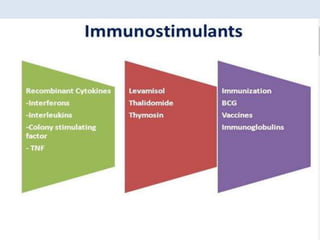
• Cytokines Developed by rDNA (recombinant) technology .
• TNF
• Colony Stimulating factors (G-CSF, M-CSF, GM-CSF, etc)
• Interferon (INF): INF- α,β,γ
• Antiviral, anticancer.
• Adverse Effects: flu-like symptoms, fatigue malaise
• Interleukin-2 (IL-2)
• T cell proliferation, T H , NK, LAK cell activation .
• Treatment of malignant melanoma, renal cell carcinoma,
Hodgkin disease .
• Adverse Effects: fever, anorexia .
• Applications in the treatment of viral infections,
autoimmune and neoplastic diseases
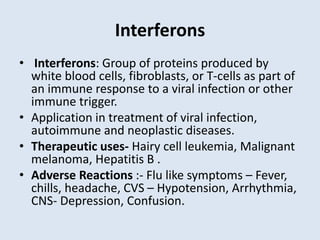
Interferons
• Interferons: Group of proteins produced by
white blood cells, fibroblasts, or T-cells as part of
an immune response to a viral infection or other
immune trigger.
• Application in treatment of viral infection,
autoimmune and neoplastic diseases.
• Therapeutic uses- Hairy cell leukemia, Malignant
melanoma, Hepatitis B .
• Adverse Reactions :- Flu like symptoms – Fever,
chills, headache, CVS – Hypotension, Arrhythmia,
CNS- Depression, Confusion.
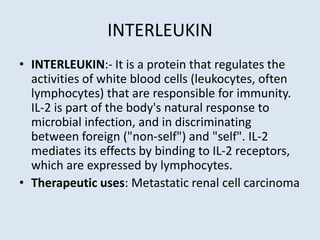
INTERLEUKIN
• INTERLEUKIN:- It is a protein that regulates the
activities of white blood cells (leukocytes, often
lymphocytes) that are responsible for immunity.
IL-2 is part of the body's natural response to
microbial infection, and in discriminating
between foreign ("non-self") and "self". IL-2
mediates its effects by binding to IL-2 receptors,
which are expressed by lymphocytes.
• Therapeutic uses: Metastatic renal cell carcinoma
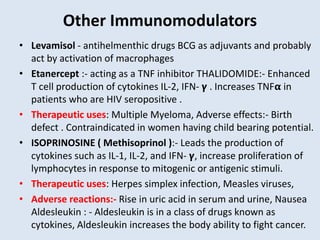
Other Immunomodulators
• Levamisol - antihelmenthic drugs BCG as adjuvants and probably
act by activation of macrophages
• Etanercept :- acting as a TNF inhibitor THALIDOMIDE:- Enhanced
T cell production of cytokines IL-2, IFN- 𝝲 . Increases TNF𝝰 in
patients who are HIV seropositive .
• Therapeutic uses: Multiple Myeloma, Adverse effects:- Birth
defect . Contraindicated in women having child bearing potential.
• ISOPRINOSINE ( Methisoprinol ):- Leads the production of
cytokines such as IL-1, IL-2, and IFN- 𝝲, increase proliferation of
lymphocytes in response to mitogenic or antigenic stimuli.
• Therapeutic uses: Herpes simplex infection, Measles viruses,
• Adverse reactions:- Rise in uric acid in serum and urine, Nausea
Aldesleukin : - Aldesleukin is in a class of drugs known as
cytokines, Aldesleukin increases the body ability to fight cancer.
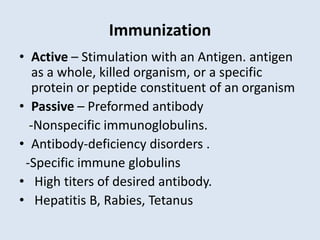
Immunization
• Active – Stimulation with an Antigen. antigen
as a whole, killed organism, or a specific
protein or peptide constituent of an organism
• Passive – Preformed antibody
-Nonspecific immunoglobulins.
• Antibody-deficiency disorders .
-Specific immune globulins
• High titers of desired antibody.
• Hepatitis B, Rabies, Tetanus
Vaccines
• Suspensions of live, attenuated (weakened) or
killed (inactivated) micro-organisms .
• The weakened form prevents the person from
contracting the disease .
• Also stimulate the production of antigens against
a specific antibody.
• Vaccinations with live bacteria or virus provide
lifelong immunity.
• Vaccinations with killed bacteria or virus provide
partial immunity, and booster shots are needed
periodically.
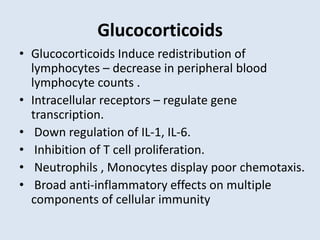
Glucocorticoids
• Glucocorticoids Induce redistribution of
lymphocytes – decrease in peripheral blood
lymphocyte counts .
• Intracellular receptors – regulate gene
transcription.
• Down regulation of IL-1, IL-6.
• Inhibition of T cell proliferation.
• Neutrophils , Monocytes display poor chemotaxis.
• Broad anti-inflammatory effects on multiple
components of cellular immunity
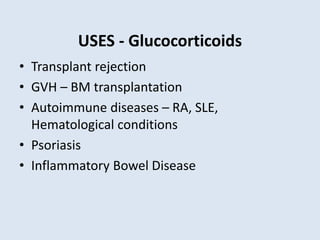
USES - Glucocorticoids
• Transplant rejection
• GVH – BM transplantation
• Autoimmune diseases – RA, SLE,
Hematological conditions
• Psoriasis
• Inflammatory Bowel Disease
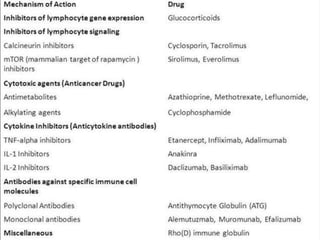
CALCINEURIN INHIBITORS
• Calcineurin (CN) is a protein phosphatase activates the T
cells of the immune system and can be blocked by drugs.
Cyclosporine –

• Bind to the cytosolic protein cyclophilin (an
immunophilin ) of immunocompetent lymphocytes,
especially T-lymphocytes .
• This complex of cyclosporin and cyclophilin inhibits the
phosphatase calcineurin, which under normal
circumstances induces the transcription of interleukin-2 .
• The drug also inhibits lymphokine production and
interleukin release, leading to a reduced function of
effector T-cells.
Uses
• Organ transplantation: Kidney, Liver, Heart
• Rheumatoid arthritis, IBD, uveitis
• Psoriasis
• Aplastic anemia
• Skin Conditions- Atopic dermatitis, Alopecia
Areata, Pemphigus vulgaris, Lichen planus,
Pyoderma gangrenosum
Tacrolimus
– It binds to the immunophilin FKBP1A , followed
by the binding of the complex to calcineurin and
the inhibition of its phosphatase activity. In this
way, it prevents the cell from transitioning from the
G 0 into G 1 phase of the cell cycle . Tacrolimus is
more potent than ciclosporin and has less
pronounced side-effects.
Uses
- Prophylaxis of solid-organ allograft rejection
–Topical preparation available for use in atopic
dermatitis and psoriasis.
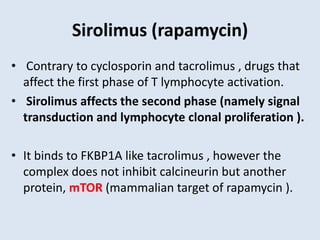
Sirolimus (rapamycin)
• Contrary to cyclosporin and tacrolimus , drugs that
affect the first phase of T lymphocyte activation.
• Sirolimus affects the second phase (namely signal
transduction and lymphocyte clonal proliferation ).
• It binds to FKBP1A like tacrolimus , however the
complex does not inhibit calcineurin but another
protein, mTOR (mammalian target of rapamycin ).
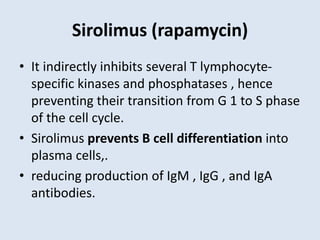
Sirolimus (rapamycin)
• It indirectly inhibits several T lymphocyte-
specific kinases and phosphatases , hence
preventing their transition from G 1 to S phase
of the cell cycle.
• Sirolimus prevents B cell differentiation into
plasma cells,.
• reducing production of IgM , IgG , and IgA
antibodies.
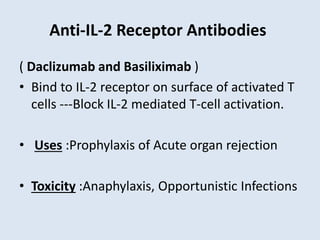
Anti-IL-2 Receptor Antibodies
( Daclizumab and Basiliximab )
• Bind to IL-2 receptor on surface of activated T
cells ---Block IL-2 mediated T-cell activation.
• Uses :Prophylaxis of Acute organ rejection
• Toxicity :Anaphylaxis, Opportunistic Infections
Anti-TNF Agents
• Anti-TNF Agents TNF – Cytokine at site of
inflammation Infliximab Etanercept
Adalimumab
Infliximab
Uses :
• Rheumatoid arthritis
• Chron’s disease – fistulae
• Psoriasis
• Psoriatic arthritis
• Ankylosing spondylosis .
• Toxicity
• Infusion reaction – fever, urticaria , hypotension,
dyspnoea
• Opportunistic infections – TB, RTI, UTI
• Thalidomide – inhibits angiogenesis, reduces
phagocytosis , enhances cell mediated
immunity – Increases levels of IL- 10 . – Used
in multiple myeloma, graft versus host disease
, myelodysplastic syndrome, colon and
prostrate Cancer.
• Mycophenolate Mofetil – mycophenolic acid
– Inhibits inosine monophosphate
dehydrogenase which is a key enzyme in
guanine nucleotide synthesis . – Used in
steroid refractory GVHD, RA, SLE.
• Leflunomide – it inhibits pyrimidine synthesis in
actively dividing cells. Antibodies by B cells is
depressed. Used in RA.
• Cyclophosphamide – alkylating agent which
destroys proliferating lymphoid cells. Used in SLE,
autoimmune haemolytic anaemia , multiple
sclerosis, Wegener’s granulomatosis .
• Muromonab CD3 – T cell receptor complex ( blocks
Ag recognition ). – Used in steroid resistant
rejection.
• Daclizumab , Basiliximab – IL-2 receptor (blocks IL-2
mediated T cell activation ). – Used in acute organ
rejection in renal transplant patients.
• Azathioprine ( Mercaptopurine ) – interferes
with purine nucleic acid metabolism and
incorporates false nucleotide.
• –Used in Renal allograft, RA, SLE, ITP, Crohn’s
disease, glomerulonephritis
Immunomodulators
Immunomodulators
Immunomodulators
Immunomodulators

Immunomodulators

  • 1.
  • 3.
  • 4.
    Immune System • ImmuneSystem A biochemical complex that protects the body against Pathogenic organisms, Foreign bodies and Its own cells that become cancerous. • Immunity: Innate, Natural -Complement, Granulocytes, Monocytes /macrophages, NK cells, Mast cells, Basophils Adaptive, Learned - B and T lymphocytes, B: antibodies, T : helper, cytolytic , suppressor
  • 5.
    Immune System The systemincorporates the • Humoral immune response- B Cells- antibodies . • Cell mediated response, - uses T-cells • Dysregulation of this system can result into serious problem. • Autoimmune diseases • Allergic reactions including anaphylaxis • Tissue/organ rejection
  • 6.
    Immunostimulants: Immunostimulants: • Increase theimmune responsiveness of patients who have either selective or generalized immunodeficiency. • Used for: immunodeficiency disorders, chronic infectious diseases, and cancer
  • 8.
    Cytokines • Cytokines Developedby rDNA (recombinant) technology . • TNF • Colony Stimulating factors (G-CSF, M-CSF, GM-CSF, etc) • Interferon (INF): INF- α,β,γ • Antiviral, anticancer. • Adverse Effects: flu-like symptoms, fatigue malaise • Interleukin-2 (IL-2) • T cell proliferation, T H , NK, LAK cell activation . • Treatment of malignant melanoma, renal cell carcinoma, Hodgkin disease . • Adverse Effects: fever, anorexia . • Applications in the treatment of viral infections, autoimmune and neoplastic diseases
  • 9.
    Interferons • Interferons: Groupof proteins produced by white blood cells, fibroblasts, or T-cells as part of an immune response to a viral infection or other immune trigger. • Application in treatment of viral infection, autoimmune and neoplastic diseases. • Therapeutic uses- Hairy cell leukemia, Malignant melanoma, Hepatitis B . • Adverse Reactions :- Flu like symptoms – Fever, chills, headache, CVS – Hypotension, Arrhythmia, CNS- Depression, Confusion.
  • 10.
    INTERLEUKIN • INTERLEUKIN:- Itis a protein that regulates the activities of white blood cells (leukocytes, often lymphocytes) that are responsible for immunity. IL-2 is part of the body's natural response to microbial infection, and in discriminating between foreign ("non-self") and "self". IL-2 mediates its effects by binding to IL-2 receptors, which are expressed by lymphocytes. • Therapeutic uses: Metastatic renal cell carcinoma
  • 11.
    Other Immunomodulators • Levamisol- antihelmenthic drugs BCG as adjuvants and probably act by activation of macrophages • Etanercept :- acting as a TNF inhibitor THALIDOMIDE:- Enhanced T cell production of cytokines IL-2, IFN- 𝝲 . Increases TNF𝝰 in patients who are HIV seropositive . • Therapeutic uses: Multiple Myeloma, Adverse effects:- Birth defect . Contraindicated in women having child bearing potential. • ISOPRINOSINE ( Methisoprinol ):- Leads the production of cytokines such as IL-1, IL-2, and IFN- 𝝲, increase proliferation of lymphocytes in response to mitogenic or antigenic stimuli. • Therapeutic uses: Herpes simplex infection, Measles viruses, • Adverse reactions:- Rise in uric acid in serum and urine, Nausea Aldesleukin : - Aldesleukin is in a class of drugs known as cytokines, Aldesleukin increases the body ability to fight cancer.
  • 12.
    Immunization • Active –Stimulation with an Antigen. antigen as a whole, killed organism, or a specific protein or peptide constituent of an organism • Passive – Preformed antibody -Nonspecific immunoglobulins. • Antibody-deficiency disorders . -Specific immune globulins • High titers of desired antibody. • Hepatitis B, Rabies, Tetanus
  • 13.
    Vaccines • Suspensions oflive, attenuated (weakened) or killed (inactivated) micro-organisms . • The weakened form prevents the person from contracting the disease . • Also stimulate the production of antigens against a specific antibody. • Vaccinations with live bacteria or virus provide lifelong immunity. • Vaccinations with killed bacteria or virus provide partial immunity, and booster shots are needed periodically.
  • 18.
    Glucocorticoids • Glucocorticoids Induceredistribution of lymphocytes – decrease in peripheral blood lymphocyte counts . • Intracellular receptors – regulate gene transcription. • Down regulation of IL-1, IL-6. • Inhibition of T cell proliferation. • Neutrophils , Monocytes display poor chemotaxis. • Broad anti-inflammatory effects on multiple components of cellular immunity
  • 19.
    USES - Glucocorticoids •Transplant rejection • GVH – BM transplantation • Autoimmune diseases – RA, SLE, Hematological conditions • Psoriasis • Inflammatory Bowel Disease
  • 21.
    CALCINEURIN INHIBITORS • Calcineurin(CN) is a protein phosphatase activates the T cells of the immune system and can be blocked by drugs. Cyclosporine – • Bind to the cytosolic protein cyclophilin (an immunophilin ) of immunocompetent lymphocytes, especially T-lymphocytes . • This complex of cyclosporin and cyclophilin inhibits the phosphatase calcineurin, which under normal circumstances induces the transcription of interleukin-2 . • The drug also inhibits lymphokine production and interleukin release, leading to a reduced function of effector T-cells.
  • 22.
    Uses • Organ transplantation:Kidney, Liver, Heart • Rheumatoid arthritis, IBD, uveitis • Psoriasis • Aplastic anemia • Skin Conditions- Atopic dermatitis, Alopecia Areata, Pemphigus vulgaris, Lichen planus, Pyoderma gangrenosum
  • 24.
    Tacrolimus – It bindsto the immunophilin FKBP1A , followed by the binding of the complex to calcineurin and the inhibition of its phosphatase activity. In this way, it prevents the cell from transitioning from the G 0 into G 1 phase of the cell cycle . Tacrolimus is more potent than ciclosporin and has less pronounced side-effects. Uses - Prophylaxis of solid-organ allograft rejection –Topical preparation available for use in atopic dermatitis and psoriasis.
  • 26.
    Sirolimus (rapamycin) • Contraryto cyclosporin and tacrolimus , drugs that affect the first phase of T lymphocyte activation. • Sirolimus affects the second phase (namely signal transduction and lymphocyte clonal proliferation ). • It binds to FKBP1A like tacrolimus , however the complex does not inhibit calcineurin but another protein, mTOR (mammalian target of rapamycin ).
  • 27.
    Sirolimus (rapamycin) • Itindirectly inhibits several T lymphocyte- specific kinases and phosphatases , hence preventing their transition from G 1 to S phase of the cell cycle. • Sirolimus prevents B cell differentiation into plasma cells,. • reducing production of IgM , IgG , and IgA antibodies.
  • 28.
    Anti-IL-2 Receptor Antibodies (Daclizumab and Basiliximab ) • Bind to IL-2 receptor on surface of activated T cells ---Block IL-2 mediated T-cell activation. • Uses :Prophylaxis of Acute organ rejection • Toxicity :Anaphylaxis, Opportunistic Infections
  • 29.
    Anti-TNF Agents • Anti-TNFAgents TNF – Cytokine at site of inflammation Infliximab Etanercept Adalimumab
  • 30.
    Infliximab Uses : • Rheumatoidarthritis • Chron’s disease – fistulae • Psoriasis • Psoriatic arthritis • Ankylosing spondylosis . • Toxicity • Infusion reaction – fever, urticaria , hypotension, dyspnoea • Opportunistic infections – TB, RTI, UTI
  • 31.
    • Thalidomide –inhibits angiogenesis, reduces phagocytosis , enhances cell mediated immunity – Increases levels of IL- 10 . – Used in multiple myeloma, graft versus host disease , myelodysplastic syndrome, colon and prostrate Cancer. • Mycophenolate Mofetil – mycophenolic acid – Inhibits inosine monophosphate dehydrogenase which is a key enzyme in guanine nucleotide synthesis . – Used in steroid refractory GVHD, RA, SLE.
  • 32.
    • Leflunomide –it inhibits pyrimidine synthesis in actively dividing cells. Antibodies by B cells is depressed. Used in RA. • Cyclophosphamide – alkylating agent which destroys proliferating lymphoid cells. Used in SLE, autoimmune haemolytic anaemia , multiple sclerosis, Wegener’s granulomatosis . • Muromonab CD3 – T cell receptor complex ( blocks Ag recognition ). – Used in steroid resistant rejection. • Daclizumab , Basiliximab – IL-2 receptor (blocks IL-2 mediated T cell activation ). – Used in acute organ rejection in renal transplant patients.
  • 33.
    • Azathioprine (Mercaptopurine ) – interferes with purine nucleic acid metabolism and incorporates false nucleotide. • –Used in Renal allograft, RA, SLE, ITP, Crohn’s disease, glomerulonephritis