IMMUNOMODULATORS
The Immune Response - why and
how ?
• Discriminate: Self / Non self
• Destroy:
–Infectious invaders
–Dysregulated self (cancers)
• Immunity:
–Innate, Natural
–Adaptive, Learned
• Innate immune response
– first line of defense against an antigenic insult.
Includes
•defenses like physical (skin),
• Biochemical (complement, lysozyme, interferons)
•cellular components (neutrophils, monocytes,
macrophages).
• Adaptive immune response
a) Humoral immunity - Antibody production –
killing extracellular organisms.
b) Cell mediated immunity – cytotoxic / killer T
cells – killing virus and tumour cells.
ABNORMAL IMMUNE
RESPONSE
• Hypersensitivity reactions
Type 1 – Anaphylactic shock
Type 2 – mismatched blood transfusion
Type 3 – Serum Sickness, glomerulonephritis
and arthritis.
Type 4 – TB
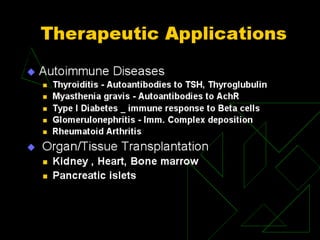
Autoimmunity
– Autoimmune diseases arise
when the body mounts an immune response
against itself as a result of failure to distinguish
self tissues and cells from foreign antigens.
Rheumatoid Arthritis, Type 1 Diabetes Mellitus,
Multiple Sclerosis etc….
• Immunodeficiency Diseases
Extrinsic – HIV causing AIDS.
IMMUNOMODULATORS
DEFINITION
Immunomodulators are drugs which
either suppress the immune system –
Immunosuppressants
or
stimulate the immune system –
Immunostimulants
Immunosuppressant
Immunosuppressants
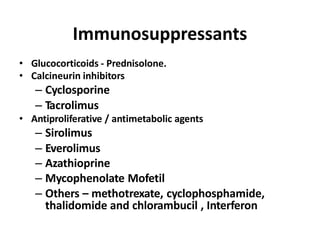
• Glucocorticoids - Prednisolone.
• Calcineurin inhibitors
– Cyclosporine
– Tacrolimus
• Antiproliferative / antimetabolic agents
– Sirolimus
– Everolimus
– Azathioprine
– Mycophenolate Mofetil
– Others – methotrexate, cyclophosphamide,
thalidomide and chlorambucil , Interferon
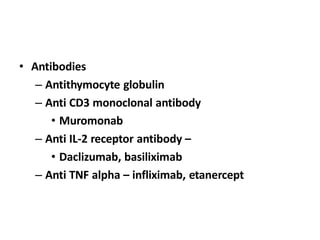
• Antibodies
– Antithymocyte globulin
– Anti CD3 monoclonal antibody
• Muromonab
– Anti IL-2 receptor antibody –
• Daclizumab, basiliximab
– Anti TNF alpha – infliximab, etanercept
Problem
Life long use
Infection, cancers
Nephrotoxicity
Diabetogenic
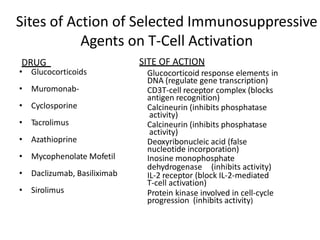
Sites of Action of Selected Immunosuppressive
Agents on T-Cell Activation
DRUG SITE OF ACTION
Glucocorticoid response elements in
DNA (regulate gene transcription)
CD3T-cell receptor complex (blocks
antigen recognition)
Calcineurin (inhibits phosphatase
activity)
Calcineurin (inhibits phosphatase
activity)
Deoxyribonucleic acid (false
nucleotide incorporation)
Inosine monophosphate
dehydrogenase (inhibits activity)
IL-2 receptor (block IL-2-mediated
T-cell activation)
Protein kinase involved in cell-cycle
progression (inhibits activity)
• Glucocorticoids
• Muromonab-
• Cyclosporine
• Tacrolimus
• Azathioprine
• Mycophenolate Mofetil
• Daclizumab, Basiliximab
• Sirolimus
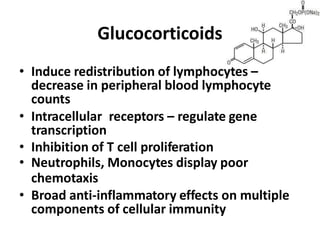
Glucocorticoids
• Induce redistribution of lymphocytes –
decrease in peripheral blood lymphocyte
counts
• Intracellular receptors – regulate gene
transcription
• Inhibition of T cell proliferation
• Neutrophils, Monocytes display poor
chemotaxis
• Broad anti-inflammatory effects on multiple
components of cellular immunity
USES - Glucocorticoids
• Transplant rejection
• Autoimmune diseases – RA , Hematological
conditions
• Psoriasis
• Inflammatory Bowel Disease, Eye conditions
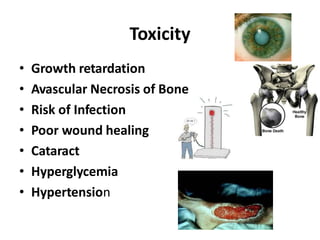
Toxicity
• Growth retardation
• Avascular Necrosis of Bone
• Risk of Infection
• Poor wound healing
• Cataract
• Hyperglycemia
• Hypertension
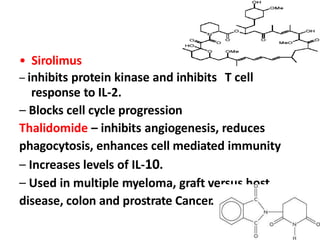
• Sirolimus
– inhibits protein kinase and inhibits T cell
response to IL-2.
– Blocks cell cycle progression
Thalidomide – inhibits angiogenesis, reduces
phagocytosis, enhances cell mediated immunity
– Increases levels of IL-10.
– Used in multiple myeloma, graft versus host
disease, colon and prostrate Cancer.
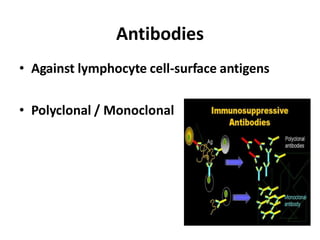
Antibodies
• Against lymphocyte cell-surface antigens
• Polyclonal / Monoclonal
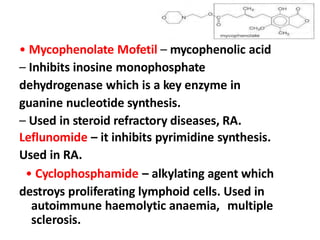
• Mycophenolate Mofetil – mycophenolic acid
– Inhibits inosine monophosphate
dehydrogenase which is a key enzyme in
guanine nucleotide synthesis.
– Used in steroid refractory diseases, RA.
Leflunomide – it inhibits pyrimidine synthesis.
Used in RA.
• Cyclophosphamide – alkylating agent which
destroys proliferating lymphoid cells. Used in
autoimmune haemolytic anaemia, multiple
sclerosis.
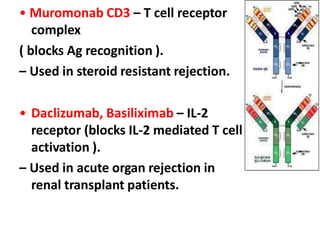
• Muromonab CD3 – T cell receptor
complex
( blocks Ag recognition ).
– Used in steroid resistant rejection.
• Daclizumab, Basiliximab – IL-2
receptor (blocks IL-2 mediated T cell
activation ).
– Used in acute organ rejection in
renal transplant patients.
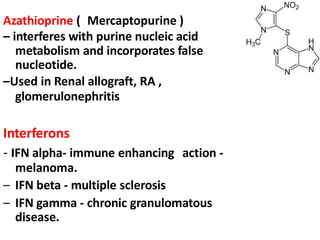
Azathioprine ( Mercaptopurine )
– interferes with purine nucleic acid
metabolism and incorporates false
nucleotide.
–Used in Renal allograft, RA ,
glomerulonephritis
Interferons
- IFN alpha- immune enhancing action -
melanoma.
– IFN beta - multiple sclerosis
– IFN gamma - chronic granulomatous
disease.
Immunostimulants
Immunostimulants
USES:
• immunodeficiency disorders
• Chronic infections
• cancer
specific Immunostimulants
• Levamisole
• Thalidomide
• BCG
• Recombinant Cytokines
Interferons
Interleukin-2
• Other drugs
– inosiplex, azimexon, imexon, thymosin,
methylinosine monophosphate
• Immunization
Vaccines , Immune Globulin , Rho (D) Immune Globulin
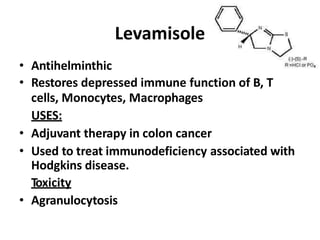
Levamisole
• Antihelminthic
• Restores depressed immune function of B, T
cells, Monocytes, Macrophages
USES:
• Adjuvant therapy in colon cancer
• Used to treat immunodeficiency associated with
Hodgkins disease.
Toxicity
• Agranulocytosis
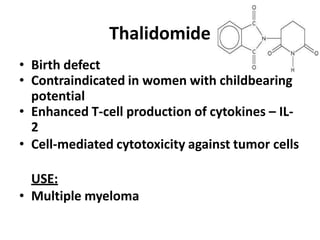
Thalidomide
• Birth defect
• Contraindicated in women with childbearing
potential
• Enhanced T-cell production of cytokines – IL-
2
• Cell-mediated cytotoxicity against tumor cells
USE:
• Multiple myeloma
Bacillus Calmette-Guerin
• Live, attenuated culture of BCG strain of
Mycobacterium Bovis
• It causes activation of macrophages to make them
more effective killer cells.
• used as intravesical therapy for superficial bladder
cancer.
Adverse Effects
– Hypersensitivity
– Shock
– Chills
Interferons
• Antiviral
• Immunomodulatory activity
• Bind to cell surface receptors – initiate intracellular
events
– Enzyme induction
– Inhibition of cell proliferation
– Enhancement of immune activities
– Increased Phagocytosis
Interferon
• Hairy cell leukemia
• Malignant melanoma
• sarcoma
• Hepatitis B
Adverse reactions
• Flu-like symptoms – fever, chills, headache
• CVS- hypotension, Arrhythmia
• CNS- depression, confusion
Interleukin-2 (aldesleukin)
• Proliferation of cellular immunity –
Lymphocytosis, eosinophilia, release of multiple
cytokines .
Uses
• Metastatic renal cell carcinoma
• Melanoma
Toxicity
• Cardiovascular: capillary leak syndrome,
Hypotension
Capillary leak syndrome
• (systemic capillary leak syndrome or Clarkson
syndrome)
• A rare medical condition where the number
and size of the pores in the capillaries are
increased which leads to a leakage of fluid
from the blood to the interstitial fluid,
resulting in dangerously low blood pressure
(hypotension), edema and multiple organ
failure due to limited perfusion.
Immunization
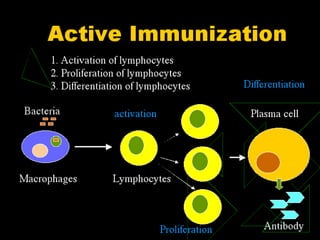
• Active – Stimulation with an Antigen
• Passive – Preformed antibody
Active immunization
Vaccines
• Administration of antigen as a whole, killed
organism, or a specific protein or peptide
constituent of an organism
• Booster doses
• Anticancer vaccines:
Vaccinating patients with autologous antigen
presenting cells (APC) expressing tumor-
associated antigens (TAA)
Immune Globulin
Indications
• Individual is deficient in antibodies –
immunodeficiency
• Individual is exposed to an agent, inadequate time
for active immunization
– Rabies
– Hepatitis B
• Nonspecific immunoglobulins
–Antibody-deficiency disorders
• Specific immune globulins
–Hepatitis B, Rabies, Tetanus

Agents affecting immune system

  • 1.
  • 2.
    The Immune Response- why and how ? • Discriminate: Self / Non self • Destroy: –Infectious invaders –Dysregulated self (cancers) • Immunity: –Innate, Natural –Adaptive, Learned
  • 3.
    • Innate immuneresponse – first line of defense against an antigenic insult. Includes •defenses like physical (skin), • Biochemical (complement, lysozyme, interferons) •cellular components (neutrophils, monocytes, macrophages). • Adaptive immune response a) Humoral immunity - Antibody production – killing extracellular organisms. b) Cell mediated immunity – cytotoxic / killer T cells – killing virus and tumour cells.
  • 4.
    ABNORMAL IMMUNE RESPONSE • Hypersensitivityreactions Type 1 – Anaphylactic shock Type 2 – mismatched blood transfusion Type 3 – Serum Sickness, glomerulonephritis and arthritis. Type 4 – TB
  • 5.
    Autoimmunity – Autoimmune diseasesarise when the body mounts an immune response against itself as a result of failure to distinguish self tissues and cells from foreign antigens. Rheumatoid Arthritis, Type 1 Diabetes Mellitus, Multiple Sclerosis etc…. • Immunodeficiency Diseases Extrinsic – HIV causing AIDS.
  • 6.
  • 7.
    DEFINITION Immunomodulators are drugswhich either suppress the immune system – Immunosuppressants or stimulate the immune system – Immunostimulants
  • 8.
  • 9.
    Immunosuppressants • Glucocorticoids -Prednisolone. • Calcineurin inhibitors – Cyclosporine – Tacrolimus • Antiproliferative / antimetabolic agents – Sirolimus – Everolimus – Azathioprine – Mycophenolate Mofetil – Others – methotrexate, cyclophosphamide, thalidomide and chlorambucil , Interferon
  • 10.
    • Antibodies – Antithymocyteglobulin – Anti CD3 monoclonal antibody • Muromonab – Anti IL-2 receptor antibody – • Daclizumab, basiliximab – Anti TNF alpha – infliximab, etanercept
  • 12.
    Problem Life long use Infection,cancers Nephrotoxicity Diabetogenic
  • 13.
    Sites of Actionof Selected Immunosuppressive Agents on T-Cell Activation DRUG SITE OF ACTION Glucocorticoid response elements in DNA (regulate gene transcription) CD3T-cell receptor complex (blocks antigen recognition) Calcineurin (inhibits phosphatase activity) Calcineurin (inhibits phosphatase activity) Deoxyribonucleic acid (false nucleotide incorporation) Inosine monophosphate dehydrogenase (inhibits activity) IL-2 receptor (block IL-2-mediated T-cell activation) Protein kinase involved in cell-cycle progression (inhibits activity) • Glucocorticoids • Muromonab- • Cyclosporine • Tacrolimus • Azathioprine • Mycophenolate Mofetil • Daclizumab, Basiliximab • Sirolimus
  • 14.
    Glucocorticoids • Induce redistributionof lymphocytes – decrease in peripheral blood lymphocyte counts • Intracellular receptors – regulate gene transcription • Inhibition of T cell proliferation • Neutrophils, Monocytes display poor chemotaxis • Broad anti-inflammatory effects on multiple components of cellular immunity
  • 15.
    USES - Glucocorticoids •Transplant rejection • Autoimmune diseases – RA , Hematological conditions • Psoriasis • Inflammatory Bowel Disease, Eye conditions
  • 16.
    Toxicity • Growth retardation •Avascular Necrosis of Bone • Risk of Infection • Poor wound healing • Cataract • Hyperglycemia • Hypertension
  • 17.
    • Sirolimus – inhibitsprotein kinase and inhibits T cell response to IL-2. – Blocks cell cycle progression Thalidomide – inhibits angiogenesis, reduces phagocytosis, enhances cell mediated immunity – Increases levels of IL-10. – Used in multiple myeloma, graft versus host disease, colon and prostrate Cancer.
  • 18.
    Antibodies • Against lymphocytecell-surface antigens • Polyclonal / Monoclonal
  • 19.
    • Mycophenolate Mofetil– mycophenolic acid – Inhibits inosine monophosphate dehydrogenase which is a key enzyme in guanine nucleotide synthesis. – Used in steroid refractory diseases, RA. Leflunomide – it inhibits pyrimidine synthesis. Used in RA. • Cyclophosphamide – alkylating agent which destroys proliferating lymphoid cells. Used in autoimmune haemolytic anaemia, multiple sclerosis.
  • 20.
    • Muromonab CD3– T cell receptor complex ( blocks Ag recognition ). – Used in steroid resistant rejection. • Daclizumab, Basiliximab – IL-2 receptor (blocks IL-2 mediated T cell activation ). – Used in acute organ rejection in renal transplant patients.
  • 21.
    Azathioprine ( Mercaptopurine) – interferes with purine nucleic acid metabolism and incorporates false nucleotide. –Used in Renal allograft, RA , glomerulonephritis Interferons - IFN alpha- immune enhancing action - melanoma. – IFN beta - multiple sclerosis – IFN gamma - chronic granulomatous disease.
  • 22.
  • 23.
  • 24.
    specific Immunostimulants • Levamisole •Thalidomide • BCG • Recombinant Cytokines Interferons Interleukin-2 • Other drugs – inosiplex, azimexon, imexon, thymosin, methylinosine monophosphate • Immunization Vaccines , Immune Globulin , Rho (D) Immune Globulin
  • 25.
    Levamisole • Antihelminthic • Restoresdepressed immune function of B, T cells, Monocytes, Macrophages USES: • Adjuvant therapy in colon cancer • Used to treat immunodeficiency associated with Hodgkins disease. Toxicity • Agranulocytosis
  • 26.
    Thalidomide • Birth defect •Contraindicated in women with childbearing potential • Enhanced T-cell production of cytokines – IL- 2 • Cell-mediated cytotoxicity against tumor cells USE: • Multiple myeloma
  • 27.
    Bacillus Calmette-Guerin • Live,attenuated culture of BCG strain of Mycobacterium Bovis • It causes activation of macrophages to make them more effective killer cells. • used as intravesical therapy for superficial bladder cancer. Adverse Effects – Hypersensitivity – Shock – Chills
  • 28.
    Interferons • Antiviral • Immunomodulatoryactivity • Bind to cell surface receptors – initiate intracellular events – Enzyme induction – Inhibition of cell proliferation – Enhancement of immune activities – Increased Phagocytosis
  • 29.
    Interferon • Hairy cellleukemia • Malignant melanoma • sarcoma • Hepatitis B Adverse reactions • Flu-like symptoms – fever, chills, headache • CVS- hypotension, Arrhythmia • CNS- depression, confusion
  • 30.
    Interleukin-2 (aldesleukin) • Proliferationof cellular immunity – Lymphocytosis, eosinophilia, release of multiple cytokines . Uses • Metastatic renal cell carcinoma • Melanoma Toxicity • Cardiovascular: capillary leak syndrome, Hypotension
  • 31.
    Capillary leak syndrome •(systemic capillary leak syndrome or Clarkson syndrome) • A rare medical condition where the number and size of the pores in the capillaries are increased which leads to a leakage of fluid from the blood to the interstitial fluid, resulting in dangerously low blood pressure (hypotension), edema and multiple organ failure due to limited perfusion.
  • 32.
    Immunization • Active –Stimulation with an Antigen • Passive – Preformed antibody
  • 34.
    Active immunization Vaccines • Administrationof antigen as a whole, killed organism, or a specific protein or peptide constituent of an organism • Booster doses • Anticancer vaccines: Vaccinating patients with autologous antigen presenting cells (APC) expressing tumor- associated antigens (TAA)
  • 35.
    Immune Globulin Indications • Individualis deficient in antibodies – immunodeficiency • Individual is exposed to an agent, inadequate time for active immunization – Rabies – Hepatitis B
  • 36.
    • Nonspecific immunoglobulins –Antibody-deficiencydisorders • Specific immune globulins –Hepatitis B, Rabies, Tetanus