K.RAHUL
GRACE COLLEGE OF PHARMACY,
PALAKKAD
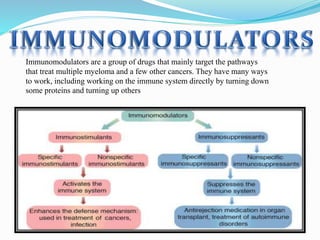
Immunomodulators are a group of drugs that mainly target the pathways
that treat multiple myeloma and a few other cancers. They have many ways
to work, including working on the immune system directly by turning down
some proteins and turning up others
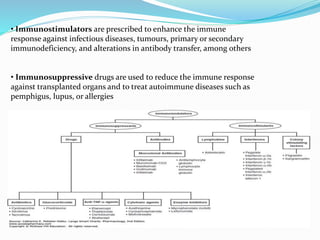
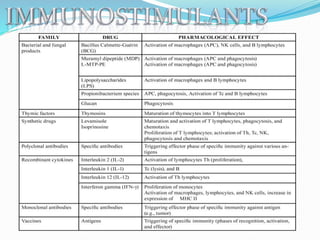
• Immunostimulators are prescribed to enhance the immune
response against infectious diseases, tumours, primary or secondary
immunodeficiency, and alterations in antibody transfer, among others
• Immunosuppressive drugs are used to reduce the immune response
against transplanted organs and to treat autoimmune diseases such as
pemphigus, lupus, or allergies
Immunostimulants, also known as immunostimulators, are substances (drugs and
nutrients) that stimulate the immune system by inducing activation or increasing
activity of any of its components. One notable example is the granulocyte
macrophage colony-stimulating factor.
Thalidomide (Thalomid), lenalidomide (Revlimid), and pomalidomide (Pomalyst) are
known as immunomodulating drugs (or IMiDs).
The use of a variety of agents to enhance immunological and nonspecific host defences and
thus to modify the defences favourably is an exciting development in
immunopharmacology. Such agents may act by:
• Increasing the humoral antibody responses,
• Enhancing the phagocytic activity of macrophages, or
• Modifying the cell-mediated immune responses
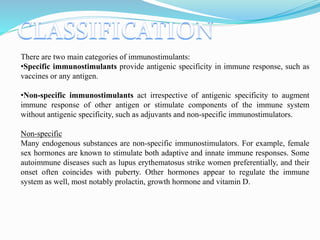
There are two main categories of immunostimulants:
•Specific immunostimulants provide antigenic specificity in immune response, such as
vaccines or any antigen.
•Non-specific immunostimulants act irrespective of antigenic specificity to augment
immune response of other antigen or stimulate components of the immune system
without antigenic specificity, such as adjuvants and non-specific immunostimulators.
Non-specific
Many endogenous substances are non-specific immunostimulators. For example, female
sex hormones are known to stimulate both adaptive and innate immune responses. Some
autoimmune diseases such as lupus erythematosus strike women preferentially, and their
onset often coincides with puberty. Other hormones appear to regulate the immune
system as well, most notably prolactin, growth hormone and vitamin D.
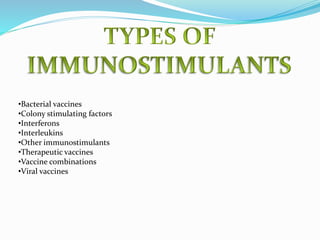
•Bacterial vaccines
•Colony stimulating factors
•Interferons
•Interleukins
•Other immunostimulants
•Therapeutic vaccines
•Vaccine combinations
•Viral vaccines
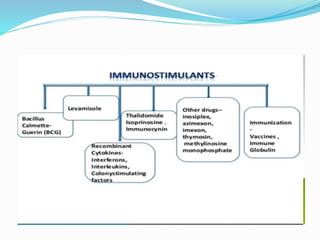
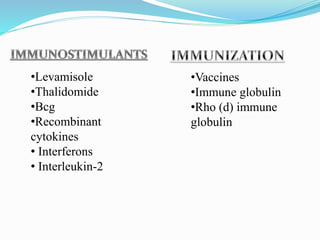
•Levamisole
•Thalidomide
•Bcg
•Recombinant
cytokines
• Interferons
• Interleukin-2
•Vaccines
•Immune globulin
•Rho (d) immune
globulin
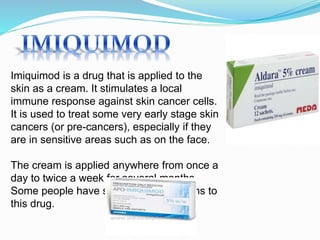
Imiquimod is a drug that is applied to the
skin as a cream. It stimulates a local
immune response against skin cancer cells.
It is used to treat some very early stage skin
cancers (or pre-cancers), especially if they
are in sensitive areas such as on the face.
The cream is applied anywhere from once a
day to twice a week for several months.
Some people have serious skin reactions to
this drug.
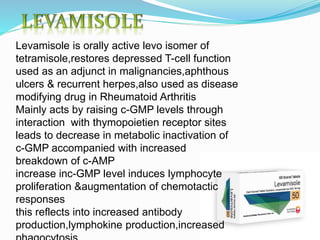
Levamisole is orally active levo isomer of
tetramisole,restores depressed T-cell function
used as an adjunct in malignancies,aphthous
ulcers & recurrent herpes,also used as disease
modifying drug in Rheumatoid Arthritis
Mainly acts by raising c-GMP levels through
interaction with thymopoietien receptor sites
leads to decrease in metabolic inactivation of
c-GMP accompanied with increased
breakdown of c-AMP
increase inc-GMP level induces lymphocyte
proliferation &augmentation of chemotactic
responses
this reflects into increased antibody
production,lymphokine production,increased
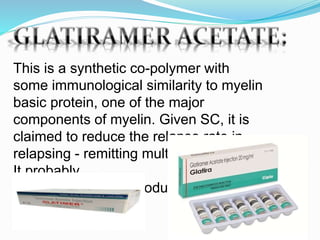
This is a synthetic co-polymer with
some immunological similarity to myelin
basic protein, one of the major
components of myelin. Given SC, it is
claimed to reduce the relapse rate in
relapsing - remitting multiple sclerosis.
It probably
acts as an immunomodulator.
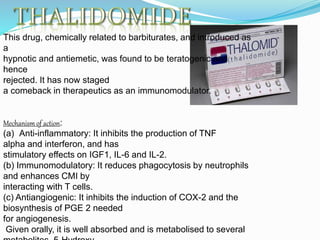
This drug, chemically related to barbiturates, and introduced as
a
hypnotic and antiemetic, was found to be teratogenic and
hence
rejected. It has now staged
a comeback in therapeutics as an immunomodulator.
Mechanism of action:
(a) Anti-inflammatory: It inhibits the production of TNF
alpha and interferon, and has
stimulatory effects on IGF1, IL-6 and IL-2.
(b) Immunomodulatory: It reduces phagocytosis by neutrophils
and enhances CMI by
interacting with T cells.
(c) Antiangiogenic: It inhibits the induction of COX-2 and the
biosynthesis of PGE 2 needed
for angiogenesis.
Given orally, it is well absorbed and is metabolised to several
Therapeutic uses:
• Drug of choice in symptomatic treatment of moderate to severe ENL ,
Multiple myeloma, refractory to other treatments.
• Refractory cutaneous lupus lesions.
• Crohn’s disease.
• Treatment of cachexia and weight loss in HIV and that due to TNF-α in
cancer patients.
•It counters nausea, vomiting and anorexia due to TNF-α in cancer patients.
• In advanced prostatic cancer, as an immunomodulator.
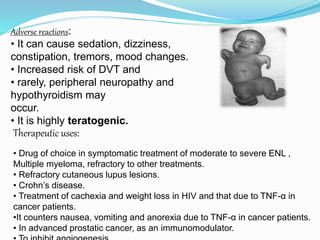
Adverse reactions:
• It can cause sedation, dizziness,
constipation, tremors, mood changes.
• Increased risk of DVT and
• rarely, peripheral neuropathy and
hypothyroidism may
occur.
• It is highly teratogenic.
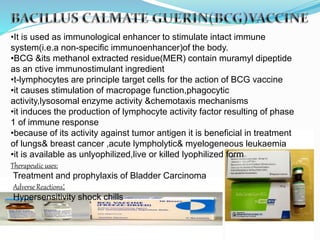
•It is used as immunological enhancer to stimulate intact immune
system(i.e.a non-specific immunoenhancer)of the body.
•BCG &its methanol extracted residue(MER) contain muramyl dipeptide
as an ctive immunostimulant ingredient
•t-lymphocytes are principle target cells for the action of BCG vaccine
•it causes stimulation of macropage function,phagocytic
activity,lysosomal enzyme activity &chemotaxis mechanisms
•it induces the production of lymphocyte activity factor resulting of phase
1 of immune response
•because of its activity against tumor antigen it is beneficial in treatment
of lungs& breast cancer ,acute lympholytic& myelogeneous leukaemia
•it is available as unlyophilized,live or killed lyophilized form
Therapeutic uses:
Treatment and prophylaxis of Bladder Carcinoma
Adverse Reactions:
Hypersensitivity shock chills
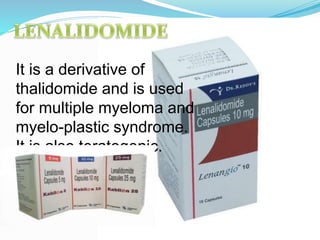
It is a derivative of
thalidomide and is used
for multiple myeloma and
myelo-plastic syndrome.
It is also teratogenic.
These are now use by rDNA technology Application
in treatment of viral infection, autoimmune and
neoplastic diseases.
INTERFERONS
•low molecularweight glycoprotein cytokines
produced by host cells in response to viral
infections
•immunomodulatory activity
•bind to cell surface receptors-initiate intracellular
events
• Enxyme induction
• inhibition of cell proliferation
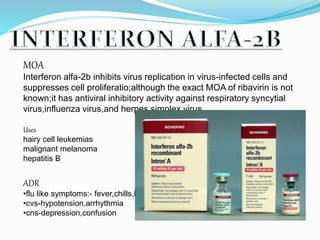
MOA
Interferon alfa-2b inhibits virus replication in virus-infected cells and
suppresses cell proliferatio;although the exact MOA of ribavirin is not
known;it has antiviral inhibitory activity against respiratory syncytial
virus,influenza virus,and herpes simplex virus.
Uses
hairy cell leukemias
malignant melanoma
hepatitis B
ADR
•flu like symptoms:- fever,chills,headache
•cvs-hypotension,arrhythmia
•cns-depression,confusion
It is a protein that regulates the activities of
WBC(leukocytes,often lymphocytes)that are
respomsible for immunity. IL-2 is a part of the
body's natural response to microbial
infection,and in discriminating between
foreign and self.
Uses
• metastatic renal cell carcinoma
•melanoma
•toxicity
•hypotension
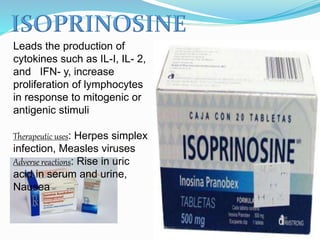
Leads the production of
cytokines such as IL-I, IL- 2,
and IFN- y, increase
proliferation of lymphocytes
in response to mitogenic or
antigenic stimuli
Therapeutic uses: Herpes simplex
infection, Measles viruses
Adverse reactions: Rise in uric
acid in serum and urine,
Nausea
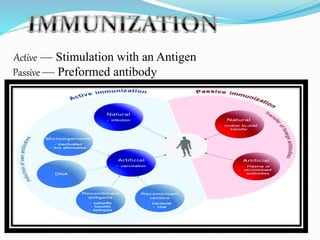
Active — Stimulation with an Antigen
Passive — Preformed antibody
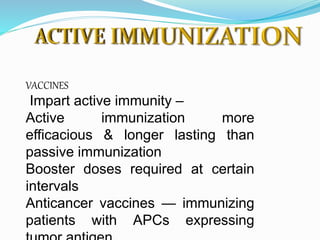
VACCINES
Impart active immunity –
Active immunization more
efficacious & longer lasting than
passive immunization
Booster doses required at certain
intervals
Anticancer vaccines — immunizing
patients with APCs expressing
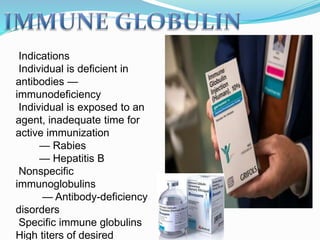
Indications
Individual is deficient in
antibodies —
immunodeficiency
Individual is exposed to an
agent, inadequate time for
active immunization
— Rabies
— Hepatitis B
Nonspecific
immunoglobulins
— Antibody-deficiency
disorders
Specific immune globulins
High titers of desired
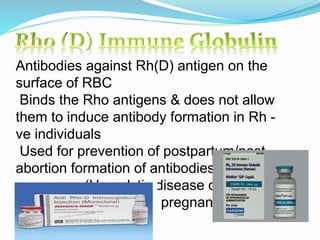
Antibodies against Rh(D) antigen on the
surface of RBC
Binds the Rho antigens & does not allow
them to induce antibody formation in Rh -
ve individuals
Used for prevention of postpartum/post-
abortion formation of antibodies in Rho-D -
ve women (Hemolytic disease of newborn)
Given at 28th week of pregnancy
colony stimulating factors are glycoprotiens that promote
production of white blood cells(mainly granulocytes such
as neutrophils), in response to infection.
An administration of exogenous colony stimulating factors
stimulates the stem cells in the bone marrow to produce
more of the particular white blood cells. The new white
blood cells migrate into the blood and fight the infection.
Uses:-
Colony stimulating factors are used in patients who are
undergoing cancer treatment that causes low white blood
counts ( neutropenia) and puts the patient at risk of
infections. Colony stimulating factors tend to reduce the
time where patients are neutropenic.
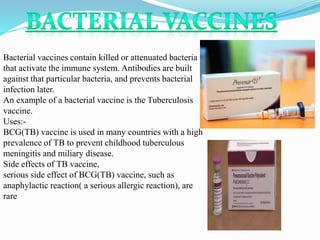
Bacterial vaccines contain killed or attenuated bacteria
that activate the immune system. Antibodies are built
against that particular bacteria, and prevents bacterial
infection later.
An example of a bacterial vaccine is the Tuberculosis
vaccine.
Uses:-
BCG(TB) vaccine is used in many countries with a high
prevalence of TB to prevent childhood tuberculous
meningitis and miliary disease.
Side effects of TB vaccine,
serious side effect of BCG(TB) vaccine, such as
anaphylactic reaction( a serious allergic reaction), are
rare
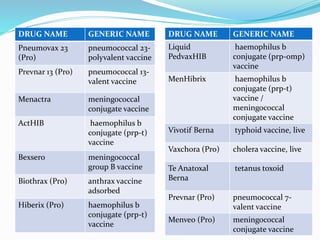
DRUG NAME GENERIC NAME
Pneumovax 23
(Pro)
pneumococcal 23-
polyvalent vaccine
Prevnar 13 (Pro) pneumococcal 13-
valent vaccine
Menactra meningococcal
conjugate vaccine
ActHIB haemophilus b
conjugate (prp-t)
vaccine
Bexsero meningococcal
group B vaccine
Biothrax (Pro) anthrax vaccine
adsorbed
Hiberix (Pro) haemophilus b
conjugate (prp-t)
vaccine
DRUG NAME GENERIC NAME
Liquid
PedvaxHIB
haemophilus b
conjugate (prp-omp)
vaccine
MenHibrix haemophilus b
conjugate (prp-t)
vaccine /
meningococcal
conjugate vaccine
Vivotif Berna typhoid vaccine, live
Vaxchora (Pro) cholera vaccine, live
Te Anatoxal
Berna
tetanus toxoid
Prevnar (Pro) pneumococcal 7-
valent vaccine
Menveo (Pro) meningococcal
conjugate vaccine
Therapeutic vaccines are vaccines which are intended to
treat or cure a disorder or disease by stimulating the immune
system.
Uses:-
they may be used to treat certain types of cancer, by
stimulating the body's immune system to help it respond
against certain cancer cell.
they may also be used in the prevention of tuberculosis who
are at high risk for exposure.
Vaccine combinations merge antigens that
prevent different diseases or that protect
against multiple strains of infectious agents
causing the same disease, into a single
product. This reduces the number of
injections required to prevent some diseases.
uses
Combination vaccines combined protection
against two or more diseases into one shot.
The measles, mumps & rubella
vaccine(MMR) and diphtheria, tetanus and
pertusis vaccine(DTaP) each protect our child
against three diseases & that means fewer
delays in disease protection for children.
some example of common combination vaccine for children,
•comvax, which combines Hib and Hep B.
•Twnrix, which combines Hep A and Hep B.
•pediarix, which combines DTaP, Hep B and IPV(polio).
•kinrix, which combines DTaP and IPV (polio)
•pentacel, which combines DTaP, IPV(polio) and Hib.
side effects of Combination vaccine
Side effects from combination vaccines are usually mild. they are
similar to those individual vaccines given separately.
Sometimes combination vaccines are usually causes slightly more
pain or swelling where the shot was given. But child got the shots
individually, he or she might have pain or swelling in two or three
spots, instead of just one.
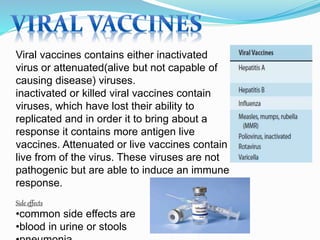
Viral vaccines contains either inactivated
virus or attenuated(alive but not capable of
causing disease) viruses.
inactivated or killed viral vaccines contain
viruses, which have lost their ability to
replicated and in order it to bring about a
response it contains more antigen live
vaccines. Attenuated or live vaccines contain
live from of the virus. These viruses are not
pathogenic but are able to induce an immune
response.
Side effects
•common side effects are
•blood in urine or stools
•Pharmacology & pharmacotherapeutics by R.S Satoskar , Nirmala N. Rege ,
S.D.Bhandarkar ,24th edition ,Page No. 1619-1620
•https://www.cancer.org/treatment/treatments-and-side-effects/treatment-
types/immunotherapy/immunomodulators.html
•https://en.wikipedia.org/wiki/Immunotherapy
•https://www.slideshare.net/JoonJyotiSahariah/immunostimulants-76870153
•https://www.slideshare.net/drswarnankparmar/immunomodulators-66778161
•https://www.slideshare.net/sameenrashid1/immunomodulators-63004559
•https://www.ncbi.nlm.nih.gov/pmc/articles/PMC3909428/
•https://www.uspharmacist.com/article/medication-safety-concerns-
surrounding-immunomodulators
Immunomodulators and immunostimulants

Immunomodulators and immunostimulants

  • 1.
    K.RAHUL GRACE COLLEGE OFPHARMACY, PALAKKAD
  • 2.
    Immunomodulators are agroup of drugs that mainly target the pathways that treat multiple myeloma and a few other cancers. They have many ways to work, including working on the immune system directly by turning down some proteins and turning up others
  • 3.
    • Immunostimulators areprescribed to enhance the immune response against infectious diseases, tumours, primary or secondary immunodeficiency, and alterations in antibody transfer, among others • Immunosuppressive drugs are used to reduce the immune response against transplanted organs and to treat autoimmune diseases such as pemphigus, lupus, or allergies
  • 5.
    Immunostimulants, also knownas immunostimulators, are substances (drugs and nutrients) that stimulate the immune system by inducing activation or increasing activity of any of its components. One notable example is the granulocyte macrophage colony-stimulating factor. Thalidomide (Thalomid), lenalidomide (Revlimid), and pomalidomide (Pomalyst) are known as immunomodulating drugs (or IMiDs). The use of a variety of agents to enhance immunological and nonspecific host defences and thus to modify the defences favourably is an exciting development in immunopharmacology. Such agents may act by: • Increasing the humoral antibody responses, • Enhancing the phagocytic activity of macrophages, or • Modifying the cell-mediated immune responses
  • 7.
    There are twomain categories of immunostimulants: •Specific immunostimulants provide antigenic specificity in immune response, such as vaccines or any antigen. •Non-specific immunostimulants act irrespective of antigenic specificity to augment immune response of other antigen or stimulate components of the immune system without antigenic specificity, such as adjuvants and non-specific immunostimulators. Non-specific Many endogenous substances are non-specific immunostimulators. For example, female sex hormones are known to stimulate both adaptive and innate immune responses. Some autoimmune diseases such as lupus erythematosus strike women preferentially, and their onset often coincides with puberty. Other hormones appear to regulate the immune system as well, most notably prolactin, growth hormone and vitamin D.
  • 8.
    •Bacterial vaccines •Colony stimulatingfactors •Interferons •Interleukins •Other immunostimulants •Therapeutic vaccines •Vaccine combinations •Viral vaccines
  • 10.
  • 11.
    Imiquimod is adrug that is applied to the skin as a cream. It stimulates a local immune response against skin cancer cells. It is used to treat some very early stage skin cancers (or pre-cancers), especially if they are in sensitive areas such as on the face. The cream is applied anywhere from once a day to twice a week for several months. Some people have serious skin reactions to this drug.
  • 12.
    Levamisole is orallyactive levo isomer of tetramisole,restores depressed T-cell function used as an adjunct in malignancies,aphthous ulcers & recurrent herpes,also used as disease modifying drug in Rheumatoid Arthritis Mainly acts by raising c-GMP levels through interaction with thymopoietien receptor sites leads to decrease in metabolic inactivation of c-GMP accompanied with increased breakdown of c-AMP increase inc-GMP level induces lymphocyte proliferation &augmentation of chemotactic responses this reflects into increased antibody production,lymphokine production,increased
  • 13.
    This is asynthetic co-polymer with some immunological similarity to myelin basic protein, one of the major components of myelin. Given SC, it is claimed to reduce the relapse rate in relapsing - remitting multiple sclerosis. It probably acts as an immunomodulator.
  • 14.
    This drug, chemicallyrelated to barbiturates, and introduced as a hypnotic and antiemetic, was found to be teratogenic and hence rejected. It has now staged a comeback in therapeutics as an immunomodulator. Mechanism of action: (a) Anti-inflammatory: It inhibits the production of TNF alpha and interferon, and has stimulatory effects on IGF1, IL-6 and IL-2. (b) Immunomodulatory: It reduces phagocytosis by neutrophils and enhances CMI by interacting with T cells. (c) Antiangiogenic: It inhibits the induction of COX-2 and the biosynthesis of PGE 2 needed for angiogenesis. Given orally, it is well absorbed and is metabolised to several
  • 15.
    Therapeutic uses: • Drugof choice in symptomatic treatment of moderate to severe ENL , Multiple myeloma, refractory to other treatments. • Refractory cutaneous lupus lesions. • Crohn’s disease. • Treatment of cachexia and weight loss in HIV and that due to TNF-α in cancer patients. •It counters nausea, vomiting and anorexia due to TNF-α in cancer patients. • In advanced prostatic cancer, as an immunomodulator. Adverse reactions: • It can cause sedation, dizziness, constipation, tremors, mood changes. • Increased risk of DVT and • rarely, peripheral neuropathy and hypothyroidism may occur. • It is highly teratogenic.
  • 16.
    •It is usedas immunological enhancer to stimulate intact immune system(i.e.a non-specific immunoenhancer)of the body. •BCG &its methanol extracted residue(MER) contain muramyl dipeptide as an ctive immunostimulant ingredient •t-lymphocytes are principle target cells for the action of BCG vaccine •it causes stimulation of macropage function,phagocytic activity,lysosomal enzyme activity &chemotaxis mechanisms •it induces the production of lymphocyte activity factor resulting of phase 1 of immune response •because of its activity against tumor antigen it is beneficial in treatment of lungs& breast cancer ,acute lympholytic& myelogeneous leukaemia •it is available as unlyophilized,live or killed lyophilized form Therapeutic uses: Treatment and prophylaxis of Bladder Carcinoma Adverse Reactions: Hypersensitivity shock chills
  • 17.
    It is aderivative of thalidomide and is used for multiple myeloma and myelo-plastic syndrome. It is also teratogenic.
  • 18.
    These are nowuse by rDNA technology Application in treatment of viral infection, autoimmune and neoplastic diseases. INTERFERONS •low molecularweight glycoprotein cytokines produced by host cells in response to viral infections •immunomodulatory activity •bind to cell surface receptors-initiate intracellular events • Enxyme induction • inhibition of cell proliferation
  • 19.
    MOA Interferon alfa-2b inhibitsvirus replication in virus-infected cells and suppresses cell proliferatio;although the exact MOA of ribavirin is not known;it has antiviral inhibitory activity against respiratory syncytial virus,influenza virus,and herpes simplex virus. Uses hairy cell leukemias malignant melanoma hepatitis B ADR •flu like symptoms:- fever,chills,headache •cvs-hypotension,arrhythmia •cns-depression,confusion
  • 20.
    It is aprotein that regulates the activities of WBC(leukocytes,often lymphocytes)that are respomsible for immunity. IL-2 is a part of the body's natural response to microbial infection,and in discriminating between foreign and self. Uses • metastatic renal cell carcinoma •melanoma •toxicity •hypotension
  • 21.
    Leads the productionof cytokines such as IL-I, IL- 2, and IFN- y, increase proliferation of lymphocytes in response to mitogenic or antigenic stimuli Therapeutic uses: Herpes simplex infection, Measles viruses Adverse reactions: Rise in uric acid in serum and urine, Nausea
  • 22.
    Active — Stimulationwith an Antigen Passive — Preformed antibody
  • 23.
    VACCINES Impart active immunity– Active immunization more efficacious & longer lasting than passive immunization Booster doses required at certain intervals Anticancer vaccines — immunizing patients with APCs expressing
  • 25.
    Indications Individual is deficientin antibodies — immunodeficiency Individual is exposed to an agent, inadequate time for active immunization — Rabies — Hepatitis B Nonspecific immunoglobulins — Antibody-deficiency disorders Specific immune globulins High titers of desired
  • 26.
    Antibodies against Rh(D)antigen on the surface of RBC Binds the Rho antigens & does not allow them to induce antibody formation in Rh - ve individuals Used for prevention of postpartum/post- abortion formation of antibodies in Rho-D - ve women (Hemolytic disease of newborn) Given at 28th week of pregnancy
  • 27.
    colony stimulating factorsare glycoprotiens that promote production of white blood cells(mainly granulocytes such as neutrophils), in response to infection. An administration of exogenous colony stimulating factors stimulates the stem cells in the bone marrow to produce more of the particular white blood cells. The new white blood cells migrate into the blood and fight the infection. Uses:- Colony stimulating factors are used in patients who are undergoing cancer treatment that causes low white blood counts ( neutropenia) and puts the patient at risk of infections. Colony stimulating factors tend to reduce the time where patients are neutropenic.
  • 28.
    Bacterial vaccines containkilled or attenuated bacteria that activate the immune system. Antibodies are built against that particular bacteria, and prevents bacterial infection later. An example of a bacterial vaccine is the Tuberculosis vaccine. Uses:- BCG(TB) vaccine is used in many countries with a high prevalence of TB to prevent childhood tuberculous meningitis and miliary disease. Side effects of TB vaccine, serious side effect of BCG(TB) vaccine, such as anaphylactic reaction( a serious allergic reaction), are rare
  • 29.
    DRUG NAME GENERICNAME Pneumovax 23 (Pro) pneumococcal 23- polyvalent vaccine Prevnar 13 (Pro) pneumococcal 13- valent vaccine Menactra meningococcal conjugate vaccine ActHIB haemophilus b conjugate (prp-t) vaccine Bexsero meningococcal group B vaccine Biothrax (Pro) anthrax vaccine adsorbed Hiberix (Pro) haemophilus b conjugate (prp-t) vaccine DRUG NAME GENERIC NAME Liquid PedvaxHIB haemophilus b conjugate (prp-omp) vaccine MenHibrix haemophilus b conjugate (prp-t) vaccine / meningococcal conjugate vaccine Vivotif Berna typhoid vaccine, live Vaxchora (Pro) cholera vaccine, live Te Anatoxal Berna tetanus toxoid Prevnar (Pro) pneumococcal 7- valent vaccine Menveo (Pro) meningococcal conjugate vaccine
  • 30.
    Therapeutic vaccines arevaccines which are intended to treat or cure a disorder or disease by stimulating the immune system. Uses:- they may be used to treat certain types of cancer, by stimulating the body's immune system to help it respond against certain cancer cell. they may also be used in the prevention of tuberculosis who are at high risk for exposure.
  • 31.
    Vaccine combinations mergeantigens that prevent different diseases or that protect against multiple strains of infectious agents causing the same disease, into a single product. This reduces the number of injections required to prevent some diseases. uses Combination vaccines combined protection against two or more diseases into one shot. The measles, mumps & rubella vaccine(MMR) and diphtheria, tetanus and pertusis vaccine(DTaP) each protect our child against three diseases & that means fewer delays in disease protection for children.
  • 32.
    some example ofcommon combination vaccine for children, •comvax, which combines Hib and Hep B. •Twnrix, which combines Hep A and Hep B. •pediarix, which combines DTaP, Hep B and IPV(polio). •kinrix, which combines DTaP and IPV (polio) •pentacel, which combines DTaP, IPV(polio) and Hib. side effects of Combination vaccine Side effects from combination vaccines are usually mild. they are similar to those individual vaccines given separately. Sometimes combination vaccines are usually causes slightly more pain or swelling where the shot was given. But child got the shots individually, he or she might have pain or swelling in two or three spots, instead of just one.
  • 33.
    Viral vaccines containseither inactivated virus or attenuated(alive but not capable of causing disease) viruses. inactivated or killed viral vaccines contain viruses, which have lost their ability to replicated and in order it to bring about a response it contains more antigen live vaccines. Attenuated or live vaccines contain live from of the virus. These viruses are not pathogenic but are able to induce an immune response. Side effects •common side effects are •blood in urine or stools
  • 34.
    •Pharmacology & pharmacotherapeuticsby R.S Satoskar , Nirmala N. Rege , S.D.Bhandarkar ,24th edition ,Page No. 1619-1620 •https://www.cancer.org/treatment/treatments-and-side-effects/treatment- types/immunotherapy/immunomodulators.html •https://en.wikipedia.org/wiki/Immunotherapy •https://www.slideshare.net/JoonJyotiSahariah/immunostimulants-76870153 •https://www.slideshare.net/drswarnankparmar/immunomodulators-66778161 •https://www.slideshare.net/sameenrashid1/immunomodulators-63004559 •https://www.ncbi.nlm.nih.gov/pmc/articles/PMC3909428/ •https://www.uspharmacist.com/article/medication-safety-concerns- surrounding-immunomodulators